




Abstract
Abstract
Purifying initial surface runoff is one of the most important measures to improve water quality and recreation value of water bodies in an urbanized area such as Moshui Lake. Two types of combined pond–wetland systems were constructed to store and treat the initial urban surface runoff together with the combined sewer overflow in rainy season and the diluted municipal wastewater or the Moshui Lake water in dry season. After one year, the deposition pond–landscape pond–vertical flow constructed wetland (VFCW)–horizontal flow subsurface constructed wetland (HFCW) system was more effective than the deposition pond–HFCW system in removing chemical oxygen demand (COD), total phosphorous (TP), total nitrogen (TN), and suspended solids (SS). After being treated by the deposition pond–landscape pond–VFCW–HFCW system, the initial influent containing COD 161.0 ± 28.4 mg L−1, TP 2.65 ± 0.27 mg L−1, TN 23.21 ± 2.04 mg L−1, and SS 531.2 ± 56.2 mg L−1 was purified to have the COD, TP, TN, and SS concentrations of 28.1, 0.3, 1.54, and 18.1 mg L−1 in the effluent. In the combined pond–wetland system, the main function of the multipond system was storage and pretreatment of the initial urban surface runoff, improvement of landscape aesthetics, and SS removal to prevent the subsequent constructed wetlands from clogging. Moreover, a hybrid system composed of VFCW and the subsequent HFCW presented higher TN removal rate because of the nitrification and the subsequent denitrification process induced by the difference of oxygen transfer capacity in VFCW and HFCW, whereas P removal was mainly influenced by wetland substrates. The aim of this work was to combine the deposition pond–landscape pond system with VFCW–HFCW system to effectively purify the initial urban surface runoff together with the combined sewer overflow and diluted municipal wastewater or Moshui Lake water on an ecoengineering scale.
Introduction
Up to the present, most studies concerning urban runoff control focus on the development of detention basin for both flood control and pollutants removal (Scholes, 1998). Alternatively, wetland has a similar function (Thurston, 1999; Lee et al., 2009). Wetland is not only famous as “the kidneys of the landscape” or as “biological supermarkets” (Brydon et al., 2006; Zhou et al., 2006; Imfeld et al., 2009; Lee et al., 2009), but also considered as a reliable, efficient, cost-effective, and easily operated way to retain rainfall, moderate streamflow, purify surface runoff, enrich water landscape (Brydon et al., 2006; Henrichs et al., 2007; Chavan et al., 2008), and even provide extra advantages such as wildlife habitat or recreational benefits if it can be under professional design (USEPA, 2000; Lee et al., 2009).
On the other hand, there is significant difference between constructed wetland treating urban runoff together with the combined sewer overflow and the regular treatment wetland (Henrichs et al., 2007). Owing to the long inundation times or the long drought periods induced by the stochastic nature of rainfall, one of the main challenges for wetland treating urban runoff is how to deal with the seriously concentrated initial surface runoff, especially when storm is preceded by a long dry period (Lee et al., 2002; Henrichs et al., 2007). If the initial urban runoff is discharged into constructed wetland directly, the input of excessive water will flood wetland, the input of excess pollutants will induce clogging, and resultantly, the survival of wetland plant will be threatened, the stability of wetland community will be disturbed, and the vegetation productivity will decrease (Yin et al., 2004; Brydon et al., 2006; Henrichs et al., 2007; Jing et al., 2009), because most plant species and corresponding aquatic biota well adapted to low pollutant conditions cannot respond well to the suddenly increased pollution load or water level when storm comes (Brydon et al., 2006; Jing et al., 2009).
To solve this problem, a separate detention pond to accommodate the initial urban surface runoff at the beginning of storm event is needed, and then the remaining stormwater can flow into wetland directly until the receiving wetland cannot hold (Brydon et al., 2006; Henrichs et al., 2007). Thus, the combined pond–wetland system can perform a variety of ecoservice functions including storage of storm water, reduction of flood flows and velocity, improving water quality, reducing erosion, increasing sedimentation, and even adding values of recreation or wildlife habitat (Shan et al., 2002; Kadlec, 2003; Brydon et al., 2006).
Moshui Lake, one of the main lakes in Wuhan City, was famous as the top 10 sceneries in Hanyang District in ancient China by presenting traditional scenery of “Ancient Ferry on Flat Lake.” But after 1980s, the eutrophication in Moshui Lake induced by high concentrations of chemical oxygen demand (COD), total nitrogen (TN), total phosphorous (TP) and suspended solids (SS) pollutants became more and more serious because of the direct discharge of industrial wastewater and urban surface runoff (Yin, 2006). Nowadays, the industrial wastewater discharge is totally under control, but the nonpoint pollution brought by the stormwater runoff in large area remains a serious challenge (Choi, 2003). To protect Moshui Lake from further eutrophication and restore the traditional scenery of “Ancient Ferry on Flat Lake” for public, ecoengineering composted of two types of pond–wetland systems was constructed to treat the seriously polluted initial urban surface runoff together with the combined sewer overflow in the new-built Taohuadao area in Hanyang District, Wuhan City, China.
Materials and Methods
Study domain
The combined pond–wetland ecoengineering is located in the Taohuadao area (29°58′N, 113°40′E) in Hanyang district, Wuhan City, Hubei Province, China (Fig. 1). Taohuadao is a new-built area with seven new communities, several dispersed old communities, one school, some plants, and companies. Although the whole catchment area in the Taohuadao Region reaches 1,330,000 m2, over 70% of the catchment area is impervious (Yin, 2006).

Combined pond–wetland ecoengineering and sampling sites. (→) Flow direction. VFCW, vertical flow constructed wetland; HFCW, horizontal flow subsurface constructed wetland; S1, influent of deposition pond; S2, effluent of deposition pond; S3, effluent of HFCW; S4, effluent of landscape ponds; S5, effluent of VFCW; S6, effluent of the hybrid VFCW–HFCW system.
In Hanyang District, the annual precipitation varies from 1,150 to 1,450 mm, and most of the precipitation occurs in June and July. Therefore, nearly all the runoff from streets, yards, and roofs flows quickly to the combined sewer in stormy weather and formed flood during summer. What makes matters worse is that all the urban runoff in the Taohuadao region will be discharged into Moshui Lake through the combined sewer finally.
Components of the combined pond–wetland ecoengineering
There are two types of combined pond–wetland systems. One type is deposition pond–horizontal flow subsurface constructed wetland (HFCW) series–wound system, and another is a hybrid pond–wetland system composed of deposition pond–landscape ponds–vertical flow constructed wetland (VFCW)–HFCW (three units in shunt-wound model) (Fig. 1).
As shown in Figs. 1 and 2, urban runoff from the combined sewers flows into the deposition ponds through catchwork and grid at first. Then, the effluent from the deposition ponds flows into two small ponds through aqueducts. Some of the wastewater in two small ponds is pumped into HFCW, and the water treated by HFCW flows to Moshui Lake directly.

Treatment flow chart of urban runoff. For HFCW in deposition pond–HFCW system, its total area was 5,000 m2. The size of each unit was 50 m × 25 m × 0.6 m and four units (Reed, Cattail, CannaI, CannaII) were vegetated by reed (Phragmites sp.), cattail (Typha sp.), and canna (Canna sp.), respectively. For the VFCW–HFCW in the hybrid pond–wetland system, its total area was 2,000 m2. The area of each unit was 500 m2 and four units (HFCWI, HFCWII, HFCWIII, VFCW) were vegetated by canna.
In two small ponds, the remaining wastewater is pumped into three landscape ponds and then pumped into the VFCW–HFCW system. The water treated by the VFCW–HFCW system flows into fishponds and then into Moshui Lake.
Operation of the combined pond–wetland ecoengineering
As designed (Table 1), two types of combined pond–wetland systems have the ability to hold 12,600 m3 wastewater in one storm event and to finish purifying in 11 days in rainy seasons (spring and summer). On the other hand, there is only a little urban runoff or sewer overflow in dry season (autumn and winter) because there is no rain during this period. Therefore, the combined deposition pond–HFCW system is designed to treat the sewer municipal wastewater diluted by Moshui Lake water with a volume proportion of 1:1 and the hybrid deposition pond–landscape pond–VFCW–HFCW system is designed to treat Moshui Lake water in 9 days in autumn and winter. Thus, the ecological function of the combined pond–wetland systems can be fully sustained even in dry season, and the water quality and recreation value of Moshui Lake can be improved continuously all the year round.
Media of constructed wetland were gravel (0.1–0.3 m at the bottom), coarse sand (in the middle part), and sand/soil (Φ < 0.05 mm on the surface) with an average depth of 0.6 m.
Deposition ponds and two small ponds were considered as part of the hybrid deposition pond–landscape pond–VFCW–HFCW system.
VFCW, vertical flow constructed wetland; HFCW, horizontal flow subsurface constructed wetland.
The designed quality and quantity of urban runoff wastewater
According to the designed standards, only the seriously polluted initial runoff from the catchment of the Taohuadao region can flow into the deposition pond. The designed capacity of the initial urban runoff is 12,600 m3 in one storm event (the initial 9.47 mm of precipitation over the whole catchment in the Taohuadao region), and the designed purification period is 11 days utmost. After investigation, sampling, and pollutant analysis, the designed upper limits of urban runoff quality are COD 200 mg L−1, TP 2.0 mg L−1, TN 25.0 mg L−1, and SS 600 mg L−1.
Water sampling and analysis
Six sampling sites were selected for regular monitoring: three for deposition pond–HFCW system and three for the hybrid deposition pond–landscape pond–VFCW–HFCW system (Fig. 1). Duplicate (three repeats per site) water samples at different sites were sampled at bimonthly intervals and then analyzed for CODCr, TP, TN, and SS concentration, according to the National Standards of the Peoples' Republic of China of Water quality—Determination of the COD—Dichromate method (GB 11914-1989), Water quality—Determination of TN–Alkaline potassium persulfate digestion—UV spectrophotometric method (GB 11894-1989), Water quality—Determination of total phosphorus—Ammonium molybdate spectrophotometric method (GB 11893-1989), and Water quality—Determination of suspended substance—Gravimetric method (GB 11901-89).
Results and Discussion
Removal effect of deposition pond–HFCW system
In rainy season, the urban surface runoff together with the combined sewer overflow was collected in deposition ponds at first and then purified by the subsequent HFCW. The overall removal rates of CODCr, TP, TN, and SS reached 75.4%–79.1%, 81.8%–84.3%, 64.9%–69.8%, and 93.8%–94.7%, respectively, with effluent concentrations of 35.8 mg COD L−1, 0.45 mg P L−1, 7.49 mg N L−1, and 30.0 mg SS L−1 (Table 2). In dry season, urban surface runoff was not much and the deposition pond–HFCW system was used to treat municipal wastewater from the combined sewer. To sustain the water quality in deposition pond, the municipal wastewater from the combined sewer was diluted by Moshui Lake water, with a volume proportion of 1:1. The overall removal rates of CODCr, TP, TN, and SS reached 71.3%–73.5%, 79.2%–82.4%, 58.9%–60.0%, and 80.4%–81.9%, respectively, with effluent concentrations of 31.5 mg COD L−1, 0.40 mg P L−1, 11.65 mg N L−1, and 22.8 mg SS L−1 (Table 2).
Averaged hydraulic load was 0.14 m3 m−2 day−1.
COD, chemical oxygen demand; S1, influent of deposition pond; S2, effluent of deposition pond; S3, effluent of HFCW.
According to a similar research result, the averaged COD removal rate could reach at least 15%–40% (over 10-month running) in the hybrid wetland system with influent COD concentration of 4.5–7.5 mg L−1 (Liu et al., 2004; Li et al., 2008). Owing to the seriously polluted initial urban runoff, COD concentration in the effluent was still relatively high, although the removal rate (64.6%–79.1%) was much higher in the deposition pond–HFCW and the hybrid deposition pond–landscape pond–VFCW–HFCW system (Tables 2 and 5).
Obviously, deposition pond was effective in purifying SS with a removal rate as high as 85% under the condition of influent concentration of 531.2 mg SS L−1, although its removal rates on COD, TN, and TP ranged only between 19.9 and 42.3 (Tables 2 and 3). The main function of the deposition pond was to store and pretreat influent with mechanisms of sedimentation, trapping, adsorption, and filtration (CWP, 2004; Henrichs et al., 2007). Besides, plankton and microorganism in the deposition pond also assimilated inorganic nutrients to decrease the concentrations of TN and TP (Kadlec, 2003; Lee et al., 2009).
Averaged hydraulic load was 0.25 m3 m−2 day−1.
S4, effluent of landscape ponds; S5, effluent of VFCW; S6, effluent of the hybrid VFCW–HFCW system; SL, Moshui Lake water.
As far as the performance of HFCW was concerned, the removal rates of COD, TP, and SS (except for TN) all reached more than 60% (Tables 2 and 3) and the effluent quality could meet the grade I standard of Integrated Wastewater Discharge Standard (GB 8978-1996, National Standard of the Peoples' Republic of China). Owing to the low TN removal rate of HFCW (41.4%–48.4%; Tables 2 and 3), the overall TN removal rates of the deposition pond–HFCW system was relatively low (Chavan et al., 2008).
Removal effect of the hybrid deposition pond–landscape pond–VFCW–HFCW system
In rainy season, the effluent from deposition ponds was pumped into three landscape ponds and then the VFCW-HFCW system. As shown in Fig. 3, every unit in the hybrid deposition pond–landscape pond–VFCW–HFCW system could remove some pollutants to decrease pollution load for the subsequent units. After treatment by the hybrid deposition pond–landscape pond–VFCW–HFCW system in rainy season, the overall removal rates of CODCr, TP, TN, and SS reached 69.0%–73.1%, 82.6%–86.6%, 89.0%–90.4%, and 64.7%–69.2%, respectively, with effluent concentrations of 24.4 mg COD L−1, 0.24 mg P L−1, 1.26 mg N L−1, and 15.8 mg SS L−1 (Table 3). In dry season, Moshui Lake water was pumped to the VFCW–HFCW system directly. After treatment, the removal rates of CODCr, TP, TN, and SS reached 64.6%–65.0%, 90.5%–91.5%, 90.6%–92.2%, and 81.3%–82.7%, with effluent concentrations of 17.8 mg CODCr L−1, 0.07 mg P L−1, 0.91 mg N L−1, and 10.0 mg SS L−1 (Table 3).

Change of pollutant concentrations in the hybrid landscape pond–VFCW–HFCW system. S1, influent of deposition pond; S2, effluent of deposition pond; S4, effluent of landscape ponds; S5, effluent of VFCW; S6, effluent of the hybrid VFCW–HFCW system. COD, chemical oxygen demand; TN, total nitrogen; TP, total phosphorous; SS, suspended solids.
Comparing with the averaged overall COD removal rate of 70.52% in a combined VFCW–HFCW system and 64.74% in a combined two vertical-flow wetlands system (Cui et al., 2009), COD removal rate of the VFCW–HFCW system in the Taohuadao region was at high levels. Especially, the removal rates of SS exceeded 90% (from 531.2 mg SS L−1 [in Table 2] to 48.7 mg SS L−1 [in Table 3]) in the deposition pond–landscape pond system, implying that the hybrid ponds system was effective in SS removal to prevent wetland from clogging (Yin et al., 2004; Henrichs et al., 2007).
For both urban surface runoff together with the combined sewer overflow and Moshui Lake water, their effluent from the VFCW–HFCW system could reach grade III–IV standard of Environmental Quality Standards for Surface Water (GB3838-2002, National Standard of the Peoples' Republic of China) and be used as water source for recreation without direct contact with human body.
Comparison of the deposition pond–HFCW system and the hybrid deposition pond–landscape pond–VFCW–HFCW system
Owing to the pretreatment of deposition pond and three landscape ponds, the influent pollutant concentration of the hybrid VFCW–HFCW system was lower than that of the deposition pond–HFCW system (Tables 2 and 3). Owing to the decreased pollution load (Chavan et al., 2008), the effluent quality of the hybrid deposition pond–landscape pond–VFCW–HFCW system was obviously better than that of the deposition pond–HFCW system (Fig. 4). The removal rates of COD, TP, TN, and SS by HFCW reached 60.7%–64.8%, 73.4%–76.2%, 41.4%–48.4%, and 60.3%–72.1% in the deposition pond–HFCW system, with influent concentrations of 83.6–98.5 mg COD L−1, 1.59–1.75 mg P L−1, 13.8–20.39 mg N L−1, and 77.8–81.1 mg SS L−1 (Table 2). In the hybrid deposition pond–landscape pond–VFCW–HFCW system, the removal rates of COD, TP, TN, and SS by VFCW reached 21.1%–38.4%, 38.0%–71.6%, 12.2%–17.5%, and 32.7%–42.6% with influent concentrations of 50.7–84.6 mg COD L−1, 0.76–1.57 mg P L−1, 10.62–12.02 mg N L−1, and 48.7–55.5 mg SS L−1, whereas the removal rates of CODCr, TP, TN, and SS by HFCW reached 42.6%–62.0%, 66.7%–78.4%, 87.0%–90.5%, and 43.3%–72.1% with influent concentrations of 32.0–62.3 mg COD L−1, 0.23–0.95 mg P L−1, 8.83–10.35 mg N L−1, and 30.2–33.9 mg SS L−1 (Table 3).
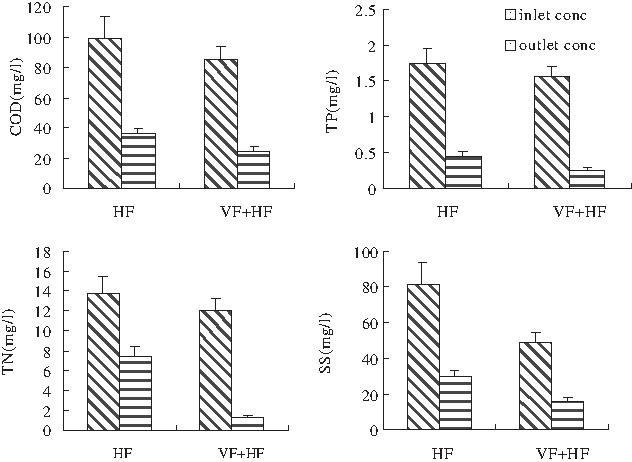
Comparison of removal rates of the deposition pond–HFCW system and the hybrid landscape pond–VFCW–HFCW system.
Generally, wetland filtration system could reduce 30%–67% TP and 30%–52% TN of the hypereutrophic water (Coveney et al., 2002; Li et al., 2008) and there was no significant difference in COD, TN, and TP removal rates between VFCW of single type (VFS) and HFCW of single type (HFS) (Li et al., 2008). For VFS, TN removal rate was averaged to be 44.6%–52% during 1-year operation and TP removal rate was averaged to be 60%–64% with effluent TP concentration of 0.056 mg L−1 (Vymazal, 2007; Li et al., 2008). For HFS, TN removal rate was averaged to be 43.6%–52% (Wu et al., 2004; Li et al., 2008) and TP removal rate was averaged to be 41%–66% with effluent TP concentration of 0.052 mg L−1 (Li et al., 2008). Comparing with the TP and TN removal rates of VFS and HFS, the VFCW–HFCW system and the deposition pond–HFCW system had much higher overall TP (79.2%–86.6%) and TN (58.9%–90.4%) removal rates (Tables 2 and 3), validating that the hybrid wetland system had better overall removal effect than wetlands in single type (Cui et al., 2009).
Phosphorous is the most limiting nutrient for the breakout of water bloom (Shan et al., 2002; Rodríguez-Lizana et al., 2007). Therefore, TP must be removed before the surface runoff was discharged into the receiving water body (Verhoeven and Meuleman, 1999). For phosphorous removal, the VFCW–HFCW system (82.6%–91.5%; Table 3) and the deposition pond–HFCW system (79.2%–84.3%; Table 2) had higher efficiencies than the reported values of 72.62% from the two combined vertical-flow wetlands system, or 55.56% from the combined system of vertical-flow constructed wetland–horizontal flow constructed wetland (Cui et al., 2009), but lower than 93.0% of a wetland system composed of many tiny ponds and ditches (Shan et al., 2002).
However, for each separate subunits, such as HFCW in deposition pond–HFCW system (73.4%–76.2%; Table 2), or VFCW (38.0%–71.6%; Table 3) or HFCW (66.7%–78.4%; Fig. 4) in the VFCW–HFCW system, their TP removal rates did not differ too much from those of VFS (60%–64%) and HFS (41%–66%) (Wu et al., 2004; Li et al., 2008). Medium adsorption was considered as the most significant mechanism of phosphorous purification because phosphorous can react with calcium (Ca), aluminum (Al), or iron (Fe) in medium by adsorption and precipitation (Arias et al., 2001; Brix et al., 2001), and TP removal of subunits would not differ too much if they contained almost the same substrate in quality and quantity, although phosphorous could be removed by either plant uptake or biological incorporation into biological films in subsurface flow wetland (Richardson, 1985; Jing and Hu, 2010). According to Table 1 and Figs. 1 and 2, the substrate order was HFS (16–26 mm gravel substrate with dimensions of 20 m × 1.5 m × 0.25 m), VFS (25–35 mm gravel substrate with dimensions of 20 m × 1.5 m × 0.25 m) < VFCW, HFCW in VFCW–HFCW system < HFCW in deposition pond–HFCW system (Li et al., 2008). Correspondingly, their TP removal rates increased gradually on the whole.
But, when it came to TN removal, the situation changed. The nitrogen removal rate in constructed wetland was averaged to be 25%–85% by a central pathway of nitrification followed by denitrification (USEPA, 1988; Spieles and Mitsch, 2000; Lee et al., 2009). For nitrogen removal, the VFCW–HFCW system (89.0%–92.2%; Table 3) and the deposition pond–HFCW (58.9%–69.8%; Table 2) had higher rates than the reported values of 44.6%–52.9% of VFS, or 43.6%–52% of HFS (Wu et al., 2004; Vymazal, 2007; Li et al., 2008), implying the advantage of the hybrid constructed wetlands over the single-type wetland. But the stormwater wetlands typically removed only around 45% of TN, most of which being made up of particulate organic nitrogen (Taylor et al., 2005; Lee et al., 2009). For separate subunits, such as HFCW in the deposition pond–HFCW system (41.4%–48.4%; Table 2) and VFCW (12.2%–17.5%; Table 3) in the VFCW–HFCW system, there appeared no obvious advantage, even disadvantage, over VFS (44.6%–52.9%) and HFS (43.6%–52%), implying that stormwater wetland in single type had a considerably lower nitrogen removal effect (Taylor et al., 2006; Lee et al., 2009).
However, the subsequent HFCW in the VFCW–HFCW system had a much higher nitrogen removal rate (87.0%–90.5%; Table 3). In the hybrid VFCW–HFCW system, water flowed through VFCW to HFCW, the former having a TN removal rate of only 12.2%–17.5%, whereas the latter of 87.0%–90.5% (Tables 2 and 3). Theoretically, VFCW was good at nitrification because of the high oxygen transfer capacity (Luederitz et al., 2001; Li et al., 2008), and then the nitrate in the nitrified wastewater was removed by denitrification in the subsequent HFCW (Li et al., 2008; Lee et al., 2009). Thus, the advantages and disadvantages of the HFCW and VFCW could make up for each other in removing TN by their special function of achieving nitrification and denitrification reaction in the hybrid VFCW–HFCW system (Luederitz et al., 2001; Li et al., 2008).
Conclusions
Both the deposition pond–HFCW system and the hybrid deposition pond–landscape pond–VFCW–HFCW system could effectively purify the initial urban surface runoff together with the combined sewer overflow in rainy season, and the diluted municipal wastewater or Moshui Lake water in dry season, implying the combined pond–wetland system was a feasible, low-cost way to improve water quality and recreation value of water body in the urbanized area.
For the combined pond–wetland system, the main function of multipond system included surface runoff storage and pretreatment, landscape effect, and high SS removal to prevent the subsequent constructed wetlands from clogging. The coexistence of VFCW and subsequent HFCW was much more effective in N removal because of the difference of oxygen carrying capacity between VFCW and HFCW, whereas P removal was mainly influenced by wetland substrates.
Footnotes
Acknowledgments
This research was funded by the National Science and Technology Supporting Programs (2006BAC10B02), Special Branch of the Water Pollution Control and Management Project (2008ZX07317), and Research Foundation for Public Benefit from the National Ministry of Water Resources (200901008).
Author Disclosure Statement
The authors declare no competing financial interests.