




Abstract
Abstract
Exposure to electromagnetic fields is a research area that has generated conflicting results and thus uncertainty about possible adverse biological effects. This article analyzes the behavior of charged particles in a biological cell when exposed to different combinations of AC-DC electromagnetic fields, by combining the Ion Forced-Vibration theory with the Ion Cyclotron Resonance and Ion Parametric Resonance theories. We analyzed (i) the physical mechanisms caused from resonance response and noise; (ii) the behavior of the particle when exposed to these fields with different combinations of initial position, initial velocity, field strengths, frequencies, and relative angle between AC-DC magnetic fields; and (iii) the particle behavior with certain values of the ratio BAC/BDC, where BAC and BDC are the strength of AC and DC magnetic fields. Our results show that the influence of combined AC-DC magnetic fields on particle displacement is larger than that of an AC magnetic field alone. The study indicates the particle's resonant response as predicted by Ion Cyclotron Resonance and Ion Parametric Resonance theories, only at unrealistically low viscosity. On the contrary, the study verifies the Ion Forced-Vibration theory in which viscosity is taken into account.
Introduction
Human organisms are multicellular with ∼1014 cells each with a typical size of 10 μm. A cell membrane, also called plasma membrane, covers each of these cells. There are free ions that can move across the membrane, such as K+, Na+, Cl−, and Ca++, on both sides of every cell membrane, but in different concentrations. These ions control the cell volume, help the signaling process, and create a strong electric field between both sides of the cell membrane (Panagopoulos et al., 2000). The key mechanism for the influence of an external oscillating EMF on biological cells is possibly the forced-vibration of all the free ions inside and outside the cells, produced by the field, as proposed by Panagopoulos et al. (2000, 2002). They have shown that this vibration of electric charge is able to irregularly gate electro-sensitive channels on the plasma membrane and thus cause disruption of the cell's electrochemical balance and function. They developed a mathematical model considering AC electric and magnetic field's influence on cells (Panagopoulos et al., 2000, 2002). Adair argued (Adair, 2003) that theoretically, the interactions caused by ELF fields must be considerably larger than the molecule's ordinary thermal interactions with the environment to result in any biological effects at cell level. Panagopoulos et al. argued that thermal motion is a random movement in every possible direction different for each ion, whereas forced-vibration is a coherent movement of the whole ionic cloud in the same direction. Hence, forced-vibration can be effective biologically, whereas thermal motion cannot (Panagopoulos et al., 2000, 2002). This aspect needs to be considered in detail to understand the complicated electromagnetic interactions in cell plasma membranes. The cell membrane contains ion channel proteins, the opening of which can be regulated by the trans-membrane voltage or mechanical stress (mechanically gated channels gated by ion pressure) or chemical signals.
An external AC electric field will exert an oscillating force on the free ions in the outside of the cell and in the channel of the protein. The interior of the cell is considered to be partially shielded from the external field, depending on the field strength and frequency, by the free ion layer. The EMF are largely produced artificially with frequency ranges from 0 to 300 GHz. These external fields exert forces on each free ion, which can pass across plasma membrane. Due to this force, a free ion is displaced at distance
where ψ is the particle valence, q is the elementary electric charge (C),
Except of the above-described Forced-Vibration theory, another theory is the Ion Cyclotron Resonance (ICR) proposed by Liboff and McLeod (1988) and Liboff (2005). A cyclotron is a particle accelerator that accelerates charged particles using high-frequency alternating voltage. Specific biological interactions with ELF magnetic fields and cyclotron frequencies that are derived from ionic charge-to-mass ratio are evident from experimental results reported in studies on a wide range of biological systems. Liboff (2005) observed the interaction of low-frequency magnetic fields with biological systems when the fields are adjusted to the cyclotron resonance frequencies of ions. Cyclotron resonance frequency is a unique function of the charge-to-mass ratio (ψq/m) and intensity of the magnetic field as
Despite the existence of the above theories, there is still scepticism regarding the mechanism by which EMFs interact with biological systems due to the complexity of this interaction. The purpose of this investigation is to analyze the IPR, ICR theories, and the behavior of charged particles inside a biological cell using the Ion Forced-Vibration proposed by Panagopoulos et al. (2000, 2002). The behavior of charged particles is studied as shown in the section AC and DC Electromagnetic Fields, when exposed to different combinations of AC and DC EMF: (i) DC magnetic field, (ii) DC electric field, (iii) AC magnetic and induced electric fields, and (iv) AC-DC magnetic fields and induced electric field. In the section Influence of Viscosity and Noise, we discuss the influence of viscosity and noise to a particle's displacement, and the consecutive section presents results and discussion on the behavior of the particle with respect to different initial positions and velocities, field strengths, frequencies, and relative angles between AC and DC magnetic fields in the presence of drag and noise.
AC and DC Electromagnetic Fields
We consider a charged particle in a viscous medium exposed to AC and DC EMF. In some experiments either the vertical or horizontal earth's magnetic field is set to zero or it is shielded (Lednev et al., 1996; Prato et al., 2009). The DC magnetic field is selected as B0 = (0, Boy, Boz) and it is in the y-z plane. Hence, the static magnetic field can be written as,
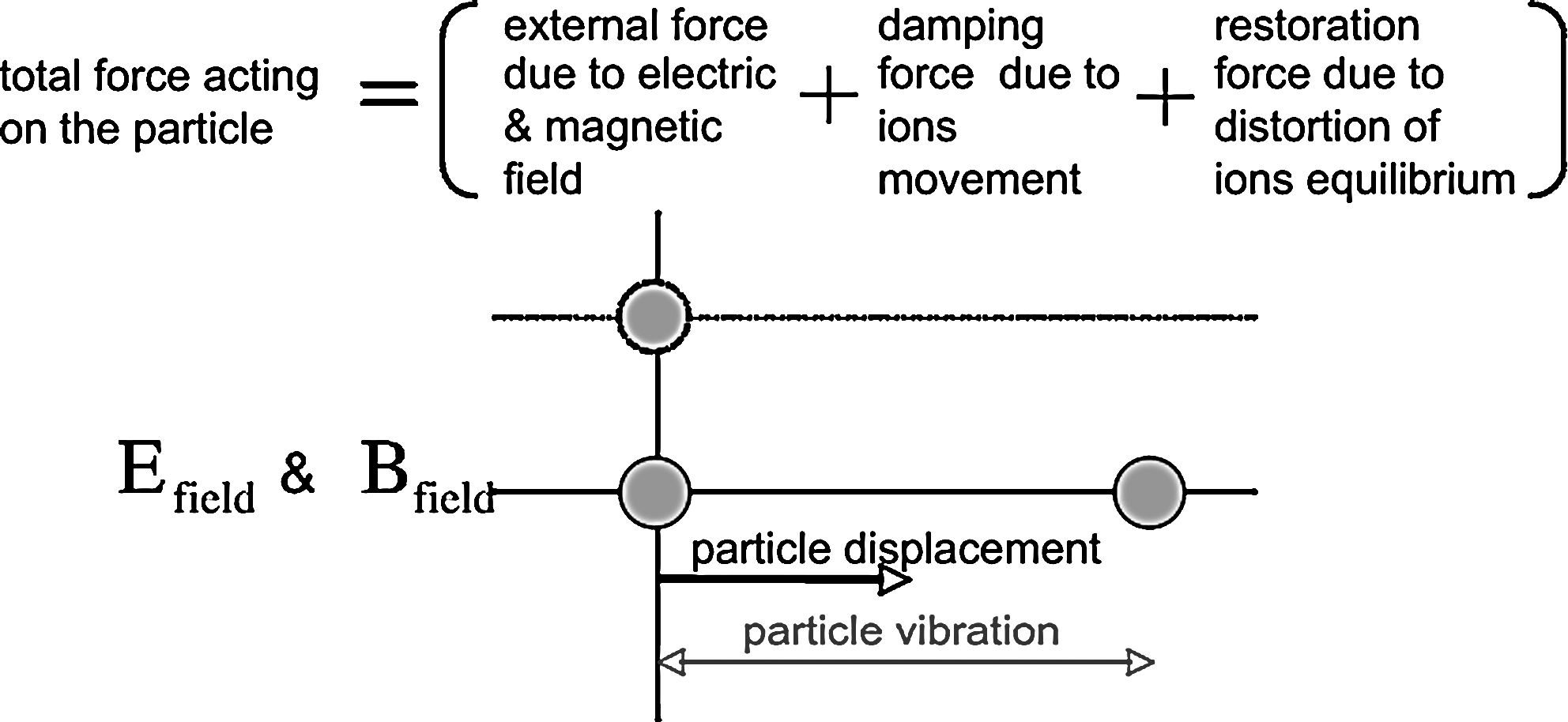
Total force acting on the charged particle due to electric and magnetic fields.

Coordinate system: DC magnetic field B0, AC electric field E, and AC magnetic field B1z. Here, DC magnetic field B0 is in the vertical y-z plane, a uniform AC electric field E is in x direction perpendicular to the y-z plane, and AC magnetic field B1z is in z direction perpendicular to the x-y plane. Color images available online at www.liebertonline.com/ees
The motion of a charged particle of mass m and charge q moving at a velocity
where D is the restoration constant, D = mω32, ω3 is the self-oscillating frequency and
Considering
where drag coefficient of the viscous medium is κ = λ/m, βox = ψqEox/m, ω1 = ψqB1/m, ωoy = ψqBoy/m and ωoz = ψqBoz/m. These parameters can be determined from Fig. 2 as, ωoy = ωo sin θ and ωoz = ωo cos θ, where θ is the angle between z direction and DC magnetic field. The angular frequencies ωoy and ωoz characterize the cyclotron resonance frequencies, which depend on the static magnetic fields in y and z directions, respectively. The self-oscillating frequency depends on whether the charged particle is a free ion or a bound ion. Panagopoulos et al. assumed that the free ions' self-oscillation frequencies, ω3, coincide with the ionic spontaneous oscillations observed in cells that do not exceed 1 Hz (Berridge and Galione, 1988; Panagopoulos et al., 2000). However, for a bound ion (ω3 > > 1 Hz), ω3 depends on the bound lifetime. For example, higher ω3 (infrared = 1012 Hz) results stronger bindings and thus longer bound lifetimes (Muehsam and Pila, 1996). The parameter ω1 gives the angular frequency due to the strength of the AC magnetic field. The forces on a charged particle due to various combinations of AC and DC EMF can be obtained from Equation 4, as shown in Table 1.
The particle's motion depends on the strength of AC and DC EMF, angular frequency of AC field ω, self-oscillating frequency ω3, and drag coefficient κ. The influence of the EMF on the particle displacement depends on whether the particle is a free ion or a bound ion. Because of the alternating nature of the EMF, the displacement is oscillatory. The resultant displacement can be obtained by the vector summation of the displacements in all three directions using Equation 4. The existence and amplitude of the displacement are determined by the initial positions, velocities of the charged particle, as well as, by the intensity, frequency and direction of the external EMF.
DC magnetic field
A charged particle will move in a circle at the equilibrium position due to the static magnetic field. The inward force or centripetal force produced by the magnetic field B0 related to this rotation is given by F = ψqvB0 = mv2/r, where r = mv/ψqB0 is the radius of the particle's path. Therefore, ω can be written as ω = v/r = ψqB0/m and the cyclotron resonance frequency becomes ω0 = ψq√ (Boy2 + Boz2)/2. The forces on the particle due to DC magnetic field using Equation 2 are, m∂
where ω0 = ψq|B0 |/m. The behavior of particles depends on ω0, ω3, and κ, which in turn characterize the roots of Equation 5 (Appendix). If ω0 < κ − 2ω3, the solution gives two real unequal roots and the displacement is over-damped causing the particle to return to equilibrium without oscillating. When ω0 > κ − 2ω3 the roots are complex and then the charged particle oscillates with the amplitude gradually decreasing to zero. For two real and equal roots when ω0 = κ − 2ω3, the particle's displacement is critically damped. Thus, the particle returns to equilibrium without oscillating.
DC electric field
A DC electric field induces an internal polarization with a magnitude proportional to the external field on the exposed surface diminishing the field inside the body (Reitz and Milford, 1967). However, already existing electric fields across the membranes are capable of interacting with the external fields. Equation 2 gives the forces on the particle due to DC electric field as
where βox = ψqEox/m. The characteristic roots of Equation 6 are imaginary when κ = 0 (Appendix). These imaginary roots cause un-damped oscillations, whereas βox introduces a constant displacement that does not change with the time but with Eox and ω3. In the presence of drag, κ > 2ω3, the displacement is over-damped. The displacement is critically damped when κ = 2ω3. The charged particle oscillates with a gradually decreasing amplitude toward to zero when κ < 2ω3.
Influence of Viscosity and Noise
The drag coefficient (κ) shows the drag or resistance on a particle moving within a fluid. This depends on the particle's size and shape as well as the fluid's viscosity. There is no force to transport the ion through the channels, and hence resonance cannot occur in a viscous medium (Halle, 1988). To recover these problems Liboff and Mcleod (1988) have assumed that the ion in the channel is very close to the wall and is forced through the channel by its spiral structure. According to Muehsam and Pila (1996) the bound lifetime is inversely proportional to viscosity. Long bound times on the order of 1 s in Ca2+/Calmodulin requires a viscosity of κ ≈ 1 s−1. The drag coefficient for shorter bound lifetimes such as 1 ms requires values in the order of κ ≈ (102−103) s−1. The bound lifetime for free ions in a medium with a viscosity equal to that of bulk water, κ ≈ 1014 s−1 (Lednev et al., 1996; Panagopoulos et al., 2000), will be in the order of 10−12 s. For a given value of viscosity, lower values for the oscillator frequency ω3 result in weaker binding and thus lower bound lifetimes (Muehsam and Pila, 1996).
The effect of noise on a particle's displacement is accounted by adding a sinusoidal noise component to the equation as in Zhadin (1998). Here, the forces on the particle become
Results and Discussion
In this section, we describe the particle motion in x, y, and z directions, as described in sections AC and DC Electromagnetic Fields, and Influence of Viscosity and Noise. This is obtained from numerical integration of Equation 4 by considering combinations of quantities such as ω0, ω1, ω3, βox, and the angle between AC and DC magnetic field, θ. Self-oscillating frequency ω3 for a free ion is considered as 1 rad/s, due to its small value (0.02−0.2) Hz (Berridge and Galione, 1988; Panagopoulos et al., 2000) and for a bound ion ω3 is taken as 106 rad/s. The particle's behavior is analyzed by varying the angle θ from 0 to 2π radians, field strength, initial position, and initial velocities. We chose the field parameters as BDC = 50 μT, BAC = 0.9BDC (Blackman et al., 1994), and f = 50 Hz. The cyclotron resonance frequency, ω0, of Ca++ at 50 μT is 240.75 rad/s. The initial positions and velocities were selected considering the cell size as 10 μm. The response of a charged particle to simple EMF configurations is discussed showing the difference of responses to different configurations of AC and DC EMF to provide qualitative understanding. The absolute values of the maximum displacement in x, y, and z directions are represented by max|x|, max|y|, and max|z| as shown in Figs. 3–6.

DC magnetic field: The particle's displacement with DC magnetic field's strength. x(0) = y(0) = z(0) = 10−9 m, x′(0) = y′(0) = z′(0) = 10−8 m/s, ω3 = 1 rad/s, κ = 10 s−1, and θ = π/4. Here x(0), y(0), and z(0) are initial positions and x′(0), y′(0), and z′(0) are initial velocities in x, y and z directions. A resonance occurs at ω0 = 90 rad/s where DC magnetic field strength is 18.7 μT. Color images available online at www.liebertonline.com/ees

DC electric field: The particle's displacement with DC electric field's strength. Here, βox = ψqEox/m, where Eox is the DC electric field's strength. x(0) = y(0) = z(0) = 10−9 m, x′(0) = y′(0) = z′(0) = 10−8 m/s, ω3 = 1 rad/s and κ = 100 s−1. Here x(0), y(0), and z(0) are initial positions and x′(0), y′(0), and z′(0) are initial velocities in x, y, and z directions. The electric field strength ranges from 1 to 20 nV/m. The displacement in x direction linearly increases with increasing electric field intensity, whereas in y and z directions it remains constant across the range of electric field intensity and is lower than the displacement in x direction. The displacement in y and z directions overlaps. Color images available online at www.liebertonline.com/ees
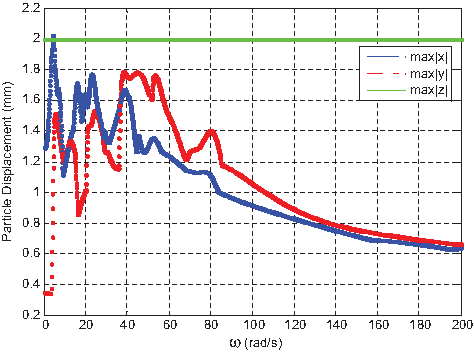
AC magnetic field and induced electric field: The particle's displacement with circular frequency of AC magnetic field. x(0) = y(0) = z(0) = 10–9 m, ω1 = 261.68 rad/s, ω3 = 1 rad/s and κ = 100 s−1. Here x(0), y(0), and z(0) are initial positions and x′(0), y′(0), and z′(0) are initial velocities in x, y, and z directions. Several resonances occur even in the absence of a DC magnetic field in x and y directions, whereas in z direction, displacement does not vary with the angular frequency. Color images available online at www.liebertonline.com/ees
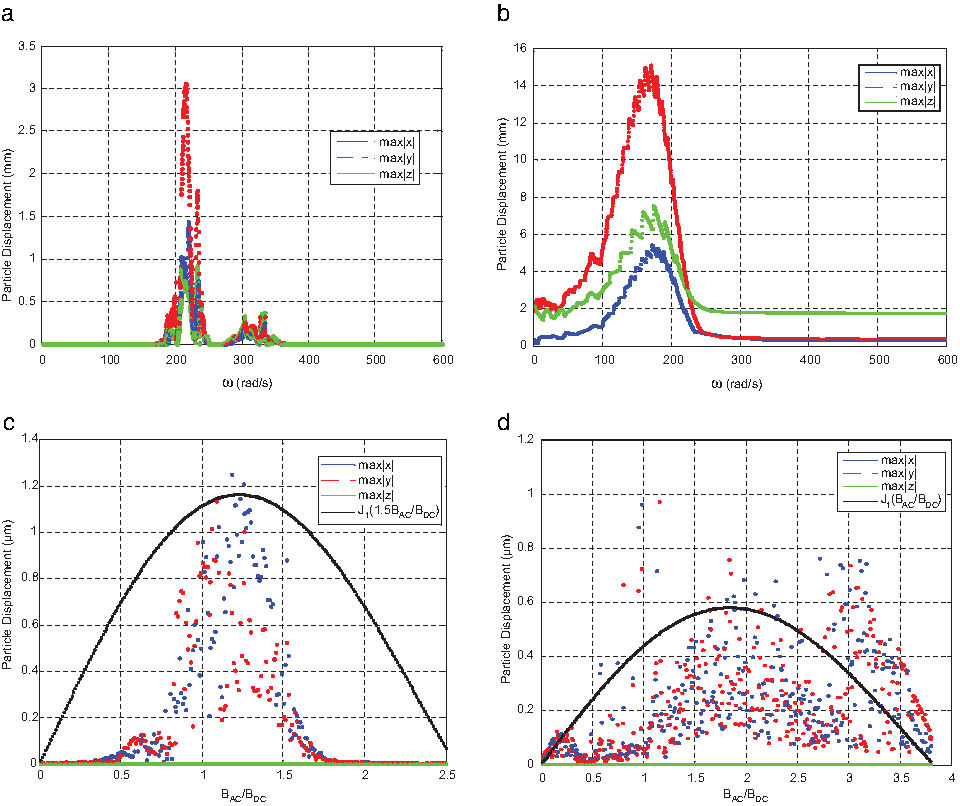
AC-DC magnetic fields and induced electric field: Here x(0), y(0), and z(0) are initial positions and x′(0), y′(0), and z′(0) are initial velocities in x, y, and z directions.
Free ion: influence of drag, noise, initial positions, and initial velocities
Here, the results for all possibilities of AC and DC EMF have been obtained. The charged particles behavior for different AC and DC EMF combinations are shown in sub-sections DC magnetic field to AC-DC magnetic fields and induced electric field. The effect of induced electric field due to AC magnetic field is discussed in sub-sections AC magnetic field and induced electric field, and AC-DC magnetic fields and induced electric field. Further, the effect of drag coefficient on the particle's displacement is considered. With increasing drag coefficient, the displacement decreases and the resonant behavior of the particle vanishes. The resonant behavior disappears around κ =1,000 s−1. This drag coefficient is similar to drag of ions that have shorter bound lifetimes such as 1 ms. Thus, a very low viscous medium is required to result in resonances and significant free ion movements. As in (Durney et al., 1988), these results indicate that the experimentally observed resonant responses of biological systems are probably not due to resonant response of charged particles in viscous medium. The influence of noise on the particle's motion is analyzed using Equation 7 and the displacement may be increased due to noise. The viscosity is proportional to the thermal noise strength (Muehsam and Pila, 1996). Hence, for an ion in a low viscosity medium, thermal influences will be low. Also, the resonant behavior of particles displacement under the thermal influences disappeared around κ = 1,000 s−1.
DC magnetic field
The effect of a DC magnetic field is considered by varying angle θ and field strength. Figure 3 shows the maximum spatial deviation of the particle with DC magnetic field strength in all directions when the drag coefficient is 10 s−1. This is obtained by integrating Equation 4 numerically over 0.4 s, when the particle's all initial positions are 10−9 m and initial velocities are 10−8 m/s. A resonance occurs at ω0 = 90 rad/s, where DC magnetic field strength is 18.7 μT. The maximum displacement in x direction occurs when θ = π/4, 3π/4, 5π/4, 7π/4, in y direction when θ = 0, π, 2π, and in z direction when θ = π/2, 3π/2. Hence, the maximum displacement of the particle occurs in directions perpendicular to the DC magnetic field. We found that with increasing initial positions or velocities, the displacement of the particle increases and it varies with ω0. The effects of DC magnetic field on biological systems are experimentally demonstrated (Lednev et al., 1996; Belova and Lednev, 2001a; Binhi et al., 2001). The gravitropic bending of flax seedlings exposed to weak DC magnetic fields in the range of 0–350 μT was stimulated and inhibited (Belova and Lednev, 2001a). These experimental results have shown the maximum biological effect at zero DC magnetic fields and rapidly decrease as the field increases (Lednev et al., 1996; Binhi et al., 2001). According to Fig. 3, though, the particle displacement at zero DC magnetic fields is not the maximum.
DC electric field
The effect of a DC electric field is shown in Fig. 4, assuming that there is no other field. This illustrates the variation in the particle's behavior with electric field strength from 1 to 20 nV/m. The initial conditions are x(0) = y(0) = z(0) = 10−9 m, x′(0) = y′(0) = z′(0) = 10−8 m/s, and the drag coefficient is 100 s−1. The displacement in x direction linearly increases with increasing electric field intensity, whereas in y and z directions it remains constant across the range of electric field intensity and is lower than the displacement in x direction. For any combination of initial positions and velocities (initial conditions), the particle's displacement in x direction is similar to Fig. 4, as the DC electric field exists in x direction. If, on the other hand, the initial conditions in y or z direction are zero, the particle does not move in that direction. The displacement in x direction with increasing initial conditions does not vary much, although in y and z direction the displacement increases. Moreover, the particle's displacement in a DC electric field is larger than that in a DC magnetic field. In reality, internally induced electric fields within the cell may be capable of interacting with external magnetic fields, which in turn increase the ion motion. According to experiments a cyclic voltage change of order 20 mV is estimated in cellular Ca++ oscillator (Liboff and Jenrow, 2000). Further, the external DC electric fields polarize the biological tissues (Popp, 1994). DC electric fields perturb normal development in amphibians at certain stages (Metcalf and Borgens, 1994) and imposed DC electric fields influence the polarity of development and regeneration of embryos, cells, and tissues (Jaffe and Nuccitelli, 1977; Levin, 2003).
AC magnetic field and induced electric field
Figure 5 shows the effects of AC magnetic and AC electric fields considering the induced electric field due to magnetic field. The particle's displacement with the intensity of magnetic field is somewhat random when initial positions are x(0) =y(0) = z(0) = 10−9 m. With increasing angular frequency, it has several resonances in x and y directions when the drag coefficient is 100 s−1 (Fig. 5). Thus, resonance also occurs in the absence of a DC magnetic field. This is because the AC magnetic field bends the particle's path and synchronizes it with the electric field as a DC magnetic field does (Durney et al., 1988). In z direction, displacement does not vary with the angular frequency. This shows that the particle's movement is perpendicular to the magnetic field. Figure 5 illustrates the resonances that occur at other frequencies. The particle displacement increases with initial conditions. Even when the initial conditions in z direction are zero, a displacement is observed in that direction. If either x or y have initial conditions, the particle moves in both directions. The resultant motion of the charged particle in an AC magnetic field is larger than in a DC magnetic field. Possible evidence that supports this result is that the body weight of male mice exposed to an extremely weak AC magnetic field was significantly less than in a DC magnetic field (Hashisha et al., 2008). The effect of weak AC magnetic field is shown by several experimental demonstrations. Weak AC magnetic fields affect biological systems, generally, such as chemically induced processes in breast cancer cells, which are influenced by a 1.2 μT, 60 Hz magnetic field (Blackman et al., 2001).
AC-DC magnetic fields and induced electric field
The particle's displacement is similar in all three directions under the AC-DC magnetic fields and induced electric field. The displacement here is larger than in case where only AC magnetic field and induced electric field exist. Additionally, the maximum displacement occurs when θ = 0, π, and 2π rad where AC and DC magnetic fields are parallel to each other. The particle displacement increases with initial conditions, if they exist. The variation of the particle displacement with DC field intensity has a resonant around ω0 = 314 rad/s, that is when ω0 = ω. The displacement with angular frequency of magnetic field is shown in Fig. 6a and 6b: it has several resonances. Also, for collinear AC and DC magnetic fields, in the absence of induced fields, resonances occur when ω = ω0, ω0/2. This satisfies the ICR model. However, due to the effect of induced fields resonances are not observed exactly at cyclotron resonance frequencies. Figure 6b shows the particle's displacement under perpendicular AC and DC magnetic fields where resonances occur in all directions. In the absence of induced electric fields this gives a resonance response at ω = ω0. Thus, the ICR model is applicable in the presence of perpendicular AC and DC magnetic fields. The ICR behavior in the presence of a perpendicular DC earth's magnetic field has been demonstrated using experiments (Fitzsimmons et al., 1994). Further, the particle does not show the resonances only at cyclotron frequencies and its sub-harmonics. The resonances also occur at other frequencies, depending on the configuration of applied fields, which is clearly illustrated in Fig. 6a and 6b (Edmonds, 1993). The effect of AC electric field in the presence of a DC magnetic field on the charged particle in a cell can be analyzed by considering only the induced electric field. Resonances occur satisfying the ICR model when the AC electric field is perpendicular to the DC magnetic field. Also, the resonances occur at noncyclotron frequencies. The resonances do not occur exactly at the cyclotron resonance and disappear when the drag coefficient increases.
Figure 6c shows the particle's motion with BAC/BDC at cyclotron resonance when BAC/BDC = 1.25. Thus, it follows J1(1.5BAC/BDC) when AC-DC magnetic and induced electric fields exist. The variation of particle displacement in x direction with BAC/BDC when θ = 0 and π/4 is observed assuming there is no induced electric field. The particle follows the Bessel function J1(BAC/BDC) when magnetic fields are parallel. This predicts the IPR model. According to Lednev (1996) biological effects follow the Bessel function J1(BAC/BDC) (Belova and Lednev, 2001b), whereas Blanchard et al. (1994) show the biological effects' dependency on the Bessel function J1(2BAC/BDC) (Blackman et al., 1994). The present study illustrated the displacement of particle's dependency on J1(BAC/BDC), but not on J1(2BAC/BDC). The effects of AC and DC magnetic fields are shown experimentally. The growth of Escherichia coli exposed to low frequency EMF of 0.01–0.1 T was altered by these factors (Justo et al., 2006). Parallel AC and DC magnetic fields, tuned to a cyclotron frequency of Ca++ ions (BDC = 46.5 μT, BAC/BDC = 0.7–3.4, fAC = 35.8 Hz), increased the rate of gravitropic bending and followed the J1(BAC/BDC) function (Belova and Lednev, 2001b).
Free ion and bound ion
The bound ion is combined to a protein and hence not free to oscillate as the free ion does. The escape of a bound ion depends on its bound lifetime. The bound ion can be forcedly removed by an external EMF that has enough energy to ionize an atom or a molecule. However, weak EMF do not carry sufficient energy to ionize atoms. The displacement of a bound ion and free ion under the influence of AC-DC magnetic fields and noise is shown in Fig. 7. The displacement of free ion is larger than the bound ion's oscillations. Thus, free ions may affect biological systems more than the bound ions. The displacement of a bound ion changes, significantly, under the noise for larger drag coefficients (∼κ > 106 s−1).

AC-DC magnetic fields and induced electric field: Here x(0), y(0), and z(0) are initial positions and x′(0), y′(0), and z′ (0) are initial velocities in x, y, and z directions.
Relation to biological systems
Our study satisfies ICR and IPR models only at very low viscosity and when induced fields are zero. When the induced fields are considered, that is, AC-DC magnetic fields and induced electric fields, the resonance does not occur at the cyclotron frequency. The resonance behavior does not occur only at the cyclotron frequencies and their sub-harmonics, but also at other frequencies. The resonances can occur due to an AC magnetic field and induced electric field in the absence of a DC magnetic field. Further, there are resonances due to perpendicular AC and DC magnetic fields. When the induced electric field is considered, the charged particle follows the Bessel function in a different way disproving IPR behavior. The experiments done to determine the ICR and IPR behavior have been conducted without canceling the induced electric fields due to AC magnetic fields (Lednev et al., 1996; Belova and Lednev, 2001b; Liboff, 2005). However, according to low frequency approximations, at low frequencies electric and magnetic fields can exist uncoupled. Hence, we can consider uncoupled electric and magnetic fields at low frequencies (Furse et al., 2008). The resonances do not occur exactly at the cyclotron frequency when the drag coefficient increases. Also, the resonance behavior is not possible to occur in a viscous medium. Thus, the experimental evidence of biological effects probably arises due to a different mechanism than IPR and ICR, possibly the Ion Forced-Vibration mechanism by its own (Panagopoulos et al., 2000, 2002). ICR and IPR models become physically impossible with increasing initial positions and velocities, integration time, and field densities. Under these conditions the particle's displacement becomes larger than the cell dimensions. If we consider actual body drag (water κ = 1014 s−1) even under these conditions our study predicts a reasonable particles displacement, but not according to ICR or IPR models. Even though the particle is not subjected to resonant behavior under larger drag, it may change the direction of its motion. This may change the force acting on the particle with time such that the particle displacement is biologically effective.
Conclusion
This article analyzed in detail the behavior of a charged particle in a cell exposed to combinations of electric and magnetic fields. Our study showed that resonance as proposed by ICR and IPR theories (Liboff and McLeod, 1988; Lednev, 1991; Lednev et al., 1996; Liboff, 2005) is not possible under realistic conditions. This result verifies the previous result of Galt et al. (1993) in regard to the ICR theory. The recorded biological effects must be due to another mechanism as is probably the Ion Forced-Vibration mechanism by its own (Panagopoulos et al., 2000, 2002). We may conclude that (i) when the induced EMF are zero, our study satisfies the ICR model when AC and DC magnetic fields are parallel or AC electric and DC magnetic fields are perpendicular to each other. However, the results show that the ICR behavior is feasible in the presence of perpendicular AC and DC magnetic fields. Resonance behaviors occur not only at cyclotron frequencies and their sub-harmonics, but also at other frequencies depending on the configuration of fields. (ii) When induced electric field is zero, for parallel AC and DC magnetic fields, the particle motion follows the Bessel function, J1(BAC/BDC), satisfying the IPR model. However, when induced AC electric field is considered, the particle displacement with BAC/BDC follows the Bessel function J1(1.5BAC/BDC) at resonance condition. (iii) When induced AC magnetic field is zero, particle displacement with E0/BDC is linear for perpendicular AC electric and DC magnetic field. (iv) The frequencies and angles that influence the minimum and maximum particle displacements vary with initial position and velocity. (v) The particle's displacement increases with increasing initial position and initial velocity. (vi) AC-DC magnetic field's influence on displacement is larger than that of AC magnetic field. (vii) Displacement decreases and resonances disappear with increasing viscosity of the medium. (viii) Particle displacement may be increased due to random noise.
Footnotes
Author Disclosure Statement
No competing financial interests exist.