




Abstract
Abstract
There is no question about the importance of understanding the fate of oil pollutants and the risks of individual components of gasoline to human health. To investigate the effects of major environmental factors on the volatilization of regular gasoline from unsaturated soils, a series of experiments were organized and performed on four typical Japanese soils under different temperature, soil organic matter content, and water content conditions. Quantitative assessment of risks of each residual gasoline component to human health was pioneered using the experimental results and a self-developed software program, Geo-Environmental Risk Assessment System (GERAS). Results of this study illustrated that (1) temperature and soil organic matter had significant effects on volatilization and thus on the residual concentrations of gasoline components remaining in unsaturated soils. These residual concentrations were positively related to the amount of soil organic matter, but inversely related to temperature. (2) Risks of residual gasoline components remaining in soils depended on exposure pathway, gasoline component, and carbon numbers. Risks of respiratory exposure due to vapor inhalation were generally higher than the risks of oral exposure due to intake of crops and water. (3) Although residual concentrations of gasoline components remaining in soils with high organic matter contents were high, their risks to human health were low. This is because high organic matter content has strong sorptivity for gasoline components, resulting in less vapor inhalation, less intake from water, and low bioavailability for crops.
Introduction
In May 2002, the Soil Contamination Countermeasures Act was enacted in Japan. This Act specifies investigation of soil contamination and prevention of harmful effects of soil contaminations on human health by a variety of toxic substances, including volatile organic compounds (VOCs), heavy metals, and polychlorinated biphenyls (PCBs). Some organic solvents, such as trichloroethylene and tetrachloroethylene, have been specified to be contaminants by the Act, but mineral oils such as gasoline, light oil, and heavy oil were not included. The Act has been amended in spring 2010 to constrain the “dig and haul” approach, which may cause secondary pollution, and to strengthen in situ remediation. To enhance countermeasures against the soil pollution by oil and its constituents and to reduce possible risks to human health caused by oil pollution, the Japanese Ministry of the Environment, in 2006, published guidelines for treating the contamination by mineral oils (Central Council for Environment, Japan, 2006).
Active remediation of soils polluted by oils may include dig and haul, soil vapor extraction, heating, pumping and treat, and bio- or accelerated bioremediation. Active remediation is relatively rapid but costly. In most cases, treatment of secondary materials, such as soils dug from a polluted site, evacuated gases, and pumped water and injection of nutrients and/or microbes are required. In contrast, passive remediation is generally more cost-effective than active remediation, but more time-consuming and conditionally applicable. As gasoline and petroleum hydrocarbons are volatile and biologically degradable, passive approaches have been used on those polluted areas that are not in urgent need of utilization. In addition, the establishment of Risk-Based Corrective Action (RBCA) (ASTM ES 38-94, 1994) has provided a scientific basis or tool for effectively selecting a pertinent remediation approach and for determining proper clean-up levels. Because of the significance and practicality of the RBCA approach, many models, including CalTox (California EPA, 1993), CLEA (DEFRA-EA, 2002), C-Soil (van den Berg, 1994), and UMS (Fresenius/focon, 1997), have been proposed and widely used throughout the world.
The environmental fate and transport of oils in the subsurface are complex. Many factors, including the type of oil and its components (Li et al., 2004; Acher et al., 1989; Zytner, 1994), soil type (Jarsjö et al., 1994; Zytner, 1994; Hayden et al., 1997), temperature (Gidda et al., 1999), and water content (Acher et al., 1989; Yaron et al., 1989; Gidda et al., 1999), are known to have effects on the volatilization behavior (Gidda et al., 1999) and the sorption and transport properties (Yaron et al., 1989; Zytner, 1994) of gasoline, but literatures are very limited. To investigate the residual concentrations of gasoline components in unsaturated soils, and to quantitatively evaluate the risk of each residual gasoline component on human health, we have designed a series of experiments to evaluate the effects of temperature, soil type or organic matter content, and water content on residual concentrations of gasoline components in four typical Japanese soils. The soil type is considered to be the most important factor, because different soils contain different minerals and different soil organic matter contents, resulting in different volatilization properties of gasoline, different sorption capacities for contaminants, and different bioavailabilities for crops. The risks of individual components to human health were assessed using a self-developed software program, Geo-Environmental Risk Assessment System (GERAS), which is based on the C-Soil model but considers mass transport and the characteristics of Japanese soils, such as soil organic matter content, porosity, permeation, and diffusive properties (Kawabe et al., 2003, 2005).
Volatilization Experiments
Test materials
Gasoline is a mixture of multiple hydrocarbons and/or components, with each component having a different risk to human health (Edwards et al., 1997; Huntley and Bechett, 2002). We have utilized a commercially available regular gasoline (RG), with a specific gravity of 0.73 g/mL. Gas chromatographic analysis of this RG illustrated that it contains >100 types of hydrocarbons, with carbon numbers ranging from C5 to C13 for aliphatic components and C5 to C12 for aromatic components.
Four types of soil commonly utilized in Japanese geotechnical and geoenvironmental laboratories were used for the experiments. Toyoura standard sand was used as a typical sandy soil with very little organic matter. Kanuma, Red, and Kuroboku soils, classified as volcanic ash soils and commonly available as gardening soils, were used as typical clayey soils containing different organic matter contents and taken from different depths from the ground surface. The Kuroboku soil is a top soil that exists near the ground surface and is rich in organic matter. The Kanuma soil exists at a relatively deeper subsurface layer and contains little organic matter. The Red soil lies in between the Kuroboku and Kanuma soils. The Toyoura standard sand, Kanuma soil, Red soil, and Kuroboku soil correspond to the Cambisol, Andosol-containing weathered pumice, Acrisols, and Andosol, respectively, in the World Reference Base for Soil Resources. All the soils were sieved, sorted with a 2-mm screen, and air dried in the laboratory at room temperature for 1 month prior to use. The content of organic matter in each soil sample was determined quantitatively, in advance, as proposed by Nakano et al. (1995) and found to be 0.36%, 11.61%, 17.04%, and 21.63% for Toyoura standard sand, Kanuma soil, Red soil, and Kuroboku soil, respectively. The volumetric water contents of air-dried soils were assumed to be 0%.
Test method, procedure, and conditions
Volatilization of RG in unsaturated soils was performed under temperature-controlled conditions to investigate the residual concentrations of different gasoline components. Glass vials, measuring 120 mm in height and 20 mm in diameter, were filled with soil samples to a depth of 10 mm from the bottom. The bulk densities of filled soils were about 1.71, 0.71, 0.91, and 0.99 g/cm3 (1 g/cm3 = 103 kg/m3), respectively. The vials were placed in a temperature-controlled water bath overnight for temperature homogenization (Fig. 1). Using a microsyringe, 250 μL of RG was injected into the bottom of the soil in each vial and allowed to volatilize under atmospheric pressure. The residuals of gasoline compositions remaining in the soil samples were extracted and analyzed at different time periods by a flame ionization detector-type gas chromatograph.
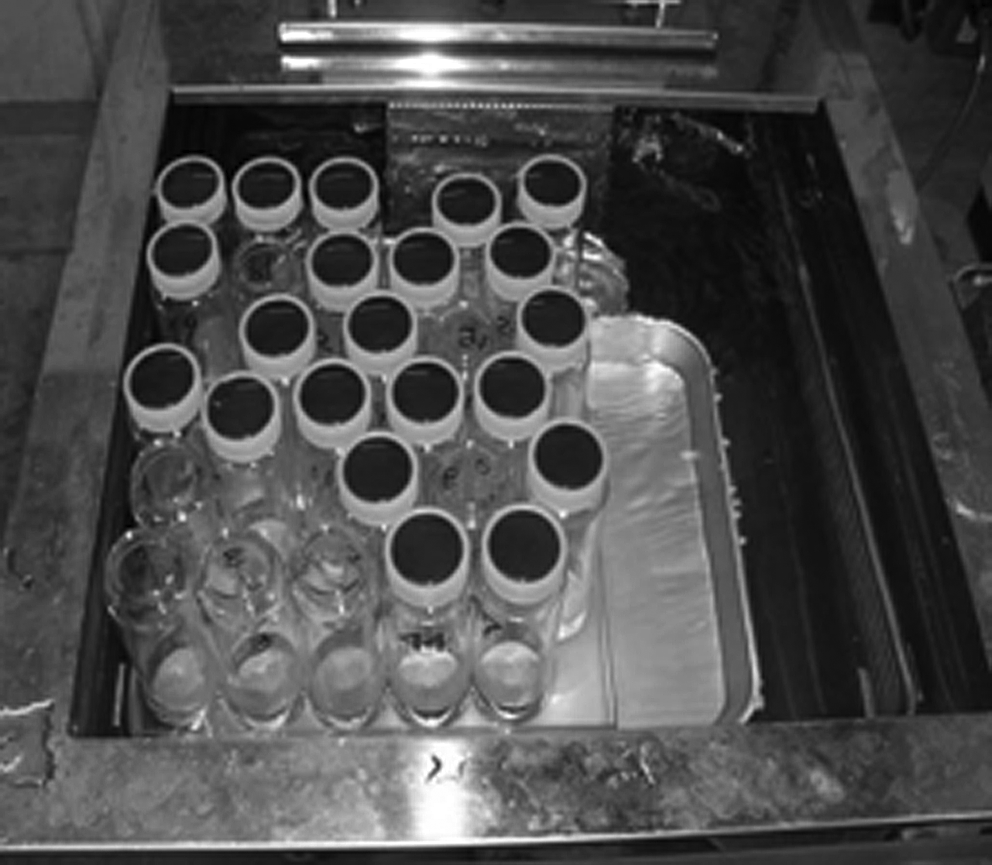
A temperature-controlled water bath used for volatilization experiments.
The conditions used for laboratory volatilization experiments are shown in Table 1. The effects of temperature were investigated using air-dried Toyoura standard sand and the effects of soil type were investigated using the four typical Japanese soils described above. To investigate the effects of water content, the volumetric water content of Toyoura standard sand was adjusted to 0%, 5%, and 33%. The conditions for experiments 2, 4, and 8 were the same, but they are labeled with different numbers to facilitate description and comparisons.
Experimental results and discussion
Volatilization of gasoline from unsaturated soil was concentration dependent. Over a certain concentration, volatilization was intensive, whereas, below this threshold, volatilization was very slow. Under the test conditions, intensive volatilization ceased within about 34 h. Thus, the residual concentration of each component was defined as the average concentration of that component analyzed after 34 to about 180 h. The chemical composition of residual gasoline was divided into aliphatic and aromatic components, with each component further fractionated into five groups (Edwards et al., 1997), noting that RG does not contain carbon numbers greater than C13 for aromatic components and C14 for aliphatic components. The residual concentrations of individual components remaining in soils under different experimental conditions are shown in Table 2.
We found that the volatilization of gasoline from soils was temperature dependent (Table 2, left column). At 4°C, the volatilization rate was very slow, with high concentrations of gasoline components remaining in soil after volatilization for 34 h, a time at which intensive volatilization of gasoline ceased under all other conditions shown in Table 1. At temperatures higher than 4°C, temperature had a relatively significant effect on volatilization. We found that higher volatilization temperature resulted in lower residual concentrations in soils. This decrease in residual concentrations was due to the higher volatilization rates induced by increased vapor pressure at higher temperatures. These findings are in good agreement with previous results on the volatilization of gasoline from a loamy sand (Donaldson et al., 1992) and on the volatilization of kerosene from different types of soil (Jarsjö et al., 1994) and with the enhanced soil vapor extraction technology commonly used in engineering practice, in which gasoline-contaminated soils are heated to accelerate active remediation (Davis, 1997).
Soil organic matter also had a relatively significant effect on the volatilization of gasoline from soils, but depended on carbon numbers (Table 2, middle column). Compared with other components, C9–C12 aliphatic components and C9–C10 aromatic components tended to remain in soils containing greater amounts of organic matter. In addition, C7–C8 and C13 aliphatic components and C11–C12 aromatic components tended to remain in soils at certain levels. We found that the residual concentrations of these components were higher in Kanuma soil containing lower concentrations of organic matter than in Red and Kuroboku soils containing higher concentrations of organic matter. This was likely due to the presence of allophone, a poorly crystalline mineral present in volcanic ash and having very strong adsorptivity, in Kanuma soil.
Compared with the effects of temperature and organic matter, the effects of volumetric water content on the residual concentrations of gasoline components in soils were not as obvious under these experimental conditions. C7–C8 aliphatic components and C9–C10 aromatic components tended to remain in wet soils. This may be due to differences in soil–water partition coefficients and the wicking effects of different components. Additional studies, however, are necessary to understand the mechanism of this phenomenon.
Risk Assessment
Methodology and assumptions
Lifetime risks of exposure to individual gasoline components were pioneered using GERAS, Ver. 1 software (Kawabe et al., 2003, 2005). This system is based on the C-soil model (van den Berg, 1994), but can combine with mass transport analysis and consider the types of Japanese soil. Related parameters, such as soil organic matter content, porosity, permeability, and diffusion coefficient, for typical Japanese soils are linked and included in a reference database. Major pathways of exposure include direct intake of soil, inhalation of soil particles, vapor inhalation inside and outside, ingestion of well water, and ingestion of agricultural crops. Lifetime is assumed to be 70 years, 6 years as a child and 64 years as an adult.
We utilized the toxicities of different hydrocarbons reported by the EPA Total Petroleum Hydrocarbons (EPA TPH) group (Edwards et al., 1997). The effects of related hydrocarbons on human health and the reference doses (RfD) of individual components are illustrated in Table 3 (Edwards et al., 1997). In assessing risk, respiratory reference doses (RfD(Respiratory)) were converted from respiratory reference concentrations (RfC(Respiratory)) using the following equation:
Carbon numbers greater than 14 are not applicable for regular gasoline.
Intake/exposure rates of individual gasoline components from sandy (Toyoura standard sand) and clayey soils (Kanuma, Red, and Kuroboku soils) were assumed according to the characteristics of each component, as shown in Table 4 (Kawabe et al., 2003, 2005).
Sand: Toyoura standard sand; clay: Kanuma, Red, and Kuroboku soils.
Results and Discussion
Using the above assumptions, we calculated the lifetime risks of exposure to individual gasoline components under different experimental conditions. The ratios of lifetime oral and respiratory exposure to residual gasoline components to lifetime RfD under different conditions are summarized in Tables 5 and 6, respectively. The reference dose was defined as the maximum acceptable oral dose of a toxic substance determined by the US EPA. Using this definition, ratios >1 in Tables 5 and 6 were found to indicate high risks to human health, with relative risks being proportional to the ratio.
In general, risk from a component was proportional to its residual concentration. Because of differences in toxicity and exposure pathway of individual components, however, a high residual concentration is not necessarily indicative of a high risk. Under our analytic conditions, oral exposure to aliphatic components remaining in soils would not be dangerous, because all the ratios listed in Table 5, upper column, are less than 1. Respiratory exposure to aliphatic components would thus depend on carbon number and the organic matter content of each soil.
Aliphatic components with carbon numbers C7–C10 have relatively higher risks than other aliphatic components (Table 6, upper column). However, when compared with aliphatic components, aromatic components, especially those with carbon numbers C7–C10, are associated with significantly higher risks to human health (Tables 5 and 6, lower columns).
The residual concentrations of gasoline components remaining in soils with higher organic matter contents are high and their risks are relatively small. This is due to the higher adsorptivity of organic matter, resulting in less exposure to vapor gases and contaminants from crops and food.
In most cases, the risks due to respiratory exposure are higher than the risks due to oral exposure. This is because gasoline components are volatile, and vapor inhalation is the major pathway of exposure. Increased water content may increase the risks of oral exposure. Under conditions of high water content, the migration of vapor gases through soils becomes slower (Johnson and Perrott, 1991; Ong et al., 1992; Gidda et al., 1999), and oral exposure to polluted water and crops increases (Beck et al., 1996).
Concluding Remarks
Gasoline is a mixture of multiple hydrocarbons that are harmful to human health and the environment. Assessment of the risk of exposure to gasoline components can provide a scientific basis for effectively protecting human health and the environment and/or for deciding remedial goals in engineering practice. To investigate the effects of environmental factors, specifically temperature, soil organic matter, and water content, on residual concentrations of individual gasoline components, and to quantify the risks of individual gasoline components remaining in unsaturated soils on human health, we designed a series of experiments on four typical Japanese soils and assessed the risks from individual gasoline components using a self-developed software program, GERAS. The major results of our study can be summarized as follows:
(1) Volatilization of gasoline from soils is temperature dependent. At temperatures higher than a certain level, typically 4°C as in our test conditions, the residual concentrations of gasoline components remaining in soil are inversely proportional to the increase in temperature. (2) Soil organic matter also has relatively significant effects on volatilization, depending on the individual gasoline components. Compared with other components, C9–C12 aliphatic components and C9–C10 aromatic components tend to remain in soils containing higher proportions of organic matter. In addition, other minerals with strong adsorptivity, such as allophone, affect the residual concentrations of gasoline components remaining in soils. (3) Water content has a relatively smaller effect on the residual concentrations of gasoline components remaining in soils. C7–C8 aliphatic components and C9–C10 aromatic components tend to remain in wet soils. (4) The risks of residual gasoline components remaining in soils depend on the type of exposure and the individual gasoline components and their carbon numbers. Oral exposure to C7–C10 aromatic components and respiratory exposure to C7–C10 aliphatic and aromatic components are associated with relatively higher risks to human health. (5) A high residual concentration of a chemical component does not necessarily mean high risk. Quantitative risk assessments, considering the toxicities and exposure pathways of individual gasoline components, are needed.
The experimental results illustrated in this article were obtained under the experimental conditions described, and the findings obtained from risk assessment were based on the analysis assumptions. Although different results may be obtained under different experimental conditions and risk values for individual components may change because of changes of assumptions, our results may offer some basic considerations for designing volatilization experiments and risk assessments for oil contaminants. As biological degradation may also occur in soil, further studies of risk assessment should consider these factors.
Footnotes
Acknowledgments
The authors acknowledge the financial support of the Ministry of the Environment, Japan. The authors are also grateful to Ms. Keiko Ogawa of AIST, Japan, for her assistance in performing experiments.
Author Disclosure Statement
No competing financial interests exist.