




Abstract
Abstract
Environmental safety assessments of products using cement from co-processing of hazardous wastes in cement kilns and formulation of criteria for pollution control of the cement products are necessary in Chinese environmental management departments. This article discusses the release of heavy metals from concrete using cement from the co-processing of hazardous wastes in cement kilns. The leaching test was based on typical applications of concrete in China. Total amount of heavy metals are much greater than leachability, and the ratio of total amount to leachability was dependent on the type of heavy metal. A good linear correlation between total amount and leachability of Cd was found (R2 is 0.994), but this was not the case for Cr, As, and Pb. pH influenced the release of heavy metals significantly, and the influences were related to the kinds of heavy metals. Diffusion control was the major release mechanism of Cr and Cd in concrete and the release curves fit very well the standard line with a slope of 0.5. Slopes of different increments were all between 0.35 and 0.65. For As and Pb, diffusion control was also the major release mechanism, although other release mechanisms were also present. In the continuous leaching condition, the cumulative release amounts of Cr, Pb, and Cd were all larger than in the intermittent wetting condition, but this was not the case for As.
Introduction
Release behaviors of heavy metals in concrete under different application scenarios are essential in establishing environmental safety assessment method and developing appropriate heavy metals criteria for concrete. The release behaviors of heavy metals from cements and cementitious materials as well as the release mechanisms and influence factors have been studied (van der Sloot 1990, 2002; Kossor et al., 1996; Kosson et al., 2002; Sanchez et al., 2002; Garrabrants, 2004). As the speciation of heavy metals in wastes would be changed in the process of calcinations, heavy metals speciation in concrete made from such clinker can be different from that in cement-based solidification (Serclerat et al., 2000). This would result in the release behaviors of heavy metals in concrete being different from those in cement-based solidification. Therefore, it is essential to study the release of heavy metals in concrete from cement kiln co-processing of hazardous wastes.
Leaching tests are universal tools for researching the release of heavy metals from cement-based materials. In recent years, leaching tests for construction materials and wastes have been developed with an emphasis on using them as tools to predict release over a long term. These leaching tests include NEN 7371 (2005a), NEN 7375 (2005c), and NEN 7373 (2005b) (The Netherlands), CEN/TS 14429 (2005) and CEN/TS 14405 (2004) (European Union [EU]), and DEV-S4. The leaching parameters should fit the particular scenario to reflect the actual release behavior of heavy metal, and the scenario in The Netherlands, EU, and United States are not same as that in China, so the leaching tests in these countries, which established base on the actual scenario in those countries, are unsuitable for Chinese. In this article, the main uses of cement in China were summarized to establish application scenarios of concrete, and based on particular scenario, heavy metals release under such scenarios were studied. The results presented in this article will provide the theoretical support for environmental safety assessments of cement-based materials originating from cement kiln co-processing of hazardous wastes and the development of environmental criteria for such materials.
Materials and Methods
Materials
Cement for the preparation of concrete samples was obtained from a cement plant that co-processes heavy metals-contaminated soil from a waste stockpiled site. Co-processing tests were conducted at six levels, with samples containing contaminated soil/raw materials ratios of 0.01%, 0.05%, 0.1%, 0.5%, 1%, and 2% (wt/wt). Soil and cement chemical compositions are shown in Table 1.
The most frequently used addition ratio was 0.5% in this cement plant, so cement with an addition ratio of 0.5% was used to make concrete cubes for pH dependence test, diffusion leaching test, and intermittent tank leaching test. Cement samples with all the six levels were used to make concrete cubes for heavy metal leachability test and heavy metal concentration measure. The concrete cubes (10 × 10 × 10 cm) were prepared in accordance with the Chinese national standard (GB/T 17671-1999), with cement, gravel, standard sand, and water in the ratio 1:2.45:3.68:0.63 (wt/wt) and a gravel particle size of <5 mm. The concrete cubes were wet cured in plastic bags for 28 days prior to testing.
For the leachability test, the total amount test, and the pH dependence test, the concrete cubes were crushed in a jaw crusher to a size of <125 μm for 95% of materials.
Determination and analysis of typical application scenarios
Cement applications from 2000 to 2005 in China showed that the main uses of cement were construction of building and road (Table 2). In a building, only a small proportion of the concrete has direct contact with rainwater, whereas most of the concrete in a road would be in contact with rainwater often. Considering the amount of concrete used in each application and the environmental exposure factors, concrete pavements were used as a typical scenario for this research.
With pavement scenarios such as road washouts and the immersion of roads by rainfall, the heavy metals in the concrete pavement might leach out and be transferred to soil and groundwater. Leaching pH is one of the significant factors that can influence the release of heavy metals in concrete. Therefore, rainfall pH is an important parameter in pavement scenarios. In addition, concrete pavements undergo intermittent wetting, and the carbonation caused by intermittent wetting as CO2 dissolves in concrete pore water during dry periods results in decreased pore water alkalinity, formation of calcium carbonate, and reduction in the Ca/Si ratio of the calcium silicate hydrate (CSH) gel (Sanchez et al., 2002; Garrabrants et al., 2004). So, intermittent wetting can also influence the release of heavy metals.
Extensive areas of China, such as the cities of Wuhan and Chongqing and the Guizhou Province, are prone to severe acid precipitation. Rainfall pH data from 98 precipitation observation stations in acid rain areas show that the lower 95% confidence interval for pH is 3.2 ± 0.5 (Yang et al., 2008, 2009). Using worst case assumption, the pH for the simulated precipitation in the concrete pavement scenarios was set at 3.2. SO42− is the main component of acid rain. However, NO3− is increasing because of increasing vehicle exhaust emissions, which generate increasing amounts of NO x . Therefore, the acid component of the simulated acid precipitation was a mixture of HNO3 and H2SO4 at a weight ratio of 1:2 (Liu et al., 2008). The liquid-to-solid ratio (L/S) has little effect on the heavy metal concentrations in the leachate (Yang et al., 2009).
Leaching test methods
Leachability and total amount of heavy metal
The leachability test used a modified version of NEN 7371. The concrete cubes were ground to <125 μm and extracted in two steps, each with L/S = 50 L kg−1, with deionized water at pH = 7 ± 0.5 (first extraction) and pH = 3.2 ± 0.5 (second extraction). The pH was kept constant by feed-back control and the addition of an acid mix liquid (H2SO4:HNO3 = 2:1). The contact time in each extraction was 3 h. The two extracts were combined before analysis.
The concrete cubes were ground to <125 μm and digested on an electric heating plate with aqua regia and hydrofluoric acid to determine the total amount of heavy metals.
pH dependence test
The pH dependence test (CEN/TS 14429, 2005) provides information on the pH sensitivity of the leaching behavior of the material. The test consists of a number of parallel extractions of a material at an L/S ratio of 10 over 24 h at a series of preset pH values. As pH is one of the main parameters controlling the amount of leaching, the information can be used to evaluate the repeatability in testing (resulting from measurement at a steep concentration ± pH slopes) and to provide information on the sensitivity to pH in specific field scenarios (van der Sloot, 1996; van der Sloot et al., 1995, 1997).
Diffusion leaching tests
The NEN 7375 tank leach test is a procedure for evaluating release from monolithic materials predominantly by diffusion control (e.g., exposure of structures to external influences). In this test, the specimen (concrete) is subjected to leaching in a closed tank. The leachant is renewed after immersion at the times 6 h, 1 day, 2.25 days, 4 days, 9 days, 16 days, 36 days, and 64 days. Leachant volume-to-specimen surface area ratio is ∼5. The results are expressed in milligrams per square meter (mg m−2). In this study, the leachant pH was set at 3.2 ± 0.5.
Release mechanism determination
On the basis of the concentration factors and slopes calculated, the leaching mechanism(s) involved in the release of different components from the test piece can be determined (NEN 7375 2005). By linear regression of the log
ɛn
− log
ti
relation (with i = n), the slope rc for each increment a–b was calculated as follows:
where ɛn is the derived cumulative leaching of a component for period n comprising fraction i = 1 to n, in mg m−2; ti is the replenishment time of fraction i, that is, the time at the end of fraction i in seconds. For more details, refer to NEN 7375.
Intermittent tank leaching
Continuous tank leaching (i.e., without a storage period) and intermittent tank leaching (i.e., leaching with interspersed periods of storage) were carried out on concrete cubes to determine the release of heavy metals as a function of intermittent wetting. The leachate pH was set at 3.2. For the intermittent tank leaching, the schedule consisted of cycles of multiple leaching periods followed by a storage period under controlled environmental conditions. Each cycle had four consecutive and progressive leaching intervals followed by one period of storage, with duration equal to the total leaching time for the cycle. In cycle 1, for example, after concrete cubes had been wetted for 6 h, the leachant was refreshed and kept wetted for the next 6 h, and then the leachant was refreshed again, wetted for 12 h, and refreshed once again. After that, the concrete cube was wetted for 24 h subsequently for continuous tank leaching schedule, but was stored for intermittent wetting schedule. In all, five cycles of leaching and storage were conducted (Table 3). During the leaching intervals, samples were contacted with deionized water using a liquid-to-surface area ratio of 10 cm3 cm−2. During the dry intervals, samples were stored in air.
Analytical methods
Leachate samples were evaluated for pH, conductivity, and cation concentrations. The concentrations of heavy metal cations were determined by using inductively coupled plasma-mass spectrometry. Samples were preserved with nitric acid under refrigeration.
Data processing methods
In the tests, each treatment was performed in triplicate and the data were processed using statistical software (Origin).
Results and Discussion
Release potential of heavy metals in concrete
The release potential of heavy metals in concrete is one of the crucial factors influencing their release. In the process of cement raw materials calcining and cement hydration, heavy metals would be combined with silicate or substitute Ca to enter the C-S-H gel (Yousuf and Mallh, 1992; Lin et al., 1994). This portion of heavy metals is rarely released into the environment except in extreme exposure circumstances (strong acidity or crushing). Hence, the total amount of heavy metals in concrete does not reflect the release potential (Kossor et al., 1996). The relationship between the total amount and the leachability of each heavy metal in concrete is shown in Fig. 1.
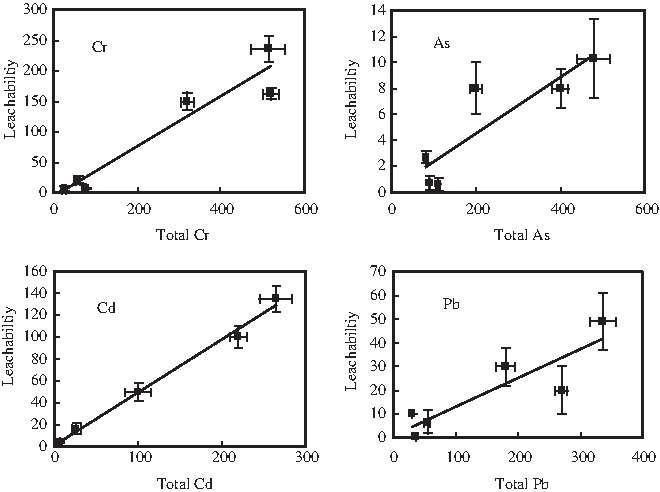
Total amounts and leachabilities of heavy metals in the concrete.
Figure 1 shows that the total amount is higher than the leachability and the ratio of total amount to leachability is related to the heavy metal species. The differences depend on the species of heavy metals present in concrete and their solubility under different pH conditions. In this study, the values of the ratios between the total amounts of heavy metals and their availabilities are all larger than those obtained by van der Sloot (2000). This is due to the fact that in our leachability test the pH of leachant in the second step was 3.2, not 4.0 (van der Sloot, 2000). A strong linear relationship between the total amount and the leachability of Cd was observed in our work, with an R2 value of 0.994. However, the linear relationship was not as good for Cr, As, and Pb, similar to van der Sloot's reports on cement mortar research (van der Sloot, 2000). Although the leachability of Cr, As, and Pb increases with total amount, the relationship is not linear.
Release as a function of pH
Leachate pH is a significant parameter influencing heavy metal leaching behavior (van der Sloot et al., 2001; van der Sloot, 2002). Release of heavy metal in concrete as a function of leachate pH is shown in Fig. 2.

Leaching of heavy metals from concrete as a function of pH.
The amount of Cr leached was relatively large under low or high pH conditions and reached its minimum (about 5.6 μg L−1) when pH = 5.5. The leaching amount stayed at a relatively high level for pH = 7–11 and reached the maximum at pH = 11. This was approximately equal to the amount leached at pH = 2. The valence of Cr and the leachant pH are the key factors that influence the leaching amount (Achternbosch, 2003). Under alkaline conditions, Cr6+ is present in the form of CrO42−, which does not precipitate as hydroxides (Achternbosch, 2003), so dissolution is relatively easy. Cr(OH)3 is an amphoteric compound that can easily be dissolved as Cr(OH)4− over a pH range from 9 to 11 (Achternbosch, 2003). Under strong acid conditions (pH < 3), Cr is dissolved in the form of Cr3+ (Achternbosch, 2003). It has been shown that the leaching amount of CrO42− is very low at high pH conditions, reaches a maximum under neutral and weakly alkaline conditions, and attains its minimum at about pH = 5 (van der Sloot et al., 2004). These results are similar to the leaching curve at pH < 5 in this article, showing that Cr was present in the concrete mainly in the form of Cr6+.
The leaching amount of As was relatively large under low pH conditions, reached a minimum at pH = 5, and then increased with increasing pH. A transition was observed at pH = 9, the leaching amount began to decrease with increasing pH. Concrete is an alkaline medium, and in an alkaline medium, As is present as AsO43− (Achternbosch, 2003). Close to the neutral range, As is adsorbed to the surface of metal oxides, such as the oxides of iron and aluminum (Garrabrants et al., 2004). With decreasing pH, the metal oxides start to dissolve and cause a reduction in the adsorption phase of As and the leaching amount is increased. Under alkaline conditions, adsorption of As by Ca-phase minerals including portlandite and ettringite has been observed (Garrabrants et al., 2004). With increasing pH, more and more calcium hydroxide is formed from Ca and OH, decreasing the leaching amount. Therefore, the leaching behavior of As (+V) was not controlled by precipitation of arsenate species, but rather by adsorption of arsenate to Ca-bearing cement mineral phases (Sanchez et al., 2002).
The leaching amount of Cd reached a minimum at pH = 11 and stayed at a low level (<1 μg L−1) over a pH range of 9–13. In the pH range of 9–11, Cd is present in the form of Cd(OH)2, which hardly dissolves (Achternbosch, 2003). At pH >11, the leaching amount increased rapidly. This phenomenon occurs because Cd(OH)2 dissolves again forming Cd(OH)3− at higher pH (Karlsruhe, 2003). But the leaching amount of Cd decreased with an increasing pH for pH values from 5 to 9, because Cd(OH)2 combined with H+ and generated Cd2+, keeping it invariant when pH was <5, which shows that the leaching amount is affected by the leachability of Cd in concrete.
The leaching curve of Pb is approximately consistent with that of Cd, exhibiting the special amphoteric behavior.
Assessment of dynamic release: release modeling
NEN 7375, a test for the determination of the leaching of inorganic components from molded or monolithic materials using the diffusion test (the tank test), has been used to assess the release of heavy metals in monolithic cement-based materials (van der Sloot, 2002; Petkovic et al., 2004; The Netherlands Normalization Institute Standard, 2005c). With fully diffusion controlled leaching, the slope is exactly 0.5 in each increment and the significance of the slope of the different increments is summarized in Table 4 (The Netherlands Normalization Institute Standard, 2005c). Cumulative release amounts of heavy metals in the concrete and the value of slope of each increment are shown in Fig. 3 and Table 5.

Cumulative release amounts of heavy metals in the concrete (pH 3.2).
The release mechanism of heavy metals in concrete can be assessed from the graph of the leaching (Fig. 3) and the slope of each increment (Table 5). As shown in Fig. 4, diffusion control is the major release mechanism of the Cr and Cd in the concrete. Further, the release curves fit the standard line slope 0.5 very well, and the slopes of the different increments are all between 0.35 and 0.65 (Table 5) (NEN 7375 2004). These results are in accordance with those obtained by van der Sloot (2000).
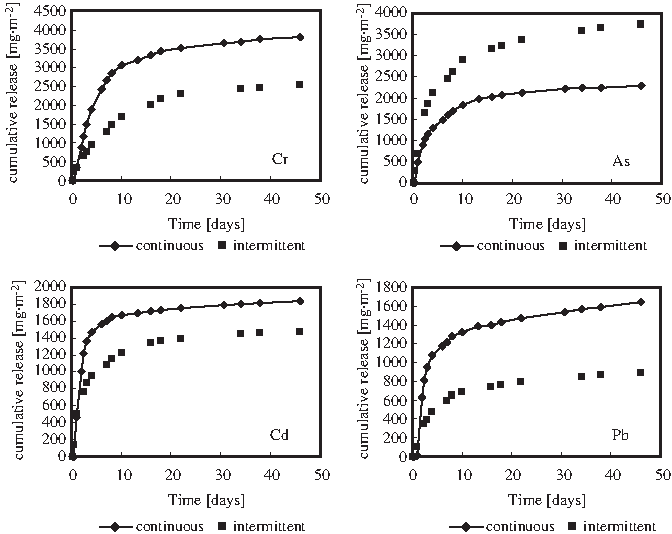
Release of heavy metals under different immersion conditions (pH 3.2).
The derived cumulative leaching in the prophase of As is higher than the standard line (slope defined by rc = 0.5) and the slopes of increment 1–4 are all <0.35, showing that surface wash-off occurred in the prophase of leaching. Apart from the first phase, the release curves of As fit very well the standard line with a slope of 0.5, and in the other phases, the slopes of the increments are all between 0.35 and 0.65 (Table 5), showing that the main release mechanism is diffusion controlled.
Surface wash-off also occurred in the prophase of Pb and the slopes of increment 1–4 are <0.35. In the metaphase, the release curves of Pb fit the standard line with a slope of 0.5 very well and the slopes of increments 2–5, 3–6, and 4–7 are all between 0.35 and 0.65 (Table 3), which indicates that the main release mechanism is diffusion controlled. However, in the anaphase, the release curve is above the line with a slope of 0.5, and the slopes for increment 5–8 is >0.65, which indicates that dissolution has taken place. This phenomenon is caused by the pH range of the leachant. Concrete is a basic material, and OH− is released continuously into the leachant during long-term immersion. This results in a continuously rising pH, which reaches 11.5–12.5 in increment 5–8. Pb is an amphoteric compound and some of its hydroxides can generate soluble Pb(OH)42−; therefore, Pb present as hydroxides is dissolved gradually in the anaphase (Seco et al., 2003).
Effect of intermittent wetting and drying on release
In many fields, concrete is not continuously wetted, but experiences cyclic wetting and drying (i.e., variable relative humidity, atmospheric CO2). During periods of storage in a water unsaturated environment, many processes that change the chemical and physical properties of the material may occur (i.e., carbonation, precipitation, changes in contaminant distribution, oxidation). These processes can influence the release potential and release rates of heavy metals from the concrete. Two processes considered to be important are (1) the relaxation of constituent concentration gradients during storage, and (2) carbonation of the matrix, which results in lowering of the pH within the matrix-pore water and may cause re-speciation of constituents (Sanchez et al., 2002). The release of heavy metals under continuous wetting and intermittent wetting is shown in Fig. 4.
As shown in Fig. 5, in the leaching process, the pH values of leachants were about 7.5 and 6.5 in continuous and intermittent environments, respectively. This shows that the pH of pore water in concrete was decreased by carbonation during the storage process. However, in the pH range 5–10, the leaching amount decreased as the pH decreased. The concentration gradient of Cr was greatly reduced in continuous leaching, which could be reflected in the fact that conductivity of the leachant in continuous wetting is much less than in intermittent wetting (Fig. 6). Consequently, the amount of Cr released under continuous wetting conditions (3.93 mg m−2) was more than that released in the intermittent environment.
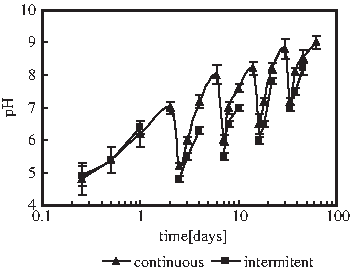
Leachate pH under different immersion conditions.
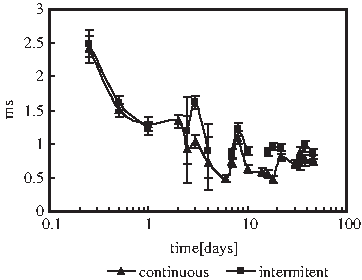
Leachate conductivity under different immersion conditions.
In the pH range 5–10, the leaching amounts of Cd and Pb decreased as the pH increased, but the amount released in continuous wetting was still larger than that released in intermittent wetting. This shows that the influence of the concentration gradient on the release of Cd and Pb is more important than pH.
The effect of intermittent leaching on the release of As was different than for the others. The amount of As released in the intermittent environment (4.06 g m−2) was more than that released in the continuous environment (1.69 mg m−2). The reason for this phenomenon may be that the decalcification of silicate caused by carbonation, which promotes the release of As, is more effective than the repressive effect from the decrease of the concentration gradient during storage.
Conclusions
Leachant pH was one significant factor influencing the release behavior of heavy metals in concrete, and based on the main application scenarios of concrete in china, the leachant pH should be set at 3.2 ± 0.5 in the leaching test.
Leachability is an appropriate indicator for assessing the release potential of heavy metals in concrete.
Diffusion control was the major release mechanism of heavy metals in concrete, although there were some small differences between the elements; so, a release model based on diffusion control could be chosen to predict the amount released over the service life of the concrete.
Intermittent wetting influenced the heavy metal release from the concrete and so this influence should be considered in predicting the amount released over the service life of the concrete.
Footnotes
Acknowledgments
This work was supported by the Projects in the China Science and Technology Pillar Program during the 11th Five-Year Plan Period with No. 2007BAC16B03, and financial support was also received from the Ministry of Environmental Protection of the People's Republic of China.
Author Disclosure Statement
No competing financial interests exist.