




Abstract
Abstract
Numerous commercial products incorporate novel engineered nanomaterials such as gold, silica, zinc oxide, and fullerenes in complex matrices such as polymer composites, creams, and textiles. Analytical methods for detecting nanomaterials in complex matrices are not well developed. Moreover, nanomaterial content and properties of these commercial products are typically unknown and protected for proprietary reasons. This study had two primary aims: detection of C60 within commercial face creams to establish a baseline concentration in these products (the first time this has been performed) and detection of residual C60 reactivity remaining in the products aged in water under various light conditions with a view toward environmental exposure assessment. To achieve these aims, three commercial creams advertised as containing the fullerene nanomaterials were investigated using a range of analytical techniques. Among the detection methods tested, only extraction followed by high-performance liquid chromatography was able to detect fullerenes in these products. The measured quantities of C60 in these creams represented <0.005% (w/w) with an unknown yield because total amounts added to the creams were unknown. Production of reactive oxygen species from these face creams was measured after aging them in water as well as exposing them to solar spectrum illumination or ultraviolet light, or storage in the dark. Singlet oxygen generated in the products after 48 h of aging was correlated with the amounts of C60 extracted from preaged samples, indicating residual photochemical reactivity and pointing toward the long-term impacts of utilizing these materials in commercial products.
Introduction
Early reports of fullerene toxicity to both bacterial (Fortner et al., 2005; Lyon et al., 2006, 2008; Fang et al., 2007; Chae et al., 2009b) and human cell cultures (Xia et al., 2006; Roberts et al., 2008) use methodologies and organism specificities that as of now do not produce a universal indication of what may be the wide-ranging impacts of these materials. However, Lyon et al. (2008) have recently put forth a more general toxicity hypothesis pointing to the electron affinity of C60 altering the electron transport chain at the surface of the cell wall in bacteria and therefore disrupting normal cell respiration and eventually leading to death. Interestingly, this electron affinity of C60 or “radical sponge fullerene” is the same property that led to incorporating it into antiaging commercial cream products.
In addition to toxicity effects in the absence of light, fullerene derivatives and fullerenes can be photoactivated in aqueous environments to produce ROS such as superoxide (O2•−) and singlet oxygen (1O2) via type I and type II photosensitization pathways given appropriate suspension conditions (Pickering and Wiesner, 2005; Hotze et al., 2008). Photosensitized production of ROS does not appear to be associated with bacterial inactivation (Lyon et al., 2008). ROS generation by fullerene derivatives, however, has been shown to impact bacteriophages by inactivating them at much higher rates than those found for irradiation alone (Badireddy et al., 2007). As these creams are of proprietary composition, information on the C60 content is largely lacking and must be surmised from measurements of the total amount of detectable fullerene present in the products. Measurements of ROS generation by dispersed creams might also provide information on C60 content, although interferences with other materials present in the creams (e.g., antioxidants or surfactants) and the aggregation state of C60 may reduce ROS generation and therefore conceal or obscure the presence of C60. Finally, changes in C60 properties over time due to aging of the material might also affect ROS generation, transport properties, and impacts on organisms.
This study has two primary aims: detection of fullerene within commercial face creams to establish for the first time a baseline concentration in these products and to quantify residual fullerene reactivity remaining in the products aged in water under various conditions of illumination. Both of these aims were performed with a broader view toward the environmental exposure assessment of the use of nanomaterials in commercial products. Quantitative measurements of fullerene in commercial products and various environmental samples are not fully developed even though some previous studies have reported measurement of C60 in biological and geological samples (Moussa et al., 1997; Jehlicka et al., 2005; Isaacson et al., 2009), as well as aqueous matrices (Bouchard and Ma, 2008; Chen et al., 2008). Extraction of C60 essentially involves organic solvent (e.g., toluene) followed by chromatographic separation and appropriate detection method. Of the detection methods attempted, mass spectrometry achieves the lowest detection limit, but with the highest costs and lowest operating efficiency. Alternatively, ultraviolet (UV) spectroscopy offers a cheaper and more efficient alternative with an acceptable detection limit (Bouchard and Ma, 2008; Chen et al., 2008). In this study, four methods were evaluated for detecting C60 in these products: Fourier transform infrared spectroscopy (FTIR), scanning electron microscopy with energy-dispersive X-ray spectroscopy (SEM-EDX), carbon-13 NMR (13C NMR), and high-performance liquid chromatography (HPLC). We observed that only the method of extraction into toluene followed by HPLC was able to detect what appear to be extremely small amounts of C60 present in the creams. Creams were then aged in water under solar spectrum irradiation, UV-A irradiation, and dark conditions, each resulting in three separate layers of aged product. This was followed by ROS detection of superoxide by XTT [2,3-bis(2-methoxy-4-nitro-5-sulfophenyl)-2H-tetrazolium-5-carboxanilide; reduction followed by spectrophotometric detection] or detection of singlet oxygen by Singlet Oxygen Sensor Green (SOSG; reaction followed by fluorescence detection) in UV-A irradiated samples of the aged products.
Experimental Protocols
Chemicals and products
Three commercial face creams were purchased and labeled as products A, B, and C (see Table 1 for detailed information). C60 (99.9% pure) and hydroxylated C60 [fullerol, C60(OH)24] were purchased from MER (Tucson, AZ). Superoxide dismutase (SOD) (bovine ethrocytes), β-carotene, and XTT were obtained from Sigma-Aldrich (St. Louis, MO). SOSG was purchased from Molecular Probes–Invitrogen (Carlsbad, CA). Double deionized (DI) water had resistivity of >18.2 MΩ cm and dissolved organic carbon concentration was <10 μg/L.
EDTA, ethylenediaminetetraacetic acid; SOD, superoxide dismutase; PEG, polyethylene glycol; TIMP, tissue inhibitors of metalloproteinases; BH, butylated hydroxytoluene.
Characterization of C60 in face creams
Samples were analyzed directly by FTIR, SEM-EDX, and 13C NMR without any aging processes being applied. FTIR was performed with an Equinox 55 Bruker spectrometer. Emitted light spectra were recorded in the midinfrared spectra in the range 2,100–400 cm−1 at a resolution of 4 cm−1 with 32 scans per spectrum. All scans were made by dehydrating ∼1 mg of each cream at 60°C overnight and homogenizing the resulting oil with 30 mg crushed KBr, which was pelleted before analysis. SEM imagery coupled with X-ray analysis provided information on the elemental composition of the three products. 13C NMR was performed with an Avance 400 WB Bruker spectrometer. Spectra were obtained with high-resolution magic angle spinning (1 kHz) and 1H decoupling. A pulse at 100.7 MHz (13C) was applied at 30°. The acquisition time was 270 ms, with a 2 s recycling time between acquisitions and a total of 80,000 scans.
The ability to extract fullerene aggregates from an aqueous matrix to toluene was then evaluated. About 3 g of each product was placed in a glass vial containing 10 mL DI water with 20 mM KCl before the addition of 20 mL of toluene. Preliminary experiments optimized the concentration of KCl and volume ratio between water and toluene (data not shown). Then, the vial was vertically mixed overnight and the supernatant containing fullerene was further analyzed using an HPLC. For quantitative analysis of fullerene, a standard curve was developed using known concentrations of C60 in toluene. From the HPLC analysis, it was found that fullerene in toluene has two distinguishing peaks at 285 and 334 nm, with a retention time of 7.7 min. A linear relationship between concentrations of fullerene in toluene and absorbance at 285 nm (peak area) was observed over the concentration range from 15 ppb to 15 ppm (data not shown). Lastly, quantitative analysis of fullerene was performed using an HPLC (ProStar, Varian, Palo Alto, CA) equipped with a Cosmosil Buckyprep column (Nacalai USA, San Diego, CA). The chromatographic separation was performed in isocratic mode at a constant flow rate of 1 mL/min with a mobile phase of 100% toluene at 285 nm UV wavelength. Comparison of resulting spectra to the calibration curve allowed for the fullerene concentration to be determined by peak area. To evaluate recovery rate, different amounts of fullerene were spiked into product B and tested by the protocol described.
Aging process
Cream samples stored in their original containers are referred to in this study as “unaged” creams. Aging of the three face creams was performed by addition of 3 mg of unaged cream into 50 mL of ultrapure water and stirring for 48 h. Three illumination conditions were tested for each of the three creams: covered (dark); UV-A lamps (365 nm); and a lamp meant to mimic the solar spectrum. Low-pressure UV-A irradiation was done in the presence of two 15-W fluorescent UV bulbs (Philips TLD 15 W/08). These bulbs have an output spectrum peak at 365 nm (ranging from 354 to 396 nm) and a total irradiance of 24.1 W/m2 (Pickering and Wiesner, 2005). The solar spectrum irradiation was done in the presence of one 400-W lamp (Philips Mater HPI-T Plus 400 W/645 E40 SLV). This bulb had an output spectrum ranging from 300 to 900 nm, with a total irradiance of 72.19 W/m2. Aged cream was separated into three distinct layers. The top layer of the aged sample was nonaqueous, could be separated easily, and is referred to as the surface layer. Aqueous aged material remaining below the top layer was further separated by centrifugation at 10,000 rpm for 1 h. The resultant supernatant (stable layer) remaining in suspension was analyzed separately from the resuspended, centrifuged pellet.
Detection of ROS in face creams
SOSG was used to measure 1O2 concentrations (Flors et al., 2006) in irradiated aged samples of three fullerene cosmetic products. SOSG was first prediluted in 33 μL methanol and ultrapure water to 165 μM as recommended by the manufacturer and then diluted 10-fold to a final concentration of 16.5 μM before measurement. Suspensions were placed in a 25-mL Petri dish with ∼20 cm2 surface area. Samples of 1 mL were taken at every 5 min for 30 min in the dark. The fluorescence units (a.u.) from this dark measurement were read as a background (Modulus Single Tube 9200; Turner Biosystems, Sunnyvale, CA) and subtracted from readings taken at every 5 min for 30 min once UV-A lamps were switched on (Philips TLD 15 W/08). Fluorescence intensity could then be correlated with relative production of singlet oxygen by unaged and aged cream products.
XTT reduction was employed to measure the production of superoxide. The reduction of XTT results in an increase in optical density at 470 nm, which can be used to quantify the relative amount of superoxide present (Ukeda et al., 1997; Bartosz, 2006). The concentration of superoxide was determined by comparing XTT reduction with and without a quencher for superoxide, SOD, which allowed nonsuperoxide-related XTT reactions to be accounted for. SOD-containing samples served to eliminate the influence of background absorbance of suspensions at 470 nm. Optical density could then be correlated with relative production of superoxide by unaged and aged cream products. Here, we compare photochemical reactivity of the cosmetic products with those of fullerol, which is a well-known ROS generator (Pickering and Wiesner, 2005). Fullerol suspension (a positive control) was prepared by adding the powdered form of these materials to the DI water (Chae et al., 2009a). The ideal negative control for ROS (identical composition minus the C60) was not available because of the proprietary nature of the creams. All experiments were performed in triplicate and standard deviations are included. Student's t-test was used to assess the significance of the results with a 95% confidence interval.
Results and Discussion
SEM-EDX, FTIR, and 13C NMR measurements
SEM technique coupled with element analysis (EDX) provided general information about carbon and particle content for the unmodified products. From this analysis, it was found that carbon compounds were indeed present with other elemental spectra (data not shown). But, this information (along with SEM images) is limited because it is difficult to distinguish nano-based carbon material from other forms found in cream ingredients. We subsequently explored the use FTIR and 13C NMR techniques as a basis for detecting the presence of C60 in these cosmetics.
All three products were analyzed by FTIR following partial dehydration. However, even after the dehydration step, samples contained at least 50% water by volume. FTIR spectra for all three products did not include the major bands (1,426–1,429 and 1,179–1,181 cm−1) attributed to the icosahedral symmetry of the C60 molecule (Treubig and Brown, 2002) (data not shown). However, these measurements do not rule out the possibility that C60 molecules were present at lower concentrations as the C60 may have been obscured by the presence of other molecules (e.g., molecules containing C=C bonds absorbing near 1,460 cm−1) in the cream matrix. 13C NMR with 1H decoupling was also performed with the goal of obtaining a qualitative picture of fullerenes present relative to other carbon molecules in the cream matrix of product A. Significant amounts of carbon from fullerene present in the sample would be indicated by the appearance of a distinct single peak around 143 ppm (Yannoni et al., 1991; Fortner et al., 2005). But, in the case of product A, no such peak could be differentiated from the background of the spectrum (data not shown). Because of the inability to distinguish C60 from other carbon-based molecules by 13C NMR, SEM-EDX, or FTIR in the cream matrix of product A, subsequent characterization of products A, B, and C was limited to extraction and HPLC analysis of C60 in these creams.
Quantitative analysis of C60 in face creams by HPLC
For the quantitative analysis of C60 by HPLC, different amounts of pure fullerene were spiked into product B by the protocol described and recovery rate was evaluated. As shown in Table 2, when 20 mg of C60 was spiked into 2 g of the product (1%, w/w), 86% of recovery rate was achieved (run 1). In run 2, the recovery rate slightly decreased to 82% when 2 mg of C60 was spiked into 20 g of the product (0.01%, w/w) and the detected C60 concentration (8.2 mg/L) of the spiked sample by HPLC was close to detected C60 concentrations (2.6–6.8 mg/L) in the products (Table 3). However, these recovery rates were slightly lower than that from the DI water without product B (in this case, about 90% of the spiked fullerene was recovered by the first extraction). This 8% loss in recovery rates was probably due to amphiphilic organic macromolecules such as stearic acid in the face cream acting as a de facto surfactant and stabilizing fullerenes in water, thereby decreasing the extraction efficiency from water to toluene. However, the recovery rate increased to above 95% with a second toluene extraction with fresh solvent. Finally, small quantities of fullerene were detected at levels of <0.005% (w/w) in all products by HPLC with the described protocol.
Originally, product B contains fullerene (2.6 mg/L; see Table 3). When recovery rate was calculated, the background fullerene concentration in product B was subtracted from the detected amount in the fourth column in this table.
HPLC, high-performance liquid chromatography.
ROS production of unaged and aged cream products
XTT formazan adsorption was monitored under UV light to study superoxide production from the three unaged parts (i.e., surface layer, stable, and centrifuged pellet) of each face cream (three samples in triplicate). Superoxide production from unaged samples is summarized in Fig. 1A. The XTT formazan production rate, indicating superoxide production, was slightly higher in samples from surface and stable layers compared with that observed for samples from centrifuged pellets. When 5 mg/L of fullerol was added to the unaged samples (preseparation), no additional superoxide generation was observed (Fig. 1B).
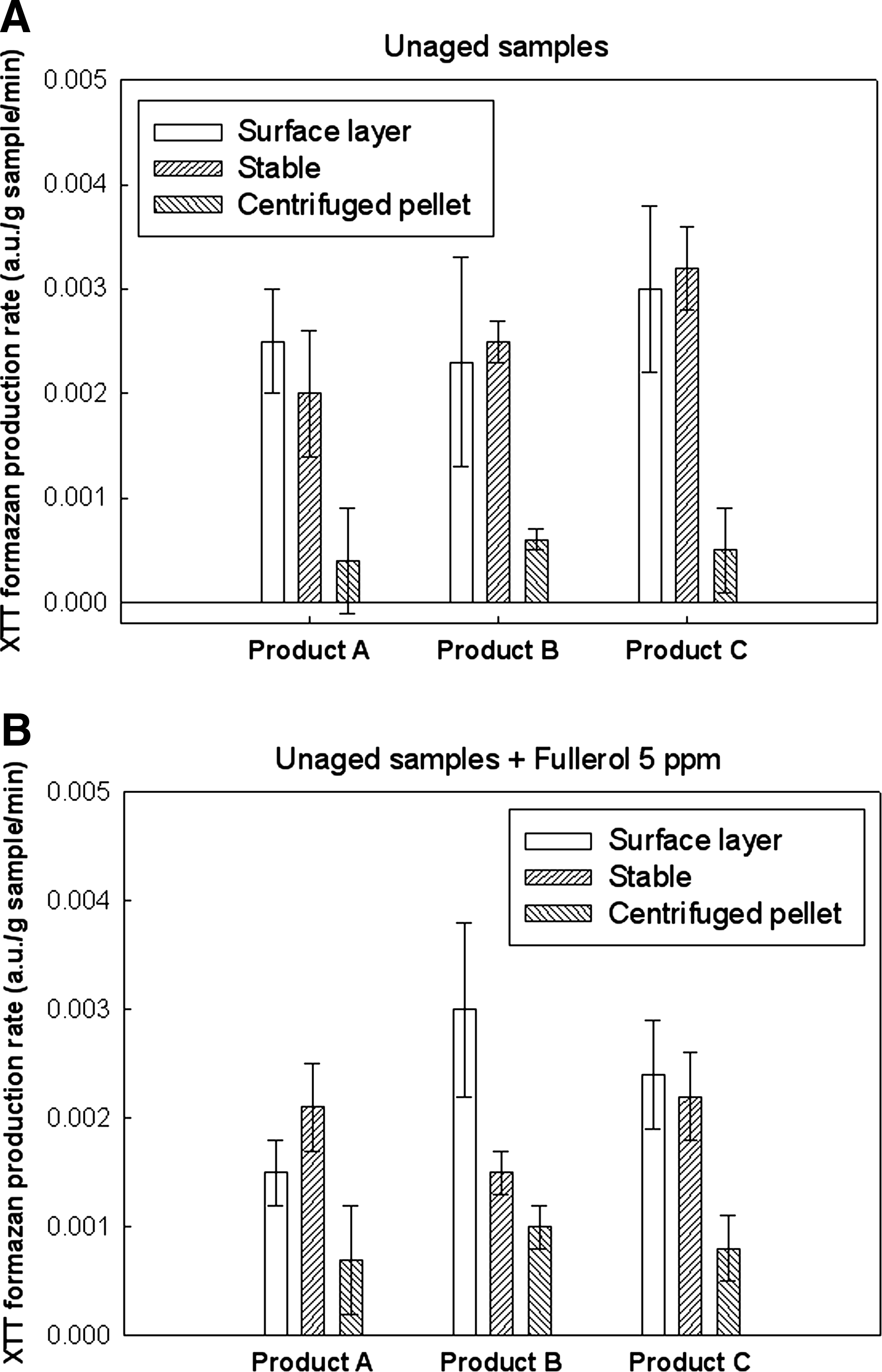
Superoxide generation of unaged face creams (
Aged creams were tested after three different aging processes (i.e., in the dark, or with solar spectrum or UV-A) followed by separation (nine samples in triplicate). As shown in Fig. 2, the superoxide generation of all aged samples is negligible, indicating there was no measurable generation of superoxide. In the presence of oxygen and light, fullerene produces singlet oxygen via a type II pathway and may also produce the superoxide radical via a type I pathway if an appropriate electron donor is present (Hotze et al., 2008). Therefore, we conclude that solution conditions in the cream samples are not appropriate for the generation of superoxide (i.e., no reducing agent is present to enable the transfer of an electron to oxygen).
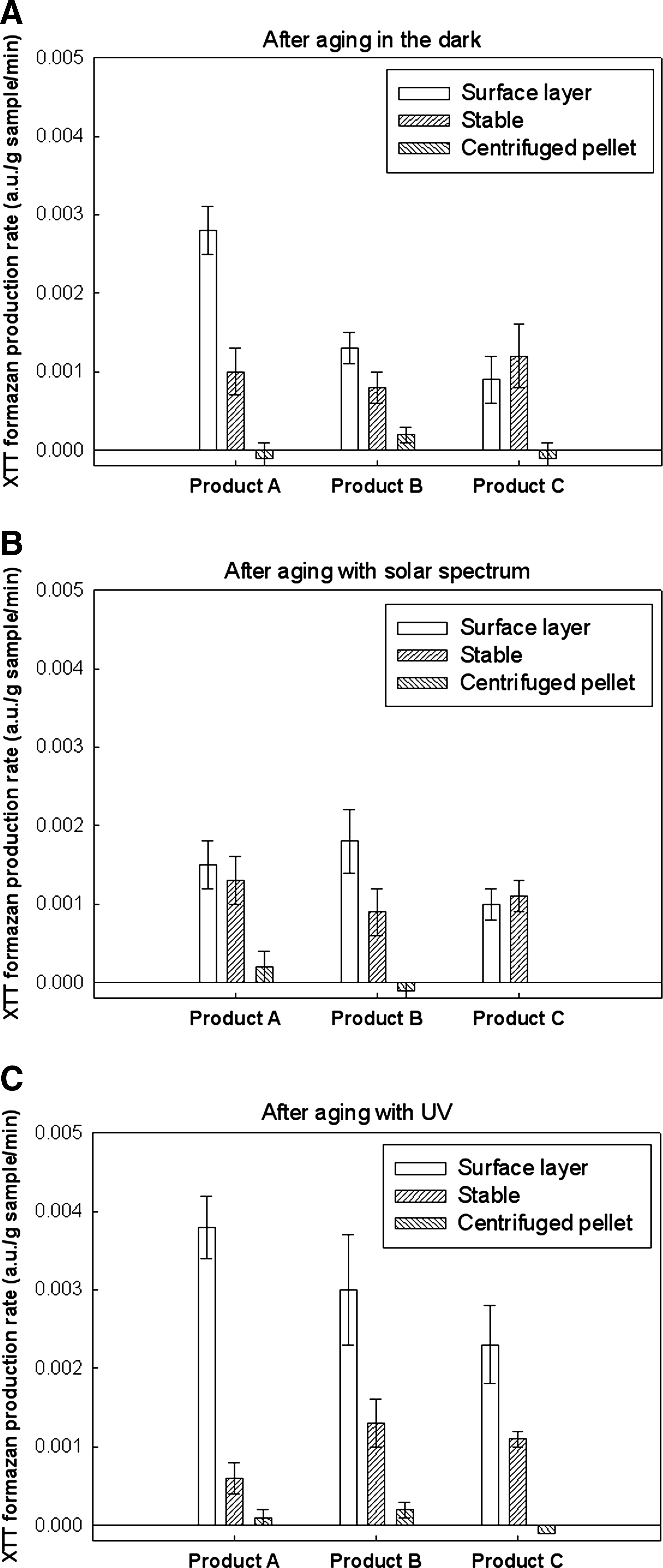
Superoxide generation of aged face creams in the dark (
On the other hand, Fig. 3A shows that SOSG detects significant production of singlet oxygen from unaged face creams. Adding 5 mg/L of fullerol, the singlet oxygen production rate increased by about 50–70 a.u./g sample/min in all parts (Fig. 3B). As shown in Fig. 4, aging of the three products (especially, “surface layer” part) with UV-A resulted in the highest singlet oxygen generation (124–308 a.u./g sample/min), followed by aging with solar spectrum (33–135 a.u./g sample/min) and in the dark (23–106 a.u./g sample/min). Generally, product A (average = 142.2 a.u./g sample/min) showed the highest amount of singlet oxygen production, whereas products B (average = 66.2 a.u./g sample/min, p < 0.005 when compared with product A) and C (average = 53.8 a.u./g sample/min, p < 0.005 when compared with product A) appeared to generate smaller and comparable amounts of singlet oxygen. Figure 3B demonstrates that adding a known amount of fullerol, a known 1O2 producer (Pickering and Wiesner, 2005; Hotze et al., 2008; Chae et al., 2009a), to the unaged cream product results in lower generation rates than the aged product A in Fig. 4.
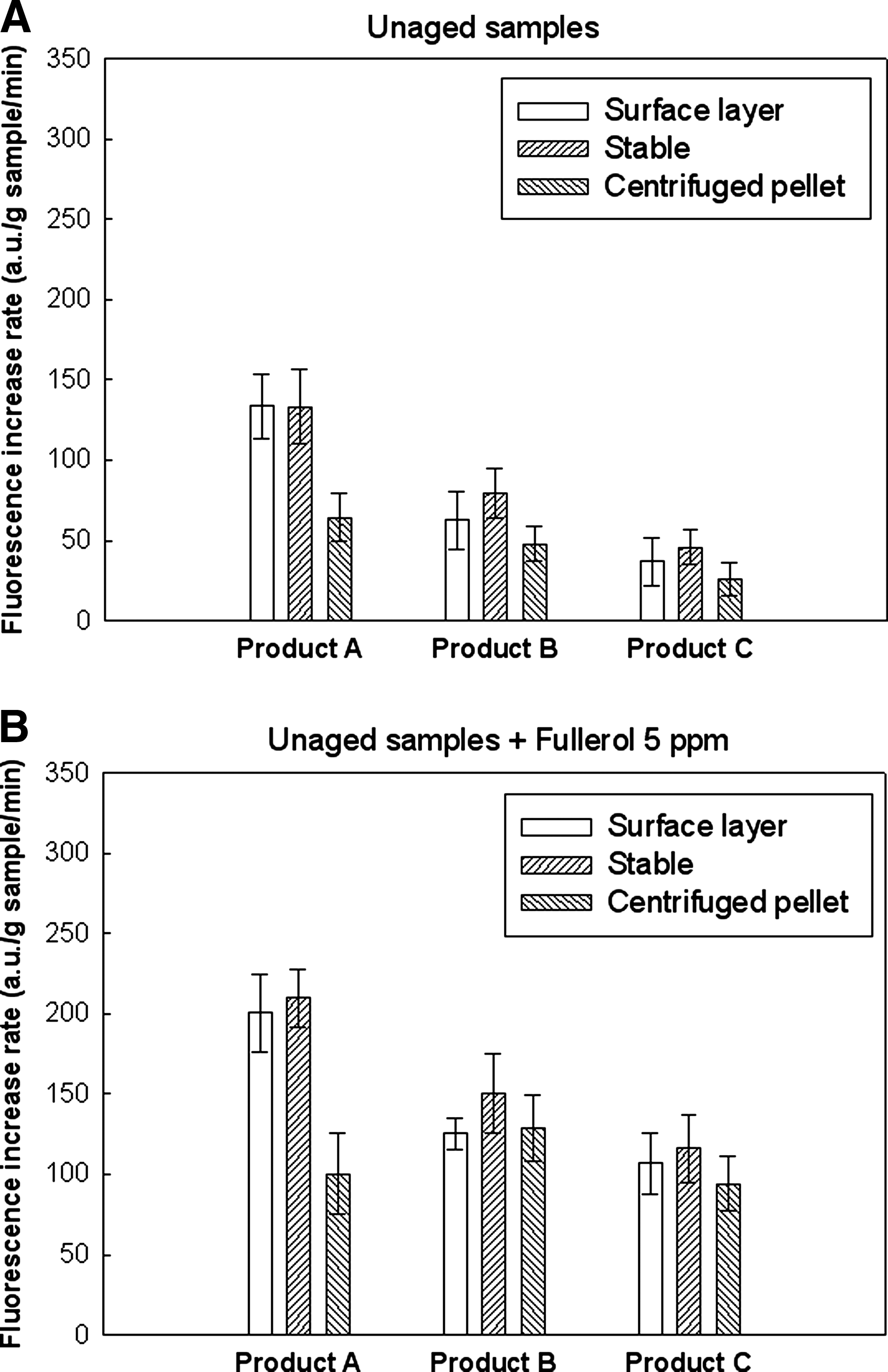
Singlet oxygen production of unaged face creams (
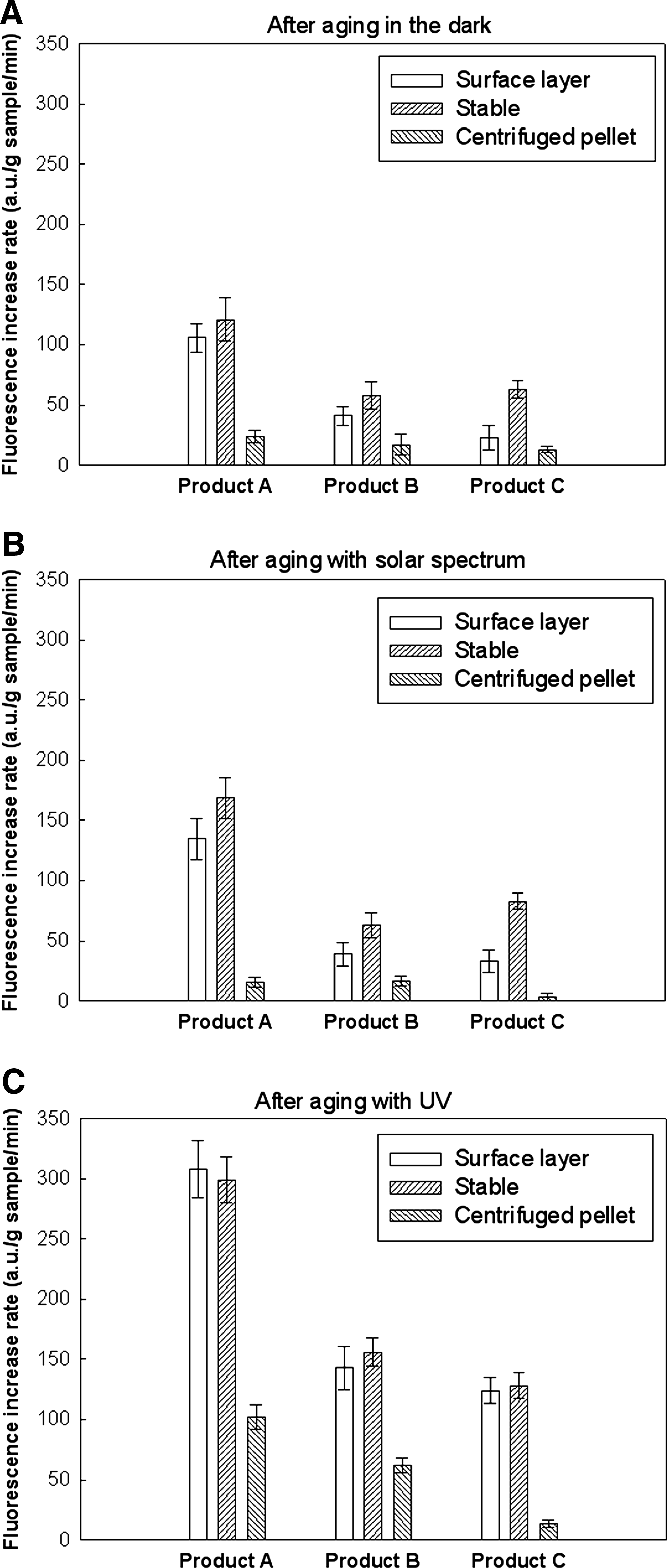
Singlet oxygen production of aged face creams in the dark (
We postulate that the breakdown of other molecules contained within these cosmetics, either typical of cosmetics (e.g., thickeners, emulsifiers, and plasticizers) or more likely antioxidants (e.g., green tea extract, SOD, and others), during the aging process allows for increase of singlet oxygen production detected by the SOSG. This hypothesis would also explain why the unaged creams show less singlet oxygen production (Fig. 3A) than the aged samples (Fig. 4). Alternatively, the breakdown of these products could lead to photoactive molecules not present in the unaged samples (Roscher et al., 1994; Huong et al., 2008).
From Fig. 4, we determined that the highest generation rate of singlet oxygen (a.u./g sample/min) from product A (surface layer or stable part) is 0.03% of that generated by fullerol (Fig. 5). The cream type and aging conditions altered the amount of singlet oxygen produced by the creams and was significantly above levels produced by control samples. Moreover, the surface layer and stable suspension displayed similar levels of singlet oxygen generation, whereas the centrifuged pellet part had the lowest production of singlet oxygen regardless of aging processes or product tested. The presence of amphiphilic molecules such as stearic acid may act as de facto surfactants, keeping fullerene molecules suspended in water. This result implies that the parts of the aged cream with the highest potential for ROS generation also have the highest colloidal stability. Another possible but admittedly tenuous observation is that product A contains approximately twice the amount of C60 than product B or C (Table 3) and produces approximately twice the singlet oxygen when aged under UV light (Fig. 4).
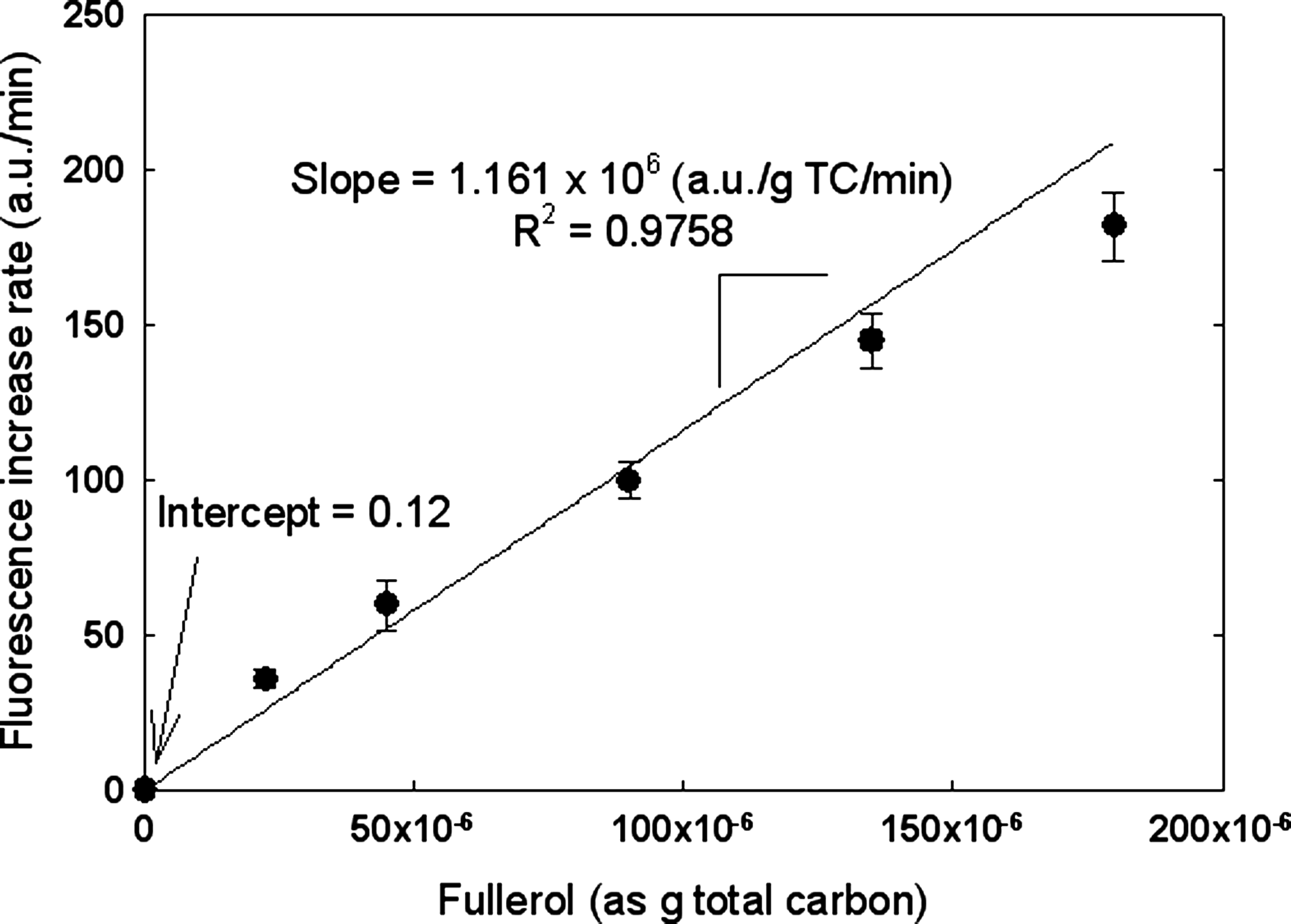
Singlet oxygen production of fullerol in deionized water.
Conclusions
From SEM-EDX, FTIR, and 13C NMR analyses, it was found that the quantity of fullerene in face creams was undetectably low for these analytical instruments and methodologies. In the case of SEM-EDX, fullerene peaks could not be separated from other organic ingredients in a carbon spectrum. For FTIR and 13C NMR, fullerene peaks were not distinct because they were either below detection limits of the instruments or obscured by the presence of other molecules. Extraction by toluene followed by HPLC analysis, however, detected small quantities of fullerene at levels of <0.005% (w/w). And we observed that ROS production of a cosmetic product (product A) containing fullerene is only 0.03% of that generated by fullerol nanoparticles.
Nanoengineered materials are likely to find numerous applications in commercial products because of their novel properties. Fullerene C60, added in creams as an antiaging and antioxidant agent, is one example. The unknown and untested possibility of direct effects of the fullerene materials on consumers remains an outstanding issue. But, unintended effects on the environment could result from the electron affinity and photochemistry of the molecule if it remains reactive over time in the aqueous environment. Detection of a significant amount of singlet oxygen production in the aged cream products raises several issues about the use of fullerene materials. Although radical scavenging may occur in the dark, it would appear that photochemically generated ROS would produce the opposite effect of that intended by adding fullerenes to these creams. We also conclude that the portions of the aged cream with the most transport potential (those remaining in the surface layer and stable suspension) are also the most photochemically active fractions. When cream byproducts are discharged into wastewater streams and ultimately water environments, higher mobility could lead to significant impacts of residual chemically active fullerenes. However, our ability to manipulate and fully exploit the direct relationship between fullerenes present in the products and ROS generation is limited. Further investigation of ROS generation by these and other aged products will improve our understanding of how their degradation will impact the environment.
Footnotes
Acknowledgments
This material is based upon work supported by the National Science Foundation (NSF) and the Environmental Protection Agency (EPA) under NSF Cooperative Agreement EF-0830093, Center for the Environmental Implications of NanoTechnology. The authors thank Dr. Hiroshi Yamamura at Hokkaido University and Armand Masion at CEREGE, Aix-Marseille University for help with SEM-EDX and 13C NMR analysis, respectively. Additionally, the authors acknowledge support from Dr. Fabio Ziarelli and the Spectropole, the Analytical Facility of Aix-Marseille University, by allowing special access to the instruments purchased with European funding (FEDER OBJ2142-3341).
Author Disclosure Statement
No competing financial interests exist. Any opinions, findings, conclusions, or recommendations expressed in this article are those of the authors and do not necessarily reflect the views of the NSF or the EPA. This work has not been subjected to EPA review and no official endorsement should be inferred.