




Abstract
Abstract
Road dust is a major source for airborne particulate matter (PM). It is an agglomerate of deposited particles from vehicle exhaust, tire wear, break-lining wear, road surface and litter abrasions, local soil dust, vegetative detritus, and atmospheric fallout from many sources. Consequently, road dust is a mixture of coarse PM (road surface abrasions, soil dust, tire wear, and brake-lining wear) and fine PM (vehicular exhaust and portions of most sources of coarse PM). Although most studies concerned with road dust report the inorganic composition, only a few focus on organic constituents. Here, as part of the San Joaquin Valley Fugitive Dust Characterization Study, road dust samples from paved and unpaved urban and rural roads have been analyzed for close to 200 individual organic compounds, including n-alkanes, n-alkanoic and alkenoic acids, n-alkanols, n-alkanals, n-alkan-2-ones, alkylcyclohexanes, steroids, steranes, hopanes, triterpenoids, isoprenoids, benzothiazoles, polycyclic aromatic hydrocarbons, saccharides, pesticides, plasticizers, and diphenylamines. Organic compounds indicative of both higher plant detritus and traffic-related emissions (exhaust plus tire wear) are highest in paved road dust, suggesting that the grinding of plant detritus by vehicle tires on the hard paved surface liberate natural lipids and other natural occurring compounds that then admix with the road dust and can become airborne. Fossil fuel combustion markers such as hopanes and polycyclic aromatic hydrocarbons are highest for most paved roads and farming staging areas and lowest for unpaved roads. The highest level of vehicular exhaust organics associated with road dust was found in rural paved road dust. Rural roads compared with urban roads are typically not swept and have lower traffic density and as a result lower traffic induced resuspension. Consequently, vehicular exhaust deposited onto paved roads is more likely to accumulate on rural roads than on urban roads.
Introduction
In the San Joaquin Valley (SJV), California, fugitive dust is a major contributor to PM10 and a significant PM2.5 component, mainly during the summer and fall seasons (Chow et al., 1992, 1993). Fugitive dust emissions are intermittent and highly variable, and in SJV it is believed to originate from paved and unpaved roads, parking lots, agricultural fields (preparation, cultivation, harvesting, staging area for farm equipment, and crop transfer), wind erosion of fallow land, and construction of buildings and roadways (Chow et al., 2003; Padgett et al., 2008). The central California Fugitive Dust Characterization Study (FDCS, Ashbaugh et al., 2003) was undertaken to determine the extent that enhanced chemical characterization might improve the discrimination of fugitive dust subtypes from each other. Thus, a series of soil and dust samples from the SJV was provided by the FDCS for organic compound analyses; see also Rogge et al. (2006, 2007).
The amounts of road dust emitted to the atmosphere depend on many factors, including daily frequency and speeds of vehicles, traffic density, types and conditions of road surfaces, as well as wind and weather (Rogge et al., 1993c; Claiborn et al., 1995; Hussein et al., 2008). Since human activity happens around and on roads, both coarse and fine road dust is of concern for human health. People travel on roads where dust is constantly mixed into the atmosphere by turbulent shear flow induced by the moving vehicles and prevailing winds. Likewise, people live in homes and work in offices or industrial buildings that typically line the sides of roads. Consequently, exposure to road dust can be substantial even when not in transit on roads. Since outdoor air infiltrates through open windows and cracks in buildings, indoor exposure to road dust is also important and is visible as dust deposits on indoor surfaces (Chuang et al., 1995; Thatcher and Layton, 1995; Mukerjee et al., 1997). Consequently, exposure to road dust can be substantial even when not in transit on roads. Further, road dust becomes a critical pollutant for aquatic life when rainstorms wash the road surfaces and transport accumulated road dust into gutters and eventually to rivers and lakes (Ross and Oros, 2004). To achieve mass closure in source-receptor apportionment, source profiles from all major sources are necessary. Although source-specific compounds facilitate source-receptor modeling greatly and reduce the chance for colinearity among source profiles, they are not a prerequisite but preferred. Since road dust is a mix of many sources, careful selection of organic and inorganic compounds of road dust source profiles will greatly reduce the uncertainty of contributions for all sources to a respective ambient site of interest. Here, the organic compositions of paved (urban and rural) and unpaved (public and agricultural) roads taken from the FDCS will be described in detail, so that their organic compounds source profiles may contribute for source evaluation of road dust resuspension into the atmosphere in the SJV region.
Experimental Methods
Soil samples
The road dust was collected from each road by Ashbaugh and coworkers (2003) as part of the FDCS. Samples from unpaved roads were obtained by sweeping loose surface material into a dustpan, and paved road samples were collected by vacuum sweeping. Further, dust samples from a staging area and construction sites were also available. A staging area is a designated area for farm equipment to gather, for example, before and after fieldwork and for loading crops during harvest. Surface soil samples from two construction sites were also collected that had been earlier impacted by dozers and other earth moving equipment; for more details, see Ashbaugh et al. (2003). Although portions of these samples were size-segregated using a resuspension chamber (Ashbaugh et al., 2003) into PM10 and PM2.5, only the total road dust samples were available to us for analysis. The samples were shipped frozen overnight to our FIU laboratory (Miami, FL), where they were stored on arrival in a freezer at <−21°C. To obtain representative results, samples of 5 g dust each were prepared for extraction. The sample codes, descriptions, and locations are given in Table 1.
Source: Ashbaugh et al. (2003).
Extraction and instrumental analysis
The sample extraction method applied here is identical to that used to extract surface dust samples collected at feedlots and dairies as part of the SJV FDCS; therefore, for a detailed description of extraction and instrumental analysis using gas chromatography–mass spectrometry (GC-MS), the reader is referred to Rogge and coworkers (2006).
Compound identification and quantification
Data were acquired and processed with the HP-Chemstation software. Individual compounds were identified by comparison of mass spectra with literature and library data, comparison of mass spectra and GC retention times with those authentic standards and/or interpretation of mass spectrometric fragmentation patterns, see Rogge et al. (2006). Relative response factors (RRF) were determined using 1-phenyldodecane as injection standard. Identifiable compounds were quantified using the MS-data system. Ion counts were converted to compound mass using the area counts of the internal recovery standards (five deuterated standards added to the samples before extraction, including three perdeuterated n-alkanes (C20D42, C23D50, and C30D62) and two perdeuterated n-alkanoic acids (n-decanoic-D19 acid, n-tetradecanoic-D27 acid). Measurement uncertainty was determined using replicate solvent extractions, GC-MS analyses and the standard deviation of each of the RRFs obtained for authentic standards, replicate sample analysis, and error propagation. For compounds for which no authentic standards were available, the RRFs and measurement uncertainties were assumed to be identical to those of available standard compounds with similar chemical structures, polarities, and molecular weights; see footnote to Table 2.
All concentrations reported as ng g−1. FDPVR#, FDUPR#, FDSTA1, and FDCON1-2 denote Sample IDs.
Compounds were identified via authentic standard verification and quantification unless otherwise indicated. * denotes compounds identified via MS-spectrum verification and quantified using authentic standard with similar structure, polarity, and volatility.
Error estimated through error propagation considering error related to response factor, replicate sample analyses, recovery.
Averaged values plus standard deviation of FDUPR1, FDUPR2, FDUPR3.
Averaged values plus standard deviation of FDUPR4, FDUPR5, FDUPR6.
Only FDUPR5-6 considered for n-alkylcyclohexanes.
Averaged values plus standard deviation of FDCON1, FDCON2.
Only FDCON2 considered for n-alkan-2-ones.
CPI: n-alkanes=ΣC23-C33/ΣC22-C32; n-alkanoic acids=ΣC24-C34/ΣC23-C33; n-alkanols and n-alkanals=ΣC22-C32/ΣC21-C31; n-alkanones=ΣC23-C35/ΣC22-C34.
UCM is estimated by integrating the area under the hump minus all individual peaks. nd, not detected; UCM, unresolved complex mixture.
Results and Discussion
The concentrations of the organic compounds in the extracts of the dust samples from paved (urban and rural) and unpaved (agricultural and public) roads are given in Table 2. Examples of representative GC-MS data are shown in Figs. 1–3.
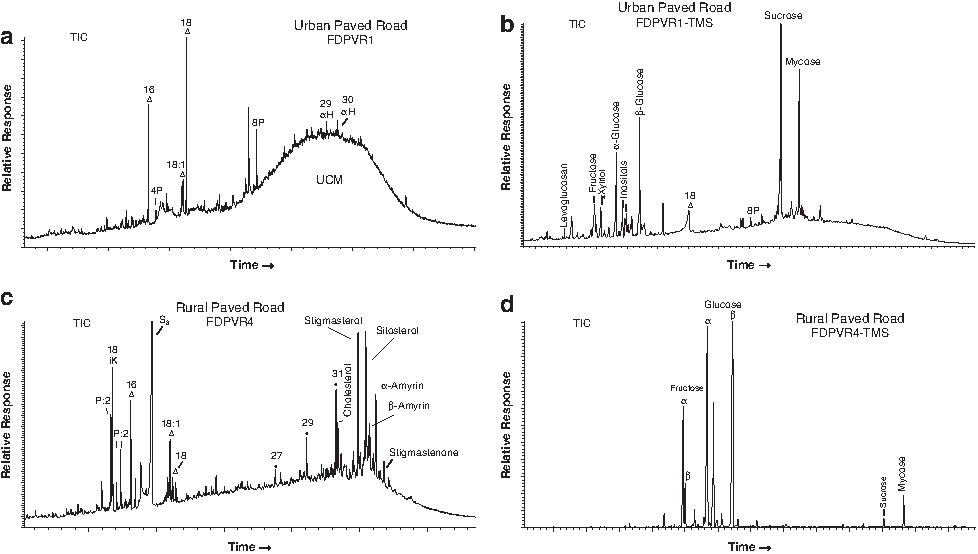
Annotated GC-MS total ion current (TIC) tracers for solvent soluble organic matter of road dusts:

Salient features of the GC-MS data for the total extract of unpaved agricultural road dusts:

Annotated GC-MS data for the total extracts of dusts from unpaved roads and staging area:
Aliphatic lipids
n-Alkanes found in dust samples from paved roads in urban and rural areas showed distributions that are indicative of a mixture derived from biogenic (natural) and fossil fuel sources, with the higher plant contributions less dominant in urban areas (see CPI values, Table 2). Similarly, dust samples from agricultural and public unpaved roads had n-alkane distributions originating from fossil fuel products (C14–C26) and biogenically derived n-alkanes (C25–C35) with odd-carbon number predominance, peaking at C31. Further, tire-wear abrasion with its distinct higher molecular weight n-alkane levels of up to C40 and higher (Rogge et al., 1993c) is especially pronounced in road dust collected from an urban paved road (FDPVR1), which revealed overall highest concentrations, followed closely by the other rural paved road dust samples; see Fig. 4a. Not surprising, urban paved road dust (FDPVR1) extracts revealed a large unresolved complex mixture (UCM) of branched and cyclic hydrocarbons (Table 2, Figs. 1a and 3a), a typical indicator for fossil fuel-derived inputs (Simoneit, 1982, 1985; Rogge et al., 1993b). The soil samples analyzed for the staging area showed an even more pronounced fossil fuel input (Fig. 3c). Possibly, dripping of engine oil from the farm equipment added to the UCM.

Total concentrations for biogentic, fossil fuel, and traffic-derived organic compounds.
n-Alkanoic acids (C8–C36) belong to the most prominent compound class detected in road dust, staging area, and construction sites. Dust samples from unpaved roads presented a bimodal n-alkanoic acid distribution, the homologs >C22 are derived mainly from higher plant waxes and those <C20 are ubiquitous in origin. Overall, the highest total fatty acid and n-alkanes concentrations are found in paved road dust (see Fig. 4a). Not surprising, consider that the grinding motion of tires over a hard paved surface is more effective in pulverizing vegetative detritus that contains n-alkanes and n-alkanoic acids as part of their surface waxes (Rogge et al., 1993c, 1993d). Further, n-alkanoic acid content of samples from paved roads is enriched by lower molecular weight fatty acids, likely of microbial and fungal origin (Rogge, 2000), which is more prevalent where mechanical grinding of vegetative detritus allows enhanced microbial decay. At the urban paved road site, the C18 fatty acid dominates, whereas in the rural paved samples, the fatty acid distribution is dominated by C16. The presence of the monounsaturated C18 fatty acids in both paved and unpaved road samples (Fig. 2c) is representative of fresh and unoxidized lipids at these sites. In all samples, including the staging area, vascular plant wax inputs were apparent, that is, n-alkanoic acids >C22 with a strong even carbon number predominance and Cmax at 28 or 30 (Table 2).
n-Alkanols could not be identified in dust from the urban paved road, but occurred at low levels in the public unpaved road and staging area samples (Table 2, Fig. 2b). n-Alkanols peaked at C28 for the rural paved and agricultural unpaved road sites, typical of vascular plant wax (Rogge et al., 1993d; Simoneit, 1999). The chromatograms from dirt roads show strong contributions of crude oil type products (see UCM in Figs. 1a, and 3a, c); therefore, potentially minor n-alkanol contributions from natural sources are simply masked and not detectable.
Similarly, n-alkanals were not detectable in both the urban paved road and staging area samples, see Fig. 4a. On the other hand, dust samples from paved roads going through rural areas and unpaved roads used by agricultural equipment and the public contain fatty aldehydes with an even-to-odd carbon number preference and Cmax at 28 or 30 indicative of recent plant litter input. However, for the unpaved roads used for agricultural purposes only and those for private use, a continuous n-alkanal series is observed with little carbon number preference for the lower carbon numbers, less than C20. n-Alkan-2-ones, which were postulated to be the direct result of microbial β-oxidation of n-alkanes (Allen et al., 1971; Rieley et al., 1991), presented Cmax=33 in the rural paved road sample FDPVR4, different than the peak observed for the n-alkanes (Cmax=31). However, the public unpaved road samples revealed a very similar distribution for the higher molecular n-alkanes and n-alkan-2-ones, similar to the urban (FDPVR1) and rural (FDPVR3) paved roads. Possibly, the mechanical pulverization of litter on paved roads by car tires aids the microbial β-oxidation of n-alkanes.
The presence of alkylcyclohexanes is particularly pronounced in paved and unpaved roads and in the staging area and further supports the input from vehicular emissions, as their distribution ranging from C20 to C28 and Cmax at 23 or 24 falls within the values observed for diesel truck particulate emissions (Schauer et al., 1999). Therefore, not surprising, the levels of alkylcyclohexanes determined collaborates with the findings for hopanes (pentacyclic triterpanes), polycyclic aromatic hydrocarbons (PAH), and benzothiazoles that are associated with traffic-related exhaust and brake dust emissions (Rogge et al., 1993b, 1993c).
Steroids
Steroids are typical constituents in soil organic matter (Stevenson, 1966; Jaffé et al., 1996; Rogge et al., 2007) and are the most abundant compound group in soils from dairies and feedlots (Rogge et al., 2006). The prominent phytosterols (C28 and C29 sterols) derived from terrestrial plants are sitosterol, stigmasterol, and campesterol (Manitto, 1981; Volkman, 1986), and these compounds were observed in the paved rural and unpaved road samples (e.g., Fig. 2d). Sitosterol was also detected in the staging area at a relatively high concentration (141 ng g−1). Cholesterol is the major sterol in body tissue of animals, but is also found at a lesser degree in plants (Heftmann, 1968; Manitto, 1981), and at very low levels in bacteria (Heftmann, 1968). Cholesterol was observed for all road samples but in the construction sites. Cholestane, one possible tracer for fossil fuel and fossil fuel combustion products (Rogge et al., 1993b; Simoneit, 1999), was present in all samples with higher concentrations in dust from paved roads and staging area. These cholestane concentrations seem to reflect the usage of the roads by vehicles and other machinery that are operated by internal combustion engines.
Terpenoids and isoprenoids
Only a few triterpenoids were detected in these road dust samples. The pentacyclic triterpenoids α-amyrin, β-amyrin, ursolic, betulinic acids, and taraxerol, common constituents of higher terrestrial plants (Chandler and Hooper, 1979; Pushpa and Rastogi, 1979) were identified only in the rural paved road sample and may reflect plant detritus on the ground (Rogge et al., 2007). Dehydroabietic acid, a biomarker of conifers (Simoneit, 1977; Rogge et al., 1998), was observed only in the staging area dust sample, possibly due to wood storage or biomass burning at or near this site. Amyrin acetates were found at low levels for the public unpaved road site (Table 2, Fig. 3a). The production of acetates in soil seems to be related to the presence of anaerobic microorganisms, which utilize this compound as an intermediate during the turnover of carbon in habitats subject to steep oxygen gradients (Küsel et al., 1999).
Phytol in soil is an indicator of fresh and recent plant litter and was detected at a higher concentration in the rural paved road sample (Table 2). Phytol was below the detection limit in dust samples from the urban paved road, staging area, and construction sites. Its degradation product, 6,10,14-trimethylpentadecan-2-one, was observed in all road dust samples, except for the staging area. Identical to phytol, its highest concentration was for the dust samples from rural paved roads. Squalene, the precursor of all steroids, showed the highest concentration for the construction sites and was not detected in the paved road dust.
Benzothiazoles and sulfur
Benzothiazole is derived from the chemical breakdown of vulcanization accelerators used during tire manufacturing and was already detected in tire wear particles and fine particulate dust from residential roads (Rogge et al., 1993c). In the present study, benzothiazole was found in dust from sites that are used by vehicles, that is, paved and unpaved roads (Fig. 4b). 2-Hydroxybenzothiazole was detected only in paved road dust samples, where also the highest benzothiazole concentrations were observed. In fact, at those sites, a major UCM was found (e.g., Fig. 1a, Table 2), and for the rural paved road samples, a considerable amount of sulfur was also detected (Fig. 1c). This supports inputs from vehicular emissions to those locales, as UCM is an indicator of fossil fuel inputs, similar to hopanes with the 17α(H), 21β(H) configuration, and Cmax at 30 (Fig. 3d); and sulfur is a raw material for vulcanizing in tire manufacture.
Polycyclic aromatic hydrocarbons
PAH are formed during the incomplete combustion of fossil fuels and biomass burning (Rogge et al., 1993a, 1993b, 1993c; Rogge et al., 1998; Simoneit et al., 2005). These compounds are also introduced via road construction materials such as asphalt and other tar containing products (Rogge et al., 1993c; Srogi, 2007) that may add PAH to the road dust when asphalt surface is fresh and tire frictions result in asphalt particles abrasion or later when weathered asphalt surface becomes brittles and breaks up (Lee and Dong, 2010). Direct, vehicular exhaust is the major contributor of PAH found in road dust from paved and especially unpaved roads, but also tire wear particles, lubricating oils, and organic brake lining wear particles add PAH to the road dust (e.g., Rogge et al., 1993c; Srogi, 2007). Indirectly, via atmospheric fallout, PAH can be added to the road surface originating from virtually any source that generates PAH. In addition to the genotoxicity and carcinogenicity, PAH may induce immunomodulatory and cytotoxic effects on humans (e.g., Strickland and Kang, 1999; Janssen et al., 2003; Jalava et al., 2007). Due to wind and weather, PAH associated with road dust can be injected back into the atmosphere, a process that can occur multiple times, and expose especially people living and working near roadways (Tiitanen et al., 1999). Along roads that lead through agricultural areas, PAH deposition onto plants decreases quickly with the distance from the road; nonetheless, PAH are observed in forages that are consumed by farm animals and are ultimately associated with food products (Rogge et al., 1993d; Killian et al., 2000; Crépineau et al., 2003; Srogi, 2007; Dan-Badjo et al., 2008).
PAH ranging from three-ring phenanthrene to six-ring coronene have been detected and quantified in the road dust samples (Fig. 4b). Highest PAH concentrations were found in paved road dust from a rural road (FDPVR3) with 1443.4 ng g−1 and urban road (FDPVR1) with 924 ng g−1. In contrast, the other rural paved road (FDPVR4) reveals very little PAH, with only 35 ng g−1 (>40 times less than determinant in FDPVR3) indicating that PAH content in paved road dust can vary substantially, depending on the usage frequency. Among the unpaved roads, the roads used exclusively by agricultural equipment (FDUPR1–3) show the lowest total average PAH concentration with just 4.7 ng g−1. Instead, publicly used unpaved roads (FDUPR4–6) show a 17 higher total PAH concentration, that is, with 83 ng g−1 still far below concentration levels observed for paved rural and urban roads. The unpaved staging area (FDSTA1) shows the highest PAH concentrations with 740 ng g−1 for any of the roads or areas used by farm equipment. Construction sites (FDCON1–2) are impacted by heavy earth moving equipment for a short time only, and, therefore, the PAH content in surface dust is of recent origin only. Nonetheless, the average total PAH concentration is with 113 ng g−1 much higher than that found in dust from unpaved roads. PAH released with the exhaust from vehicles from internal combustion engines show a linear relationship between alkylcyclohexanes, PAH, and hopanes (following discussed) emissions, a trend that is observed here as well (see Table 2) which is indicative of the origin of most PAH found here to be derived from fossil fuel-powered internal combustion engines.
Pentacyclic triterpanes
Pentacyclic triterpane hydrocarbons, mainly hopanes, are associated with fossil fuel that have been matured over millions of years and are today, similarly to steranes, used to assess the maturity of crude oils. Although not found in gasoline and diesel fuel since they belong to the higher boiling fraction of crude oil, they are associated with lubricating oils and are consequently found in the exhaust of gasoline as well as diesel fuel-powered vehicles and are widely used as marker compounds for vehicular emissions (e.g., Rogge et al., 1993b, 1993c; Simoneit, 1985, 1999). Here, the major eight hopanes have been quantified, with the highest concentrations of 4163 ng g−1 for dust collected from the rural paved road (FDPVR3), followed by the urban paved road FDPVR1 with 2998 ng g−1 and unpaved staging area (FDSTA1) with 3305 ng g−1. The lowest hopane concentrations are found for the unpaved roads, paralleling cholestane, a sterane used as well as a marker compound for vehicular emissions and the concentrations for alkylcyclohexanes and PAH as just discussed.
Saccharides
The extracts of dust samples from rural and urban paved roads have distinct saccharide distribution patterns. The rural paved roads are marked by the presence of high concentrations of monosaccharides (α- and β-glucose, α- and β-fructose, Fig. 1d), whereas the reduced sugars (inositols, xylitol) occurred only in the urban paved road sample (Fig. 1b). The latter may be related to fungal metabolic products from intracellular osmoregulators (mainly under stress conditions) (Loos et al., 1994). The disaccharides sucrose and mycose (or trehalose) were detected in both paved and unpaved roads (see Figs. 1b, d, 2a, and 3b). Mycose is a fungal metabolite (Martin et al., 1988); whereas sucrose is the predominant sugar in the phloem of plants (Bieleski, 1995). The occurrence of sucrose/mycose ratios lower than 1 was observed for rural paved and agricultural unpaved road samples (e.g., Fig. 2a), indicating more pronounced fungi/yeast residues from microbial activity near those sites at that time. Similar saccharide distribution profiles were observed for dust from unpaved road samples. Both agricultural and public road locales had α- and β-glucose, sucrose, mycose, and glycerol as the most common sugars found. In fact, those saccharides occurred in most dust samples analyzed here, and were the dominant saccharide tracers of all agricultural soil samples from the SJV (Rogge et al., 2007). Levoglucosan, a tracer for biomass burning (Rogge et al., 1998; Simoneit et al., 1999), was detected at low levels only in the dust sample from an urban paved road (Fig. 1b).
Pesticides and plasticizers
Two different pesticides were found in the agricultural unpaved road samples. DDE, a degradation product of the already banned pesticide DDT, was detected at low concentrations (e.g., 13 ng g−1). The defoliant Fosfall was identified at a higher level (428 ng g−1, e.g., Fig. 2a). This indicates that some spillage of agricultural products has occurred along the roads bordering fields. Dactual (DAC-893) was present in the sample from the staging area at 238 ng g−1. Plasticizer contamination was detected in dust from urban paved and public unpaved road samples (Fig. 3a), as well as in the staging area. These plasticizers are dominant components of plastics and major compounds in smoke from burning plastics (Simoneit et al., 2005).
Diphenylamines
Diphenylamine and derivatives are widely used as an antioxidant in the rubber and elastomer industry (as antiager), in the production of dyes and lubricating oils, as a stabilizer for nitrocellulose-containing explosives and propellants and diphenylamine is used to prevent postharvest deterioration of apples and pears (Drzyzga, 2003). Butyl-octyl diphenylamine, particularly, can control the increase of oil viscosity in internal combustion gasoline engine. Some ecotoxicological studies demonstrated the potential hazard of various diphenylamines to the aquatic environment and to bacteria and animals (Drzyzga, 2003). This compound class was found at the staging area site only, reinforcing the significant input of anthropogenic-derived organic components at this site.
Conclusion
The dust samples taken from paved and unpaved roads, in the of SJV, CA, show both common and distinct features: grinding of vegetative detritus on paved surfaces by tires add pulverized plant material to the surface dust that is evidenced by the much higher levels of waxy n-alkanes and fatty acids in paved road dust samples when compared with unpaved roads. Although paved as well as unpaved roads and the staging area at rural sites reveal overall lower contributions of vegetative detritus to their surface dusts, they are more pristine in their makeup as indicated by the higher CPIs. Dust from construction sites is unusual, because its signature of vegetative detritus is mainly removed by the earthmoving equipment, relatively enhancing vehicular exhaust emissions mixed into the surface soil. Paved roads (both urban and rural) had strong contributions of fossil fuel products from vehicular emissions that masked minor contributions of natural source indicators (such as n-alkanols) to these samples. Hopanes and PAH are distinctly enriched in surface dust of paved roads and staging area as well. This was affirmed by the presence of major amounts of UCM, an indicator of fossil fuel inputs, and sulfur, a raw material for tire manufacture, in the paved road samples. Similar results have been reported for road dusts in urban areas of large cities (Rogge et al., 1993b, 1993c; Rushdi et al., 2005; Al-Mutlaq et al., 2007; Omar et al., 2007). Tire-wear abrasion products are clearly visible by the abundance of higher molecular weight n-alkanes and benzothiazoles and are particularly enriched in paved road dust.
For both paved and unpaved road dust samples, the most common saccharide tracers found were α- and β-glucose, sucrose, mycose, and glycerol. The high mycose levels in most samples indicate significant fungal activity. The dust sample taken from the rural paved road exhibited higher concentrations of monosaccharides (α- and β-glucose, α- and β-fructose), whereas at the urban paved site, the presence of reduced sugars (inositols, xylitol) may also indicate fungal metabolites.
Footnotes
Acknowledgment
This research was supported by the California Air Resources Board under Agreement 98-3PM.
Author Disclosure Statement
No competing financial interests exist.