




Abstract
Abstract
In this study, a synthetic layered double hydroxide modified with chloride ions (LDH-Cl) was employed for the removal of phosphorus from wastewaters. A series of phosphate adsorption experiments demonstrated that the adsorption capacity of LDH-Cl was described well by the three-parameter isotherm model (Langmuir–Freundlich combination model). LDH-Cl was found to have ∼50 mg P/g of ion exchange capacity for phosphate, which was sufficient for phosphate recovery from wastewaters. Phosphate adsorption by LDH-Cl also followed pseudo-second-order reaction kinetics. Effective replacement of Cl− with PO43− during sorption was confirmed by X-ray diffraction and Fourier transform infrared analyses. Adsorption capacity varied with pH and reached a maximum value at pH 3. Anions commonly present in most wastewaters, such as nitrate, sulfate, and chloride, had a minimal effect on phosphate adsorption by LDH-Cl. On the contrary, the amount of phosphate ions removed by LDH-Cl decreased with increasing bicarbonate ion concentration. LDH-Cl also exhibited a sufficient chemical stability against adsorption/desorption repetitions and ∼80% of desorption rate was achieved at 5 M NaCl concentration. LDH-Cl exhibited a high phosphate removal capacity and a low sensitivity to the environmental conditions of wastewaters, supporting use as an effective means for the removal of phosphate.
Introduction
Alternatively, adsorbents and ion exchangers have been used for the removal and recycling of phosphate from wastewaters (Jang and Kang, 2002). In particular, metal-bearing ligand exchangers have been highly preferred because of their great selectivity and capacity for the removal of phosphate ions from the secondary effluent of wastewater treatment plants (Chubar et al., 2005). Mesoporous materials have been recently synthesized using surfactant micelles as a template because they can be used as a very effective adsorbent and the ion exchange can occur effectively in the mesoporous structure of zirconium sulfate (Iwamoto et al., 2002). Further, the hexagonal mesoporous structure had a great potential to remove and recover phosphorus from wastewaters even if the economic feasibility was not fully verified because of the high cost of zirconium (Tanaka et al., 2004; Lee et al., 2007).
Layered double hydroxides (LDHs) are minerals with a significant permanent anion exchange capacity, whereas clay minerals have high cation exchange capacity (Khan and O'Hare, 2002). Mg–Al–LDHs, one of the LDH minerals, are commonly referred to as hydrotalcites or anionic clays (Das et al., 2006). LDHs are layered structural materials composed of positively charged metal hydroxide sheets in their brucite layers in which Mg2+ ions are substituted with Al3+ ions. The overall charge is balanced by the exchangeable charge-compensating anions and water molecules present in the interlayer space. The positive surplus charges are compensated by inorganic anions (De Roy et al., 2001), and thus, LDHs can be used as ion exchangers (Vaccari, 1999; Malherbe and Besse, 2000; Chitrakar et al., 2005). Various LDHs can be synthesized on both laboratory and industrial scales depending upon their applications (Komarneni et al., 1996; Das et al., 2006). LDHs are increasingly utilized for environmental purposes including soil remediation, which needs the potential capacity to immobilize heavy metals and other contaminants in soil, sediments, and waters (Ulibarri and Hermosín, 2001). Seida and Nakano (2002) also demonstrated that phosphate even at very low levels was successfully removed from drain waters using LDHs. In addition, various LDHs have been investigated for phosphate adsorption and it was found that the adsorption process was spontaneous and exothermic in nature (Das et al., 2006). In this study, [Mg–Al–Cl] LDH was employed as an adsorbent to assess the feasibility of LDH-aided phosphate removal from domestic wastewaters as a possible remediation strategy. The adsorption of phosphate onto the synthesized hydrotalcites material was characterized using estimated adsorption isotherms for phosphate.
Materials and Methods
Synthesis of LDHs
A layered double hydroxide inserted with chloride ions (LDH-Cl) was synthesized using the coprecipitation method developed by Seida and Nakano (2000). The detailed procedure can be summarized as follows: MgCl2 · H2O was reacted with AlCl3 · 6H2O, followed by precipitation under alkaline conditions. The molar ratio of Mg2+/Al3+ was set to 3. The pH was maintained in the range from 8 to 9 using 2 M NaOH under temperature-controlled conditions. After the hydrothermal reaction, the precipitate was filtered, centrifuged, and washed several times with 0.001 M HCl to insert chloride ions. The synthesized materials were dried at 80°C for 100 h. Elemental composition of the synthesized LDH-Cl is provided in Table 1. The structure was analyzed with an X-ray diffraction spectroscopy (Rigaku DMAX-2500; Rigaku Americas, Woodlands, TX). The ion exchange between PO43− and Cl− was characterized by a Fourier transform infrared (FTIR) spectroscopy (Infinity Gold FT-IR 60AR; Thermo Mattson, Waltham, MA) using KBr pellet for background corrections.
Procedures for adsorption experiments
Adsorption experiments were carried out using Erlenmeyer flasks immersed in a thermostatic shaker bath. Standard phosphate solutions used as a synthetic wastewater were prepared using anhydrous KH2PO4 dissolved in distilled water. LDH-Cl was mixed with the phosphate solutions at various initial concentrations (2.5, 5, 10, 50, 100, 150, and 200 mg P/L). The flasks were stirred at 25°C ± 2°C for 24 h. The initial pH was adjusted ranging from 2 to 11 with 5 M HCl and 5 M NaOH to assess the effect of pH. To evaluate the effect of actual wastewater on phosphate adsorption by LDH-Cl, another set of adsorption experiments were also performed using the secondary effluent water collected from the Osan wastewater treatment plant (Osan, Korea). Total phosphate concentrations in the effluent ranged from 2.5 to 10 mg P/L. In addition, the effects of coexisting ions (i.e., Cl−, NO3−, NH4+, SO42−, and HCO3−) commonly found in most wastewaters were also examined. Phosphate adsorption experiments were carried out in the presence of each of the aforementioned coexisting ions in the same manner as described previously for the adsorption experiments. Desorption of phosphate was conducted using the LDH adsorbents after phosphate adsorption with the aqueous solutions containing NaCl of 1, 3, and 5 M, respectively. In addition, the adsorption and desorption were conducted sequentially and repeatedly to evaluate the stability of LDH-Cl as a reusable adsorbent. Phosphate concentration in the aqueous solution was determined using the ascorbic acid method (APHA, 1998). Experimental results for the adsorption isotherms were analyzed by nonlinear regressions graphically with a SigmaPlot® graphic software (SigmaPlot® 11; Systat Software, San Jose, CA).
Results and Discussion
Phosphate adsorption isotherm
In this study, the adsorption isotherms for phosphate ions and LDH-Cl were analyzed by two two-parameter equilibrium adsorption models (Freundlich and Langmuir models) and a three-parameter model (Langmuir–Freundlich combination model). The determined model parameters are summarized in Table 2. The phosphate adsorption onto LDH-Cl was relatively well explained by all models tested except that the deviation of the three-parameter model from the experimental data became slightly more significant in the high solute concentration ranges (Fig. 1). The two-parameter models such as Freundlich and Langmuir models have been more practically used, compared with the three-parameter Langmuir–Freundlich combination model, because of the complexities inherent in many parameters involving models (Peleka and Deliyanni, 2009). However, Zeng et al. (2004) reported that the three-parameter model can often provide a better fit for the isotherm data than the two-parameter model in many cases. Likewise, the Langmuir–Freundlich combination model yielded the smallest sum of squared errors and the greatest coefficient of determination value (R2) in this study, indicating that this isotherm model was more appropriate for describing the adsorption by LDH-Cl than the two-parameter models. The Langmuir–Freundlich parameters determined in this study were significantly higher than those found by Zeng et al. (2004), who observed an iron oxide tailing when natural adsorbents were used. It should also be noted that LDH-Cl had a phosphate adsorption capacity as high as that of mesoporous zirconium developed by Lee et al. (2007) as an effective synthetic adsorbent for phosphate.
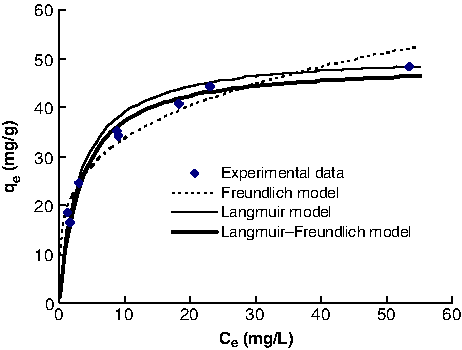
Phosphate adsorption by synthetic layered double hydroxide modified with chloride ions (LDH-Cl).
LDH, synthetic layered double hydroxide; SSE, sum of squared errors.
Adsorption on LDH structure
The effects of adsorption on the structure of LDH-Cl were examined using X-ray diffraction spectroscopy. Strong peaks at (003) and (006) faces were observed in the raw LDH-Cl (Fig. 2), indicating the distance between double layers in the LDH structure. In case of the LDH-Cl adsorbed by phosphate ions, the peaks at (003) and (006) faces were shifted to smaller angles than those for the raw LDH-Cl. FTIR spectra of LDH-Cl before and after the phosphate adsorptions are provided in Fig. 3. A high peak at 672 cm−1 ascribed to chloride ions and a low peak at 1,026 cm−1 assigned to phosphate ions were notable in the spectra of LDH-Cl before the adsorption. After phosphate adsorption (when the phosphate concentration in the aqueous phase was close to the undetectable levels), the peak at 1,080 cm−1 for phosphate ions became far more evident, whereas the peak for chloride ions became less marked. This indicated that the ion exchange of chloride ions with phosphate occurred effectively by the adsorption of phosphate onto LDH-Cl.
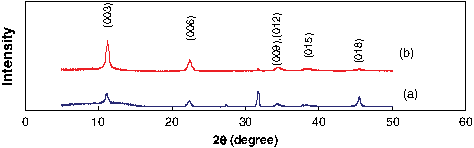
X-ray diffraction spectra for LDH-Cl (

Fourier transform infrared spectra for LDH-Cl (
Adsorption kinetics
In the experiment for the adsorption kinetics, the changes in the concentration of phosphate ions were monitored during the initial adsorption period. The adsorption reactions were completed within 60 min under the given experimental conditions. Even at the initial phosphate concentration of 50 mg P/L with 3 g LDH-Cl, the phosphate concentration dropped to below its detection limit within 10 min. The phosphate adsorption kinetic data were analyzed by the first-order kinetic model, formulated as follows:
where qe (mg P/g LDH) is the amount of phosphate adsorbed at equilibrium, qt (mg P/g LDH) is the amount of phosphate adsorbed at time t (min), and k1 (1/min) is the first-order rate constant for adsorption. The average adsorption rate was determined as 0.55 mg P/g LDH/min, indicating that LDH-Cl was an effective and favorable adsorbent and also supporting that LDH-Cl can be used in full-scale applications for the removal of phosphate. Other than the first few minutes, however, the adsorption data started to deviate from the first-order kinetic model significantly (data not shown). Thus, the pseudo-second-order model developed by Ho and McKay (2000) was additionally employed in this study, which is formulated as follows:
where k2 (g LDH/mg P/min) is the rate constant of the second-order adsorption kinetics. Chubar et al. (2005) also demonstrated that the adsorption of phosphate onto inorganic ion exchangers was found to be described reasonably by the pseudo-second-order model. As illustrated in Fig. 4, all data for the adsorption kinetics were well fitted to the second-order model. The model parameters determined graphically are presented in Table 3. As the initial phosphate concentration decreased, the adsorption kinetic rate increased correspondingly.
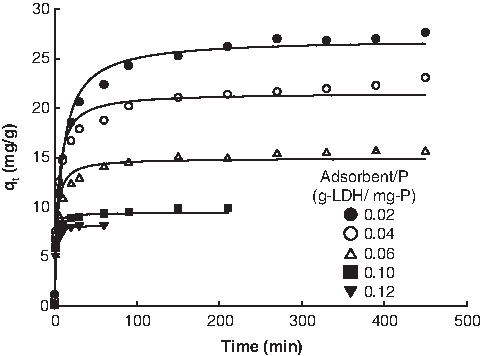
Kinetics of phosphate adsorption analyzed by pseudo-second-order model.
Effect of pH
As pH is considered to be one of the most important factors influencing the adsorption of anions at solid–liquid interfaces, the effect of pH on the adsorption of phosphate by LDH-Cl was evaluated within the pH range from 2 to 11 (Fig. 5). When phosphate adsorption was completed, the quantity of adsorbed phosphate sharply increased along with pH and reached a maximum value at pH 3. As pH increased up to 11, the uptake of phosphate decreased gradually because of its adsorption by LDH-Cl. Also, dissolution of LDH-Cl was observed in the low pH ranges, supporting changes in the LDH-Cl structure. Zeng et al. (2004) observed similar phenomena in their adsorption of phosphate, and they attributed such effects to high pH that can make adsorbent surfaces carry more negative charges, and as a result, the surfaces could repel negatively charged species to the surrounding solution more significantly. It should, however, be noted that this can also be stimulated by high concentration of carbonate ions at high pH ranges. The results of our study also support that high pH may not be favorable for the removal of phosphate by its adsorption onto LDH-Cl.
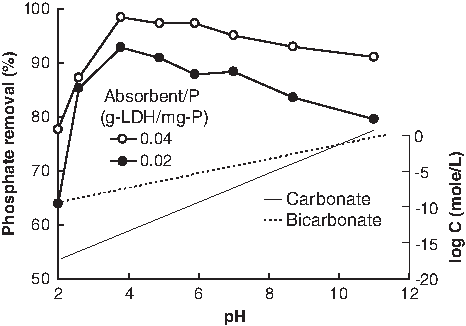
Effect of pH on phosphate removal by LDH-Cl.
Effect of coexisting ions
The phosphate removal potential of LDH-Cl was examined using the secondary effluent collected from a wastewater treatment plant, as depicted in Fig. 6. Although >80% of phosphate in the effluent was removed by LDH-Cl, the removal efficiency was ∼15% lower than that obtained from the experiment using the synthetic wastewater. This discrepancy may be attributed to the difference in competitions among the anions existing in the secondary effluent of wastewaters. The effect of individual ions on the competitions for phosphate adsorption was further evaluated. Cl−, NO3−, NH4+, SO42−, and HCO3− were selected as representative ions because these ions are commonly present in the secondary effluent of wastewaters. As presented in Fig. 7, the presence of each of Cl−, NO3−, NH4+, and SO42− ions had minimal impacts on phosphate adsorption up to their concentrations of 50 mg/L, presumably because of the lower adsorption selectivities for Cl− and NO3− than that for PO43− by LDH-Cl. Chitrakar et al. (2005) reported the adsorption selectivity sequence for anions as Cl− < NO3− < SO42− < HPO42− considering the equilibrium distribution coefficients in the phosphate adsorption onto LDHs and heat-treated materials. The presence of HCO3− ions reduced the phosphate removal efficiency because they can compete with phosphate ions for the adsorption sites on the surface of LDH-Cl. Our results also confirmed that 40 mg/L of bicarbonate inhibited the adsorption, resulting in a decrease in the phosphate removal efficiency by as high as 30% relative to that obtained from the phosphate adsorption with no bicarbonate ions. Note that the phosphate removal efficiency by its adsorption onto LDH was markedly decreased when the bicarbonate concentration was 120 mg/L, a level commonly observed in most wastewaters or secondary wastewaters.

Efficiency of phosphate removal by LDH-Cl from wastewaters.
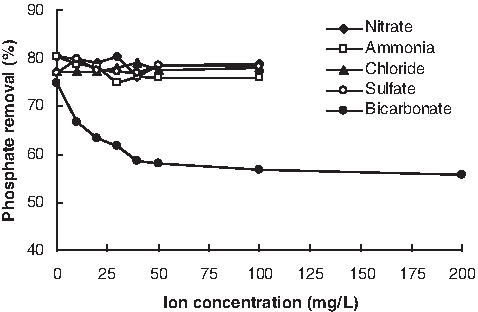
Effect of coexisting ions on removal of phosphate by LDH-Cl.
Desorption and reuse of LDH-Cl
Desorption of phosphate from LDH-Cl was examined using NaCl as a regenerating reagent. Experiments of phosphate desorption were carried out at three different NaCl concentrations (1, 3, and 5 M) and pH range of 6.8–7.2 (Fig. 8). The phosphate desorption rate was defined in this study as the ratio of desorbed phosphate to total adsorbed phosphate, and the accumulated desorption rate was indicated as the degree of phosphate desorption from the adsorptive materials (He et al., 1999). The amount of desorbed phosphate increased as the concentration of regenerating reagent increased. The maximum desorption rate for the first stage of desorption was ∼80% in the 5 M NaCl solution. The desorption rate eventually reached almost 100% after three times of elution. The adsorption, desorption, and readsorption were sequentially and repeatedly conducted to evaluate the feasibility of reuse of the adsorbent and recovering phosphate. The results are presented in Fig. 9. Approximately 80% of phosphate adsorbed was effectively desorbed in the first stage of desorption. The maximum adsorption capacity of LDH-Cl for phosphate was almost constant in each step of desorption–adsorption repetitions. This indicated that most adsorption sites were recovered even if the desorption process was not completed but still in slow progress. These results also supported that LDH-Cl possess a high chemical stability against phosphate adsorption/desorption.
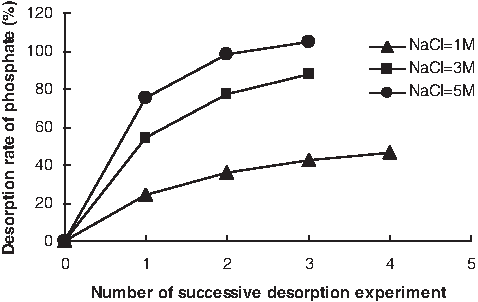
Elution (desorption) rate of phosphate from LDH-Cl adsorbent.
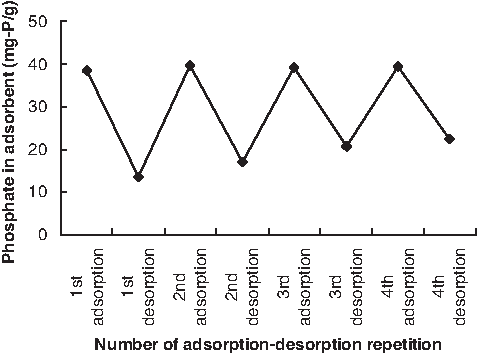
Phosphate content in LDH-Cl adsorbent during successive repetitions of adsorption and desorption.
Conclusion
LDH-Cl was synthesized by the coprecipitation method and the feasibility of LDH-Cl as an adsorptive agent for the removal of phosphate from wastewaters was evaluated. The adsorption capacity was described by the three-parameter isotherm model (Langmuir–Freundlich combination isotherm) successfully. Adsorption of phosphate onto LDH-Cl was accomplished rapidly with an adsorption rate of 0.55 mg P/g LDH/min, supporting that LDH-Cl can be used in full-scale applications. The pH within the range from 3 to 11 had a mild effect on the LDH adsorption capacity, but the capacity was substantially decreased in the pH level below 3 because of the property change of LDH surfaces. The anions commonly found in most wastewaters, such as Cl− and NO3−, demonstrated no significant effect on the phosphate removal efficiency, whereas HCO3− had a markedly negative effect on the LDH adsorption capacity because of its high selectivity. It was verified from the adsorption experiment using the secondary effluent collected from a wastewater treatment plant that bicarbonate ions can compete with phosphate for the adsorptive sites on the surface of LDH-Cl. LDH-Cl used for phosphate adsorption was also effectively regenerated by NaCl, which was evidenced by the phosphate desorption rate as high as 80% in the first stage of desorption. In addition, LDH-Cl demonstrated a good chemical stability against the adsorption–desorption repetitions. Thus, it can be concluded that the synthetic adsorbent material, LDH-Cl, is a feasible alternative of conventional chemical agents for the removal of phosphate because it exhibits a high phosphate removal capacity and a low sensitivity to other environmental conditions.
Footnotes
Acknowledgment
This research was supported by the Faculty Research Fund of Konkuk University (2008).
Author Disclosure Statement
No competing financial interests exist.