




Abstract
Abstract
Chlorobenzene (CB) in aqueous solution is effectively degraded using nanoscale zerovalent iron (ZVI) particles suspended in the solution as the dielectric media with microwave irradiation. When nonaqueous CB is flushed out of groundwater from the contaminated soil, a cosolvent (e.g., methanol or ethanol) is usually added to aid the process. However, the cosolvent in the aqueous solution may interfere with the decomposition of dechlorination using ZVI. Results of this study confirm that if the CB aqueous solution is treated with nanoscale ZVI particles irradiated with microwave, the cosolvent will lower the contact between ZVI particles and water molecules, thus reducing the CB degradation rate. When 250-W microwave (MW) energy was applied to the CB aqueous solution containing methanol (a cosolvent) for 150 s, increasing methanol fraction in the CB solutions impaired the CB degradation rate. CB removal efficiencies are 65.4% for 0% MeOH, 53.7% for 40% MeOH, 32.2% for 60% MeOH, and 2.7% for 100% MeOH. Although the microwave radiation improved active sites on the iron particle surface, the presence of methanol suppressed adsorption of CB on iron particle surfaces thus lowering CB removal efficiency. Overall, reductive dechlorination of chlorinated organic solvents by nanoscale ZVI particles is a surface-mediated reaction; presence of a cosolvent reduces the effectiveness of dechlorination even in the presence of microwave radiation.
Introduction
Results of previous studies suggest that adsorption of chlorinated organic compounds to the ZVI surface indeed occurs (Kim and Carraway, 2000; Schäfer et al., 2003; Xu et al., 2005a). However, little recent literature explores the effect of alcohol cosolvents on iron-catalyzed degradation of chlorinated hydrocarbons (Loraine, 2001; Clark et al., 2003). The existence of cosolvents in the CB solution raises the solubility of nonaqueous phase liquids in water that will enhance the adsorption of chloro-organic substances by the iron particles, and decrease the degradation of the former.
MW radiation is a form of electromagnetic radiation, with frequency ranging from 100 MHz to 300 GHz (Tai and Jou, 1999). The microwave irradiation can make the polar molecules in a solution rotate freely to bring about obvious heat effects. At the same time, the absorbed microwave can further reduce the activation energy of the reaction system, and weaken the chemical bond intensities of various molecules (Zhang et al., 2007). When the microwave frequency is fixed, the absorbed microwave power is only depended on the effective relative dielectric loss factor of the medium (McLoughlin et al., 2003; Moriwaki et al., 2006). The rate of temperature increase when the material absorbs microwave energy is given by Equation 2 (Zhang and Hayward, 2006):
where Pabs is the absorption of MW energy per unit volume of dielectric material in W/cm3, f is the frequency in Hz, ɛ0 is the permittivity of free space (8.854 × 10⁻¹² F/m), ɛ is the complex component of the relative permittivity of the dielectric, E is the electric field in V/m, Cp is the specific heat of the material in J/kg °C−1, ρ is the density of the material in kg/m3, Δt is the time duration in seconds, and ΔT is the temperature rise in the material in °C.
The increasing cosolvent fraction, for example, methane, is expected to decrease the degradation of chlorinated organic substances by reducing their adsorption on the iron particle surface (Loraine, 2001; Clark et al., 2003). However, the information regarding the influence of increasing cosolvent fraction on the capacity of microwave-induce nanoscale ZVI in decomposing the dechlorination of chlorinated organic compounds in aqueous solution is not available in literature. The objectives of this study were to (1) evaluate the effectiveness of ZVI in treating an aqueous solution containing the cosolvent of CB and methanol for studying the influence of cosolvent (methanol) on the CB degradation efficiency with and without microwave irradiation, and (2) compare the influence of nanoscale ZVI particles suspended in the cosolvent solution on the absorption of microwave energy and the resulting solution temperature.
Materials and Methods
Materials
Pure methanol (99.9% purity, GR Reagent; TEDIA) and de-ionized water were used in the MW adsorption study. The CB solution was prepared by dissolving 905 μL of CB (99.9% purity GR Reagent; TEDIA) in methanol (99.9% purity, GR Reagent, TEDIA) with the final concentration of the stock solution adjusted to 20,000 mg/L. The working solution was prepared when needed by dissolving 250 μL of the stock solution in de-ionized water (18.2 MΩ; Millipore Co.) to a final concentration of 100 mg/L CB. The nanoscale ZVI particles (purity 99.9%; CBT Co., Ltd.) have 43.9 m2/g specific surface area as determined using the BET (Brunauer-Emmett-Teller isotherm) method (Beckman Co., SA-300).
A modified household microwave oven (Sampo Co., frequency 2.45 GHz, max. power 650 W) was utilized for generating the microwave energy. The column reactor was made of low-energy-loss boron-silica glass; it was installed into the microwave oven as shown by the schematic diagram in Fig. 1.

Schematic diagram of the experimental setup: 1, microwave (MW) irradiation; 2, boron–silica glass column reactor; 3, methanol or de-ionized water; 4, zerovalent iron (ZVI).
Batch tests
The study was initiated by placing 40 mL of 100 mg/L CB solution in 40 mL boron–silica serum bottles without headspace covered with Teflon-coated screwed caps. After added with 1 g of nanoscale ZVI particles at methanol fractions of 0%, 20%, 60%, and 100%, the samples were placed in a constant-temperature container to complete the CB decomposition for different reaction periods, that is, 30, 60, 120, 150, 180, 210, and 240 min.
The MW output power was at 250 W and for various durations, for example, 10, 20, 30, … , and 60 s. Two sets of samples were prepared by mixing 1.0 g nanoscale ZVI particles directly in 50-mL de-ionized water or methanol solution in the boron-silica glass column reactor. The 100 mg/L CB solution was then added to the boron-silica glass column reactor. One gram of nanoscale ZVI particles was added to each of the samples containing methanol fractions of 0%, 20%, 60%, and 100%, and the ZVI-containing samples were subject to MW treatment. The microwave energy was kept constant at pre-selected levels to treat the prepared CB samples according to a pre-determined scheme of operating conditions: 10 s of MW radiation time, 120 s of MW interruption radiation time = 120 s, and 150 s of total radiation time for 15 cycles.
Methods and analysis
An HP 436 gas chromatography coupled with an HP 5973 mass selective detector and a capillary column (HP-624, 60 m × 250 μm × 1.4 μm) was used for identifying intermediate and final degradation products. The carrier gas (He) flow rate was maintained constant at 1.2 mL/min. The oven temperature was programmed to be at an initial temperature of 40°C for 1 min, increased at 8°C/min to 180°C, and then held at 180°C for 5 min. It was subsequently increased to 220°C at a rate of 10°C/min. The gas chromatography injector temperature was 190°C and mass selective detector injector temperature was 250°C. The real permittivity and permittivity loss factor of ZVI, analyzed using an Impedance Analyzer (Agilent, 4291B) operated at 1.8 GHz and 25°C, are 20.6 F/m and 39.5 F/m, respectively. A mercury thermometer was used to check temperature variations of the media during the reaction process.
Results and Discussion
Influence cosolvent on CB reduction
The degradation of CB by ZVI was observed at four different volume fractions of methanol cosolvent (0%, 20%, 60%, and 100%) to determine how the cosolvent affects the CB degradation rate. Figure 2 shows that increasing the methanol fraction in the CB solutions decreases the CB degradation rates; the CB removal efficiency after 240 min is 18.1% for no methanol, whereas the methanol removal approaches zero for 20%, 60%, and 100% of methanol fractions. The dechlorination of chlorinated organic solvents by ZVI is a surface-mediated reaction; organic substances diffuse to the surface of ZVI particles to be absorbed so that the dechlorination reaction can proceed directly. Water, which has a higher polarity than methanol, is rich in dissolved oxygen; ZVI in the aqueous is corroded to produce hydrogen gas and hydroxyl ions. The methanol that exists in the aqueous solution will reduce the contact and reactions between ZVI particles and water molecules, thus reducing the corrosive rate and the adsorption of CB. Hence, the CB molecules that cannot contact the ZVI particles will not be effectively dechlorinated, leading to reduced CB removal efficiency in solutions with acidic pH values (e.g., 6.94, 6.71, 6.14, and 6.05) obviously decrease. Results of laboratory studies confirm that when the fraction of methanol in the aqueous solution increases, quantities of the hydrogen bubbles formed and ZVI particles re-suspended obviously decrease. Similar effects of cosolvent existing in the aqueous solution on the reduction of perchloroethylene decomposition have also been reported by Clark et al. (2003) and Loraine (2001).
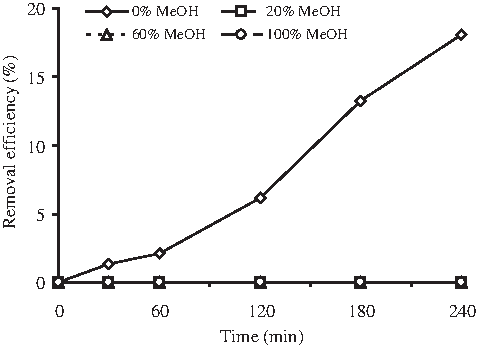
Chlorobenzene (CB) removal efficiencies versus reaction time for CB solutions containing various fractions of methanol.
Influence of ZVI nanoparticles on the absorption of microwave energy and the resulting solution temperature
When a dielectric solvent is placed in an electric or electromagnetic field, the dielectric medium becomes polarized to store the electrical energy. The level of polarization depends on the state and composition of the solvent and the frequency of the applied electric field. Additionally, the heating of a substance with MW irradiation depends on the dielectric characteristics of the substance. When the MW radiation contacts substances of various dielectric characteristics, the radiation will couple selectively with the substance with higher dielectric loss (Venkatesh and Raghavan, 2004). If the MW output power is 250 W, the addition of 1 g ZVI will cause the water temperature to rise from 36°C to 40°C (temperature elevation rates raised from 0.19°C/s to 0.25°C/s, or 11.2% increase) for water, and from 39.7°C to 45°C (temperature elevation rates raised 0.25°C/s to 0.34°C/s, or 13.4% increase) for methanol.
Microwave heating of a material depends on its dielectric constant (ɛ′), which indicates the capability of a material to be polarized by an electric field (Galinada and Guiochon, 2005), and on the dielectric loss factor (ɛeff ′′), which expresses the ability of the material to absorb microwave energy and transform it into heat (Bilbao-Sáinz et al., 2007). Equation 2 indicates that the temperature rising rate for a substance under MW irradiation is proportional to its dielectric loss factor. Since methanol has a higher dielectric loss factor than water (14.4 vs. 12.5), it experiences a faster temperature rising rate (0.25°C/s) than water (0.19°C/s). These results conform to the results published by Mcloughlin et al. (2003) that methanol has a higher temperature rising rate than water when both are exposed to MW radiation. The observation by Liao et al. (2001) that a substance with higher dielectric constant may not be heated up faster is also confirmed. Additionally, the ZVI has a much higher dielectric loss factor (39.5); adding ZVI to methanol or water will raise the microwave energy absorbed and the heat generated for either methanol or water.
On the other hand, the calculated average power absorbed using Equation 2 for water and methanol during the treatment period is shown in Fig. 3. The average MW power absorbed by water increases from 38.4 to 52.3 W/cm3, and from 51.3 to 69.7 W/cm3 by methanol. The addition of nanoscale ZVI particles to the aqueous solution will further increase the MW power absorption by 36.2% for water, and 35.9% for methanol solution.
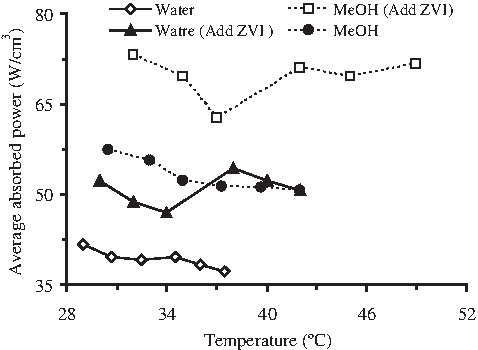
Influence of adding ZVI particles on the temperature rising and average absorbed power (W/cm3) absorbed for methanol and water 250 W MW.
Influence of cosolvent on CB reduction with microwave irradiation
In the presence of MW irradiation, the degradation of CB by ZVI was studied for four different volume fractions of methanol cosolvent (0%, 20%, 60%, and 100%) to determine how cosolvents affect the CB degradation rate. Figure 4 indicates that after irradiated with 250 W MW for 150 s, increasing methanol fraction in the CB solution decreases the CB degradation rate. The CB removal efficiencies are 65.4% for 0% MeOH, 53.7% for 40% MeOH, 32.2% for 60% MeOH, and 2.7% for 100% MeOH. When ZVI particles contact water, hydrogen gas and hydroxyl ions are generated to produce a small quantity of bubbles rising from the iron particles that have settled at the bottom of the reactor. In the presence of microwave irradiation, ZVI particles absorb the microwave energy; the energy absorption enhances the oxidation of iron particles, the production of bubbles, and re-suspension of ZVI particles so that the contact between ZVI particles and contaminants is increased to enhance the decomposition reaction rate and removal efficiency.
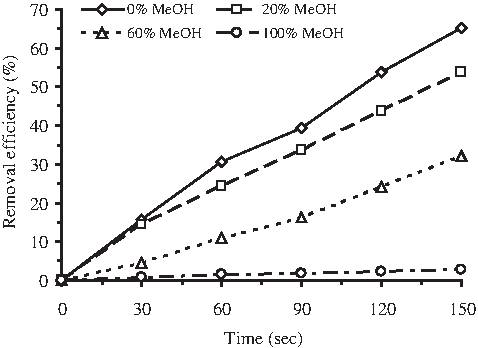
CB removal efficiency for various volume fractions of methanol cosolvent (irradiated with 250 W MW energy for 150 s).
However, with increasing fraction of methanol in the aqueous solution, quantities of bubbles and re-suspended iron particles apparently diminish. A possible cause is that methanol prevents ZVI particles from contacting the water, thus reducing the oxidation rate of ZVI particles. Figure 5a reveals that the surface of virgin ZVI particles are agglomerated; the microwave-irradiated ZVI particles surface structure apparently appears loose (Fig. 5b), and in the solution containing the methane cosolvent, microwave-irradiated ZVI particles surface structure obviously appears more loose (Fig. 5c). On the other hand, methanol also prevents CB from being adsorbed on the ZVI particle surface, and hence reduces the dechlorination and removal efficiency of CB at the surface of ZVI particles.
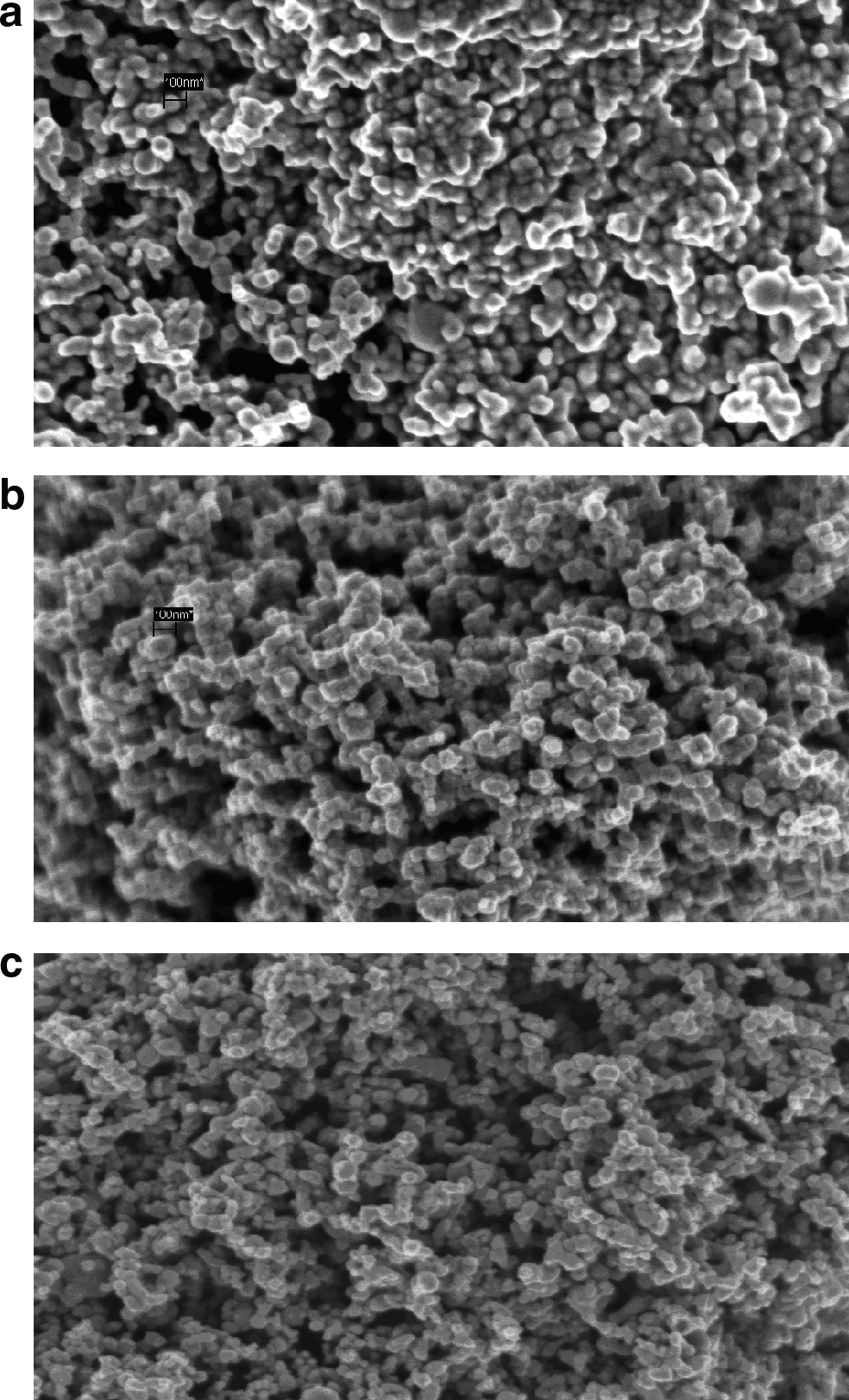
Scanning electron microscopy images showing changes of surface structure for ZVI before and after being used as the medium in the microwave treatment for CB.
Conclusions
The effectiveness of using microwave-induced ZVI in treating an aqueous solution of CB containing different fractions of methanol cosolvent is evaluated by observing how the quantity of cosolvent affects the CB degradation. Because water, which has a higher polarity than methanol, is rich in dissolved oxygen, ZVI reacts with water to produce hydrogen gas and hydroxide ions. The presence of methanol in the solution suppresses the sorption of CB on the iron surfaces to reduce the CB removal efficiency. When the MW energy is applied at 250 W for 150 s, increasing fractions of methanol in the CB solutions decrease the CB degradation rates; the CB removal efficiencies are 65.4% for 0% MeOH, 53.7% for 40% MeOH, 32.2% for 60% MeOH, and 2.7% for 100% MeOH. Overall, the presence of cosolvent has been confirmed to reduce the effectiveness of CB dechlorination by ZVI even with microwave irradiation. The results demonstrate the interference of cosolvent on CB degradation using nanoscale ZVI irradiated with microwave energy. Because the field CB-contaminated wastewater may contain impurities that may behave like cosolvent to interfere with CB decomposition, the application of laboratory results to field practices requires future investigations to assure a successful technology transfer.
Footnotes
Author Disclosure Statement
No competing financial interests exist.