




Abstract
Abstract
A novel microwave-assisted photocatalytic active ZrO x catalyst, which has mix-valences and wide bandgap, has been prepared by cetyltrimethylammonium bromide–assisted hydrothermal method. Structural and optical properties were characterized by X-ray photoelectron spectroscopy, X-ray diffraction, transmission electron microscopy, N2 adsorption–desorption, and UV–vis techniques. Total organic carbon (TOC) removal of dimethyl phthalate (DMP) (100 mL, 50 mg L−1) with 1 g L−1 ZrO x approached 84% after a 30-min reaction, which was about 15% and 11% higher than ZrO2 and P25 TiO2, respectively. TOC removal of DMP by microwave-assisted photocatalytic process followed pseudo–first-order kinetics in all cases, and ZrO x evidently accelerated the degradation of DMP. Degradation half-life time of DMP using ZrO x was shortened 43% and 34%, compared with ZrO2 and P25 TiO2, respectively. A possible catalytic mechanism of ZrO x was proposed based on microwave response and interfacial charge transfer analyses. Further research on ZrO x may develop a promising new generation of highly efficient catalysts for the microwave-assisted photocatalytic process for environmental remediation.
Introduction
Microwave-assisted photocatalytic (MW/PC) process is a recently developed highly efficient wastewater treatment, especially for the degradation of unbiodegradable organic pollutants. Many researches indicated that the introduction of microwave irradiation could remarkably improve the efficiency and accelerate the reaction rate of traditional photocatalytic processes (Horikoshi et al., 2003d, 2004a, 2007b; Ai et al., 2005; Ta et al., 2006; Horikoshi and Serpone, 2009c). According to our former research, photocatalytic degradation of DMP could be significantly enhanced when coupled with microwave irradiation (Liao and Wang, 2009). To the best of our knowledge, the catalysts commonly used in the MW/PC process were focused on commercial Degussa P25 TiO2 and some modified TiO2 (Horikoshi et al., 2002e, 2003f; Zhang et al., 2007, Žabová et al., 2009). The design of the MW/PC catalysts was mainly concentrated on the photocatalytic activity of catalyst, and there is a lack of consideration of the microwave response activity. Consequently, the microwave energy in the MW/PC process could not be efficiently utilized, and so there was a need to develop a characteristic catalyst with simultaneously good response to both microwave and UV light for the MW/PC process. Besides, UV-C light (i.e., 254 nm) can be effectively emitted by the microwave discharged electrodeless lamp (MDEL) under microwave irradiations, which enables the use of wide bandgap photocatalyst with powerful oxidation capacity to achieve deep degradation of pollutants. Thus, developing a catalyst with wide bandgap and high response to both microwave and UV light is indispensable for the application of MW/PC process.
Zirconia is a wide bandgap semiconductor with many unique properties. It is the only transitional metal oxide that presents both acidity and alkalescency centers, along with high performance in mechanical, thermal, optical, and catalytic properties and high ionic conductivity at elevated temperatures (>1,000 K) (Yang et al., 2008). Particularly, ZrO2 possesses stronger microwave absorption ability than TiO2 (Durka et al., 2009). Over the past few years, ZrO2 has attracted much attention as a catalyst. For example, CoO x /ZrO2 could be used for selective catalytic reduction for NO with NH3 (Pietrogiacomi et al., 2009) and sulfated ZrO2 was recognized as a solid super-acid and has been used as catalytic support and catalyst (Pasel et al., 2000). Moreover, ZrO2 has also shown its superior photocatalytic activity; doped and coupled (Ti, Zr)O2 could greatly enhance the photocatalytic efficiency for both volatile organic compounds (VOCs) and unbiodegradable organic compound-contaminated water (Alvarez et al., 2007; Venkatachalam et al., 2007; Fresno et al., 2008).
Herein, we first report a novel and potential ZrO x catalyst, which has simultaneously good response to both microwave and UV irradiations and possesses remarkably high efficiency for the MW/PC degradation of DMP. Further, a possible catalytic mechanism of ZrO x is proposed based on the characterization of ZrO x and a comparative study with commercial Degussa P25 TiO2 and ZrO2 in different processes is presented.
Experimental
Preparation of ZrOx
All reagents were of analytical grade without further purification. ZrO x was prepared by a surfactant-assisted hydrothermal method (Yan et al., 2008; Wang et al., 2009). In a typical synthesis, 0.10 g cetyltrimethylammonium bromide (Aladdin Reagent [AR]) and 1.07 g ZrOCl2 · 8H2O (AR, 99.999%) were mixed with 15 mL of deionized water with stirring for 30 min. NaOH solution (30 wt%) was slowly added to the mixture until pH 10 was reached. The mixture was stirred for 1 h before transferring into a stainless Teflon-lined autoclave of 100 mL inner volume. The temperature of the autoclave was maintained at 433 K for 12 h, followed by cooling naturally to room temperature. The product was centrifuged, filtered, and rinsed with alcohol and deionized water for several times. Finally, ZrO x was obtained after drying in air at 333 K overnight. For ZrO2 case, the sample was further calcined in the muffle furnace at 673 K (ramp: 3 K min−1) for 2 h after the above preparation processes.
Characterization of ZrOx
X-ray photoelectron spectroscopy (XPS) measurement was performed with a physical electronic 5700 (Physical Electronics) spectrometer equipped with a hemispherical electron analyzer and Al Kα X-ray source (1486.60 eV, 12.5 kV, 250 W). The pressure in the analysis chamber ranged typically from 10–8 to 10–9 mbar during spectra acquisition. The resolving power of the binding energy values was ± 0.2 eV. Curve fitting was carried out using a Physical Electronics PC-ACCESS ESCA-V6.0E program with a Gaussian–Lorentzian sum function. X-ray diffraction (XRD) pattern was monitored using a D-MAX-RB diffractometer (Cu Kα radiation, λ = 1.5418 Å, voltage = 45 kV, current = 40 mA, scanning rate = 0.02° s−1, scanning range = 10°–90°). Transmission electron microscopy (TEM) image was obtained on a Hitachi H-7650 microscope (Hitachi). Carbon-coated copper grid was used as the sample holder. Brunauer–Emmett–Teller (BET) surface area was measured by nitrogen adsorption–desorption technique at 77 K with a Micromeritics ASAP 2020 equipment (Micromeritics). The UV–vis absorption spectra of the samples were recorded on a Varian Cary 500 Scan UV-Vis-NIR spectrometer (Varian), where BaSO4 was used as a reference sample.
The determination of hydroxyl radicals was conducted by a fluorescence method proposed by Ishibashi et al. (2000). The capture agent was terephthalic acid. The generated hydroxy product named 2-hydroxyterephthalic acid has fluorescence emission peak at 425 nm under the excitation wavelength of 315 nm. Fluorescence spectra were measured with a JASCO FP-6500 fluorescence spectrophotometer (Jasco). The excitation wavelength was 315 nm and the scanning range was 250–600 nm. The initial concentration of terephthalic acid was 800 mg L−1, which could ensure that all the hydroxyl radicals are trapped by the capture agent under experimental conditions.
Microwave-assisted photocatalytic degradation of DMP
The MW/PC degradation of DMP (AR) was conducted in an integrated microwave and UV reaction facilities equipped with a MDEL (filled with 10 mg mercury and 2.5 Torr argon, maximal emission at 254 nm; made by Shanghai Jiguang Special Illumination Instrument Factory), as reported in our former paper (Liao and Wang, 2009). A thermal-assisted photocatalytic (TH/PC) process was carried out for comparison with the MW/PC process. A Heraeus GU22-10T5L Hg lamp (15 W, maximal emission at 254 nm) was employed as the UV source, and a heating jacket was used as a thermal source to heat the photocatalytic reaction system in the TH/PC process.
In all the experiments, unless otherwise noted, a raw 100 mL DMP solution (50 mg L−1, pH 5.61) with 1.0 g L−1 catalysts was added into a glass reactor and stirred in the dark for 30 min to obtain adsorption–desorption equilibrium before reactions. The microwave power for the MW/PC process was 400 W, and the MDEL light intensity for the MW/PC process was 9.79 mW cm−2. The UV light intensity in the TH/PC process was the same as that in the MW/PC process. Both the MW/PC and TH/PC processes were carried out at 378 ± 2 K.
The catalytic abilities of Degussa P25 TiO2 (specific surface area, 51 m2 g−1 by BET; particle size, 20–30 nm by TEM) and ZrO2 were also tested under the same reaction conditions in comparison with ZrO x . For better characterization of the thorough mineralization degree of DMP, total organic carbon (TOC) removal was used as the degradation evaluation index of DMP in this article, which was different from the evaluation index (UV absorption) used in our previous paper (Liao and Wang, 2009). The decrease in TOC of DMP was determined with a Shimadzu TOC 5000 A (Shimadzu).
Results and Discussion
Characteristics of ZrOx
XPS measurement was performed to determine the surface chemical states of ZrO x . The XPS survey-scan spectrum for ZrO x displays the presence of zirconium and oxygen, which are in accordance with the preparation process. High-resolution spectra were measured to further characterize ZrO x . The high-resolution Zr 3d spectrum of ZrO x shows a broad and complex peak, and the best fits of the spectrum are illustrated in Fig. 1. As we know, the gap between the binding energies of Zr 3d5/2 and Zr 3d3/2 is 2.43 eV, so it can be analyzed from the Zr 3d XPS fitting spectra that three components exist in ZrO x after deconvolution. In detail, the peaks at 182.22 and 184.60 eV are assigned to ZrO2, which are in good agreement with the reported values of ZrO2 samples (Ardizzone et al., 2009; Wu et al., 2009). Also, zirconium has been confirmed to exist as a ZrO complex, which has three intermediate oxidation states between metal Zr and ZrO2 (Satoh et al., 1996; Kawata et al., 1997), and the binding energies of the four different oxidation states of Zr shifted about 1.1 eV per metal-oxygen bond (Morant et al., 1989). Accordingly, it can be deduced that the peaks at 181.01 and 183.44 eV are attributed to Zr2O3, and the peaks at 180.01 and 182.44 eV correspond to ZrO. The content of these three kinds of Zr oxides on the total surface of ZrO x is also presented in Fig. 1, and ZrO2 is the main composition of ZrO x .
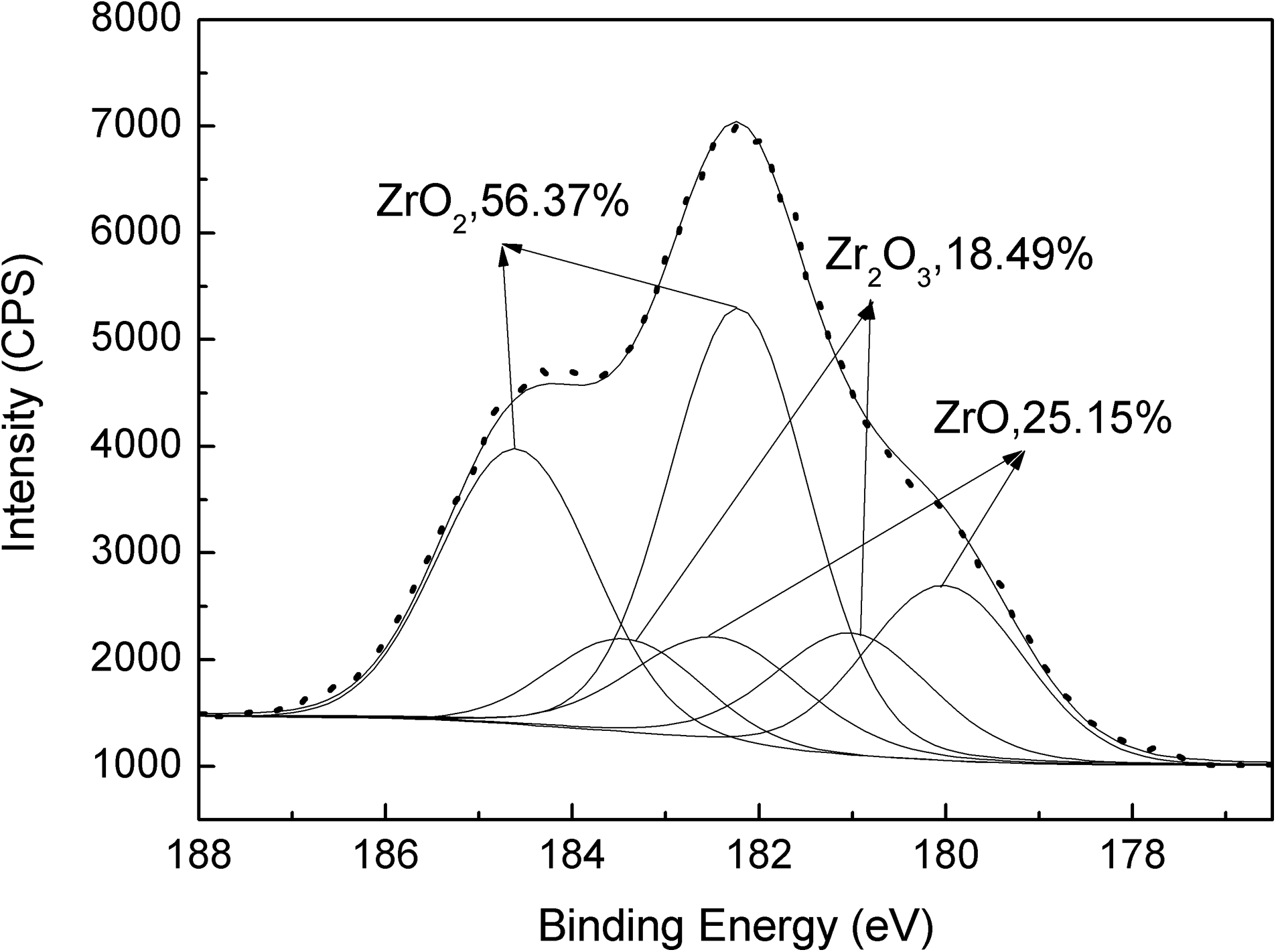
X-ray photoelectron spectroscopy spectra of Zr 3d of ZrO x . Experimental result and the fitted peaks are presented as dotted and solid curves, respectively.
Figure 2 presents the XRD pattern for ZrO x . Diffraction peaks corresponding to monoclinic ZrO2 (JCPDS: 13-0307) and tetragonal ZrO2 (JCPDS: 14-0534) are clearly observed. The monoclinic ZrO2, which takes 48% of the total catalyst, is characterized by peaks located at 27° and 31°, and the tetragonal ZrO2, which takes 51% of the total catalyst, is characterized by peaks located at 30°, 35°, 50°, and 59°. The crystallite size of ZrO x is calculated to be ca. 8 nm using Scherrer formula. Besides, the mix-valence Zr oxides found in the XPS spectrum are not shown in the XRD pattern, which may be because the detection limit of XPS is much lower than XRD, and the small amount ZrO and Zr2O3 cannot be effectively detected by the XRD technique.
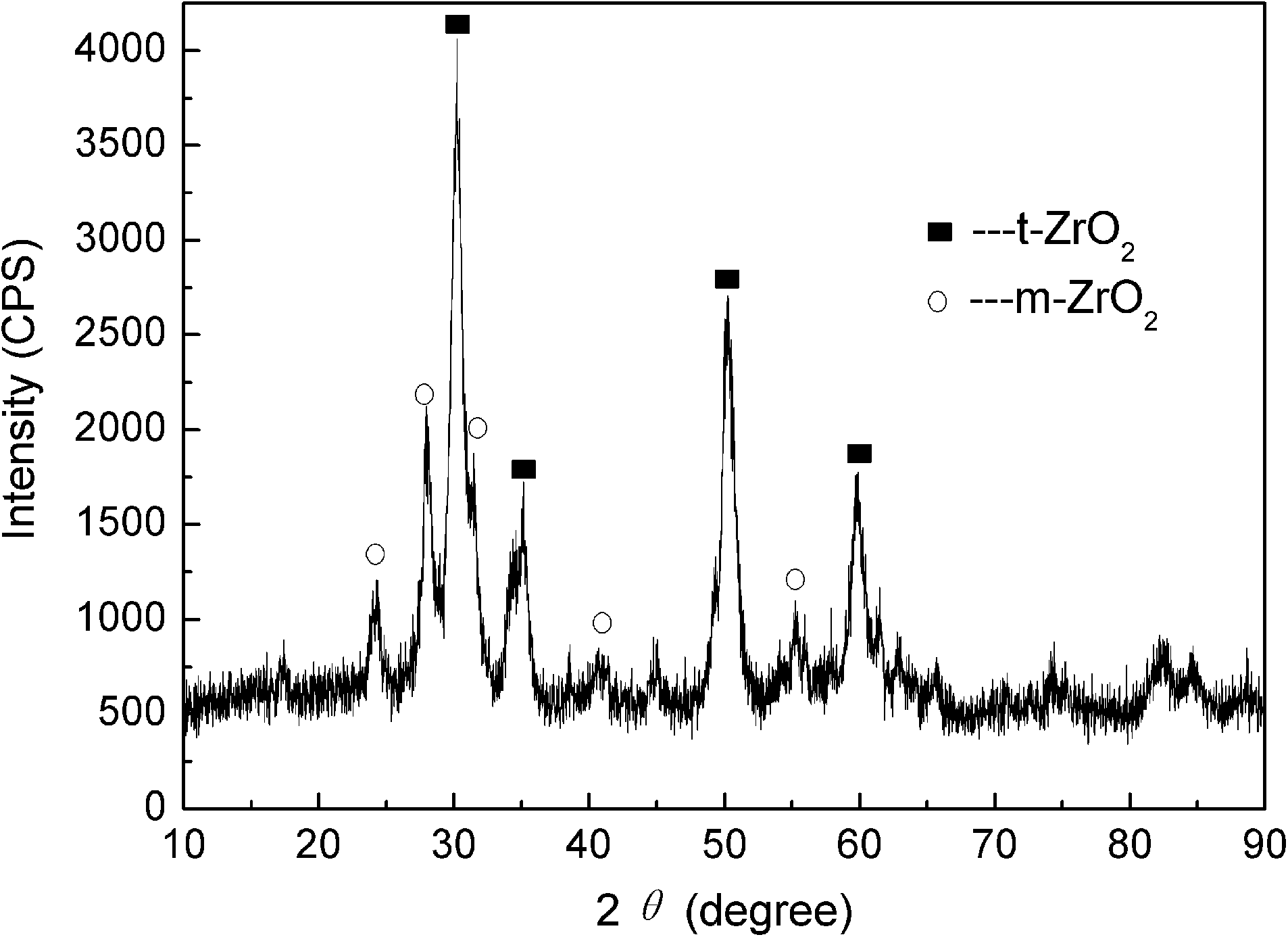
X-ray diffraction pattern of ZrO x .
Figure 3 is a representative TEM image of ZrO x . The powders are very fine and agglomerate. Using the TEM image, the particle size of ZrO x has been measured to be ca. 10 nm. The BET-specific surface area for ZrO x calculated from the N2 adsorption–desorption is 74 m2 g−1, whereas it is 51 m2 g−1 for Degussa P25 TiO2. The larger surface area can provide more surface sites for the adsorption of reactants molecules, making the degradation more efficient. UV–vis absorption spectra of ZrO x , ZrO2, and P25 TiO2 are illustrated in Fig. 4. The absorption spectrum of ZrO x consists of a single and intense absorption at 250 nm because of charge transfer from the valence band to the conduction band, whereas the spectrum of ZrO2 demonstrates a main absorption at 250 nm and a weak shoulder peak in the region of 250–340 nm. It is obvious that ZrO x and ZrO2 have much wider bandgap than P25 TiO2. Because of the wide bandgap, the photon-generated holes and electrons on the surfaces of ZrO x and ZrO2 have stronger redox ability than P25 TiO2 (Hou et al., 2006), and this is favorable for the decomposition of stable intermediates.
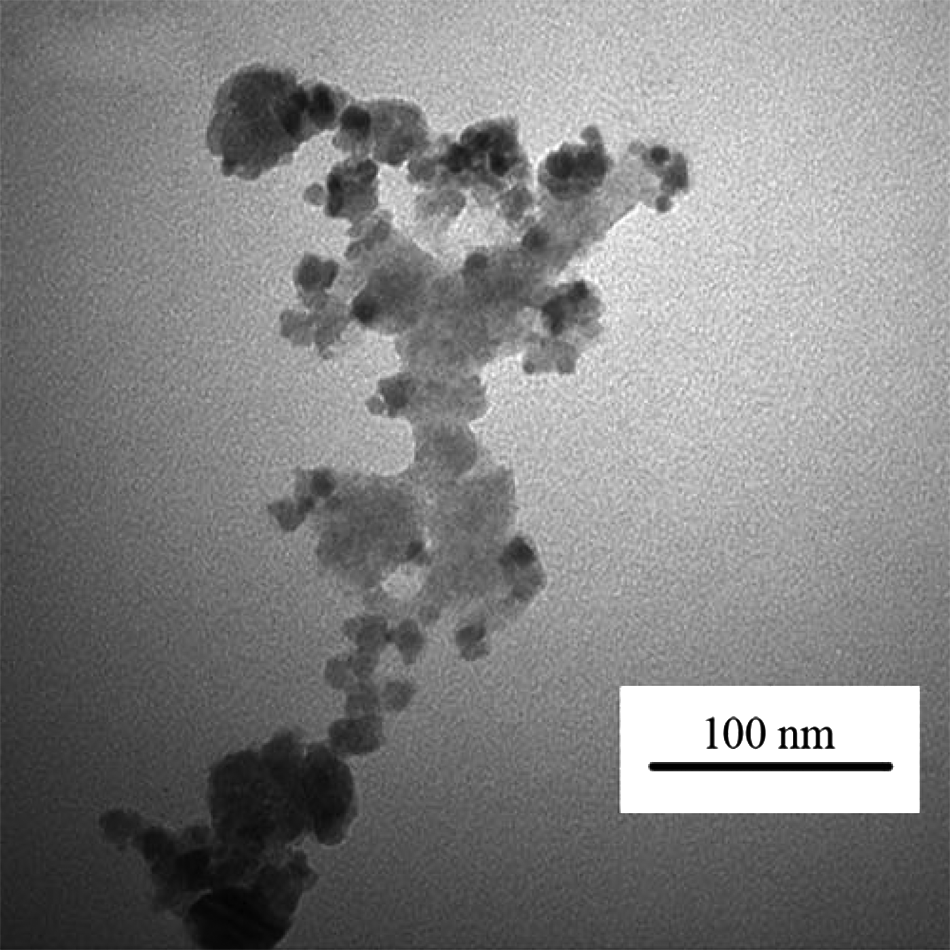
Transmission electron microscopy image of ZrO x .

Diffuse reflectance absorption spectra of ZrO x , ZrO2, and P25 TiO2.
Microwave-assisted photocatalytic degradation of DMP with ZrOx
Comparison of degradation efficiencies
ZrO x was used as the catalyst for the MW/PC degradation of DMP, and the TOC removal with ZrO x was compared with those using ZrO2 and P25 TiO2, as shown in Fig. 5. Both ZrO x and ZrO2 have lower activities than P25 TiO2 in the TH/PC process, and it is presumably because ZrO x and ZrO2, which have much wider bandgaps than P25 TiO2, cannot be effectively excited by 254 nm UV light in the TH/PC process. However, the TOC removal of DMP by ZrO x , ZrO2, and P25 TiO2 photocatalysis was remarkably enhanced under microwave irradiations, especially for ZrO x . The TOC removal of DMP without catalyst is 17% after a 30-min reaction in the MW/PC process. Adding catalyst evidently improves the MW/PC degradation efficiency of DMP. The TOC removal of DMP in the MW/PC process with ZrO x approaches 84% after a 30-min reaction, which is about 15% and 11% higher than those using the same dosage of ZrO2 and P25 TiO2 as the catalyst, respectively. Besides, the efficiency of ZrO2 also becomes much closer to P25 TiO2. Microwave irradiation shows an evident promoting effect on the photocatalytic degradation, and because the degradation reactions were carried out at the same temperature in the TH/PC and MW/PC processes, this promoting effect could not only be contributed to the heat effect. It can be deduced that the wide-bandgap catalysts ZrO x and ZrO2 are more effectively activated under the simultaneous microwave and UV light irradiations. In particular, mix-valences ZrO x has much better performance than single valence ZrO2 under microwave irradiations, although ZrO x and ZrO2 have almost the same wide bandgap.

Comparison of ZrO x , ZrO2, and P25 TiO2 in different processes.
Comparison of degradation kinetics
The TOC degradation kinetics of DMP in the MW/PC process in the presence of ZrO x , ZrO2, and P25 TiO2 were also analyzed based on the TOC removal results in Fig. 5, respectively. Figure 6 shows that ln(C0/C) has linear relationship versus reaction time for each catalyst, so it can be concluded that the TOC degradation of DMP by the MW/PC process follows pseudo–first-order kinetics. Table 1 shows the kinetics equations and parameters of different catalysts. It can be seen that the TOC degradation half-life time of DMP (50 mg L−1) with ZrO x is 12 min, which is 9 and 6 min shorter than those with ZrO2 and P25 TiO2, respectively. ZrO x evidently enhances the TOC degradation rate of DMP in the MW/PC process relative to P25 TiO2 and ZrO2.

Dependence of ln(C0/C) versus reaction time with different catalysts.
Catalytic mechanism analysis
The ratio of dielectric loss to dielectric constant (tan δ) is an important parameter commonly used to measure the ability of a material to absorb microwave. According to Durka et al. (2009), the tan δ value of ZrO2 (tan δ = 0.1) is obviously higher than that of TiO2 (tan δ = 0.005). Therefore, ZrO2 needs smaller activation energy (Ea) to cause the interstitial atoms or vacancies in the material to become mobile, in terms of Equation 1 proposed by Zhang et al. (2002),
where the constants kA and kM are measures of the contribution made by microwave absorbers bound in deep and shallow potential wells, respectively, and Ea is the activation energy required to cause the interstitial atoms or vacancies in the material to become mobile. It suggests that ZrO2 is easier to be activated under the same microwave irradiation, compared with TiO2. Further, the coexistence of three different valences Zr ions (as shown in Fig. 1) in ZrO x can form a nonstoichiometric defect structure. Electrons in this defect structure are prone to transfer from one ion to another ion with different valence under microwave irradiation (Duan, 1998a; Duan et al., 1998b; Jin, 1999; Ni et al., 2008). Consequently, mix-valences ZrO x has superior electron mobility to single-valence ZrO2, and ZrO x is even easier to be activated than ZrO2 under microwave irradiation.
Moreover, because the mobility of electrons and vacancies on the catalysts are enhanced after the introduction of microwave, microwave irradiation can help the excitation of valence band electrons on semiconductor catalysts under UV light irradiation (Li et al., 2002). Consequently, the excitation of ZrO x and ZrO2 are greatly improved in the MW/PC process, which induces great progress in DMP degradation compared with those in the TH/PC process. In addition, the photon-generated electrons and holes formed on the wide bandgap ZrO x have stronger redox activity than those on P25 TiO2 (Hou et al., 2006), and so the activated ZrO x provides higher photocatalytic degradation efficiency of DMP. In particular, mix-valences ZrO x possesses superior electron mobility to single-valence ZrO2, and so, when microwaves irradiate on the surface of ZrO x , the electrons on the valence band of ZrO x are much more inclined to be excited than those on ZrO2 under UV light emission at 254 nm. Besides, the recombination rate of the photon-generated electrons and holes on the highly defected ZrO x surface may be lower than that on ZrO2 because of the separation of the photon-generated electrons and holes on Zr oxides with different valences. Thus, ZrO x has obvious better performance than ZrO2 in the MW/PC process.
Further, for the concentration of hydroxyl radicals, which is one of the important factors for efficient photodegradation of organic pollutants, the detection of hydroxyl radical is essential for the study of catalytic mechanism. As shown in Fig. 7, the formation of hydroxyl radicals in different catalysts-catalyzed MW/PC processes further explains the degradation results in Fig. 5. The MW/PC process with ZrO x owns the highest amount of hydroxyl radicals relative to other catalysts. Based on the above results and discussion, it can be deduced that the formation and separation of photon-generated electrons and holes on ZrO x is evidently efficient under the simultaneous irradiation of microwave and UV light. Subsequently, the electrons can be captured by the adsorbed O2, and the holes can be trapped by the surface hydroxyl, both resulting in the formation of hydroxyl radical species. Owing to the nonselectivity and high oxidative capacity, the hydroxyl radical species can attack and oxidize DMP molecules adsorbed on the surface of ZrO x (Lu et al., 2008) and finally cause the highest MW/PC degradation efficiency of DMP.

Comparison of the hydroxyl radicals formed in different processes. Terephthalic acid solution volume = 100 mL; CT = 800 mg L−1; λex = 315 nm; λem = 425 nm.
Conclusively, ZrO x sufficiently utilizes the microwave and microwave-discharged UV light energy and greatly enhances the MW/PC degradation efficiency of DMP. First, the intense response to microwaves helps the activation of the wide-bandgap ZrO x under 254 nm UV light irradiation. Second, the effectively activated wide-bandgap ZrO x , which has stronger photon-generated electrons and holes, improves the degradation of DMP. Particularly, ZrO x , which has better response to microwaves, achieves better catalytic activity than ZrO2 in the MW/PC process. Besides, the larger surface area of ZrO x may also be helpful for the oxidation of DMP, but this may not be the dominating reason for the superior degradation efficiency in the MW/PC process because P25 TiO2 still has much higher efficiency than ZrO x in the TH/PC process.
Conclusions
ZrO x with mix-valences and wide bandgap have been successfully synthesized via a cetyltrimethylammonium bromide–assisted hydrothermal process and found to be highly effective in the MW/PC degradation of DMP. Under a given condition (DMP concentration 50 mg L−1, microwave power 400 W, UV light intensity 9.79 mW cm−2, reaction time 30 min, catalyst dosage 1 g L−1, pH 5.61), the TOC removal efficiency of DMP with ZrO x approaches 84%, which is about 15% and 11% higher than ZrO2 and P25 TiO2, respectively. Also, the degradation reaction of DMP follows a pseudo–first-order kinetic, and the degradation half-life time of DMP (50 mg L−1) with ZrO x is 12 min, which is 9 and 6 min shorter than those using ZrO2 and P25 TiO2, respectively. The high activity of ZrO x could be attributed to the co-existence of three different valences Zr oxides, which induces higher electrons and vacancies mobility under microwave irradiation. Subsequently, the photon-generated electrons on the wide-bandgap ZrO x can be effectively excited by UV light irradiation and finally causes sufficient use of the wide-bandgap energy to achieve superior MW/PC degradation efficiency. ZrO x , which makes a successful synthetic utilization of microwave and UV light, offers some new insights into designing highly efficient catalysts for the MW/PC process. Modified ZrO x may introduce a promising new generation of catalysts for the MW/PC process for environmental remediation. Further studies are currently being carried out in our lab.
Footnotes
Acknowledgment
The authors are grateful to the financial support from the National Nature Science Foundation of China (nos. 50678045 and 50821002).
Author Disclosure Statement
The authors declare that no competing financial interests exist.