




Abstract
Abstract
This study examined the optimum conditions for aniline oxidation by sulfate radicals generated from persulfate activated by ferrous iron in the presence of citric acid. With inputs from preliminary studies, the Design-Expert 7.0 Software was used to design experimental scenarios, identify key factors, and provide optimum conditions. Within the studied ranges of persulfate, ferrous iron, citric acid, temperature and pH of 15–50 mM, 2.5–10 mM, 0–1 mM, 18°C–25°C, and 6–8, respectively, the degradation of 0.5 mM aniline largely depended on persulfate, ferrous iron, and citric acid. Results showed that persulfate could be effectively activated by ferrous iron to form sulfate radicals. Citric acid could efficiently act as a chelating agent to ferrous iron, thus resulting in increasing ferrous iron solubility and sequentially promoting sulfate radical formation. The predicted model generated from the software is proposed to provide an estimation of aniline removal by persulfate radicals. In addition, among all chelating agents being tested, pyrocatechol provided the best performance for aniline removal.
Introduction
Since aniline is a stable organic compound and is, thus, not easily degraded by bacteria (Chen et al., 2007), treating wastewater contaminated by aniline requires a chemical process. In situ chemical oxidation (ISCO) is a remediation technology used to clean-up contaminated soils and groundwater in-place utilizing an oxidant. It has been demonstrated that certain oxidants such as sodium persulfate (Na2S2O8) can be activated to promote the formation of sulfate free radicals (SO4•−), leading to the destruction of stable compounds (Block et al., 2004; Waldemer et al., 2007; Liang et al., 2008a). The sulfate free radical (with a redox potential, E0 [SO4•−/SO42−] of 2.6 V) (Eberson and Ekstrom, 1987) is a more aggressive oxidizing agent than persulfate anion (E0 [S2O82−/2 SO42−] of 2.01 V) (Latimer, 1952). Besides, persulfate application for subsurface remediation usually exhibits low soil oxidant demand (SOD) (Liang et al., 2008b), which is good for in situ treatment due to the lower consumption of oxidants. Sulfate free radicals are also more stable oxidants than peroxide or permanganate, which can oxidize over extended periods, increasing the possibility of contact with contaminants (Waldemer et al., 2007) and oxidize organics over a wider pH range (Liang et al., 2003, 2007; Richard et al., 2008).
Persulfate activation to destroy the target compound has been demonstrated to be obtainable using thermal (Huang et al., 2002) or chemical activation by transition metals (Anipsitakis and Dionysiou, 2004; Liang et al., 2004a, 2004b) that focus on ferrous iron (Buxton et al., 1997), as presented in Eqs. (1) and (2), respectively:
Thermal activation (Johnson et al., 2008):
Metal activation (Buxton et al., 1997):
For in-situ practice, Fe2+-activation approach seems to be superior. However, the solubility of Fe2+ largely depends on pH and becomes minimal near a neutral pH range due to ferric hydroxide precipitation. To overcome this limitation, a chelant is applied to increase Fe2+ solubility. Since, according to ASTM-A-380, chelating agents or chelating agents are chemicals that form soluble, complex molecules with certain metal ions, inactivating the ions that cannot normally react with other elements or ions to produce precipitates or scale results in metal buffering and solubilization (Weber and Werner, 2007). Therefore, extra chelating agents could increase Fe2+ solubility to enhance sulfate radical formation. In this study, citric acid was used as a chelating agent (Liang et al., 2004a, 2008a), because it is not an environmental toxin and is quickly decomposed by biological processes (Harrigan et al., 2007; Min et al., 2007). Therefore, it is frequently used in the environmental field.
Design-Expert 7.0 Software has been successfully used in design experimental scenarios (Sayyad et al., 2007), predicting experimental models, identifying key factors, and providing optimum conditions. Thus, it was employed in this study. The major aim of this study was to examine the optimum conditions of persulfate activated by Fe2+ in the presence of citric acid chelating agent for aniline oxidation.
Experimental Protocols
Materials
All chemicals were of analytical grade: β-cyclodextrin (98%), pyrocatechol (99%), and sodium triphosphate pentabasic (90%–95%) were obtained from Sigma-Aldrich. The sodium peroxydisulfate (99%), citric acid monohydrate (99.5%), ferrous-sulfate heptahydrate (99.5%–102%) and aniline (99.5%) were obtained from Merck. Aqueous solutions used for the experiments were prepared from DI water.
Experimental methods
Synthetic aniline wastewater at 0.5 mM was prepared in a 250 mL Erlenmeyer flask, then citric acid and ferrous-sulfate were added. They were mixed and temperature controlled by an incubating shaker at 100 rpm. Solution pH was adjusted to the desired value by HClO4 or NaOH. To begin the experiment, a predetermined amount of persulfate was added. Samples of 5 mL were taken from the experimental flask at 0, 20, 40, 60, 120, and 300 seconds. They were immediately injected into brown glass bottles of 20 mL, then pH was adjusted to 11 by NaOH and filtered with 0.45 μm microfilter to separate the iron sludge from the solutions. Then, the reaction was stopped by placing the sample bottles in an ice container. Mineralization of the synthetic wastewater was determined by aniline residual using GC-FID from the Agilent Company model 4980d. The solution ORP was measured by Model pH-1000 pH/mV meter.
Results and Discussion
Pretest for chelating effect on persulfate activation
This part was conducted to examine the possibility of citric acid increasing the efficiency of persulfate activation to generate sulfate radicals. Figure 1 shows the time profiles of aniline disappearance in the presence and absence of citric acid. It can be seen that the sulfate radicals rapidly reacted with aniline, and the oxidation process almost ceased within the first minute of the reaction. In addition, the presence of citric acid could increase aniline oxidation efficiency by 15%, even at a very low concentration, that is, one-fiftieth of the persulfate concentration. This implies that citric acid could effectively serve as a chelating agent to promote ferrous iron solubility, consequentially enhancing the persulfate activation to generate sulfate free radicals for aniline oxidation. Therefore, further investigations will be discussed in the next sections in greater detail.

Effect of citric acid on aniline oxidation by sulfate radical: (black line) Aniline removal in the experiment with persulfate/ferrous/citric acid/aniline of 100/5/0/1 at pH 6 and 18°C; (gray line) Aniline removal in the experiment with persulfate/ferrous/citric acid/aniline of 100/5/2/1 at pH 6 and 18°C.
Key factors
Data compilation
The experimental matrix was constructed using the Design Expert 7.0 Software. With five potential factors including pH, temperature, persulfate, ferrous iron, and citric acid, the 2-level factorial design yielded 32 experimental runs. The studied range of each factor was identified, and a specific code was assigned for the upper and lower values, as summarized in Table 1. All 32 experimental scenarios were then carried out. Aniline removal efficiency from all 32 runs was used as a required response, and the results were shown in Table 2. The aniline removal levels were in between 43% (Run #25) and 100% (Run #10) with a standard deviation of 12.75% and a maximum to minimum ratio of 2.33.
Identification of key factors
To find the key factors drastically affecting the oxidation of aniline within the studied conditions, analysis of variance or ANOVA was used to test the significance of individual factors as well as cofactors. The results from ANOVA are shown in Table 3. The F-value of the model was 19.62, implying that this model was significant with the P-value of <0.0001 implying there was less than 0.01% chance of background noise being able to affect model manipulation. In addition, the statistical data revealed that Variables “C,” “E,” and “CDE” were significant factors affecting aniline oxidation by sulfate radicals. To develop a prediction model, coefficient values for all variable/covariable were estimated by the Design-Expert 7.0 Software, as shown in Table 4. Then, the complete Coded Factors Model was constructed, as shown in Eq. (3), and could be transformed to Actual Factors Model as in Eq. (4). The inputs for Coded Factors Model were coded values such as “−1” and “1,” whereas the inputs for Actual Factors Model were the concentration of each chemical used in the oxidation reaction. The output of both models was aniline removal estimation. For the Coded Factors Model, it was found that an increasing amount of persulfate, ferrous iron, and citric acid could increase aniline removal efficiency due to the positive sign of each factor coefficient. Persulfate was the most influential factor followed by citric acid and ferrous iron with coefficient values of 9.36, 4.91, and 1.70, respectively. As mentionedearlier, the “C,” “E,” and “CDE” were statistically significant model terms for aniline removal, with coefficient values of 9.36, 4.91, and 3.22, respectively. Further study of the optimum conditions selected “C,” “D,” and “E” to be the three key factors for optimization.
Optimization
Development of prediction model
To examine the optimum conditions using the response surface program Box Behnken of Design Expert 7.0 Software, 15 sets of experiments were required, as shown in Table 5. The aniline oxidation efficiencies are also shown in Table 5, which were between 62.68% and 88.30%.
Resembling the previous section, the results from ANOVA are shown in Table 6, and the coefficient values for all variable/covariables were shown in Table 7. The response surfaces representing the interaction between two independent variables were constructed and illustrated in Figs. 2–4. From Fig. 2, increasing the persulfate concentration could increase aniline removal efficiency until the persulfate concentration reached 32.5 mM, after which, further increasing the persulfate concentration decreased aniline removal efficiency. This was dissimilar to ferrous iron that only increased aniline removal efficiency with an increasing concentration. Figure 3 shows that increasing the persulfate and citric acid concentration increased aniline removal efficiency until the persulfate and citric acid concentration reached 32.5 mM and 0.5 mM, repectively, after which, further increasing both chemicals' concentration decreased aniline removal efficiency. Figure 4 shows that increasing the citric acid concentration increased aniline removal efficiency until the concentration reached 0.5 mM, after which, further increasing the citric acid concentration decreased aniline removal efficiency. This was dissimilar to ferrous iron, which only decreased aniline removal efficiency with an increasing concentration.
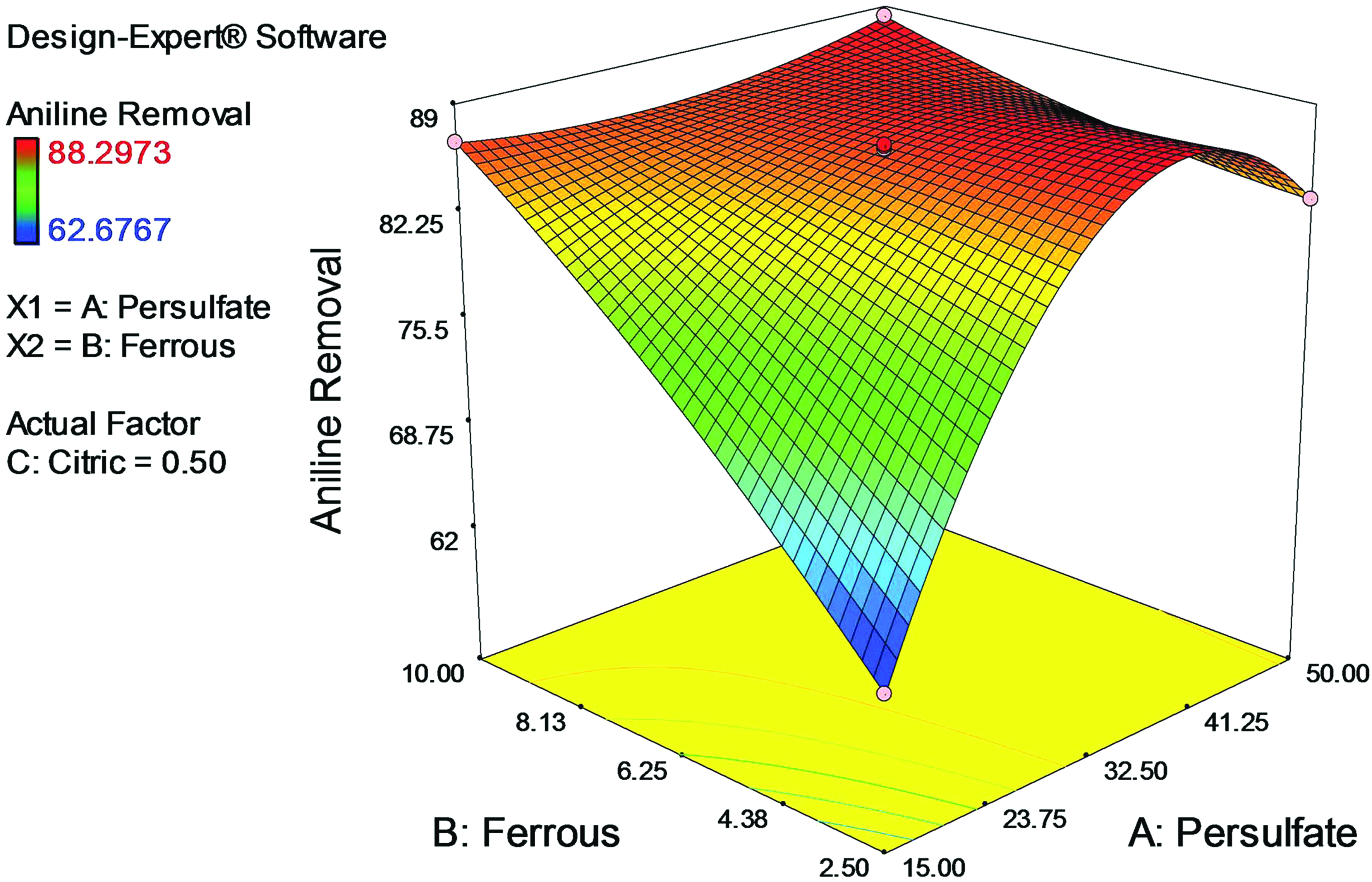
Interaction of persulfte and ferrous in aniline removal efficiency. Color images available online at www.liebertonline.com/ees

Interaction of persulfte and citric acid in aniline removal efficiency. Color images available online at www.liebertonline.com/ees

Interaction of ferrous and citric acid in aniline removal efficiency. Color images available online at www.liebertonline.com/ees
The final equation for estimating aniline oxidation was developed as shown in Eq. (5). The model type selected from the software was the cubic type, which provides only the Coded Factors Model.
Verification of prediction model
Once the final equation for predicting aniline removal by persulfate/ferrous iron/citric acid was statistically derived (Eq. (5)), it is important to verify its accurancy. The following persulfate, ferrous iron, and citric acid concentrations of 38.96, 2.50, and 0.47 mM, respectively, were randomly selected and substituted into Eq. (5) to calculate the removal of aniline, which was found to be 88.15%. An experiment under these conditions was conducted, and the disappearances of aniline were monitored as shown in Fig. 5. It was found that the removal efficiency for aniline was only 60% in 5 min, compared with the predicted value of 88.15%. This implies that the prediction model in Eq. (5) is still insufficient to provide a reliable estimation for aniline removal. More experiments with different reagent concentrations are required to improve the accurancy of Eq. (5).
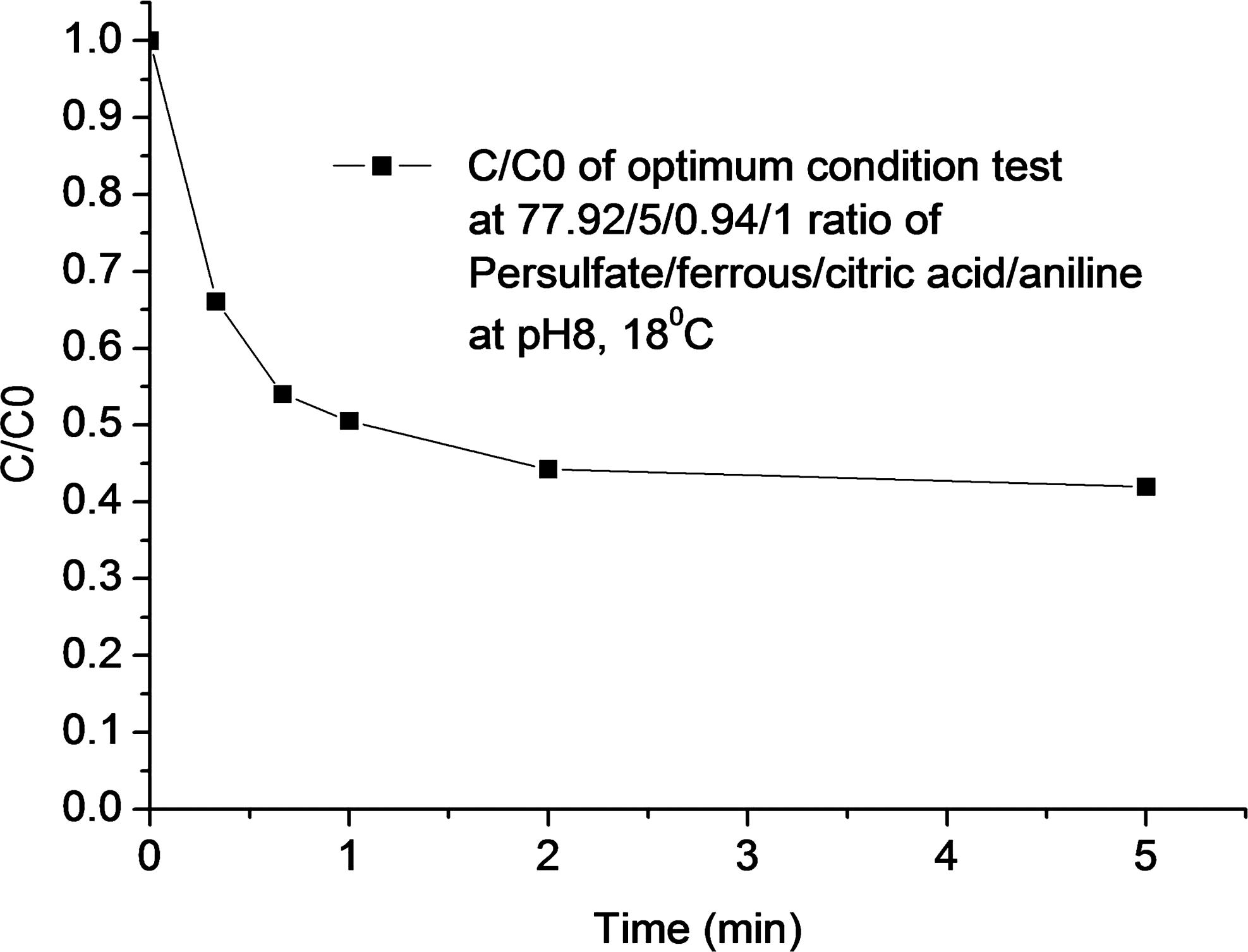
Aniline removal in the experiment with persulfate, ferrous, citric acid, and aniline of 38.96, 2.5, 0.47, and 0.5 mM, respectively, and at pH 8 and 18°C.
Effect of chelating agents
This experimental part was conducted to examine the effect of chelating agent type on the aniline removal efficiency by persulfate oxidation. The concentrations of persulfate, ferrous iron, chelant, and aniline used in this part were 38.96, 2.5, 0.47, and 0.5 mM, respectively, equaling the ratio of 77.92/5/0.94/1 on the molar basis at pH 8 and 18°C. The chelating agents used for the comparision were citric acid (Min et al., 2007), sodium tripolyphosphate (Black et al., 1998; Nayak and Kenney, 1999; Cui et al., 2000), pyrocatechol (Sacan et al., 2008), β-cyclodextrin, and ethylene- diaminetetraacetic acid. All chelating agents are harmless to humans at low concentration (Liang et al., 2004a, 2008a, 2009; Rastogi et al., 2009b). The aniline removal efficiencies were 58.05, 65.13, 82.92, 67.17, and 47.32%, respectively. It can be seen that pyrocatechol was the best ferrous iron chelant for persulfate oxidation when considering the aniline removal efficiency. The structure of chelating agents affects removal efficency, as shown in Fig. 6. Chelating agents are chemicals that form soluble, complex molecules with certain metal ions, inactivating the ions that cannot normally react with other elements or ions to produce precipitates. The purpose of using chelating agents in this study was to prevent ferrous iron from being oxidized to ferric iron, which has no catalytic ability for generation of radicals at high pH (Rastogi et al., 2009a) Therefore, pyrocatechol nonpreference oxidation mechanism is used among all chelating agents over a selected pH (Antoniou et al., 2009). However, further studies are needed to verify its use in field practice.
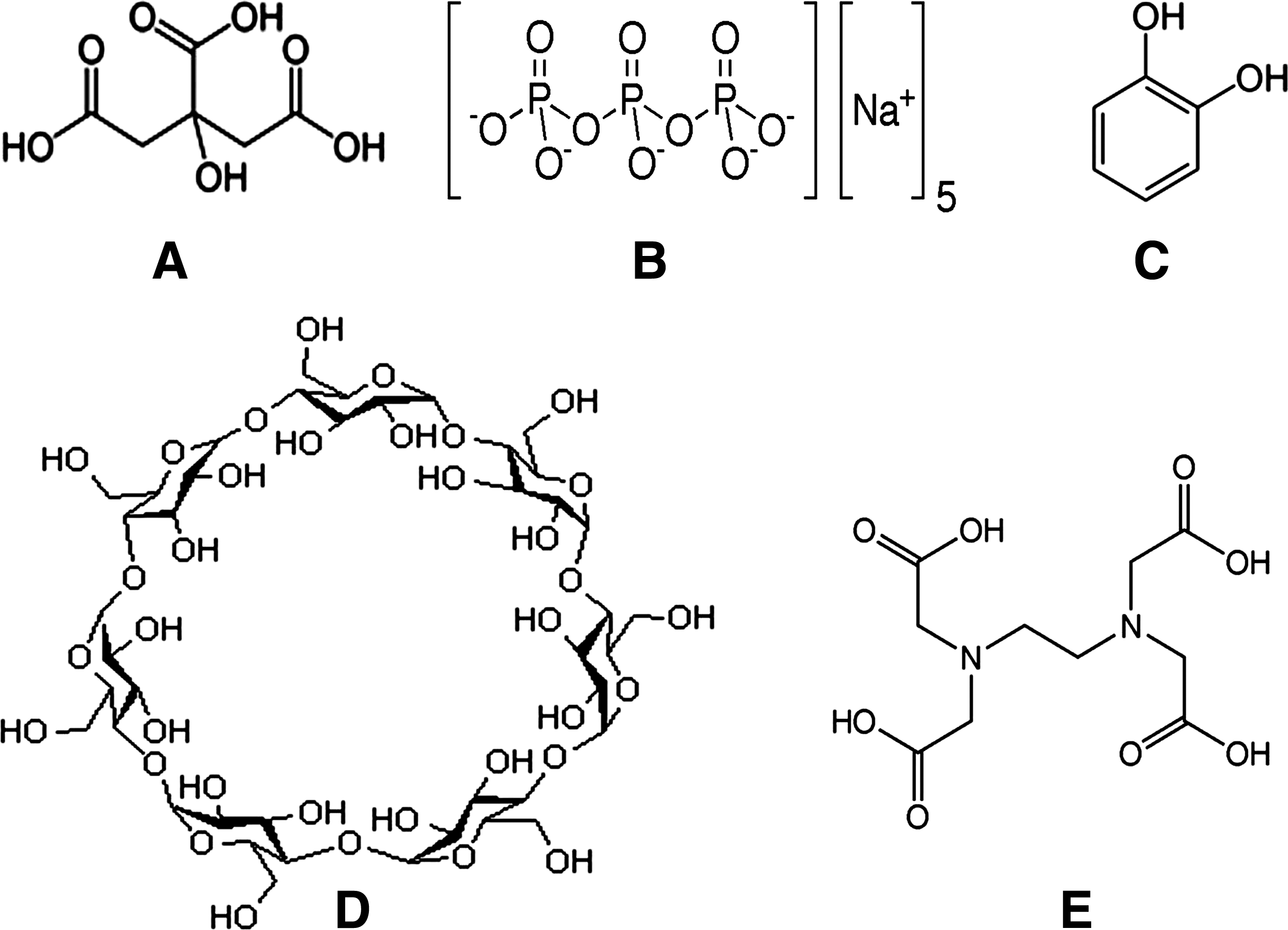
Molecular structure of chelating agents:
Conclusions
The presence of citric acid can enhance the removal efficiency of aniline oxidation. Citric acid, which is a chelating agent, can increase ferrous iron solubility, resulting in increasing decomposition of persulfate to form sulfate free radicals. Under the studied conditions, persulfate, ferrous iron, and citric acid were found to be the key factors affecting aniline oxidation. In the optimization experiments, the ratio of persulfate/ferrous iron/chelating agent/aniline with 77.92/5/0.94/1 at pH 8 and 18°C was randomly selected from a model by which the authors calculated the aniline removalwas 88.15% but the removal obtained by the experiment was only 60%. The main reason is that the model surface was not scrupulous enough and also the selected range cannot show the overview of surface. Using different conditions can improve the model. For example, Fig. 2 shows the high level converging between ferrous iron and persulfate. The red surface area tends to lift up. Therefore, increasing the range might show a better overall view, because what we found was only one side of slope, not overall of the peak surface. In addition, it is necessary to carry out more experiments with different conditions to develop the model scrupulously. The interaction between persulfate and citric acid in Fig. 3 also needs to be improved for the accuracy by the same method. For the interaction between ferrous iron and citric acid in Fig. 4, the capture of surface shows an over view. Even enlarge the range, the graph trend is still the same. However, it is necessary to carry out more experiments with different conditions to scrupulously develop the model. Pyrocatechol was the best ferrous iron chelating agent among all the chelating agents being tested, because it provided significantly better aniline removal efficiency.
Footnotes
Acknowledgments
This research was supported by the Ministry of Education (Grant: P9823) and the National Science Council, Taiwan (Grant: NSC 96-2628-E-041-001-MY3).
Author Disclosure Statement
No competing financial interests exist.