




Abstract
Abstract
Liquid-state vermiconversion (LSV) of excess activated sludge by vermifilter (VF) is a low-cost and ecologically sound process. A VF (with earthworms) and a conventional biofilter (BF; no earthworms) were steadily performed in parallel to treat sewage sludge for 200 days. Elemental analysis, Fourier transforms infrared spectroscopy, gel filtration chromatography, and three-dimensional excitation-emission matrix fluorescence spectroscopy were used to identify changes in organic substances through LSV. Results demonstrated that after BF and VF treatment, the C/N and H/C ratios increased in the VF treatment and decreased in the BF treatment. On the basis of elemental analysis and Fourier transforms infrared spectra, the vermicast in the VF treatment appeared increasingly similar to native excrement expelled by earthworms. Additionally, the VF played a crucial role in converting large molecules (160 kDa) into intermediate molecules (141.9 kDa), while the BF had no effect on the conversion of the large molecules (169.5 kDa). Excitation-emission matrix fluorescence contours described that humic-like substances were detected in sludge treated with VF, while humic-like substances were not detected in BF, suggesting that the VF provides more adequate stability on activated sludge. Consequently, vermifiltration is adaptable for LSV of excess activated sludge, especially in small towns where the economic and technical aspects of treatment are of concern.
Introduction
At present, considerable work has been carried out on various organic wastes by solid-state bioconversion/vermiconversion (composting/vermicomposting). However, it is noteworthy that sludge dewatering has been identified as one of the most expensive and least understood process in wastewater sludge treatment and disposal (Alam and Fakhru'l-Razi, 2003). The use of earthworms for sludge management has turned out to be ecologically sound, economically viable and socially acceptable (Sinha, 2009). Accordingly, recently, an alternative way to treat wastewater sludge before dewatering using earthworms has been developed. Liquid-state vermiconversion (LSV) refers to the conversion of liquid-state waste which involves the conversion of organic material into a source of energy through the interactions of earthworms and microorganisms. Consequently, research on LSV may guide opportunities for a natural, environmentally friendly and nonhazardous management and disposal method for wastewater sludge.
Recently, we reported some encouraging findings on LSV of excess activated sludge by vermifilters (VFs), using Eisenia fetida at an ambient temperature. Volatile organic materials were greatly reduced (56.2%–66.6%), and there was better sludge settleability in our previous work (Zhao et al., 2010). During the vermistabilization process, earthworms ingest, grind and digest organic waste with the help of aerobic and anaerobic microflora in their gut, which lead to a rapid mineralization and humification process and a conversion of the unstable organic matter to a relatively stable and humus-like material (Gupta and Garg, 2009). Thus, the evolution of organic matter stabilization during vermistabilization is of primordial importance in controlling the efficiency of the process. From a theoretical viewpoint, a better knowledge of the distribution and transformation of organic matter is fundamental to better understand many of the natural processes that occur during the vermistabilization process.
Few investigations have advanced knowledge of the distribution and transformations of organic matter in VFs induced by the joint actions of earthworms and microorganisms. Accordingly, the objectives of this study were to address the influences of earthworm amendment on the compositional, structural, and functional properties of organic substances during vermifiltration, using elemental analysis, gel filtration chromatography (GFC), Fourier transforms infrared (FTIR) spectroscopy, and excitation-emission matrix (EEM) spectroscopy.
Materials and Methods
VF design
A cylindrically shaped VF (with earthworms, 30 cm diameter and 60 cm depth), naturally ventilated, was equipped with a perforated polypropylene pipe (1.3 cm diameter) to distribute inflow evenly (Fig. 1). The VF contained a 0.5 m filter bed packed with spherical ceramic pellets (6–9 mm diameter). A layer of plastic fiber was located at the surface of the filter bed to avoid direct hydraulic impacts on earthworms. The inflow was pumped into the VF via a peristaltic pump. Before introduction of concentrated sludge into the VF, it was diluted to a constant organic load of around 1.5 kg VSS/m3·day using tap water; this diluted sludge will be called inflow activated sludge (IAS). After passing through the filter bed, the treated sludge was separated in a sedimentation tank located below the VF; and the supernatant in the sedimentation tank was recycled (Fig. 1).
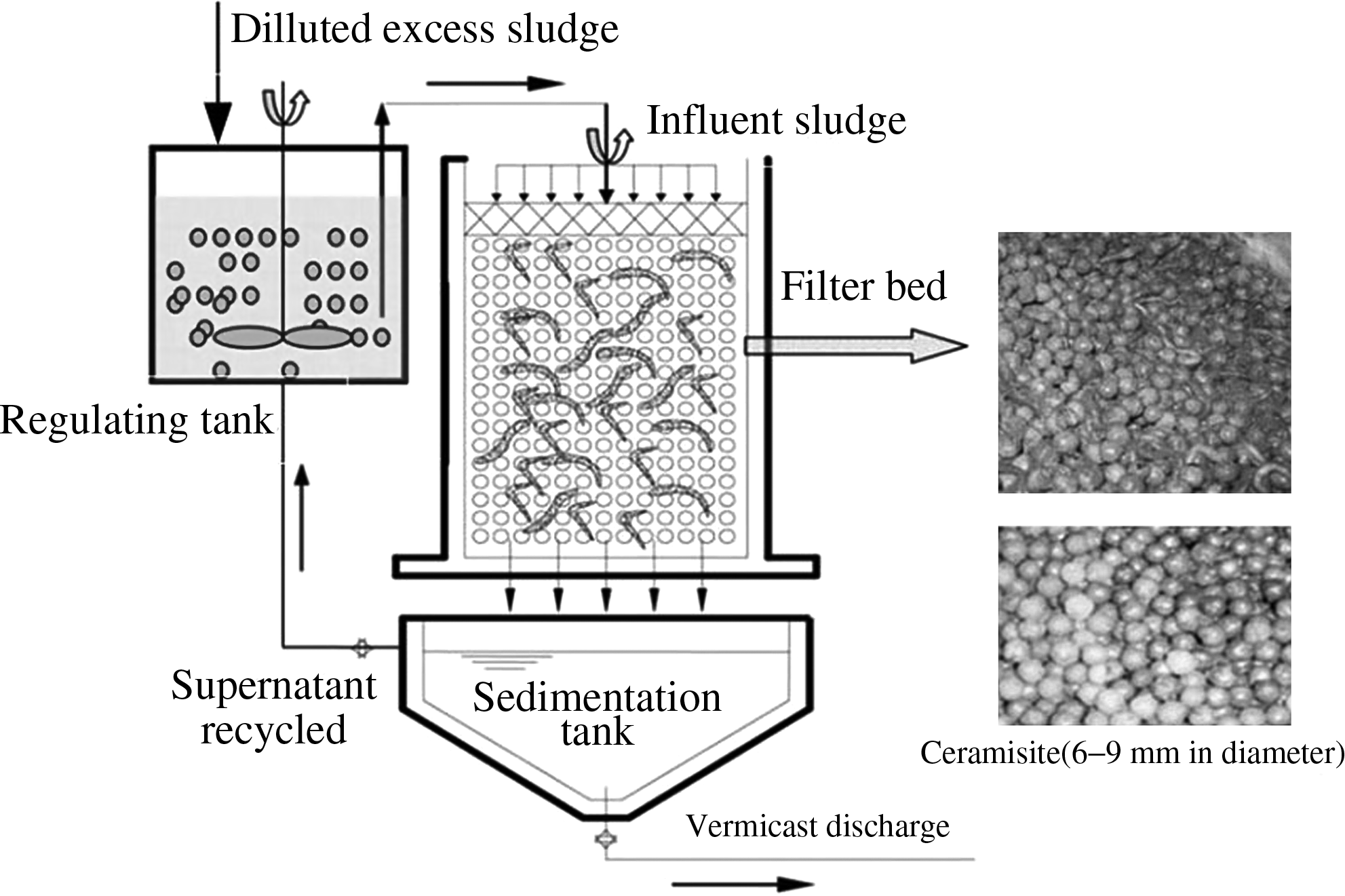
Schematic diagram of the vermifilter (with earthworms).
Sewage sludge characteristics
The initial excess sludge was collected from the secondary clarifier at the Quyang Wastewater Treatment Plant in Shanghai, China. It was characterized for several chemical and physical properties, including water content (99.5%), pH (6.8–7.8), chemical oxygen demand (COD; 9,900–20,000 mg/L), suspended solids (SS; 4,800–7,500 mg/L) and volatile SS (VSS; 65.4%–74.7%).
Cow dung system
Ten mature earthworms were cultured in circular plastic containers (15 cm diameter×14 cm depth) filled with 100% cow dung. The moisture level of the substrate was maintained at ∼70%–72% during the experimental period by periodically sprinkling an adequate quantity of tap water on it. Containers were placed in a humid and dark room at a temperature of 25°C±1°C. As the growing earthworms consumed the substrate material, 100 g was removed and replaced with 100 g of fresh cow dung at a regular interval of 3 weeks so that food shortage would not limit the growth of the worms.
Experimental procedures
To achieve the objectives, a conventional biofilter (BF; no earthworms) was established as a control. On the basis of our previous experimental results, spherical ceramic pellets (Fig. 1) were the preferred filter material because they provide a favorable habitat for both earthworms and microbes. Eisenia fetida was selected as a candidate species mainly because they are distributed worldwide, their life cycles are short, they have a wide temperature and moisture tolerance range, and they are resilient earthworms that can be readily handled (Brulle et al., 2005). The initial earthworm stocking density was 32±1.6 g/L (wet weight). The hydraulic loading rate of the BF and VF was kept at 3 m/day during the experimental period. After an ∼40-day acclimation period, the VF and BF were continuously operated for 200 days.
Samples of the IAS, effluent sludge from the BF (BFS) and VF (VFS), excrements expelled by the earthworms in the VF (VVT) and the cow dung system (VCT) were collected for elemental and FTIR analysis following centrifugation at 9,600×g for 30 min. The samples were air-dried and crushed to pass through a 0.5 mm sieve. Dissolved organic matters (DOMs) were isolated, according to Traversa et al. (2010), for GFC and EEM fluorescence spectroscopy analysis.
Analysis methods
Elemental and FTIR analysis
The variation in C, N, H and S elemental concentrations were measured by a Elementar Vario-III element analyzer. The oxygen concentrations were calculated by difference: O%=100−(C+H+N+S)%. All samples were analyzed in triplicate.
The FTIR spectra of pellets were obtained by pressing a mixture of ∼2–5 mg of a sludge sample and ∼200 mg of spectrometry grade dried KBr under reduced pressure, which was measured immediately after preparation. The IR absorption spectra were collected on a FTIR spectrometer (Nicolet 5700; Thermo Electron Corporation). The scan range of the spectra was 4,000 to 400 cm−1, and the resolution was 4 cm−1.
GFC analysis
The IAS, BFS and VFS samples were fractionated by a GFC analyzer. The GFC system consisted of a TSK G4000SW gel column (TOSOH Corporation) and a liquid chromatography spectrometer (LC-10ATVP, SHIMADZU). Polyethylene glycols with a molecular weight (MW) of 1,215,000, 124,700, 11,840, and 620 Da (Merck Corporation) were used as standards for calibration. The elution of elements at different time intervals was collected by an automatic fraction collector and was automatically analyzed using UV spectroscopy and a dissolved organic matter analyzer to obtain a MW distribution curve.
Three-dimensional EEM fluorescence spectroscopy
All of the three-dimensional EEM spectra were measured using luminescence spectrometry (F-4600 FL spectrophotometer; Hitachi). In this study, the EEM spectra were collected with corresponding scanning emission spectra from 250 to 550 nm at 5 nm increments by varying the excitation wavelength from 200 to 400 nm at 5 nm sampling intervals. The excitation and emission slits were maintained at 10 nm, and the scanning speed was set at 1,200 nm/min for this study. A 290 nm emission cutoff filter was used in scanning to eliminate second order Rayleigh light scattering. The spectrum of Milli-Q water was recorded as a blank. The software, Sufer 8.0, was employed to process the EEM data. The EEM spectra were plotted as the elliptical shape of contours. The X-axis represented the emission spectra from 250 to 550 nm while the Y-axis indicated the excitation wavelength from 200 to 400 nm, and the third dimension, that is, the contour line, expressed the fluorescence intensity at an interval of 5.
Results and Discussion
Elemental analysis
The elemental compositions of the sludge samples, IAS, BFS, VFS, and VVT, are reported in Table 1 and are depicted in Fig. 2.

C, H, N, and S elemental concentrations in the IAS, BFS, VFS and VVT samples. BFS, bilfilter treated sludge; VFS, vermifilter treated sludge; VVT, vermicast produced by the earthworms in vermifiltration; IAS, inflow activated sludge.
IAS, inflow activated sludge; BFS, bilfilter treated sludge; VFS, vermifilter treated sludge; VVT, vermicast produced by the earthworms in vermifiltration.
The reported elemental analysis data indicated a decrease in C, H, N, and S, and an increase in O in the BFS, VFS, and VVT samples. The total content of C, H, N, and S in influent sludge was 56.4%, which decreased to 49.5%, 40.1%, and 42.6%, after BF and VF treatment and VVT, respectively (Fig. 2). The variations in VFS were closer to those of the VVT sample, which demonstrates that the characteristics of VFS resemble the native vermicast. Additionally, the content of C, H, N and S after BF treatment decreased by 5.5%, 0.5%, 0.7%, and 0.4%, respectively. In comparison, the contents decreased by 10.0%, 1.0%, 1.7%, and 0.9%, respectively, after VF treatment. A more substantial decrease in C was observed in the VFS samples than in the BFS samples. This observation identified that the decomposition capacity for C in the VF treatment was linked to the joint actions of earthworms and microorganisms and exceeded that of the BF treatment relative to the actions of microorganisms by themselves. First, organic matter is one of preferred foods of earthworms, especially E. fetida, although microbes are sharply responsible for the biochemical degradation of the organic matters (Aira et al., 2007). In addition, earthworm amendment indeed enhanced microbial activity during organic matters degradation (Edwards, 2004; Aira et al., 2007). The decrease in H indicates a substitution or fusion of aliphatic chains to form aromatic groups or aliphatic unsaturated compounds. However, as shown in Table 1, the H/C ratio increased in the VFS samples, indicating a relative increase in saturated, over unsaturated, structures. Meanwhile, the ratio decreased in the BF sample. The increase in the O/C ratio indicated that the O-containing group (C=O) increased in both the BF and VF processes. The increase in the C/N ratio suggests that the loss of N was larger than the reduction in C in both VFS and VVT samples, whereas the C/N ratio decreased in BFS samples. According to the previous report that a loss of N was mainly due to its incorporation into the earthworm's body proteins, some N may have also been lost through denitrification and trace elements as volatile ammonia (Hartenstein and Hartenstein, 1981). Because nitrogen (N) conversion by earthworms has increasingly focused on (Postma-Blaauw et al., 2006) nitrogen mineralization, its mass balance will be discussed in our future study.
FTIR spectra
The main absorption bands and corresponding assignments of the samples are summarized in Table 2. All spectra feature common and distinctive absorption bands, with some differences in their relative intensity. The main characteristics of these spectra are as follows: ∼3,400 cm−1 is associated with an O-H stretching vibration peak in the range of 3,650–3,200 cm−1, indicating the occurrence of alcohols, phenols and organic acids; ∼2,925 and 2,853 cm−1 associated with asymmetric and symmetric C-H stretching, respectively, of CH2 groups; ∼1,460, 1,380, and 770 cm−1 associated with C-H bending of CH3 and CH3 groups, indicating the occurrence of alkanes; approximately the range of 1,900 to 1,650 cm−1 associated with C=O stretching of aldehydes, ketones, COOH and other carbonyl groups; ∼1,040 cm−1 associated with C-O stretching of polysaccharides or a SiO2 stretching vibration peak, which was probably contributed by a Si-O-C stretching vibration; ∼1,654, 1,541, and 1,234 cm−1 indicating amide I, associated with C-O stretching vibration; amide II, associated with N-H bending and C-N stretching vibration; and amide III, associated with C-N stretching and N-H bending vibration, respectively. The former two are the characteristic absorption bands of proteins. Finally, ∼2,360 and 667 cm−1 can be ignored in the analysis because they are associated with a background peak created by CO2 disturbance.
FTIR spectra of IAS, VVT and VCT
The FTIR spectra of IAS, VVT and VCT are depicted in Fig. 3. The bands at ∼2,850 to 2,925 cm−1 can be attributed to aliphatic C-H group stretching. In comparison with IAS, the FTIR spectrum of VVT shows a sensible decrease in the bands of 2,850 to 2,925 cm−1, indicating that a number of types of organic matter with aliphatic C-H groups in the sample IAS were decomposed by earthworm. The similar character of the band at ∼1,650 cm−1 reflected a substance with aromatic C=C, C=O stretching of amide groups (amide I band), quinonic C=O and/or C=O of the H-bonded conjugated ketone. The bands at ∼1,515 to 1,580 cm−1 can be attributed to lignocellulose. In comparison with the sample IAS, a disappearance of the bands in the relative intensity of absorption bands in the VVT samples indicated that lignocellulose can be completely degraded by the earthworms. Additionally, in bands at ∼500 to 900 cm−1, the FTIR spectra of the VVT samples tended to be smooth compared with those of the VCT samples, which made an indent appearance where there was an aromatic C-H bending vibration, suggesting an aromatization of humic-like substances (HLS). A variety of literature has reported that the interactions of earthworms and microorganisms lead to rapid humification and mineralization processes (Arancon et al., 2006, 2008; Zhao et al., 2010). The humification that occurred in the vermifiltration may be ascribed to the presence of enzymes such as proteases, amylases, lipase, cellulase and chitinase, which continue to disintegrate organic matter even after they have been ejected (Sharma et al., 2005). The HLS presents composition, structure and properties similar to natural humic substances in soil and compost (Arancon et al., 2005, 2006), which discussed further in an additional vermifiltration study (not discussed in detail here).
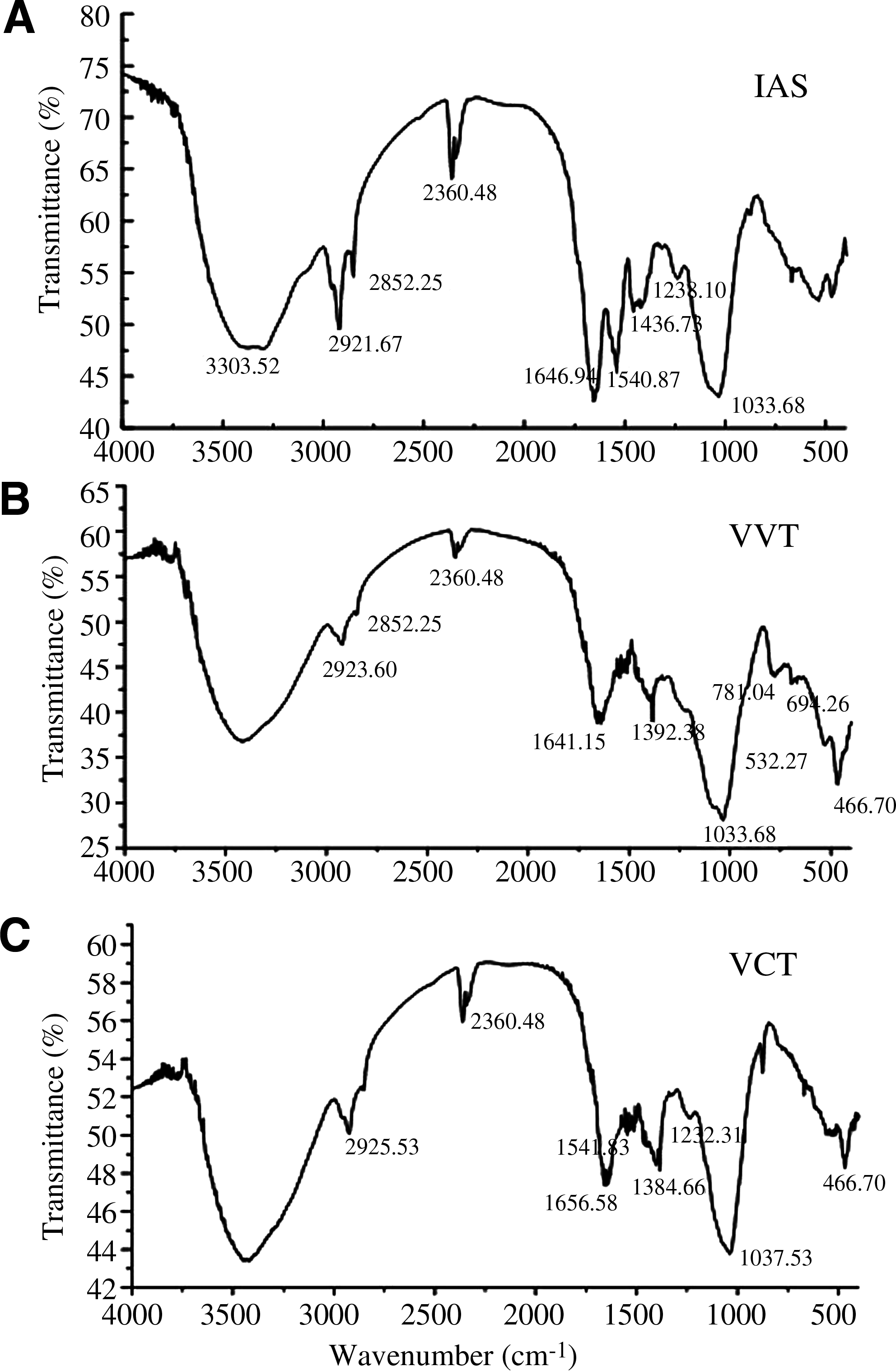
The Fourier transforms infrared spectra of the IAS, VVT, and VCT samples. VCT, vermicast produced by cow dung in vermifiltration.
In addition, a number of peaks in the FTIR spectrum from the VVT sample became weak or disappeared. For example, there was a dramatic decrease in the relative intensity of absorption bands at 2,923, 2,852, and 1,720–1,200 cm−1. It is noteworthy that a shoulder occurred at 1,040 cm−1 in the VVT samples, which indicates that the content of inorganic substances increased. In general, the FTIR spectra of VVT samples appeared increasingly similar to those of native vermicast produced by earthworms cultured in cow dung; even its stabilization took precedence over that of VCT samples. This result can be attributed to a stronger stimulation effect on microbial activity by the earthworms in the VF treatment than that in the vermicast produced by the VF treatment.
The FTIR spectra of IAS, BFS and VFS
FTIR spectra of the IAS, BFS and VFS samples are displayed in Fig. 4. In comparison with IAS, the FTIR spectra of the BFS and VFS samples showed a significant decrease in relative intensity of the absorption bands at 2,850–2,925 cm−1, indicating that a number of types of organic matter with aliphatic C–H groups were substantially reduced. Though a slight change in the intensity of the absorption peaks arises, the appearance characteristics of the FTIR spectra were similar between the BFS and VFS samples, which indicate that BF and VF play a similar role in the decomposition of organic substances. The similarity is that some intermediate molecules can be converted into small molecules, combining with the GFC analysis. However, in our elemental analysis, a greater decrease in the total content of C, H, N and S after VF was observed than that after BF, which indicates that the difference in the outflow sludge lies in the content of organo-functional group. This result can be explained by the qualitative nature of FTIR spectral analysis where small (insensitive) peaks can be hidden because of the complex make-up of the sewage sludge (Han et al., 2005).
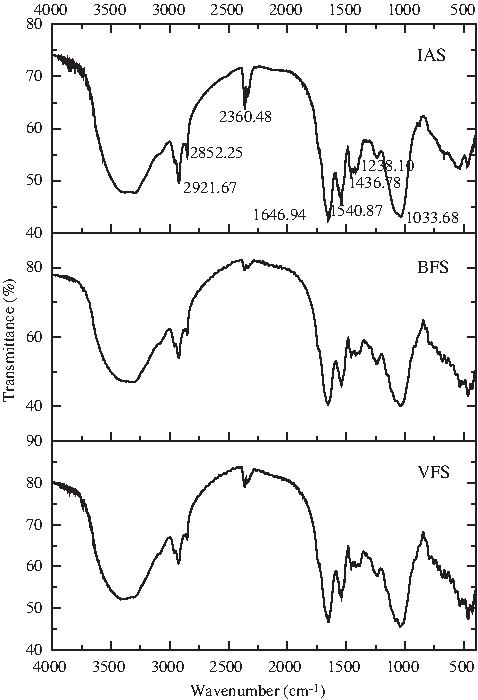
Fourier transforms infrared spectra of the IAS, BFS, and VFS samples.
GFC analysis
The GFC chromatograms and specific parameters of the DOM peaks of DOM in IAS, BFS and VFS samples are illustrated in Fig. 5. The X-axis represents the time when the peak appeared, while the Y-axis indicates the strength of the peak signal. To make a better comparison of the chromatograms, the organic material distribution information between them is depicted in Table 3.
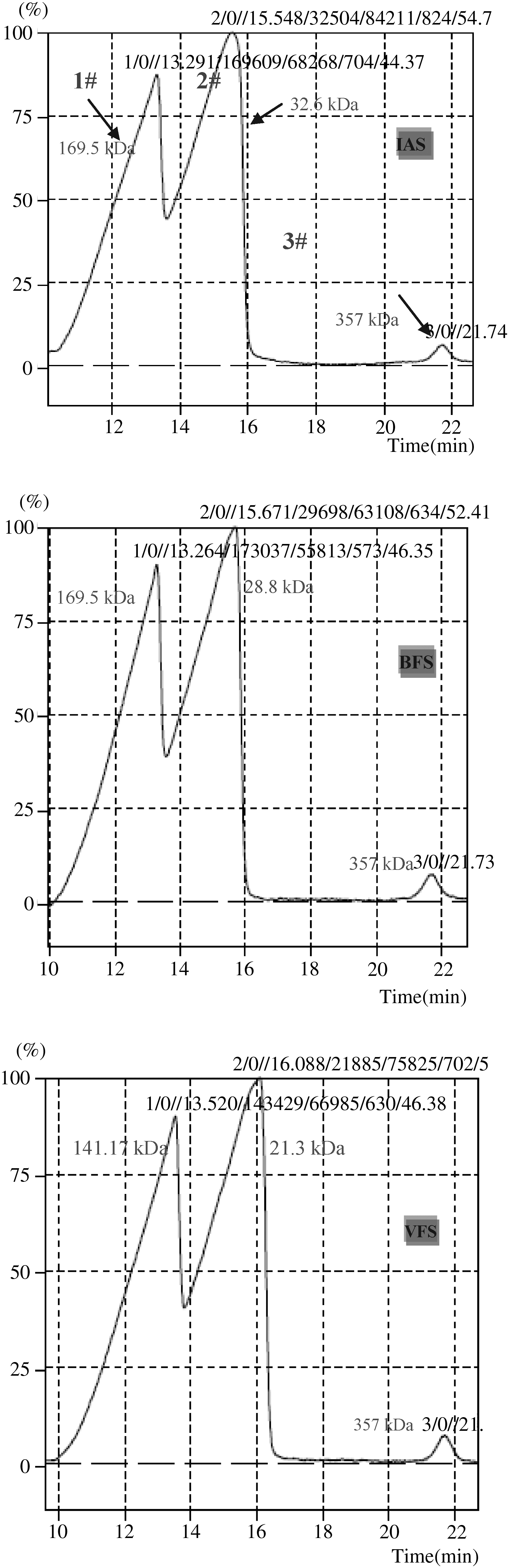
Molecular weight distributions of dissolved organic matter in the IAS, BFS, and VFS samples.
MW, molecular weight.
It is evident that the IAS, BFS and VFS samples have a similar characteristic chromatogram and three peaks (defined as the first peak, the second peak and the third peak) detected in the three samples. However, the differences can be discerned by the elution times, which feature the MWs of the DOM. The elution times of the first peak are 13.29, 13.29, and 13.54 min in the IAS, BFS and VFS samples, respectively. The corresponding MWs are 169.5, 169.5, and 141.1 kDa, respectively, which suggest that VF can convert large molecules (169.5 kDa) into intermediate molecules (141.1 kDa). This pattern can be attributed to ingestion and digestion of the large MW molecules into low MW organics by the earthworms in the VF. However, the microorganisms alone could not convert the large MW molecules in the BF.
The MWs of the second peaks in the IAS, BFS, and VFS samples are 32.6, 28.8, and 21.3 kDa. The results indicated that the BF and VF had a dominant influence on the degradation of intermediate molecules. In general, the organic degradation in the VF was more powerful than that in the BF, underlining that earthworm amendment plays a crucial role in the decomposition of organic matter, wherein during the process, earthworms fragment the waste substrate, providing a larger surface for microbes and accelerating the rate of decomposition of the organic matter and leading to a vermistabilization effect through which unstabilized organic matter becomes stabilized (Garg et al., 2006).
Fluorescence spectra
The EEM spectra of the IAS, BFS, and VFS samples are exhibited in Fig. 6. Fluorescence parameters of the spectra including peak location and fluorescence intensity, and the corresponding substances are summarized in Table 4. It is evident that two main peaks could be readily identified in the EEM fluorescence spectra of the IAS, BFS and VFS samples. The first main peak was identified at the excitation/emission wavelength (Ex/Em) of 285/340 nm (Peak T), while the second main peak was observed at the Ex/Em of 240/350 nm (Peak T). According to Table 4, the two detected peaks were reported as protein-like peaks, in which the fluorescence is associated with the aromatic amino acid tryptophan (Coble, 1996; Baker et al., 2004). It should be noted that Peak T and T′ were detected in all three samples. However, because of the weaker fluorescence intensity of Peak T′, its appearance was obscured in the BFS sample. Peak T is described as the large MW molecules, which has a broad distribution in the IAS sample, while Peak T′ belongs to the small biodegradable molecules in conjunction with the GFC results. Consequently, the combination of earthworms and microorganisms showed greater decomposition than microorganisms themselves.

The excitation-emission matrix fluorescence spectra of the IAS, BFS, and VFS samples.
Ex/Em, excitation/emission.
Additionally, another peak (Peak C) with low fluorescence intensity that is not obvious in Fig. 6 is also listed in Table 4. Depending on the five regions of EEM divided by the previous literature (Chen et al., 2003), Peak C (detected in an additional study and not described in detail here) indicates the occurrence of the HLS, which indicate stabilization of the treated sludge by vermifiltration, as discussed in our previous study (Zhao et al., 2010). The detection of HLS by fluorescence spectra agreed with the FTIR results.
Conclusions
Our previous work demonstrated that vermifiltration is a feasible method for successfully treating liquid-state excess sludge. Compared with composting and vermicomposting (a solid-state bioconversion/vermiconversion), LSV of excess sewage sludge is expected to reduce the total treatment costs. Abridging the addition of cheap supplements (carbon sources) and substituting sludge drying for sludge dewatering due to enhanced settleability and dewaterability of the sludge by vermiconversion (not discussed in detail here) will reduce costs. Consequently, this method of treatment is economically and technically adaptable for use in small towns.
The following principal conclusions were drawn:
(1) The two filters with and without earthworms exhibited different organic decomposing abilities. The BF with earthworms (VF) represented a better degradation and humification process on the organic matter, owing to the interactions of the earthworms and microorganisms. (2) The chemical and spectral analysis demonstrated that the VF exerted a greater effect on the reduction of the organic carbon in comparison to the BF and was able to convert the large MW molecules into intermediate molecules, which the BF did not do. (3) The better stabilization of the sewage sludge produced by VF can be attributed to the occurrence of the humic substances detected by EEMs, which were intimately associated with the ingestion, grinding and digestion of the earthworms.
Footnotes
Acknowledgments
The authors gratefully acknowledge the financial support from Young Cadre Teachers of Tongji University Project (2008KJ021), National Spark Program of China (2010GA680004), Shanghai Science & Technology Research Programs (09dz1204107), and the National Major Project of Science & Technology Ministry of China (2008ZX07421-001,002, 2008ZX07407-007-1). The Program for New Century Excellent Talent in University (NCET-08-0404) and the Excellent Doctoral Dissertation Nationwide Foundation (200756) are also acknowledged.
Author Disclosure Statement
The authors declare that no conflicting financial interests exist.