




Abstract
Abstract
Extractions of extracellular polymeric substances, be it in their soluble (soluble microbial polymers [SMPs]) or extractable (extractable extracellular polymers) form, are commonplace in activated sludge research. However, a large variety of extraction protocols exists. This study focuses on the SMP polymers extraction. A literature survey revealed the prevalence of four extraction protocols: centrifugation, centrifugation combined with filtration, filtration, and sedimentation; but even within each of these protocols, the applied extraction conditions vary extensively. To decrease this variety, the impact of different extraction conditions was first investigated. In a second step, the different extraction protocols were compared with each other in terms of the extracted amount of SMP and their repeatability. Finally, a validation test on the different types of sludge was performed. This led to the conclusion that centrifugation (5000 g for 10 min) followed by filtration (prerinsed filter of 11 μm pore size) is the most reliable and generic applicable SMP extraction protocol.
Introduction
The emphasis is mostly laid on the extraction of the extractable EPS (eEPS) fraction, but the extraction of the soluble microbial polymers (SMP) is of equal importance. The SMP fraction is of particular interest in an MBR context given its presumed fouling properties.
Current status of SMP extraction
In literature, not much attention has been paid to the comparison and optimization of different SMP extraction protocols, although a wide variety exists. Table 1 illustrates part of this variety in SMP extraction methods. The most widely used protocols are as follows (in order of decreasing use): (1) centrifugation, (2) centrifugation combined with filtration, (3) filtration, and (4) sedimentation. The remaining extraction protocols are either combinations of centrifugation with other techniques or less-used SMP extraction protocols such as ultrasound or heat extraction.
The reason for the dominance of centrifugation-based techniques can probably be found in the practical definition of SMPs. This definition states that SMP is the fraction that can be extracted by centrifugation alone, with the polymers in the supernatant defined as SMP and the polymers bound to the pellet, which need an additional extraction step to loosen them from the cell, as eEPS (Wingender et al., 1999).
The variety among SMP extraction protocols is not the only problem; a lot of variation also exists within each extraction protocol. For example, for centrifugation, there is no consensus on the centrifugation force or time (see Table 1). This makes it hard to compare and interpret results. Therefore, it is necessary to know the effects of the different process conditions on the SMP extraction, such that those conditions which ensure the most reliable and generic results can be selected.
In this article, the four most widely used SMP extraction protocols are investigated. The impact of different extraction conditions (within each of these extraction protocols) on the SMP fraction is quantified. Apart from the total extracted amount, the repeatability and general applicability also will be assessed. On the basis of the obtained results, a comparison is made between all four extraction protocols. Based on these results, the most reliable and generic applicable SMP extraction protocol is selected, which should make the comparison of future SMP results more straightforward.
Experimental Protocols
Activated sludge samples were collected from a large-scale municipal wastewater treatment plant (Leuven, 130,000 people equivalents). All samples were stored at 4°C and analyzed within 2 days of collection. Mixed-liquor suspended solids (MLSS), mixed–liquor volatile suspended solids (MLVSS), and sludge volume index (SVI) were performed in accordance with the procedures described in APHA Standard Methods (Clesceri et al., 1998).
Extraction protocols
All extraction methods were performed in duplo. Although it is common practice (see, e.g., Jin et al., 2003; Sponza, 2003; Comte et al., 2006; Li and Yang, 2007; Sheng et al., 2007), the activated sludge samples were neither concentrated before extraction nor were they washed with a buffer or distilled water, because this would mean a loss of SMP (Gehr and Henry, 1983).
Sedimentation
Ten 250 mL activated sludge samples were allowed to settle in 250 mL measuring cylinders. From each cylinder, a 10 mL supernatant sample was taken once with a pipette at the following preset time instances: 1, 2.5, 5, 7.5, 10, 15, 20, 30, 45, and 60 min (i.e., cylinder one at 1 min; cylinder two at 2.5 min; and so on). The supernatant was used for further analysis.
Centrifugation
A 50 mL activated sludge sample was centrifuged in an Eppendorf 5810R centrifuge with a fixed angle rotor (F34-6-38, rotor radius: 11.5 cm, fitted with appropriate adapters). All samples were centrifuged at 4°C. Two series of centrifugation runs were made: (1) increasing the relative centrifugal force (RCF) (500, 1000, 2500, 5000, 7500, and 10,000 g) with a constant centrifugation time of 10 min, and (2) increasing the centrifugation time (1, 5, 10, 15, 30, 45, and 60 min) with a constant RCF of 5000 g. The supernatant was carefully decanted and used for analysis.
Filtration
A 20 mL activated sludge sample was filtered over different filters (Table 2). The filtrate was used for analysis. All filters were rinsed with demineralised water to leach all loosely attached filter material that could interfere with polysaccharide analysis (Jiang, 2007).
Analysis of extracts
All extracts were analyzed in the same way. If analysis was not performed on the same day of extraction, then the extracts were stored in a refrigerator at 4°C and analyzed within 2 days. All analyses were performed in duplo.
Soluble microbial polymer
Polysaccharides were determined according to Dubois et al. (1956) and proteins, according to Lowry et al. (1951), modified by Frølund et al. (1996). The SMPs were calculated as the sum of polysaccharides and proteins.
Turbidity
Turbidity was measured as absorbance at 650 nm on a DR 5000 spectrophotometer (Hach Lange).
Results and Discussion
Standardization of SMP extraction techniques
Sedimentation
The extraction of SMPs by means of sedimentation is dictated by two parameters: the settleability of the sludge and the sedimentation time. Due to the varying nature of the sludges' settleability and time constraints, this method does not always yield good results (Rosenberger et al., 2005). The SVI provides an indication of the settleability of the sludge. If given enough time, even sludge with a high SVI value (e.g., bulking sludge) will eventually settle. To avoid interference of bad settling sludge at this stage of the study, the sludge samples in this part of the study exhibited low SVI values, thus allowing for easy sampling because the biomass settles well and fast.
The influence of sedimentation time on the amount of SMP extracted is shown in Fig. 1. The SMP concentration rapidly reaches a constant value of 11.57±3.94 mg/g MLVSS after 5 min of settling. The high SMP concentration at the lower sedimentation times (1 and 2.5 min.) are due to biomass entrainment in the pipette, because the sludge has not settled enough to be able to take a clear supernatant sample. This leads to higher measurements of proteins and polysaccharides (and, thus, SMPs).
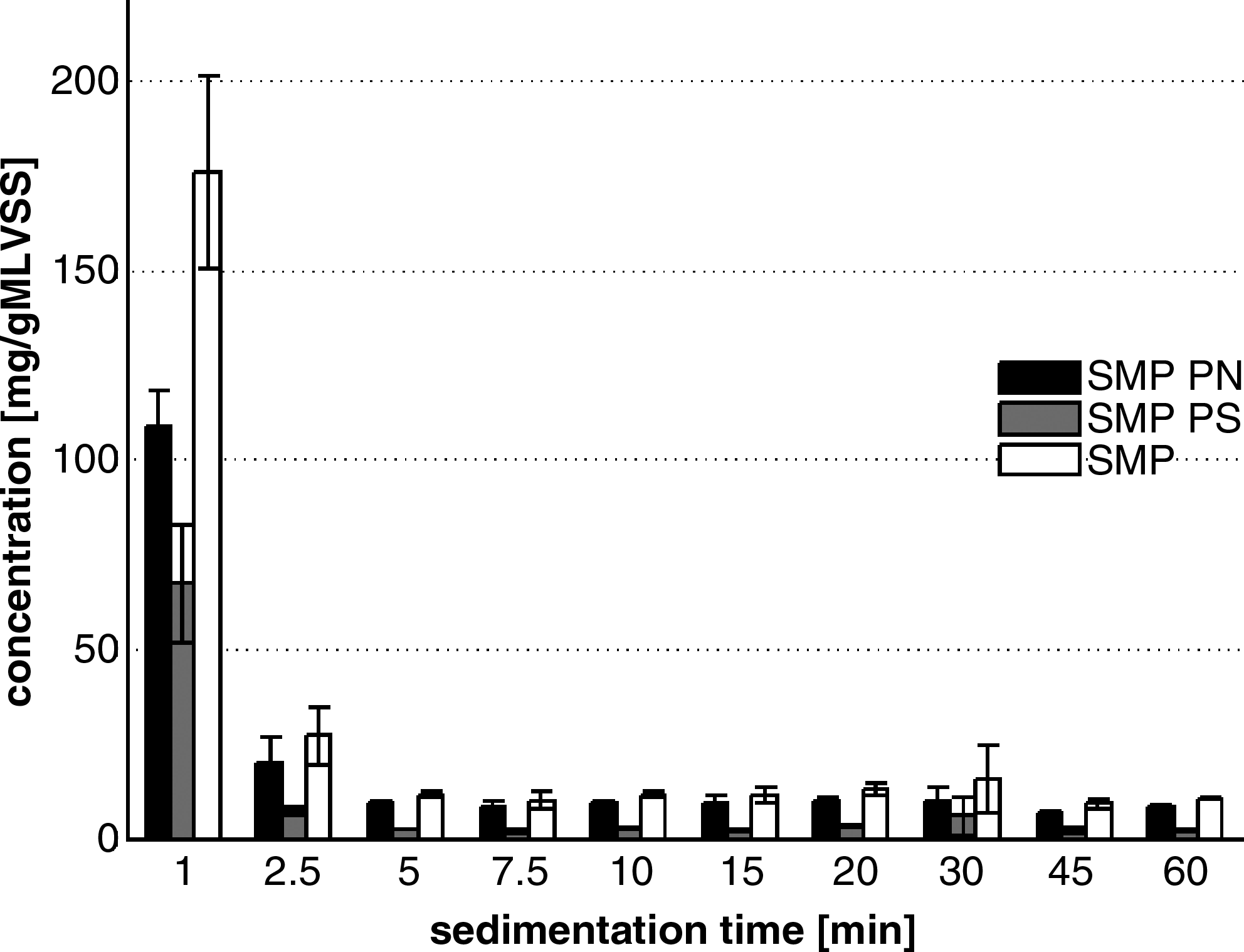
Evolution of protein (PN) and polysaccharide (PS) fractions of the SMPs and the total SMP amount with increasing sedimentation time (MLSS: 4.96 g/L; MLVSS: 2.73 g/L; SVI: 80.56 mL/g). SMP, soluble microbial polymer; MLSS, mixed–liquor suspended solids; MLVSS, mixed–liquor volatile suspended solids; SVI, sludge volume index.
Hence, it is clear that the extract should be void of suspended solids (measured as turbidity at 650 nm) to have a large repeatability. The turbidity during sedimentation dropped from 1.347 after 1 min to 0.106 after 2.5 min and from thereafter, remained lower than 0.030.
Centrifugation
In literature, a great variety exists within this method concerning the RCF or rotations per minute (rpm) and centrifugation time used. These settings have an important effect on the extraction of SMPs by means of centrifugation. Both RCF and rpm can be used, with an easy conversion from one to the other when the radius of the rotor is known.
First, the effect of RCF on the SMP extraction was investigated. The centrifugation time was kept constant at 10 min. The extracted SMP amount decreases with increasing RCF (Fig. 2a), which is logical as a higher RCF allows for more (small) particles to settle (Rosenberger et al., 2005). Although the quality of the sludge pellet is, at first sight, not of interest for SMP extraction, it is important to note that a sample with a firm sludge pellet is easier to decant and leaves a minimal amount of suspended solids in the supernatant. This leads to more stable readings (with a lower standard deviation) for SMPs. Turbidity decreased continuously from 0.041 at 500 g to 0.006 at 10,000 g.
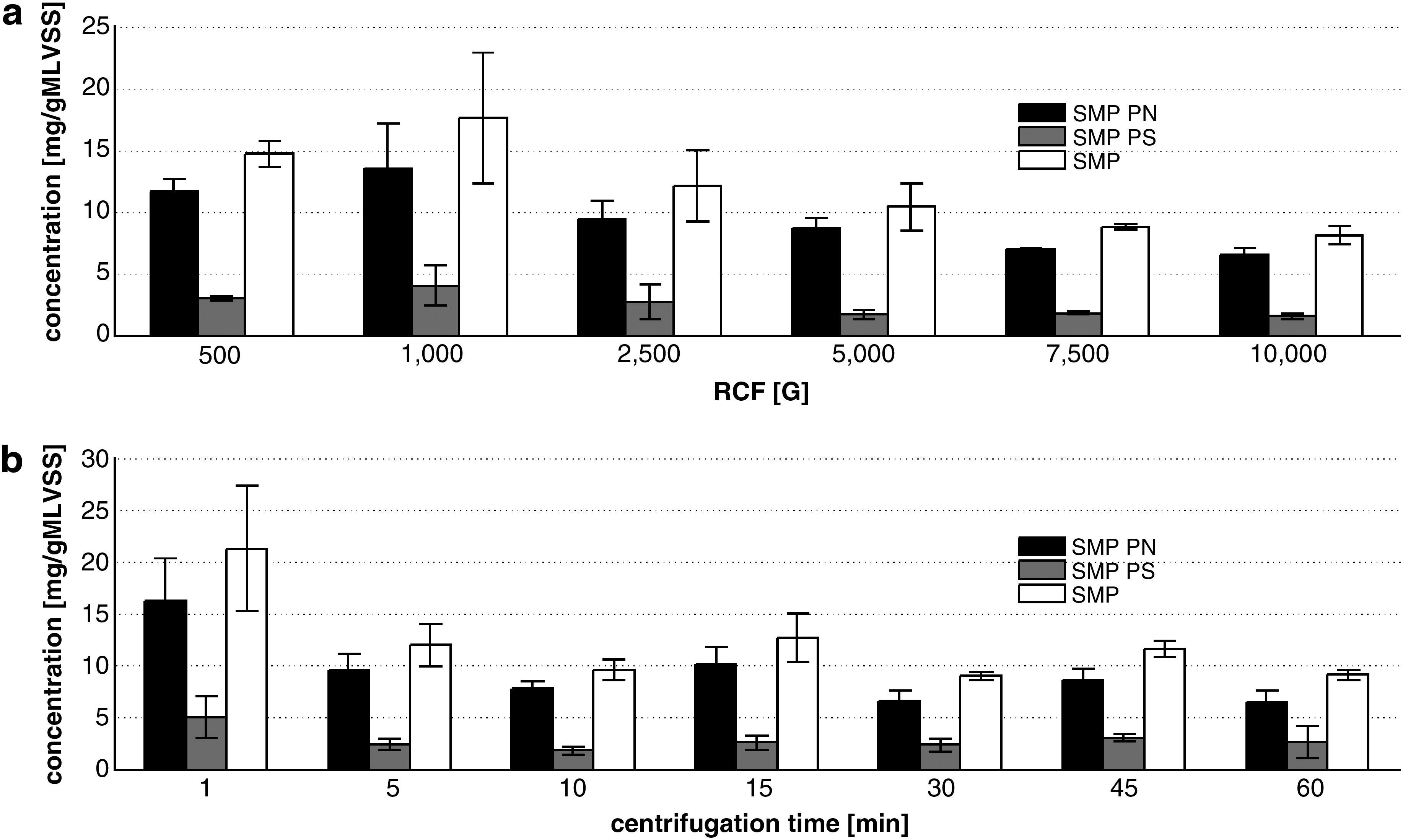
Second, the impact of centrifugation time (1, 5, 10, 15, 30, 45, and 60 min) on the amount of extracted SMP was examined (Fig. 2b). The centrifugation force was kept constant at 5000 g. The amount of extracted SMP reaches a constant value of 10.66±0.59 mg/g MLVSS fairly quickly. The work from Evenblij and Van der Graaf (2004) suggests a drop in protein concentration (±50 to±25 mg/L) from 10 to 60 min, but no intermediate times where analyzed. At centrifugation times longer than 60 min protein, concentrations remained constant. Time does not seem to have a big impact on the amount of extracted polymer, although a minimal amount of time is required to allow for the (small particles in the) activated sludge to settle. The impact on turbidity is less pronounced but follows the same trend. At a centrifugation time of 1 min, a high turbidity (0.085) is measured. A centrifugation time of 5 min, or higher, yields a turbidity lower than 0.036; and even lower turbidity is measured at higher centrifugation times (30, 45, and 60 min).
Filtration
With the filtration extraction method, two aspects need to be taken into account, that is, filter material and pore size.
The first aspect is often forgotten but, nevertheless, an important feature, because some filters can leak filter material when used. Most researchers use paper (i.e., cellulose) filters. When leakage occurs, this is analyzed as polysaccharides by the Dubois method (Evenblij and Van der Graaf, 2004; Rosenberger et al., 2005; Jiang, 2007). The amounts are small, that is, in the range of 2–5 mg/L, but they can influence the SMP results. Other materials, such as, glass fiber or polyethersulfon, are used when smaller pore sizes are required.
To have a uniform procedure, all filters of all types were rinsed with 100 mL demineralized water before SMP extraction.
The second and most important aspect is the pore size. Fractionation of SMPs (and eEPS) in different classes, for example, based on size, becomes possible. In addition, filtration of biomass leads to exclusion of bigger particles, because the biomass layer acts as an additional filter. Hence, it is important not to overload the filter with sample; otherwise, more SMP components will be captured in this secondary (biomass) filter (Evenblij and Van der Graaf, 2004). The resulting turbidity in the filtrate always remained lower than 0.007.
Figure 3 shows that with decreasing pore size, the amount of extracted SMPs decreases.
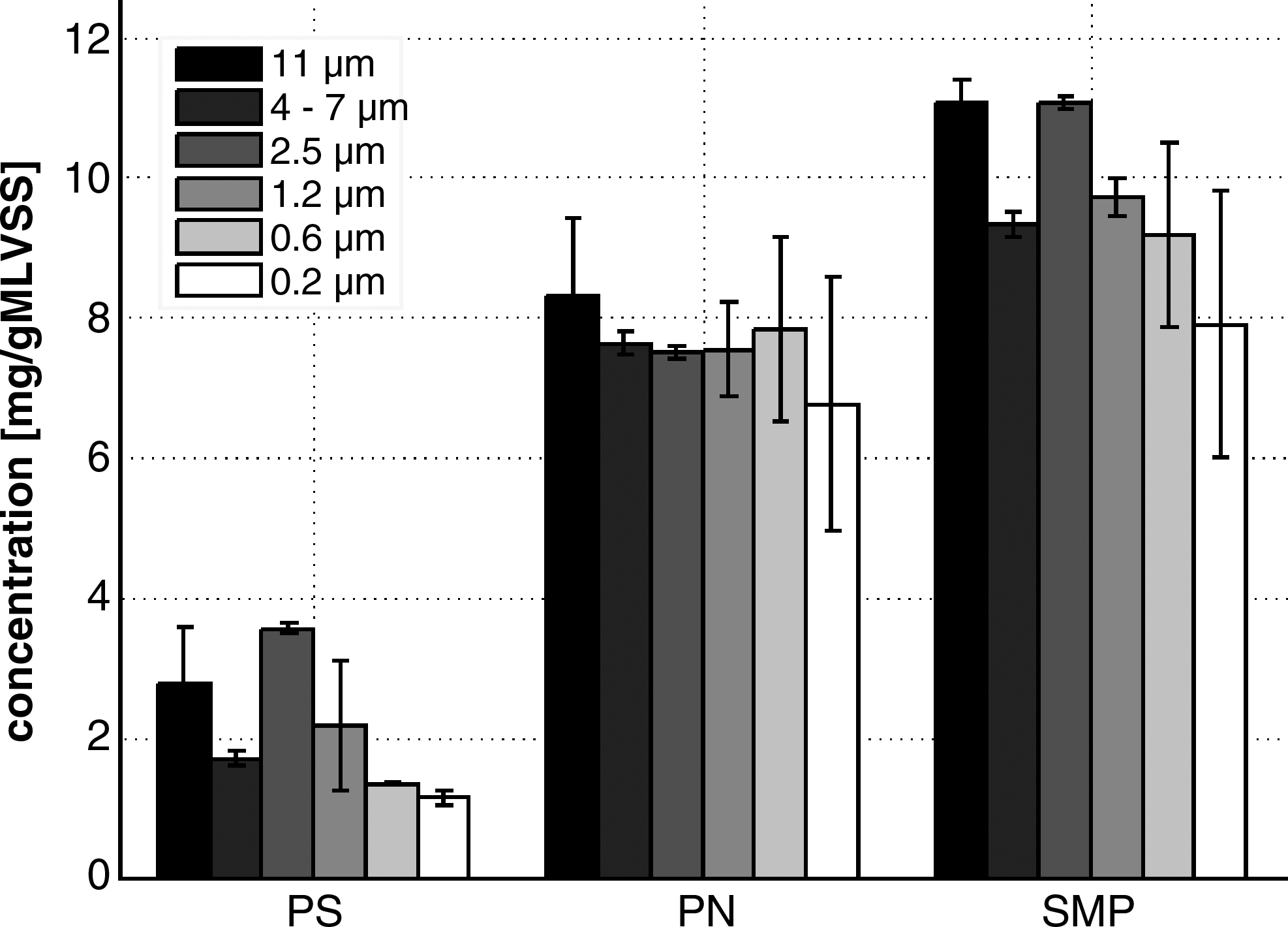
Effect of pore size on extracted amount of SMP-PS, SMP-PN, and total SMP (MLSS: 3.39 g/L; MLVSS: 2.32 g/L; SVI: 58.92 mL/g).
To enable a fair comparison, the most suitable extraction parameters of the investigated SMP extraction methods were selected to test additional samples:
Sedimentation: A sedimentation time of 30 min in a 250 mL measuring cylinder was selected as most suitable, although this largely depends on the settleability of the sludge. This extraction method tends to give the highest readings for SMPs.
Centrifugation: 5000 g (or 6239 rpm) as RCF and 10 min of centrifugation time were selected, which, combined, give the sludge sample ample time to sediment and form a good sludge pellet.
Filtration: A paper filter (or equivalent) with a pore size of 11 μm was selected for the extraction. The filter was rinsed with 100 mL demineralized water before extraction.
Centrifugation followed by filtration: The proposed method for centrifugation and filtration was combined in this method. The advantage is that after centrifugation, most of the suspended solids are already removed; and, hence, there is no additional biomass filter that reduces the pore size of the filter material. This method yields turbidities lower than 0.007 in the final filtrate.
Repeatability
In the next step, the repeatability of each method was investigated. With repeatability, the variation among repeated extractions on one activated sludge sample is meant. Here, 10 repetitions were made for each extraction method on the same bulk sample (Table 3). The coefficient of variation (CV) was calculated for each of the repeated extracts. Surprisingly, the CV for the centrifugation method is rather high, that is, 7.42%. This is because the sludge did not form firm pellets, and some suspended solids remained in the supernatant, which led to a higher supernatant turbidity. In some samples, the turbidity in the supernatant was higher than in others, which gave a broad range in SMP values and, thus, a high CV. Normally, the CV of centrifugation is expected to lie between filtration and sedimentation.
MLSS: 3.77; MLVSS: 2.07; SVI: 50.84 mL/g.
For each method, 10 extractions were performed.
CV, coefficient of variation.
According to the CV, the most stable measurements are obtained by centrifugation followed by filtration (3.54%), and goes in increasing order from filtration (3.80%) over sedimentation (4.44%) to the centrifugation (7.42%.) method.
Validation
To validate the different methods, extractions were performed on different types of activated sludge: dairy, starch, and sugar industry. Also, a bulking sludge sample (i.e., a high SVI sample) from the originally sampled municipal wastewater treatment plant was analyzed.
It is apparent from Table 4 that a large variety in SMP amounts exists among different types of activated sludge. For all samples, the protein concentration was higher than the polysaccharide concentration. On average, sedimentation yields the highest amount of SMPs, whereas the combination method (centrifugation followed by filtration) yields the lowest amount. In order of decreasing SMP yield, this becomes sedimentation>centrifugation>filtration>centrifugation+filtration. This is in accordance with Evenblij and Van der Graaf (2004), who found that the highest yield for protein concentration for municipal activated sludge can be achieved by centrifugation (10 min at 5000 rpm), followed by paper filtration (Schleicher & Schüell 589/2, 4–12 μm pore size), and the lowest amount by filtration after centrifugation. The standard deviation, on the other hand, is the lowest for the combination method and the highest for the sedimentation method. From the viewpoint of working toward a generic applicable SMP extraction protocol, the most important conclusion which can be drawn from this table is that for some samples, it was impossible to extract SMPs by means of sedimentation or filtration, due to the bad settling behavior of the sludge (dairy and sugar samples) or blocking of the filter (sugar sample). In contrast, centrifugation followed by filtration of the resulting supernatant was always possible. Centrifugation alone yields (evidently) higher SMP values; but whether this is due to the intrinsic content of the supernatant or due to a part of the pellet that came loose is not clear. To maximize the repeatability of SMP extraction and to rule out the quality of the sludge pellet, we, therefore, propose to always add a filtration step after the centrifugation step, resulting in lower but much more precise SMP values.
The recorded SMP values (mg/g MLVSS) are mentioned for each of the four extraction methods.
n.a., no SMP values could be obtained; b, bulking sludge sample.
Conclusions
The problem with SMP extractions is twofold: a vast variety of extraction protocols exists; and within each method, a large variety exists in applied conditions, which makes comparison of results difficult. Therefore, the impact of different extraction parameters on centrifugation, centrifugation followed by filtration, filtration, and sedimentation was investigated. A validation test on different sludges revealed that sedimentation and filtration are not always possible because of settling or filtration problems. Centrifugation (5000 g for 10 min) and centrifugation followed by filtration of the resulting supernatant (5000 g for 10 min followed by filtration over a 11 μm prerinsed (100 mL demineralized water) cellulose filter) was always possible for the sludges under investigation. Despite lower yields of the combination method, it is here proposed as the most reliable and generic applicable SMP extraction method.
Footnotes
Acknowledgments
J.V.D. is a doctoral student financed by the Institute for the Promotion of Innovation by Science and Technology in Flanders (IWT Flanders) IWT-SB/81355. The work is further supported by Projects IDO/06/008, OT/10/35, and PFV/10/002 (Program Funding: Optimization in Engineering) of the K.U. Leuven Research Council, the MEMFICS IWT-70406 Project (sponsored by IWT Flanders and Keppel Seghers), and the Belgian Program on Interuniversity Poles of Attraction, initiated by the Belgian Federal Science Policy Office. J.V.I. holds the Chair Safety Engineering sponsored by the Belgian Chemistry and Life Sciences Federation Essenscia. The scientific responsibility is assumed by its authors.
Author Disclosure Statement
No competing financial interests exist