




Abstract
Abstract
A three-pathway reaction mechanism is proposed to describe the electrochemical oxidation for decomposition of organic molecules. On the basis of the mechanism, experiments were conducted as direct and indirect treatments to distinguish the contribution of each pathway on color removal and chemical oxygen demand (COD) reduction. For indirect treatment, efforts were made to investigate the interaction among pH, oxidation reduction potential, and the formation of OCl−, the major oxidizing agent in the electrolysis of NaCl aqueous solution. With 30 min electrolysis under 10 V on a solution of 1 g/L NaCl, the current was able to produce enough oxidizing agent to completely remove the color in a solution of 50 mg/L Reactive Blue 19. It took 2 g/L NaCl under 20 V in 30 min to generate enough oxidizing agent to reduce >99% of the COD in 20 min. In direct electrochemical treatment, dye molecules are oxidized by oxychlorine compounds and secondary oxidizing agents generated in electrolysis as well as by direct oxidation on the surface of the anode. Synergetic effects between oxidizing agents and surface oxidation dramatically increase the reaction rate constant for color reduction and shorten the treatment time for COD removal. With 2 g/L NaCl in the solution, color removal was almost instantaneously and 99% COD removal was achieved in 10 min. The three-pathway mechanism adequately explains why freshly generated hypochlorite solutions are more effective than commercial bleach for color reduction. It also explains the difference in COD reduction between direct and indirect electrochemical treatment processes. Quantitative data from direct and indirect treatments were collected and presented to assist reactor and process design. This work also lays a foundation for future research on system optimization.
Introduction
The commonly accepted mechanism of AOP processes for dye decomposition is based on the formation of very reactive hydroxyl radicals (HO•). With a standard reduction potential of 2.80 V, the HO• can oxidize a broad range of organic bonds and functional groups. As these radicals are so reactive and unstable, they must be continuously produced on site by means of photochemical and/or chemical reactions. According to the way HO• radicals are produced, AOP can be categorized as hydrogen peroxide-based (H2O2) (Aleboyeh et al., 2003; Mahmoodi et al., 2005), ozone-based (O3) (Khadhraoui et al., 2008; Wu et al., 2008), and UV-based (Liu and Chiou, 2005; Kim and Park, 2006) processes. In most applications, a combination of the chemicals and irradiation is applied to create a synergetic effect on color removal. The most important AOP are H2O2/UV, H2O2/O3 and Fenton reagent.
Electrochemical oxidation has been studied extensively for its ability to reduce color without generating sludge during the treatment (Carneiro et al., 2003; Esteves and Silva, 2004; Sanroman et al., 2004; Chatzisymeon et al., 2006; Rajkumar et al., 2007; Costa et al., 2009). The process relies on the electrolytic generation of oxidizing agents such as H2O2, ozone, hypochlorous acid (HOCl), hypochlorite (OCl−), or chlorine (Cl2), which can then be used to decompose organic dyes in the solution. In general, electrochemical oxidation can be categorized as direct, reversible indirect, and irreversible indirect processes. Among these processes, irreversible indirect oxidation process is the most widely used.
Reactive Blue 19 (RB 19), as shown in Fig. 1, is an anthraquinone-based vinylsulphone dye. This dye is popular because of its bright blue hue with excellent light fastness. Fixation of RB 19 molecules onto fibers occurs through covalent bonding by nucleophilic addition of vinylsulphone group at the hydroxyl group on cellulose. In recent years the dye has been widely used as a target pollutant for the study of textile effluent treatment. Treatment of RB 19-bearing solutions and effluents with electrochemical oxidation (Rajkumar et al., 2007; Montanaro and Petrucci, 2009), hydrogen peroxide (Rezaee et al., 2008), ozone (Chu and Ma, 2000), Fenton's reagent (Parac-Osterman et al., 2007), enzymatic degradation (Champagne et al., 2010), hypochlorite (Ho et al., 2010), bromate (Gemeay et al., 2007), biological decolorization (Lee and Pavlostathis, 2004), MgO adsorption (Moussavi and Mahmoudi, 2009), and electrochemical coagulation (Yang and McGarrahan, 2005) have been reported in the literature. Owing to its simplicity and effectiveness, electrochemical oxidation was chosen for further study.
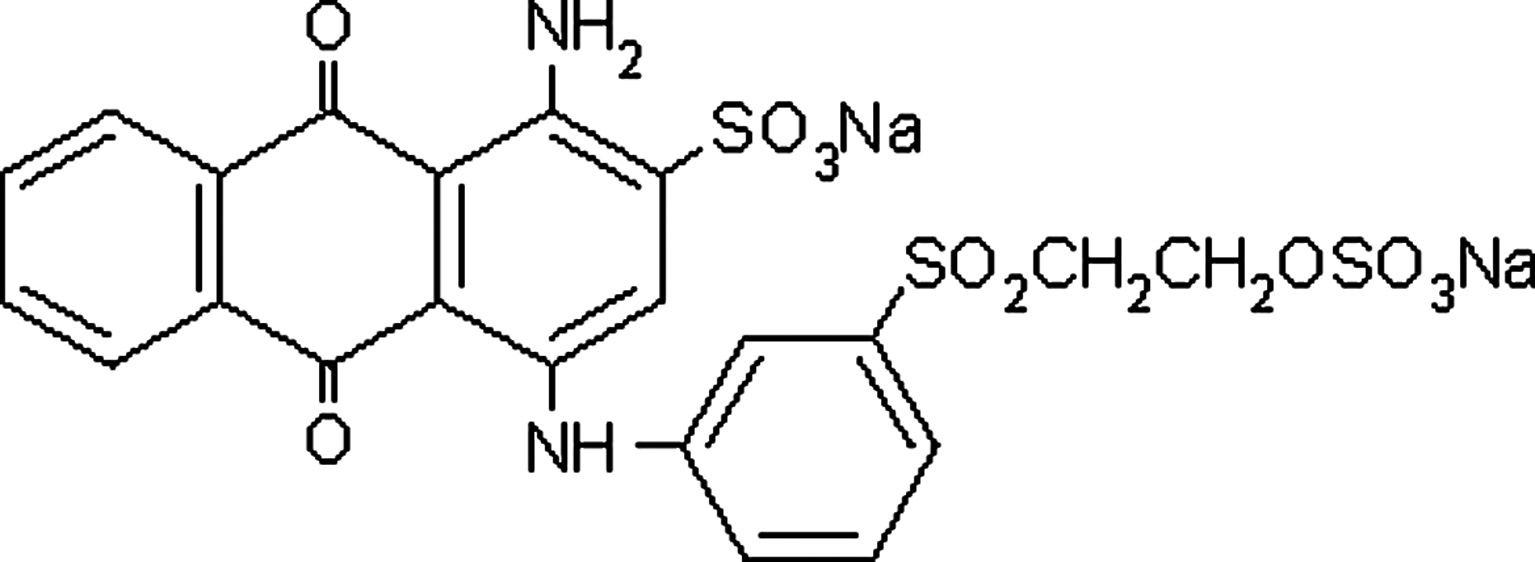
The anthraquinone structure of Reactive Blue 19 (RB 19).
Process Chemistry
In the presence of chloride ions, indirect electrochemical process involves the generation of chlorine (Lorimer et al., 2001; Szpyrkowicz et al., 2001).
Subsequently, chlorine hydrolyzes to produce hypochlorous (HOCl) and hydrochloric acids in the solution.
In aqueous solution, hypochlorous acid dissociates to produce hypochlorite and hydrogen ions.
On the cathode, water was reduced to generate hydrogen gas and a hydroxyl group.
Ultimately, the dominating species of the oxidizing agent will depend on the final pH of the solution. Since solubility and standard reduction potentials are very different among these agents, the reaction rate will be strongly influenced by the pH of the solution.
Other than oxychlorine compounds, most of the active species produced in AOP processes can be generated in an electrochemical cell. During water electrolysis HO· are produced on the surface of the anode (Gotsi et al., 2005; Chatzisymeon et al., 2006; Panizza and Cerilosa, 2006).
Reactions between water and free radicals yield molecular oxygen and hydrogen peroxide.
Molecular oxygen can further react on the anode to produce ozone.
These secondary oxidizing agents are relatively stable. Once produced on the surface of the anode, they are quickly released into the bulk of the solution. Although difficult to identify, these electrolytically generated oxidizing agents, if in existence, can significantly increase oxidizing capacity and further shorten treatment time for removal of color and chemical oxygen demand (COD).
Besides the secondary oxidizing agents, direct surface oxidation on the anode also plays an important role in dye molecule decomposition (Simond et al., 1997). The direct oxidation on the surface of a metal oxide (MOx) anode involves an electrochemical reaction that leads to the formation of an active species (MOx + 1) by water electrolysis.
MOx + 1 is the active species that is responsible for oxidation of organic compounds and oxygen evolution.
Where R is an organic compound, RO is the higher oxidation state of the organic compound. These two reactions take place with the higher oxidation state metal oxide, MOx + 1 being regenerated according to Equation 9.
The objective of this research is to investigate and quantify the effectiveness of electrochemical oxidation for decomposition of anthraquinone reactive dyes. As described in the proposed process chemistry, there are three major pathways to decompose RB 19 in an electrochemical oxidation process. Efforts were made to evaluate the synergetic effect of indirect oxidation by oxychlorine compounds, by secondary oxidizing agents, and by direct oxidation on the surface of a metal oxide anode on the decomposition of RB 19. The effect will significantly improve the performance of electrochemical treatment for color and COD reduction in dye- containing effluents.
Experimental
The chemical reaction between RB 19 and sodium hypochlorite has been investigated in a previous work to lay a foundation for the study of electrochemical oxidation (Ho et al., 2010). In this study, experiments were conducted to distinguish the reactions of RB 19 with hypochlorite and secondary oxidizing agents with and without direct anodic surface oxidation. For indirect treatment, sodium chloride aqueous solutions were prepared and injected into the parallel plate electrochemical cell to generate oxidizing agents. After characterization the solution was then mixed with RB 19 solutions in a separate beaker to evaluate its effectiveness for color removal and COD reduction. For direct treatment, RB 19 and NaCl aqueous solutions were prepared and introduced into the cell for electrolysis. It is believed that in the direct treatment, RB 19 is decomposed by the reactions in the cell including with oxychlorine compounds, with secondary oxidizing agents and by direct oxidation on the surface of the metal oxide anode.
A bench-scale electrochemical system, as shown in Fig. 2, was constructed for this study. The system consists of a DC power supply, a power control and measurement unit, an undivided electrochemical cell, a reservoir, a feed pump, a flow control valve, a flow-measuring unit, and a circulation pump. For side-by-side comparison with literature (Esteves and Silva, 2004; Rajkumar et al., 2007), a pair of ruthenium oxide (RuO2)-coated titanium plate was used as the electrodes. The material was selected for its low cost and commercial availability. The surface of the electrode is coated with 30 g/m2 ruthenium oxide prepared by US Filter. The dimensions of these electrodes are 150 mm by 100 mm by 2.5 mm. The two electrodes are situated ∼3 cm apart from each other and are submerged in the solution. Effective surface area of the electrode in the cell is 100 cm2. The volume of the cell is 300 cm3. A Model 3670 dual range DC power supply from Electro Industries, Inc., was used as the power source. In most of the experiments the system was operated in a simple batch mode.
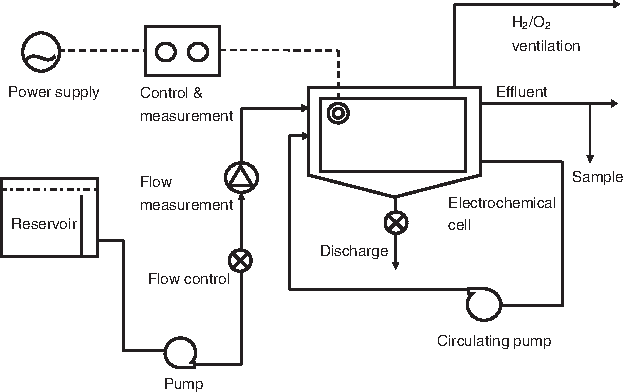
Flow chart of the bench-scale electrochemical system.
The Reactive Blue 19 disodium salt of 1-amino-2-sulfo-4-(3-sulfoxy-ethyl-sulfo-phenyl-1-yl-amino)-5,10-anthraquinone (C22H16N2Na2O11S3, MW 626.54 g/mol, 100%) was purchased from Clariant Corporation and was used in the experiments without further purification. For daily experimental runs, a stock solution was prepared by mixing the dye with deionized water. The solution was wrapped in aluminum foil and stored in the dark to avoid exposure to light. For practical reasons, sodium hypochlorite was acquired from local grocery stores as commercial bleach. Its initial concentration was determined by potentiometric titration with high purity (99.99%) sodium thiosulfate (Na2S2O3) acquired from Sigma-Aldrich. Details of the titration were presented in a previous work (Ho et al., 2010). A Hach DR/4000 UV/Vis spectrophotometer was used to identify and determine the concentrations of RB 19 and hypochlorite. The pH measurements were carried out with a Fisher Scientific AB 15 digital pH meter equipped with an Accumet glass electrode. The pH meter was calibrated with standard buffer solutions daily. The COD was determined by Hach method 8000 (Hach Company, 1997). This method is a modified dichromate titrimetric method as described in Standard Methods for the Examination of Water and Wastewater (Eaton et al., 1995).
Results and Discussion
RB 19 identification and analysis
A stock solution was prepared by mixing 1 g of RB 19 with 1 L of deionized water. Because of high color intensity, the solution was further diluted to 150 mg/L before analysis. Figure 3 shows the UV–visible range absorption spectra of the diluted RB 19 solutions. The wavelength of maximum absorbance at 601 nm was identified and selected for the determination of color intensity in this study. A set of standard solutions was prepared from the stock solution by successive dilutions. Absorbance of the standard solutions at 601 nm was taken to establish a correlation between absorbance and dye concentration. A linear relationship between absorbance at 601 nm and concentration of RB 19 was established with a correlation coefficient of 0.9973. The molar absorptivity of RB 19 was determined at four different concentrations as 8,272 (cm−1 M−1).

UV–visible range absorption spectra of the diluted RB 19 solutions.
OCl− identification and analysis
A stock solution was prepared from commercial bleach. The solution was titrated with 0.01 M thiosulfate solution to determine its OCl− content. During the titration, oxidation reduction potential (ORP) was measured continuously to determine the end point. A set of standard solutions was then prepared from the stock solution by successive dilutions. Figure 4 shows the UV/Vis spectra between 250 and 400 nm of these standard solutions that were taken with the DR/4000 spectrophotometer. After the scanning, the wavelength of maximum absorbance at 292 nm was identified. The absorbance at 292 nm was then used to construct a calibration curve. The molar absorptivity of OCl− was determined at three different concentrations as 1,047 (cm−1 M−1).

UV–visible range absorption spectra of the diluted OCl− solutions.
Indirect treatment
According to Equations 1 to 3, oxychlorine compounds along with other oxidizing agents are generated when sodium chloride aqueous solutions are treated in an electrochemical cell. Equation 4 further describes the generation of OH− on the cathode to bring up the pH in the treated mixture. When generated in water, chlorine forms hypochlorous acid (HOCl) and hypochlorite ions (OCl−) in the solution. White (1986) provides complete equilibrium data to determine the proportions of each component as a function of pH. Since the equilibrium among these oxychlorine compounds is strongly dependent on the pH, it is critical to monitor the change of pH in the solution. Experiments were performed to study the dynamics and interaction among these active components. The use of common salt is essential to all batchwise dyeing processes for reactive dyes. There is always significant amount of NaCl in dyehouse effluents. For practical reasons, solutions of 1 and 2 g/L of sodium chloride were treated in the cell at a voltage of 10, 15, or 20 V. The voltages were needed to provide reasonable operating current densities in the cell.
The general trend, between the two dash lines in Fig. 5, is that the pH increased from 6.5 to around 9.2 in 10 min and stabilized at around 9.2 throughout the 30-min electrolysis. With 2 g/L NaCl in the solution the ions provided a conductivity of 2,700 μS/cm that drew a current density of about 22 mA/cm2 across the solution between the two electrodes under 20 V. The current quickly generated enough OH− to bring the pH up to 9.4 in a minute. With 1 g/L NaCl in the solution, the ions provided a conductivity of 1,500 μS/cm between the two electrodes. Under 10 V DC, the voltage drew a current density of about 5 mA/cm2 through the solution between the two electrodes. With a slower pace the current produced OH− in the solution and increased the pH from 6.5 to 7.6 in 1 min and continue to 9.2 in 30 min. At early stage of the electrolysis, the pH of all the treated mixtures scattered between these two cases.
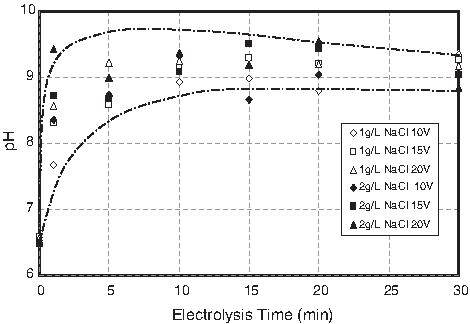
Change of pH in a 30-min electrolysis with 1 and 2 g/L NaCl as supporting electrolyte.
Since oxidizing agents are generated during the electrolysis, ORP would be a good indicator to monitor the process. During the electrolysis, samples were withdrawn periodically to take ORP and pH measurements. Figure 6 shows the change of ORP in the mixture with respect to electrolysis time. The fluctuation of ORP measurements in 1 g/L NaCl solutions was observed from time to time. However, at a higher concentration the increase of ORP during the treatment is more stable and reasonable. With 2 g/L NaCl in the solution, the current quickly raised the pH to 9.4. At pH 9.4 OCl− is the dominate species among the oxychlorine compounds produced in the solution. With a simple mechanism to produce a single product, OCl−, the ORP steadily increased as represented by the dashed lines in Fig. 6. However, with 1 g/L NaCl in the solution, the situation is very different. Treatment produced enough OH− to bring the pH up to 7.6 in the first few minutes. At pH 7.6 the oxychlorine compounds are evenly distributed between HClO and ClO− (White, 1986).
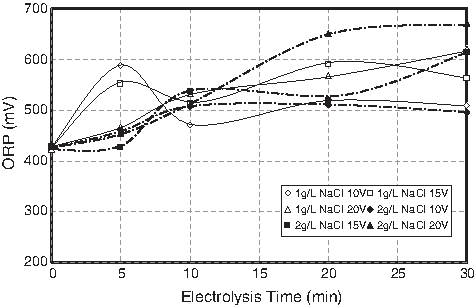
Change of oxidation reduction potentials (ORP) in 1 and 2 g/L NaCl solutions with respect to electrolysis time.
Hypochlorous acid has an oxidation potential of 1.49 V, whereas that of hypochlorite is only 0.94 V (Rajkumar et al., 2007). With a significant difference in oxidation potential between the two compounds, HClO contributes more to the overall reading of the ORP in the solution. This explains why at the early stage of electrolysis solutions with lower NaCl concentration had higher ORP measurements. The phenomenon has been observed and reported in a literature (Vlyssides et al., 1999). It happened only when the initial pH of the solution was lower than 7.0.
In an effort to identify the contribution of other oxidizing agents to the ORP measurement, samples were taken during electrolysis and treated with NaOH to bring their pH up to 10. At pH 10 all of the oxychlorine compounds are converted to OCl− that has a distinguished maximum absorbance wavelength at 292 nm. After pH adjustment, spectra of the samples were taken by the spectrophotometer. Concentrations of OCl− in the treated mixtures were determined by measuring the absorbance at 292 nm. Figure 7 shows the concentrations of OCl− in the treated mixture with respect to electrolysis time. Comparable to the ORP, dashed lines in Fig. 6, the concentration of OCl− increased faster early in the process and slowed down after 10 min into the electrolysis. It is believed that the slow down is caused by the lack of available NaCl in the solution after 10 min of electrolysis. As expected, the higher the NaCl concentration the higher the concentration of OCl− was in the treated mixture. This implies that the fluctuation of ORP is caused by the formation of secondary oxidizing agents at the early stage of the process.

Formation of OCl− in 1 and 2 g/L NaCl solutions during a 30-min electrolysis.
During electrolysis 10 ml of the mixture was removed from the electrochemical cell periodically. After characterization the samples were then mixed with 10 ml of 100 mg/L RB 19 solutions to determine their effectiveness for color and COD reduction. To minimize the effect of Cl− on COD readings, samples were diluted before each test. After mixing, the solutions were kept at room temperature for a week to ensure the completion of the reaction. Figure 8 shows the efficiency of the treated mixtures for color reduction. With 2 g/L NaCl in the solution, it took 1 min of electrolysis to generate enough OCl− and secondary oxidizing agents to reduce more than 90% of the color. Even with only 1 g/L NaCl in the solution, the process is able to generate enough oxidizing agents in 10 min to reduce more than 99% of the color in the solution. When mixed with insufficient amount of OCl−, RB 19 solutions turned purple, pink, and orange at different OCl− concentrations (Ho et al., 2010). The observation indicates that the oxidizing agents breakdown the bridge group between the reactive system and the chromophore of the dye molecule. That is why during the treatment, color is shifted to a longer wavelength with much lower intensity.
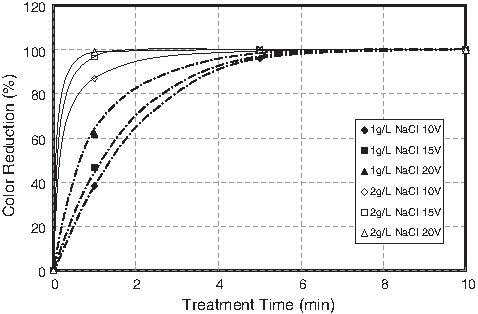
Removal of color from 100 mg/L RB 19 solutions with oxidizing agents freshly generated from electrolysis of 1 and 2 g/L NaCl solutions.
As shown in Fig. 9, it took 20 min to generate enough oxidizing agents in a 2 g/L NaCl solution to remove more than 99% of COD from the solution. Most of the chromophores carry one or more fused aromatic rings, anthraqunone in this case, which is stable and difficult to breakdown (Shore, 1995). This explains why color can be removed rapidly while COD resist the treatment. Ho and colleagues reported that it takes a molar ratio of 44 for OCl− to completely oxidize 50 mg/L RB 19 in the solution (Ho et al., 2010).
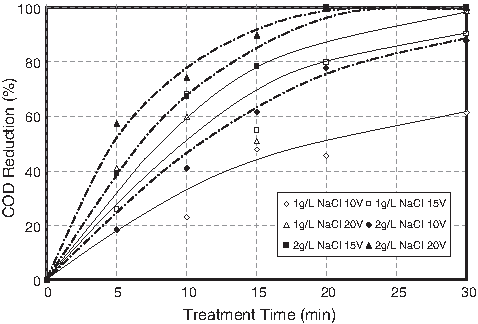
Removal of chemical oxygen demand (COD) from 100 mg/L RB 19 solutions with oxidizing agents freshly generated from electrolysis of 1 and 2 g/L NaCl solutions.
Direct treatment
Direct treatment of RB 19 aqueous solutions were carried out by injecting dye solutions directly into the electrochemical cell for electrolysis. In a typical experiment, a solution of 300 ml with 50 mg/L RB 19 and 1 g/L NaCl is treated in the cell at 10, 15 or 20 V for up to 30 min. The current densities are 5.1, 8.9, and 13.3 mA/cm2, respectively. Like indirect treatment,the pH of the solution increased with respect to treatment time. Regardless of NaCl concentration and applied voltage, the pH in the solution quickly reached its final value in 2 min and stabilized throughout the treatment. Depending on the concentrations of NaCl in the solution, the final pH scattered between 8.0 and 9.2.
Like indirect treatment, the ORP fluctuated during the treatment. The lower the NaCl concentration, the higher the ORP. In general, 1 g/L NaCl solution treated under 10 V DC had the highest ORP measurements throughout the treatment. Owing to the relatively low pH in 1 g/L NaCl solution, the equilibrium among the oxychlorine compounds shifts to HOCl. As stated in a previous section, HOCl has a higher oxidation potential than OCl−. Even with the same amount of both components, HOCl will contribute more to the overall measurement of ORP in the solution. Vlyssides and colleagues reported a similar observation (Vlyssides et al., 1999). They concluded that the higher the pH the lower the ORP, which can be explained by the distribution between HOCl and OCl−. Another possibility is the formation of other oxidizing agents such as ozone and hydrogen peroxide in the solution. Although no quantitative relationship was established between ORP and oxidizing agents in the treated mixtures, the observation strongly suggests the formation of HOCl at low pH and the existence of other oxidizing agents.
With all three oxidizing pathways created in the direct electrochemical treatment, it is expected that the process be effective on both color and COD reduction. Figure 10 shows the reductions of color and COD with 1 g/L NaCl as the supporting electrolyte in the 50 mg/L RB 19 solution, whereas Fig. 11 presents the color and COD reductions with 2 g/L NaCl in the solution. As expected, color was quickly removed in 1 min in both cases. Regarding COD reduction, the higher the NaCl concentration, the higher the removal efficiency. With 2 g/L NaCl in the solution it took 5 min to remove 84% of the COD, but it took 10 min for 1 g/L NaCl in the solution to reach the same level of COD reduction. Esteves and Silva studied the degradation of RB 19 in a synthetic dyebath with a parallel plate electrochemical cell with a pair of RuO2-coated titanium (Ti) electrodes (Esteves and Silva, 2004). The result demonstrated an 87% COD reduction in a 15-min treatment with 8 V DC across the 1.5 cm gap between the two electrodes. The system is similar to the one that is used in this study and the outcome is comparable.
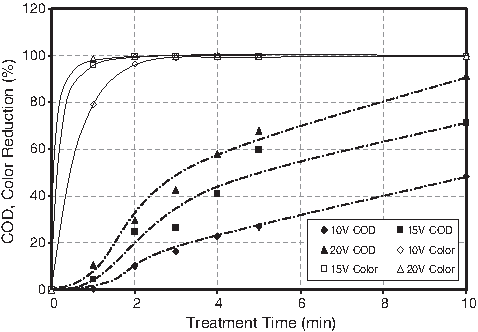
Removal of color and COD from 50 mg/L RB 19 solutions by direct electrochemical treatment with 1 g/L NaCl as supporting electrolyte.
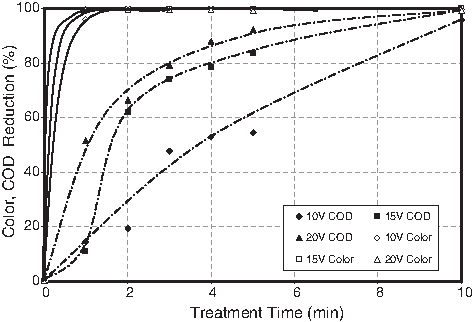
Removal of color and COD from 50 mg/L RB 19 solutions by direct electrochemical treatment with 2 g/L NaCl as supporting electrolyte.
Rajkumar and colleagues reported a similar study with a Ti mesh coated with a mixture of TiO2, RuO2 and IrO2 as anode (Rajkumar et al., 2007). Although their study was focused on the effect of operating parameters and reaction intermediates, some data on COD reduction was presented as well. The system reduced 56% of the COD from a solution of 400 mg/L RB 19 and 1.5 g/L NaCl with a charge loading of 9 Ah/L. In Fig. 11, a data point on the curve 15 V COD was selected for comparison. At 15 V, an average current density of 15 mA/cm2 was drawn across the solution between the two electrodes. The equivalent charge loading for a 5-min treatment is 0.42 Ah/L. The discrepancies in color and COD reduction among research groups indicate that a thorough study on cell design and process optimization is critical.
Synergetic effect
The first step to optimize a treatment process is to understand the process chemistry. Under comparable conditions, it took about 60 min for OCl− oxidation (Ho et al., 2010), 20 min for indirect electrochemical treatment, and 10 min for direct electrochemical treatment to reduce more than 95% of the COD from a solution of 50 mg/L RB 19. One has to ask why the difference if the only active component in these processes is hypochlorite. The basic assumption is that there are three major pathways, that is, oxidation by oxychlorine compounds, oxidation by secondary oxidizing agents, and direct anodic surface oxidation to decompose organic molecules in an electrochemical oxidation process. Direct electrochemical treatment provides a condition for all three pathways to occur, whereas indirect treatment only provides oxidizing agents for dye molecule decomposition.
A kinetic model was developed to study the color reduction during the reaction between RB 19 and OCl− in a previous study (Ho et al., 2010). The kinetics was 0.5-order with respect to RB 19 concentration, and the apparent reaction rate constant (k′) of the pseudo 0.5-order reaction is proportional to OCl− concentration. The dashed line in Fig. 12 shows the linear correlation between k′ and its corresponding OCl− concentration. The apparent reaction rate constant is defined as the product of the intrinsic reaction rate constant and the concentration of total oxidizing agents. In this case, OCl− is the only oxidizing agent in the solution. For comparison, a set of experiments were conducted to acquire k′ for indirect electrochemical treatment. NaCl solutions were treated in the electrochemical cell to produce OCl−. During the electrolysis, samples were taken at various time periods to determine their OCl− content. After the analysis, the samples were then mixed with RB 19 solutions in a curvet. The absorbance at 601 nm was monitored continuously with the UV/Vis spectrophotometer. The data set was used to determine k′ by using Equation 6 in the previous study (Ho et al., 2010). The solid line in Fig. 12 shows the apparent reaction rate constants at various OCl− concentrations. At the same OCl− concentration indirect electrochemical treatment shows higher apparent reaction rate constants at all OCl− concentrations. Since k′ is the product of intrinsic reaction rate constant and total concentration of oxidizing agents, it is believed that the higher k′ in the indirect treatment is because of the formation of secondary oxidizing agents during the electrolysis of the NaCl solution. These secondary oxidizing agents were lumped together with oxychlorine compounds in the total content of oxidizing agents. Therefore, even with the same concentration of OCl− in the solution, indirect electrochemical treatment performs better than chemical oxidation for decolorization.
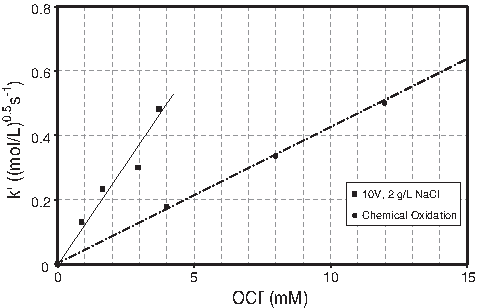
Apparent rate constant of reactions between RB 19 and OCl− in chemical oxidation and indirect electrochemical oxidation processes.
To identify the contribution of surface anodic oxidation for color and COD reduction, solutions of 1 g/L NaCl with and without 50 mg/L RB 19 were prepared and tested in both direct and indirect electrochemical treatment processes. The dashed line in Fig. 13 shows the effectiveness of indirect treatment for color reduction. In 1 min electrolysis the current generates enough OCl− and secondary oxidizing agents in the solution to reduce 62% of the color. When treated directly in the electrochemical cell, the treatment reduced more than 90% of the color in 1 min, shown by the solid line in Fig. 13. The difference between the two processes can be attributed to the direct oxidation of the dye molecules on the surface of the anode. Up to 2 min both direct and indirect treatments were able to reduce the color beyond the detection limit of the spectrophotometer.
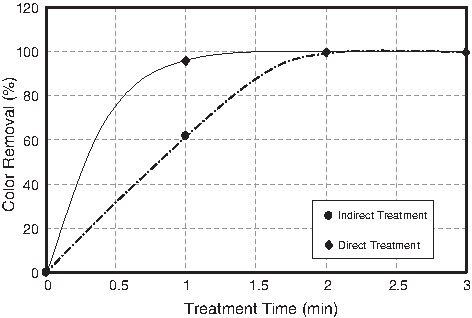
Removal of color from 50 mg/L RB 19 solutions by direct and indirect electrochemical treatments with 1 g/L NaCl as supporting electrolyte under 20 V DC.
During the test for color reduction, samples were taken periodically for COD analysis. Figure 14 shows the COD reduction by direct and indirect electrochemical treatments. As shown in the figure, it took 10 min for direct treatment to reduce the COD to more than 99%, whereas twice the time is needed for indirect treatment to reach the same level of COD reduction. The results reaffirm the proposed mechanism that in direct electrochemical treatment there are three major pathways, which cause the oxidative decomposition of organic compounds. Evidently, the synergetic effect between the chemical oxidation and anodic surface oxidation has significantly shortened the treatment time for COD reduction.
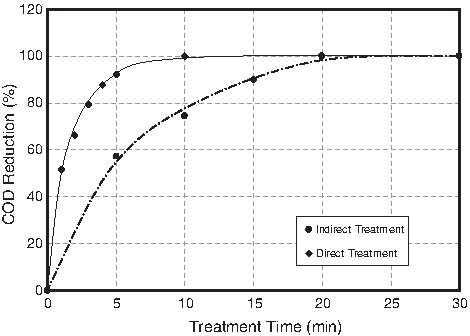
Removal of COD from 50 mg/L RB 19 solutions by direct and indirect electrochemical treatments with 2 g/L NaCl as supporting electrolyte under 20 V DC.
Conclusion
Both direct and indirect electrochemical treatments are effective for color and COD reduction from aqueous solutions containing 50 to 100 mg/L RB 19. NaCl is an essential and effective supporting electrolyte to generate oxychlorine compounds and secondary oxidizing agents for dye molecule decomposition. Color and COD can be reduced more than 99% in reasonable treatment times. Under comparable conditions, direct treatment can be four times as effective as indirect treatment in terms of shorting treatment time to reach the same level of color and COD reduction. Since the system does not have direct physical contact with wastewater, the indirect treatment process is much easier to design, operate, and maintain. However, the direct treatment process greatly reduces the treatment time and thus the total footprint of the system.
On the basis of a thorough literature review, a three-pathway reaction mechanism was proposed to describe electrochemical oxidation for decomposition of organic molecules. In direct electrochemical treatment, organic dye molecules are oxidized by oxychlorine compounds and secondary oxidizing agents generated in the cell as well as by direct oxidation on the surface of the metal oxide anode. Because of the formation of secondary oxidizing agents in the mixture, indirect electrochemical treatment is more effective than chemical oxidation with only OCl− for color removal. Also, the mechanism adequately explains why the direct electrochemical treatment performs better than the indirect process. The difference between the two is attributed to the contribution of direct surface oxidation on the anode. The synergetic effect between chemical oxidation and anodic surface oxidation has significantly shortened the treatment time for color removal and COD reduction.
Footnotes
Acknowledgment
The authors are grateful to Alyssa Medeiros of the Department of Materials and Textiles at the University of Massachusetts–Dartmouth for editing the manuscript.
Author Disclosure Statement
No competing financial interests exist.