




Abstract
Abstract
Elevated concentrations of Al in acid rock drainage (ARD) from a highway embankment in Centre County, PA, are reported to have ruined a former trout fishery stream. Long-term data (1999–2008) on the release of Al in this ARD site suggest a first stage (1999–2003) of Al release from the subsurface clays to surface seeps that follows first-order kinetics, followed by a slower second stage (2003–2008) that follows zero-order kinetics. Batch laboratory leaching of smectite clays with synthetic acid mine drainage (AMD) was consistent with the observed evolution of Al from this ARD field site. Initially, rapid release of Al from clays appeared to result from exchange reactions. This was followed by a slower release of Al that appeared to be dominated by longer term dissolution processes. PHREEQC simulations were consistent with these experimental results, suggesting that Fe2+ (in addition to H+), which is common in AMD/ARD, can enhance the release of Al from smectite clays at low pH. The outcome of this study assists in a better understanding of the occurrence of high concentrations of Al in AMD/ARD by pointing out the significance of ferrous iron in AMD/ARD on the release of Al from smectite clays.
Introduction
In U.S. regions historically supporting coal and metal mining activity, this problem is localized and can be severe. The U.S. Environmental Protection Agency (USEPA, 2008) estimated that over 95% of the AMD problems are located in the Appalachian region, including Pennsylvania. Reported analysis of mine discharge samples from 140 abandoned coal mines collected in summer and fall of 1999 in Pennsylvania showed that over 50% of these discharges had dissolved Al concentrations higher than 1 mg/L (Cravotta, 2008a, 2008b). The highest Al concentrations in these mine discharge samples, up to 108 mg/L, were found in the acidic range of pH from 2 to 5 (Cravotta, 2008a, 2008b).
The USEPA (1992) secondary maximum contaminant level for Al in drinking water is 0.05–0.2 mg/L, based on aesthetic effects. Although safe from a point of view of drinking water quality, Al at these levels can be detrimental to freshwater aquatic ecosystems (Baker and Schofield, 1982). The USEPA (2009) criteria continuous concentration and criteria maximum concentration values for Al are 0.087 and 0.75 mg/L, respectively.
Al typically is observed in AMD when the local bedrock and soil contain Al-bearing minerals, such as clays, and other aluminosilicate mineral phases (Rozalen et al., 2009). Smectite clays, Mx[Mg0.66Al3.34][Si8]O20(OH)4 (H2O)n, where x commonly represents 0.33 exchangeable divalent cations (generally Ca) or 0.66 monovalent cations (generally Na or K) (Metz et al., 2005), are the most common phyllosilicates in soils and sediments (Sondi et al., 2008). The prevalence of smectite and other Al bearing minerals in soils in the Appalachian mining region of the United States increases the potential for the generation of ARD with high concentrations of Al.
The oxidation of pyrite and consequent development of low pH (<4) typically generates elevated Fe2+ and H+ levels in AMD, above background concentrations, and may result in the release of Al from clay minerals by ion-exchange (Tan, 2000) and dissolution processes (Essington, 2004). The presence of anions such as SO42− in AMD may also increase the concentration of Al due to aqueous complexation reactions (Cravotta, 2008b; Pu et al., 2010). In the presence of smectite clays, such as sodium-saturated montmorillonite, Na0.33Mg0.33Al1.67Si4O10(OH)2, these processes can be illustrated as follows:
where Al−Mont. and Fe−Mont. represent an exchangeable Al and ferrous iron in the smectite (montmorillonite) adsorption complex, respectively.
Al released from Al-bearing minerals due to exchange reactions was suggested by Kombo et al. (2003), who studied the interactions of acidic red soil and seawater and observed high Al concentrations (over 50 mg/L) and decrease of cation concentrations in seawater at low pH values (at around 4). Likewise, synthetic underground and brackish ARD containing high concentrations of Fe2+, K+, and Na+ salts enhance the release of Al from kaolinite and smectite clays as compared to synthetic sulfuric acid solutions without those cations at the same initial pH values of 3 (Vazquez et al., 2010).
Proton-promoted dissolution of a variety of clays, such as smectites, has been widely studied (Komadel et al., 1996; Gates et al., 2002; Rozalen et al., 2009; Shaw and Hendry, 2009). The higher cation exchange capacity (CEC) and specific surface area of smectite relative to kaolinite clays (Meunier, 2005; Shaw and Hendry, 2009) result in an increased adsorption of H+ on exchange sites and interaction over a larger surface area. Thus, smectite clays are more susceptible to dissolution with decreasing pH (Komadel et al., 1996; Gates et al., 2002). Shaw and Hendry (2009) have shown that the crystallinity of smectite-rich clays was more vulnerable than the crystallinity of kaolinite clays when these clays were exposed to H2SO4 between pH of 5 and below 0.
Al remains one of the least understood AMD/ARD parameters in treatment system design. The Pennsylvania Bureau of Abandoned Mine Reclamation treatability guidance indicates that AMD with >5 mg/L of Al is unsuitable for passive treatment (Cavazza et al., 2008). To meet desirable discharge standards for Al, there is a need for it to be particularly managed within the treatment system. Thus, the development of a scientific understanding to predict the generation of Al-containing AMD discharges becomes important.
This article (1) evaluates the release of Al from smectite clays leached with synthetic AMD and sulfuric acid leaching solutions, and (2) further investigates the exchange of ferrous iron with Al in the surface of smectite clays hypothesized in a previous article (Vazquez et al., 2010). The goal of these leaching experiments was to indicate the main processes involved in the generation of soluble Al in AMD/ARD. The significance of this work is that it helps in understanding factors leading to Al generation and discharge from AMD and ARD. This knowledge can be used to consider alternative remediation strategies for ARD with elevated Al concentrations.
Pennsylvania site description
In Pennsylvania, AMD has been historically associated with the mining industry, but ARD can also be attributed to earth moving projects such as highway or dam construction (Smoke, 2007). One example of ARD contamination is from a Centre County site in Pennsylvania. The contamination has been traced to the construction of a highway embankment along I-80 and directly over the Jonathan Run stream (Smoke, 2007). The stream flows through a concrete culvert under this embankment and Al precipitates are seen at the exit and downstream of this concrete culvert.
The embankment was constructed using locally available fill material. Exploratory drilling through the embankment revealed the presence of sandstone boulders and pyritic and clay material in the fill and confirmed it as the main source of Al-containing ARD discharging into the local stream (Smoke, 2007). There are no mineralogical analyses or characterization of the fill clay material at this site. Groundwater samples collected from the boreholes throughout the embankment showed the presence of groundwater Al and iron concentrations as high as 160 and 173 mg/L, respectively, near the culvert (Hedin Environmental, 2003; GAI Consultants, 2007; Neufeld et al., 2007). However, the surface seepage from the embankment and discharging into the stream consistently had low concentrations of iron (<2 mg/L) concomitant with elevated concentrations of Al (∼48 mg/L).
The quarterly averaged Al concentrations from this major surface seep measured during the time frame 1999–2008 appear to follow two different trends: from 1999 to 2003 and from 2003 to 2008, as shown in Fig. 1. The averaged Al concentrations released from the main source discharging into the stream, as shown in Table 1, were 105 mg/L for the period 1999–2003, and decreased to 48 mg/L for the period 2003–2008, reaching an apparent steady state, as shown in Fig. 1. The field pH of this main discharge, as reported on Table 1 and shown graphically on Fig. 2, averaged 4.1 for the first period, and 3.5 for the second period.

Evolution of Al released from the main subsurface seep discharging into the Jonathan Run stream at Centre County, Pennsylvania (1999–2008).

Field pH from the main subsurface seep discharging into the Jonathan Run stream at Centre County, Pennsylvania (1999–2008).
Materials and Methods
Laboratory experiments were conducted to quantify the sorption of ferrous iron and the release of Al from smectite clays at pH commonly found in AMD. Sodium-saturated bentonite, which is mostly montmorillonite (dioctahedral smectite), supplied by Fisher Scientific (Pittsburgh, PA), was pretreated and acidified before use in batch experiments. A predetermined quantity of this smectite (225 g) was slurried with 11 mL of 12.1 N HCl and deionized (DI) water, resulting in 2 L of smectite stock suspension at pH 3.0 with the composition shown in Table 2. Measured quantities of FeSO4·7H2O and H2SO4 were used to prepare synthetic AMD and sulfuric acid stock leaching solutions. Chemical compositions of these synthetic AMD and sulfuric acid stock solutions (Table 2) were chosen to obtain desired initial chemical compositions of smectite mixtures in the reactors (Table 3). For this purpose, two 2 L Erlenmeyer flasks were used as reactors to conduct the experiments. Known volumes of smectite stock suspension (830 mL) were added to each reactor. Synthetic AMD and sulfuric acid stock leaching solutions (970 mL) were subsequently added to each reactor, resulting in 1,800 mL suspensions containing 93.4 g of smectite in each reactor. The resultant wt/wt (g/g) clay-to-solution ratio in the reactors was 1:20. The election of this clay-to-solution ratio was made to obtain detectable Al concentrations, determined by flame atomic absorption spectrometry, in the smectite–AMD mixture. The smectite–AMD mixture was prepared to contain initial ferrous iron concentrations of around 500 mg/L at pH of 3. On the other hand, the smectite–sulfuric acid mixture was prepared to have an initial pH of 3, as shown in Table 3.
Determination of Al from nondigested filtered extracts.
Below PQL of 1 mg/L.
AMD, acid mine drainage; PQL, practical quantitation limit.
Theoretical determination of initial composition of smectite mixtures in reactors based on compositions of prepared stock suspension, synthetic leaching solutions, and mixed volumes in reactors.
All the chemicals used were reagent grade. The reactors were continuously stirred to maintain the solid phase in suspension. An inert atmosphere was maintained throughout the experiments by means of a N2 blanket within the reactors to minimize the oxidation of ferrous iron. After predetermined reaction times, the samples were collected and monitored for dissolved oxygen (Orion O2 electrode Model 97-08-00). The O2 content in the samples was repeatedly observed to be around 1.6 ± 0.7 mg/L. The samples were subsequently centrifuged at 8,500 g for 15 min in a Fisher Scientific AccuSpin Model 400 benchtop centrifuge to separate the clays from the aqueous portion. The pH was measured after centrifugation using a previously calibrated Fisher Accumet 25 benchtop pH electrode meter equipped with a Fisher Scientific Accumet pH electrode. Subsequently, the supernates were filtered through 0.45 μm HA Isopore™ membrane filters supplied by Millipore Corp. (Billerica, MA). Filtered extracts were stored at 4°C for further analysis.
The experiments continued until steady-state conditions were approached. The experiments were considered close to steady state when the Al levels in at least three consecutive samples taken at least 1 week apart appeared to approach an asymptotic value and were within 10% of the highest Al level. Before cation analysis, the filtered extracts were digested with 5 mL of concentrated HNO3 and 2 mL of concentrated HCl during 30 min at 170°C in a CEM-MARS (Matthews, N.C.) microwave digester following USEPA method 3015 (USEPA, 1994). The concentrations of total Al, iron, and sodium were determined by flame atomic absorption spectrometry (Eaton et al., 2005).
Preliminary experiments were conducted involving leaching of three different types of clays (kaolinite, smectite, and field clays from the Jonathan Run site) with three different leaching solutions (sulfuric acid with different concentrations of Fe2+ and K+ and Na+ salts) at initial pH values of around 3 and during 67 h. The Al released from these clays was determined from both microwave digested and nondigested filtered extracts and showed equal results. Thus, microwave digestion for Al in leachate samples for the experiments conducted in this study was discontinued. Analysis for Al content used filtered nondigested samples, which allowed for no further dilution of samples associated with the digestion procedure and enhanced the detection of this cation. Samples of each leachate were analyzed in triplicate and results averaged.
The U.S. Geological Survey geochemical model PHREEQC for Windows (version 2.16.03) (Parkhurst and Appelo, 1999) was used to simulate the batch experiments. Input data for the model included initial conditions of smectite–synthetic solution mixtures in reactors (synthetic AMD and sulfuric acid solution), as shown in Table 4. The smectite (sodium-saturated montmorillonite), [Na0.33Mg0.33Al1.67Si4O10(OH)2], selected from the Llnl.dat database of PHREEQC, was used for the calculation of solution compositions at equilibrium. Other defined conditions in the simulation of these experiments included room temperature, 25°C, oxygen concentrations of 1.6 mg/L, and a exchange stoichiometry of 0.095 mol Na/mol-Na-montmorillonite [∼29% the exchange stoichiometry of sodium-saturated montmorillonite; 0.33 mol Na/mol-Na-montmorillonite; as shown in Equation (2)]. The exchange stoichiometry of the smectite in the smectite–(leaching) solution mixtures was not known. The election of 0.095 mol Na/mol Na-montmorillonite to conduct the PHREEQC computer simulations was a rough estimation based on the fact that initial smectite–(leaching) solution mixtures contained previously acidified smectite clays (smectite stock suspension), which reasonably fit the experimental data.
Theoretical determination of initial conditions of smectite–synthetic solution mixtures in reactors based on composition of prepared smectite stock suspension, leaching solutions, and mixed volumes in reactors.
Determination of Al from nondigested filtered extracts.
Below PQL of 1 mg/L, or 0.74 μmol/g within our experimental conditions.
Results and Discussion
The concentration of Al leached from smectite in batch reactors approached steady-state values after around 1,000 h (<2 months) of leaching time. The Al released to the smectite–sulfuric acid mixture at initial pH ∼3 was below the practical quantitation limit of 1 mg/L (0.74 μmol/g). Initial iron concentrations of around 5 mg/L detected in the smectite–sulfuric acid mixture represent iron impurities released from the structure of smectite at the initial pH 3 environment. The iron concentrations throughout the experiment in this mixture remained stable (around 5 mg/L). The pH increased over time as shown in Fig. 3, from an initial value of around 3 to a final value around 3.8. The sodium concentrations increased from an initial concentration of over 440 mg/L to a final value of around 500 mg/L (Fig. 3). The increase in sodium concentrations and pH suggest an exchange of H+ with sodium in the surface of the clay. However, a mass balance around this exchange does not entirely explain the increase of sodium (∼2.6 mM) and decrease of H+ (0.8 mM) in this mixture. Deviations in the measurement of pH values would explain the unbalance of cations in this suspension. The outcome of the PHREEQC simulations of this smectite–sulfuric acid mixture (Table 5) supports this hypothesis.
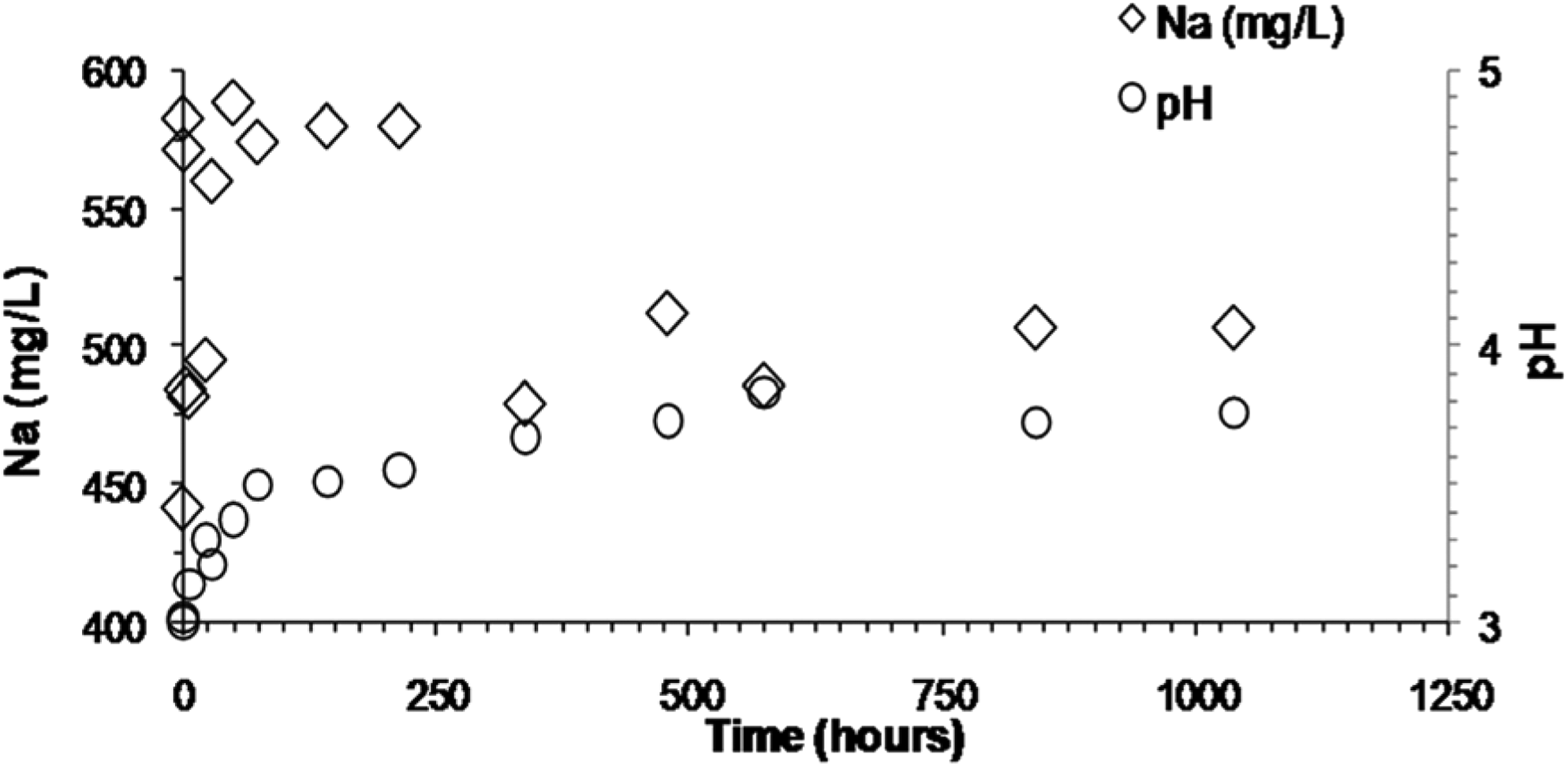
Evolution pH and Na in a mixture of smectite and synthetic sulfuric acid solution at a wt/wt clay-to-solution ratio of 1:20.
Steady state pH, Al, Fe, and Na levels were determined as the average of the last three consecutive samples taken at least 1 week apart and within 10% of the highest pH, Al, Fe, and Na levels, respectively.
Determination of Al from nondigested filtered extracts.
Below PQL of 1 mg/L, or 0.74 μmol/g within our experimental conditions.
Al in the smectite–AMD mixture was initially released quickly (and its concentration increased) from <0.74 to around 1.9 μmol/g, concomitant with a sharp decrease of ferrous iron concentrations, from around 500 to around 250 mg/L, within the first 80 h. This is shown on Figs. 4 and 5, respectively. Likewise, there was an initial and sharp increase of sodium from over 440 to over 560 mg/L. This first stage of fast release of cations suggests that exchange reactions involving ferrous iron in AMD and sodium and Al on the surface of the clay took place within the first hours within the reactor. Around 9 meq/L of H+ disappeared from the initial mixture while the appearance of Na+ and Al3+ added only around 5.7 meq/L. The unbalance of 3.3 meq/L is likely the result of other nonmeasured cations, such as Ca, Mg, or Mn, representing impurities released from the smectite clay. The initial rapid release of Al was followed by a second stage of slower release of Al at a relatively constant rate, in the presence of excess clay, giving the appearance of a zero-order reaction, from around 1.9 to 2.3 μmol/g (approaching steady state). During this second stage, the iron and sodium concentrations in the smectite–AMD mixture became constant, suggesting that slow clay dissolution processes dominated the long-term release of Al.

Evolution of Al and pH in a mixture of smectite and synthetic acid mine drainage (AMD) at a wt/wt clay-to-solution ratio of 1:20. Initial Al concentration is <1 mg/L (detection limit) or 0.74 μmol/g within experimental conditions. About 1 μmol/(g of clay) = 1.35 mg/L.

Evolution of Fe and Na in a mixture of smectite and synthetic AMD at a wt/wt clay-to-solution ratio of 1:20. The pH ranged from 3.1 to 3.4 throughout the experiment.
Once steady states were attained in these mixtures, the Al released to a mixture of smectite–AMD containing initial ferrous iron concentrations of about 500 mg/L was at least three times higher than the Al released to a smectite–sulfuric acid mixture at the same initial pH value of around 3. This illustrates that aqueous ferrous iron exacerbates the leaching of Al from smectites.
The exchange of Fe2+ with other cations such, as Na or Ca, on the surface complex of smectite clays has been previously reported by Charlet and Tournassat (2005) and Lantenois et al. (2005). A conceptual model proposed by Lantenois et al. (2005) explained the destabilization of dioctahedral smectites as a result of their interaction with metal Fe at realistic temperatures in the context of nuclear waste disposal (80°C). This model relies on the existence of high (basic) pH conditions that result in the deprotonation of OH-groups in smectite and further oxidation of Fe0 to Fe2+ (Fe0 acting as a proton acceptor). This step is followed by sorption of Fe2+ cations on the edges of smectite particles that present high affinity for this cation (Charlet and Tournassat, 2005; Lantenois et al., 2005). Although the experiments in the present study, conducted at acidic conditions (initial pH of 3) and temperature of 25°C, differed from those conditions in the study of Lantenois et al. (2005), the adsorption of Fe2+ suggested in our study is in agreement with the conceptual model proposed by Lantenois et al. (2005).
Part of the cations, including Al, previously released from the smectite clay to the AMD may be re-adsorbed and re-incorporated into the aluminosilicate inter-layer to counteract its high CEC (Sondi et al., 2008). Thus, the relatively higher concentrations of Al in the mixture containing initial high concentrations of Fe2+ (smectite–AMD mixture) as compared to the smectite–sulfuric acid mixture may be the result of the exchange of Fe2+ with Al in the surface complex of smectites.
In a recent work, Shaw and Hendry (2009) studied the mineralogical alteration of smectite-rich and other clays after leaching with H2SO4 solutions at a wt/wt clay-to-solution ratio of 1:20 and pH values between 5 and <0. On the basis of their results, Shaw and Hendry (2009) presented a conceptual model of the impact of H2SO4 on these clays where cations are mobilized from the aluminosilicate inter-layer by substitution reactions with H+ ions from the H2SO4 solution. As the pH decreases to between 3 and 1, the Al-octahedral and Si-tetrahedral layers undergo dissolution. The exchange and dissolution processes suggested in this article as the major mechanism of release of Al after leaching of smectite clays with synthetic AMD and sulfuric acid at initial pH values of 3 appear to be consistent with the conceptual model of Shaw and Hendry (2009).
The dissolution reaction rates of clays are generally slow, in contrast to the exchange reaction rates, which are typically fast (Li et al., 2006). The slowest rate of release of Al from a mixture of smectite and synthetic AMD seems to be consistent with the second stage illustrated in Fig. 1, which appear to follow a zero-order rate reaching eventually an apparent steady state at about 48 mg/L in the field. Likewise, the rapid release of Al concomitant with a sharp decrease of ferrous concentrations in AMD (within 80 h as shown in Fig. 6) appears to be consistent with the first stage of Al release shown in Fig. 1.
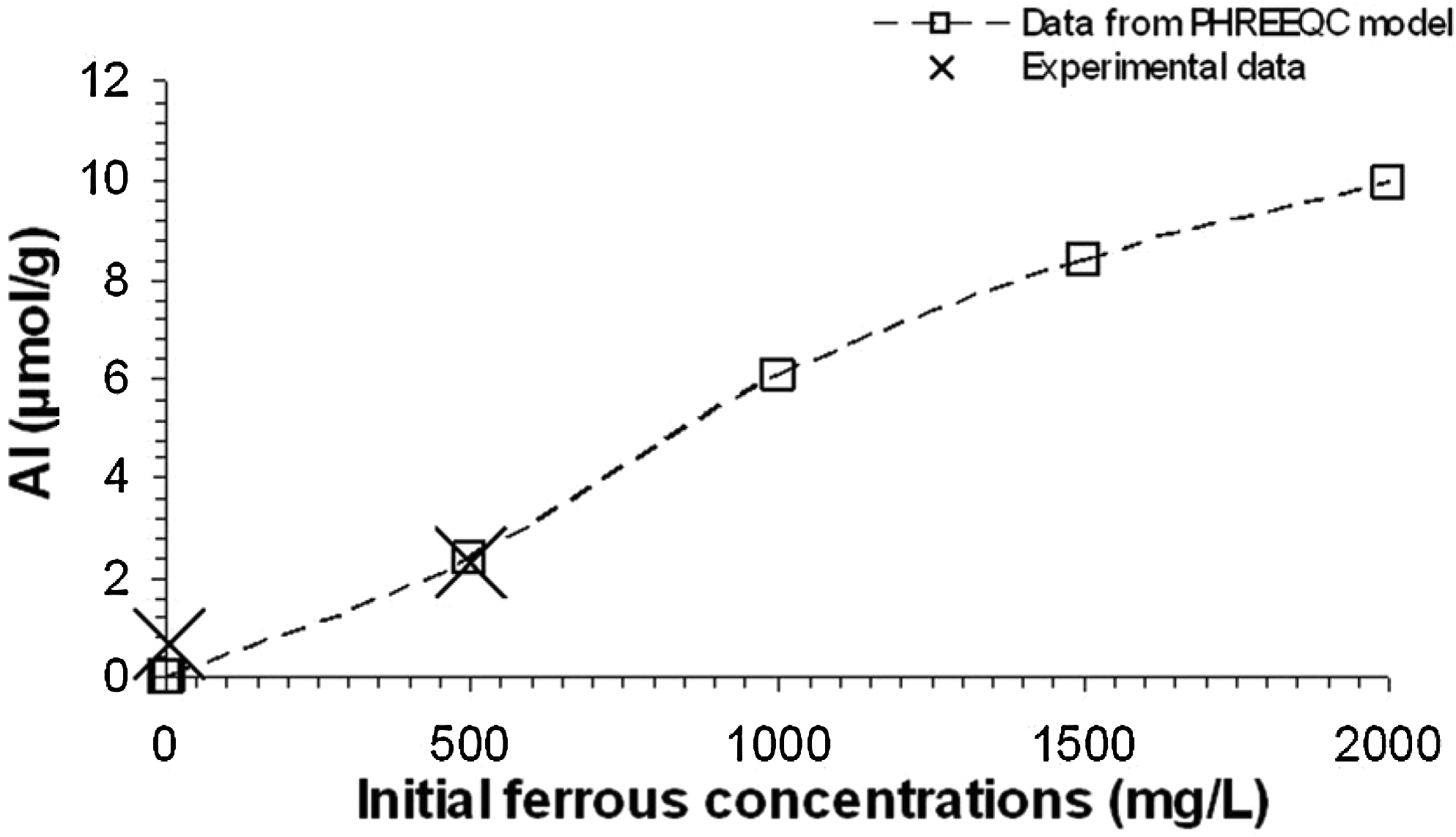
PHREEQC modeled leaching experiment conducted with smectite and synthetic AMD and sulfuric acid leaching solutions at a wt/wt soil-to-solution ratio of 1:20. Line shown does not represent any fit and it is only shown to guide the eye.
From a comparison of the evolution of Al released from these batch experiments and the early stage in the historical data (1999–2003) from ARD discharging from the I-80 culvert into the Jonathan Run stream, it appears that the site over this time period was still in the stage of evolution of Al that is dominated by exchange processes, involving high-CEC and acid unstable Al-bearing clays, such as smectites. This first stage was followed by a second stage that suggests Al release dominated by longer term dissolution processes. These results are consistent with the observed low iron concentrations in ARD from this Centre County pyritic sandstone and shale fill.
Geochemical modeling
The PHREEQC simulations produced a reasonable fit to our experimental data and support the observation that ferrous iron in AMD enhances the release of Al from smectite clays. Simulated equilibrium concentrations of Al, 2.37 μmol/g (Fig. 6), are consistent with those in leaching experiments (2.30 μmol/g) with initial synthetic AMD containing 516 mg/L Fe2+, after about 1,000 h (<2 months) of leaching time (Table 5). The simulated leaching of smectite clays with AMD containing initial ferrous iron concentrations, from 0 to 2,000 mg/L, at a wt/wt clay-to-leaching ratio of 1:20, resulted in Al concentrations up to around 9.63 μmol/g, as shown in Fig. 6. This figure shows that ferrous iron in AMD is an important factor on the release of Al from these clays. Results from our laboratory experiments coupled with PHREEQC simulations suggested that leaching of smectites with initial ferrous concentrations ranging up to 2,000 mg/L in AMD release at least 13 times more Al than leaching of smectites with sulfuric acid solution at the same initial pH value of around 3, as shown in Fig. 6.
The PHREEQC model indicated that smectite (beidellite and nontronite), kaolinite, and quartz, plus ferric hydroxide, were supersaturated and thus the potential to precipitate from simulated smectite–sulfuric acid mixtures at initial pH (pHi) values ranging from 2.3 to 5 (Table 6). The most significant supersaturated solid phases remained supersaturated at the equilibrium pH (pHf) values from 3.9 to 5.9 as shown in the Table 6. The indicated degree of supersaturation with various clay minerals could result if pH values are in error (+1 unit).
The pHf values represent outcome equilibrium pH values of the model.
Conclusions
The steady-state Al concentration (2.3 μmol/g) in a mixture of smectite and synthetic AMD was at least three times higher than the Al concentration in a mixture of smectite and sulfuric acid <0.74 μmol/g for the same initial pH ∼3.
An early release of Al from smectite clays leached with synthetic AMD from <0.74 to around 1.9 μmol/g, was dominated by exchange reactions involving ferrous iron and H+.
Long-term release of Al from smectite clays leached with synthetic AMD was dominated by smectite dissolution processes, and resulted in Al concentrations up to 2.3 μmol/g once steady state was approached.
The PHREEQC simulation of smectite dissolution and cation exchange was consistent with the experimental results.
Results from these experiments coupled with PHREEQC simulations suggested that Fe2+, which is common in ARD/AMD, can enhance the release of Al from smectite clays at low pH.
Footnotes
Acknowledgments
The authors would like to thank the Pennsylvania Department of Transportation District 2 for their assistance and facilitation of the project and GAI Consultants and Hedin Environmental Consultants for their guidance and facilitation of field research. This work was supported by the Pennsylvania Department of Transportation under Intergovernmental Agreement Work Order 004 at the University of Pittsburgh.
Author Disclosure Statement
No competing financial interests exist.