




Abstract
Abstract
Electron beam radiolysis experiments were undertaken to gain insights into the kinetic mechanisms of diethyl phthalate (DEP) degradation in aqueous solutions. DEP degradation was found to follow pseudo-first-order kinetics. The pseudo-first-order rate constant decayed exponentially with DEP initial concentrations (C0), whereas G values of DEP and C0 followed linear relationship. Addition of sodium carbonate to irradiated DEP solutions reduced DEP decomposition. H2O2 was not favorable for removal of DEP. An effective degradation was achieved in both N2O-saturated and t-BuOH–containing N2-saturated DEP solutions. High removals (>99%) were achieved at 15 kGy without these radical scavengers. Radical scavenging tests indicated that both •OH and e−aq played significant roles in DEP radiolysis. Several intermediates such as monoethyl phthalate, phthalate acid, and short-chain aliphatic carboxylic acids were formed from DEP radiolytic degradation. Finally, DEP was completely mineralized when the absorbed dose was high enough. Results also indicate that electron beam radiolysis is a promising process for an efficient removal of DEP in aqueous solutions.
Introduction
As one of the most frequently affirmed PAEs, diethyl phthalate (DEP) with short-chain structure and high water solubility were detected at high concentrations in surface water, drinking water, and sea water (Penalver et al., 2000; Ogunfowokan et al., 2006; Xu et al., 2007; Montuori et al., 2008; Zeng et al., 2009). To explore the prospects of reducing the effects of DEP in the aqueous environment, a considerable amount of investigations on DEP degradation has been carried out, most of which have focused on photochemically initiated degradation processes and biological methods (Muneer et al., 2001; Mailhot et al., 2002; Chang et al., 2004; Yang et al., 2005; Fang et al., 2007; Xu et al., 2007). However, the common disadvantages of biodegradation technologies still exist, such as long reaction time and difficulty to biologically decompose (Yuan et al., 2002). For physicochemical methods, the addition of catalysts or oxidants to the solutions is required, which may lead to high cost and secondary pollution. So an effective environmental friendly technology for the treatment of DEP is required. Ionizing radiation has been proven as a promising approach for contaminant destruction and an effective technique for elucidating reaction mechanisms and kinetics (Spinks and Woods, 1990; Cooper et al., 1998; Zhang et al., 2007b). In addition, a complete degradation of pollutants can be achieved by irradiation treatment without further pollution and without utilization of any chemicals (Sakumotoa and Miyataa, 1984). It is known that water radiolysis results in the formation of hydrated electrons (e−aq), hydroxyl radical (•OH), hydrogen radical (H•), as well as less-active species (H2O2, H3O+, and H2) [equation (1)].
The values in parentheses are the radiation-chemical yields of these species, that is, G values (μmol J−1) (Buxton et al., 1988; Jeong et al., 2010).
The objective of this study was to investigate the electron beam radiolysis of DEP, with particular emphasis on the kinetics and reaction pathways. The pseudo-first-order rate constant and G value of DEP were determined at various concentration levels. In addition to reporting the degradation kinetics, we have investigated the removal efficiencies of DEP radiolysis in radical scavengers' experiments and have identified some of intermediate products to provide preliminary insight into the mechanisms that might occur under typical water treatment conditions.
Materials and Methods
Materials
DEP was obtained from Sigma (>99% purity). Ethanol, acetonitrile, dichloromethane, and tert-butyl alcohol (t-BuOH) were of high-performance liquid chromatography (HPLC) grade and purchased from Sigma. Na2CO3, NaHCO3, and H2O2 were obtained from Shanghai Chemical Reagent Company and of the highest purity commercially available.
Sample preparation
Throughout the experiments, all solutions were prepared using water filtered with a Millipore Milli-Q system. For kinetic studies, DEP aqueous solutions with initial concentrations (C0) from 10 to 500 mg L−1 were used, and C0 of 50 mg L−1 was used in other experiments unless otherwise stated. Appropriate amount of ethanol, Na2CO3, and H2O2 were added to DEP aqueous solutions just prior to irradiation. High-purity N2O (99.999%) and N2 (99.999%) were sparged into DEP aqueous solutions before radiolysis. All experiments were carried out at ambient temperatures.
Irradiation experiments
All irradiation experiments were conducted using an electron accelerator (GJ-2-II, Xianfeng electrical plant) with beam energy of 1.8 MeV and variable current of 0–10 mA, which belonged to the Institute of Applied Radiation, Shanghai University, China, and the schematic diagram of electron beam irradiation device is shown in Fig. 1. Samples were placed in the radiation field about 30 cm distance from the source. The volume and thickness of DEP solutions were 10 mL and 2 mm, respectively. A dose rate of 0.045 kGy s−1 was utilized. The experiments were carried out mainly at absorbed doses of 1–300 kGy.

Schematic diagram of an electron beam irradiation device.
Analytical methods
Quantitative determination of DEP was carried out using HPLC (Agilent 1200). The HPLC system consisted of a C18 column (150 mm × 4.6 mm), an autosampler, and a UV detector (G1314B). The mobile phase consisted of acetonitrile and water (50:50, v/v) and the flow rate was 1.0 mL min−1. An injection volume of 10 μL was used and the concentration of DEP was determined by UV detection at 224 nm. Peak area was used for quantitative calculations. UV–vis absorption spectra were measured with a UV–vis spectrometer (Agilent 8453). Total organic carbon (TOC) concentrations were tested using a TOC analyzer (multi C/N 2100).
Negative ions produced from DEP radiolysis were determined using an ion chromatograph (IC-Metrohm MIC advanced) consisting of a hydrophilic anion exchange column and an autosampler. A METROSEP A SUPP 5-250 (5 μm particle size, 250 mm × 4 mm) column was employed and an eluent of 3.2 mM Na2CO3/1.0 mM NaHCO3 at a flow rate of 0.70 mL min−1 was used. Injection volume was 10 μL.
Gas chromatography/mass spectrometry (GC/MS) and Hybrid Quadrupole-TOF LC/MS/MS analyses were also performed to identify the degradation products. Before GC/MS analysis, 50 mL of irradiated samples were extracted (liquid–liquid extraction) in three stages using 10, 10, and 5 mL of dichloromethane. Analysis was performed using a gas chromatograph (GC-2010; Shimadzu) coupled with a quadrupole mass spectrometer (GC/MS-QP2010 Plus; Shimadzu) equipped with a DB-5 MS column (30 m × 0.25 mm). Helium was used as the carrier gas at a constant flow rate of 1 mL min−1. The GC temperature program was 40°C (held for 2 min) to 280°C (held for 10 min) at 15°C min−1. The mass spectrometer was operated in scan mode with positive ionization by electron impact. The mass range was 50–300 m/z units. Both injection and ion source temperature were 250°C and the GC/MS interface was set at 280°C. Analyses by LC/MS/MS were performed using an HPLC (Agilent 1100) system equipped with a C18 column (150 mm × 4.6 mm) and an MS (Q-STAR) system with an electrospray interface operating in positive ion mode between 50 and 300 m/z units. The mobile phase used was a mixture of acetonitrile (60%) and water (40%) at a flow rate of 0.7 mL min−1.
Results and Discussion
Radiolytic degradation of DEP aqueous solution
The evolution of UV–vis absorption spectra of DEP aqueous solutions before and after electron beam irradiation as a function of absorbed doses is depicted in Fig. 2. It is noticeable that a significant decrease of the optical densities of DEP is observed. The disappearance of 230 and 280 nm absorption bands and the reduction of absorption bands around 200 nm were observed with increasing absorbed doses. Therefore, the decrease of absorbance is due to the reduction of DEP. Consequently, it was confirmed that electron beam radiolysis was an effective process for the decomposition of DEP.
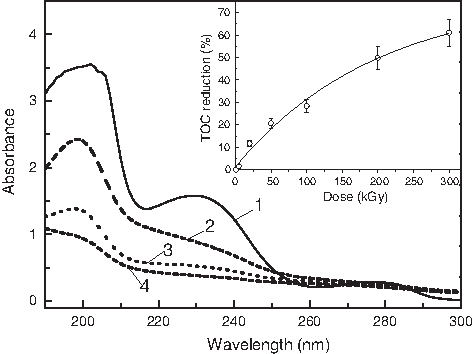
UV–vis absorption spectra of DEP evolution at different absorbed doses (absorbed dose from line 1 to 4: 0, 1, 5, and 15 kGy, respectively). Inset: TOC reduction of DEP aqueous solutions versus absorbed dose. DEP, diethyl phthalate.
To determine the extent of mineralization of DEP, TOC values of the solution were monitored during electron beam radiolysis, and the TOC removal of DEP is illustrated in the inset of Fig. 2. It was obvious that the mineralization efficiency of DEP increased with increase of absorbed dose. For example, at an absorbed dose of 1 kGy, no TOC reduction is observed, whereas nearly 30% and 60% TOC reductions are, respectively, achieved after absorbed doses of 100 and 300 kGy. This result suggested that electron beam radiolysis could be an effective method to mineralize the DEP in aqueous solutions.
Kinetics of DEP degradation at different initial concentrations and absorbed doses
DEP radiolytic degradation kinetics was investigated in aqueous solutions following the decrease of DEP. From the slope of linear relationship of ln C (DEP concentration) versus absorbed doses, the pseudo-first-order (R2 > 0.99) rate constants (k1) were estimated.
Figure 3 shows that k1 decays exponentially with C0. The concentrations of active radicals from water radiolysis are dependent on absorbed dose and the effective concentration of the reactants is based on the steady-state assumption. Therefore, at a fixed absorbed dose, an increase of C0 reduces the concentration of active radicals. Because k1 is the product of radical concentrations with the absolute second-order rate constants of reactions between radicals and reactants, k1 is proportional to the radical concentrations. Therefore, k1 decay exponentially with C0.
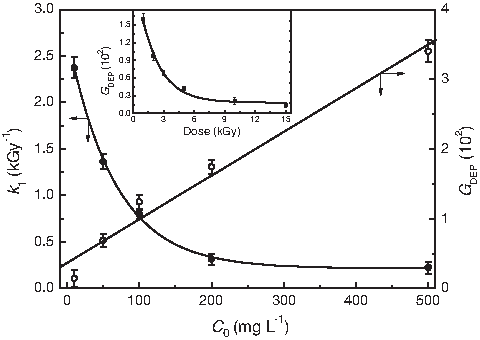
Profiles of GDEP as a function of C0 at an absorbed dose of 3 kGy and k1 as a function of C0 at absorbed doses from 1 to 15 kGy. Inset: Profile of GDEP as a function of absorbed doses from 1 to 15 kGy.
where ΔR is the amount of reduced DEP (M), NA is the Avogadro constant (6.02 × 10²³ molecules mol−1), D is absorbed dose in kGy, 6.24 × 10¹⁹ indicates the conversion constant from kGy to 100 eV L−1 (100 eV L−1 kGy−1), and G is the specific reduction efficiency (molecules [100 eV]−1) (Nickelsen et al., 2002; Zhang et al., 2007a).
The G values of DEP (GDEP), which delegated the utilization efficiency of active species from water radiolysis in DEP degradation, are determined by equation (2). On the one hand, GDEP decreases exponentially with increasing absorbed dose (see Fig. 3, inset), suggesting that a high absorbed dose does not facilitate DEP radiolytic degradation, that is, the utilization efficiency of reactive radicals. On the other hand, the profiles of GDEP versus C0 show a good linearity (>0.98) (Fig. 3), implying that GDEP is positively proportional to C0. That is to say, the utilization efficient of reactive radicals is enhanced with increasing C0. The results discussed above are consistent with general trends of reactions known in radiation chemistry and could be explained by the principles of competitive reaction kinetics. These experimental results suggest that the predominant reactions in radiolysis of DEP aqueous solutions are as follows:
GDEP is a measurement of the utilization efficient of reactive radicals in DEP radiolysis degradation. A higher absorbed dose means a lower contribution of reaction 4 among reactions 3–5. Therefore, GDEP decays with absorbed dose. On the contrary, an increase of C0 enhances the proportion of reaction 4. Consequently, GDEP and C0 follow linear relationship.
Radical scavenger effects on DEP degradation
The effects of radical scavengers on DEP electron beam irradiation degradation are illustrated in Fig. 4. Figure 4A shows that the removal value of DEP in the presence and absence of Na2CO3 improves with increasing absorbed doses, and the increasing concentration of Na2CO3 results in the decrease of the degradation value of DEP at the same absorbed dose. As presented in Fig. 4A, at Na2CO3 concentration of 3.0 mM, DEP degradation efficiency is 83% at an absorbed dose of 5 kGy, whereas at 10.0 mM Na2CO3, a reduction value of 65% is obtained. As CO32− can react with •OH [equation (6)] (Buxton et al., 1988; Nickelsen et al., 2002), the concentration of •OH is somewhat lower in DEP solutions containing Na2CO3 than in DEP solutions because of competitive kinetics. It can be indicated that •OH plays an important role in DEP radiolytic destruction.

Degradation efficiency of DEP electron beam radiolysis with addition of Na2CO3
The effects of various levels of H2O2 on DEP radiolysis is displayed in Fig. 4B. It is clear that with or without H2O2, >99% DEP is removed at an absorbed dose of 15 kGy. Extraordinarily, the presence of H2O2 does not facilitate the degradation of DEP, but it somewhat decreases the removal efficiency of DEP. This result could be explained by two reasons. On the one hand, the oxidizing potential of H2O2 is not sufficient to degrade organic pollutants without activation (Steensen, 1997); moreover, H2O2 hardly absorbs high-energy electron beams and there are no active species produced through dissociation (Jung et al., 2003). On the other hand, active species are not generated from the reaction of H2O2 with the irradiation products of DEP as well as water. In general, H2O2 reacts with both •OH and e−aq and then produces and consumes •OH [equations (7) and (8)], respectively (Taghipour and Evans, 1997); the rate constant of H2O2 with e−aq is 3 orders of magnitude faster than that with •OH. As a result, active species in the solution with H2O2 are reduced compared with the one without H2O2. One conclusion may be that e−aq is important for DEP destruction in the electron beam radiolysis process.
To further elucidate which active species played a main role in DEP radiolytic degradation, experiments were performed with 0.1 M t-BuOH–containing DEP solution deoxygenated by N2 and with DEP solution saturated with N2O. In N2O-saturated DEP aqueous solutions, •OH is the main active species in the solutions, as e−aq and •H are scavenged by N2O to form •OH through reactions 9 and 10 (Song et al., 2008a, 2008b). In the presence of t-BuOH saturated with N2 solutions, t-BuOH scavenges •OH and •H [equations (11) and (12)] (Song et al., 2008a, 2008b) and converts them into relatively inert t-BuOH radicals; as a result, e−aq is the main species in solution. The results are presented in Fig. 4C. It was obvious that >99% DEP was decomposed at an absorbed dose of 15 kGy in both conditions. Therefore, both •OH and e−aq played key roles in DEP degradation.
Mechanism of DEP degradation
In addition to the kinetics and radical scavengers' effects on DEP degradation, the products from DEP radiolytic degradation in aqueous solutions were identified by IC, GC/MS, and LC/MS/MS analyses.
Organic acids produced from DEP degradation by electron beam irradiation were detected by IC and many organic acids were detected. According to the IC of standard organic acids, formic acid, acetic acid, and oxalic acid were determined (change of these three acids concentrations were illustrated in Fig. 5), and there were still some other acids to be further determined. It was clear that the concentrations of these organic acids reached a maximum and then declined with absorbed dose. Combining with TOC tests (inset of Fig. 2), it was indicated that the concentration of these acids ultimately went below the detection limits while the absorbed dose was high enough.
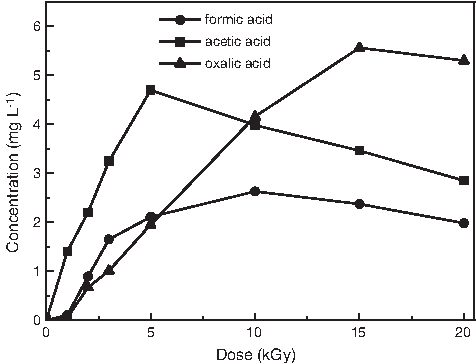
Determined organic acids produced in the DEP degradation process by electron beam irradiation.
Intermediate products were also detected by GC/MS and LC/MS/MS. One product (m/z: 104, 76) was identified by the mass fragment peak and through comparison with GC/MS NIST library data. The similarities of this product to the NIST library data were >85%. According to these results, monoethyl phthalate was determined. LC/MS/MS analysis of the product peak showed a [M–H2O + K] + ion at m/z 187, suggesting a molecular weight of 166. Comparing LC/MS/MS profiles of standard samples with the profile of this product, phthalate acid was detected.
Considering the identified intermediates in this work, a possible mechanism of DEP radiolytic degradation is proposed in Fig. 6. On the one hand, first e−aq transfers to ester groups more easily than to aromatic rings (Szadkowska-Nicze and Mayer, 1999) generates ester radical anions of DEP (2), and then •OH attacks the intermediate product 2, forming product 3, which can lead to the formation of the detected monoethyl phthalate (6) upon loss of an ethoxy group. Then, ethoxy group via a whole train of oxidation reactions produce acetic acid. On the other hand, because of H atom in α-position is the most labile H atom in the methylene groups of the ester function, electrophilic •OH as predominate species mainly attacks aliphatic chain (Bajt et al., 2001), via the abstraction of H atom on this CH2 group forming highly unstable hydroxylated derivative (5). (Mailhot et al., 1999). The obtained product 5 hydrolyzes into 6 and acetic acid. Subsequently, 5 may then undergo a further abstraction of α-H or electron transfer and •OH addition, and then the observed phthalate acid (7) is formed. However, acetic acid is easily mineralized into water and carbon dioxide, and the relatively unstable 7 undergoes decarboxylation, forming a more stable and resistant benzoic acid (8) (Onwudili and Williams, 2007). Then, •OH attacks the aromatic ring through a series of reactions, and ring-opening products are formed, such as formic acid and oxalic acid. Ultimately, these intermediate products are completely mineralized under further electron beam irradiation.
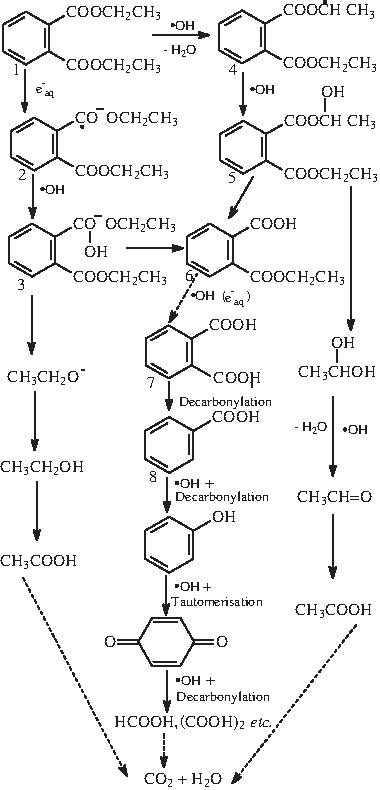
A possible degradation pathway of DEP electron beam radiolysis.
Conclusions
The investigation into DEP degradation induced by electron beam irradiation demonstrated that electron beam radiolysis was an effective method for DEP degradation. DEP electron beam radiolysis followed pseudo-first-order kinetics; k1 and GDEP were functionally related to C0 and absorbed doses. Na2CO3, H2O2, N2O, and t-BuOH decreased the degradation efficiency of DEP because they were good active species scavengers, which demonstrates that both •OH and e−aq played important roles in DEP radiolysis. Two different pathways could form monoethyl phthalate and phthalate acid as intermediates. IC detections indicated that ring-opening products were generated in DEP radiolysis. The mineralization efficiency of DEP was nearly 30% at 100 kGy and it increased with increasing absorbed dose in aqueous solutions.
Footnotes
Acknowledgments
The authors thank the National Natural Science Foundation of China (No. 40973073, 40830744), National Key Technology R&D Program in the 11th Five-Year Plan of China (No. 2008BAC32B03, 2009BAA24B04), Shanghai Leading Academic Discipline Project (No. S30109), and Shanghai Municipality Natural Science Foundation (No. 09ZR1411300) for financial support to this study.
Author Disclosure Statement
No competing financial interests exist.