In this article, a novel batch reactor of ultraviolet (UV) light-emitting diodes (LEDs) and peroxydisulfate has been studied for the degradation of Basic Red 46 (BR46) as a model organic pollutant in water. Almost no dye degradation was achieved with UV LED alone, whereas 43% of destruction was obtained in the presence of peroxydisulfate. More than 90% of the dye content was eliminated using UV LED and peroxydisulfate simultaneously in 30 min. Effects of different parameters such as UV LED irradiation, peroxydisulfate concentration, dye concentration, pH, and current on the removal of BR46 were investigated. Satisfactory degradation of BR46 was observed for tested pH range of 2–9.8, with peak at pH 6.43. Electrical energy per order (EEO) for degradation values of BR46 using both UV LEDs and traditional UV lamps in different concentrations of peroxydisulfate were calculated. Our results show that using LEDs reduces EEO significantly. On increasing the current from 360 to 2,000 mA, the decolorization rate increased. Hence, 720 mA of current intensity was preferred to avoid consumption of energy. A novel and effective cooling system was installed to increase the lifespan of LEDs and make the system economically more feasible for water and wastewater treatment.
Introduction
Effluents from the textile, leather, food processing, dyeing, cosmetics, paper, and dye manufacturing industries are major sources of dye pollution (Bhatnagar and Jain, 2005). In general, dyes are not easily degradable and not easily removed from wastewater by conventional wastewater treatment systems (Isik and Sponza, 2005; Sarioglu et al., 2007). As some dyes and their breakdown products may be toxic toward living organisms (Wuhrmann et al., 1980), the degradation of dyes is a critical aspect of wastewater treatment before discharge.
Common treatment methods for color removal from dye-contaminated effluents consist of various processes involving biological oxidation and adsorption and physical and chemical decolorization (Wuhrmann et al., 1980; Galindo et al., 2001; Bhatnagar and Jain, 2005; Isik and Sponza, 2005; Sarioglu et al., 2007). Although less expensive than other approaches, biological treatment is ineffective for decolorization as the dyes are toxic. As for the physical adsorption methods, contaminants may be effectively confined on the activated carbon substrates. However, disposal of the sludge is required (Galindo et al., 2001). Advanced oxidation processes (AOPs) are alternative techniques of destruction of dyes and many other contaminating organics (Paterlini and Nogueira, 2005). These processes generally involve ultraviolet (UV)/H2O2, UV/O3, or UV/Fenton's reagent for the oxidative degradation of contaminants (Daneshvar et al., 2007a, 2007b; Vilhunen and Sillanp, 2009). It has been shown that AOPs are useful in treating dyes and giving a more effective performance than using single oxidants. It has been concluded that hydroxyl radical is effective in degrading Basic Red 46 by using the above processes. However, the information regarding the decay of organics by a new approach, UV/peroxydisulfate or sulfate radicals, is very limited. It has been reported that the reaction rate constants of \documentclass{aastex}\usepackage{amsbsy}\usepackage{amsfonts}\usepackage{amssymb}\usepackage{bm}\usepackage{mathrsfs}\usepackage{pifont}\usepackage{stmaryrd}\usepackage{textcomp}\usepackage{portland,xspace}\usepackage{amsmath,amsxtra}\pagestyle{empty}\DeclareMathSizes{10}{9}{7}{6}
\begin{document}$${\rm UV} / {\rm S}_2{\rm O}_8^{2-}$$\end{document}and UV/H2O2 (the most common process) are the same (Chu et al., 2006). Moreover, peroxydisulfate benefits UV/H2O2 and other similar approaches by the following reasons: (1) peroxydisulfate ions seems to be more promising because of the potential quenching effect of using H2O2 when the process is not well controlled (such as overdosing) (Chu et al., 2006); (2) as peroxydisulfate is a solid oxidant, it would be more capable for industrial uses in comparison to liquid oxidants such as H2O2; (3) peroxydisulfate salts are much cheaper than other oxidants such as hydrogen peroxide and ozone (Anipsitakis and Dionysiou, 2003, 2004). Because of the high reactivity of \documentclass{aastex}\usepackage{amsbsy}\usepackage{amsfonts}\usepackage{amssymb}\usepackage{bm}\usepackage{mathrsfs}\usepackage{pifont}\usepackage{stmaryrd}\usepackage{textcomp}\usepackage{portland,xspace}\usepackage{amsmath,amsxtra}\pagestyle{empty}\DeclareMathSizes{10}{9}{7}{6}
\begin{document}$${\rm UV} / {\rm S}_2{\rm O}_8^{2-}$$\end{document}, high solubility of peroxydisulfate, and other mentioned advantages, their application in wastewater treatment has been recently the focus of attention (Vilhunen and Sillanp, 2009).
Majority of previous photodegradation and photocatalytic studies investigated the application of traditional UV lamps (Daneshvar et al., 2007a, 2007b; Khataee et al., 2009). Traditional UV light sources are mostly incandescent lamps. UV emission of such sources depends on filament temperature (∼300 K) and their emission comprises only 0.2% of the total output, which naturally results in low efficiency (Philips, 1983). Gas-discharged sources are another type of traditional UV lamps that contain mercury, a hazardous air pollutant according to the U.S. Environmental Protection Agency (Chen, 2005). Besides, the short life, instability of output power, and difficulties in reactor design are other drawbacks of traditional UV lamps. Hence, new light-emitting diodes (LEDs) and also laser light are postulated as viable light sources for photodegradation and photocatalytic purposes (Qamar et al., 2009). In case of laser, in comparison to traditional lamps, there is high absorption of photons of particular laser emission wavelengths by photocatalysts (Qamar et al., 2010). In LEDs, light is emitted by recombination of excessive electrons and holes (Chen et al., 2007). Actually, waste of energy in the form of heat is not considerable in LEDs and almost all the electrical energy is transformed into light. LEDs are programmable for periodic illumination; decreasing electron-hole recombination and hence increasing photonic efficiencies (Vilhunen and Sillanp, 2009). Besides, their long life (>100,000 h), rugged structure, compact size, and specific emission wavelength make them ideal UV sources (Chen et al., 2007). However, the current cost of UV LEDs is relatively high, and thus, attempts have been made to design efficient cooling systems and make the method economically more feasible by increasing the lifespan of LEDs.
In this study, use of UV LEDs and peroxydisulfate for degradation of dye pollutions has been studied. Moreover, a self-designed cooling system was applied and the effects of different parameters such as UV LED irradiation, peroxydisulfate concentration, dye concentration, pH, and current were investigated. Electrical energy per order (EEO) for degradation values of Basic Red 46 (BR46) was calculated using both traditional UV lamps and LEDs.
Experimental Protocols
Materials
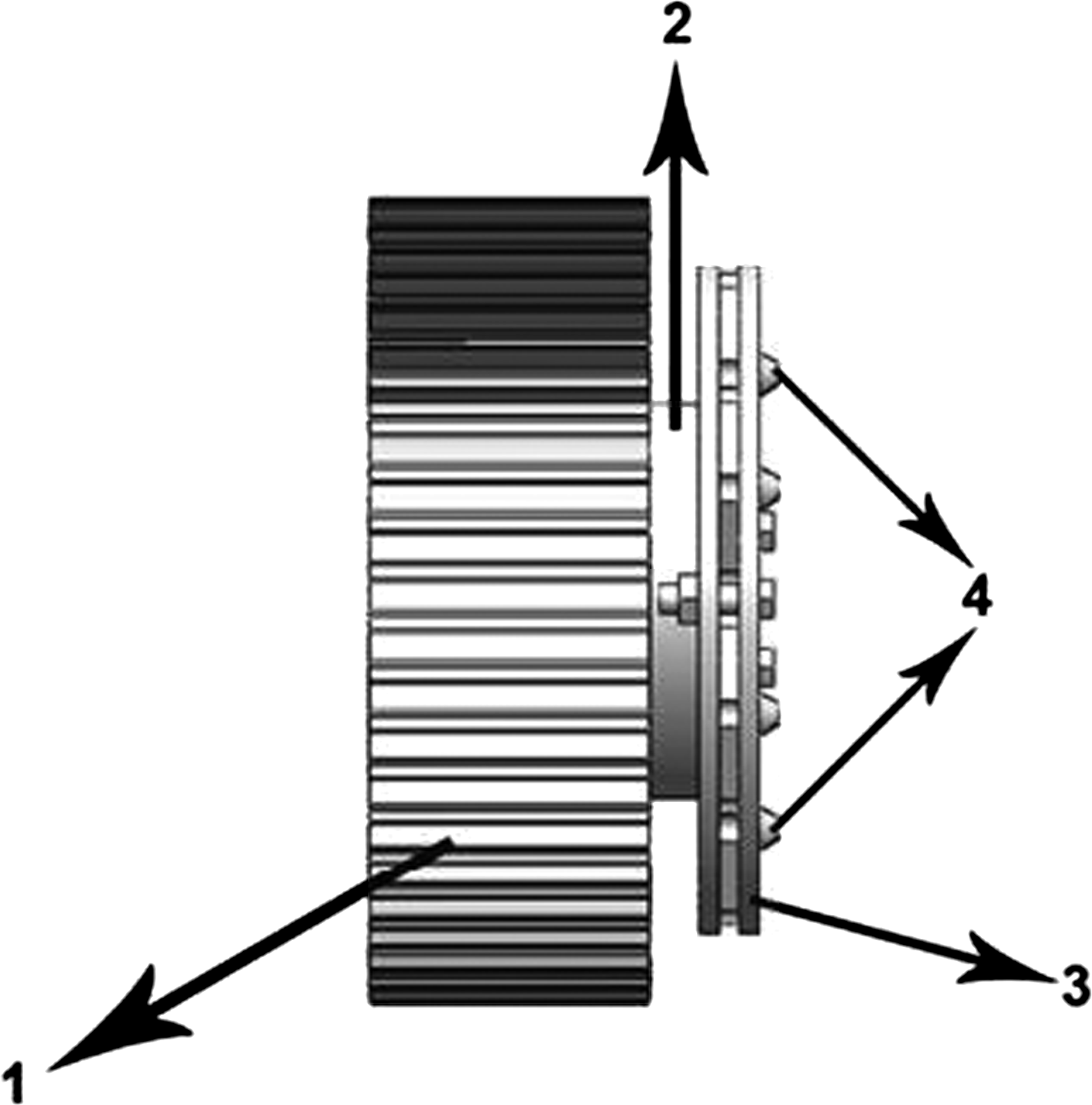
Color Index (C.I.) BR46 (C.I. No. 110825) was obtained from Boyakhshaz, Tabriz, Iran, and used without further purification. The dye characteristics are given in Table 1. Ammonium peroxydisulfate was obtained from Merck. Its solution was immediately prepared before the measurements to avoid the change of concentration due to self-decomposition. Dilute solutions of sodium hydroxide and hydrochloric acid are used for pH adjustment. TO-18 LEDs were manufactured by Seoul Optodevice Co., Ltd., and the power of each LED is 1 W. After electrical connection, the LEDs were put into plastic covers. To increase the lifespan of LEDs, a novel cooling system was designed using an aluminum radiator and an appropriate connection to transfer the heat from LEDs to the radiator (Fig. 1). UV LEDs and cooling system were attached using a 5-cm clamp above the beaker. Current and voltage were adjusted by a DC power supply with galvanostatic operational options (Fig. 2).
Schematic drawing of LEDs and cooling system: (1) aluminum radiator; (2) transfers the heat from LEDs to the radiator; (3) LEDs; (4) plastic cover.
Schematic drawing of a batch reactor: (1) DC power supplier; (2) magnetic stirring; (3) beaker; (4) UV light-emitting diodes; (5) cooling system; (6) clamp. UV, ultraviolet.
Characteristics of Basic Red 46
Structure
λmax (nm)
Chemical class
Mw (g/mol)
531
Mono-azo
357.5
Procedure
The photoreactor was operated with an initial working volume of 100 ml. Solutions were prepared by dissolving the necessary quantity of the dye and \documentclass{aastex}\usepackage{amsbsy}\usepackage{amsfonts}\usepackage{amssymb}\usepackage{bm}\usepackage{mathrsfs}\usepackage{pifont}\usepackage{stmaryrd}\usepackage{textcomp}\usepackage{portland,xspace}\usepackage{amsmath,amsxtra}\pagestyle{empty}\DeclareMathSizes{10}{9}{7}{6}
\begin{document}$${\rm S}_2{\rm O}_8^{2-}$$\end{document} in distilled water and fed into the photoreactor. Peroxydisulfate and dye concentrations were varied from 10 to 200 mM and 5 to 40 ppm (ppmw), respectively. Effect of pH was also investigated in a range of 2–10. The solution in the beaker was continuously stirred with a stirrer to prepare uniform mixing of the degrading dye solution. Six UV LEDs (1 W) were turned on at room temperature (25°C ± 2°C) and the dye solution samples were taken at desired time intervals and analyzed on a UV/visible spectrophotometer (Shimadzu 160) at λmax=531 nm with a calibration curve based on the Beer–Lambert's law. For each experiment, operating conditions are summarized in the corresponding figure legends.
Results and Discussion
Effect of UV irradiation and peroxydisulfate on degradation of BR46
Degradation of BR46 (20 ppm) was investigated in the presence of UV irradiation, \documentclass{aastex}\usepackage{amsbsy}\usepackage{amsfonts}\usepackage{amssymb}\usepackage{bm}\usepackage{mathrsfs}\usepackage{pifont}\usepackage{stmaryrd}\usepackage{textcomp}\usepackage{portland,xspace}\usepackage{amsmath,amsxtra}\pagestyle{empty}\DeclareMathSizes{10}{9}{7}{6}
\begin{document}$${\rm S}_2{\rm O}_8^{2-}$$\end{document}(without UV radiation), and both UV radiation and \documentclass{aastex}\usepackage{amsbsy}\usepackage{amsfonts}\usepackage{amssymb}\usepackage{bm}\usepackage{mathrsfs}\usepackage{pifont}\usepackage{stmaryrd}\usepackage{textcomp}\usepackage{portland,xspace}\usepackage{amsmath,amsxtra}\pagestyle{empty}\DeclareMathSizes{10}{9}{7}{6}
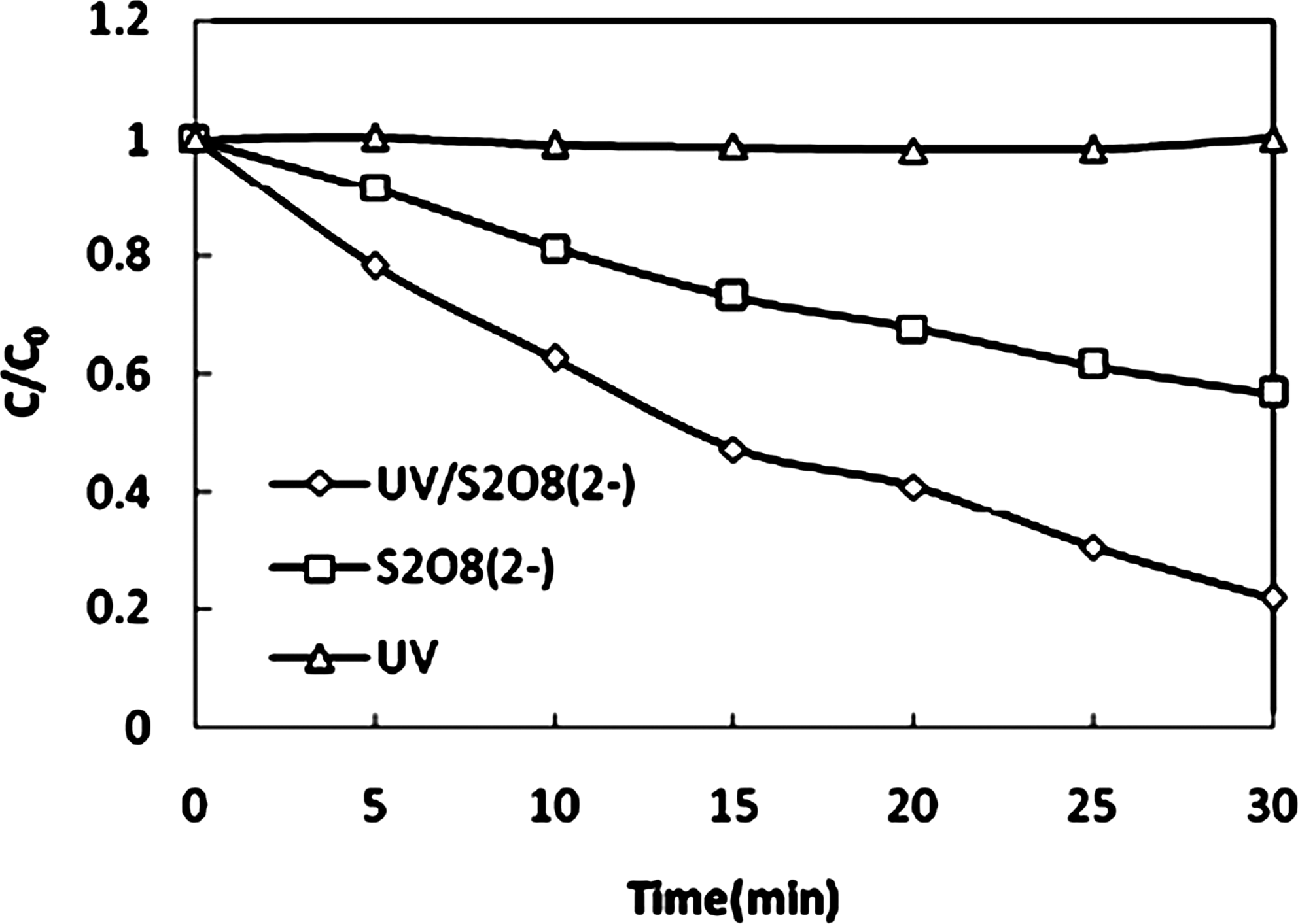
\begin{document}$${\rm S}_2{\rm O}_8^{2-}$$\end{document}, with 40 and 100 mM solutions of peroxydisulfate, 20 ppm of dye, and pH 6.4. In the first case, no color removal was evidenced in the absence of peroxydisulfate, whereas by using peroxydisulfate a maximum degradation of 42% was achieved in dark. The result of 80% dye removal was obtained with peroxydisulfate under UV irradiation in 30 min and >90% was observed under optimum conditions (Figs. 3 and 4). In general, this is due to the formation of more powerful hydroxyl and sulfate-oxidizing radicals under UV radiation. Reactions of peroxydisulfate are slow at normal temperature. Thus, as summarized in equations (1)–(5), thermal or photochemical activated decomposition of \documentclass{aastex}\usepackage{amsbsy}\usepackage{amsfonts}\usepackage{amssymb}\usepackage{bm}\usepackage{mathrsfs}\usepackage{pifont}\usepackage{stmaryrd}\usepackage{textcomp}\usepackage{portland,xspace}\usepackage{amsmath,amsxtra}\pagestyle{empty}\DeclareMathSizes{10}{9}{7}{6}
\begin{document}$${\rm S}_2{\rm O}_8^{2-}$$\end{document} ion to \documentclass{aastex}\usepackage{amsbsy}\usepackage{amsfonts}\usepackage{amssymb}\usepackage{bm}\usepackage{mathrsfs}\usepackage{pifont}\usepackage{stmaryrd}\usepackage{textcomp}\usepackage{portland,xspace}\usepackage{amsmath,amsxtra}\pagestyle{empty}\DeclareMathSizes{10}{9}{7}{6}
\begin{document}$${\rm SO}_4^{\bullet -}$$\end{document} radical has been proposed for acceleration of the process (Salari et al., 2008):
\documentclass{aastex}\usepackage{amsbsy}\usepackage{amsfonts}\usepackage{amssymb}\usepackage{bm}\usepackage{mathrsfs}\usepackage{pifont}\usepackage{stmaryrd}\usepackage{textcomp}\usepackage{portland,xspace}\usepackage{amsmath,amsxtra}\pagestyle{empty}\DeclareMathSizes{10}{9}{7}{6}
\begin{document}
\begin{align*}
{\rm S}_2{\rm O}_8^{2 -} + \hbox{\rm Photons or Heat} \rightarrow 2\,{\rm SO}_4^{\bullet -} \tag {1}
\end{align*}
\end{document}\documentclass{aastex}\usepackage{amsbsy}\usepackage{amsfonts}\usepackage{amssymb}\usepackage{bm}\usepackage{mathrsfs}\usepackage{pifont}\usepackage{stmaryrd}\usepackage{textcomp}\usepackage{portland,xspace}\usepackage{amsmath,amsxtra}\pagestyle{empty}\DeclareMathSizes{10}{9}{7}{6}
\begin{document}
\begin{align*}
{\rm SO}_4^{\bullet -} + {\rm RH}_2 \rightarrow {\rm SO}_4^{2 -} + {\rm H}^ + + {\rm RH}^{\bullet} \tag {2}
\end{align*}
\end{document}\documentclass{aastex}\usepackage{amsbsy}\usepackage{amsfonts}\usepackage{amssymb}\usepackage{bm}\usepackage{mathrsfs}\usepackage{pifont}\usepackage{stmaryrd}\usepackage{textcomp}\usepackage{portland,xspace}\usepackage{amsmath,amsxtra}\pagestyle{empty}\DeclareMathSizes{10}{9}{7}{6}
\begin{document}
\begin{align*}
{\rm RH}^{\bullet} + {\rm S}_2{\rm O}_8^{2 -} \rightarrow {\rm R} + {\rm SO}_4^{2 -} + {\rm H}^ + + {\rm SO}_4^{\bullet -} \tag {3}
\end{align*}
\end{document}\documentclass{aastex}\usepackage{amsbsy}\usepackage{amsfonts}\usepackage{amssymb}\usepackage{bm}\usepackage{mathrsfs}\usepackage{pifont}\usepackage{stmaryrd}\usepackage{textcomp}\usepackage{portland,xspace}\usepackage{amsmath,amsxtra}\pagestyle{empty}\DeclareMathSizes{10}{9}{7}{6}
\begin{document}
\begin{align*}
{\rm SO}_4^{\bullet -} + {\rm RH} \rightarrow {\rm R}^{\bullet} + {\rm SO}_4^{2 -} + {\rm H}^ + \tag {4}
\end{align*}
\end{document}\documentclass{aastex}\usepackage{amsbsy}\usepackage{amsfonts}\usepackage{amssymb}\usepackage{bm}\usepackage{mathrsfs}\usepackage{pifont}\usepackage{stmaryrd}\usepackage{textcomp}\usepackage{portland,xspace}\usepackage{amsmath,amsxtra}\pagestyle{empty}\DeclareMathSizes{10}{9}{7}{6}
\begin{document}
\begin{align*}
2{\rm R}^{\bullet} \rightarrow {\rm RR} ({\rm dimer}) \tag {5}
\end{align*}
\end{document}
Effect of UV radiation and peroxydisulfate on oxidative decolorization of BR46. [BR46]0 = 20 ppm, \documentclass{aastex}\usepackage{amsbsy}\usepackage{amsfonts}\usepackage{amssymb}\usepackage{bm}\usepackage{mathrsfs}\usepackage{pifont}\usepackage{stmaryrd}\usepackage{textcomp}\usepackage{portland,xspace}\usepackage{amsmath,amsxtra}\pagestyle{empty}\DeclareMathSizes{10}{9}{7}{6}
\begin{document}$$[{\rm S}_2 {\rm O}_8^{2-}]_0 = 100 \ {\rm mM}$$\end{document}, pH 6.4. BR46, Basic Red 46.
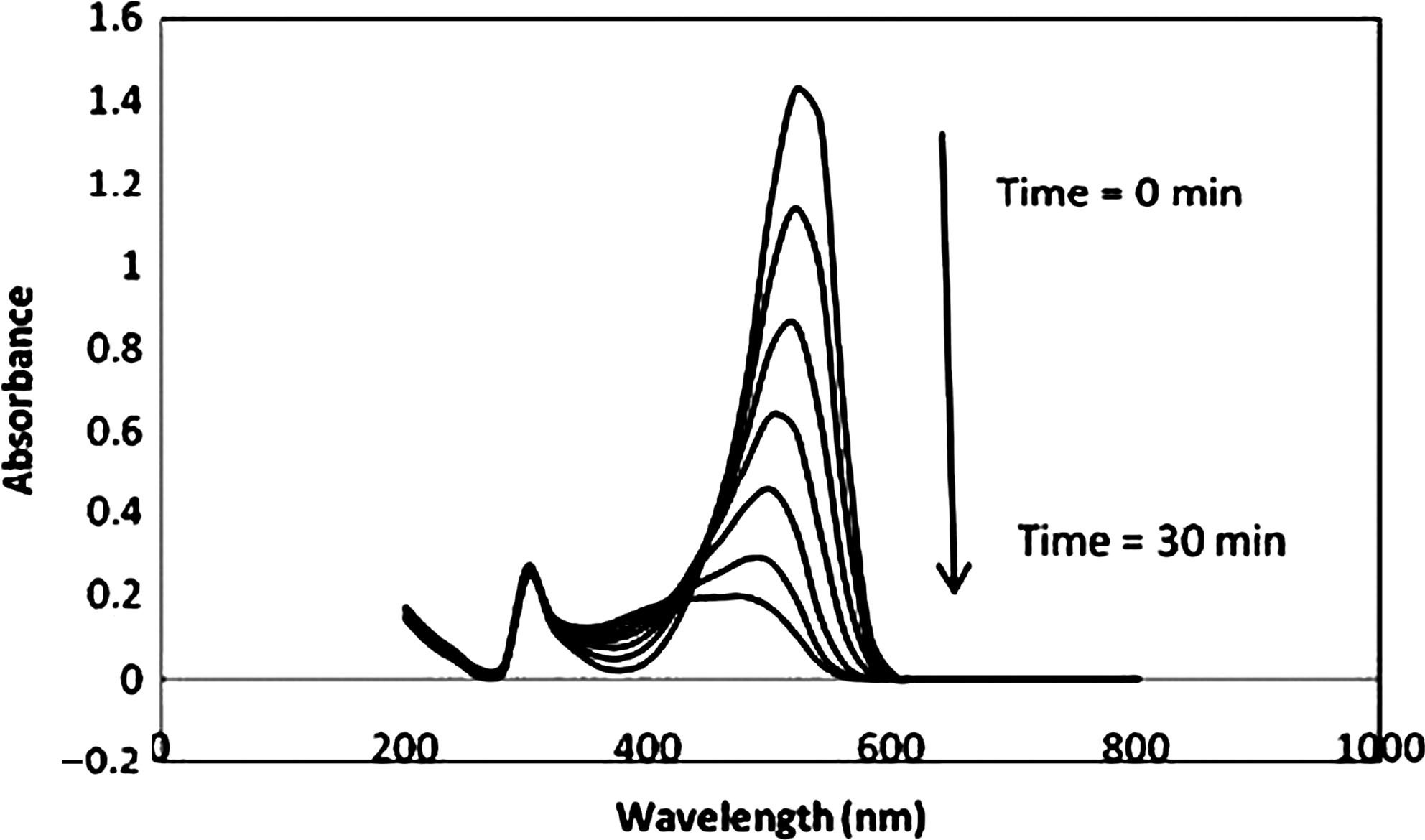
Spectral changes of BR46 solution during illumination in the presence of \documentclass{aastex}\usepackage{amsbsy}\usepackage{amsfonts}\usepackage{amssymb}\usepackage{bm}\usepackage{mathrsfs}\usepackage{pifont}\usepackage{stmaryrd}\usepackage{textcomp}\usepackage{portland,xspace}\usepackage{amsmath,amsxtra}\pagestyle{empty}\DeclareMathSizes{10}{9}{7}{6}
\begin{document}$${\rm S}_2 {\rm O}_8^{2-}$$\end{document}. [BR46]0 = 20 ppm, \documentclass{aastex}\usepackage{amsbsy}\usepackage{amsfonts}\usepackage{amssymb}\usepackage{bm}\usepackage{mathrsfs}\usepackage{pifont}\usepackage{stmaryrd}\usepackage{textcomp}\usepackage{portland,xspace}\usepackage{amsmath,amsxtra}\pagestyle{empty}\DeclareMathSizes{10}{9}{7}{6}
\begin{document}$$[{\rm S}_2 {\rm O}_8^{2-}]_0 = 100 \ {\rm mM}$$\end{document}, current = 720 mA, pH 6.4.
Both \documentclass{aastex}\usepackage{amsbsy}\usepackage{amsfonts}\usepackage{amssymb}\usepackage{bm}\usepackage{mathrsfs}\usepackage{pifont}\usepackage{stmaryrd}\usepackage{textcomp}\usepackage{portland,xspace}\usepackage{amsmath,amsxtra}\pagestyle{empty}\DeclareMathSizes{10}{9}{7}{6}
\begin{document}$${\rm SO}_4^{\bullet-}$$\end{document} and OH• are possibly responsible for the destruction of organic contaminants and either radical may predominate over the other depending on pH conditions. \documentclass{aastex}\usepackage{amsbsy}\usepackage{amsfonts}\usepackage{amssymb}\usepackage{bm}\usepackage{mathrsfs}\usepackage{pifont}\usepackage{stmaryrd}\usepackage{textcomp}\usepackage{portland,xspace}\usepackage{amsmath,amsxtra}\pagestyle{empty}\DeclareMathSizes{10}{9}{7}{6}
\begin{document}$${\rm SO}_4^{\bullet-}$$\end{document} and OH• react with organic compounds mainly by three mechanisms: hydrogen abstraction, hydrogen addition, and electron transfer. In general, \documentclass{aastex}\usepackage{amsbsy}\usepackage{amsfonts}\usepackage{amssymb}\usepackage{bm}\usepackage{mathrsfs}\usepackage{pifont}\usepackage{stmaryrd}\usepackage{textcomp}\usepackage{portland,xspace}\usepackage{amsmath,amsxtra}\pagestyle{empty}\DeclareMathSizes{10}{9}{7}{6}
\begin{document}$${\rm SO}_4^{\bullet-}$$\end{document} is more likely to participate in electron transfer reactions than OH•, which is more likely to participate in hydrogen abstraction or addition reactions (Minisci and Citterio, 1983).
Effect of initial peroxydisulfate concentration
Initial \documentclass{aastex}\usepackage{amsbsy}\usepackage{amsfonts}\usepackage{amssymb}\usepackage{bm}\usepackage{mathrsfs}\usepackage{pifont}\usepackage{stmaryrd}\usepackage{textcomp}\usepackage{portland,xspace}\usepackage{amsmath,amsxtra}\pagestyle{empty}\DeclareMathSizes{10}{9}{7}{6}
\begin{document}$${\rm S}_2{\rm O}_8^{2-}$$\end{document} concentration is shown to have a promising effect on the degradation of BR46. Investigations are made by varying \documentclass{aastex}\usepackage{amsbsy}\usepackage{amsfonts}\usepackage{amssymb}\usepackage{bm}\usepackage{mathrsfs}\usepackage{pifont}\usepackage{stmaryrd}\usepackage{textcomp}\usepackage{portland,xspace}\usepackage{amsmath,amsxtra}\pagestyle{empty}\DeclareMathSizes{10}{9}{7}{6}
\begin{document}$${\rm S}_2{\rm O}_8^{2-}$$\end{document} concentration from 10 to 200 mM at fixed initial dye concentration of 20 ppm, under specific pH value and room temperature of 25°C ± 1°C, for 30 min (Fig. 5). Studies revealed that increase in the amount of \documentclass{aastex}\usepackage{amsbsy}\usepackage{amsfonts}\usepackage{amssymb}\usepackage{bm}\usepackage{mathrsfs}\usepackage{pifont}\usepackage{stmaryrd}\usepackage{textcomp}\usepackage{portland,xspace}\usepackage{amsmath,amsxtra}\pagestyle{empty}\DeclareMathSizes{10}{9}{7}{6}
\begin{document}$${\rm S}_2{\rm O}_8^{2-}$$\end{document} leads to enhanced dye degradation, which is in accordance with previous studies that used conventional UV lamps (Daneshvar et al., 2007a). The observation may be explained by the fact that by increasing the peroxydisulfate concentration, more hydroxyl and sulfate radicals are generated. In concentrations above 180 mM, the dependence of degradation efficiency on concentration is decreased and BR46 decomposition is slightly slowed down at higher \documentclass{aastex}\usepackage{amsbsy}\usepackage{amsfonts}\usepackage{amssymb}\usepackage{bm}\usepackage{mathrsfs}\usepackage{pifont}\usepackage{stmaryrd}\usepackage{textcomp}\usepackage{portland,xspace}\usepackage{amsmath,amsxtra}\pagestyle{empty}\DeclareMathSizes{10}{9}{7}{6}
\begin{document}$${\rm S}_2{\rm O}_8^{2-}$$\end{document} concentrations. The trend is totally acceptable as hydroxyl radicals recombine in high concentrations, forming less-reactive H2O2 species [equation (10)], which are known as quencher of OH• radical [equation (13)]. However, such a recombination effect is not much significant because of the low steady-state concentration of the radicals, and high BR46 decay rates are still expected at higher \documentclass{aastex}\usepackage{amsbsy}\usepackage{amsfonts}\usepackage{amssymb}\usepackage{bm}\usepackage{mathrsfs}\usepackage{pifont}\usepackage{stmaryrd}\usepackage{textcomp}\usepackage{portland,xspace}\usepackage{amsmath,amsxtra}\pagestyle{empty}\DeclareMathSizes{10}{9}{7}{6}
\begin{document}$${\rm S}_2{\rm O}_8^{2-}$$\end{document} concentrations (Anipsitakis and Dionysiou, 2003; Daneshvar et al., 2007a).
\documentclass{aastex}\usepackage{amsbsy}\usepackage{amsfonts}\usepackage{amssymb}\usepackage{bm}\usepackage{mathrsfs}\usepackage{pifont}\usepackage{stmaryrd}\usepackage{textcomp}\usepackage{portland,xspace}\usepackage{amsmath,amsxtra}\pagestyle{empty}\DeclareMathSizes{10}{9}{7}{6}
\begin{document}
\begin{align*}
2{\rm OH}^{\bullet} \rightarrow {\rm H}_2 {\rm O}_2 \ (\hbox{\rm Only in acidic to neutral pH}) \tag{13}
\end{align*}
\end{document}
Effect of initial concentration of peroxydisulfate on oxidative decolorization of BR46. [BR46]0 = 20 ppm, pH 6.4.
Effect of initial dye concentration
The initial dye concentration has a remarkable influence on photocatalytic degradation of BR46. To study the effect, dye concentration was changed from 5 to 40 ppm while keeping the peroxydisulfate concentration constant (100 mM) at room temperature (25°C ± 1°C). At the concentration of 5 ppm, the dye was completely eliminated, whereas only 47% decolorization was achieved at 40 ppm concentration of dye in 30 min. As shown in Fig. 6, the higher the dye concentration is, the lower will be the degradation rate. One possible reason may be that as the dye concentration increases, the hydroxyl radical:dye ratio decreases and the process efficiency reduces. Further, as the rate of photolysis of \documentclass{aastex}\usepackage{amsbsy}\usepackage{amsfonts}\usepackage{amssymb}\usepackage{bm}\usepackage{mathrsfs}\usepackage{pifont}\usepackage{stmaryrd}\usepackage{textcomp}\usepackage{portland,xspace}\usepackage{amsmath,amsxtra}\pagestyle{empty}\DeclareMathSizes{10}{9}{7}{6}
\begin{document}$${\rm S}_2{\rm O}_8^{2-}$$\end{document} is strongly dependent on the UV light, highly absorbing solutions such as dyes may act as filters limiting the penetration of light through the solution (Galindo and Kalt, 1998). At a high concentration of dye, most of the UV light will be absorbed by the dye molecules instead by \documentclass{aastex}\usepackage{amsbsy}\usepackage{amsfonts}\usepackage{amssymb}\usepackage{bm}\usepackage{mathrsfs}\usepackage{pifont}\usepackage{stmaryrd}\usepackage{textcomp}\usepackage{portland,xspace}\usepackage{amsmath,amsxtra}\pagestyle{empty}\DeclareMathSizes{10}{9}{7}{6}
\begin{document}$${\rm S}_2{\rm O}_8^{2-}$$\end{document}, thus decreasing the generation of OH• and \documentclass{aastex}\usepackage{amsbsy}\usepackage{amsfonts}\usepackage{amssymb}\usepackage{bm}\usepackage{mathrsfs}\usepackage{pifont}\usepackage{stmaryrd}\usepackage{textcomp}\usepackage{portland,xspace}\usepackage{amsmath,amsxtra}\pagestyle{empty}\DeclareMathSizes{10}{9}{7}{6}
\begin{document}$${\rm SO}_4^{\bullet-}$$\end{document} radicals available for photodegradation of BR46.
Effect of initial concentration of BR46 on oxidative decolorization of dye. \documentclass{aastex}\usepackage{amsbsy}\usepackage{amsfonts}\usepackage{amssymb}\usepackage{bm}\usepackage{mathrsfs}\usepackage{pifont}\usepackage{stmaryrd}\usepackage{textcomp}\usepackage{portland,xspace}\usepackage{amsmath,amsxtra}\pagestyle{empty}\DeclareMathSizes{10}{9}{7}{6}
\begin{document}$$[{\rm S}_2 {\rm O}_8^{2-}]_0 = 100 \ {\rm mM}$$\end{document}, pH 6.4.
Effect of initial pH
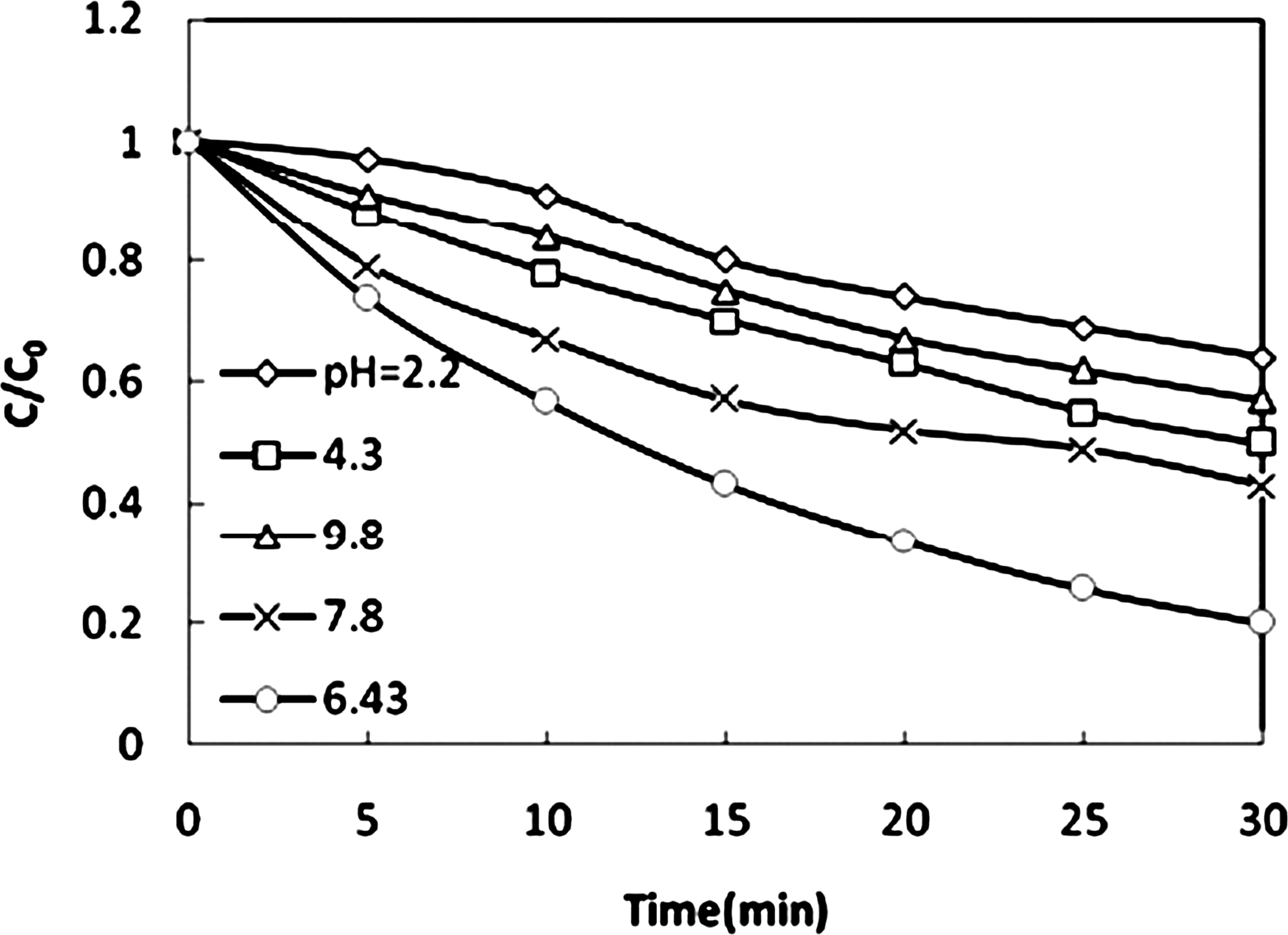
The effect of initial pH was investigated in the range of 2.2–9.8 with 20 ppm of dye and 100 mM of peroxydisulfate at room temperature (25°C ± 1°C) (Fig. 7). Photodegradation of BR46 was found to proceed perfectly at all the ranges of pH, with the best results obtained at pH 6.43. Thus, the method may be regarded to be ideal for wastewater treatment. The photodecay performance was found to increase with pH and peaks at a value of 6.43.
Effect of pH on oxidative decolorization of BR46. [BR46]0 = 20 ppm, \documentclass{aastex}\usepackage{amsbsy}\usepackage{amsfonts}\usepackage{amssymb}\usepackage{bm}\usepackage{mathrsfs}\usepackage{pifont}\usepackage{stmaryrd}\usepackage{textcomp}\usepackage{portland,xspace}\usepackage{amsmath,amsxtra}\pagestyle{empty}\DeclareMathSizes{10}{9}{7}{6}
\begin{document}$$[{\rm S}_2 {\rm O}_8^{2-}]_0 = 100 \ {\rm mM}$$\end{document}.
Under neutral or basic pH conditions, \documentclass{aastex}\usepackage{amsbsy}\usepackage{amsfonts}\usepackage{amssymb}\usepackage{bm}\usepackage{mathrsfs}\usepackage{pifont}\usepackage{stmaryrd}\usepackage{textcomp}\usepackage{portland,xspace}\usepackage{amsmath,amsxtra}\pagestyle{empty}\DeclareMathSizes{10}{9}{7}{6}
\begin{document}$${\rm SO}_4^{\bullet-}$$\end{document} formed may undergo reactions with H2O or OH− in accordance with equation (6), respectively, to generate OH•. The presence of various ions in solution (e.g., \documentclass{aastex}\usepackage{amsbsy}\usepackage{amsfonts}\usepackage{amssymb}\usepackage{bm}\usepackage{mathrsfs}\usepackage{pifont}\usepackage{stmaryrd}\usepackage{textcomp}\usepackage{portland,xspace}\usepackage{amsmath,amsxtra}\pagestyle{empty}\DeclareMathSizes{10}{9}{7}{6}
\begin{document}$${\rm SO}_4^{\bullet-}$$\end{document}) may result in the inhibition of the reactivity of OH• or \documentclass{aastex}\usepackage{amsbsy}\usepackage{amsfonts}\usepackage{amssymb}\usepackage{bm}\usepackage{mathrsfs}\usepackage{pifont}\usepackage{stmaryrd}\usepackage{textcomp}\usepackage{portland,xspace}\usepackage{amsmath,amsxtra}\pagestyle{empty}\DeclareMathSizes{10}{9}{7}{6}
\begin{document}$${\rm SO}_4^{\bullet-}$$\end{document}. For example, the order of influence of various anions on the rate of 4-chlorophenol degradation by OH• via Fenton's reaction is \documentclass{aastex}\usepackage{amsbsy}\usepackage{amsfonts}\usepackage{amssymb}\usepackage{bm}\usepackage{mathrsfs}\usepackage{pifont}\usepackage{stmaryrd}\usepackage{textcomp}\usepackage{portland,xspace}\usepackage{amsmath,amsxtra}\pagestyle{empty}\DeclareMathSizes{10}{9}{7}{6}
\begin{document}$${\rm ClO}_4^- \approx {\rm NO}_3^- > {\rm SO}_4^{2-} > {\rm Cl}^- > {\rm HPO}_4^- >> {\rm HCO}_3^-$$\end{document} (Lipctnska-Kochany et al., 1995). Among these anions, the sulfate anion is obviously the most abundant species in the peroxydisulfate oxidation system.
Relatively, more hydroxyl radicals are formed at pH 7.8 and 9.8 in comparison to pH 6.43 in accordance with equations (6) and (9), respectively. Therefore, it is likely that more hydroxyl radicals would be scavenged at pH 7.8 and 9.8 by sulfate ions than at pH 6.43, thereby resulting in decreases in BR46 degradation rates at pH 7.8 and 9.8 and a relatively improved performance at pH 6.43. Further, this decrease may be attributed to the instability of H2O2 at high pH levels and also relatively higher amounts of \documentclass{aastex}\usepackage{amsbsy}\usepackage{amsfonts}\usepackage{amssymb}\usepackage{bm}\usepackage{mathrsfs}\usepackage{pifont}\usepackage{stmaryrd}\usepackage{textcomp}\usepackage{portland,xspace}\usepackage{amsmath,amsxtra}\pagestyle{empty}\DeclareMathSizes{10}{9}{7}{6}
\begin{document}$${\rm SO}_4^{\bullet-}$$\end{document} and OH• in alkaline conditions, which induces recombination of the two radicals [equation (9)] (Lau et al., 2007). In an acidic solution, additional \documentclass{aastex}\usepackage{amsbsy}\usepackage{amsfonts}\usepackage{amssymb}\usepackage{bm}\usepackage{mathrsfs}\usepackage{pifont}\usepackage{stmaryrd}\usepackage{textcomp}\usepackage{portland,xspace}\usepackage{amsmath,amsxtra}\pagestyle{empty}\DeclareMathSizes{10}{9}{7}{6}
\begin{document}$${\rm SO}_4^{\bullet-}$$\end{document} could be formed by acid-catalyzation (Liang et al., 2007). However, higher \documentclass{aastex}\usepackage{amsbsy}\usepackage{amsfonts}\usepackage{amssymb}\usepackage{bm}\usepackage{mathrsfs}\usepackage{pifont}\usepackage{stmaryrd}\usepackage{textcomp}\usepackage{portland,xspace}\usepackage{amsmath,amsxtra}\pagestyle{empty}\DeclareMathSizes{10}{9}{7}{6}
\begin{document}$${\rm SO}_4^{\bullet-}$$\end{document} generation rate causes higher radical concentrations, which could favor radical with radical reactions, or radical with radical scavenger reactions over radical with organic reactions (e.g., BR46) (Peyton, 1993).
Electrical energy efficiency and effect of current on photodecay efficiency
Photodegradation of aqueous organic pollutant is an electric energy-intensive process. Thus, electric energy is of great importance and makes a major part of the operation costs (Lau et al., 2007). Recently, the Photochemistry Commission of the International Union of Pure and Applied Chemistry (IUPAC) proposed a figure-of-merit (or more appropriately, an efficiency index, as it compares the electrical efficiency of different AOPs) for UV-based AOPs, which compares the electrical efficiency of different UV-based AOPs and is a measure of the electrical efficiency of an AOP system. It is defined (for low concentration of pollutants) as the electrical energy in kilowatt hours (kW h) required to bring about the degradation of a contaminant by 1 order of magnitude in 1 m3 of contaminated water. Considering first-order degradation kinetics, the UV dose was calculated for each of the processes using equation (14). The EEO values were obtained from the inverse of the slope of a plot of log (C0/C) versus energy dose (kW h/m3). In this study, the EEO for degradation values of BR46 in different concentrations of peroxydisulfate exploiting both UV LEDs and traditional UV lamps (Philips, 30 W) are presented (Table 2). The results confirm that using LEDs instead of traditional UV lamps reduces EEO significantly, which reveals that using LEDs is economically more feasible. Further, by applying a desired peroxydisulfate concentration the EEO can be reduced (Salari et al., 2005).
\documentclass{aastex}\usepackage{amsbsy}\usepackage{amsfonts}\usepackage{amssymb}\usepackage{bm}\usepackage{mathrsfs}\usepackage{pifont}\usepackage{stmaryrd}\usepackage{textcomp}\usepackage{portland,xspace}\usepackage{amsmath,amsxtra}\pagestyle{empty}\DeclareMathSizes{10}{9}{7}{6}
\begin{document}
\begin{align*}
{\rm UV \ dose} = \frac {100 \times \hbox {\rm Lamp power} \ ({\rm kW}) \times {\rm Time} \ ({\rm h})} {\hbox {\rm Treated volume} \ ({\rm L})} \tag {14}
\end{align*}
\end{document}
EEO Values for Degradation of Basic Red 46 (20 ppm) by Using two Ultraviolet Light Sources in the Presence of Different Amounts of Peroxydisulfate
EEO, electrical energy per order; UV, ultraviolet.
The effect of current intensity on the photodecay of BR46 was also investigated. By elevating the current intensity from 360 to 2,000 mA, the photodegradation was improved (Fig. 8). It appears that with increasing the current intensity the decolorization rate increases. This increase is due to the enhanced production of hydroxyl and sulfate radicals. At low UV power, the rate of photolysis of \documentclass{aastex}\usepackage{amsbsy}\usepackage{amsfonts}\usepackage{amssymb}\usepackage{bm}\usepackage{mathrsfs}\usepackage{pifont}\usepackage{stmaryrd}\usepackage{textcomp}\usepackage{portland,xspace}\usepackage{amsmath,amsxtra}\pagestyle{empty}\DeclareMathSizes{10}{9}{7}{6}
\begin{document}$${\rm S}_2 {\rm O}_8^{2-}$$\end{document} is limited, and at high UV power, more hydroxyl and sulfate radicals are formed upon the photodissociation of \documentclass{aastex}\usepackage{amsbsy}\usepackage{amsfonts}\usepackage{amssymb}\usepackage{bm}\usepackage{mathrsfs}\usepackage{pifont}\usepackage{stmaryrd}\usepackage{textcomp}\usepackage{portland,xspace}\usepackage{amsmath,amsxtra}\pagestyle{empty}\DeclareMathSizes{10}{9}{7}{6}
\begin{document}$${\rm S}_2 {\rm O}_8^{2-}$$\end{document} and, hence, decolorization rate increases (Leea et al., 2002; Modirshahla and Behnajady, 2006). However, high current intensities, which result in high UV power, are not always ideal as more energy is disposed in the form of heat. Besides, similar yield was evidenced for 720 and 2,000 mA. Hence, 720 mA of current intensity is preferred to avoid consumption of energy.
Effect of current on oxidative decolorization of BR46. [BR46]0 = 20 ppm, \documentclass{aastex}\usepackage{amsbsy}\usepackage{amsfonts}\usepackage{amssymb}\usepackage{bm}\usepackage{mathrsfs}\usepackage{pifont}\usepackage{stmaryrd}\usepackage{textcomp}\usepackage{portland,xspace}\usepackage{amsmath,amsxtra}\pagestyle{empty}\DeclareMathSizes{10}{9}{7}{6}
\begin{document}$$[{\rm S}_2 {\rm O}_8^{2-}] _0 = 100 \ {\rm mM}$$\end{document}, pH 6.4.
Spectral change of the dye at different times
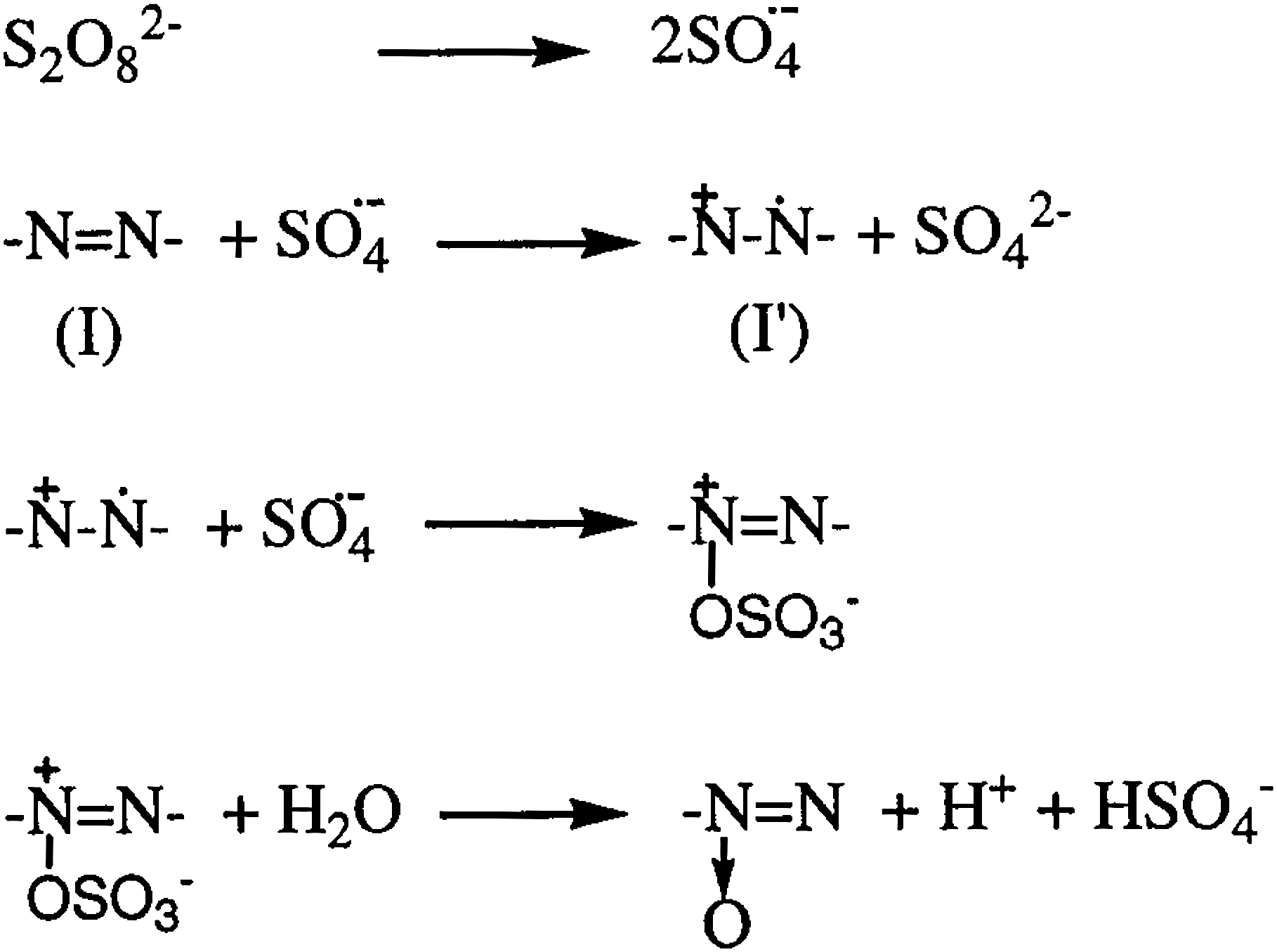
Changes in the absorption spectra of BR46 solution were studied during the process of destruction (Fig. 4). The visible spectrum of BR46 exhibits a main band at 531 nm. The absorption band diminishes and approximately disappears during the reaction course, which is indicative of the mono azo dye degradation. Besides, no new absorption bands appear in either visible or UV regions. Actually, as the 531 nm band is attributed to the nitrogen to nitrogen double bond of BR46, −N = N− may be regarded to be most vulnerable to oxidative attack. More than 90% decolorization of the dye was observed after 30 min of reaction under optimized conditions.
The following mechanism has been proposed for the oxidation process of BR46 azo dye (Gemeay et al., 2007):
Conclusion
Application of peroxydisulfate, along with UV LED irradiation, introduces an effectual and safe method for oxidative removal of BR46 at laboratory scale. Degradation rate of BR46 is shown to be dependent on the pH, current, and dye and peroxydisulfate concentration. The higher the concentration of dye, the lower will be the decolorization percentage. The increase in peroxydisulfate concentration from 100 to 180 mM enhanced the degree of photodegradation from 81% to 99%, respectively. However, this increase slowed down at concentrations >180 mM of peroxydisulfate. A pH value of 6.43 was found to be the optimum. The dye degradation reduced from 81% to 64% by increasing the pH from 6.43 to 7.8. EEO calculated for UV LEDs was 42.67 kW h/m3, whereas it was 125.23 kW h/m3 for UV lamps at 100 mM peroxydisulfate, which reveals that using LEDs is economically more feasible in comparison to traditional UV lamps. On increasing the current intensity from 360 to 2,000 mA, the decolorization rate increases. Hence, 720 mA of current intensity is preferred to avoid consumption of energy.
No significant destruction was observed with separate UV LED illumination. Over 90% removal was shown in 30 min by adding peroxydisulfate solution at optimum levels of dye concentration, peroxydisulfate concentration, and current. An effective cooling system was also installed to minimize the heat on the surface of LEDs and attain a longer life time. The results reveal that UV LEDs, which have long life, rugged structure, compact size, and specific emission wavelength, are ideal alternative choices for the design of efficient photoreactors with high yield. Further, parallel application of UV LEDs and peroxydisulfate provides a completely successful method for wastewater treatment.
Footnotes
Acknowledgments
The authors are grateful to Zanjan University and also Islamic Azad University (Tehran North Branch) for the financial support.
Author Disclosure Statement
The authors declare that no competing financial interests exist.
References
1.
AnipsitakisG.P., DionysiouD.D.2003. Degradation of organic contaminants in water with sulfate radicals generated by the conjunction of peroxymonosulfate with cobalt. Environ. Sci. Technol., 37:4790.
2.
AnipsitakisG.P., DionysiouD.D.2004. Radical generation by the interaction of transition metals with common oxidants. Environ. Sci. Technol., 38:3705.
3.
BhatnagarA., JainA.K.2005. A comparative adsorption study with different industrial wastes as adsorbents for removals of cationic dyes from water. J. Colloid Interface Sci., 281:49.
4.
ChenD.H.2005. Oxidation of PCE with a UV LED photocatalitic reactor. Chem. Eng. Technol., 28:1.
5.
ChenD.H., KuY., IrwanA.2007. Photodecomposition of o-cresol by UV-LED/TiO2 process with controlled periodic illumination. Chemosphere, 69:184.
6.
ChuW., LauT.K., FungS.C.2006. Effects of combined and sequential addition of dual oxidants (H2O2/S2O82−) on the aqueous carbofuran photodegradation. J. Agric. Food. Chem., 54:1047.
7.
DaneshvarN., AberS., Seyed DorrajiM.S., KhataeeA.R., RasoulifardM.H.2007a. Photocatalytic degradation of the insecticide diazinon in the presence of prepared nanocrystalline ZnO powders under irradiation of UV-C light. Sep. Purif. Technol., 58:91.
8.
DaneshvarN., RasoulifardM.H., KhataeeA.R., HosseinzadehF.2007b. Removal of C.I. Acid Orange 7 from aqueous solution by UV irradiation in the presence of ZnO nanopowder. J. Hazard. Mater., 143:95.
9.
GalindoC., JacquesP., KaltA.2001. Photochemical and photocatalytic degradation of an indigolid dye: a case study of acid blue 74 (AB74)J. Photochem. Photobiol. A., 141:47.
10.
GalindoC., KaltA.1998. UV- H2O2 oxidation of monoazo dyes in aqueous media: a kinetic study. Dyes Pigm., 40:27.
11.
GemeayA.H., HabibA.M., BorhanM.A.2007. Kinetics and mechanism of the uncatalyzed and Ag(I)-catalyzed oxidative decolorization of Sunset Yellow and Ponceau 4R with peroxydisulphate. Dyes Pigm., 74:458.
12.
IsikM., SponzaD.T.2005. A batch study for assessing the inhibition effect of Direct Yellow 12 in a mixed methanogenic culture. Process Biochem., 40:1053.
13.
KhataeeA.R., VatanpourV., Amani GhadimA.R.2009. Decolorization of C.I. Acid Blue 9 solution by UV/Nano-TiO2, Fenton, Fenton-like, electro-Fenton and electrocoagulation processes: a comparative study. J. Hazard. Mater., 161:1225.
14.
LauT.K., ChuW., GrahamN.J.D.2007. The aqueous degradation of butylated hydroxyanisole by UV/S2O82−: study of reaction mechanisms via dimerization and mineralization. Environ. Sci. Technol., 41:613.
15.
LeeaJ.C., KimbM.S., KimbB.2002. Removal of paraquat dissolved in a photoreactor with TiO2 immobilized on the glass-tubes of UV lamps. Water Res., 36:1776.
16.
LiangC.J., BruellC.J., MarleyM.C., SperryK.L.2003. Thermally activated persulfate oxidation of trichloroethylene (TCE) and 1,1,1-trichloroethane (TCA) in aqueous systems and soil slurries. Soil Sedim Contam., 12:207.
17.
LiangC., WangC., BruellC.J.2007. Influence of pH on persulfate oxidation of TCE atambient temperatures. Chemosphere, 66:106.
18.
Lipctnska-KochanyE., SprahG., HarmsS.1995. Influence of some groundwater and surface waters constituents on the degradation of 4-chlorophenol by the Fenton reaction. Chemosphere, 30:9.
19.
MinisciF., CitterioA.1983. Electron-transfer processes: peroxydisulfate, a useful and versatile reagent in organic chemistry. Acc. Chem. Res., 16:27.
20.
ModirshahlaN., BehnajadyM.A.2006. Photooxidative degradation of Malachite Green (MG) by UV/H2O2: influence of operational parameters and kinetic modeling. Dyes Pigm., 70:54.
21.
PaterliniW.C., NogueiraR.F.P.2005. Multivariate analysis of photo-Fenton degradation of the herbicides tebuthiuron, diuron and 2, 4-D. Chemosphere, 58:1107.
22.
PeytonG.P.1993. The free-radical chemistry of persulfate-based total organic carbon analyzers. Mar. Chem., 41:91.
23.
PhilipsR.1983. Source and Applications of Ultra Violet Radiation. San Diego: Academic Press, Inc.
24.
QamarM., GondalM.A., HayatK., YamaniZ.H., Al-HooshaniK.2009. Laser-induced removal of dye derivative eosin yellowish catalyzed by n-type WO3 semiconductor catalyst. J. Hazard. Mater., 170:584.
25.
QamarM., GondalM.A., YamaniZ.H.2010. Removal of Rhodamine 6G induced by laser and catalyzed by Pt/WO3 nanocomposite. Catalysis Comm, 11:768.
26.
SalariD., DaneshvarN., AghazadehF., KhataeeA.R.2005. Application of artificial neural networks for modeling of the treatment of wastewater contaminated with methyl tertbutyl ether by UV/H2O2 process. J. Hazard. Mater., 125:205.
27.
SalariD., DaneshvarN., NiaeiA., AberS., RasoulifardM.H.2008. The photooxidative destruction of C.I. Basic Yellow 2 using UV/S2O82− process in a rectangular continuous photoreactor. J. Environ. Sci. Health A., 43:1.
28.
SariogluM., BaliU., BisginT.2007. The removal of C.I. Basic Red 46 in a mixed methanogenic anaerobic culture. Dyes Pigm, 74:223.
29.
VilhunenS.H., SillanpM.E.T.2009. Ultraviolet light emitting diodes and hydrogen peroxide in the photodegradation of aqueous phenol. J. Hazard. Mater., 161:1530.
30.
WuhrmannK., MechnsnerK., KapplerT.1980. Investigation on rate determining factors in microbial reduction of azo dyes. Eur. J. Appl. Microbiol. Biotechnol., 9:325.