




Abstract
Abstract
Four representative broiler and laying hen houses in the central and southern Taiwan were sampled to investigate their ammonia concentrations and emissions. Generally, ammonia concentrations in hen cages and around the exhausting outlets of sealed houses ranged from 1 to 9 ppm and 0.5 to 12.5 ppm, respectively. Notably, ammonia concentrations from manure disposal sites were as high as 500 ppm at 10 cm above the manure surface. Moisture spraying was occasionally used for prevention of ammonia effluent from sealed houses, and ammonia removal efficiencies were 30%–50%. Mechanical rapid composting systems are effective for manure digestion, and bioscrubbers attached to acid wet scrubbers are recommended because they are highly efficient for ammonia removal. Emission rates of 0.24 and 0.42 kg NH3/hen/year were emitted from the houses of broiler and laying hens, respectively, in summer. However, in winter, the emission rates were 0.15 and 0.19 kg NH3/hen/year from the broiler and laying hen houses, respectively. Further, average ammonia emission rates for a broiler raising stock (8 weeks) were 36.9 g NH3/broiler in summer and 23.1 g NH3/broiler in winter. Ammonia emission rates from henhouses in winter were only 45%–63% of those in summer.
Introduction
A study by Guiziou and Belin (2005) reported ammonia concentration distributions of 0.8–32 ppm in broiler houses in France. The study of Kentucky chicken houses by Department of Biosystems and Agricultural, University of Kentucky Research Group (2003) reported ammonia concentrations of 5–10 ppm. However, the ammonia concentrations averaged 10–20 ppm in houses with dried manure on the ground. In a preliminary study of Taiwanese chicken houses, the authors of the present study detected ammonia concentrations of 5–48 ppm around the outlets of exhaust fans of sealed houses and 50–200 ppm ammonia emitted from the manure digestion composting sites.
The Environmental Protection Administration in Taiwan wished to understand the emission characteristics of ammonia from broiler and laying hen houses, so this project was issued and financially supported. This study evaluated the ammonia concentrations and emissions from different houses (half-sheltered and sealed), chickens (broiler and laying hen), and manure disposal methods (mechanic compositing system and natural dry disposal site). The field examinations were conducted at different ambient temperatures in summer and winter. Additionally, the ammonia emission rates (kg/hen/year), which were recommended to be determined on both ammonia mass rate (kg/h) and numbers of chickens during a specific feeding period, were assessed for sealed houses in this study (Groot Koerkamp, 1994; Demmers, et al., 1999; Ni et al., 2000; Lacey et al., 2003). Additionally, a self-designed hood was used to simulate ammonia emissions from the manure disposal site under windy conditions.
Materials and Methods
Field survey
From July 2008 to June 2009, ammonia emissions were examined in four large broiler and laying hen houses located in central and southern Taiwan. Henhouses A–D were totally examined four times in the summers of 2008 and 2009 and two times in the winter from 2008 to 2009. Table 1 shows the numbers and types of hen and the method used to prevent ammonia emissions. Sealed and mechanical ventilation via exhausting fans (Fig. 1a, b), as well as half-sheltered (Fig. 2) are commonly used in Taiwan chicken houses. Data for hen numbers were provided orally by the managers of each henhouse. Notably, hen manure in houses C and D was dried by natural ventilation and sun (Fig. 3) and then packed as manure fertilizer for sale. To analyze the high ammonia emission rate from manure disposal site, a hood connected to an exhausting system (Fig. 4) was used to simulate the windy conditions in the hen manure disposal site of house C. The simulation and calculation via the simulator are described in the following discussion of ammonia emission rate estimation.
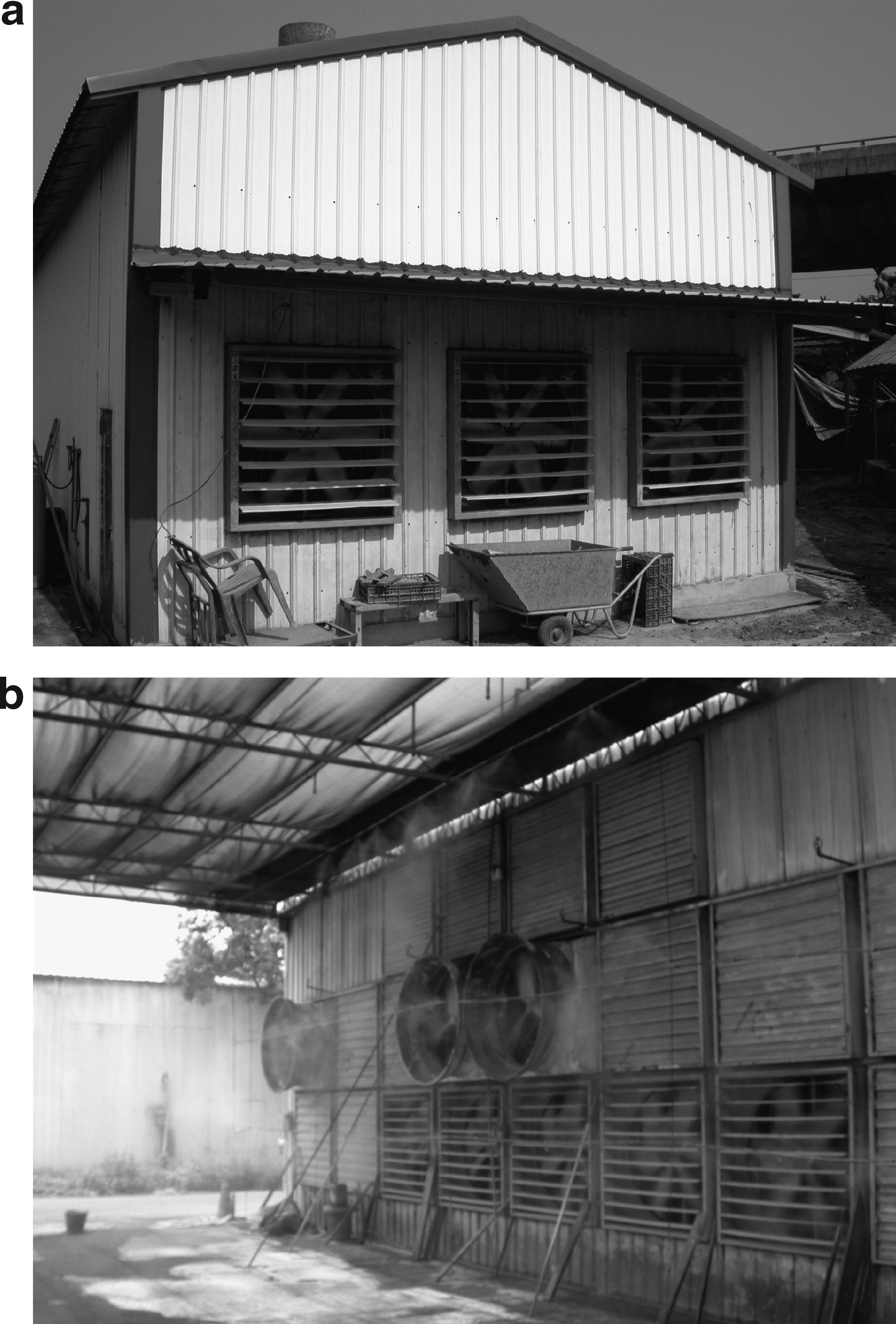
Sealed houses of broiler and laying hens and mechanical exhausting systems.
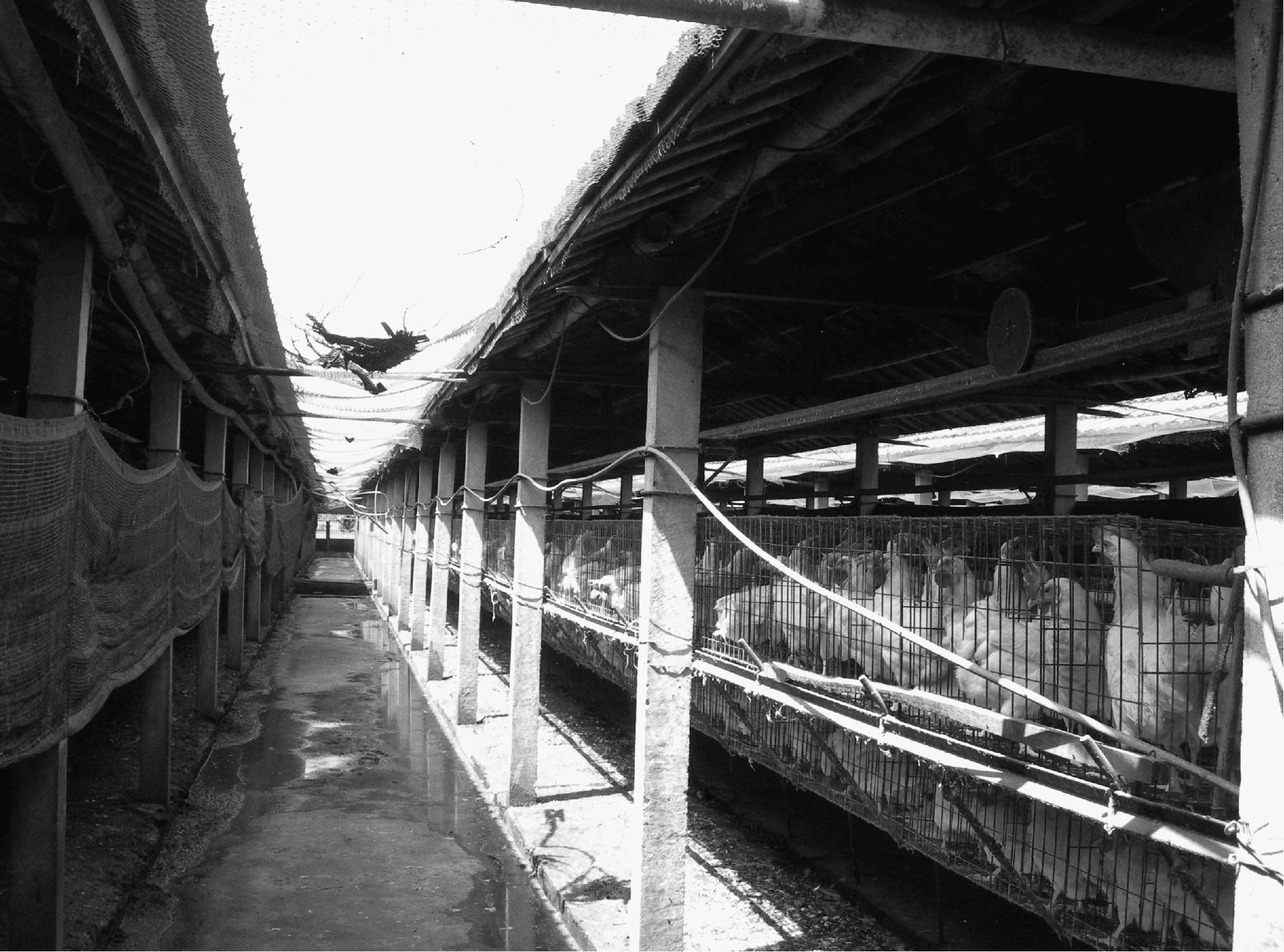
Half-sheltered house.

Hen manure was dried via natural ventilation and sun. Equipment for rain proof was insufficient in this site.

Schematic exhausting hood and its operation. Main body: wood; inner lining: aluminum foil.
The names of township and county were translated using “Online Translation System of Geographic Name” by Taiwanese Ministry of the Interior (2009).
The bird stocking density in a house was around 20,000.
All broiler were raised on litter and no bedding on ground.
No ammonia prevention in houses B–D.
Partial 20,000 young hens (less than 6 months old) were in sealed house with mechanical ventilation. Other 40,000 laying hens were in half shelters.
Hen manure was dewatered via natural ventilation, dried by sun, and then packed as manure fertilizer for sale.
Analysis
The analysis included ammonia concentrations from the sidewalks between hen cages, ventilation exhaust outlets, and manure disposal systems in houses. Except house A, where the ammonia detection was only at the outlet exits of ventilation, ammonia concentrations were measured along the worker sidewalks between hen cages in half-sheltered houses B–D, and the analyzer was located roughly 10 cm above the autoconveyors of hen manure. In house C, approximately 20,000 young hens (younger than 6 months old) were in the sealed house, where ammonia was also detected at the ventilation outlets. Finally, in houses B–D, the manure disposal systems were also examined. Atmospheric temperature, relative humidity, and wind speed (10 cm above conveyers or manure, and exhausting fan outlets from sealed henhouses) were also detected and recorded. The background concentrations of ammonia in the upwind were examined for each field evaluation. The concentrations were lower than 0.2 ppm, which is the detection limit of the sampling tube.
Ammonia analysis was conducted using a portable toxic gas monitor (VRAE Hand-Held 5-Gas Surveyor; RAE Systems, San Jose, CA) and ammonia sampling tubes (No. 3L; Gastec Corp., Ayase, Japan). The toxic gas monitor has a valid range of 0–50 ppm and resolution of 1 ppm; the sampling tube has a range of 0.5–78 ppm and a detection limit of 0.2 ppm. The toxic gas monitor was calibrated via a two-point field calibration of zero and span gas (50 ppm), which was recommended by the manufacturer. All ammonia concentration data were analyzed via the toxic gas monitor and recorded using its data recorder. Sampling tubes were used for further confirmation. If ammonia concentrations were higher than the valid analytical ranges of gas monitor or sampling tube, 1-L Teflon bags (SKC, Eighty Four, PA) were used for sampling gas, and ammonia concentrations were then analyzed after dilution with highly pure nitrogen of 10 times volume. According to the finding of bias of Tedlar bags for measuring agricultural odorous compounds (Trabue et al., 2006), the procedures of dilution and detection for ammonia must be finished shorter than 3 min. All Teflon bags before use were flushed preliminarily by nitrogen in a laboratory. Temperature, relative humidity, and wind speed were analyzed using a multifunctional analyzer with a data log programmer (testo 400; TESTO, Lenzkirch, Germany).
Principles of ammonia emission rate estimation
The ammonia emission rates per bird (E, kg/hen/year) were calculated for sealed houses A (Fig. 1a) and C (Fig. 1b). Additionally, in house C, the ammonia emission rate from the open hen manure disposal site, where hen manure was dried via natural ventilation and sunshine (Fig. 3), was examined using a simulator connected to an exhaust fan and PVC pipelines (Fig. 4).
For sealed houses A and C, ammonia concentrations (C, ppm) were examined for 10 min at roughly 3 cm from the surface of exhaust outlets. Also, the air blowing speed (m/s), temperature (T, °C) and relative humidity (%) were examined in the field. The flow rate from each exhaust outlet (q, m3/min) was obtained by multiplying the detected blowing speed (m/s) by the cross-sectional area (m2) of the individual exhausting exit. The ammonia mass rate (
In Eq. (a), the pressure correct was omitted because the local atmospheric pressure was the same as the standard (1 atm). The manure disposal site of house C was divided into five sampling zones of similar area (approximately 30 m2), and the manure surface was covered by a wood exhausting hood (Fig. 4) for each sampling zone. Field simulations included the following conditions: (1) fresh manure recently turned over by machine in the morning; (2) dried manure without rain moistening; and (3) manure transferred into slurry after a rain storm. The concept of using a simulator covering an emission source to examine pollutant emission rates was derived from earlier studies for assessing volatile organic compounds from open wastewater treatment basins (Cheng et al., 2008). The simulator was connected to a continuous exhausting system and operated under a negative pressure. The exhaust flow rates were regulated by a hand-regulating valve. Emissions were measured for simulated surface winds of 1.2 ± 1.0 m/s and temperatures of 32.4°C ± 1.8°C (mean ± standard deviation for wind and temperature data values), which were the mean wind speeds recorded in the surrounding area during the past 5 years. All data (wind speed, temperature, and relative humidity) were recorded after an air exhaust flush for 5 min.
The continuous detections of ammonia concentrations, temperatures, and relative moisture were examined via both sampling holes on the 1½” PVC pipeline (Fig. 4) that was connected to the simulator. All data were also recorded by the analyzers. The ammonia emission rates from the manure disposal site were estimated using Eqs. (a)–(c). The values of
Results and Discussion
Distribution characteristics of ammonia concentration in henhouses
Table 2 lists the ammonia concentration distributions for houses A–D. The data confirmed that the ammonia concentrations measured on the sidewalks between hen cages and exhausts from the ventilation system were much lower than the Taiwan legal labor exposure limits (8-h time-weighted average [TWA] is 50 ppm and short-term exposure limit is 75 ppm) and USA limits (TWA is 25 ppm and short-term exposure limit is 35 ppm, National Institute of Occupational Safety and Health [NIOSH]; TWA 50 ppm, Occupational Safety and Health Administration [OSHA]) (Taiwanese Council of Labor Affairs, 2003; NIOSH, 2005). In fact, in houses B–D, ammonia concentrations at 10 cm above manure conveyors between hen cages ranged from 1 to 9 ppm. Ammonia exhaust concentrations from sealed henhouses ranged from 0.5 to 12.5 ppm (after moisture-spraying screen and the ammonia removal efficiency of 30%–50%) for house A and ranged from 2 to 12 ppm (without any pollution prevention) for house C.
Ammonia was detected at the location of 10 cm above the manure on conveyer.
Ammonia was detected at the location of 10 cm above the manure on ground.
Not applicable for detecting indoor ammonia. All hens were in sealed house A and only outlets of ventilation were examined.
The concentrations of ammonia before moisture spraying were 9.0 ± 8.0 ppm. The actual emitted ammonia after spraying screen was detected as shown.
Ventilation outlets were combined together for sealed henhouse and manure disposal system in house A.
Not applicable for half-sheltered henhouses.
The original concentration exhausted from the rapid mechanic composition system was 132 ± 112 ppm, which was reduced by a biotrickling scrubber, connected to an acid wet scrubber. The overall exhausting ammonia was detected as shown.
The effluent ammonia concentration under no odor prevention.
The manure was fresh and just turned over by machine in the morning.
The manure was almost dried and no rain moistened it.
The manure became slurry by rain.
In house B, manure was treated using a mechanic rapid composting system equipped with a wet scrubber for removal of ammonia. The highly efficient manure treatment and odor prevention system reduced ammonia concentration from the manure disposal system of house B concentrations to 0–4 ppm. However, in house C, the relatively low ammonia concentrations from half-sheltered chicken cages caused the workers to underestimate the ammonia hazard. Ammonia concentrations measured at 10 cm above the surface of the dry manure after mechanical turnover in the morning of sampling were extremely high (up to 500 ppm). The operator complained of dizziness and eye irritation while turning hen manure once per 2 weeks. The operator wore a cotton-weaving mask to cover his nose and mouth rather than the recommended elastomeric facepiece respirator with ammonia filters for the highly hazardous ammonia. Additionally, long-sleeve working shirt and personal eye protection are recommended for worker safety and health. Actually, the sealed disposal of hen manure, like mechanic rapid composting system with odor prevention equipment in house B, is environmentally friendly and safe for workers. The high ammonia emission rate from the open manure dry site in house C is discussed in detail below.
In Table 2, the ammonia concentrations from manure gradually decayed. During the normal manure-drying period of 0–14 days, the ammonia concentrations (mean ± deviation for all analyses values) of 266 ± 234°ppm on day 1 from the fresh manure, which was just turned over by machine, decreased to 8.3 ± 3.7 ppm on day 10 at the manure site, house C. A rain on day 14 remarkably reduced ammonia to 1.8 ± 0.2 ppm. The slurry hen manure also emitted limited ammonia in house D.
Estimation of ammonia emission rate
Equations (a)–(c) were used for estimating the ammonia mass rates (
Calculation based on
The manure was fresh and turned over mechanically in the morning.
The manure was almost dried and no rain moistened it.
The manure became slurry by rain.
The values of E for the sealed henhouses in summer were remarkably higher than those for winter. The trend of different emission rates from henhouses between summer and winter has been also observed in North Carolina, Iowa, Kentucky, and Pennsylvania (Battye, et al., 2003; Liang, et al., 2005; Wheeler, et al., 2006). Li and Xin (2010) also reported that ammonia emission positively related to air temperature. Based on the ammonia emission data from house A, the average ammonia emission rates for a broiler raising stock (8 weeks) were 36.9 g/broiler in summer and 23.1 g/broiler in winter. The ammonia emitted from sealed houses A and C in winter was only 45%–63% of that in summer.
The duration of drying and the moisture content of manure are important factors in ammonia emissions from hen manure. Generally, the drying period for a batch of manure in house C was 2 weeks. The emission rate per hen on the first day, which was calculated using data in Table 3 (0.59–0.27 = 0.32), was extremely high, approaching 0.32 kg NH3/hen/year. Notably, the manure was still fresh and mechanically turned that morning. The ammonia emission rate gradually decreased when the manure dried under the sun with no rain moistening it. The value of E on day 10 was 0.10 kg NH3/hen/year. The rain-prevention system for the manure disposal site was insufficient, and a rain moisturized the site on day 13. The value of E became 0.01 kg NH3/hen/year on day 14. The percentage of ammonia emission from manure disposal ranged from 4% to 54% of total emissions from house C. Misselbrook et al. (2000) concluded that the ratio of ammonia emissions from hen cages to litter is roughly 1:1. Also, van Paul et al. (2008) estimated that the ammonia emissions from manure are 15%–60%. Laying hens were generally raised for 2 years in house C and the cycle of E roughly per 14 days, incidentally disturbed by rain, revealed the trends of ammonia emission rates for the hen manure dry disposal sites.
Ammonia abatement and efficiency
According to the theory and practice of ammonia abatement by fine moisture spray (Huang, 2005), the exhaust air containing ammonia was scrubbed for 3 min by moisture spray once per 15 min in sealed house A. The exhausted concentrations of ammonia decreased from 9.0 ± 8.0 to 6.5 ± 6.0 ppm. The moisture spray was composed of an odor-masking substance, that is, camphor oil or citronella oil, which was diluted to 1 part per 5,000–10,000 parts water. After the moisture-spraying system was installed, local residents (nearly 100 m away) rarely complained of odors emitted from house A.
A mechanic rapid composting system was installed in house B for treating manure. The daily capacity of the composting system was 5 tons of fresh manure, which produced 1.5 tons dry digested hen manure compost fertilizer daily. A PVC bioscrubber packed with fern-chip was used to treat the exhausted ammonia from the composting system. The dimensions of the bioscrubber were 2 m × 2 m × 1.25 m (H) = 5.0 m3. The scrubber was equipped with a 30 m3/min suction blower and a 5-HP motor. The maximum operational ammonia loading for the fern-chip packing was 60 g/m3 packing/h. The ammonia decreased from 132 ± 112 to 23 ± 16 ppm (average removal efficiency of 79%). The exhausted stream was purified by an acid wet scrubber. The overall ammonia exhausts ranged from 0 to 4 ppm after wet scrubbing by aqueous sulfuric acid. The optimum pH values of the aqueous sulfuric acid were 3–6. Almost all ammonia were abated in the series of fern-chip packing bioscrubber and the acid wet scrubber. Notably, the cycling liquor of the scrubbers, which contained ammonia sulfate, could be sold as liquid nitrogen fertilizer.
Limitation of using the ammonia concentration and emission data
According to the results of this work, air temperature and relative humidity in the hen buildings affected the ammonia emission from the manure conveyors in the hen cages. The time before the hen litter was removed from the sealed houses also affected ammonia emission rates. The hen-raising procedures and atmospheric conditions during the examination in the site should be carefully considered in further data comparisons.
Additionally, because the broilers are only raised for around 2 weeks in this study, an equivalent factor of 2.74 is provided herein for transferring the unit of emission rate from kg/hen/year to g/hen/day. The readers could use the unit, g/hen/day, for making sense of emission rates.
Conclusions
This study found that the ammonia concentrations (Table 2) in the hen cage areas among the three houses B–C approximated those in France and the United States. However, the highest ammonia concentrations occurred within the manure disposal system, especially the dry manure site. In house C, ammonia concentration of 500 ppm was detected in the morning when the manure was turned over. These ammonia exposures are extremely hazardous for workers in manure compost operations. It is strongly recommended that an effective air pollution prevention equipment should be equipped. For example, a negative-pressured bioscrubber should be applied to the ammonia emission from the hen manure composting system and should be isolated from workers. For traditional half-sheltered manure dry disposal sites, an elastomeric facepiece respirator with ammonia filters should be worn by workers when turning manure. The explicit recommendations for health protection of workers for ammonia exposure (e.g., the specifications of the respirator) should be further studied in the future.
Ammonia emission rates of 0.15–0.24 (mean: 0.195) and 0.19–0.42 (mean: 0.305) kg NH3/hen/year were from the broiler and laying hen houses, respectively, including manure systems in Taiwan. Actually, the ammonia emission rates from henhouses in this evaluation were close to the values reported by Battye et al. (2003) and Faulkner and Shaw (2008) (Table 4). Moreover, the average ammonia emission rates for a broiler-raising stock (8 weeks) were 36.9 g/broiler in summer and 23.1 g/broiler in winter.
Annual ammonia emission mass from the chicken houses in this study were 1.294 × 10⁴ and 1.106 × 10⁴ tons produced by 66.36 million broilers and 36.25 million laying hens, respectively, in Taiwan (Taiwanese Council of Agriculture, 2008). That is, 2.4 × 10⁴ tons of ammonia was emitted from the Taiwan poultry farms.
Footnotes
Acknowledgments
The authors thank the Environmental Protection Administration and National Science Council, Taiwan, Republic of China, for financially supporting this research under contract No. NSC 97-EPA-M-110-001. The authors especially thank all managers and operators of henhouses who provided kind assistance and indispensable information for this work.
Author Disclosure Statement
The authors declare that no competing financial conflicts exist.