




Abstract
Abstract
Inorganic–organic-intercalated (IO) bentonites were modified with Co2+, Ni2+, or Cu2+ to create adsorbents for the removal of relevant emerging contaminants (naproxen, salicylic acid, clofibric acid, and carbamazepine) from water, overcoming challenges associated with low concentration and polar nature of these contaminants by relying on weak chemical complexation interactions. Characterization of the materials via X-ray diffraction, porosimetry, scanning electron microscopy, thermal gravimetric analysis, and Fourier transform infrared spectroscopy indicated general structural integrity and a metal loading that increases as follows: Ni < Cu < Co. Single-point adsorption experiments were done at room temperature with different pH conditions and using an initial adsorbate concentration of 14 ppm. In general, the transition metal-modified IO bentonites displayed adsorption capacities that varied depending on the type of metal, pH, and nature of the adsorbate. The largest adsorption capacity was observed for salicylic acid, probably because of its smaller footprint. In addition, it appears that the presence of some functional groups plays an important role during the adsorption of a particular adsorbate, possibly indicating complexation with the transition metal. For carbamazepine, although the observed adsorption loadings are comparable to those of other adsorbents discussed elsewhere, the modification of the IO bentonites does not appear to enhance the unmodified material capacity. This could be due to the absence of key functional groups in this particular adsorbate.
Introduction
Current wastewater treatments consist of primary and secondary stage processes commonly based on filtration technologies and conventional activated sludge (Bendz et al., 2005; Gros et al., 2010). However, PPCPs are complex molecules with particular properties that depend on molecule functionalities, pH, and octanol–water coefficient (Kummerer, 2009). Because most of them are polar compounds, a given molecule may contain a negative or positive charge depending on the pH of the surrounding medium. Moreover, they usually occur at low concentration levels (ng/L to μg/L range), presenting unique challenges for their removal using traditional technologies (Snyder et al., 2003). Although expensive and energy consuming, advanced oxidation processes have shown to be effective tools for the elimination of the PPCPs (Esplugas et al., 2007; Klavarioti et al., 2009). However, there is evidence that even if the parental compound is not detectable, complete mineralization is not always obtained, producing transformation products that are not noticeable or may have uncertain potential risks to the environment (Huber et al., 2005; Rosal et al., 2008; Sanchez-Polo et al., 2009). Alternatively, adsorption technologies have been proposed for the removal of organic contaminants from the environment, especially at concentrations lower than parts-per-million (ppm) levels.
Recent studies have found that adsorption of PPCPs onto activated carbon (Ternes et al., 2002; Ayranci and Duman, 2006; Yu et al., 2008), metal oxide surfaces (Lorphensri et al., 2006), various types of membranes (Rohricht et al., 2009), and polymers (Frimmel et al., 2002; Robberson et al., 2006) may be highly dependent on experimental conditions. The reported differences in uptake capacities may be attributed to the physicochemical properties of the contaminants. In addition, the nature of the surface charge of the sorbents contributes to specific interactions (van der Waals, electrostatic, or dipole–dipole) with the polar contaminants (San Miguel et al., 2006).
To use adsorption-based technologies in real scenarios, it is crucial to develop adsorbent materials that can achieve better selectivity at the present and near future concentration levels and at a variety of conditions. One alternative focuses around natural and modified clays, which have been considered for the removal of organic compounds from water systems (Wu et al., 2001; Zhou et al., 2008; Marsal et al., 2009; Zhu et al., 2009b). Bentonite is abundant, inexpensive, and a naturally occurring clay containing silica sheets with isomorphic substitutions of Mg+, Fe2+, or Al3+. Consequently, an interlayer may become negatively charged, requiring the presence of extraframework inorganic cations such as Na+, Ca2+, and K+. The use of bentonite as an adsorbent relays in its ability to exchange specific molecules with these inorganic cations, high specific area, chemical and physical stability, expandable interlayer space, and tunable surface properties (Zhu and Chen, 2009). Two important methods have been used to enhance the adsorption capacity of bentonite toward organic pollutants: surfactant intercalated (Zhou et al., 2008; Marsal et al., 2009) and inorganic–organic-intercalated (IO) bentonites (Wu et al., 2001; Zhu et al., 2009b). For example, Zhu and coworkers have demonstrated that simultaneous intercalation of both surfactant and aluminum results in an increase in basal spacing and sorbent stability (Wu et al., 2001; Zhu et al., 2009b). The aforementioned methods have shown that the bentonite surface could be changed to a highly hydrophobic one, to be able to adsorb large organic contaminants with multiple aromatic rings and oxy-anions. However, because of the polar nature of most PPCPs, different strategies should be implemented to overcome challenges associated with chemical structure and low concentrations of these compounds in water systems (Hari et al., 2005).
The present work describes the study of the adsorption of four PPCP compounds into four types of modified bentonite clays at different pH conditions. The adsorbates were selected to be representative of a wide range of PPCP contaminants and because of their physical properties and reported occurrence in surface waters as shown in Table 1. In addition to using current modified bentonite preparation methods, we present the incorporation of transition metals in an effort to increase selectivity toward a specific PPCP compound. Studies related to the transformation of pharmaceuticals into new drugs suggest that transition metals (e.g., Cu2+, Ni2+, Co2+, Fe2+, and Zn2+) could form stable complexes (Weder et al., 2002; Kovala-Demertzi et al., 2005; Kovala-Demertzi, 2006; Cini et al., 2007; Yaqub et al., 2009) and this phenomenon could lead to the bottom-up design of novel adsorbents tailored for a particular set of PPCP compounds. Our group has already shown that grafting of transition metals onto silica-based mesoporous substrates affects the affinity of the adsorbents toward Naproxen (Rivera-Jimenez and Hernandez-Maldonado, 2008; Rivera-Jimenez et al., 2010). A similar approach could be employed with bentonites, which are typically more hydrophobic than mesoporous silicas. The main challenge, however, is the inclusion of the transition metals because it would require a nongrafting approach.
In addition to the aforementioned objectives, this work also aims to get insight on the plausible effect of drug ionization in the adsorption capacities of the materials. This was accomplished by varying pH conditions over and under the specific pKa values of the adsorbates. The main hypothesis is that the selection of the appropriate transition metal according to a target adsorbate molecule could be a potential strategy for the development of tailored clay-based sorbents for PPCPs removal.
Materials and Methods
Materials
The bentonite clay used in this study is primarily a Na- and K-rich montmorillonite (NaKBt; Sigma-Aldrich). An estimated cation exchange capacity of 100 mmol/100 g was used throughout our calculations because it is the typical value for this family of materials (Zhou et al., 2008). The following chemicals were used for the modification of the NaKBt samples: hexadecyltrimethylammonium bromide (HDTMAB, ≥99.0% purity), aluminum chloride (AlCl3, ≥99.9%), and sodium carbonate (Na2CO3, ≥99.0%). Chemicals used for the adsorption experiments were naproxen sodium, salicylic acid (acetylsalicylic acid, >99%), clofibric acid [2-(4-chlorophenoxy)-2-methyl propionic acid, 97%], and carbamazepine. All chemicals were purchased from Sigma-Aldrich, and all water used was distilled and deionized to a conductivity of 18 mΩ/cm.
Preparation of organo-bentonites
Before modification with the surfactant, pure NaKBt (50 g) was added to a predetermined volume of a 0.5 M Na2CO3 solution, which was previously mixed with 2 M HCl to promote the solubility of the CO32− species (Zhou et al., 2008) and produce a Na-rich bentonite. The resulting slurry was allowed to mix for 20 h under vigorous stirring at room temperature. Afterward, the suspension was washed several times with deionized water, separated by centrifugation, air dried overnight at 60°C, and pulverized down to a 150 μm mesh size. For reference, the material that resulted from this modification will be known as NaBt.
In a typical surfactant-based modification, a 0.1 M HDTMAB solution was prepared by dissolving the surfactant powder into deionized water previously heated to 80°C. The solution was kept under stirring at 80°C for 20 h. Then, 20 g of NaBt was added to the surfactant solution and stirred overnight at 80°C. The final slurry was washed several times with fresh deionized water to remove excess surfactant and then separated by centrifugation at 3,500 rpm. The recovered solid was air dried at 60°C overnight and crushed down to a 150 μm mesh size. This material will be known as HDTMA-Bt.
Preparation of IO bentonites
A hydroxy-aluminum solution with a final hydrolysis of OH/Al ratio of 2.4 was prepared as part of the synthesis of IO bentonites (Zhu et al., 2009b). This was achieved by adding 0.5 M Na2CO3 to a 1.0 M AlCl3 solution and under vigorous mixing for 24 h. About 3.7 g of HDTMAB was added later to the hydroxy-aluminum solution and mixed for 2 h. After this, 10 g of NaBt was slowly added and allowed to mix overnight under continuous agitation. The resulting slurry was allowed to stand for 30 min in a precipitation flask and the excess supernatant was removed. The remaining material was washed several times with fresh deionized water and separated by centrifugation at 3,500 rpm. The solid fraction was air dried overnight at 60°C and crushed down to a 150 μm mesh size. This material will be referred to as Al-HDTMA-Bt.
Preparation of transition metal-modified IO bentonites
The metal-modified IO bentonites were prepared by mixing 5 g of the Al-HDTMA-Bt with a 0.05 M aqueous solution of the corresponding M2+ sulfate (M = Co, Ni, or Cu) solution for 24 h. After recovery of the solid via centrifugation, the procedure was repeated again for maximum incorporation of the metal ions. Finally, the resulting material was air dried overnight at 60°C, crushed, and sieved through a 150 μm mesh size. These materials will be referred to as Co-Al-HDTMA-Bt, Ni-Al-HDTMA-Bt, and Cu-Al-HDTMA-Bt, respectively.
Procedures for adsorption tests
Equilibrium single-point adsorption experiments were performed batchwise using 25-mL Teflon-lined containers. In a typical experiment, 300 mg of a particular adsorbent material was added to a 15 mL solution containing an initial concentration of about 14 ppm of the corresponding PPCP (naproxen, salicylic acid, carbamazepine, or clofibric acid). Although this concentration value is higher than the reported concentration level of pharmaceuticals in the environment, some practical aspects of the experimental procedure, including the usage of UV–vis, required such concentration level. Further, as the primary objective of this study was to perform a detailed screening of adsorbents tailored with surface properties for PPCPs removal, the use of the aforementioned sorbate concentration value should provide the required information for analysis.
Whenever required, pH adjustments were done to the initial solution used for the adsorption experiments using 1 M HCl and 1 M NaOH solutions. Values for pH were set to ∼2 and 12 and the rest of manuscript will refer to them as low and high pH, respectively. Natural pH refers to the pH value of the PPCP in water without adjustment and the values are shown in Table 1. No further pH adjustment was done after addition of the adsorbent material. During the adsorption tests, mixtures were allowed to equilibrate at room temperature for ∼24 h in a constant temperature oscillation shaker operated at 250 rpm. Although uptake tests performed with the largest sorbates indicated that equilibrium apparently was reached after ∼2 h, a longest equilibration time was chosen to ensure the highest uptake possible. At the end of the adsorption experiment, the final slurry was centrifuged at 3,500 rpm for 15 min. Triplicate measurements were taken of the remaining liquid phase to determine the equilibrium concentration, which was measured using a Shimadzu UV-2401 PC UV/Visible spectrophotometer using the corresponding characteristic wavelength of each PPCP. The adsorbed amount of the particular PPCP was calculated by applying mass balances.
Characterization methods
X-ray diffraction (XRD) patterns were collected using a Rigaku Ultima III system with Cu Kα radiation (λ = 1.5418 Å) and operating at 40 kV and 44 mA conditions. All samples were analyzed in the 2θ range between 0.5° and 25.0° and using a scanning rate of 0.3°/min. Porosimetry properties were measured using a Micromeritics ASAP 2020 volumetric adsorption instrument equipped with turbo molecular drag pumps and with nitrogen as the analysis gas at −196°C. For this test, all samples were first degassed under vacuum for 5 h at 125°C. Surface area values were calculated using the Brunauer, Emmett and Teller (BET) isotherm model. Scanning electron microscopy (SEM) micrographs were obtained using a JEOL-JSM-6930 instrument operating with a secondary electron detector and an accelerating voltage of 10 kV. Energy-dispersive X-ray analysis (EDX) was used to estimate the metal atomic ratios with respect to silica. These experiments were done using the aforementioned SEM unit operated at 10 kV. Standardless quantification analysis was used to determine surface composition. All EDX results are reported based on the average of six different randomly selected areas in an attempt to represent the sample's bulk properties.
Thermal gravimetric analysis (TGA) was performed using a high-resolution TA-Q500 thermogravimetric analyzer. Measurements were done by placing the sample onto a platinum holder and exposing it to a constant flow of air at 60 mL/min. All samples were heated from room temperature to 800°C at a rate of 5°C/min. To avoid contamination during analysis, air was pretreated using moisture and hydrocarbons traps. Fourier transform infrared (FTIR) spectroscopy was done using a Nicolet 6700 instrument equipped with a Praying Mantis diffuse reflectance module. Data were collected with a 4 cm−1 resolution and averaged over 400 scans in the wavelength range of 4,000–400 cm−1. All the spectra were gathered at room conditions and, therefore, corrected for presence of humidity and carbon dioxide.
To provide further evidence in support of the TGA data interpretation, we performed coupled TGA/FTIR tests to analyze the HDTMA gas phase decomposition products for as-received HDTMA-Br and Al-HDTMA-Bt. Briefly, the experimental setup consisted of a Nicolet 6700 Optical Spectrometer equipped with a Nicolet X700 TGA/IR external interface module, which houses a high-efficiency condensing and collection optics, a DLa TGS detector, a nickel-coated stainless-steel gas cell, and a heated transfer line. During the experiments, the solid sample was placed in the TGA compartment and heated at a rate of 20°C/min in a flow of dry, high-purity helium.
Results and Discussion
Structural and morphology characterization of the modified bentonites
Structural analysis results for the original and modified bentonites are summarized in Table 2. Changes in the gallery size were estimated from basal spacing data obtained from the XRD patterns shown in Fig. 1. For the original bentonite, NaKBt, the diffraction peak located at ∼2θ = 7.4° corresponds to a basal spacing of 1.19 nm. After Na+ ions were exchanged into NaKBt, a small change in basal spacing was observed. However, when HDTMA+ was added to the Na-rich bentonite, an increase in basal spacing to 2.03 and 4.24 nm was observed (Fig. 1). Bimodal behaviors like this have been reported before for HDTMA-NaBt samples and could be attributed to different conformation and arrangement of the HDTMA+ moiety within the interlayer spacing (Wang et al., 2004; Zhou et al., 2008). TGA-based calculations indicated an HDTMA+ loading of 0.12 mmol/g of sample. In addition, TGA data indicate that the surfactant-rich bentonite, as expected, is more hydrophobic because its water content decreased by 0.4 mmol/g when compared with that of NaBt. In general, all these results confirmed the presence of the organic species inside the interlayer spacing of the NaBt sample.

X-ray diffraction patterns of as-received and modified bentonites.
For the Al-HDTMA-Bt samples, a basal spacing of 1.82 nm is reported. In addition, a lower HDTMA+ loading of 0.06 mmol/g was observed, probably suggesting that the presence of the aluminum polycations limited the amount of organic present inside the gallery. In addition, because of potential mixing of organic and inorganic species, the sample is less hydrophobic than HDTMA-NaBt (Table 2). It should be mentioned that the metal content varied considerably after the HDTMA molecule was incorporated into the Na-rich bentonite. This effect should be considerable when a larger amount of HDTMA is incorporated inside the galleries.
Also, when transition metals are incorporated onto the IO bentonite samples, XRD data for the resulting materials (Fig. 1) showed no further changes in basal spacing, whereas TGA data indicated that HDTMA+ loading remained constant. These results suggest that the modification process does not affect the integrity of the Al-HDTMA-Bt support (Wang et al., 2004). SEM micrographs (Fig. 2) further support this observation because the particles of the unmodified and modified materials share similar morphologies. The only exception could be the case of nickel-modified Al-HDTMA-Bt samples, where it appears that the process results in some deformation of the particles. Although complete understanding of the latter phenomenon will require further studies, the absence of significant morphology changes in most of the samples suggests that the employed modifications were not detrimental to the overall integrity of the supports.
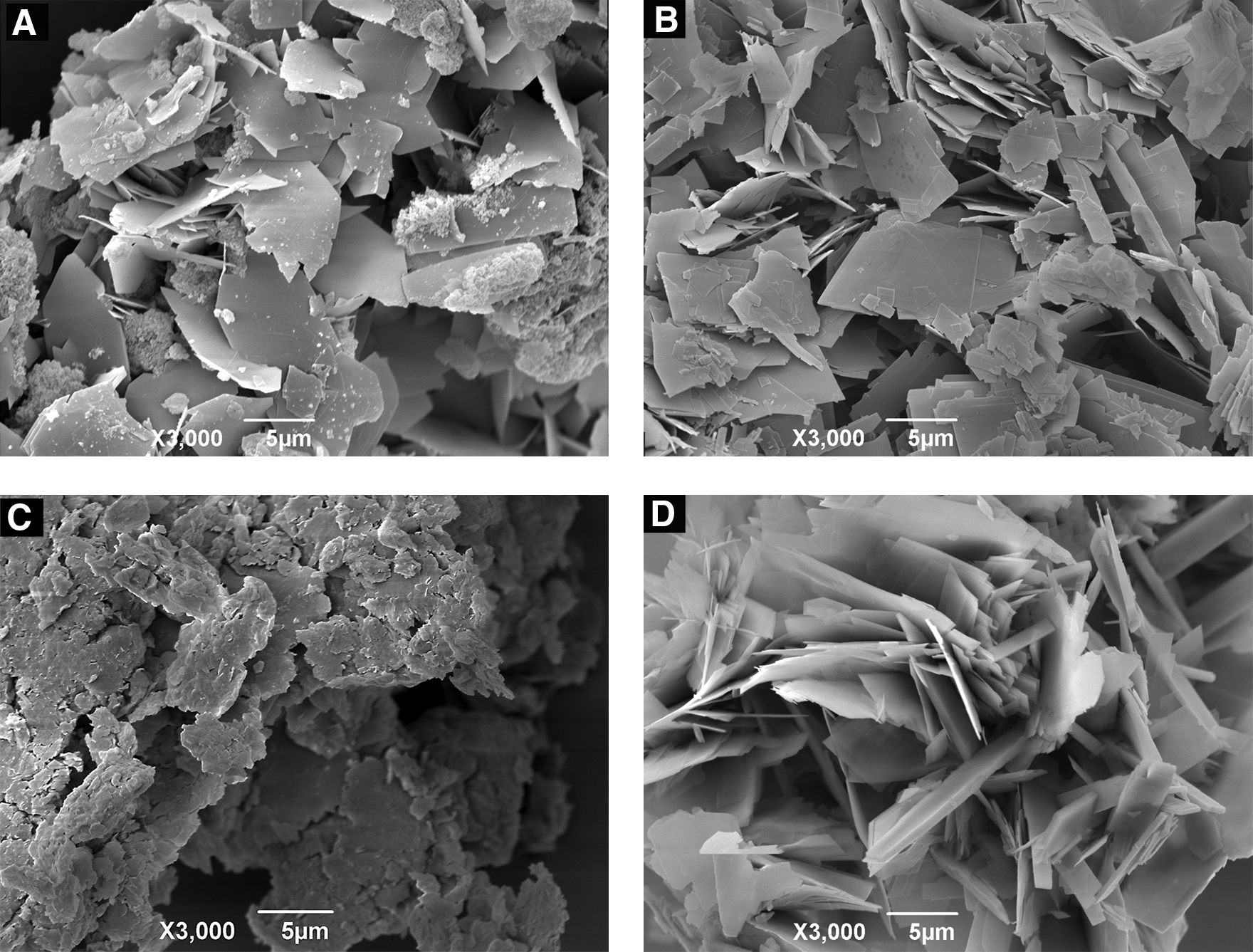
Scanning electron microscopy micrographs for
TGA data were used to quantify the amount of free water present in each material, which evolved at temperatures around 100°C. Decomposition of the surfactant occurred at higher temperatures as evidenced by the coupled TGA/IR results shown in Fig. 3. A similar result is reported in the literature for montmorillonites modified with surfactants (Hedley et al., 2007). For the metal-modified samples, the water content varied depending on the metal being loaded (Ni ≈ Cu ≤Co) (Table 2). One could hypothesize that such behavior is due to strong coordination of the metal species with the surfactant species. However, transitions metals are well known to have multiple coordination to water molecules, therefore affecting the overall hydrophobic character of the samples. EDX analysis indicated that the metal content normalized by the silica present in the sample (ηmetal/ηSi) is ∼0.29, 0.06, and 0.17 for Co-, Ni-, and Cu-Al-HDTMA-NaBt samples, respectively. In addition, EDX results showed that no sulfate species remained after the metal modification step, suggesting that the cations were successfully incorporated onto the IO bentonites. Differences in loadings could be attributed to ion exchange equilibrium limitations and transition metal hydrolysis phenomena (Baes and Mesmer, 1986).

Three-dimensional Fourier transform infrared spectroscopy (FTIR) spectra of the desorbed species arising from the decomposition of HDTMA+ in
FTIR of modified bentonites
Further evidence of the presence of the organic, inorganic, and transition metals in modified bentonite comes from FTIR analyses. The IR spectra data are shown in Fig. 4. The region between 1,200 and 800 cm−1 provides information about the structural units in the interlayer of bentonite (Farmer, 1974). The weak band at 1,112 cm−1 in the spectrum of NaKBt corresponds to the Si-O stretching vibrations typical of montmorillonite. After the modification with Na+, this band becomes a shoulder and less evident for all the modified samples. When metals are incorporated, the band at 1,112 cm−1 is shifted to lower wavenumber values, suggesting interaction of the metals with the Si-O in the interlayers. In addition, bands at 925 and 854 cm−1 are attributed to the Al-OH and Mg-OH vibrations and were maintained after modification. In general, these results suggest that all the incorporated species have specific interaction with the Si-O tetrahedral sheet within the interlayer (He et al., 2006a).

Fourier transform infrared spectroscopy spectra of as-received and modified bentonites.
The regions corresponding to 1,700–1,600 and 3,700–3,100 cm−1 ranges give information about the water adsorbed on the surface of the bentonites and the single O-H interactions, respectively. The position of the band associated with the H-O-H bending vibrations of water molecules adsorbed on bentonite was shifted from 1,629 cm−1 (NaBt) to 1,637 cm−1 for the modified materials and their intensities are slightly decreased. In addition, the presence of a strong band at 3,633 cm−1 and a broad band at 3,398 cm−1 accompanied with a shoulder at 3,230 cm−1 for the NaBt sample may be attributed to specific interaction of water molecules with structural O-H groups, hydrogen bonding and cation hydration, respectively (He et al., 2006a). The band due to O-H groups decreases after the modification of the transition metals, being moderate for the case of Ni-HDTMA-NaBt. This probably correlates with the TGA observations for water content, where the nickel-based materials exhibited considerable hydrophobicity. O-H groups coordinated to the structure are very difficult to remove, usually requiring high temperatures.
The incorporation of the HDTMA+ was further confirmed by the presence of bands in the 3,100–2,800 cm−1 region of the spectra of the modified samples, particularly the bands at 2,929 and 2,856 cm−1, which correspond to CH2 asymmetric and symmetric stretching modes of HDTMA+, respectively. Different wavenumber values for these bands may be attributed to variations in the conformation of the molecules within the interlayer of the bentonite (Zhu et al., 2009a).
Nitrogen adsorption–desorption
Nitrogen equilibrium adsorption–desorption isotherms for all the samples are gathered in Fig. 5. Despite appreciable differences in nitrogen loading, all of the isotherms are of type II, some with H3 hysteresis loops characteristic of slit-like materials (Lowell, 2006). The hysteresis observed for NaKBt and NaBt samples suggests the presence of mesopores. Although XRD data indicate that the increase in gallery size arises from the Al-HDTMA inclusion process, the collapsing of the corresponding nitrogen adsorption isotherm hysteresis loops suggests that the pores are significantly filled with surfactant molecules. As a consequence, it was expected to see a decrease in surface area for both organic and IO bentonites after modification (Table 2) (Wang et al., 2004; He et al., 2006b; Zhou et al., 2008; Zhu et al., 2009b). It should be mentioned that despite the lower surface area, inorganic–organic bentonites such as the one presented here have been used to remove large sorbates from water. That is the case of a recent report by Zhu and coworkers, where a bentonite simultaneously intercalated with aluminum and cetyltrimethyl ammonium bromide was used to adsorb naphthalene from water (Zhu et al., 2009b). Further, a log–log scale analysis (Fig. 5) reveals that modified bentonite materials contain small amounts of effective micropores arising from the surfactant addition.

Nitrogen adsorption isotherm of as-received and modified bentonites. Bottom side of the figure shows the log–log scale version of the isotherms.
PPCP adsorption performance
The use of single-point adsorption experiments is a simple and useful approach that, given the number of sorbents tested here, should provide significant quantitative information about the effect of pH and transition metal incorporation on the adsorption of the selected PPCPs. For clarity, Fig. 6 shows the results obtained for adsorption onto the modified materials after 24 h of equilibration at room temperature. Zhu et al. (2009b) found that the equilibrium adsorption of naphthalene molecules onto IO bentonites could be obtained after ∼4 h, which suggests that a similar behavior should be observed for adsorption of other organic compounds of similar dimensions. From Fig. 6 it is evident that for all adsorbates the use of inorganic–organic bentonites improved the adsorption capacity when compared with that of the organic-modified bentonite at any pH condition. The HDTMA+ molecule acts as a hydrophobic agent, whereas aluminum hydroxide promotes adsorption probably due to complexation with the oxygen from the carboxylic groups (Guan et al., 2006). However, when transition metals are incorporated to the inorganic–organic bentonite variants, the resulting adsorption performance seems to be highly dependent on the nature of the transition metal and the pH condition. For polar aromatic contaminants, it is expected that this dependence could be correlated to the ionization state (pKa values) and to changes of electron density of the bentonite surface when transition metals are added (Hari et al., 2005; Chang et al., 2009).
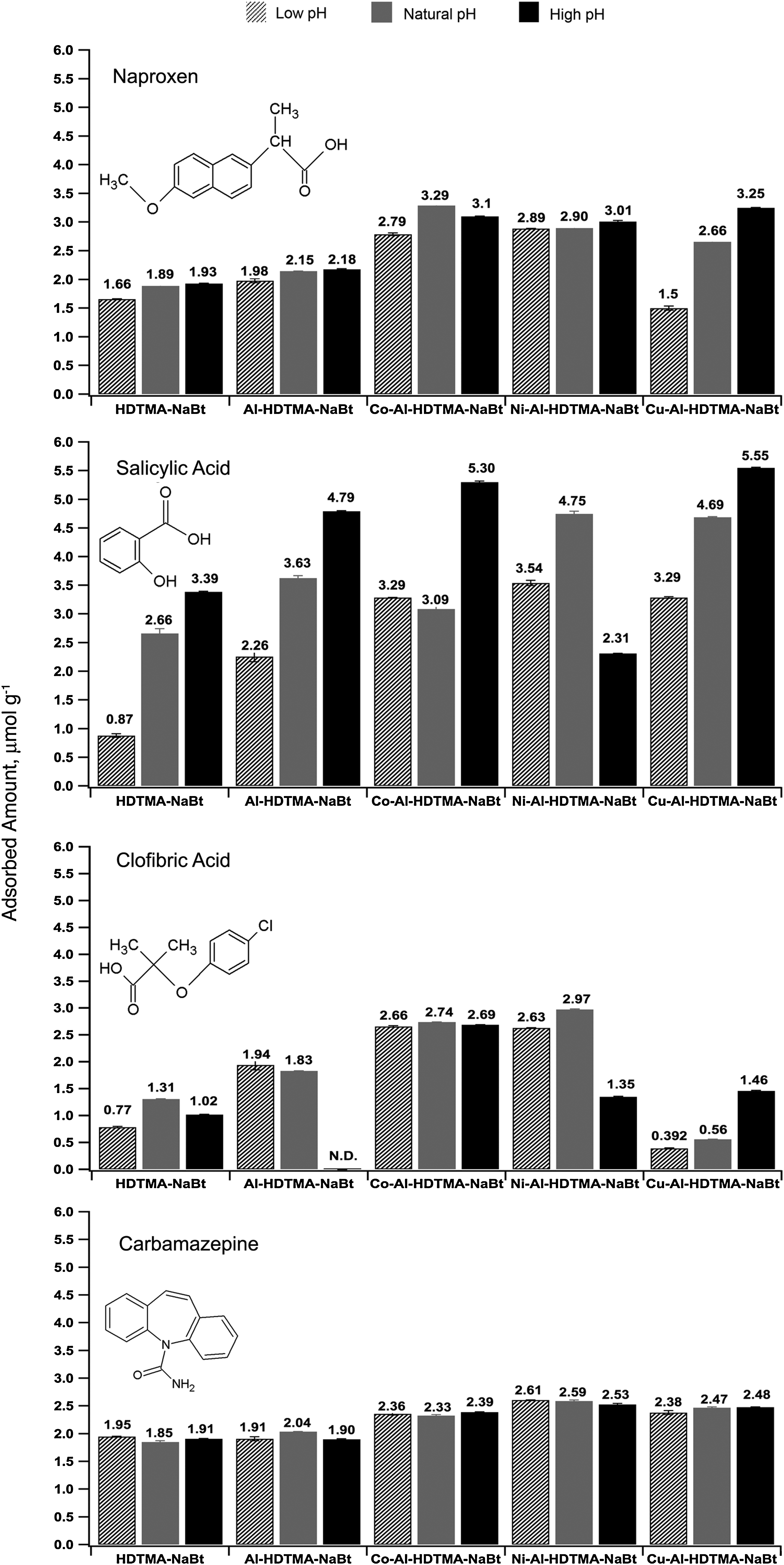
Adsorption capacities for the removal of selected pharmaceuticals and personal care products (Ci = 14 ppm) from water at 25°C and different pH conditions.
Results revealed that at natural pH, Co-Al-HDTMA-NaBt seems to be the most effective adsorbent for naproxen removal followed by Ni-Al-HDTMA-NaBt and Cu-Al-HDTMA-NaBt. In addition, comparable adsorption capacities were obtained at high pH for all transition metal-modified materials. At low pH, only Co- and Ni-Al-HDTMA-NaBt materials exhibited comparable adsorption capacities of 2.79 and 2.89 μmol/g, respectively. However, this is not the case of Cu-Al-HDTMA-NaBt, which displayed the lowest adsorption capacity for naproxen (1.5 μmol/g), indicating that the material surface potential is probably affected by the pH conditions. Naproxen is a two-ring aromatic polar carboxylic acid with a reported pKa of ∼4.2 and with evidence of binding to first-row transition metals (Yaqub et al., 2009). The former characteristic means that at pH > pKa, naproxen will be present mainly as an electron donor adsorbate because of deprotonation of its OH group. However, at pH close to the pKa value, it will be present in water as a neutral compound. For both Co- and Ni-modified IO bentonites, this ionization state should not affect the adsorption performance significantly, suggesting that the resulting adsorption capacity of naproxen was a result of an enhanced interaction brought by the presence of its two aromatic rings, carboxylic and/or O-H groups, and the transition metals. These results may be explained by the formation of π-complexes by these groups, which have π-electrons for donation, and the positive charge of the metal that is to be considered an electron acceptor (Matito and Sola, 2009). On the other hand, it appears that the copper-based material has greater affinity for the deprotonated form of naproxen, suggesting the presence of a different type of complexation mechanism. Kowalska et al. (1994) have discussed the formation of water-bridging type complexation between metals and anionic and polar compounds in clays. According to the data shown in Table 2, the copper-based variant contains the largest amount of water among the transition metal-modified IO bentonites, indicating that water bridging could be a predominant aspect.
For Co- and Cu-Al-HDTMA-NaBt, the highest naproxen adsorption capacities were observed at pH > pKa, indicating that the availability of an electron donor in both OH groups of the adsorbates enhanced the overall adsorbent performance. This trend was not observed for Ni-Al-HDTMA-NaBt, suggesting an adsorption capacity driven by the presence of the two aromatic rings at natural pH. Nevertheless, the results obtained for transition metal-modified IO bentonites suggest that the adsorption mechanism in general is highly dependent on the ionization state of the molecule.
Figure 6 also shows uptake data gathered for salicylic acid. This adsorbate contains only one aromatic ring, and because of its chemical functionalities, it has a reported pKa value of 2.97. In addition, it has a small molecular footprint when compared with the other adsorbates, allowing for better access to any void space between the intercalated species. This was evidenced in the observed adsorption capacities, which are the largest among all the cases. For salicylic acid, once again, the use of IO clays improved the adsorption capacity of the bentonite. However, pH again seems to be a key factor in the observed adsorption performance of the transition metal-modified IO bentonites. Highest adsorption capacities were obtained at high pH conditions increasing as follows: Ni < Co < Cu. On the other hand, the lowest adsorption capacities were obtained at low pH conditions. These observations could be attributed to the ionization of salicylic acid, which at high pH could result in more O-H groups being deprotonated, therefore enhancing the overall adsorption performance.
Clofibric acid exhibited a similar adsorption behavior when compared with that of naproxen. However, the highest adsorption capacity was obtained using Ni-Al-HDTMA-NaBt at natural pH conditions (Fig. 6). Cobalt-modified IO bentonite does not appear to be affected by pH changes, suggesting that the underlying adsorption mechanism is probably based on the interaction of the aromatic ring and the transition metal. Also, the copper-based IO bentonite seems to have less affinity toward clofibric acid, displaying the overall lowest adsorption capacities for this adsorbate.
Adsorption capacities of carbamazepine were not significantly affected by pH and/or type of bentonite modification. Because of its larger size and lack of functional groups capable of undergoing ionization, carbamazepine adsorption could be attributed then to the hydrophobic nature of the bentonite surface after modification. No selectivity toward carbamazepine was observed among the tested modified IO bentonites.
In general, the observed adsorption capacities for the selected PPCPs seem to be comparable to those reported in the literature for bentonites, bentonite-rich matrices, or other porous adsorbents (Drillia et al., 2005; Ayranci and Duman, 2006; Yu et al., 2008; Xu et al., 2009). However, the incorporation of transition metals into the IO bentonites indicates that the selectivity of these materials toward particular PPCPs may be tailored. Moreover, as the majority of these contaminants are dependent on pH changes and present at low concentration levels, the use of transition metal-modified IO bentonites may be suitable in the design of adsorption strategies that take advantage of these variables for enhanced removal and selectivity. The metal–organic complex formation could lead to the design of potential sorbents based on weak chemisorption, which is a stronger interaction when compared with physisorption, but weak enough for the material to be regenerated. To complement the findings of this work, our group is currently working in the development of regeneration strategies and the analysis of more complex systems to elucidate the potential of the adsorbents in real-case scenarios.
Conclusion
The removal of naproxen, salicylic acid, clofibric acid, and carbamazepine by water phase adsorption was found to be highly dependent on the nature of the adsorbate, pH conditions, and the type of transition metal incorporated onto the IO bentonites. Modification of the IO bentonite does not seem to affect its structural characteristic and the metal loading increased as follows: Ni < Cu < Co. In general, the PPCP adsorption capacities observed for the transition metal-modified materials increases as follows: carbamazepine < clofibric acid < naproxen < salicylic acid. Different interaction mechanisms may explain the observed results, including hydrophobicity and metal complexation with carboxylic groups and deprotonated OH groups, but further studies are required to elucidate which one dominates. Nevertheless, specific interactions between the transition metal IO bentonites and the adsorbates are evident upon pH changes. This observation could lead to the development of adsorption strategies that take into account the polarity of the contaminant, pH, and type of transition metal to enhance adsorption performance and selectivity.
Footnotes
Acknowledgments
This work was supported by the National Science Foundation under grant CBET-0546370. The authors acknowledge Professor Carlos Rinaldi (UPRM Chemical Engineering) for providing access to UV–vis spectrometer.
Author Disclosure Statement
No competing financial interests exist.