




Abstract
Abstract
This study investigated the effect of the addition of montmorillonite (MMT) organoclay on water solubility of polyvinyl alcohol (PVA) gels, which have been used as an entrapment material in microbial immobilization for biological wastewater treatment. Reduction in the solubility of the PVA gels was proportional to the concentration of organoclay added. Water solubility was reduced to between 83 and 90% on the addition of 1 to 10% organoclay to the PVA gels. However, as the addition of organoclay was increased, it dissolved back into the water phase, which increased the turbidity of the bulk solution. Solubility of the PVA gels decreased with increasing saponification ratio and molecular weight of PVA. Reduction in solubility due to organoclay was compared with the addition of powdered activated carbon (PAC). Organoclay/PVA gels were less water soluble than the PAC/PVA gels, which can be explained by the smaller particle size of the organoclay. Consequently, the reduced solubility caused by the addition of MMT to PVA gels could enhance the applicability of PVA gels to wastewater treatment processes.
Introduction
There are two types of immobilization technique: attachment and encapsulation. Immobilization by attachment is achieved by spontaneous adhesion of microorganisms onto porous supporting media, such as polyurethane foam and an inorganic matrix. Encapsulation is usually accomplished using porous polymeric materials. Many diverse natural and synthetic gel matrices have been proposed, as possible biomass carriers can be used for encapsulated immobilization, that is, alginate, agar, polyacrylamide, carrageenan, cellulose acetate, and polyvinyl alcohol (PVA), to confine the migration of microorganisms (Yang et al., 1995; Leenen et al., 1996; Lozinsky, 1998; Kim et al., 2000; Rostron et al., 2001). The porous structure of polymers allows substrates and oxygen to diffuse into their internal pores where the encapsulated cells dwell.
Immobilization by attachment has been preferred for wastewater treatment, because it requires no addition of chemicals. However, much higher cell concentrations can be guaranteed via encapsulation than by attachment. Moreover, selective immobilization of specific microorganisms is possible via encapsulation techniques.
The most widely used material for encapsulated immobilization is PVA, because its gels can be readily prepared using a simple freezing-thawing method, which does not require chemical initiation. Many studies have been carried out with PVA encapsulation for nitrification (Asano et al., 1992; Chen et al., 1998; Vogelsang et al., 1999; Seo et al., 2001).
For their use as a supporting matrix for cell immobilization in biological wastewater treatment processes, PVA gels should possess certain physical properties; for example, solubility, biodegradability, diffusivity, and mechanical stability should be considered. In particular, due to the high solubility of PVA in water, this property should be reduced. PVA has a hydrophilic nature due to the hydroxyl functional groups (-OH) in its molecular structure. If the immobilized PVA gels are easily dissolved into water, encapsulated cells are gradually released into the bulk solution and, thus, the lifetime of the immobilized media will be shortened. Therefore, reducing the solubility of PVA gels should be a priority in the immobilization processes.
To enhance the physical properties of polymeric materials, various fillers can be used; for example, calcium carbonate, talc, glass fiber, and wood flour are used as fillers for preparing reinforced synthetic organic polymers, as their anisotropy can help reinforcement of the matrix (Hong et al., 2005a). However, strong interparticle interactions between fillers limit their application. Recently, to overcome this problem, organoclay has been added to or blended with polymeric materials. Montmorillonite (MMT) clay, which is found in a layered silicate structure with a high surface area, has frequently been used for this purpose. Exchanging the cations present between the silicate layers with bulkier and more-organophilic cations can alter the clay structure to allow easier exfoliation or intercalation into the organic polymer structure. Nanocomposites can be obtained by exfoliation or intercalation of the organoclay layers into polymers. This nanocomposite structure makes it possible to change the physical properties of the organic polymers for their beneficial use (Hong et al., 2005b).
The objective of this study was to investigate the effects of the addition of filler on the water solubility of PVA gels. Particularly, organoclay based on MMT was added to reduce the water solubility of the PVA gels. The reduced solubility due to the addition of powdered activated carbon (PAC) was also attempted, with its performance compared with that of the addition of organoclay.
Materials and methods
Preparation of PVA gels
Five PVAs, with different saponification ratios (SR) and molecular weights (MW), were used in this study. The PVAs were provided by Tong-Yang Jechul Chemicals, Inc. Table 1 shows the characteristics of each PVA. P stands for a partially saponificated PVA (SR is 87 mol%), whereas F stands for a fully saponificated PVA (SR is 98 mol%). The number in their names represents the degree of polymerization; for example, the MWs of both P17 and F17 were 74,800 Da (= 1,700×44 Da, 44 is the MW of the repeated unit of the PVA monomer). Similarly, the MW of the P24 was calculated to be 105,600 Da.
PVA, polyvinyl alcohol.
An aqueous PVA solution (w/w 25%) was prepared, and the solution was frozen to −5°C for 2 h and then cut into small cubes (∼1 cm3). To obtain PVA gels, the cubes were immersed in boric acid and agitated for 24 h to give PVA crosslinked to boron. Finally, the PVA gels were washed with deionized water.
The organoclay or PAC was mixed with the PVA solution during the initial stage of the preparation. The commercially available organic modified MMT, Nanomers 20 (Nanocor), was selected as a representative of organoclay.
Determination of water solubility of PVA gels
The solubilities of the PVA gels in water were tested as follows: the prepared PVA gels were immersed in 1 L of distilled water and agitated at a velocity gradient (G) of 155 s−1. Temperature during the test was kept at 20°C±3°C. The water was then periodically sampled over time. The total organic carbon (TOC) of the sampled water was measured to monitor how much of the PVA had dissolved into the water. Therefore, the solubilities of the PVA gels were expressed as the TOC concentration of the sampled water.
Analysis
The TOC was measured using a TOC analyzer (Phoenix8000; Tekmar Dohrmann), and the turbidity was measured using a turbidometer (2100N; Hach). Scanning electron micrographs (S-4300; Hitachi) were used to monitor the surface and interior structures of the prepared PVA gels. Size analyses of the PAC and organoclay were conducted using a lazer scattering particle size analyzer (Hellos; Sympta-TC).
Results and Discussion
Effect of organoclay addition on PVA solubility
Figure 1 shows the effects of the addition of the organoclay on the solubilities of the PVA gels. Compared with the organoclay-free PVA gels (•: symbol in Fig. 1), all the additions of organoclay to the PVA gels gave significantly low TOC concentrations. That is, the addition of organoclay to PVA led to a substantial reduction in the water solubility. For example, the TOC of the sampled water from the organoclay-free PVA gel was close to 900 mg/L after 30 h of agitation; whereas, that of the 10% organoclay-PVA gel was only 91 mg/L under the same conditions. About a 90% reduction in the solubility of the PVA gel resulted from the addition of organoclay.
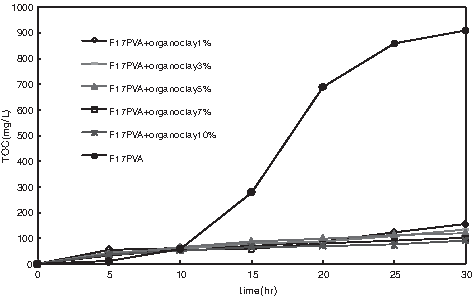
Variations in total organic carbon (TOC) concentrations within the polyvinyl alcohol (PVA) gels with different organoclay contents (0–10 w/w%).
The solubility was dependent on the amount of organoclay added. As the organoclay concentration was increased from 1% to 10%, the TOC of the sampled water decreased from 155 to 91 mg/L, that is, the greater the addition of the organoclay to the PVA, the less soluble the PVA became. However, the reduction in the solubility was not linearly proportional to the concentration of the organoclay added; degree of the reduction in the solubility was mitigated with increasing organoclay concentration.
Conversely, with increasing organoclay concentration, the turbidity of the sampled water increased from 0.6 to 13 NTU after 30 min agitation (Fig. 2). After the addition of the organoclay exceeded 5%, the turbidity began to markedly increase. Particularly, the addition of 10% organoclay to the PVA gels resulted in a significantly high turbidity (13 NTU). The increase in the turbidity may have been due to the dissolution of the organoclay within the PVA gels into the bulk solution. The composite structure between the organoclays and PVA molecules may have been only formed due to the overdosing of organoclay above an appropriate concentration. Therefore, the overdosed organoclay particles appeared to dissolve back into the bulk solution, resulting in the increased turbidity of the bulk solution. Consequently, as the addition of the organoclay was increased, the water solubility of the PVA gels decreased, but with the overdosed organoclay dissolving back into the solution.

Variations in turbidity of F17 PVA gels with different organoclay contents (0–10 w/w%).
The reduced solubility could be explained by steric-hindrance of the organoclay particles, which could interfere with the hydrogen bonding. Fig. 3a shows the normal hydrogen bonding between the hydroxyl groups on the organoclay-free PVA and water molecules in the bulk phase. Strong hydrogen bonding causes the PVAs to become soluble in water. However, the organoclay particles intercalated into the PVA molecules can effectively screen and/or block the hydrogen bonding between the PVA and water molecules (Fig. 3b), making those less soluble in water.
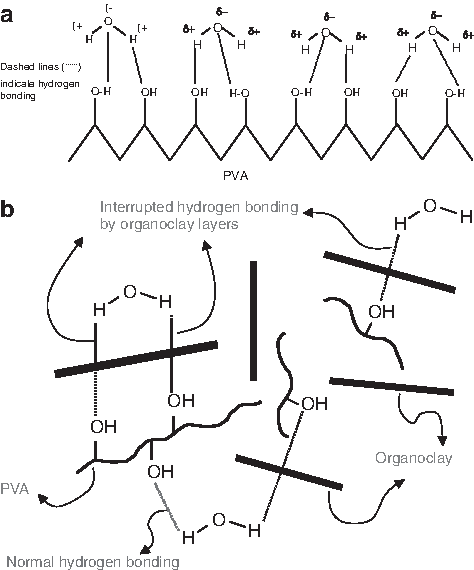
Hydrogen bonding between hydroxyl groups in PVA and water molecules: organoclay-free PVA
Figure 4 shows the SEM images of the organoclay-free and organoclay-added PVA gels. A porous structure evenly and broadly developed in the organoclay-free PVA gels (Fig. 4a), which can provide many immobilization sites for microorganisms. On the other hand, the addition of the organoclay particles caused intercalation into the PVA structure (Fig. 4b), suggesting that the hydrogen bonding between PVA and water could be inhibited. Since organoclay has a characteristic layered silicate structure, it can easily intercalate with the PVA gels. Consequently, the addition of organoclay to PVA gels resulted in their lower solubilities in water due to interference with the hydrogen bonding.
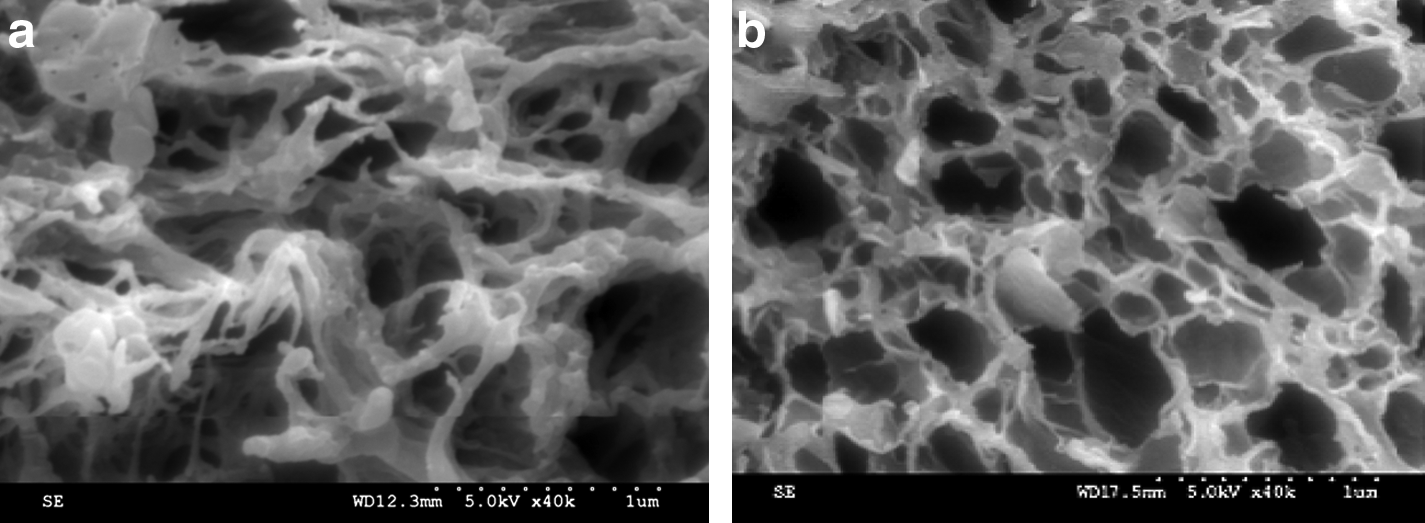
SEM observation (×40,000) showing the morphology of the organoclay-free PVA gels
Effect of characteristics of PVA on water solubility
The effect of the molecular structure of PVA on the water solubility should also be considered. For example, the SR and MW of PVA can influence the solubility of the PVA gels with the addition of organoclay.
Figure 5 shows the effects of the SR and MW of the PVA gels on the solubilities of the organoclay PVA gels. Regardless of the kind of PVA used, the TOC concentration gradually increased over time, finally reaching a plateau. The overall order of the water solubilities was P05>P17>P24>F05 >F17. The lower the SR of the PVA, the higher the TOC; the solubility of the P series with low SRs (P05, P17 and P24) was much higher than that of the F series with high SRs (F05 and F17). Moreover, the higher the MW of the PVA, the lower the TOC; the solubility of the PVA decreased with increasing MW. This coincided well with the previous work (Chang et al., 2005) on the elucidation of the effects of SR and MW of PVA gels on their water solubilities, where the solubilities of the PVA gels decreased as their SR and MW became higher, which was explained by the inter- and intra-molecular hydrogen bonding between and within the PVA molecules. A similar mechanism seemed to work for the PVA gels with the addition of organoclay. That is, hydrogen bonding between intermolecules makes the F series PVA difficult to dissolve in water. In contrast, the P series, having relatively weak hydrogen bonding between intermolecules, are more easily dissolved in water than the F series.

Variations in TOC concentrations of PVA gels with different organoclay contents (5 w/w%) with regard to different saponification ratio and molecular weight.
Comparison of organoclay and PAC
The water solubilities of the organoclay- and PAC-added PVAs are compared in Fig. 6. As with the addition of organoclay, PAC reduced the solubilities of the PVA gels. However, the TOC concentration of the PVA with the addition of PAC was always higher than that with the addition of organoclay. For example, after 30 min agitation, the TOC concentration of the PVA with the addition of PAC was 126 mg/L; whereas, that of the PVA with the addition of organoclay was 94 mg/L, indicating that the water solubility of the PVA on the addition of organoclay was lower than that on the addition of PAC. In other words, the organioclay could screen and/or block the hydrogen bonding more effectively than PAC.
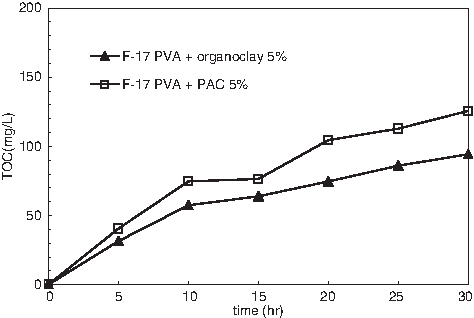
Variations in TOC concentrations of powdered activated carbon (PAC) and organoclay-added PVA.
The reason the organoclay more effectively screened the hydrogen bonding could be explained by the different particle size. Figure 7 shows the particle size distributions of the PAC and organoclay before their addition to the PVA. The median particle sizes of the PAC and organoclay when dispersed in water were 22.5 and 3.4 μm, respectively. Since the weight percent of both fillers were 5%, smaller particle size will have a larger surface area; therefore, the organoclay had a much higher probability of inhibiting the hydrogen bonding than the PAC. This could be the reason the organoclay was more efficient than PAC at reducing the solubility of the PVA gels.
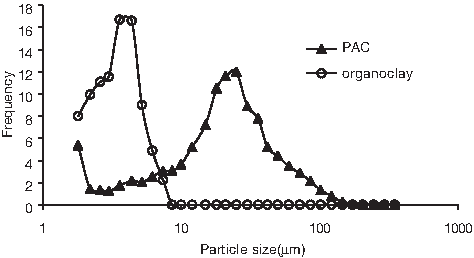
Particle size distributions of organoclay and PAC.
Conclusion
The effects of the addition of fillers on the water solubility of PVA gels used for cell immobilization were investigated. Particularly, the reduction in the solubility on the addition of an organoclay based on MMT was tested. The solubilities of the PVA gels were reduced with increasing organoclay concentration; the solubilities were reduced to between 83% and 90% on the additions of between 1% and 10% organoclay. The mechanism of the reduced solubility was explained by steric hindrance of the organoclay particles within the PVA gels. However, the organoclay added to the PVA dissolved back into the water as the concentration of the organoclay was increased, thereby increasing the turbidity of the bulk solution. The PVA gels with the addition of organoclay were less soluble in water than those with the addition of PAC, which was explained by the smaller particle size of the organoclay.
Footnotes
Acknowledgments
This work was supported by the Korea Research Foundation Grant by the Korean Government (KRF-521-2008-1-D00240); by the Ministry of Education, Science Technology (MEST); and by Korea Institute for Advancement of Technology (KIAT) through the Human Resource Training Project for Regional Innovation.
Author Disclosure Statement
No competing financial interests exist.