




Abstract
Abstract
Triethylene glycol dinitrate (TEGDN) is an energetic plasticizer presently used in the synthesis of new insensitive formulations. However, little is known about its environmental fate and impact. In the present study, we measured several environmental physicochemical parameters that are necessary to predict the fate and impact of the chemical in the environment. High solubility of TEGDN in water (7,430 mg L−1 at 25 °C), its low log Kow value (0.79), and low Kd values (0.09–0.78 L kg−1) suggest that TEGDN will be very mobile in soils. We also investigated the kinetics and mechanisms of several degradation processes likely to occur in the environment. Hydrolysis and degradation in sterile soils were found to be very slow. No significant biological transformation was detected after 3-month incubation in soils under aerobic conditions. Photolysis was the fastest process to take place with a rate of 0.049 day−1 (t1/2 = 14 days) and 0.031 day−1 (t1/2 = 22 days) at 25°C in the dissolved or dry form, respectively. Nitrate, formaldehyde, and formate were the major photoproducts. Glyoxal, glycolaldehyde, and polycondensation products were also observed in the absence of water.
Introduction
NG and EGDN have been extensively studied in terms of fate and toxicity due to their wide use as major constituents of dynamite and double or triple base propellants (Yinon, 1990). Both chemicals are volatile, fairly soluble in water, and mobile in soils, which favors their transport from the contamination source to potential receptors (Mirecki et al., 2006). These two nitrate esters have been shown to be highly toxic substances. The most common symptoms in humans are severe headaches and adverse cardiovascular effects, including nitrate dependence in the case of chronic exposure (Carmichael and Lieben, 1963; Yinon, 1990). Several cases of sudden death in dynamite (mixtures of NG and diethylene glycol dinitrate [DEGDN]) and EGDN workers occurred in the 1920s and 1930s (Carmichael and Lieben, 1963).
Replacing the highly volatile EGDN (vapor pressure of 0.071 mm Hg at 25°C) (Burrows et al., 1989) by less volatile nitrate esters such as DEGDN or triethylene glycol dinitrate (TEGDN) should decrease the inhalation hazards associated with use of these plasticizers. In addition, DEGDN and TEGDN are much less sensitive than NG, which is an advantage when synthesizing new propellants. DEGDN and TEGDN have already been used in few applications (Bocksteiner and Whelan, 1995; Beaupré et al., 1997), and are now being considered for the synthesis of new insensitive propellants (Abou-Rachid et al., 2008; Yi et al., 2009a, b).
As they have not been widely used, however, fewer studies have been conducted to understand the fate and toxicity of DEGDN and TEGDN, compared to NG and EGDN. DEGDN appeared to be moderately toxic to aquatic organisms (Fisher et al., 1989) and rats (Brown et al., 1994). TEGDN was found to be acutely toxic in rats with the major effects being hypotension and methemoglobin formation (Andersen et al., 1976). Some data have been reported by Haag et al. (1991) on the environmental fate of DEGDN that indicate a relatively high stability and mobility of the chemical in surface waters. However, to our knowledge, no data are available on the environmental fate of TEGDN in waters and soils.
The objective of the present research was thus to provide data that will help predicting the fate of TEGDN in soils and waters. We measured physicochemical parameters, including the aqueous solubility, the octanol/water coefficient, and soil/water distribution coefficients for TEGDN. In addition, we determined the kinetics and mechanisms of several degradation processes that may be encountered in the environment such as hydrolysis, abiotic and biotic degradation in soils, and photolysis.
Materials and Methods
Materials
TEGDN was obtained from General Dynamics (Salaberry de Valleyfield, Canada) dissolved in acetone (50/50 w/w). Small volumes of solution (50–100 μL) were dried for 24 h at room temperature under a fume hood to evaporate the acetone before using. A pale yellow oily liquid was obtained after evaporation. Acetonitrile (CH3CN; HPLC grade) was purchased from Fisher (Nepean, Canada) and deionized water was obtained with a Milli-Q Advantage A10 system (Millipore, Billerica, MA). All other chemicals were of reagent grade or better.
To study the sorption of TEGDN on soil, we used a sandy surface soil (DRDC) collected in 2008 at a training range from Defense Research and Development Canada–Valcartier and a fine-loamy mesic Webster clay loam (WCL) sampled at Story County, Iowa, in 2002, that was richer in organic matter and clay. Both soils were passed through a 2 mm sieve, kept at 4°C, and air-dried for 72 h in a fume-hood before use. Selected characteristics of DRDC and WCL soils are given in Table 1.
CEC, cation exchange capacity; DRDC, Defense Research and Development Canada; WCL, Webster clay loam.
Aqueous solubility
The aqueous solubility of TEGDN was determined by suspending the viscous liquid obtained after evaporating acetone in 2.5 mL of water. The solution was gently stirred at room temperature for 21 days. Aliquots (0.4 mL) of the mixture were sampled at days 4, 6, 14, and 21; centrifuged at 16,100 g for 5 min; and the aqueous phase was analyzed using high-performance liquid chromatography (HPLC) as described below. The experiment was conducted in triplicate.
Kow measurements
The octanol–water partition coefficient (Kow) of TEGDN was measured at 22°C ± 1°C as described in the OECD Guideline 107 (OECD, 1981). The measurements were performed with nonsaturated solvents. A volume (4 mL) of an aqueous solution of TEGDN at 5 mg L−1 was added to 1-octanol (2, 3, or 4 mL) in a 16-mL PTFE-lined capped glass tube. The mixtures were equilibrated for four 10-min shaking periods spaced 10 min apart. The tubes were centrifuged for 10 min at 3,237 g. The octanol fraction was diluted (1:3) with a solution containing 70% methanol in water, and the concentration of TEGDN in both water and octanol fractions was determined by HPLC as described below. Experiments were run in triplicate.
Batch soil experiments
Batch equilibration studies lasting 3 months were used to quantify sorption and degradation of TEGDN in the presence of DRDC and WCL soils. Aerobic conditions were selected due to the sandy nature of DRDC soil that makes the site aerobic over several tens of centimeters. A volume (10 mL) of filtered aqueous solution of TEGDN (50 mg L−1) was added under sterile conditions to nonsterile DRDC or WCL soil (1.5 g) in autoclaved 125-mL headspace glass bottles. The latter were closed, but not sealed, with butyl rubber stoppers. The bottles were kept in the dark at 22°C ± 1°C and opened and shaken twice a week to ensure aerobic conditions. At various time intervals, three replicates were sacrificed. After 2 h of settling, the supernatant was withdrawn, filtered through a 0.45 μm Millipore filter, diluted 1/1 in acetonitrile (CH3CN), and analyzed by HPLC as described below. Sorbed analyte was extracted from soil as described in the EPA SW-846 Method 8330 (USEPA, 1997). Briefly, soil was sonicated with CH3CN (10 mL) at 20°C for 20 h, and the supernatant was diluted 1/1 in an aqueous CaCl2 solution and filtered through a Millex-HV 0.45-μm filter before HPLC analysis. The soil water distribution coefficient (Kd) was calculated as the soil-to-water analyte concentrations ratio. A percent recovery was calculated by adding the soluble and sorbed fractions of analytes. When loss was detected, the contribution of abiotic processes was estimated by conducting a similar experiment with the same soil after sterilization 3 times 30 min at 121°C.
Column soil experiments
Flow-through columns were conducted at room temperature (22°C ± 1°C) to evaluate the transport and fate of TEGDN in the two soils. The columns consisted of 15.0-cm-long by 2.2-cm-internal diameter glass cylinders fitted with a sintered glass filter and a valve at the bottom, and a rubber cap on the top. Solutions were introduced in the column from the top at fixed flow rate (0.4 mL min−1) using a HPLC binary pump (Model 590; Waters, Milford, MA). Outflow samples were collected continuously into 10-mL tubes using an automatic fraction collector (Foxy Jr.; ISCO, Inc., Lincoln, NE).
Air-dry soil (∼90 g) was poured into the column in small amounts at a time and manually pressed to a bulk density of 1.63–1.65 g cm−3. All solutions passing through the column contained 0.005 M Ca(NO3)2 as background electrolyte. Moreover, sodium chloride was added as a tracer at a concentration of 5 mgCl L−1. The soil column was saturated with the Ca(NO3)2 solution, which was pumped through the column for 20 h (corresponding to 20–25 pore volumes) to ensure a regular flow. The pore volume, determined as the volume necessary to fill the packed column, was found to be around 18 mL for both soils. The pure background electrolyte solution was then replaced by the solution containing TEGDN (50 mg L−1) and the tracer. Every fourth outflow sample was analyzed by HPLC as described below.
At the end of each column experiment, the soil was separately extracted by sonication in acetonitrile for 18 h and mass balances were calculated from the sum of the concentration found (or interpolated from measured samples) in the eluates and soil extract.
Hydrolysis experiments
Hydrolysis of TEGDN was measured in deionized water adjusted to acid or alkaline pH (3, 5.5, 11, or 12) with H2SO4 or NaOH solutions, respectively. The TEGDN solutions of a given pH were kept static and away from light at various temperatures (30–50°C). After increasing time intervals, aliquots of solutions were withdrawn and analyzed for TEGDN.
Irradiation experiments
To predict the photosensitivity of TEGDN under naturally occurring conditions, irradiation experiments were conducted using artificial sunlight generated from a SolSim Solar Simulating Photoreactor (Luzchem Research, Inc., Ottawa, Canada). Luzchem's simulator is designed to yield the internationally accepted standard for sunlight (ASTM Air Mass 1.5 Global Tilt Standard). The total irradiance of the solar simulator output spectrum calibrated to the best approximation of AM1.5 standard in the 280–800 nm region was 590,000 mW m−2. Experiments were conducted at 25°C in 20 mL quartz crucibles (25 mm, internal diameter) covered with a quartz lid using 5 mL of aqueous solutions of TEGDN (7.8 mg L−1) in deionized water. All tests were done in triplicate. Samples were periodically sacrificed and analyzed for TEGDN and photoproducts as described below.
A similar experiment was conducted using pure TEGDN (62 mg or 260 μmol) to evaluate the potential for photodegradation in dry formulation particles spread out on soil. At the end of irradiation, the remaining compounds were dissolved in 10 mL of a mixture H2O/CH3CN (50/50, v/v) and analyzed for TEGDN. A separate run was conducted for the analysis of photoproducts; the latter was dissolved in water only and analyzed as described below.
Analytical methods
TEGDN solutions in acetonitrile/water (50/50; v/v) were analyzed by reverse-phase HPLC-UV. The system consisted of a W600 pump (Waters), a 717 plus autosampler, and a 2996 Photodiode-Array Detector. Samples (50 μL) were separated with a Discovery C18 column (25 cm × 4.6 mm × 5 μm) (Supelco, Oakville, Canada), at 35°C. The mobile phase (50% aqueous methanol) was run isocratically at 1 mL min−1. The method allowed TEGDN to be separated well from other common explosives such as 2,4,6-trinitrotoluene; hexahydro-1,3,5-trinitro-1,3,5-triazine (RDX); octahydro-1,3,5,7-tetranitro-1,3,5,7-tetrazocine (HMX); nitroguanidine; and NG. The detector was set to scan from 200 to 350 nm. The detection limit at 205 nm was estimated at 0.05 mg L−1.
The ammonium cation was analyzed by ion chromatography as described previously (Balakrishnan et al., 2004). Formaldehyde was analyzed by HPLC-UV after derivatization with 2,4-pentanedione as described previously (Hawari et al., 2002).
Glycolate, acetate, formate, and glyoxylate were quantified by HPLC (Waters) equipped with a pump model 600, an autosampler model 717 plus, and a conductivity detector (model 432). The separation was made on a Dionex (Sunnyvale, CA) IonPac AS15 column (4 × 250 mm). A mobile phase of 5 mM KOH was first run for 20 min, and then a gradient up to 40 mM KOH was used for 30 min, which was maintained for additional 5 min at a flow rate of 1.5 mL min−1 and 40°C. The detection of anions was enhanced by reducing the background with an autosuppressor from Altech (model DS-Plus), which allowed detection limits for each anion of 0.15 mg L−1.
Other anions (Cl−, NO2−, and NO3−) were monitored using an HPLC from Dionex (system DX-500) equipped with a conductivity detector and Dionex ion chromatography column (IonPac AS15) (250 mm × 4 mm inner diameter). The mobile phase was 30 mM KOH solution. Analysis was carried out at room temperature at a flow rate of 1.5 mL min−1. The detection limits were enhanced by reducing the background with a self-regenerating suppressor, model ASRS 300, and estimated at 0.050 mg L−1 for the three anions.
TEGDN early degradation products were identified as their 2,4-dinitrophenyl hydrazine (DNPH) derivative using a Bruker MicroTOFQ mass analyzer attached to a HPLC system (Hewlett Packard 1200 Series) equipped with a diode array detector. The samples were injected into a 3.5 micron-pore size Zorbax SB-C18 column (2.1 mm inner diameter × 150 mm; Agilent, Mississauga, Canada) at 25°C. The solvent system was composed of a CH3CN/H2O gradient (40–80 v/v) at a flow rate of 0.15 mL min−1. For mass analysis, negative electrospray ionization (ES-) was used to produce deprotonated molecular ions [M-H]− of the derivatized products. The mass range was scanned from m/z 40 to 1,000.
Results and Discussion
Aqueous solubility
No quantitative data about the aqueous solubility of TEGDN was found in the literature. The aqueous solubility of TEGDN was thus measured at 25°C by gently stirring a saturated mixture for several weeks. The analysis of the aqueous fraction made after 6, 14, and 21 days indicated a constant value of 7,430 ± 90 mg L−1. TEGDN was found to be more soluble in water than its smaller analogs DEGDN and EGDN for which solubility values of 3,900 and 5,600 mg L−1, respectively, have been reported in water at 25°C (Burrows et al., 1989; Haag et al., 1991). The high solubility of TEGDN in water will favor its dissolution from solid particles into the environment.
Octanol/water partition coefficient
Determining the 1-octanol/water partition coefficient (Kow) is important because this parameter can be used to predict soil adsorption, migration through subsurface soil, and bioaccumulation in terrestrial and aquatic biota by providing an estimate of the affinity of a chemical for organic matter. Several Kow values have been reported for DEGDN (9.6) (Haag et al., 1991), EGDN (14.45) (Burrows et al., 1989), and NG (1.62 and 1.77) (Burrows et al., 1989), but to our knowledge no data have been reported for TEGDN. We measured Kow for TEGDN using three different combinations of water/1-octanol mixtures each in triplicate. Regardless of the octanol/water ratios used, Kow of TEGDN remained constant and a value of 6.2 ± 0.2 (Log Kow = 0.79 ± 0.03) was obtained. DEGDN and EGDN have been reported to exhibit low affinity for soil or sediment organic matter (Haag et al., 1991). The present finding suggests that TEGDN sorption to the soil or sediment organic matter will be even lower than what had been estimated for DEGDN and EGDN.
Hydrolysis
Hydrolysis of TEGDN was measured at 30°C, 40°C, or 50°C in deionized water (pH 5.5) as well as in acidified (pH 3.0) and alkaline (pH 11.0 and 12.0) aqueous solutions (Fig. 1 and Table 2). TEGDN appeared to be stable at both 30°C and 40°C between pH 3 and 11. Only a small loss (8%) of TEGDN was observed after 3 months at 30°C and pH 12, confirming the stability of TEGDN under these harsh alkaline conditions. Various amounts of TEGDN (11%–32%) degraded after 3 months at 50°C, corresponding to degradation rate constants ranging from 0.0015 to 0.0056 day−1 (t1/2 = 124–462 days). The rate measured at 50°C and pH 12 (0.0056 day−1) was >1,200 times slower than the rate previously measured for HMX (7.128 day−1) under similar conditions (Monteil-Rivera et al., 2008) with the latter hydrolyzing more slowly than several other explosives, including RDX (Monteil-Rivera et al., 2008) or CL-20 (Monteil-Rivera et al., 2004). Although TEGDN degradation was slightly faster at pH 12.0, the degradation rates did not correlate with the concentration of hydroxide ion, thus suggesting a main degradation mechanism different from alkaline hydrolysis. The fact that degradation occurred at 50°C but not at lower temperatures suggests a thermal process. From the negligible TEGDN loss after 3 months at 30°C under both acid and alkaline conditions, we can conclude that TEGDN hydrolysis will be very slow under most environmental conditions (0°C–40°C, 3 < pH < 10).
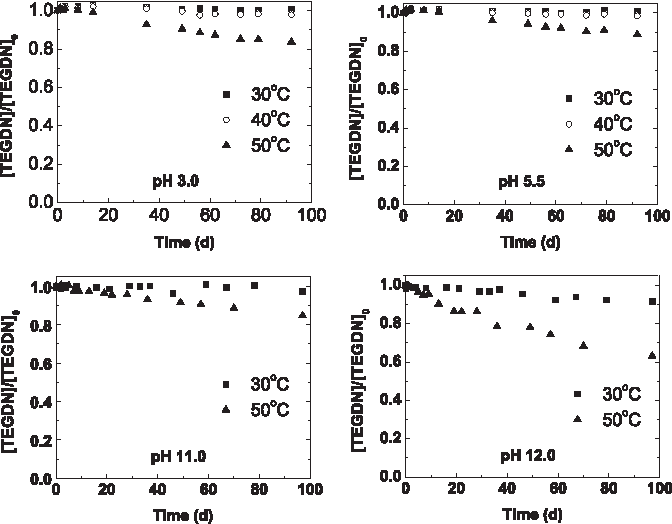
Hydrolysis of TEGDN in deionized water at various pH and temperatures (initial concentration of TEGDN: 50 mg L−1). TEGDN, triethylene glycol dinitrate.
k1, first-order rate constant calculated from linear regressions of first-order plots.
N.D., no data.
Transport and degradation of TEGDN in soil
Both batch and column experiments were conducted to assess the sorption and stability of TEGDN in soil. Two soils were used, that is, a sandy weakly acid soil with a low amount of organic matter (DRDC soil) and a soil containing significant amounts of clay and organic matter (WCL soil). The batch experiments carried out over 3 months allowed us to determine the extent and kinetics of sorption as well as the kinetics of degradation. As shown in Fig. 2, TEGDN barely sorbed onto DRDC soil and sorbed slightly to WCL, with corresponding Kd values estimated at 0.09 ± 0.03 and 0.78 ± 0.08 L kg−1, respectively. Normalizing these values relative to the organic carbon led to Koc values of 25 ± 9 L kg−1 (Log Koc = 1.40) and 33 ± 3 L kg−1 (Log Koc = 1.51), respectively. These values fall between the Koc values previously reported for EGDN (Log Koc = 1.28) (Burrows et al., 1989) and DEGDN (Log Koc = 2.00–2.08) (Haag et al., 1991). The similarity of the Koc values measured in DRDC and WCL soils indicates that the low sorption measured in both soils was mainly attributable to the organic matter with hardly any contribution from the clay present in WCL soil. If clay had contributed significantly to the sorption process, one would have observed higher Kd and Koc values in WCL soil. Although more sorption experiments have to be conducted to understand the sorption of nitrate esters on other soils, the sorption of TEGDN was governed by soil organic matter in the present experiments, in contrast to the nitroamines RDX and HMX for which sorption was governed by clay (Monteil-Rivera et al., 2003). In addition, the sorption of TEGDN onto both soils was a fast process as supported by the unchanged distribution between water and soil measured from 1 to 90 days (Fig. 2).
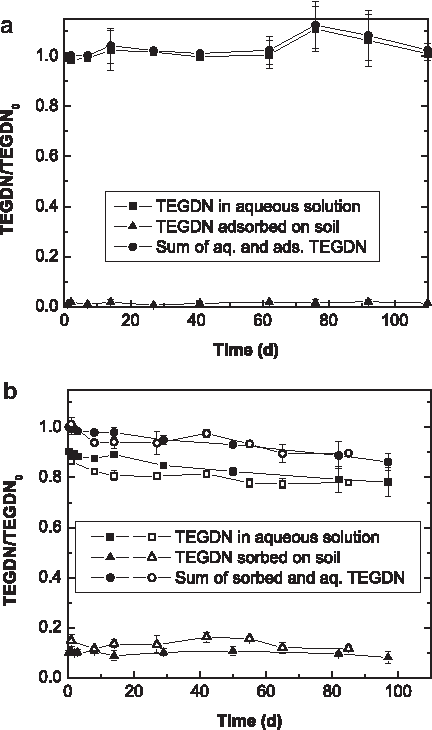
Distribution and recovery of TEGDN in
No loss of TEGDN was observed in nonsterile DRDC soil over 3 months, thus indicating the high stability of TEGDN in this soil as well as the absence of irreversible binding (Fig. 2a). TEGDN appeared to be slightly less stable in nonsterile WCL soil with a 14% mass loss after 3 months corresponding to a first-order degradation rate knonsterile WCL of 0.0015 day−1 (t1/2 = 463 days) (Fig. 2b). Conducting the same experiment with sterile WCL soil led to roughly the same disappearance rate (ksterile WCL= 0.0014 day−1) (Fig. 2b), thus suggesting that most of the degradation measured originated from an abiotic process. Given the absence of hydrolysis previously demonstrated under these conditions, it is possible that degradation of TEGDN in WCL soil was due to the presence of clay or reducing species such as Fe(0) or Fe(II). The WCL soil was deliberately chosen to favor higher sorption and degradation. The low Kd values and slow degradation measured in this soil let us predict a high stability and mobility of the nitrate ester in soils.
Breakthrough curves were plotted on a time basis from the column experiments conducted with TEGDN and chloride ion in the two soils (Fig. 3). Chloride ion was used as a tracer due to its low affinity with soils. The breakthrough curve of TEGDN in DRDC soil was superimposed on the tracer curve, indicating an absence of sorption of the nitrate ester in this soil. This observation is consistent with the very low Kd value determined in the batch experiments. In WCL soil, TEGDN exhibited a little retardation consistent with the higher Kd value determined in the batch experiments. The high stability of TEGDN in DRDC soil was confirmed by the quantitative recovery (100.8%) of the chemical obtained in the aqueous eluates. For WCL soil, a slightly lower recovery (96.4%) was measured that may be partially due to the above-mentioned abiotic process. Like the batch experiments, the column experiments predict a high stability and mobility of TEGDN in soils.

Breakthrough curves for TEGDN on DRDC
Photolysis of pure TEGDN
Recently, chunks of 2,4,6-trinitrotoluene (Taylor et al., 2009) and Composition B (Walsh et al., 2010) were reported to photodegrade at the solid surface into products that were washed off with rain. The particles of propellant formulations that set on soil surfaces will most likely be exposed to sunlight before being actually dissolved or contacted with water. As a consequence, it is important to know if the chemical can photodegrade in the absence of water. To this aim, pure TEGDN was exposed for 10 days to artificial sunlight using a solar simulator (total irradiance 590,000 mW m−2). At the end of exposure, the reaction medium was diluted in water or water/CH3CN and analyzed for various products. A TEGDN loss of 27% was measured after 10 days corresponding to a rate of 0.031 day−1 that confirmed that the nitrate ester can degrade under solar irradiation even in the absence of water. Photolysis of 1 mol of TEGDN was accompanied by the formation of 0.18 mol of nitrate, 0.18 mol of formate, 0.05 mol of nitrite, 0.03 mol of glyoxalate, 0.02 mol of formaldehyde, and 0.02 mol of glycolate. In addition, other products were detected by HPLC-UV after derivatization with DNPH (Fig. 4). Glyoxalate (

High-performance liquid chromatography/UV chromatogram extracted at 360 nm after derivatization with DNPH obtained after irradiating pure TEGDN for 10 days with simulated solar light. Identification of compounds is provided in Table 3.
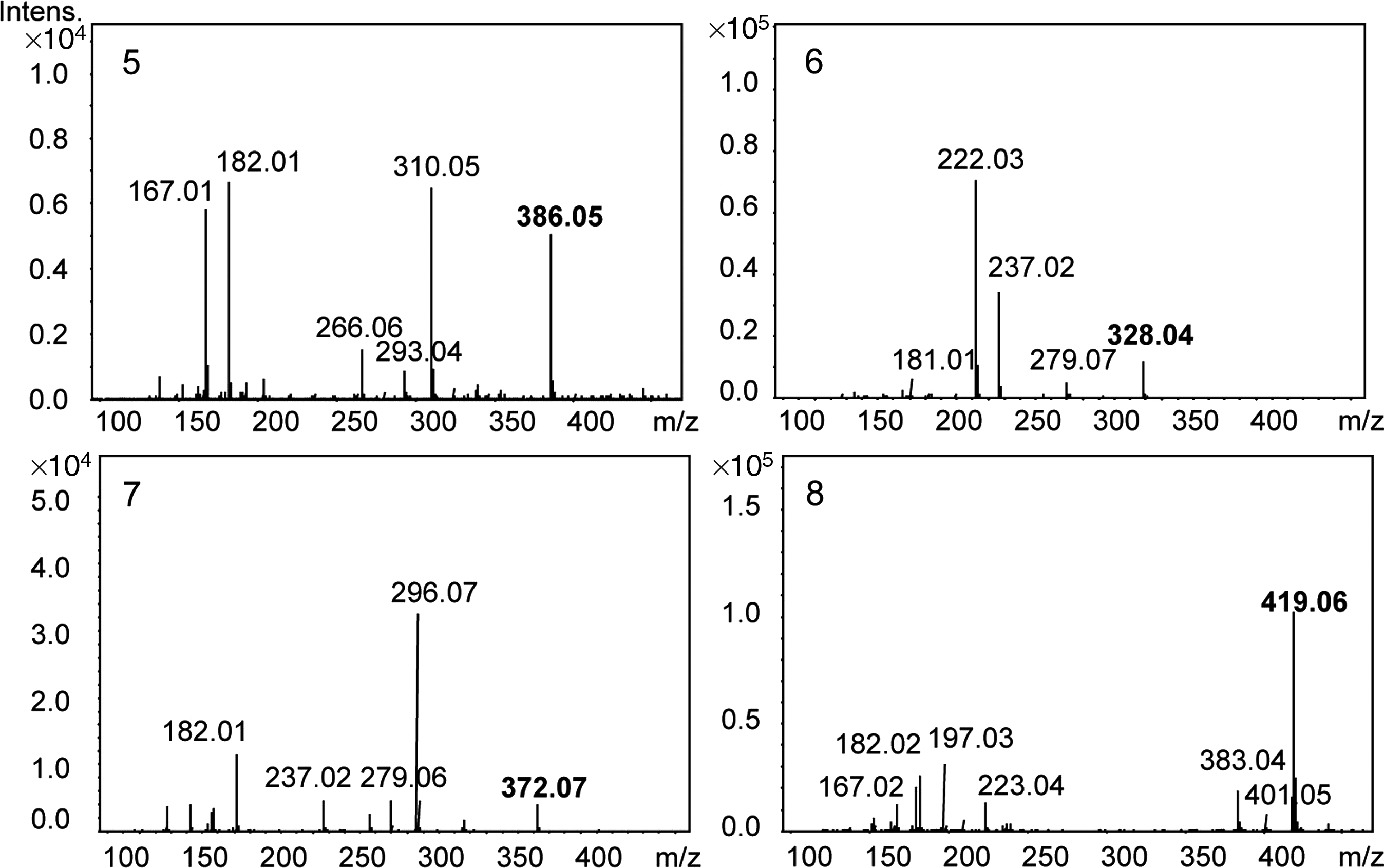
Negative-ion ESI spectra of photolysis products of TEGDN derivatized with DNPH. Compounds numbers are given in this figure and Table 3.
m/z for [DNPH derivative of M–H]−.
Singly (3a) and doubly (3b and 3c) derivatized glyoxal.
MW, molecular weight.
Quantified products (nitrate, nitrite, formate, formaldehyde, and glycolate) only accounted for 12% of the nitrogen and 5% of the carbon; however, several reactions can take place in the dry state that may explain these low mass balances. In particular, nitrite or nitrate radicals can form gaseous nitrogenated species that escape and thus lead to a loss of nitrogen. On the other hand, glycolaldehyde, formic acid, or other hydroxyl-containing molecules can condense with glyoxal and/or formaldehyde to form polymers as supported by the detection of chemical
Photolysis of TEGDN in water
Photolysis experiments were also conducted in water using the same solar simulator to estimate the extent of TEGDN photodegradation in water once it has dissolved from the solid. Figure 6 gives the time course for TEGDN photodegradation in deionized water under artificial solar irradiation. The reaction followed a first-order kinetics with a rate constant khν of 0.049 day−1, corresponding to a half-life of 14 days. This rate is very close to the summer photolysis rate that had been estimated for DEGDN (t1/2 = 15 days) using outside aqueous experiments in combination with an actinometer (Haag et al., 1991), thus suggesting a similar initial reaction for both chemicals. This rate is, however, significantly lower than the rate we measured for the two nitroamines, HMX (t1/2 = 1.8 days), or nitroguanidine (t1/2 = 0.5 day), under similar irradiation conditions (results not shown). Alkyl nitrates and nitroamines are known to photolyze through the initial cleavage of the RO-NO2 or RN-NO2 bond, respectively (Calvert and Pitts, 1966; Hawari et al., 2002). The observed kinetics can be explained by the higher energy required to form radicals from the O-N bond compared to the N-N bond. Although slower than for nitroamines, the photolysis of TEGDN was still much faster than the rates determined herein for hydrolysis or degradation in soil, thus indicating the preponderance of this process in surface waters.
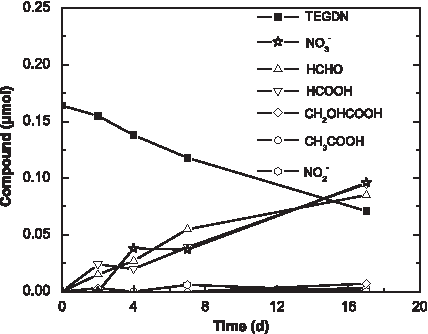
Time course for photodegradation of TEGDN (7.8 mg L−1) in deionized water.
The removal of TEGDN during photolysis in water was accompanied by the concurrent formation of nitrate, formate, formaldehyde, and traces of 2 C molecules, including glycolic and acetic acid (Fig. 5). Traces of the nitrite ion were also detected but only in some of the samples. Previously, nitrite, nitrate, and formic acid were also reported to be the major products of DEGDN photolysis in water (Haag et al., 1991), and similarly to our results, nitrate was formed in larger amount than nitrite. Direct nitrate release from DEGDN was suggested by Haag et al. (1991) rather than indirect formation through the photolysis of nitrite. In a control experiment run under similar conditions, nitrite was found to photo-oxidize to nitrate at a rate of 0.382 day−1, which would not let us detect nitrite if it was formed. From the present experiment, one cannot conclude without uncertainty whether nitrate ions were formed directly or through nitrite release and subsequent photolysis. After 17 days of irradiation, TEGDN photolysis gave roughly one molar equivalent of nitrate, one molar equivalent of formaldehyde, and one molar equivalent of formate per mole of TEGDN degraded. Chemicals
Conclusion
We measured several environmental physicochemical parameters, including the aqueous solubility, the octanol–water distribution coefficient, and soil sorption coefficients for TEGDN. The high solubility of TEGDN in water (7,430 mg L−1 at 25°C) and its low Kow (6.2) and Kd (<0.79) values suggest that TEGDN will be very mobile in soils. The transformation of the chemical was also monitored under various environmental conditions. Hydrolysis was found to be too slow to be measured at 30°C between pH 3 and 11, indicative of a high resistance of the chemical to hydrolysis. Some abiotic degradation was measured in the clay-rich soil used but was also very slow. Photolysis was the fastest process among those tested with a degradation rate in water of 0.049 day−1 (t1/2 = 14 days). Interestingly, photolysis of TEGDN also occurred in the absence of water. Under both wet and dry conditions, photolysis took place via monodenitration and led to the formation of formaldehyde, formate, and nitrate as the main products along with traces of nitrite and other 2 Cs compounds. In the absence of water, the 1 and 2C(s) compounds tended to condense to polymers.
Footnotes
Acknowledgments
Dr. Roman Kuperman from Edgewood Chemical Biological Center (ECBC) is thanked for providing us with a sample of WCL soil. Pascal Bougie from General Dynamics is thanked for providing us with a sample of TEGDN. Chantale Beaulieu, Stéphane Deschamps, and Alain Corriveau from BRI are thanked for their assistance in the HPLC analyses of various products. The present research was supported by the Director General Environment, DND, Canada.
Author Disclosure Statement
The authors declare that no competing financial interests exist.