




Abstract
Abstract
This article presents a bench-scale experimental study performed to investigate the remediation of low permeability clay soil contaminated with pentachlorophenol (PCP), Lindane, and dinitrotoluene (DNT) using electrokinetic technique. Three bench-scale electrokinetic experiments were conducted on kaolin soil. In each test, the soil was spiked with one of the following contaminants: PCP, Lindane, and DNT at target concentrations of 100, 500, and 1,000 mg/kg, respectively. The applied voltage gradient across the soil in each test was 1 volt direct current (VDC)/cm for about 500 h. Extent of PCP, DNT, and Lindane destruction in the soil as a result of electrokinetics was ascertained. The study demonstrated that degradation of PCP, DNT, and Lindane occurred during electrokinetics without using any solubilizing or reducing agents in the flushing solution. Results showed that PCP, DNT, and Lindane were degraded by a direct electrochemical reductive process at the electrodes. Contaminant degradation across the soil ranged from 40% to 95%, 28% to 80%, and 26% to 60% for PCP, Lindane, and DNT, respectively. The effectiveness of the electrochemical reduction of the contaminant during electrokinetics depended on the contaminant solubility and soil pH. Overall, this study demonstrated that electrokinetic technology has the potential to remediate chlorinated aromatic and nitroaromatic contaminants in low permeability soils by the direct reductive process.
Introduction
The conventional treatment of organic pollutants in soils includes incineration, landfilling, immobilization, thermal removal, or solvent extraction. However, these methods are relatively expensive, slow, or limited by the production of concentrated waste streams that pose disposal problems. Other methods such as soil washing, bioremediation, and thermal desorption methods have been used to treat organic contaminated soils (Cheah et al., 1998; Lee et al., 1998; Bonten et al., 1999; Chu and Kwan, 2003); however, such methods do not always yield satisfactory results, especially when applying to low permeability soils. Further, the presence of persistent organic contaminants in soils poses a challenge to remediation due to their nonionic nature and low solubility in water. Therefore, there is a need to develop an effective remediation method to clean up sites contaminated with persistent organic compounds.
Electrokinetic remediation has shown to have a great potential to decontaminate organic pollutants from low permeable soils under different conditions (Reddy and Saichek, 2004; Ribeiro et al., 2005; Isosaari et al., 2007; Niqui-Arroyo and Ortega-Calvo, 2007). In addition, the electrokinetic treatment has been recognized as an efficient in-situ process for the remediation of many soils contaminated with heavy metals (Alshawabkeh et al., 1999; Zagury et al., 1999; Page and Page, 2002; Sawada et al., 2004; Amrate et al., 2005; Deng and Jennings, 2006) and soils contaminated with both metals and organics (Maturi and Reddy, 2006; Reddy et al., 2009). The implementation of electrokinetic remediation involves inserting electrodes into the soil to encompass the contaminated/plume area and applying low electric potential across the electrodes. The electric potential induces the migration of contaminants toward the electrode by two primary transport processes, namely electromigration and electroosmosis (Reddy and Cameselle, 2009). Electromigration occurs in all soils, whereas electroosmosis is only significant in low permeability soils such as clay. On the other hand, electroosmosis is not significant in sandy soils, but contaminant mobilization can be enhanced by water/solvent flushing.
To date, very few studies have investigated the application of the electrokinetic treatment on soils contaminated with PCP (Ross et al., 1997; Kim et al., 2000; Reddy and Karri, 2008) and DNT (Khodadoust et al., 2006). In such studies, however, solubilizing and/or oxidizing/reducing agents were used to enhance the contaminant removal from the soil. In addition, no studies have investigated the potential of electrokinetics to treat clay soils contaminated with Lindane without enhancements. The aim of this study was to investigate the potential of the electrokinetic system for the effective remediation of PCP-, DNT-, or Lindane-contaminated clay soil. In particular, the study has been directed to ascertain the extent of PCP, DNT, and Lindane destruction in the soil as a result of electrokinetics in the absence of solubilizing agents such as surfactants and cosolvents or oxidizing/reducing agents such as hydrogen peroxide, permanganate, persulfate, and nanoscale zero-valent iron. Bench-scale electrokinetic experiments were conducted using kaolin soil spiked with one of the following contaminants: 100 mg/kg of PCP, 500 mg/kg of Lindane, and 1,000 mg/kg of DNT. All tests were performed with an applied voltage gradient of 1 VDC/cm. The experimental results helped assess the extent of degradation and removal of the contaminants under applied electric potential.
Materials and Methods
Materials
Table 1 shows the mineralogy and properties of the kaolin soil used in this investigation. Kaolin basically consists of the kaolinite mineral and it has a hydraulic conductivity of 1 × 10⁻⁸ cm/s. Kaolin is often used for electrokinetic laboratory experiments, because it has a low organic content, is fairly nonreactive, and has a low cation exchange capacity. In addition, the white color of kaolin enhances the visualization of any color changes due to chemical reactions that may occur during the electrokinetic process.
ASTM, American Society for Testing and Materials.
The contaminants used in this study were PCP, Lindane, and DNT. These organic contaminants were chosen due to the high environmental problems they pose. The source chemicals were obtained from Aldrich Chemicals (Milwaukee, Wisconsin). PCP is a highly chlorinated organic molecule (98% pure, C6HCl5O; molecular weight 266.3), and it has an aqueous solubility of 14 mg/L and a log Kow of 5.04 at 20°C (Sawyer et al., 2003). Lindane (1,2,3,4,5,6-Hexachlorocyclohexane) with γ-isomers of 97% purity was used (molecular weight 290.8). Lindane has a water solubility of 7.5 mg/L and a log Kow of 3.72 at 20°C (Sawyer et al., 2003). 2,4-DNT (CH3C6H3(NO2)2) with 97% purity was also used in this study. DNT has an aqueous solubility of 270 mg/L and log Kow of 1.98 at 25°C. In addition, electrolyte flushing solution was used in the experiments to simulate groundwater conditions. This was done due to the fact that the use of deionized water would not represent pore water composition in real-world soils. The chemical composition and properties of the electrolyte solution used are shown in Table 2. The electrolyte solution consisted of 0.006 M NaHCO3, 0.002 M CaCl2, and 0.001 M MgCl2.
Electrokinetic test setup
The electrokinetic test setup used in this study simulated one-dimensional transport of contaminants under an induced electric potential. The schematic diagram of the electrokinetic test setup used in this study is shown in Fig. 1, and it is described in detail by Reddy et al. (2009). The setup consisted of an electrokinetic cell, two electrode compartments, two electrode reservoirs, a power source, a multimeter, flow control valves, and gas vents. The electrokinetic cell was made of Plexiglas and had an inside diameter of 3.8 cm and a length of 13.5 cm. The setup also incorporated two graphite electrodes, two porous stones, filter papers, and tubing. The electrode reservoirs were made of Plexiglas, and they were connected to the electrode compartments using Tygon tubing. Gas vent ports were provided in the electrode compartments to allow gases resulting from the electrolysis reactions to escape. Tubing was attached to gas vent ports to collect any liquid (condensate) that was removed along with the gases.
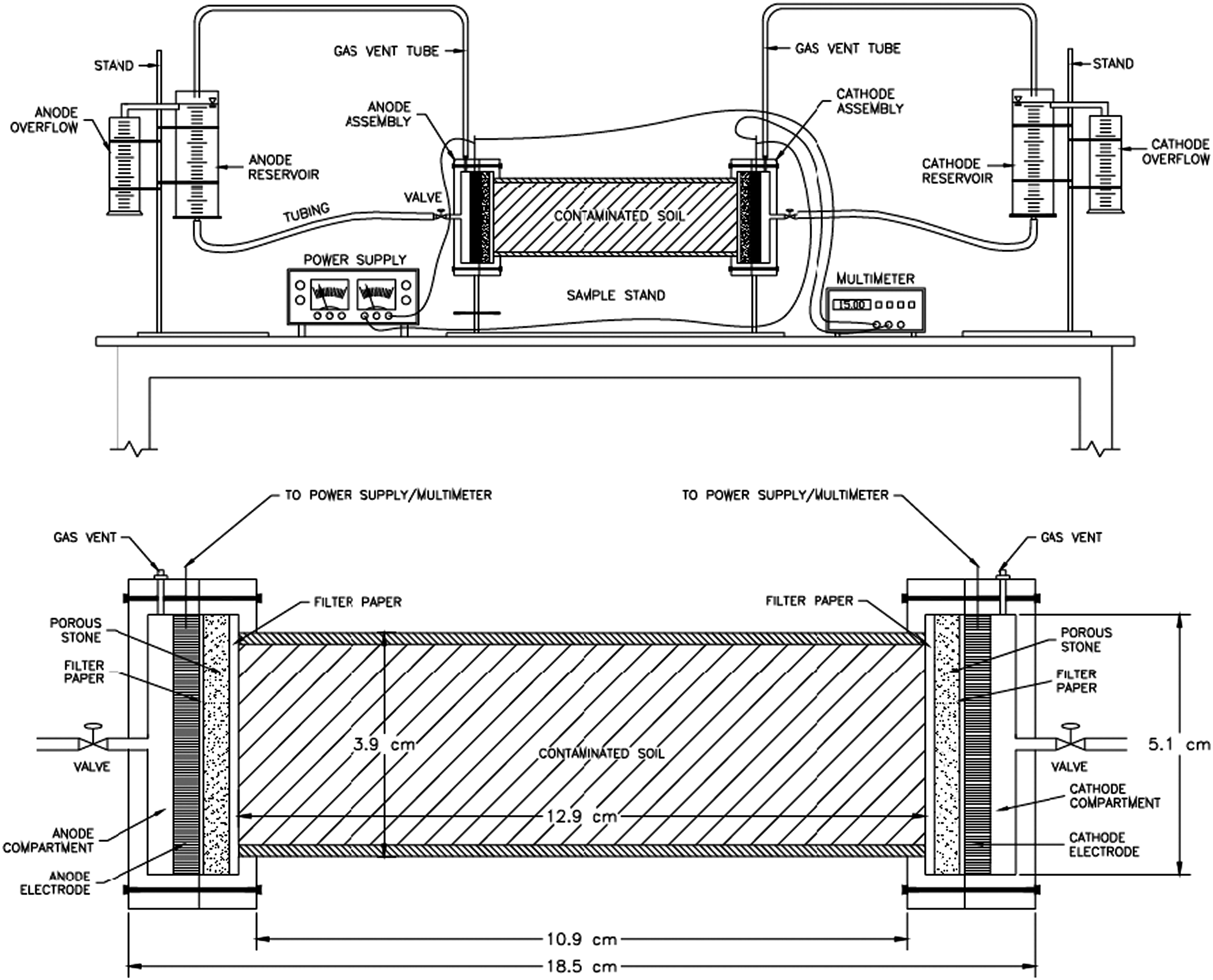
Schematic diagram of electrokinetic set-up.
Testing procedure
Three electrokinetic experiments were conducted in this study using kaolin soil spiked with one of the organic contaminants: PCP, Lindane, and DNT with target concentrations of 100, 500, and 1,000 mg per 1 kg of dry soil, respectively. These levels of concentrations represent typical concentration of PCP, Lindane, and DNT in the field. Each test was performed under an applied voltage gradient of 1 VDC/cm. In each electrokinetic test, the designated contaminant was dissolved in 600 mL of hexane before addition to the soil. Hexane was used due to the low solubility of the selected contaminants in water. The soil-hexane-contaminant mixture was well stirred and homogeneously blended. Afterward, the mixture was placed beneath a ventilation hood for a week and stirred every day until the hexane completely evaporated and the contaminated soil was dry. All mixing operations were performed in glass beakers with stainless steel spoons. A sample was taken for the initial analysis of contaminant concentration in the soil as a portion of the contaminant volatilizes along with the solvent (hexane). After the contaminated soil was dry, the soil was mixed with electrolyte solution to achieve a moisture content of around 35% (w/w). The moist contaminated soil was then placed in the electrokinetic cell in layers and uniformly compacted using a stainless steel rammer. The soil was allowed to equilibrate for a week before applying the voltage gradient. The exact weight of soil used in the cell was determined for each experiment to assure the accuracy in the contaminant removal results and mass balance. Electrolyte solution was used to fill the reservoir at both the anode and cathode reservoirs for 24 h for saturation (Table 2). The liquid level in both reservoirs was maintained constant at the same level throughout the testing to assure that no hydraulic gradient existed across the soil specimen. The electrodes were then connected to the power supply, and a constant voltage gradient of 1 VDC/cm was applied to the soil sample. The current, voltage, and volume of solution at both ends were measured at specific time intervals. The experiments were performed for over 500 h at room temperature. At the completion of each test, aqueous solutions from the reservoirs and the electrode compartments were collected and analyzed for PCP, Lindane, or DNT content. The soil specimen was divided into four equal sections and analyzed for contaminant concentration. In addition, pH, redox potential, and electrical conductivity (EC) of the soil sections were measured using a soil to water ratio of 1:1 as described in ASTM method D4972. The pH and redox potential were measured using an Orion pH-triode probe. The EC was measured using an EC glass probe.
Chemical analysis
The concentrations of PCP, DNT, and Lindane in the soil and effluent were determined using gas chromatography (GC) according to Environmental Protection Agency Method 8091 (USEPA, 1996). The PCP in various soil sections was extracted using 75% ethanol, DNT was extracted by acetone and acetonitrile (1:1 v/v), and Lindane was extracted using 100% acetone for 24 h (Khodadoust et al., 1999, 2006). The extraction soil-to-solvent ratio was 1:5 (g:mL). The soil extracts were centrifuged at 7,000 rpm for 10 min. The liquid extracts were diluted in ethanol. Deionized water was added to the diluted ethanol samples, and hydrochloric acid or sodium hydroxide was added to the water-ethanol dilutions. Liquid-liquid extraction was performed to transfer the organic compounds from the diluted aqueous water-ethanol phase into hexane phase for GC analysis. For GC analysis, 1-chloro-3-nitrobenzene was used as surrogate standard. For PCP 60 μL of tribromo, phenol was used as the standard, whereas 125 μL of tetrachloro-o-oxylene was used for Lindane. The hexane extracts were injected into an Agilent 6890 Series GC (Wilmington, DE) with a microelectron capture detector for analysis of PCP and Lindane, whereas flame ion detector was used for the analysis of 2,4-DNT. A DB-5 (J&W, Folsom, CA) capillary GC column was used with helium and argon-methane as column carrier and detector makeup gases, respectively (Khodadoust et al., 2006).
Results and Analysis
Electric current and electroosmotic flow
Figure 2 shows the changes in the electrical current that occurred during the electrokinetic experiments. For all tests, current increased rapidly on the first day of the testing and then started to stabilize thereafter. The results show that the test with DNT attained the highest peak current followed by Lindane and then PCP, which were, respectively, 15, 11, and 9 mA. The current then dropped to about 3 mA after 48 h of testing and then stabilized between 0.1 and 1 mA throughout the rest of the experiment. Overall, the current with the Lindane test was slightly higher than the tests with PCP and DNT. The initial high current is attributed to increased mobility of ions in the soil as a result of dissolution of salts (Mitchell, 1993; Reddy and Karri, 2008). During the process, H+ and OH− ions are generated at the anode and cathode due to electrolysis, respectively. The presence of more ions will increase mobility in soil, and constant production of H+ ions at the anode will also help increase the current. The ions generated migrate toward the electrodes due to the processes of electromigration and electroosmosis. The migration of ions will deplete the amount of mobile ions present, resulting in the reduction/lowering of the current. This phenomenon explains why the current tended to reduce from about 9–15 mA to 0.5 mA with time, as the initial amount of ions present reduced with time.
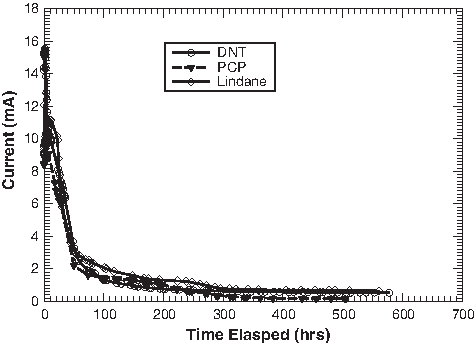
Variation of current with time during elecrokinetic treatment.
The cumulative electroosmotic flow for each test is shown in Fig. 3. The results show that the flow rate in all tests increased with time initially and then decreased. The electroosmotic flow is a function of several factors such as electric field strength, zeta potential, dielectric constant, pH of the system, and fluid viscosity. High flow was relatively observed with the test involving Lindane, followed by the test with PCP, and then DNT. The respective accumulative flow at the end of the tests is 165, 145, and 100 mL for the tests with Lindane, PCP, and DNT, respectively. The electroosmotic flow of all three experiments continuously decreased with time. The initial high flow rate was a result of initial high currents in all tests; however, the flow rate reduced with time as current dropped. The decrease in mobility of ions resulted in a decrease in current, which, in turn, resulted in a reduction in flow rate. Moreover, the soil pH reduction as a result of the electrokinetic process reduces the soil surface potential, which, in turn, reduces the electroosmotic flow. Further, the soil surface potential will shift from a negative to a positive value when the soil pH gets below the kaolin zero point of charge (i.e., 2.8), reversing the direction of the electroosmosis (Al-Hamdan and Reddy, 2005).

Variation of electroosmotic flow with time.
Soil pH, redox potential, and EC
Figures 4–6 show the pH, oxidation-reduction potential (ORP), and EC, respectively, of soil sections for all three tests after the electrokinetic treatment. Also, the pH and ORP values of the anode and cathode reservoir solutions at the end of testing for all tests are shown in Table 3. In all tests, a sharp pH gradient in soil can be seen from anode to cathode. The soil pH was reduced from an initial value of 4.9 to approximately 2.4–3.5 in the first three sections near the anode. However, the pH increased to 5.5–5.8 in section 4 for all tests except for the test with DNT (i.e., 8.8). These pH changes indicate that the hydrogen ions generated at the anode by the water hydrolysis migrated as an acid front up to section 3, whereas hydroxyl ions generated at the cathode migrated as a base front up to section 4. Since the mobility of the hydrogen ion is higher than the hydroxyl ion and the hydroxyl ion electromigrates in the opposite direction of flow, acid-front migration into the soil occurred faster than base-front migration (Acar and Alshawabkeh, 1993). In addition, the acid-buffering capacity of kaolin is very low, thus facilitating the acid-front migration to occur faster.
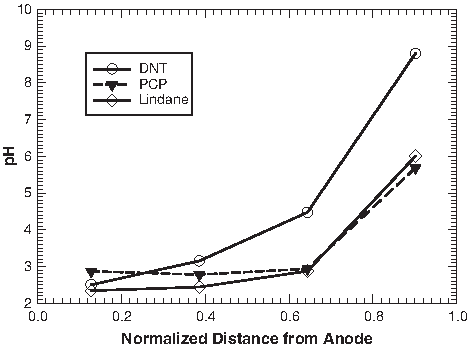
Distribution of soil pH after electrokinetic treatment.
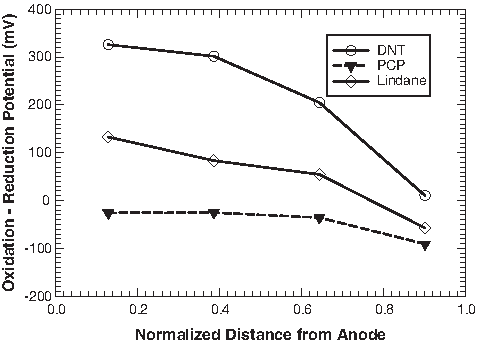
Distribution of soil oxidation-reduction potential after electrokinetic treatment.

Distribution of soil electrical conductivity after electrokinetic treatment.
Due to the electrolysis reactions, the electrons are taken away from the anode causing oxidizing conditions, whereas the electrons are pushed into the cathode causing reducing conditions. In general, when the redox potential (oxygen-reduction potential) is above 200 mV, the system is considered slightly oxidizing, and when it is above 800 mV, it is considered highly oxidizing. Further, when the redox potential is below 200 mV, it indicates slightly reducing conditions, and when it gets below 100 mV, it is considered a highly reducing environment (Sposito, 1989). Figure 5 shows the redox potentials measured in the soil in all three tests after the electrokinetic treatment. As shown in Fig. 5, reducing conditions existed throughout the soil in all tests, except in the test with DNT where a slightly oxidizing condition was in the region close to the anode. However, the variations of redox in the soil decreased from the anode region to the cathode region. The test with PCP showed the lowest (most reduced) system among all tests. The results also showed that highly reducing environment existed in the cathode reservoir in all tests (Table 3). In the anode reservoir, however, highly reducing environment was detected in the tests with PCP and Lindane, whereas a lightly oxidizing condition was detected in the test with DNT.
Figure 6 shows the EC of the soil sections after the electrokinetic treatment for the three tests performed. The EC indicates the amount of dissolved ionic species, and it depends on the ionic strength of the pore solution in the soils. The initial EC of the soil was approximately 1,600 μS/cm, and the EC of the soil was reduced throughout the soil for all tests except for the one with Lindane in the section closest to the anode. However, the reduction in EC values was higher near the cathode than near the anode in all tests. The conductivity of a system depends on the concentration of ions present, their charge, and ability to dissociate. The higher conductivity close to the anode might be due to the lower pH. This is because at lower pH, more H+ ions are produced that will result in higher EC. Also, the presence of OH− anions might lower the conductivity, as they have the capability of forming compounds with other ions.
Degradation of PCP, lindane, and DNT
Figure 7 shows the distribution of PCP, Lindane, and DNT in soil at the conclusion of the electrokinetic experiments. The amount of PCP was low in all tests, but varied across the section from anode to cathode. The results show that the amount of PCP was low near the anode, which gradually increased toward the third section and decreased near the cathode. The respective percentages of PCP remaining in the soil after electrokinetic treatment at sections 1, 2, 3, and 4 (from anode to cathode) are 8.9%, 41.9%, 59.3%, and 4.95%, respectively. These results suggest that PCP was transported from the anode region to the cathode region by electro-osmotic flow. The transport of PCP is solubility dependant, and studies have shown that solubility increases with an increase in pH (Arcand et al., 1995). Just after the application of the voltage gradient, the pH in the soil was still relatively high, causing the transport of soluble PCP toward the cathode. However, after some time, the pH at the anode region reduced, which, in turn, reduced solubility, thereby resulting in the decrease in mobility of PCP. Since further transport was limited from the anode, most of the PCP concentrated in the third section. However, the high pH conditions near the cathode region allowed continuous depletion of PCP from section 4 into the cathode reservoir. A small amount of PCP was detected in the cathode reservoir at the end of the electrokinetic treatment. This indicates that there was a direct electrochemical reduction of PCP at the cathode where electrons are donated for the reduction to take place. Moreover, the electrons donated to the PCP cause electrochemical reductive dechlorination of one or more of the halogenated chlorines (Ross et al., 1997). The reaction pathway of the PCP reduction may follow the suggested scheme proposed by Ross et al. (1997) as shown in Fig. 8. According to their proposed mechanistic scheme, the electrode process is the reduction of a proton rather than of PCP. After initial acid dissociation of PCP (reaction 1) and trace water (reaction 2), the reduction of protons yields an adsorbed layer of hydrogen on the electrode surface (reaction 3), which can then mediate the reduction of both PCP and its partially dechlorinated products, giving a mixture of chlorinated phenols and regenerating a proton for each released chloride ion (reaction 4) (Ross et al., 1997).

Contaminant distribution in soil after electrokinetic treatment.
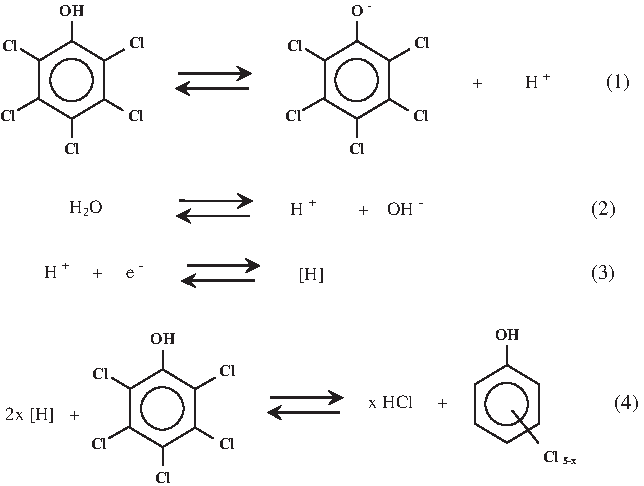
Reaction pathway for the electrochemical reductive dechlorination of pentachlorophenol (Ross et al., 1997).
The Lindane distribution in the soil after electrokinetic treatment is also shown in Fig. 7. The results show that the amount of Lindane was the lowest near the cathode after electrokinetic treatment. The respective percentages of Lindane remaining in the soil after treatment at sections 1, 2, 3, and 4 (where 1 is near the anode and 4 near the cathode) are 42%, 67%, 72%, and 20%, respectively. The amount of Lindane in soil was high in the first three sections of the column and decreased near the cathode. The variability of residual Lindane across the soil column may be due to the varied soil pH in the soil, which affects the solubility of Lindane. As mentioned earlier, the application of voltage potential results in lower soil pH at sections 1, 2, and 3 (1 is near the anode) and higher soil pH at the cathode region (section 4), increasing Lindane solubility at the cathode region. Thus, more Lindane is transported from the soil near the cathode toward the cathode reservoir. However, similar to PCP, a negligible amount of Lindane was detected in the cathode reservoir at the end of the electrokinetic treatment. This could be attributed to the direct electrochemical reductive dechlorination of Lindane that was transported into the cathode where electrons are donated for the reduction to take place. The electrochemical reduction of Lindane is a six-electron process whereby Lindane is quantitatively transformed into benzene as shown in the following reaction (Beland et al., 1976):
In addition, the degradation of Lindane might be increased due to the hydrolysis of the compound. The hydrolysis degradation could be formed by loss of HCl with the formation of a double bond (i.e., dehydrohalogenation) or by displacement of Cl− by OH− followed by dehydration (Solomons, 1986). According to Kubatova et al. (2002), the major reaction pathway for Lindane is dehydrohalogenation to form trichlorobenzenes followed by subsequent hydrolysis and hydride/chloride exchange to form chlorophenols, lower chlorobenzenes, and phenol as the major final product. Moreover, the hydrolysis of Lindane increases with the increase of system pH (Ngabe et al., 1993). Thus, the degradation of Lindane increases in the soil region near the cathode where high pH conditions exist as a result of electrokinetics.
Similarly, the distribution of DNT retained in the soil after the test is shown in Fig. 7. The amount DNT degraded in the soil varied from section to section. The percentages of DNT retained in the soil at the end of the experiment were, respectively, 43%, 74%, 73.9%, and 37.2% for sections 1, 2, 3, and 4, where section 1 is near the anode and section 4 is near the cathode.
These results suggest that DNT was transported from the anode region to the cathode region by electro-osmotic flow. However, since further transport of DNT was limited from the anode region as a result of pH drop, most of the DNT concentrated in the midsections. On the other hand, more DNT was carried by electro-osmotic flow from the soil near the cathode (section 4) where high pH conditions existed, making its way to the reservoir. However, only a small amount of DNT was detected in the cathode reservoir at the end of the electrokinetic treatment, indicating that electrochemical reduction of DNT had occurred. The ORP results in the DNT test showed that the cathode is at a reducing state, which confirms the favorable conditions for the reduction to occur. The reaction pathway of DNT reduction may follow the suggested scheme proposed by Doppalapudi et al. (2002) as shown in Fig. 9. As seen in Fig. 9, the electrochemical reduction of DNT may yield products such as 4-amino-2-nitrotoluene, 2-amino-4-nitrotoluene, and diaminotoluene (DAT). The mechanism is the reduction of the nitrogroup to the hydroxylamino group by a combination of electronation-protonation and electrocatalytic hydrogenation process in which water functions as a convenient source of chemisorbed hydrogen (Velin-Prikidanovics and Lessard, 1990). The following reaction takes place at the surface of the anode and cathode electrodes, respectively:
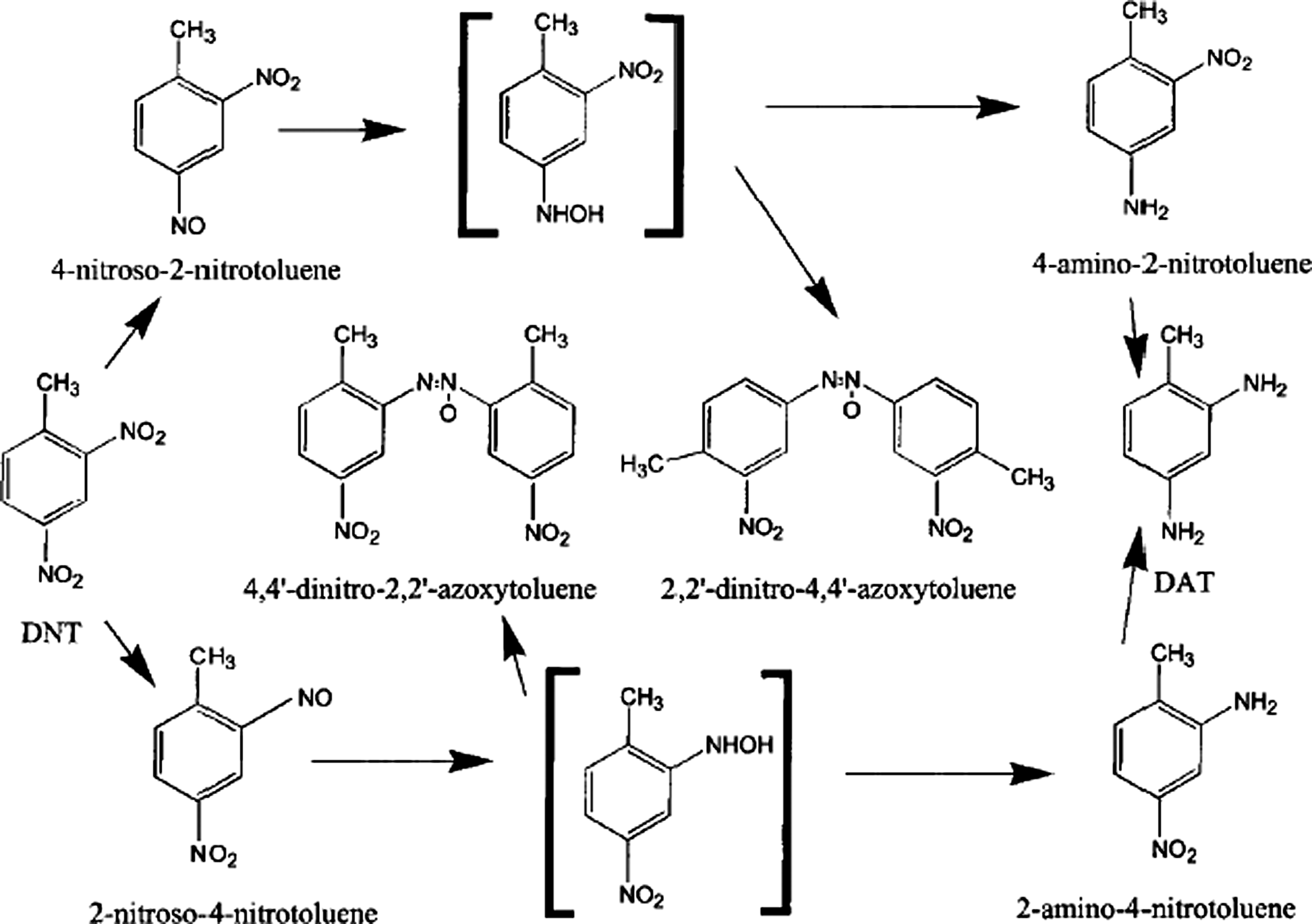
Reaction pathway for the electrochemical reductive of dinitrotoluene (Doppalapudi et al., 2002).
Thus, the overall conversion of DNT to DAT may occur by an electrocatalytic hydrogenation mechanism as summarized by the reactions below, where M is the surface of the electrode, M(H) represents chemisorbed hydrogen generated at the surface of the electrode by the reduction of protons, and M(DNT) and M(DAT) are the adsorbed starting material and product, respectively.
The overall degradation and removal of PCP, DNT, and Lindane are shown in Fig 10. The difference between the initial contaminant mass in the soil and the sum of the contaminant mass found in the effluent and the soil after the treatment was attributed to degradation. The results show that the overall degradation percentages with regard to the initial contaminant mass in the soil were 59%, 43%, and 40% for PCP, Lindane, and DNT, respectively. The higher degradation of DNT compared with that of PCP and Lindane may be attributed to the relatively high aqueous solubility of DNT, causing more DNT to reach the electrode and then undergo electrochemical transformation. Although Lindane solubility (14 mg/L) is higher than that of PCP (7.5 mg/L), more Lindane mass was degraded than PCP. This could be attributed to the additional destruction of Lindane as a result of the hydrolysis process at the region of high pH besides the electrochemical reduction process. The variability destruction of PCP, Lindane, and DNT shows that the effectiveness of electrochemical degradation depends on the type and concentration of compound present. Moreover, the contaminant solubility, soil pH, and contaminant ability to transport through the soil to the electrodes have a greater impact on the electrochemical transformation of contaminants during electrokinetics.

Overall degradation, removal, and residual contaminant mass after electrokinetic treatment.
Conclusions
Soils contaminated with persistent chlorinated aromatic and nitroaromatic organic pollutants are rampant in our environment, and this study investigated the use of the electrokinetic system to clean up such contaminants in low permeability kaolin soil. Based on the results of the three experiments performed in this study using kaolin spiked with PCP, Lindane, and DNT, the following conclusions can be drawn:
Electrokinetic system can be directly used to remediate recalcitrant organic contaminants such as PCP, DNT, and Lindane. The process is possible due to direct electrochemical reduction at the electrodes. Degradation of PCP, DNT, and Lindane occurred without any reducing agents used in the flushing solution. Degradation depends on the type of the organic contaminant present, as differences in chemical properties such as solubility will affect the rate of degradation when using the electrokinetic system. The environmental conditions such as pH, permeability, and ORP in a contaminated media have to be well characterized, as they can each affect the degradation rate. Thus, the geochemical conditions are very important.
Overall, this study demonstrated that the electrokinetic system has the potential to effectively clean up organic contaminants from clayey soils by direct reductive process.
Footnotes
Acknowledgment
The authors are thankful to Amid Khodadoust for assistance in analytical testing.
Author Disclosure Statement
No competing financial interests exist.