







Abstract
Abstract
Conventional spectrophotometers that do not include an integrating sphere assembly do not account for scattered ultraviolet (UV) light in a water sample containing particles and can therefore overpredict absorbance. Water samples from the secondary effluent of a municipal wastewater treatment plant were monitored over the course of 1 year to determine whether the error introduced in UV absorbance measurements when neglecting scatter was significant. The error was interpreted in terms of UV fluence that would be calculated for varying path lengths of solution. The error ranged from 10% to over 90% and increased independently with total suspended solids and path length. Combination of increasing path length and total suspended solids, together, amplified the error. This study demonstrates that, in some situations, integrating sphere absorbance measurements may be warranted to minimize significant errors in estimated UV fluences; however, in other situations (e.g., short path lengths), conventional spectrophotometers may be sufficient.
Introduction
Scattering can be accounted for in measurements of UV absorbance by using a spectrophotometer with an integrating sphere attachment. The integrating sphere uses mirrors and reflective lenses to measure the amount of scattered light that otherwise would be considered absorbed. The principle of using an integrating sphere to reduce errors in UV absorbance measurements in the context of water and wastewater treatment has been previously reported (Linden and Darby, 1998; Christensen and Linden, 2003; Mamane and Linden, 2006); however, there is little information available on the magnitude of the potential errors under realistic treatment conditions and for specific purposes—for example, when using UV254 to calculate online UV doses, for the design of a new UV reactor, or for conducting collimated beam tests using that water. The purpose of this short communication was to provide data from a year-long study that illustrates the magnitude of such errors, so that practitioners may be better positioned to decide whether an integrating sphere assembly is necessary or not.
Materials and Methods
Municipal wastewater samples were collected 20 times over the course of a year from the effluent of a secondary clarifier at the Ashbridges Bay Wastewater Treatment Facility in Toronto, Canada. UV absorbance data (λ = 254 nm) were collected with a spectrophotometer (model CE3055; Cecil Instruments), equipped with a conventional accessory or a fixed 11° angle center-mounted integrating sphere accessory (Lapsphere). Total suspended solids (TSS) measurements were performed according to Standard Methods 2540-D (APHA, 2005) using 47-mm-diameter GF/C glass-fiber filters (Whatman International Ltd.).
Results and Discussion
Effect of TSS on UV absorbance
The effect of different levels of TSS on the UV254 absorbance measured conventionally and with the integrating sphere is shown in Fig. 1. The UV254 absorbance measured using the integrating sphere was consistently 10%–30% lower than when measured conventionally, demonstrating that the conventional measurements incorrectly attribute scattered light to absorbance. The difference between the two measurements tends to increase with TSS, indicating that the TSS particles, whose composition likely changed over the course of the year, nevertheless consistently contributed more to scattered light than to absorbed light. The absorbance of the TSS particles (per mg/L TSS) can be calculated as the difference between the slopes of the conventional and integrating sphere absorbance readings and averaged 0.0094 cm−1 per mg/L TSS (i.e., 0.0130 minus 0.0036). This suggests that the suspended solids in this secondary effluent are similar to highly reflective submicrometer alumina particles, which reportedly have an absorbance between 0.0089 and 0.0095 cm−1 per mg/L alumina (Mamane et al., 2006).

UV absorbance (254 nm) measured by conventional and integrating sphere spectroscopy versus TSS. Second axis: scattering albedo. Data at TSS = 22 mg/L not included in regression because of leverage. TSS, total suspended solids; UV, ultraviolet.
In the absence of reflective particles, the conventional and integrating sphere UV absorbance data will provide equivalent data as can be seen in the similar y-intercepts in Fig. 1 (∼0.12 cm−1). This was also confirmed by measuring the UV254 absorbance of the samples filtered through a 0.45 μm pore-size filter—and therefore free of suspended solids—with absorbance values between 0.11 and 0.14 cm−1, depending on the sample.
The scattering albedo is the ratio of UV light that is lost due to scatter, to the total amount of lost light (i.e., due to scatter + absorption). For this particular water, the albedo ranged between 15% and 53%, with most albedo values falling between 20% and 40% (Fig. 1). This range is consistent with the report by Mamane et al. (2006), who reported scattering albedo values between 20% and 30% for wastewater effluent samples. The albedo also increased with TSS (r2 = 0.47), suggesting that the particles contributing to higher TSS were more reflective than particles in the low TSS waters—perhaps indicating that they were inorganic (e.g., clay, alumina).
Effect of path length on error
UV254 absorbance measurements are used in a number of applications to determine UV fluence or dose. One such application is a collimated beam test to determine the inactivation kinetics of a microorganism when exposed to UV light. Collimated beam tests were conducted in a parallel study to this one, using methods described by Bolton and Linden (2003) and involving the same 20 water samples described earlier. The errors in calculated UV fluence during a collimated beam test that would result from measuring UV254 absorbance with a conventional spectrophotometer instead of one with an integrating sphere were determined (Fig. 2). The calculations show that for path lengths in the order of 1 cm, the scattering of UV light due to particles, if ignored, would result in the UV fluence experienced by the volume of water in the collimated beam tests being underestimated by >10% for most of the waters tested. As path lengths increase, the errors increase so that path lengths in the order of 6–8 cm yield errors in the range of 10%–60% for most samples (with the 22 mg/L TSS sample exhibiting a 90% error). In other words, for the waters sampled, collimated beam tests using UV254 absorbance measurements without an integrating sphere spectrophotometer would have significantly underpredicted the UV fluences, with the error increasing with the sample depth during the test. This result can be extrapolated to other UV fluence (or dose) calculations. For example, a sensor used to calculate UV dose for a reactor treating water containing particles similar to those in this study would underpredict the dose without an integrating sphere, with the error significantly increasing with path length. Sensors in medium-pressure UV reactors can often be many centimeters from the lamps, which can lead to relatively large errors according to Fig. 2.

Percentage of error in UV absorbance as a function of path length, for samples with different TSS.
The same data were also interpreted to more clearly establish the three-way relationship between error in calculated fluence for collimated beam tests, TSS, and path length (Fig. 3). As there is scatter in the data, a general trend of increasing error with increasing TSS for all path lengths shown is evident.
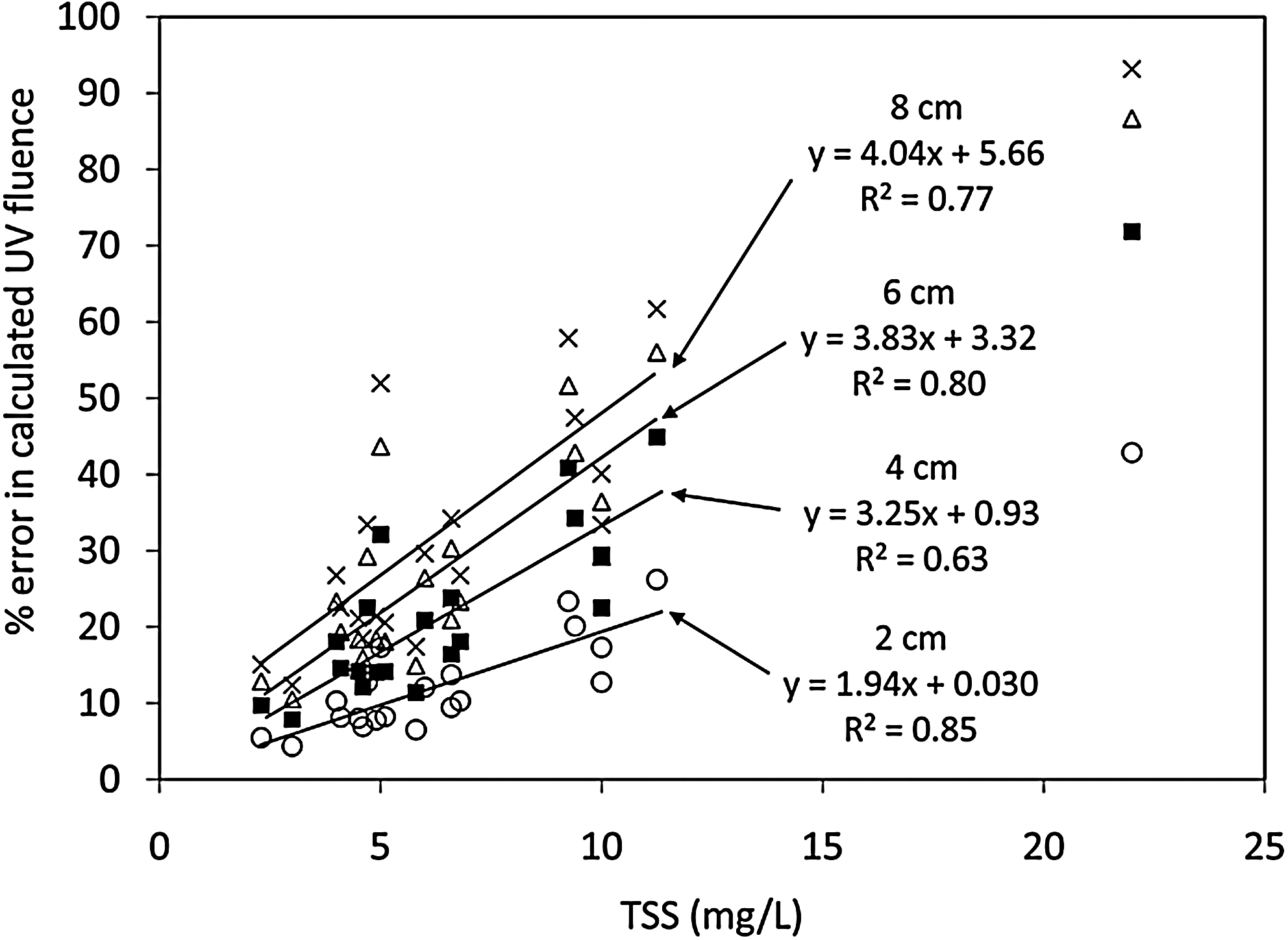
Percentage of error in UV absorbance as a function of TSS for different path lengths.
The slopes of the regression curves in Fig. 3 are the percentage error in calculated UV fluence per mg/L TSS for the path length shown. These slopes were then calculated for a range of path lengths up to 8 cm and plotted as function of path length in Fig. 4. This graph can be interpreted as indicating that as path lengths increase between the source of UV light and the (nonintegrating sphere) sensor, the error caused by scatter for each mg/L TSS increases.
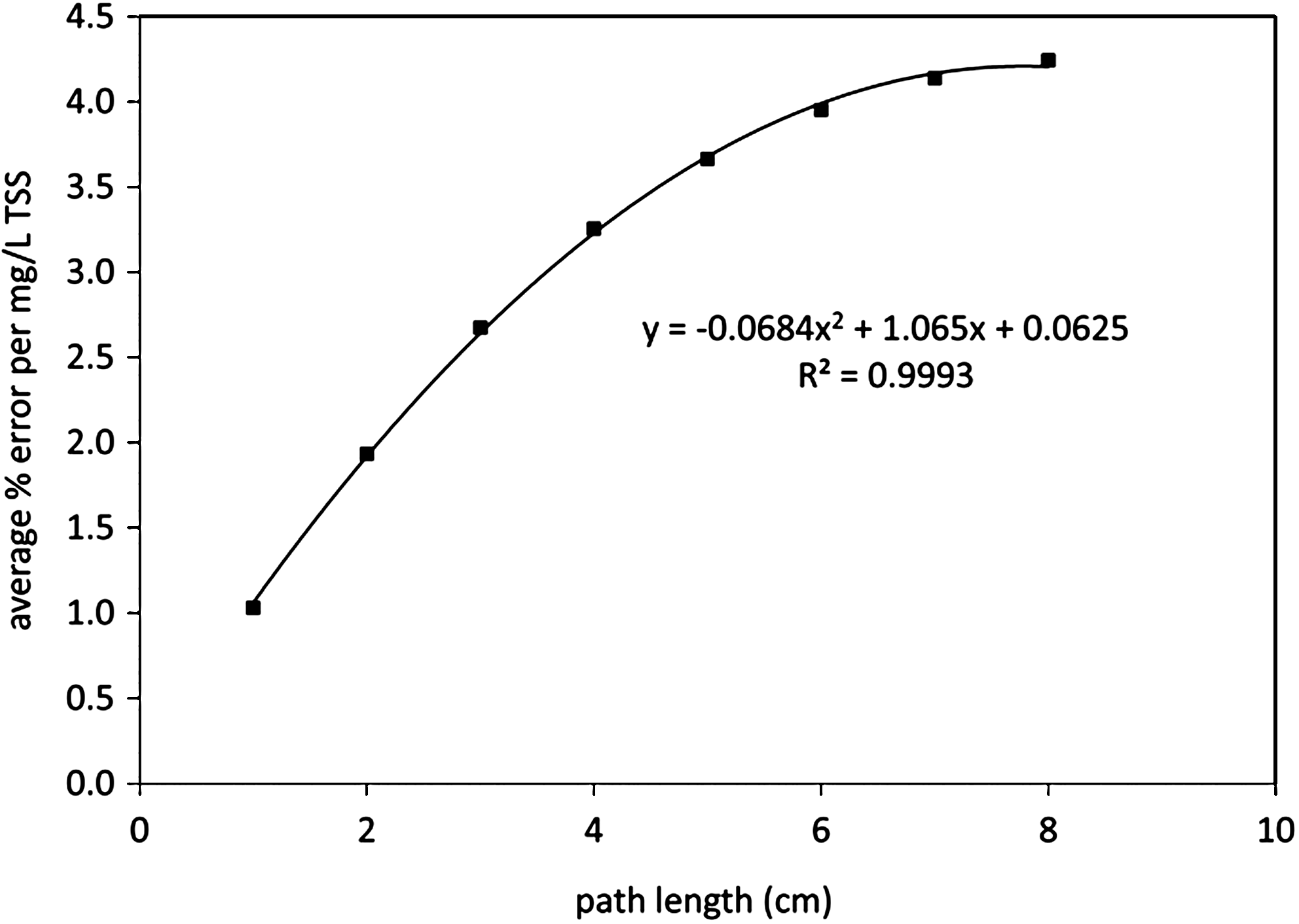
Effect of path length on the UV absorbance error observed per mg/L TSS.
Relevance and case study
The overestimate of UV absorbance based on conventional absorbance measurements in waters containing particles can affect UV systems in important ways. The sizing of a UV reactor during the design stage is based on the UV absorbance of the secondary effluent. As the conventional UV absorbance measurements are higher than the integrating sphere measurements, UV absorbance data acquired with a conventional spectrophotometer will result in an overly conservative UV reactor design. In this study, a TSS of 9.3 mg/L led to a 0.12 cm−1 overestimate of UV254 absorbance. According to Cotton et al. (2001), such an overestimate in UV absorbance, if carried through design and operation, could result in a >50% increase in capital and operations costs for a 1 million gallon per day drinking water treatment plant using UV disinfection.
Errors in UV absorbance measurement can also adversely affect the operational control of UV dose. When the UV absorbance of the water increases, compensation is needed to maintain the target UV dose. Increased UV exposure can be delivered by increased power to the UV lamps or additional lamps going online. Erroneously overestimating the UV absorbance may therefore lead to inflated energy consumption. A counterargument to this problem, however, is that organisms in water containing particles may be somewhat protected from disinfection through particle enmeshment, warranting higher than normal UV doses. This argument is not necessarily borne out by all the literature, however, and the issue is complex. For example, the inactivation kinetics of indigenous microorganisms during both chlorination and UV exposure of water containing particles have sometimes been shown to be unaffected by the presence of particles for the first 3 or more logs of inactivation (e.g., Ormeci and Linden, 2002; Thurston-Enriquez et al., 2003; Cantwell and Hofmann, 2008; Page et al., 2009). The hypothesis is that particles may not interfere appreciably with the inactivation kinetics of free-floating organisms or organisms on the surface of particles, but once those organisms have been inactivated, the remaining particle-enmeshed organisms are difficult to inactivate. A thorough analysis of this complex issue is beyond the scope of this short communication.
When conducting low-pressure UV collimated beam experiments, fluences are calculated as a function of UV254 absorbance. In a work associated with this project, collimated beam tests were conducted over the course of 1 year using the secondary clarifier effluent from the Ashbridges Bay wastewater treatment plant to explore the survival of microorganisms across a UV reactor. An example inactivation curve for total coliform bacteria is shown in Fig. 5. The water sample depth in the collimated beam tests was only 0.34 cm, which, according to Fig. 4 and demonstrated in Fig. 5, suggests relatively minor errors introduced by the lack of use of an integrating sphere spectrophotometer for calculating UV fluences. Such errors would have been <5% for all waters tested in the collimated beam in this study. This illustrates that an integrating sphere may be required to ensure accuracy in some contexts, whereas in others (e.g., short path length and/or low TSS) a conventional spectrophotometer may be acceptable.
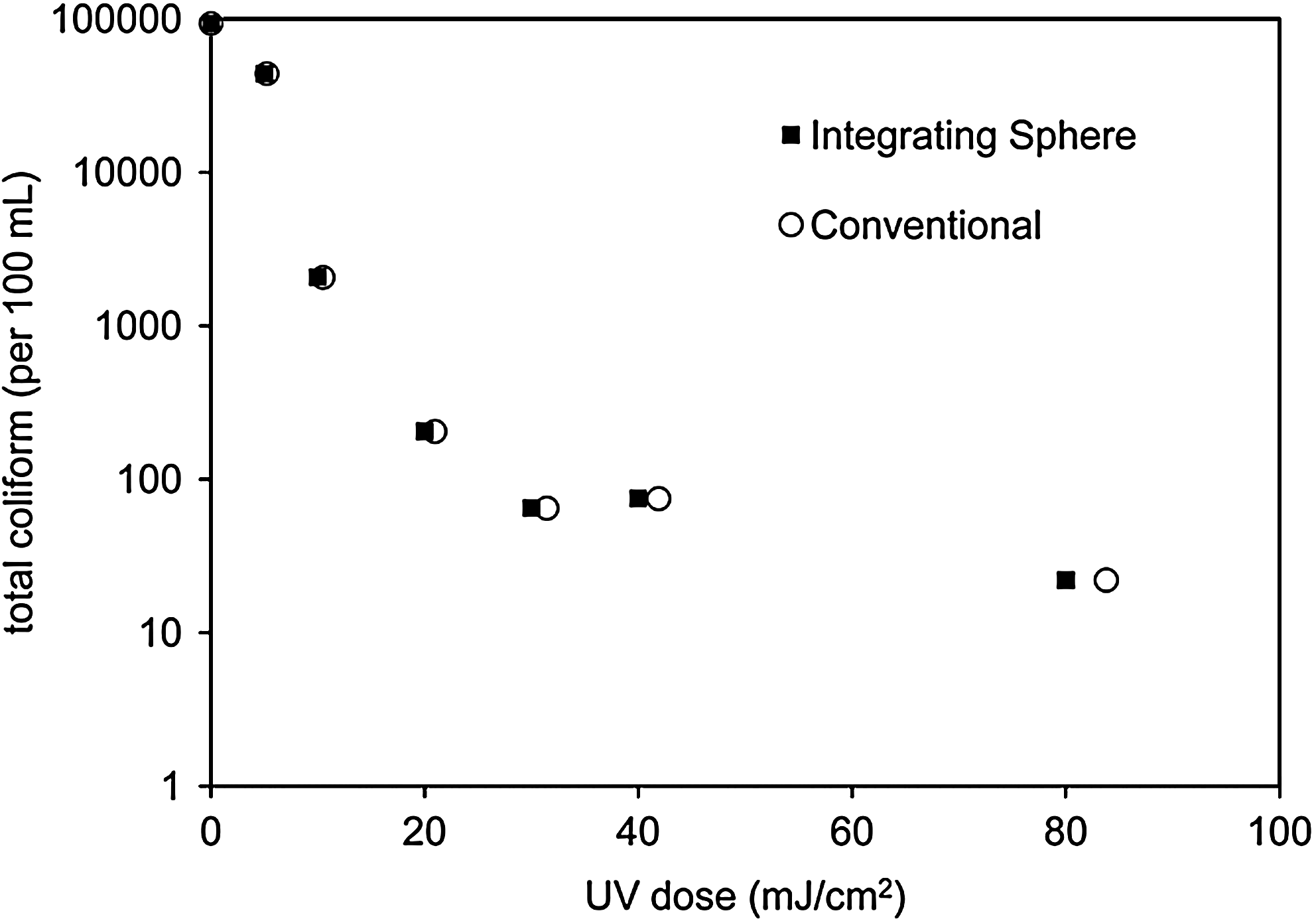
Inactivation curves for total coliform bacteria using conventional and integrating sphere spectrophotometry. TSS = 9.3 mg/L; UV254 = 0.264 (integrating sphere).
Footnotes
Acknowledgment
This research was funded in part by Calgon Carbon Corporation and the Canadian Water Network.
Author Disclosure Statement
The authors declare that no competing financial conflicts exist.