




Abstract
Abstract
Polyester manufacturing wastewater consists of water formed as a coproduct of step-growth polymerization reactions, typically performed between diols and dicarboxylic acids. Due to the solubility of the reactants and byproducts of polymerization, the wastewater is typically heavily contaminated and can possess considerable toxicity that can strongly inhibit biological wastewater treatment processes. However, very little has been published on the treatment of wastewater produced during polyester manufacture. We have demonstrated that the toxicity of the wastewater is largely attributable to volatile organic compounds (VOCs). Gas chromatography and mass spectrometry analysis of the wastewater revealed highly toxic and mutagenic α,β-unsaturated aldehydes (acrolein congeners) as major components of the VOCs present. Activated sludge treatment was performed under two aeration regimes, coarse bubble sparging and passive aeration through the surface layer, to access their effect on biodegradation/volatilization. After 24 h of incubation in the presence of 10% polyester plant wastewater, coarse bubble sparging resulted in 88% reduction in chemical oxygen demand compared to 45% with passive aeration, both largely attributable to VOC volatilization. The polyester wastewater demonstrated high toxicity as indicated by a net decline in volatile suspended solids under both culture conditions, consistent with previous toxicity assays. Results indicate that significant VOC volatilization would occur during activated sludge treatment of polyester manufacturing wastewater containing the identified acrolein congeners. To prevent toxic VOCs exposure to plant workers and improve biodegradability, we recommend polyester wastewater containing α,β-unsaturated aldehydes be pretreated by air stripping to remove VOCs and incineration of the stripped VOCs before activated sludge treatment.
Introduction
The extent of volatilization in aeration tanks is determined by the physical and chemical properties of the VOCs present in the wastewater, and by the type of treatment plant and its respective operation (Parker et al., 1993). Three general types of aeration systems are typically used in activated sludge systems: mechanical surface aerators, diffused aeration systems, and subsurface mechanical aerators with a gas sparging system (Chern and Yu, 1995). The type of aeration employed significantly influences the rate of volatilization. Diffused aeration systems with very fine bubbles tend to produce low volatilization of VOCs, whereas surface aerators, which act by breaking up the wastewater into a spray of droplets, and subsurface mechanical aerators, with coarse bubble aeration, can produce high levels of VOC volatilization (Eckenfelder, 2000; Schultz, 2005).
This work is part of a case study that aims to generate experimental data to direct water pollution control in the polyester resins industry. Specific literature on the effluent produced by this industry is rare and mainly based on targeted chemical analysis (Meric et al., 1999). Polyester manufacturing wastewater consists of water produced during step-growth esterification condensation polymerization reactions primarily between diols (glycols) and dicarboxylic acids. Since it is formed in contact with reactants and products, this water is heavily contaminated. Characteristics of this kind of wastewater reported in the literature are based on physicochemical properties such as low pH (2.3–3.9) and high chemical oxygen demand (COD) (22,900–250,000 mg/L) (Meriç et al., 1999) and targeted chemical analysis for specific compounds such as 1,4-dioxane (about 600 mg/L) (So et al., 2009).
The polyester wastewater studied in this work was from a mixture of various process waters resulting from different esterification condensation batch reactions performed at 200°C using a tetrabutyl titanate catalyst and one of the following diols, ethylene glycol, propylene glycol, or 1,4-butanediol with a dicarboxylic acid, typically adipic acid, and in some cases added octanol to decrease fiber length. Initially, the effluent evaluated in this work was sent to third parties for treatment. However, with the aim of treating wastewater onsite, the industry hired a consulting firm which suggested the use of activated sludge treatment. As a result, a treatment plant was built and is currently operating.
Previously, studies on this effluent were conducted using a toxicity-directed approach (Caffaro-Filho et al., 2009, 2010). This approach is based on a combination of techniques, including sample fractionation, toxicity testing, and chemical analysis (Brack, 2003). The objective was to define which substances were responsible for toxicity. It was shown that most of the toxicity of the effluent was due to VOCs, and among the most abundant of these were acrolein congeners, which are highly toxic α,β-unsaturated aldehydes.
Acrolein (2-propenal) is on the list of priority pollutants of the U.S. Environmental Protection Agency (USEPA). Acrolein is highly soluble in water (208 g/L at 20°C) due to its low log octanol-water partitioning coefficient (log Kow) of −0.01, highly volatile, with a flash point of −26°C, and also very toxic to aquatic organisms, with EC50 and LC50 values for bacteria, algae, crustacean, and fish are between 0.02 and 2.5 mg/L, bacteria being the most sensitive of this group (Verschueren, 1983). The vapor is irritating to the eyes and respiratory tract, and due to the volatile nature of these compounds, their toxicity (Dimitrov et al., 2004) and proven mutagenicity (Benigni et al., 2003), we evaluated the volatilization of these compounds during activated sludge treatment under high and low gas exchange conditions. The goal of this work was to evaluate the potential for toxic VOC volatilization from polyester wastewater during activated sludge treatment and to suggest a method to mitigate exposure to workers and improve the efficiency of the activated sludge process.
Experimental Protocols
Wastewater sampling and analysis
A polyester manufacturing wastewater composite sample was made by mixing eight different process water lines in proportion to their annual production. Details about sampling methods and physical and chemical analysis of the wastewater are described in Caffaro-Filho et al. (2009), except that in this study, COD was determined by the closed reflux method (APHA/AWWA/WEF, 1998). Triplicate analyses in the same composite sample were made for the determination of each parameter, except for COD (n = 2).
Biodegradation/volatilization assay
Biomass for the biodegradation/volatilization assays were provided by mixed liquor obtained from a pilot scale activated sludge reactor treating sewage from a university campus in Sao Paulo, Brazil. Biodegradation/volatilization was performed under two aeration regimes, coarse bubble sparging in a bioreactor and passive aeration through the surface layer by orbital shaking in an Erlenmeyer flask (without baffles). Aliquots (250 mL) of the mixed liquor were added to a bench scale batch bioreactor and an Erlenmeyer flask, each with a total volume of 1 L. To each container was also added 250 mL of diluted Organization for Economic Cooperation and Development (OECD) synthetic substrate as described in the Activated Sludge, Respiration Inhibition OECD Test Method #209, 1984 (OECD, 1984) such that the final concentration of filtered COD in each recipient was 544 mg/L and the final volume was 500 mL. For filtered COD analyses, samples were filtered in a GF/C glass fiber filter (Schleicher & Schuell) that retains particles larger than 1.2 μm. COD was determined by the closed reflux method (APHA/AWWA/WEF, 1998). The concentration of volatile suspended solids (VSS), suspended solids lost on ignition (ignited to constant weight at 550°C), in each recipient was also determined (APHA/AWWA/WEF, 1998) before incubation at 30°C. In the bioreactor aeration was performed by coarse bubble sparging by air pumped through a porous rock at a rate of 3 L/min in combination with magnetic stirring. The Erlenmeyer flask was incubated in an orbital shaker at 150 rpm.
After 24 h, filtered COD and VSS were determined in each recipient (in duplicate). The contents of both recipients were mixed and transferred to a 1 L graduated cylinder. After 30 min of gravity sedimentation, 600 mL of supernatant was removed, and 500 mL of fresh synthetic OECD substrate and 100 mL (10% v/v) of polyester manufacturing wastewater were added. The content of the graduated cylinder was then divided between the bioreactor and the conical flask, and incubated as before. Filtered COD and VSS at the beginning of this stage were again determined. After another 24 h period of incubation, filtered COD and VSS were determined in the two recipients.
Analysis of VOCs by gas chromatography and mass spectrometry
Wastewater VOCs at acidic pH (3) and basic pH (11) were determined using gas chromatography coupled to mass spectrometry. The details of the methods and results of this analysis are described in Caffaro-Filho et al. (2010). VOCs were identified by comparison of mass spectra obtained in each run with those provided by the library of the National Institute of Standards and Technology 1998 (Grung et al., 2007).
Results and Discussion
Wastewater physical and chemical analyses
Results of the physical and chemical characterization of the polyester plant wastewater used in these experiments are shown in Table 1.
Results are means of triplicate analyses, except for COD (n = 2).
Analysis of VOCs by gas chromatography and mass spectrometry
Compounds volatilized upon aeration of the polyester wastewater were previously identified under both acidic (pH 3) and basic (pH 11) conditions (Caffaro-Filho et al., 2010). High pH was shown to increase the extent of toxic VOCs removal by air sparging. Over 150 peaks were detected in each chromatogram and 10 were identified as α-β unsaturated aldehydes (acrolein [2-propenal] congeners) that were volatilized to a greater extent at pH 11 in comparison to pH 3. In this work we also identified 2-ethylacrolein (2-ethyl 2-propenal/CAS 922-63-4) to be among the compounds with the largest peak areas that were volatilized significantly under both acidic and basic conditions (Fig. 1).
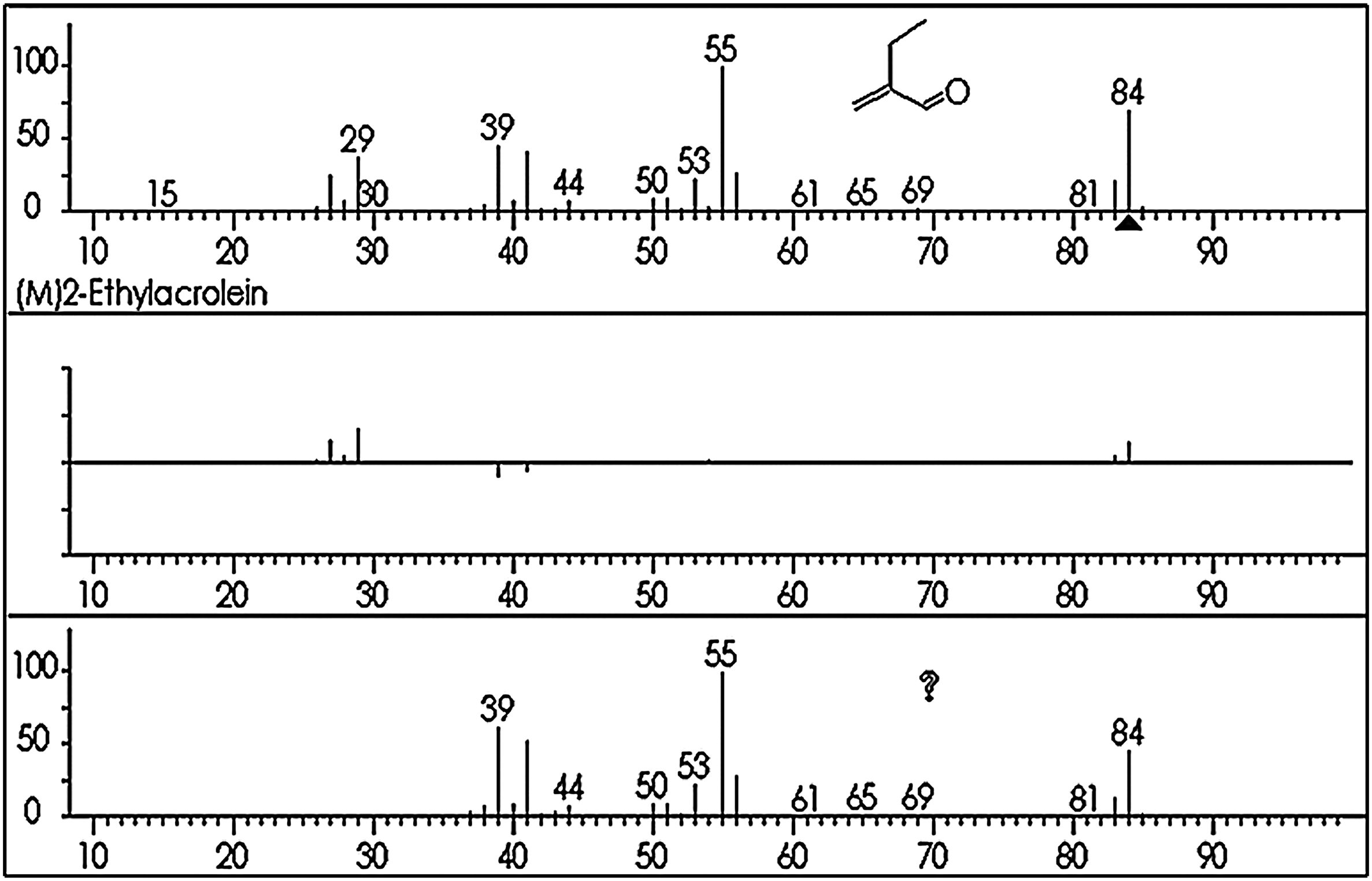
Mass spectra comparison for volatile organic compound identification: 2-ethylacrolein standard in National Institute of Standards and Technology 1998 Spectra Library (upper spectrum) and a volatile organic compound found in wastewater (lower spectrum, indicated by “?”). The molecular ion of 2-ethylacrolein (84 m/z) is indicated in the standard spectrum. The spectrum in the middle shows the differences between compared spectra. Only ions above 35 m/z were scanned in MS analysis. X-axis: mass-to-charge ratio (m/z). Y-axis: relative abundance (%).
2-Ethylacrolein like acrolein is highly volatile with a flash point of 1°C. The addition of the ethyl group makes 2-ethylacrolein slightly less toxic and less mutagenic than acrolein (Neudecker et al., 1991; Benigni et al., 2003).
Biodegradation/volatilization assay
The effect of two different biotreatment aeration regimes was performed to evaluate their effect on the change in COD and VSS in OECD synthetic sewage and polyester wastewater. The two different aeration regimes consisted of coarse bubble sparging in a mechanically mixed bioreactor and passive aeration through the surface layer in a nonbaffled flask on an orbital shaker. The biotreatment was performed in two stages. Initially, only the OECD synthetic sewage was treated with activated sludge for 24 h. After the first treatment, the biomass was combined from the two regimes and amended with fresh OECD synthetic sewage and 10% (v/v) polyester wastewater, and incubated for a further 24 h as described in methods. Results of COD and VSS analyses of the biodegradation/volatilization assays using the OECD synthetic sewage alone and the OECD synthetic sewage amended with 10% (v/v) polyester wastewater are shown in Table 2.
OECD, Organization for Economic Co-operation and Development.
For the first incubation, before the addition of 10% polyester plant wastewater, initial COD and VSS concentrations in both recipients were 544 and 1,320 mg/L, respectively. After 24 h, filtered COD was 126 mg/L in the bioreactor and 129 mg/L in the flask, with both systems producing a COD reduction of ∼77%. VSS increased in both systems to 1,600 and 1,400 mg/L in the bioreactor and the flask, respectively, as would be expected for an increase in biomass. These data are consistent with equivalent levels of substrate degradation and indicate that at this load of organic carbon differences in aeration did not result differences in COD reduction. In aeration by orbital shaker incubation, the oxygen transfer occurs mainly within a thin film of liquid formed on the wall of the bottle as it rotates, which increases the air/liquid contact surface. Although relatively low dissolved oxygen concentrations predominate in this type of incubation, this is typically not a limiting factor for aerobic metabolism if the COD is relatively modest as is the case with the COD levels used in this study (Breznak and Costilow, 1994).
In the second incubation period, after the addition of 10% (v/v) polyester plant wastewater, the results were quite different. COD removal efficiency in the bioreactor with coarse bubble sparging was much higher than in orbital shaker with passive surface aeration, 88% versus 45%, respectively. This could be attributable to higher growth levels in the bioreactor due to better aeration. However, this is contradicted by an actual decline in VSS in both the bioreactor and the flask. VSS is directly correlated with an increase in biomass from cell growth in a closed system. The lack of VSS increase in both systems is strong evidence for a toxic effect of the polyester wastewater, resulting primarily in cell lysis as opposed to cell growth. In consideration of these results, it is likely that the difference in COD removal in the presence of polyester wastewater can be attributable to a greater VOC volatilization in the bioreactor due to more efficient VOC stripping under coarse bubble aeration conditions.
Introduction of air by coarse bubble sparging (or breaking up the wastewater into a spray of droplets as is the case for wastewater surface aerators) increases the contact surface area between air and water in comparison to the orbital shaker, thereby increasing gas transfer and removal of volatile substances. Since the majority of the total solids in polyester wastewater are volatile compounds (Table 1), the greater drop in COD concentration in the bioreactor in comparison to the flask is primarily attributed to volatilization.
Of the two incubation conditions studied, the bioreactor is more akin to the conditions present in a typical activated sludge aeration tank. As a result, it would be expected that a high degree of volatilization of toxic VOCs would occur in an activated sludge system treating polyester production wastewater. In addition, the strong inhibitory effect of the polyester wastewater on the activated sludge biomass would likely result in poor removal in conventional wastewater treatment facilities without pretreatment to remove a significant portion of the toxic compounds. We have also previously shown that increasing the pH to 11 in combination with air stripping greatly decreases the toxicity of polyester plant wastewater in a Salmonella mutagenicity assay (Caffaro-Filho et al., 2010). These results indicate that pretreatment by air stripping, preferentially at pH 11, would be an effective method to remove the majority of the toxic compounds, reduce exposure to plant workers, and improve the treatability of the remaining components by conventional wastewater treatment. Incineration of the VOCs in the exhaust air in a manner consistent with recommendations for acrolein disposal described by the USEPA (1981) would be an effective means of VOC disposal.
Conclusions
Our analysis of a polyester plant wastewater indicates that volatilization of toxic compounds, particularly acrolein congeners (α,β-unsaturated aldehydes), would occur in the aeration tank of a typical activated sludge treatment plant. Although, additional toxicological studies should be conducted to better assess the risk, our data suggest that removal of toxic VOCs from polyester manufacturing wastewater is warranted before activated sludge treatment to prevent harmful consequences to human health arising from the undesired volatilization of hazardous compounds as well as to improve the efficiency of activated sludge treatment.
We recommend that polyester plant wastewaters with volatile toxic α,β-unsaturated aldehydes compounds, for example, acrolein derivatives, be pretreated by air stripping at elevated pH followed by conventional aeration basin wastewater treatment. We recommend that exhaust from the air stripping stage be incinerated by mixing with natural gas and spray injection into a furnace with an afterburner. Alternatively, the VOCs in the exhaust could be passed through a condenser and the condensed liquid VOCs injection incinerated.
Footnotes
Acknowledgment
This study was supported by the Coordination for the Improvement of Higher Level Personnel (CAPES) of the Ministry of Education of Brazil.
Author Disclosure Statement
No competing financial interests exist.