




Abstract
Abstract
This study combined molecular imprinted polymers (MIPs) and solid-phase extraction (SPE) to create a novel sample pretreatment technique for chemical analysis of polycyclic aromatic hydrocarbons (PAHs) in cigarette smoke. Experimental results demonstrated that MIPs have good selectivity for benz[a]pyrene (BaP) among mixtures of 16 PAH solutions. Molecular imprinted SPE (MISPE) cartridges were applied to a sample taken from mainstream smoke from a cigarette. Based on functional monomer and crosslinker, this study investigated four groups of MIPs. After each template was removed, tests on capacity, selectivity, recovery, scanning electron microscope observations, and real environmental sample tests were conducted. Experimental results showed that MIP-3 (methacrylic acid-co-trimethylolpropane trimethacrylate) is the best MIP, with a capacity of 7.80 ± 0.8 (μg/g), BaP selectivity exceeding 84%, and recovery exceeding 80%. In the environmental sample tests, that is, mainstream smoke from reference cigarettes 3R4F, 87% of BaP was adsorbed by the MISPE cartridge compared with that adsorbed by the filters. All experimental results suggested that MISPE can more effectively adsorb BaP among the 16 different PAHs in mixtures, reduce background interferences, and increase signal resolution as compared with traditional extraction techniques. Additionally, using MISPE cartridges in sample pretreatment reduced both the analysis time and the amount of organic solvent used. In addition, using MISPE may also extract toxic target analytes from a complex sample selectively and more effectively than traditional Soxhlet extraction. Combination of MIP-3 and SPE for environmental sample pretreatment offers a useful tool for selective isolation of the mutagenic PAHs. This study is also the first to apply an MISPE cartridge in the analysis of trace-level BaP in cigarette smoke.
Introduction
Benz[a]pyrene (BaP) is one of the well-known carcinogenic PAHs, due to its highest genotoxicity among the 16 listed PAHs. According to the USEPA, BaP has been frequently used as an indicator of the presence of PAHs (Mi et al., 2001; Tsai et al., 2001, 2002). Before PAHs can be analyzed, the sample should be pretreated by a variety of processes, including extraction, clean-up, and concentration. Although powerful instrumental approaches can be employed later, such as high-performance liquid chromatography coupled with diode array detection (Vilchez et al., 1994) and gas chromatography (GC) with a mass selective detector (GC/MSD), the analyses still require considerable manpower and consume large amounts of solvents.
In addition, previous studies (Talley et al., 2004; Bates et al., 2008) used thermal desorption method for analysis of PAHs. Although this method can provide very good recovery (>95%) of PAHs, it requires a thermal desorption instrument to desorb PAHs from samples. In this study, we focused on the development of a sample pretreatment technique to improve traditional pretreatment for chemical analysis of PAHs.
The sample pretreatment procedures have generally remained unchanged over the last few decades. Environmental samples, such as soil, water, and air, are extracted, cleaned up, and reconcentrated for chemical analysis. The environmental samples that contain PAHs from the atmosphere, soil, and water typically contain a range of substrates, such as particles and other forms of matter, which are not target compounds for analysis and can, thus, interfere with instrumental analysis and raise detection limits (Knapp, 1985; Trippel et al., 1985; Bufflap and Allen, 1995). Solid-phase extraction (SPE) is a sample pretreatment technique that is commonly utilized to pretreat PAHs, with the advantages that only a small amount of extraction solvent and the considerably less time are required, compared with liquid-liquid extraction. Additionally, the pretreatment is relatively simple, has low detection limits, and can be implemented using conventional instrumentation (Bauw et al., 1991; Potter and Pawliszyn, 1994; Vilchez et al., 1994). However, the disadvantages of SPE are that it has low selectivity toward target compounds and it requires elution with solvents of varying polarity to separate compounds according to their different polarities.
The technique of molecular imprinted polymers (MIPs), introduced in 1972 by Wulff and Sarhan, has been shown to be capable of producing materials with “antibody-like” selectivities (Tarbin and Sharman, 2001). The synthesis of MIPs has been previously reported (Lai et al., 2004; Krupadam et al., 2007). The MIPs are synthesized using a target template, a functional monomer, and a crosslinker. During polymerization, self assembly occurs with the template compound. After the completion of polymerization, the template compounds are removed from the polymers. Prerecognized sites within the polymer assume the molecular shape of a template. The functional monomers are preorganized by noncovalent bonds, such as van der Waals forces, and hydrogen bonding interactions (Wulff, 1986, 1995; Steinke et al., 1995; Hennion, 1999; Takeuchi and Haginaka, 1999). Previous research has shown that combining the advantages of the sample pretreatment processes MIP and SPE (molecular imprinted SPE [MISPE]) can overcome the shortcomings associated with conventional pretreatment methods, such as ultrasound and Soxhlet extraction (Hennion, 1999).
This study examines the MISPE cartridges for pretreating BaP in cigarette smoke. Four groups of MIPs were first synthesized, and the physical characteristics of the synthesized polymers, including adsorption capacity and recovery, were investigated and also examined with scanning electron microscopy (SEM). Real environmental samples were obtained from reference cigarettes 3R4F. Samples were collected using Cambridge filter pads and extracted using Soxhlet extractors. An MISPE cartridge was used to pretreat cigarette mainstream smoke extract after Soxhlet extraction. The sample was first loaded into an MISPE cartridge and then washed with acetonitrile in de-ionized water, before being eluted using dichloromethane (DCM). Finally, the results of the experiment were utilized to determine the applicability of MISPE cartridges for air sample extract pretreatment. This study details the extensive material tests, and, in order to understand the clean-up ability of MISPE cartridges over traditional clean-up procedures, silica gel column and a C18 cartridge were also deployed. By comparing the data from the results with and without a clean-up procedure, such as silica gel column, C18 cartridge, and MISPE cartridge, it is possible to determine which clean-up procedure can more efficiently reduce background interference. This study is also the first to apply an MISPE cartridge in the analysis of trace-level BaP in cigarette smoke.
Experimental Protocols
The experiment was divided into two parts, material tests and real environmental sample tests.
Reagents
BaP and the 16 PAH compounds (PAH mixture-610M) were purchased from Supelco. Methacrylic acid (MAA) (Trippel et al., 1985), divinylbenzene (DVB) (technical grade, 80%), trimethylolpropane trimethacrylate (TRIM), and 2-(diethylamino) methacrylate were from Fluka. 4-Vinylpyridine was purchased from Sigma-Aldrich; 2, 2′-azobis-iso- butyronitrile was from Showa; DCM acetonitrile was from Mallinckrodt; and n-hexane was from J.T. Baker. Anhydrous sodium sulfate, copper powder, and silica gel (0.063–0.200 mm) were supplied by Merck.
Preparation of MIPs and material tests
The MIPs were prepared as described elsewhere with slight modifications (Lai et al., 2004). Notably, 50.4 mg (0.2 mmol) BaP was weighed and dissolved in 3 mL DCM in a 6 mL screw-capped glass vial. Functional monomer was added to the solutions and was allowed to stand for 15 min. Cross-linkers and 50 mg 2′-azobis-iso-butyronitrile were then added to these solutions. The vial was deoxygenated with nitrogen for 5 min. After deoxygenation, the vials were sealed under nitrogen and placed in water-bath shakers to polymerize their contents at 60°C for 24 h. The resulting hardened polymers were crushed, ground, and wet-sieved in methanol-acetonitrile (v/v = 1:1) through 250 and 500 mesh sieves (W.S. Tyler). The polymers were collected and washed with DCM and horizontally shaken for 24 h. The template removal procedure was repeated until the template in the extracted solution was undetected by GC/MSD (Lai et al., 2004). Table 1 shows the functional monomer, cross-linker, and template ratios. After the polymers were synthesized, several tests were conducted. The procedures are described as follows.
The functional monomer, cross-linkers, and template ratios shown in brackets are in mmole. NIP-1 to NIP-4 represents NIP; MIP-1 to MIP-4 represents imprinted polymers (MIP).
MIP, molecular imprinted polymer; NIP, nonimprinted polymer; 4-VP: 4-vinylpyridin; MAA, methacrylic acid; DMAEM, 2-(diethylamino) methacrylate; DVB, divinylbenzene; TRIM: trimethylolpropane trimethacrylate; AIBN, 2, 2′-azobis-iso-butyronitrile.
Determination of binding capacity of MIPs
Adsorption capacity of the polymers was determined as follows: First, 100 mg of a polymer was put into a 10-mL glass vial with a cap, 3 mL acetonitrile with 0.5 ppm BaP was then put into the same vial and shaken horizontally for 16 h at 25°C. The vial with the BaP solution was allowed to stand for 15 min and then placed in a centrifuge at 13,200 rpm (Eppendorf 5145d) for 10 min. Finally, the solution was filtered, and 1.5 mL was subjected to GC/MSD analysis to determine the free BaP concentration in the solution. The same procedure was followed for all other polymers.
Selectivity tests of MIPs and nonimprinted polymers of BaP among 16 PAHs
The selectivity tests of MIPs and nonimprinted polymers (NIPs) of BaP among 16 PAHs was performed as follows. First, 100 mg each of the NIP and MIPs were separately placed in 5-mL amber bottles; 3 mL acetonitrile solution containing 16 PAHs each at 0.05 ppm was added to the bottle, which was shaken horizontally for 24 h at a constant room temperature (25°C). The bottle was then left to stand for 15–20 min to allow settlement to occur. The supernatant liquid was then placed in a centrifuge for 30 min at 13,200 rpm. Two-milliliters from the top layer was then passed through a 0.45 μm filter and placed in GC vials for GC-MSD analysis. The selectivity was defined as in equation (1):
Leakage of templates
To test for possible leakage of templates into the organic solvent, MIPs were first suspended in polypropylene centrifugal microtubes with DCM and acetonitrile. Two hundred milligrams of MIP was then placed in a 6 mL screw-capped glass vial with a total solution volume of 4 mL. After 8 h of mixing at ambient temperature, the solution was centrifuged, and the concentration of the templates in the supernatant was measured.
The results demonstrate that no leakage of templates was detected in the acetonitrile solution and that for DCM, 19 ng BaP/g polymers were found after an 8 h leaching test.
SEM observations of MIPs
The nonimprinted polymer and imprinted polymer surfaces were observed via SEM (Hitachi S3000-N). The polymers were compared for surface changes. To prepare specimens for SEM analysis, they were first fixed with Karnovsky's fixative and then passed through a graded series of alcohol dehydrations. Once dehydrated, the specimens were placed in a critical-point dryer, mounted, and placed in a gold coater. When the gold coating was complete, the specimens were ready for observation.
Recovery
In order to evaluate possible losses of PAHs during the extraction before analysis with nonimprinted SPE (NISPE) and MISPE cartridges, clean-up procedures were investigated. For MISPE and NISPE, the recovery experiment utilized empty SPE cartridges with polytetrafluoroethylene frit (with a pore size of 10 μm) purchased from Supelco. In total, 100 mg MIP or NIP was placed in the cartridge to prevent loss of polymers during the experiments. The conditioned cartridge was prepared by washing a cartridge with 5 mL acetonitrile followed by drying. Next, 2 mL of the filtered extract from Soxhlet extraction was then slowly poured into the cartridge at a rate of 0.15 mL/min. The cartridge was then washed with 2 mL acetonitrile in de-ionized water (v/v = 4:6) and eluted with 2 mL of DCM. The eluant was filtered, 2 mL of which was placed in an amber glass vial for subsequent GC-MSD analysis. The purpose of washing with acetonitrile in de-ionized water (v/v = 4:6) was to remove compounds other than the target analyte (BaP). After washing, DCM was used to elute the target analyte for analysis.
For further comparison in cleaning up real environmental samples, the C18 cartridges and silica gel column clean-up method recoveries were also studied. The test procedure was the same as MISPE and NISPE recovery test procedure previously described.
For the silica gel column recovery, glass fiber filters were cleaned, weighed, and then stored in a desiccator for 8 h to reach moisture equilibrium (USEPA, 1996). Onto each glass fiber filter, 2 mL of acetonitrile solution containing 0.05 ppm of 16 PAHs was added. The filter was then transferred into a 250 mL flask and the mixture diluted to 200 mL with acetonitrile. Finally, the filter within the solution was extracted for 24 h in a Soxhlet apparatus. The extracted solution was accomplished by passing the extract through a chromatographic column (11 mm × 300 mm) that was packed with 0.1 g of activated copper at the bottom to absorb elemental sulfur, 10 g of activated silica gel, and about 2 g of anhydrous sodium sulfate on top to absorb residual water. Next, 200 mL of acetonitrile in a Kuderna-Danish concentrator was attached to a calibrated 5-mL graduated flask. Finally, a gentle stream of nitrogen was used to bring the volume of the extract down to 2.0 mL and analyzed for PAHs.
Real environmental samples test
Sampling and extraction
In this study, mainstream smoke from reference cigarettes 3R4F was sampled. Both the cigarettes and glass fiber filters were conditioned at 22°C under 60% relative humidity for at least 24 h. Total particulate matter in mainstream smoke was generated using a standard smoking protocol (60 s puff interval, 2 s puff duration, and 35 mL puff volume) and manually collected on individual glass fiber filters (Ding et al., 2006). Six cigarettes, each taken from a separate pack of the same reference cigarettes 3R4F, were smoked to determine the concentrations of each of the 16 PAHs in the smoke (Ding et al., 2005). Figure 1a shows the reference cigarettes sampling procedure.
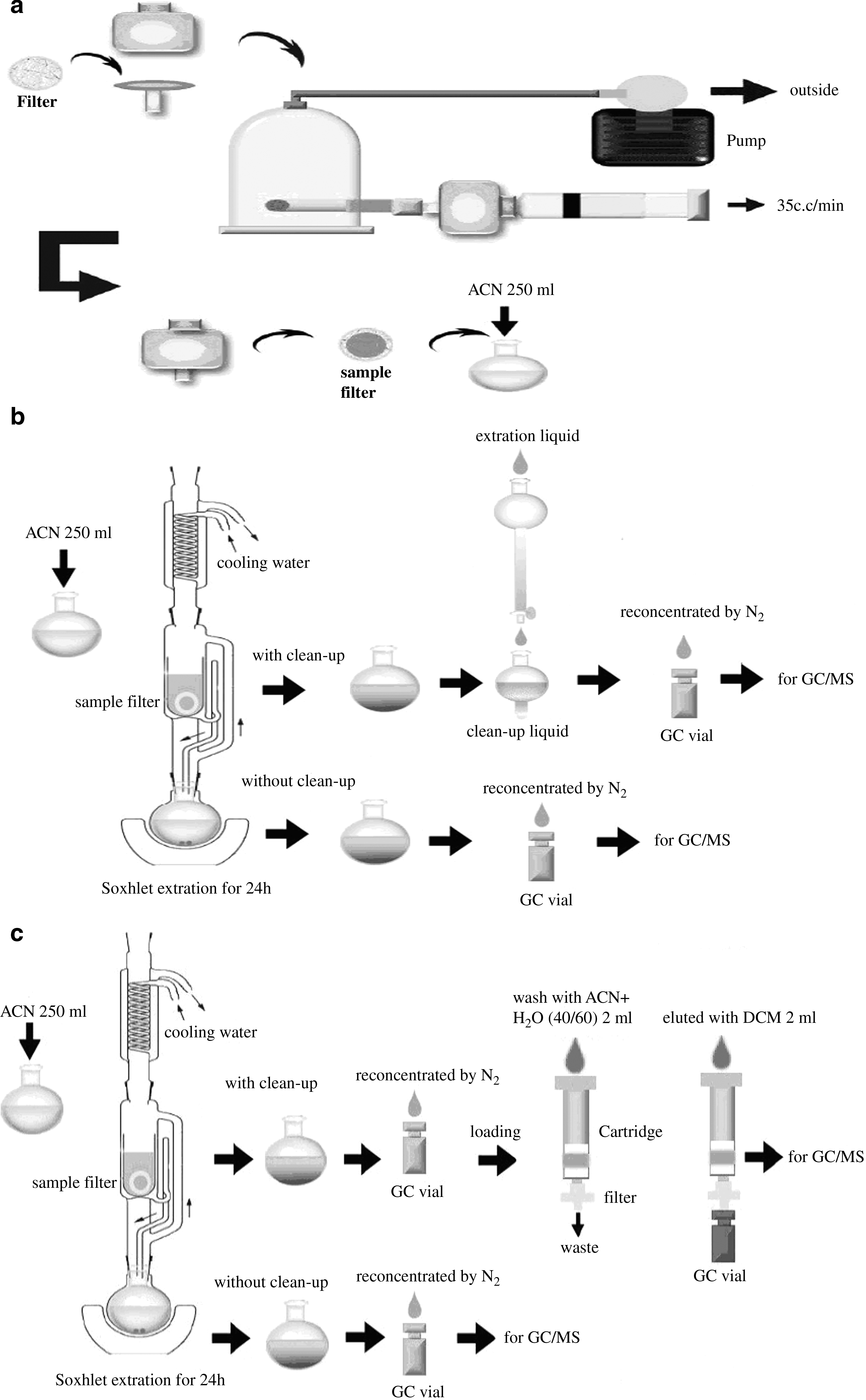
Sampling and clean-up procedure:
After sampling, the glass fiber filters were transferred into a 250-mL flask and extracted for 24 h in a Soxhlet extractor with 200 mL of acetonitrile. Excess solution was removed with a rotary evaporator (40°C, at 180 rpm) for 20 min, avoiding total dryness, followed by blowing with ultra-pure nitrogen down to a volume of 2 mL. Each concentrated solution was filtered and poured into an amber glass vial for GC-MSD analysis. The Soxhlet extraction recovery was shown in Table 2.
n = 3. The recovery is shown as a percentage.
Soxhlet represents the 16 PAHs recovery with Soxhlet extraction without clean-up procedure; MIP 1–4 and NIP 1–4 represent 16 PAHs recovery after Soxhlet extraction with MISPE and NISPE cartridge clean-up procedure.
Test with MISPE and NISPE cartridges
One hundred milligrams of the imprinted polymer (MIP) or blank polymer (NIP) was packed in an empty SPE cartridge, preconditioned with 5 mL acetonitrile, and followed by drying. The clean-up procedures for both MIPs and NIPs cartridges clean-up procedure were the same as previously described in recovery test. After the clean-up procedure, the eluant solution was then filtered and poured into an amber glass vial for GC/MSD analysis. Figure 1c shows the clean-up procedure by using MISPE and NISPE cartridges.
Two conventional clean-up methods were also deployed for real environmental samples test. The clean-up procedure of C18 cartridge and silica gel column were the same as previously described in recovery test. Figure 1b, c, respectively, shows the result of clean-up procedures by using silica gel column and by using C18 cartridge after sampling.
Analyses of PAHs
A Hewlett-Packard 6890A gas chromatograph (GC) with an MSD (Hewlett-Packard 5973N) and computer workstation were used for analyzing the PAHs. This GC/MSD was equipped with a Hewlett Packard capillary column (HP Ultra 2, 50 mm × 0.32 mm × 0.17 μm) and an HP-7673A automatic sampler injection volume set to 1 μL; a splitless injection port was at 300°C; and the ion source temperature was 280°C. The oven was programmed to heat up from 50°C to 100°C at a rate of 11°C/min, from 100°C to 280°C at a rate of 5°C/min, and finally held at 280°C for 10 min. Two internal standards, phenanthrene-d10 and perylene-d12, were employed to check response factors and recovery efficiencies when analyzing the PAHs. Target compound identification was based on detection of molecular ions and a comparison of the retention times to those of the standards. Quantification of PAHs was performed using the selected ion monitoring mode. The concentrations of the following 16 EPA-PAH compounds were determined: naphthalene; acenaphthylene; acenaphthene; fluorene; phenanthrene; anthracene (Chen et al., 2002); fluoranthene (Bufflap and Allen, 1995); pyrene; benz[a]anthracene; chrysene; benz[b]fluoranthene; benz[k]fluoranthene; BaP; indeno[1,2,3-cd]pyrene; dibenz[a,h]anthracene (DBA); and benz[ghi]perlene. Analyses of field blanks, including filters and cartridges, showed no measurable contamination from sampling throughout analysis (GC/MSD integrated area <detection limit).
Results and Discussion
Adsorption capacity of MIPs and NIPs
To the best of our knowledge, only two research groups have so far successfully synthesized BaP-imprinted polymers. Lai et al. (2004) employed 4-vinylpyridine as a functional monomer and DVB as a crosslinker and was the first to synthesize MIPs for BaP. Krupadam et al. (2007) used MAA (Trippel et al., 1985) as a functional monomer and ethylene glycol dimethacrylate (EDMA) as a crosslinker to synthesize MIPs for BaP. There are many different combinations and ratios of functional monomer and crosslinker for the synthesis of MIPs for BaP, and continuing to search for more of these is necessary to further develop MIP techniques. There is evidence in the literature that functional monomers and multifunctional crosslinkers produce a more rigid polymer and, hence, better imprinting than the difunctional crosslinkers that have been traditionally used (Tarbin and Sharman, 2001). Based on capacity, the size of the effective adsorption site of MIPs can be determined according to the adsorption volume. Different ratios for MIPs synthesis (MIP1–4, NIP1–4) are shown in Table 1. Table 3 lists the capacity of MIPs to adsorb BaP. It also shows that the polymer of MAA-co-TRIM (MIP-3) has best adsorption ability of about 7.80 ± 0.8 μg/g and that adsorption ability of all the MIPs was higher than that of the NIPs. A previous study (Lai et al., 2004) has demonstrated that the increased polarity of functional monomer can decrease polymers adsorption capacity. This study also confirmed this trend. In this study, several functional monomers and crosslinkers were chosen; the MIPs and NIPs were prepared in the same way, except that a template was omitted for NIP, the presence of the template imprinted site may explain why all the MIPs adsorption capacities were higher than those of the NIPs.
Imprinted factor = MIP/NIP.
SD, standard deviation.
The adsorption effectiveness of MIPs can be determined by comparing the maximum rebinding amount imprinted factor of the MIPs and NIPs (MIP/NIP) ratios for the experimental (MIPs) and control (NIPs) groups. Results in imprinted factor suggest that when loading BaP only for the adsorption capacity test of MIPs and NIPs, the 2-(diethylamino) methacrylate -co-DVB (MIP-4) polymers would have the highest imprinted factor than other polymers. However, in real environmental samples, the compositions of pollutants are much more complex. For instance, cigarette smoke contains more PAHs in addition to BaP. Therefore, if MIPs are used as air samples such as a cigarette smoke sample or other combustion sources, only relying on the imprinted factor cannot show which MIP would be best for air sample use; further tests would be needed to help determine which MIP would be suitable for air sample use.
Selectivity test of MIPs and NIPs for BaP among 16 PAHs
The definition of selectivity has been previously described. The selectivity test results for the experimental and control groups are given as average percentages in Table 4. It shows that NIP-1, NIP-2, NIP-3, and NIP-4 exhibited practically no selectivity for BaP. Although MIP-1 and MIP-3 did not have the expected BaP selectivity, they did provide better adsorption abilities with regard to PAHs with a high number of rings, including BaP. Clearly, the MIPs had better selectivity for BaP than the NIPs, suggesting that adding BaP as a template during the preparation of polymers can generate special adsorption sites; among the four MIPs of BaP, MIP-3 has significantly higher selectivity toward BaP, and the interaction between the functional monomer and crosslinker is better than that of MIP-1, MIP-2, and MIP-4. This result is similar to previous findings that imprinted polymers of PAHs have quite broad selectivity toward several PAHs (Lai et al., 2004; Baggiani et al., 2007). The actual adsorption mechanism is quite complex, and whether BaP is specifically adsorbed by those pores with recognition capability still remains unknown. The selectivity test only preliminarily shows that MIPs have quite broad selectivities toward several PAHs. The clean-up procedure is required when applying MIPs to real environmental samples, because they are more complex and a clean-up procedure can wash out the PAHs that are not adsorbed by the pores with recognition capability.
n = 3. PAHs level shown as a percentage.
PAH, polycyclic aromatic hydrocarbon; Nap, naphthalene; Acpy, acenaphthylene; Acp, acenaphthene; Flu, fluorene; PA, phenanthrene; Pyr, pyrene; BaA, benz[a]anthracene; CHR, chrysene; BbF, benz[b]fluoranthene; BkF, benz[k]fluoranthene; BaP, benz[a]pyrene; IND, indeno[1,2,3-cd]pyrene); DBA, dibenz[a,h]anthracene; BghiP, benz[ghi]perlene.
Recovery BaP and other PAHs
The Soxhlet extraction recoveries of PAHs from this study were 82%–94%, which were similar to those previously reported (Lee et al., 1995).
The recovery of 16 PAHs standard in MISPE and NISPE cartridges were also determined. The recovery is defined as in equation (2):
The recovery of the 16 PAHs when using the C18 cartridges and silica gel column are shown in Table 5. Table 2 and Figure 2 show the recovery (with clean-up procedure) rates for the MISPE and NISPE cartridges; MIP-1, MIP-2, MIP-3, and MIP-4 were 2%–85%, 1%–62%, 2%–97%, and 4%–92%, respectively; and NIP-1, NIP-2, NIP-3, and NIP-4 were 1%–56%, 1%–49%, 1%–28%, and 1%–61%, respectively. The recovery of BaP of MIP-3 was as high as 80%, higher than that of MIP-1, MIP-2, and MIP-4. In other words, MIP-3 have both highest recovery and selectivity toward BaP.

Recovery (defined by equation 2 in the text) of PAHs adsorption by NISPE and MISPE cartridges:
n = 3. The recovery is shown as a percentage.
The difference between the selectivity and recovery tests is that the time required for recovery tests of the MISPE cartridges is shorter, regardless of the type of clean-up procedure applied. The recovery test reveals the corresponding selectivity of BaP among the 16 PAHs, because the clean-up procedure can wash out the PAHs that were not adsorbed by those pores with recognition capability. Subsequent elution brings out the BaP molecules that were adsorbed by those pores with recognition capability. Although both MISPE and SPE separate analyses based on the difference in molecular polarity to achieve the separation BaP and clean-up of other compounds, MISPE have the additional BaP recognition capability; hence, the MISPE procedure requires less solvent and has better selectivity for certain compounds.
Previous studies show that BaP-imprinted polymers demonstrated broad selectivity toward several other PAHs. The BaP-imprinted polymers (MIPs) retain their target BaP after a suitable solvent was used to wash away other PAHs based on the polarities of the 16 PAHs. The BaP can be eluted thereafter with an appropriate solvent. The MISPE cartridge pretreatment method was developed by combining MIPs and the SPE technique (Lai et al., 2004; Baggiani et al., 2007).
SEM observation of MIPs
In this work, various combinations of polymers were prepared for BaP using bulk polymerization with various crosslinkers. A similar layer surface structure of the crosslinkers was observed from the micrographs of MIPs, as shown in Fig. 3. Among polymers with different crosslinkers, no significant surface difference can be observed from SEM photographs.

Scanning electron microscope images showing the morphology of the synthesized polymers:
Chromatography
Many previous reports (Ding et al., 2005, 2006) indicated that each cigarette generates approximately 0.01–0.03 μg BaP in the mainstream smoke. Analytical results in this study demonstrate that each 100 mg of an MIP absorbs roughly 0.6–0.7 μg BaP, which far exceeds the total amount of BaP in the mainstream smoke produced by a burning cigarette. The experimental results for adsorption capacity indicate that MAA functional monomer with TRIM crosslinker had a higher adsorption capacity than other three polymers.
Previous reports that used BaP as template to synthesise MIPs mostly focused on polymers characteristics, such as adsorption models or SEM observation. In this study, not only polymers' characteristics were discussed, but also MIPs were deployed for real environmental samples test.
One aim of this study was to test the polymers with MISPE cartridges using real samples. In the present work, reference cigarettes without clean up and with several different kinds of clean-up procedures were investigated. Chromatographic results of GC/MS were obtained in the selected ion monitoring mode. Figure 4a–d shows the total ion chromatograms of Soxhlet extraction from the reference cigarettes without clean up, with clean up by C18 cartridge, silica gel column, and MIP-3 cartridge, respectively.
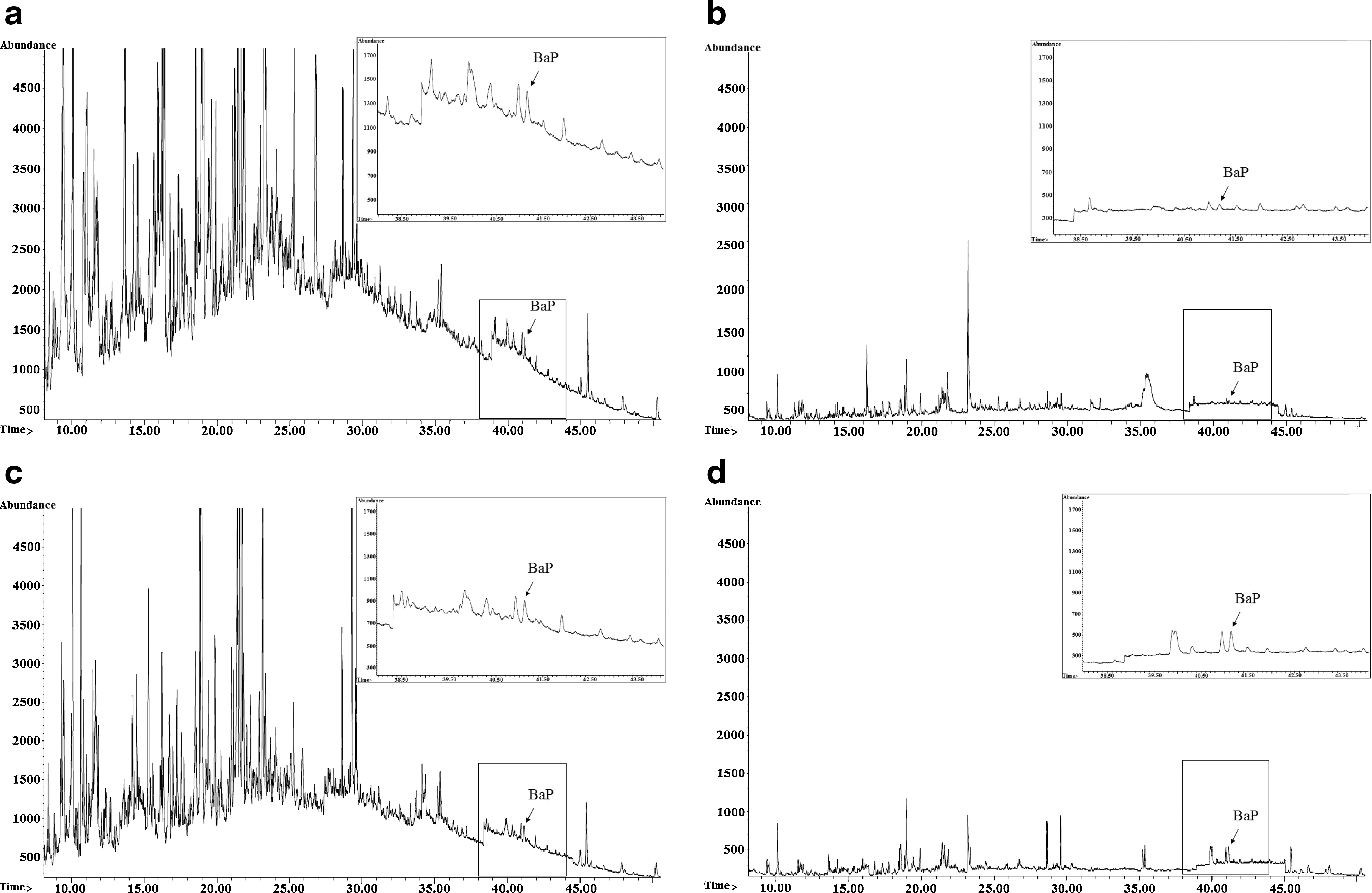
Chromatography of GC with a MSD (GC/MSD) for
The results demonstrate that after sampling, many compounds that are extractable can be extracted from the sample. After the clean-up procedure, all the baselines in the chromatograms were lower than without the procedure, as Fig. 4b–d shows. As can be observed, quantification of BaP without clean up is quite difficult due to strong interferences as shown appearing in the chromatograms. However, after cleaning the sample extracts using MIP cartridges, almost all of the interferences were removed, a high selectivity is achieved through the recognition mechanism in the MIP.
Figure 5 compares the performance of MISPE cartridges by plotting the 16 PAHs concentrations from the chromatograms of sample with and without clean up. Figure 5a shows that the silica gel column and the C18 cartridge clean-up procedures can reduce some interference. It also demonstrates that the silica gel column retains all 16 PAHs, whereas the C18 can only retain a few PAH. This is because most of the PAHs were washed out during the clean-up procedure. Both the silica gel column and C18 cartridge show no selectivity toward BaP during clean up. Figure 5b shows that most of the MISPE cartridges can retain BaP and some other PAHs with 5–6 rings and that the interferences were reduced after the clean-up procedure. It also shows that the recognition of BaP by the MISPE cartridges as a clean-up procedure for BaP was satisfactory. Figure 5c shows that most of NISPE cartridges did not retain BaP and some other PAHs with 5–6 rings. It is because most of the PAHs were washed out during the clean-up procedure. Therefore, the recognition of the NISPE cartridges with a clean-up procedure for BaP is unsatisfactory.
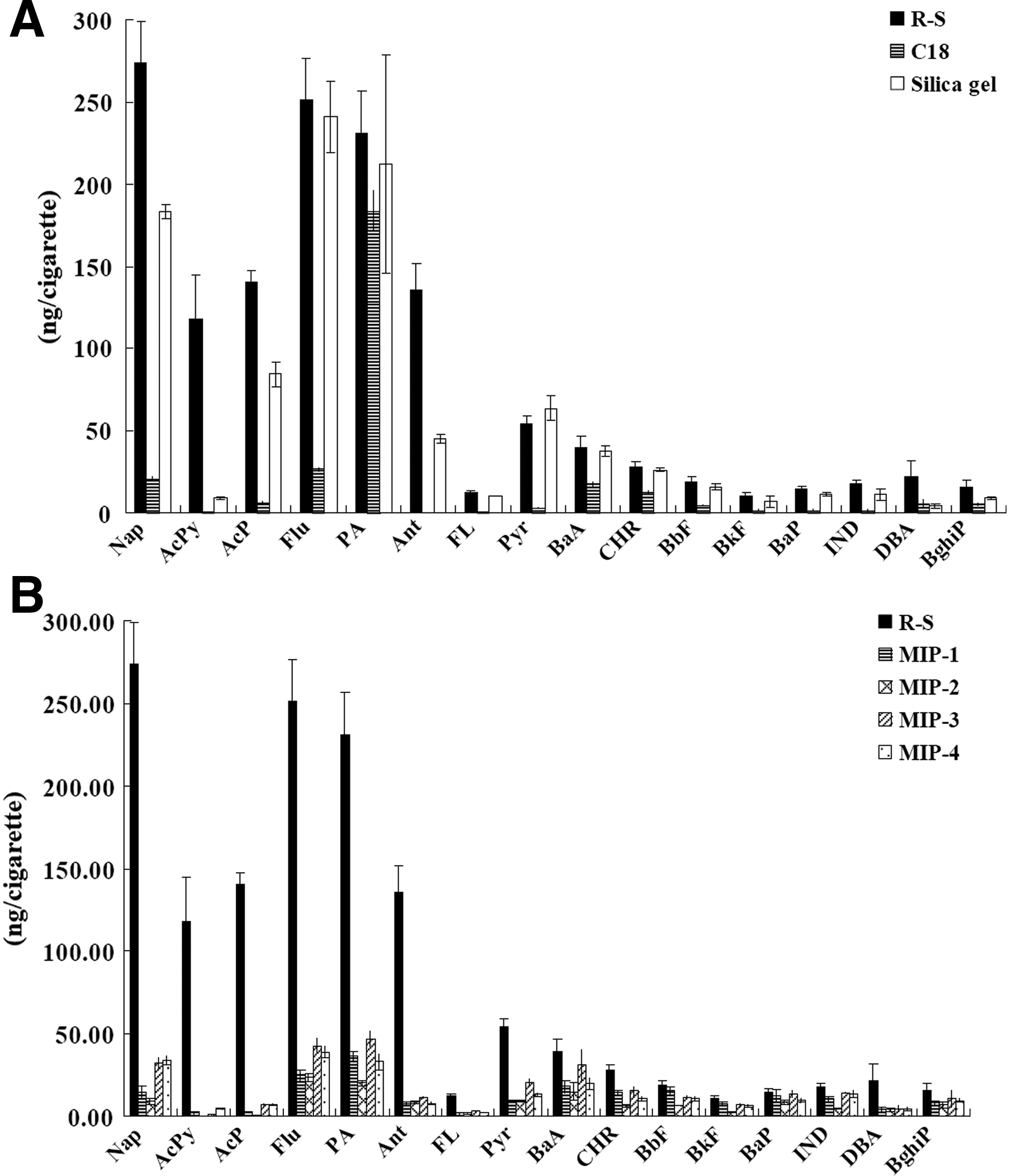
PAHs levels for
Table 6A–C summarizes the comparison of PAHs concentrations of reference cigarettes among different clean-up methods, suggesting that the NISPE and C18 cartridge exhibited very little adsorption of all 16 PAHs. The BaP levels were higher in the MISPE than in the NISPE, C18, and silica gel clean-up samples and were close to those obtained using traditional sampling. A comparison with previous reports (Ding et al., 2005, 2006) indicated that the 3R4F Kentucky reference cigarettes showed that most of PAH level distribution patterns in mainstream cigarettes are similar.
Results are presented as means of six replications ± SD.
Represents reference cigarettes 3R4F.
Results are presented as means of six replications ± SD.
Represents reference cigarettes 3R4F.
Results are presented as means of six replications ± SD.
Represents reference cigarettes 3R4F.
This study focused on MISPE cartridges for real environmental samples of BaP, and Figure 6 shows the retention rates for BaP among all 16 PAHs from the reference cigarettes' mainstream smoke, which is defined as the BaP concentration of the reference cigarettes with the clean-up sample divided by that without the clean-up procedures sample. Figure 6 shows that the retention rate of MIP-3 was the highest (87%), consistent with the results of the recovery test for BaP with MIP-3 (about 80%), and none of the NIPs show a significant BaP retention rate.
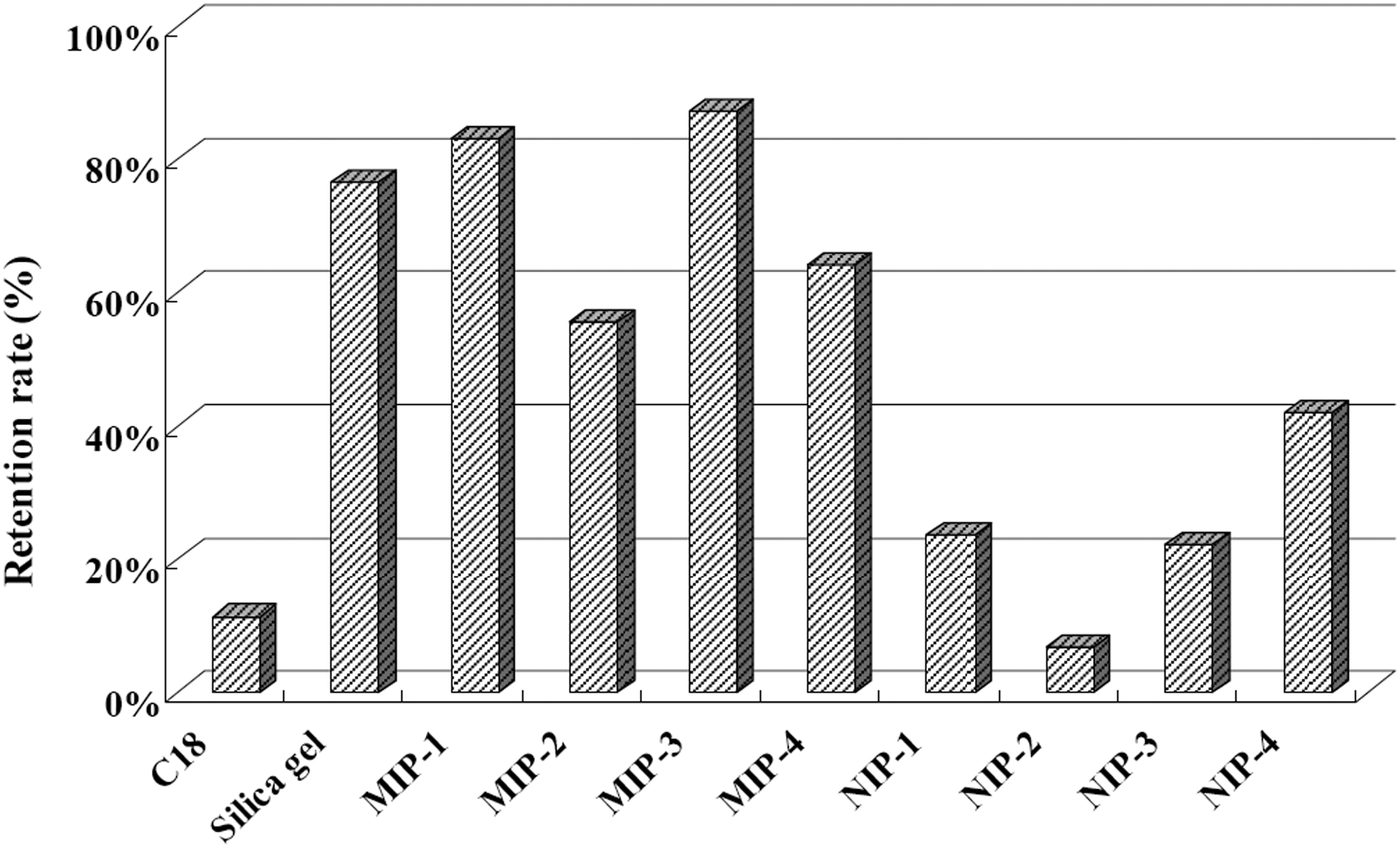
Retention rate of BaP among 16 PAHs from reference cigarettes main stream smoke (BaP concentration of reference cigarettes sample without clean up/BaP concentration of reference cigarettes sample with clean up).
The chromatographic results demonstrate that the MISPE cartridge for the cigarette mainstream smoke sample can reduce the interference of other compounds as compared with the Soxhlet extraction methods, and the chromatogram resolution was improved by the washing step.
Based on the selectivity and environmental sample test results, Fig. 2 and Table 5 show that the MIPs did demonstrate selective (though not specific) adsorption ability toward some of PAHs with bay region structure, such as benz[k]fluoranthene, indeno[1,2,3-cd]pyrene, and benz[ghi]perlene. For these three PAHs the recoveries were 82%–86% for MIP-1, 52%–62% for MIP-2, 77%–97% for MIP-3, and 65%–92% for MIP-4. As for the other 13 PAHs the recoveries were all below 40%. This indicates that in the adsorption by the BaP imprinted polymer, the bay region factor played an important role in the molecular recognition mechanism, although some minor unidentified mechanisms might also be involved. Table 7 gives a summary of the characteristic differences among SPE, silica gel column, and MISPE as sample pretreatment methods. Preliminary results indicate that the polymers' syntheses were successful and the MISPE method can be adapted to air samples. Further experiments are in progress.
Based on the amounts used in this study.
Requires solvents or mixed solvents of various polarity.
MISPE, molecular imprinted solid-phase extraction.
Conclusion
Four BaP MIPs and NIPs were synthesized. Based on various test results for adsorption capacity, recovery, and selectivity of BaP and real samples, using functional monomer MAA with crosslinker TRIM added in the preparation of MIP-3 effectively increases the adsorption ability with regard to several PAHs, including BaP. These experimental results demonstrate that the adsorption capacity of MIP-3 significantly exceeded those of MIP-1, MIP-2, and MIP-4. Selectivity tests of 16 PAHs indicate that MIP-3 effectively recognizes BaP. From SEM photographs it was found that no significance surface difference can be observed among the above four MIPs.
MIP-3 shows a recovery rate of 80% for BaP, which is significantly higher than other MIPs and C18. When applied to cigarette smoke, a real environmental sample, the adsorption efficiency of BaP was 83%, 55%, 87%, and 64% for MIP-1, MIP-2, MIP-3, and MIP-4, respectively.
Since MIP-3 has good adsorption for five- and six-ringed PAHs, especially for those PAHs with a bay region, a combination of MIP-3 and SPE for environmental sample pretreatment offers a useful tool for selective isolation of the mutagenic PAHs. Therefore, this technique is a potential tool for studying the mixture toxicity of toxic pollutants and it should contribute to the understanding of the nature of toxic compounds emitted from various pollution sources.
Also, compared with the silica gel and C18 cartridge clean-up procedures, the MIP cartridge clean-up procedure is superior in terms of time, labor, and selectivity and, thus, warrants further development.
Footnotes
Acknowledgment
The authors would like to thank the National Science Council of the Republic of China, Taiwan, for financially supporting this research under Contract No. NSC 95-2221-E-006-175.
Author Disclosure Statement
All authors declare that no competing financial interests exist.