




Abstract
Abstract
Performance of Fenton oxidation in the degradation of gallic acid (GA), one of the most representative phenolic compounds in wastewater, was studied. Factorial experimental design was used to study the main variables affecting the Fenton process as well as their interactions. Eight 22 factorial designs were performed to estimate the effects of the H2O2/GA and Fe2+/GA molar ratios on the degradation of GA and on its mineralization as percentage of initial carbon converted in carbon dioxide. H2O2/GA and Fe2+/GA ratios ranged from 0.3 to 32.3 and from 0.15 to 1.15, respectively. Experiments were conducted in batch mode and in an apparatus designed to directly measure carbon dioxide production. Results from the statistical processing of experimental data enlightened the oxidation mechanism and indicated that GA degradation is strongly influenced from both Fenton's reagents doses at low concentrations, whereas for mineralization efficiency only H2O2/GA molar ratio was statistically significant. The optimal H2O2/GA ratio resulting in the maximum phenolic compound degradation (95.5% ± 1.3%) and mineralization efficiency (41.6% ± 2.8%) was found to be 24.3 independently of the Fe2+/GA ratio.
Introduction
Phenolic compounds are one of the most abundant pollutants in industrial wastewater, that is, chemical, petrochemical, paint, textile, pesticide plants, etc. They serve as intermediates in the industrial synthesis of products as diverse as adhesives and antiseptics (Alnaizy and Akgerman, 2000). Various natural phenols and their condensation products, such as tannins or lignins, are also present in several types of agro-industrial wastes. Gallic acid (GA) is a common polyphenol present in several agro-wastewaters, for example, those from olive oil factories and boiling cork and wine processing industries, and can be also considered as one of the simplest models of natural organic matter (Zimbron and Reardon, 2009). Phenols are toxic to human beings and fish as well as several biochemical functions (Monteiro et al., 2000; Annadurai et al., 2002; Nuhoglu and Yalcin, 2005). Phenolic compounds can also seriously inhibit or repress the growth of microorganisms in biological processes (Buitron, 1993; Liu et al., 2002). Consequently, wastewaters that contain phenolic compounds are usually pretreated by an oxidation process prior to the main biological treatment (Vlyssides et al., 2009).
Hence, the main objective of this study was to evaluate the performance of Fenton oxidation in the degradation of GA, one of the most representative phenolic compounds present in wastewater. According to factorial experimental design, experiments at various molar ratios of H2O2 and ferrous iron to GA were performed to investigate the influence of Fenton's reagents on the degradation and mineralization efficiency of the oxidation process. The term mineralization efficiency implies the percentage of initial carbon converted in carbon dioxide.
Materials and Methods
Chemicals
The phenolic compound, GA analytical grade, was provided by Sigma and used as received without further purification. Molecular formula, molecular structure, and molar weight of GA are illustrated in Table 1.
Other chemicals used in the experiments, FeSO4·7H2O (Fulka) and H2O2 (Merck; Perhydrol, 30%, w/w), were applied as reagent grade. All the solutions were daily prepared in deionized water.
Reactor configuration
Batch experiments were performed in a cylindrical Pyrex glass reactor with a total volume of 250 mL. Figure 1 is a schematic representation of the apparatus used in this study. At the top of the reactor, there are inlets for feeding reactants and withdrawing samples. A magnetic stirrer was placed in the bottom to provide proper mixing. The reactor during experiments was sealed. At the end of each experiment, nitrogen gas was fed to the reaction solution to facilitate gas products removal. The latter were stripped through an alkaline solution for carbon dioxide quantitative absorption.
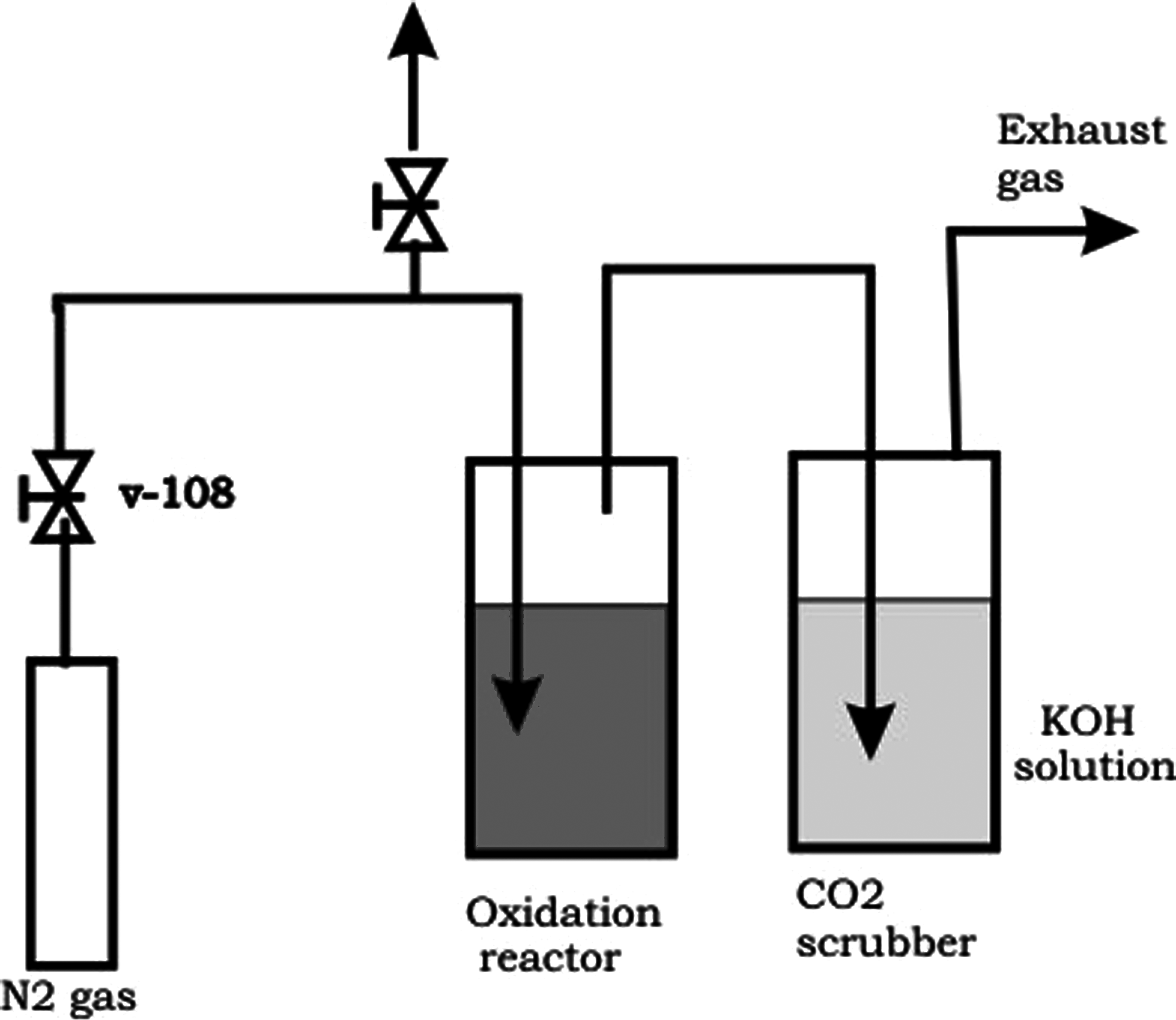
Schematic drawing of experimental apparatus.
Experimental procedure
For a standard reaction run, 200 mL of aqueous solution was used. It was prepared by adding a predetermined amount of ferrous iron and GA. In the carbon dioxide scrubber, 200 mL aqueous solution of 1 N potassium hydroxide was added. Both vessels were sealed and the predetermined amount of hydrogen peroxide was added. The reaction time started with the addition of hydrogen peroxide. For all experiments, the reaction time was 30 min. At the end of each experiment, nitrogen gas was supplied to the oxidation reactor, to facilitate gas products removal (10 more minutes). For all experiments, the initial pH value was 2.8 ± 0.2, within the range of the optimum pH values for Fenton oxidation process (Pignatello et al., 2006). The samples from the oxidation reactor were analyzed for total organic carbon (TOC) and phenolic compounds, and the samples from the carbon dioxide scrubber solution were analyzed for inorganic carbon concentration. All experiments were run in duplicate.
Statistical design
A factorial design could lead to an estimation of how a certain response variable is influenced by one or more other variables, called factors, and whether these factors in turn affect one another. Initially, the levels of each selected factor should be specified. Varying these levels leads to changes in the response. The response values are recorded at all level combinations of the factors, and the values thus determined are used to calculate the main and interaction effects of all factors. The main effect of a given factor estimates the average change in the response associated with changing the level of that factor from lower to higher. Interaction effects, on the other hand, are observed when a given factor's main effect depends on the levels at which the remaining factors are set (Bruns et al., 2006; de Souza e Silva et al., 2009a).
A wide range of Fenton's reagents concentrations were scanned by eight 22 factorial designs. They were performed sequentially to estimate the effects of two factors, the H2O2/GA and Fe2+/GA molar ratios, on the degradation of GA and on its mineralization as percentage of initial carbon converted in carbon dioxide. In all experiments, the GA concentration was maintained constant and equal to 0.026 M and the Fenton reagents' concentrations were estimated accordingly.
Higher and lower levels were chosen for the two factors according to the literature (DeHeredia et al., 2001; Benitez et al., 2006; Pignatello et al., 2006).
Figure 2 displays the levels used in the eight (A–H) designs. In a full two-level design, experiments are run at all possible combinations of the higher and lower levels of each factor. As in this case there are only two factors, there are four possible level combinations, to which a fifth one, at the central point, was added (de Souza e Silva et al., 2009a). The central points were run in duplicate to obtain a measure of experimental error, from which the statistical significance of the effects can be assessed (Bruns et al., 2006; de Souza e Silva et al., 2009a).
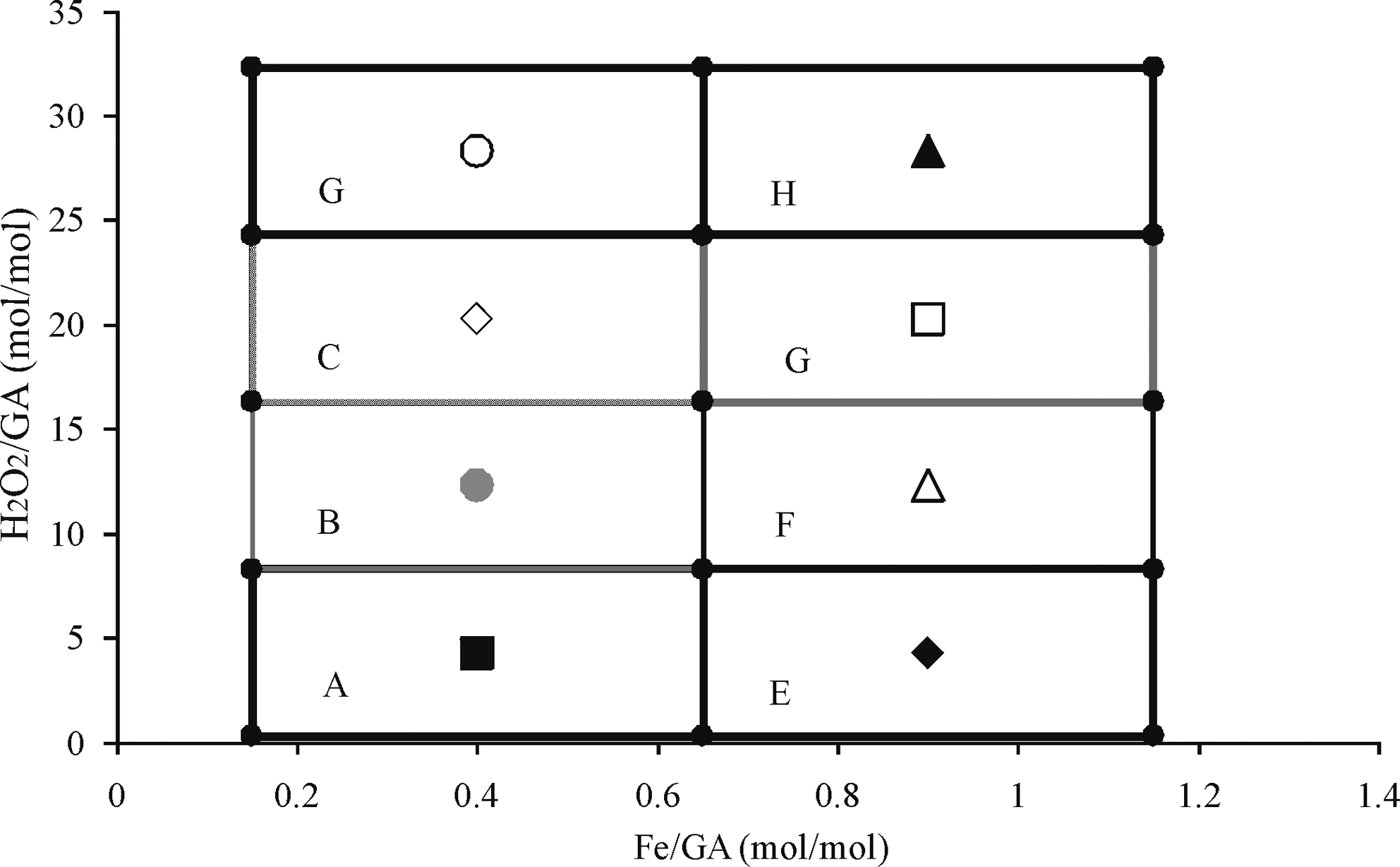
Variables' levels for two-level eight (A–H) factorial experimental designs.
From the experimental data of each design, a mathematical model was constructed. Its adequacy was checked by the Fisher criterion. The statistically important parameters of the constructed model were evaluated by Student's t-test (Vlyssides et al., 2008).
Analytical methods
Phenolic compound concentration was measured according to Folin-Ciocalteau method (Vlyssides et al., 2009). TOC was analyzed with a TOC Analyzer Dohrmann DC-80 (detection limit lower than 1 mg/L) after acidifying the sample with concentrated phosphoric acid (1 mL per 5 mL) and vortexing for 5 min to eliminate interferences from CO2. Inorganic carbon concentration was measured directly with the carbon analyzer.
Results and Discussion
Experimental runs were designed to investigate the effects of two independent variables on the GA removal and mineralization efficiency (carbon dioxide production) and also to determine the optimal conditions maximizing the removals. The independent variables were the molar ratio of hydrogen peroxide to GA (X1) and the molar ratio of ferrous ion to GA (X2). The response functions were the % GA degradation (Y1) and the % mineralization efficiency (Y2), expressed as carbon dioxide production. The experimental conditions and the results for both response functions of the whole experimental runs needed according to the factorial experimental design are summarized in Table 2.
GA, gallic acid.
From the results of Table 2, it is worth noticing that the % GA degradation ranged from 17.2% to 98.5% and mineralization efficiency from 1% to 50.7%. The wide range of response functions validates the choice of variables spectra.
Degradation of phenolic compounds
According to the results of the factorial experiment and by following a specific analytical procedure (Cochran and Cox, 1957; Alder et al., 1995), the linear models were estimated, interrelating the % degradation of GA (Y1) with the controlling parameters of the system (X1,X2). The adequacy of the mathematical models was checked by the Fisher criterion. In the cases wherein the linear model was not adequate, the interaction coefficients were needed to be accounted. The significance of the linear coefficients and their interactions were checked through statistical analysis. The derived results from the statistical analysis of the experimental data are presented in Table 3 as far as the GA degradation is concerned.
The response surface plot (Fig. 3) depicts the effect of the two controlling parameters (H2O2/GA and Fe2+/GA) on the degradation of GA.

Response surface plot of the effect of the H2O2/GA and Fe2+/GA molar ratios on percent GA degradation. GA, gallic acid.
From all data presented above, it is obvious that the % degradation of GA may reach a maximum of 95.5% ± 1.3%. The maximum GA degradation can be achieved either for the H2O2/GA molar ratio higher than 24.3 independently of the Fe2+/GA molar ratio or for the H2O2/GA molar ratio higher than 16.3 and the Fe2+/GA molar ratio higher than 0.65. The optimum experimental conditions for GA degradation could be justified by the analysis of the derived mathematical models presented below.
A quantitative estimation of the effect of a variable on the response factor can be made by the value of the variable coefficient in the mathematical model. The higher the coefficient value, the stronger will be the influence of the specific variable on the response factor. The sign of the coefficient indicates the positive or negative effect (Torrades et al., 2003; de Souza e Silva et al., 2009a, 2009b; Zhanga et al., 2009). From the equations presented in Table 3, it is obvious that for the H2O2/GA molar ratio ranging from 0.3 to 16.3 and the Fe2+/GA molar ratio ranging from 0.15 to 0.65, wherein both variables were significant, the effect of hydrogen peroxide is stronger than the respective influence of ferrous iron because the hydrogen peroxide coefficient is much higher than the ferrous iron coefficient. For high H2O2/GA molar ratio (from 16.3 to 24.3) and low Fe2+/GA molar ratio (0.15 to 0.65), the only significant variable was the Fe2+/GA molar ratio. This fact indicates that for excess hydrogen peroxide the increase of ferrous iron addition up to 0.65 mol/mol (Fe2+/GA) would promote GA degradation. On the other hand, for high Fe2+/GA molar ratio (0.65 to 1.15) and low H2O2/GA molar ratio (0.3 to 8.3), the only significant variable affecting GA degradation was the H2O2/GA molar ratio. These facts verify the classical free radical mechanism for H2O2 decomposition, wherein it is believed that the generation of hydroxyl radical is catalytic in iron, which can therefore be used in relatively low concentration (Pignatello et al., 2006)
When the H2O2/GA molar ratio ranged from 8.3 to 16.3 and the Fe2+/GA molar ratio from 0.65 to 1.15, the GA degradation was influenced by both variables and their interaction as well. The Fe2+/GA molar ratio and variables interaction had negative effect on the % GA degradation. High Fe2+/GA molar ratio above 8.3 had adverse effects on GA removal probably because of the hydroxyl ion scavenging effect of Fe2+. The results are in agreement with a literature report wherein a same effect of Fe2+ was observed in simazine oxidation with Fenton's reagents (Catalkaya and Kargi, 2009). In this case, Fe2+ dose significantly affected the percentage of simazine removal, which increased with increasing Fe2+ dose up to 15 mg/L Fe2+. Further increases in Fe2+ doses did not yield higher simazine removals. High Fe2+ doses above 30 mg/L had adverse effects on pesticide removal (Catalkaya and Kargi, 2009).
GA mineralization
The mechanism of phenolic compound oxidation is well established in literature. The main steps are the following: The first reaction step is the hydroxylation of the aromatic ring to yield hydroquinones, which are further oxidized by hydrogen abstraction to yield benzoquinones. Then, the benzoquinone ring is cleaved to form muconic acids, which decompose by OH• to form maleic, fumaric, and oxalic acids. All intermediates formed initially are finally oxidized to mainly oxalic and formic acids, which are finally destroyed after prolonged oxidation time by conversion to water and CO2 (Chen and Pignatello, 1997; Alnaizy and Akgerman, 2000; Kang et al., 2002; Lofrano et al., 2007; Klamerth et al., 2009). Thus, the overall oxidation of GA by the Fenton reagent can be described by the following reaction:
It is clear that the final product of the whole oxidation process is carbon dioxide, and thus, it could be an indicator of the whole oxidation process efficiency.
In most reports in literature wherein the TOC history was described, carbon dioxide concentrations were determined by material balances assuming that any unaccounted carbon mineralizes to carbon dioxide. In contrast, in this study, the carbon dioxide production was not indirectly calculated, but it was directly measured, because of the design of the experimental apparatus. The statistical error between the measured carbon dioxide and the estimated carbon dioxide from carbon mass balances in the reaction vessel was lower than 5% in all experiments. Thus, the proposed apparatus is reliable for carbon dioxide production monitoring during oxidation processes.
After the experimental data processing, the mathematical models concerning the second response factor, mineralization efficiency as percentage of initial carbon converted in carbon dioxide, presented in Table 4 were derived.
For all experiments, the mineralization efficiency ranged from 2% to 50%. These percentages were much lower than GA removals, indicating incomplete degradation of GA and formation of some intermediate products during the oxidation reaction, which remained in the aqueous solution without being completely degraded to CO2 and H2O.
The mineralization efficiency reached a plateau of 41.6% ± 2.8% for the H2O2/GA molar ratio higher than 16.3 independently of the Fe2+/GA molar ratio. For lower H2O2/GA ratios (from 0.3 to 16.3), the only statistically significant variable was the H2O2/GA molar ratio. Increase of the H2O2/GA molar ratio resulted in an exponential increase of mineralization efficiency. The observation that the H2O2/GA molar ratios greater than 16.3 did not result in proportional higher mineralization efficiencies can be attributed to hydroxyl radical (HO•) scavenging by excess H2O2 and consequent formation of the less reactive radical HO2• as presented by the following reactions:
The adverse effects of excess peroxide doses were also pointed out by Glaze et al. (1995), Beltran et al. (1996), and Catalkaya and Kargi (2009).
The mineralization efficiencies of 40%–50% achieved in this study are significantly elevated in comparison with the respective values reported in literature. Alnaizy and Akgerman (2000) reported that in a typical run, ∼10 wt.% of the initial carbon present in phenols was converted to CO2 in the first hour. Catalkaya and Kargi (2009) reported that the maximum TOC removal for simazine Fenton oxidation was 32% under the H2O2/Fe2+/simazine ratio equal to 55/15/3 (mg/L). The high values of mineralization efficiency could be due to the higher iron concentration used in the experiments of this study. The high availability of ferrous iron cations could have a positive effect on the exploitation of the whole amount of oxidant used.
Conclusions
The oxidation of one of the most representative phenolic compounds present in industrial wastewater (GA) using Fenton's reagents could be achieved in great extension. High GA removals indicated effective breakdown of the phenolic compound, whereas lower mineralization efficiencies indicated incomplete GA degradation and formation of intermediary products, which were not completely mineralized to CO2 and H2O.
The factorial experimental design was used to generate statistically reliable results for oxidation of GA by Fenton's reagent and also for determination of optimum conditions maximizing the GA and TOC removals. The statistical analysis of the experimental data provided better understanding of the roles of Fe2+ and H2O2 doses in the degradation of GA for a large range of concentrations.
It was proven that the % degradation of GA may reach a maximum of 95.5% ± 1.3%. The maximum GA degradation can be achieved either for the H2O2/GA molar ratio higher than 24.3 independently of the Fe2+/GA molar ratio or for the H2O2/GA molar ratio higher than 16.3 and the Fe2+/GA molar ratio higher than 0.65. It was also proved that for low H2O2/GA (0.3 to 16.3) and Fe2+/GA (0.15 to 0.65) molar ratios, both variables were significant, whereas for excess hydrogen peroxide only the increase of ferrous iron addition up to 0.65 mol/mol (Fe2+/GA) promoted GA degradation. Further increase of the Fe2+/GA molar ratio (>8.3) had adverse effects on GA removal probably because of hydroxyl ion scavenging effect of Fe2+.
As far as mineralization efficiency is concerned, it reached a maximum of 41.6% ± 2.8% for the H2O2/GA molar ratio higher than 16.3 independently of the Fe2+/GA molar ratio. Increase of the H2O2/GA molar ratio (from 0.3 to 16.3) resulted in an exponential increase of mineralization efficiency. The Fe2+/GA molar ratio proved to be a statistically insignificant parameter for the value ranges examined.
Conclusively, the results of a factorial design experiment could be used for Fenton oxidation optimization and they could also enlighten the mechanism of oxidation process.
Author Disclosure Statement
No competing financial interests exist.