




Abstract
Abstract
A modified trapezoidal-shaped fuzzy chance-constrained mixed-integer programming (TFCMP) model was advanced for municipal solid waste (MSW) management. Compared with conventional methods, TFCMP was advantageous in handling fuzzy-type uncertainties in both the left- and right-hand sides of model constraints and could be used to reflect the possibility of constraints violation at predefined confidence levels. Mixed-integer programming (MIP) was embedded into the general framework of TFCMP for handling capacity-expansion issues. The solid waste management system in a typical Chinese city was used to demonstrate the applicability of TFCMP. Study results indicated that a variety of cost-effective MSW-flow allocation solutions could be obtained from TFCMP under various scenarios of system reliability. A trade-off between the total system cost and the reliability of satisfying model constraints can be analyzed to gain an in-depth insight into the characteristics of MSW systems. Generally, decision alternatives with lower system cost would be obtained if the environmental requirement was less strict; however, this may lead to a higher system failure risk. On the contrary, a more costly management scheme would ensure the environmental constraints be satisfied with a higher degree of reliability. The proposed model could assist decision makers in identifying effective waste allocation patterns and expansion options, with both cost and risk information being considered under complex uncertainties. TFCMP is also applicable to other management fields and its function could be extended through coupling with other inexact optimization methods.
Introduction
Previously, a number of FCCP applications in various fields were reported. Liu and Iwamura (1998) first extended chance-constrained programming from stochastic to fuzzy environments and discussed the definition, types, and solution methods of the FCCP. Rong and Lahdelma (2008) modeled a scrap-charge optimization problem through FCCP and evaluated the trade-off between the system economy and reliability. Cao et al. (2009) developed a hybrid stochastic and fuzzy chance-constrained mixed-integer programming (MIP) model for solving a refinery crude oil scheduling problem under demand uncertainty. Xu et al. (2010) advanced an inexact fuzzy chance-constrained model for supporting regional air quality management under uncertainty, where ILP was effectively embedded into an FCCP framework.
Nevertheless, applications of FCCP in the environmental management field were very limited. In terms of methodology, most of the previous studies focused on tackling fuzzy parameters in the right-hand side of model constraints (i.e., single-sided) and solving models through transferring the fuzzy constraints into their equivalent crisp formats (Liu and Iwamura, 1998). These methods will encounter difficulties when both sides of the models are associated with uncertainties (i.e., double-sided). In addition, the previous FCCP models could hardly handle binary-decision (i.e., yes/no decision) problems, which may be important for seeking solutions to capacity-expansion or operation-scheduling issues (Li et al., 2008). It is thus desired that a more effective FCCP model be advanced.
The objective of this study was to advance a modified trapezoidal-shaped fuzzy chance-constrained mixed-integer programming (TFCMP) model for supporting municipal solid waste (MSW) management. In TFCMP, uncertainties associated with model parameters in both left- and right-hand sides of optimization models will be tackled as trapezoidal fuzzy sets. Fuzzy chance constraints will be introduced for addressing the possibility of constraint violations at allowable confidence levels. MIP will be embedded into the general framework for handling capacity-expansion issues. The proposed model will be applied to a real-world solid waste management case in a typical Chinese city. The overall structure of the article will be arranged as follows: (i) formulation of a general TFCMP model; (ii) illustration of the proposed method through a simple numerical example; (iii) application of the developed model to a real-world solid waste management case; and (iii) analysis of the results and discussion of the applicability TFCMP.
Methodology
Trapezoidal-shaped FCCP
Trapezoidal-shaped fuzzy chance-constrained programming (TFCCP) was first proposed by Liu and Iwamura (1998). In the TFCCP model, the left- and right-hand side coefficients in some specific constraints are presented by the trapezoidal fuzzy numbers, and the reliability of system's ability to meet fuzzy constraints is expressed as a series of predetermined confidence levels. According to Liu and Iwamura (1998), a general TFCCP model could be written as:
Subject to:
where f is the objective function value; X is a vector of deterministic decision variables;
To solve model (1), some specific algorithms for the trapezoidal fuzzy set are defined as: (i) the sum of two trapezoidal fuzzy sets is also a trapezoidal fuzzy set; (ii) the product of a trapezoidal fuzzy set and a scalar number is also a trapezoidal fuzzy set (Liu and Iwamura, 1998). The related operations are represented as follows:
where
where L(x) is a linear function of the variable x. According to the Liu and Iwamura (1998), L(x) could be converted to
Then, L+(x) and L+(x) are all nonnegative. Moreover, the linear function K(x,ã) can be written as follows:
where
For the any confidence level α, the following equations can be obtained:
Based on Eq. (7), the fuzzy chance constraints (1b) can be transformed to their respective crisp equivalents at a predetermined confidence level. The transformed deterministic model can be formulated as follows:
Subject to:
Finally, the fixed objective function values and decision variables (i.e., fopt and xopt) can be obtained through solving model (8). The related proof of the lemma can be referred to the work of Liu and Iwamura (1998).
A numerical example
To demonstrate the procedures of using the proposed method, a numerical example is presented. Let an FMP model be written as follows:
Subject to:
where (0.7, 1, 1.5, 2), (4.5, 6, 8, 11), (5, 6, 6.5, 8), (5.2, 7, 9, 10.5), (−3, −2, −1, −0.5), and (260, 275, 285, 300) are trapezoidal fuzzy sets, respectively.
The fuzzy constraints (9d) and (9e) could be satisfied at a specific confidence level α, such that the general FMP model can be transformed to a crisp equivalent as follows (Liu and Iwamura, 1998):
Subject to:
Table 1 shows the obtained solutions at different confidence levels (i.e., α-cut level) for the numerical example. Obviously, as α-cut level increases (from 0.1 to 0.9), x1 would decrease and x2 would increase. This will lead to the decrease of the objective function value. This is because, as the confidence level increases, the fuzzy chance constraints would become stricter based on the TFCCP algorithm. It also appears that the high objective-function values can only be obtained in situations when the fuzzy constraints are violated. This also reveals that TFCCP is advantageous in helping evaluate the trade-off between the system costs and reliabilities.
Overview of study case
In this study, an MSW management system in the City of Foshan, China, will be used for demonstrating the applicability of the proposed method. This case has been thoroughly discussed by Su et al. (2008, 2009). The study considers three planning periods with each one containing 5 years. The generated wastes from multiple districts should first be collected and transported to their respective transfer stations and then allocated to various waste treatment/disposal facilities, such as the landfill, the incinerators, and the composting plant (as shown in Fig. 1). Over the past decades, the local managers were facing difficulties of managing waste flows in a cost-efficient manner in light of the impacts of uncertainties, high cost of waste treatment, limited space for landfills, and limited governmental incentives for waste diversion. Therefore, how to build a rational waste management model for tackling these complexities was highly interested by the local managers.

Municipal solid waste management system.
Table 2 shows the related parameters based on the paper by Su et al. (2008). Among various treatment facilities, the landfill is used to meet the demand of waste disposal or to receive residues from the incinerators and composting plant; it has a stable cumulative capacity and will be treated as a fixed value. The incinerator and the composting plant have revenue returns but are limited by their daily operating capacities. Because of the significant variations in the capacities and treated amounts for the incinerators and composting plants, the related parameters will be expressed as trapezoidal fuzzy sets. For example, the existing capacities of the Shishan and Xingtan incinerators and the Gaoming composting plant are (850, 1,000, 1,230, 1,400), (820, 980, 1,160, 1,350), and (370, 400, 450, 490) tons (t)/day (d), respectively. As the waste generation rates may keep increasing, the capacity-expansion plans for waste treatment facilities would have to be considered in order to meet the overall waste-disposal demands in the upcoming time periods. The related parameters associated with the expansion options, such as expansion costs and expand capacities, are listed in Table 3. Further, the design safety coefficients for the waste treatment facilities (i.e., the incinerator and composting plant) and the transfer stations need to be incorporated into the management model in order to guarantee the satisfaction of the waste disposal and storage demands. They could be identified through expert consultation and round-table discussions among various stakeholders. As the safety coefficients are subjected to human judgment, they will be described as fuzzy. The design safety coefficients for the incinerators, composting plant, and transfer stations are determined to be (1.35, 1.45, 1.65, 1.8), (1.25, 1.42, 1.5, 1.7), and (1.15, 1.3, 1.4, 1.52), respectively (Su et al., 2008).
(r, s, p, q) represents a trapezoidal-shaped fuzzy set, with r, s, p, and q being the four sequential parameters from left to right.
t/d, tons/day.
The related data were referred from Su et al. (2008).
To prolong the lifespan of the current landfills and increase the reuse and recycling amounts of wastes, the government has set some specific diversion goals to ensure a certain proportion of the wastes be diverted to incinerators and composting plants. Table 4 shows the three types of diversion goals, representing the three policy scenarios for the future MSW management. The unit transportation costs and the unit operational costs of the stations and facilities, the unit revenues from the incinerators and composting plants, are relatively stable and are treated as fixed values (as shown in Table 5). Other related parameters, such as the distances between the stations and facilities, are referred from the work by Su et al. (2008).
The related data were referred from Su et al. (2008).
Formulation of a TFCMP model
Based on the general TFCCP and MIP models, a modified TFCMP model for the City of Foshan can be formulated as follows (Su et al., 2008, 2009):
Objective function:
Subject to:
(1) Constraints of treatment/disposal capacity:
(2) Capacity constraints for transfer stations:
(3) Mass balance equations:
(4) Regulated diversion rates of waste to various treatment/disposal facilities:
(5) Constraints of capacity-expansion options:
BUluk, BVlvk, and BWcwk are integers;
(6) Nonnegativity constraints:
where f is net system cost ($); k (k=1, 2,…, K) is index of time periods, where K is number of time periods; k′ is an intermediate index satisfying 1≤k′≤k; LEk is length of time period k (days); l, i, and c (l=1, 2,…, L; i=1, 2,…, I; c=1, 2,…, C) are indexes of specific landfills, incinerators, and composting plants, respectively; L, I, and C are numbers of landfills, incinerators, and composting plants; j (j=1, 2,…, J) is index of transfer stations, where J is number of transfer stations; u (u=1, 2,…, U) is index of expansion options for landfills, where U is number of options; v (v=1, 2,…, V) is index of expansion options for incinerators, where V is number of options; w (w=1, 2,…, W) is index of expansion options for composting plants, where W is number of options; XLjlk, XIjik, and XCjck are decision variables representing waste flows from transfer station j to landfill l, incinerator i, and composting plant c during period k (t/d), respectively; YIilk and YCclk are decision variables representing residue flows from incinerator i to landfill l and from composting plant c to landfill l during period k (t/d), respectively; BUluk, BVivk, BWcwk are binary variables (i.e., expressed as 1 or 0, representing yes or no answers) for landfill l with option u, incinerator i with option v, and composting plant c with option w during period k, respectively; CALl, CÃIi, and CÃCc are existing capacities of landfill l, incinerator i, and composting plant c (t/d), respectively; ΔCLluk, ΔCIivk, and ΔCCcwk are capacity-expansion amounts for landfill l with option u, incinerator i with option v, and composting plant c with option w during period k (t/d), respectively; DLjl, DIji, DCjc are transportation distances from transfer station j to landfill l, from transfer station j to incinerator i, and from transfer station j to composting plant c (km), respectively; DRIil and DRCcl are transportation distances from incinerator i to landfill l and from composting plant c to landfill l (km), respectively; ELluk, EIivk, and ECcwk are unit expansion costs for landfill l with option u, incinerator i with option v, and composting plant c with option w during period k ($/t), respectively; FIk and FCk are residue rates from incinerator to landfill and from composting plant to landfill during period k (%), respectively; GIk, and GCk are maximum allowable diversion rates of waste flows to incinerators and composting plants during period k (%), respectively;
The objective function (11a) is to achieve the minimum overall system costs (i.e., the difference between the total costs and revenue) through effectively allocating the waste flows from transfer stations to the treatment/disposal facilities. In detail, the system costs include the transportation and operational costs for the transfer stations, operational costs for the treatment facilities, and revenue for the incinerators and composting plants. The constraints (11b) to (11d) are the treatment capacity constraints for waste treatment/disposal facilities. Different from landfill, the capacity expansions for the incinerator and composting are cumulative processes; an intermediate index k′, which ranges from 1 to k, could be used to reflect such a fact. For example, when k is 1 (i.e., the first stage), k′ should be 1 as well; when k becomes 2 (i.e., the second stage), k′ will range from 1 to 2, showing a cumulative effect of the first and second stages. Moreover, the peak flows resulting from the random arrival and service times of waste-delivery vehicles may also raise a risk of insufficiency in the incinerator and composting facilities. The introduction of the design safety coefficient (
Steps of solving a TFCMP model
The proposed TFCMP model is capable of handling uncertainties in fuzzy formats and allowing the violation of constraints in the waste management system within an acceptable limit (i.e., confidence level); the binary integer variables are also incorporated into the models to reflect capacity expansion issues. The obtained solutions (including both continuous and binary variables) at different confidence levels can help decision makers analyze tradeoffs between system economy and reliability. Figure 2 shows the general framework of TFCMP. The detailed procedures of applying a TFCMP model are summarized as follows:
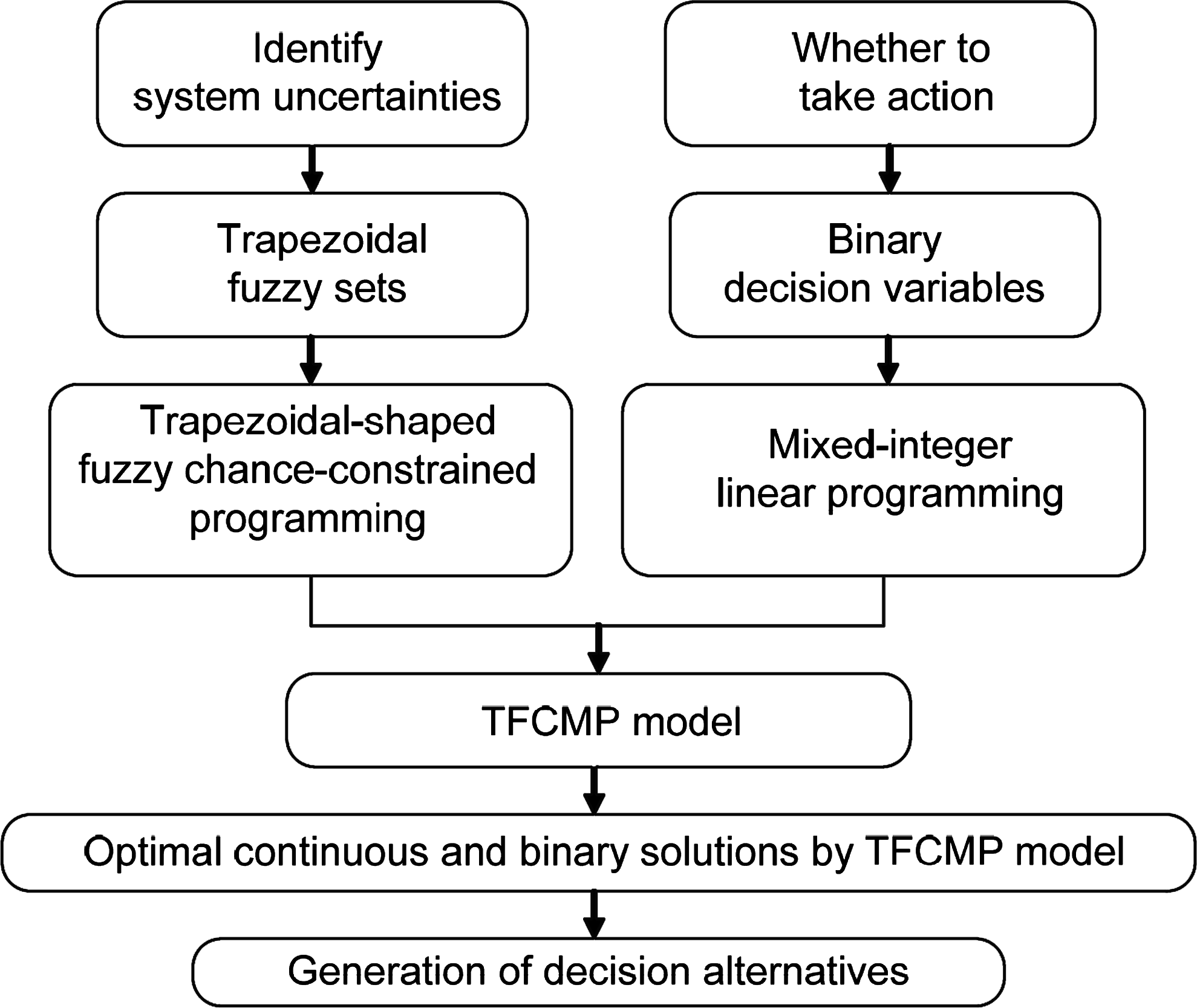
Framework of a trapezoidal-shaped fuzzy chance-constrained mixed-integer programming (TFCMP) model.
Step 1: Identify all uncertain variables and acquire the related fuzzy distribution and binary parameter information in the waste management system;
Step 2: Formulate a TFCMP model;
Step 3: Convert the fuzzy chance constraints to their respective crisp equivalents;
Step 4: Generate the final solutions.
Results and Discussions
Figure 3 presents the solutions of continuous decision variables at a fixed α-cut level (i.e., 0.8) under different scenarios obtained from TFCMP. Table 6 shows the solutions of continuous decision variables at different α-cut levels under Scenario 3. They can be used to describe the optimized allocation patterns of waste flow. Figure 4 shows the obtained expansion plans at different α-cut levels.
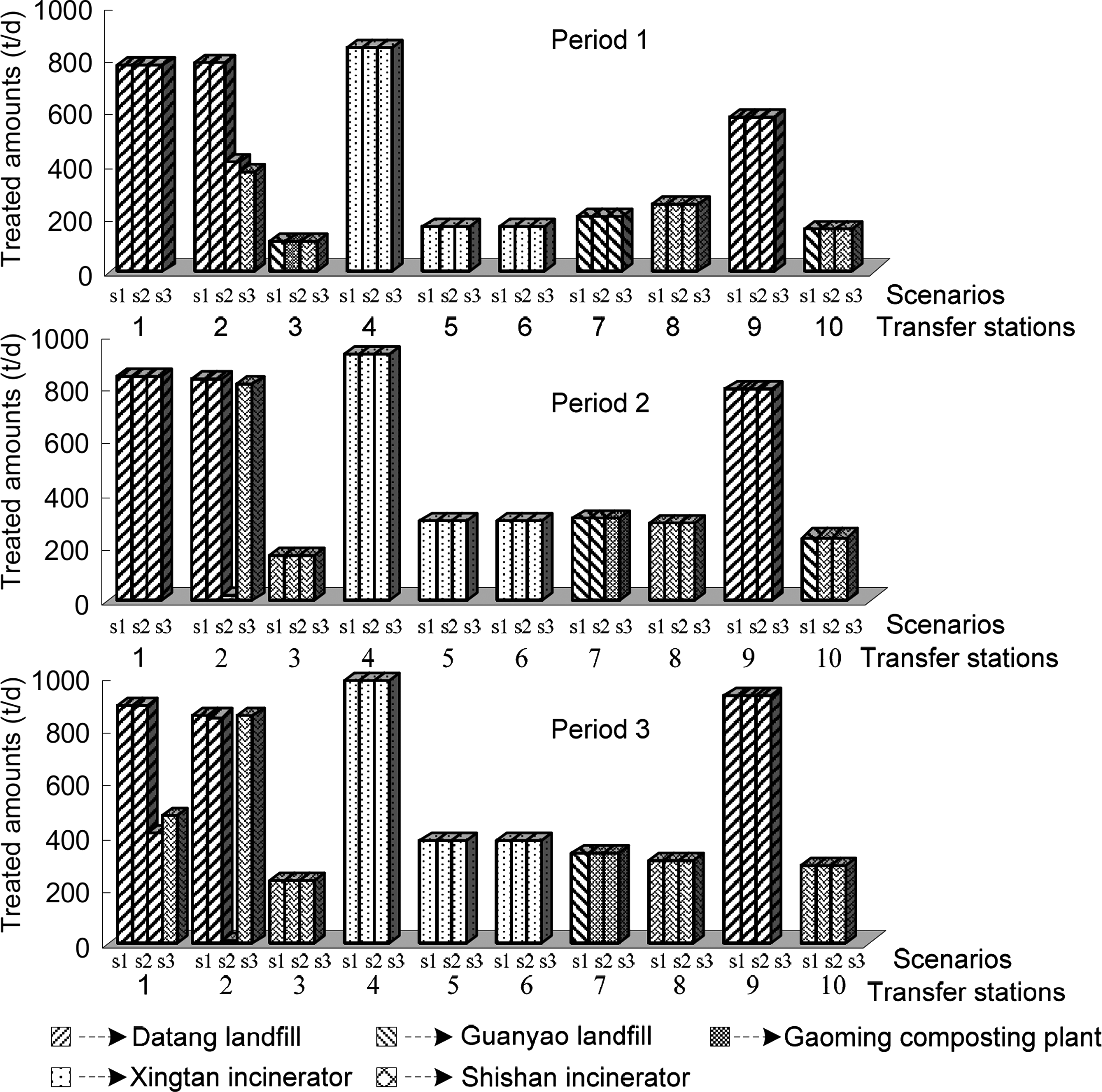
Optimized waste-flow allocation patterns over the three periods.

The optimized capacity expansion scheme over the three periods.
Transfer stations with zero amount of waste being allocated to a specific treatment facility are not listed.
From Fig. 3, under Scenario 1, the existing capacities of the waste treatment facilities and the distances between the transfer stations and facilities are two major factors in affecting the model solutions. As there is no diversion requirement, the waste flow would be assigned to the landfill in priority, followed by incinerators and composting plant. For example, at the significance level of 0.8, the total treated amounts (over the three periods) by the three landfills would be 3,200.70, 3,561.8, and 3,990.17 t/d, respectively. Those by the incinerators would be 1,262.92, 1,908.57, and 2,196.49 t/d, respectively. No waste flow would be allocated to the composting plant. This is because the landfills have the highest treatment capacities (at an average of 1,4246.58 t/d), the incinerator ranked in the middle (1,000 t/d), and the composting plant has the least treatment capacity (i.e., 400 t/d). Moreover, the allocated patterns of the waste flow also dominate the result of capacity expansions. From Fig. 4, at a significance level of 0.2, the Shishan incinerator would be expanded at the start of period 3 with an increment of the 400 t/d. As for the landfill and the composting plant, no expansion would be required. This is mainly due to the fact that the existing capacities of the landfill sites are sufficient to accommodate the generated wastes. In addition, the results of the waste flow allocation among the same type of facilities mainly depend on the distances between the transfer stations and facilities. For example, Table 6 shows that the waste flow in the Luocun district would be completely allocated to the Datang landfill. This is because the Datang landfill has a closer distance to Luocun district than the Guanyao and Gaoming landfills (Su et al., 2008, 2009). The results demonstrated that the proposed model could effectively analyze the complex interrelations among system components and generate cost-effective MSW-flow schemes.
Compared with the solutions under Scenario 1, the allocated waste-flow patterns under Scenarios 2 and 3 have considerable variations at the same significance levels. As shown in Fig. 3, the amounts of allotted waste to the landfills would be considerably reduced; meanwhile, the treated waste amounts by the incinerator and composting plant would increase. For example, at a significance level of 0.8, the allocated amounts from the Dali district to the Datang landfill under the three scenarios in period 3 are 852.53, 846.57, and 0 t/d, respectively; those to the Shishan incinerator are 0, 5.96, and 852.53 t/d, respectively; those from Genglou district to the Gaoming composting plant are 0, 337.78, and 337.78 t/d, respectively. This is because the diversion goals would force a certain amount of waste be allocated to the incinerators and composting plant. Moreover, the variations of allocated patterns also lead to the changes of expansion plans. From Fig. 4, at a significance level of 0.1, the incinerators and composting plant under Scenario 1 would not be expanded. Under Scenario 2, the Shishan incinerator would be expanded at period 3 with an increment of 400 t/d. The Gaoming composting plant would be expanded at period 2 with an increment of 600 t/d. Under Scenario 3, the Xingtan incinerator would be expanded twice at periods 2 and 3, with each having an increment of 600 t/d. The Gaoming composting plant would be expanded twice at periods 1 and 2, with each having an increment of 600 t/d.
Figure 5 shows the system cost at different α-cut levels under various scenarios. It was found that the model tends to neglect other influencing factors such as the unit operational cost and the unit transportation cost in order to achieve the diversion goal regulated by the government. This, unavoidably, will lead to the increase of system cost. For example, at a significance level of 0.1, the system costs under the three scenarios are 746, 6,100, and 8,740 (× 106 $), respectively. The waste allocation patterns with high costs could prolong the service life of the landfill and ensure more waste be reused and recycled. It is of great significance from the perspective of environmental protection and resource conservation.

Trade-off between the total cost and the untreated waste amount.
Table 6 also shows that any changes in the α-cut values would yield different waste-flow allocation and expansion patterns. Under Scenario 3, with the increase of α-cut levels, the total treated waste amounts from treatment/disposal facilities would increase. For example, in period 1, the allotted amounts to the landfill under α-cut values of 0.2, 0.4, 0.6, and 0.8 are 1,763.78, 1,874.21, 1,990.14, and 2,111.83 t/d, respectively. The allocated waste flows to the incinerators are 1,772.94, 1,817.58, 1,862.22, and 1,906.86 t/d, respectively. This is because, as the α-cut level increases, the treatment requirement would become stricter. Moreover, with the increase of α-cut levels, more expansions would be needed. For example, under Scenario 3, at a significance of 0.1, the Shishan incinerator would be expanded at period 2. The Gaoming composting plant would be expanded twice at periods 1 and 2; at a significance of 0.9, both the Shishan incinerator and the Gaoming composting plant would be expanded three times at periods 1, 2, and 3.
Figure 5 also shows the tradeoffs between system costs and the total untreated waste amounts under the three scenarios. The total untreated amount is defined as the difference between the actual treated waste amounts and the total waste generation rates (at the maximum possibility level). It is indicated that the system cost would increase as the increase of α-cut levels; also, the total untreated amounts would decrease. For example, under Scenario 2, the total costs would increase from 6,100 to 6,680 (× 106 $) when α-cut levels changes from 0.1 to 0.9; the total untreated amounts would decrease from 9,291 to 7,001 t. The results imply that a lower system cost could lead to a higher system failure risk (i.e., high untreated amount); conversely, a higher investment would ensure a more reliable system management scheme.
Generally, the above results demonstrated that TFCMP is capable of handling solid waste management problems in the City of Foshan under uncertainties. The model allows fuzzy constraints be satisfied at the specified confidence levels, such that cost-effective solutions could be obtained under various scenarios of system reliability. A trade-off between the total system cost and the reliability of satisfying model constraints can be analyzed to gain an in-depth insight into the characteristics of MSW systems. From the result analysis, it is revealed that the major advantages of TFCMP are that it could help (i) address uncertainties in solid waste management systems as trapezoidal fuzzy sets, (ii) use the concept of confidence levels of constraints satisfaction to obtain cost-effective solutions, (iii) incorporate scenario analysis into the framework and examine the trade-off between the system economy and environmental protection, (iv) analyze the trade-offs between system costs and risk, and (v) provide decision supports for waste managers in identifying effective MSW-flow plans and facility-expansion options.
To show the advantages of the proposed TFCMP, a conventional deterministic mixed-integer programming (DMIP) model is also applied to the solid waste management system of the City of Foshan for comparison. The related parameters are set as the averaged most likely values listed in Table 2. For example, the fuzzy generation rate at Longjiang is (227, 240, 260, 275) t/d; the averaged most likely value will be (240+260)/2=250 t/d. Figure 6 shows the comparison of the total treated waste amounts between DMIP and TFCMP models. The total treated waste amounts through DMIP are obviously higher than those obtained through TFCMP at different α-cut levels. Moreover, more expansion options are expected to be undertaken in order to meet the waste disposal demand. Under Scenario 3, the Shishan incinerator would be expanded at periods 2 and 3. The Xingtan incinerator would be expanded at period 2. The Gaoming composting plant would be expanded at periods 1 and 3. Such a plan would lead to the increase of the total system cost. For example, the total cost under the three scenarios are 1,240, 7,160, and 10,000 (× 106 $), respectively. The results are considerably higher than those obtained through TFCMP.
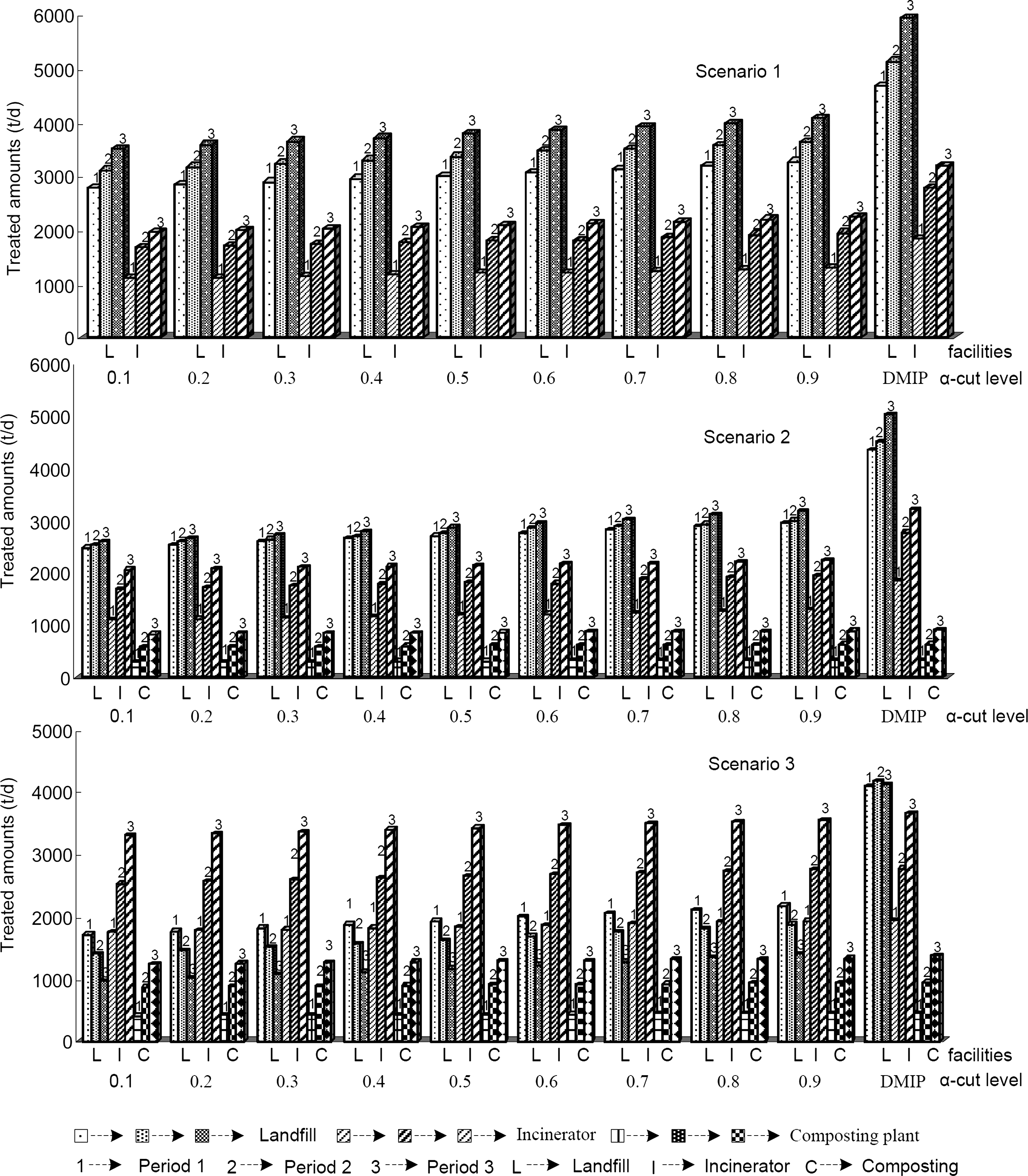
Comparison of solutions between TFCMP and deterministic mixed-integer programming.
From comparison, it is found that DMIP is incapable of handling uncertainties and reflecting constraint violations. In MSW management systems, the uncertainties are quite common and may be associated with many system components. The solutions from deterministic models are only special cases among all possible alternatives and are less reliable to be used for supporting decision making. A DMIP model also does not allow violation of system constraints, leading to relatively high system cost and overstringent protection of environment. TFCMP can tackle all these issues and is more advantageous. However, TFCMP also shows a number of limitations. First, a critical step of solving TFCMP is to predefine the confidence levels, as they significantly influence the model solutions. How to choose an appropriate confidence level of constraints satisfaction is currently arbitrary and deserves further investigations. Second, the shape of the fuzzy membership functions is limited to be trapezoidal; this is to facilitate the transformation of fuzzy chance constraints into their equivalent crisp constraints. In many applications, the shape of the fuzzy parameters may be more complicated and could be hardly handled by TFCMP. A more sophisticated approach such as genetic algorithm-aided optimization could be a viable solution for general conditions (Liu and Iwamura, 1998). Third, TFCMP is also incapable of handling multiple uncertainties, which are very common when different levels of data quality exist.
Conclusions
A modified TFCMP model was developed for MSW management under uncertainty. The TFCMP model improved upon the existing FCCP by allowing manipulation of uncertainties at both sides of model constraints and incorporation of MIP for dealing with capacity-expansion issues of waste treatment/disposal facilities. TFCMP was applied to a real-world solid waste management case in a typical Chinese city. The study results demonstrated that TFCMP allowed violation of system constraints at specified confidence levels defined as fuzzy possibilities. Decision alternatives with a lower system cost would be obtained when the environmental protection was less concerned; this may lead to higher system failure risks. Conversely, a more expensive management scheme would ensure environmental constraints be satisfied with a higher degree of reliability. The proposed method could help decision makers identify effective waste allocation patterns and expansion options, with both cost and risk information being considered under complex uncertainties.
Although the proposed model has been demonstrated effective in this study, there is still much space for improvement. For example, the identification of predetermined confidence levels of constraints satisfaction is quite subjective and needs further investigations. The shape of the fuzzy membership functions is limited to be trapezoidal for ensuring a successful transformation of fuzzy chance constraints into their equivalent crisp ones; a more general method is desired to be developed for solving such a problem. Nevertheless, this study made a valuable attempt in applying TFCMP to an environmental management problem. The results implied that the proposed method was also applicable to many other environmental problems, such as air quality management and water resources management. In addition, many other uncertainty analysis methods such as ILP and SMP could be integrated with TFCMP for handling more complicated problems (Qin et al., 2007; Xu et al., 2010).
Footnotes
Acknowledgments
This research was supported by Nanyang Technological University (NTU) start-up grant (SUG-M58030000) and DHI-NTU Water and Environment Research Centre and Education Hub. The authors deeply appreciate the reviewers' and editor's careful review and insightful comments, which have contributed much to improving the manuscript.
Author Disclosure Statement
No competing financial interests exist.