




Abstract
Abstract
Differences in ozone (O3), nitrogen oxides (NOx), and respirable suspended particulate (RSP) weekday and weekend concentrations in Hong Kong were investigated. Data were collected hourly by the Hong Kong Environmental Protection Department from January 1999 to October 2007 at 14 sites: 9 urban, 4 newly developed, and 1 rural station. Weekend O3 concentrations were 14% and 22% higher for the afternoon peak O3 time and 8-h O3 average concentrations, respectively, at six urban stations, whereas NO2 and NOx concentrations were 19% and 25% lower, respectively, during the afternoon O3 peak time on weekends. No significant differences in peak afternoon O3 concentrations were found at the newly developed or rural stations. Weekend RSP concentrations were lower at most urban stations. Urban RSP concentrations were lower on weekends than weekdays, by 14% for the morning rush hour and 8% for the daily average RSP. O3 formation sensitivity to volatile organic compounds and lower weekend NOx emissions could explain the O3 weekend effect in urban Hong Kong. Lower weekend RSP concentrations are predominantly the result of fewer anthropogenic emissions, primarily due to decreased traffic flow.
Introduction
Numerous large Chinese cities have experienced severe air pollution with the recent surge in economic growth. However, few studies have examined differences in weekday and weekend air pollution levels. This study investigated weekday and weekend O3, NO2, NOx, and RSP pollution levels in Hong Kong. O3 and RSP weekend effects were observed in urban centers, especially in downtown areas, where traffic contributes greatly to NOx and RSP emissions and varies more between weekdays and weekends. The basic mechanisms of O3 formation are as follows:
Patterns in O3 formation, destruction, and accumulation become more complex with other interactions. Chan et al. (1998) suggested that the prevailing air mass from the north industrial Pearl River Delta region is rich in O3 precursors and could contribute greatly to the elevated O3 levels in Hong Kong. Lau et al. (2008) observed lower NO2, NOx, and RSP emissions on Sundays and a positive correlation between traffic levels and NO2, NOx, and RSP concentrations in urban areas. Further, industrial activities, such as construction, may decrease on weekends, further reducing weekend RSP concentrations.
Data and Methods
Hong Kong is an international metropolis on the south coast of China with a subtropical monsoon climate. It has a population of about 7,026,400 in an area of about 1,104 km2. Hourly data, collected from January 1990 to October 2007 downloaded from the Hong Kong Environment Protection Department website, were used for this study (http://epic.epd.gov.hk/ca/uid/cairdata/p/1). The Hong Kong Air Quality Monitoring Network comprised 14 fixed monitoring stations (Fig. 1): Causeway Bay (CB), Central (C), Central Western (CW), Eastern (E), Kwai Chung (KC), Kwon Tong (KT), Mong Kok (MK), Sham Shui Po (SSP), Tsuen Wan (TW), Sha Tin (ST), Tai Po (TP), Tung Chung (TC), Yuen Long (YL), and Tap Mun (TM).
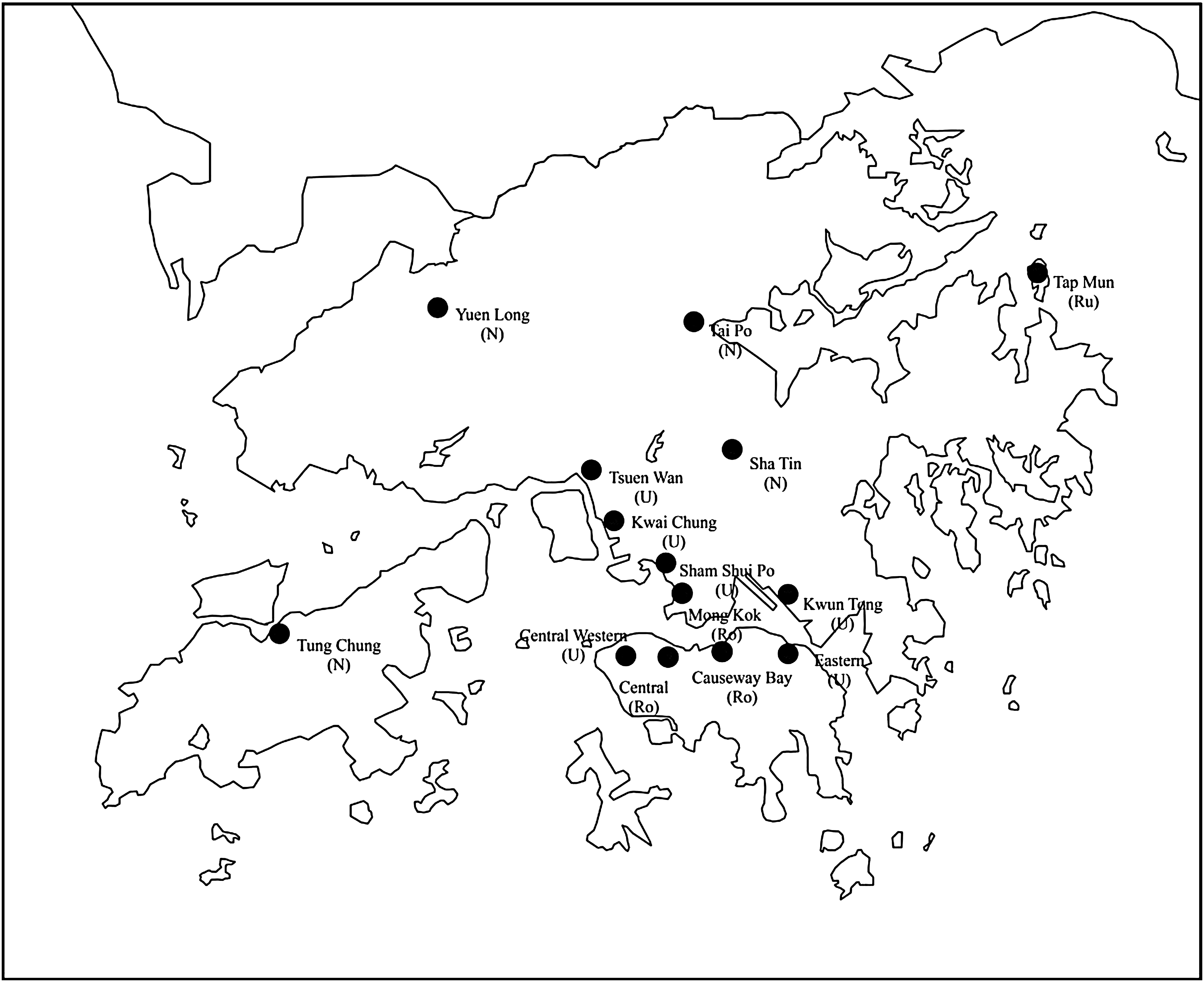
Distribution of the fourteen monitoring stations in Hong Kong, where (Ro) stands for Roadside Station; (U) stands for Urban Station; (N) stands for New Town Station; (Ru) stands for Rural Station.
Characteristics of the pollutants monitored at each station are listed in Table 1. The stations are classified into three groups, based on location: nine urban, including three roadside stations, four newly developed stations, and one rural station. The urban stations reflect urban characteristics, including densely populated residential areas with commercial and industrial development. The newly developed stations reflected air pollution in new residential areas with rapid development close to urban centers. The rural station was on an outlying island 15 km from the nearest developed area and represents background pollution levels in Hong Kong. Sulfur dioxide was measured using UV fluorescence (TECO Model 43A; Monitor Laboratories 8850), NO2 with a chemiluminescence analyzer (API 200A; Monitor Laboratories 8840), CO using nondispersive infrared absorption with gas filter correlation (TECO Model 48, 48C), and RSP with a gravimetric or oscillating microbalance (Graseby Andersen PM10 R&P TEOM Series 1400a-PM10).
Monitoring station names are abbreviated: Causeway Bay (CB), Central (C), Central Western (CW), Eastern (E), Kwai Chung (KC), Kwon Tong (KT), Mong Kok (MK), Sham Shui Po (SSP), Tsuen Wan (TW), Sha Tin (ST), Tai Po (TP), Tung Chung (TC), Yuen Long (YL), and Tap Mun (TM).
RSP, respirable suspended particulate.
O3, its NOx precursors, and RSP were selected for evaluation in this study based on previous studies (Qin et al., 2004; Blanchard and Tanenbaum, 2006; Murphy et al., 2007). The original average hourly data were separated into weekdays, Monday—Saturday, and weekends, Sunday. Sundays alone were treated as weekends, because before July 1, 2007, Saturday mornings were regular workdays. The means and standard deviations for the 24-h periods were calculated. The mean pollution levels between weekdays and weekends were analyzed with t-tests using a 5% significance level.
Three statistical comparisons were used to examine O3 and RSP concentrations between weekdays and weekends. First, the concentrations of the four pollutants at 09:00 local time were compared. Since this time was in the morning rush hour, pollutant concentrations reflected emissions primarily from vehicle exhausts (Qin et al., 2004; Blanchard and Tanenbaum, 2006). Second, O3, NO2, and NOx concentrations at the peak afternoon O3 time and maximum 8-h average O3 concentrations were compared to examine weekend O3 effects (Qin et al., 2004; Blanchard and Tanenbaum, 2006). Finally, weekday and weekend daily average RSP concentrations were compared, because the levels of some primary RSPs, such as road and construction dust, may decrease on weekends (Lonati et al., 2006).
For each monitoring station, the specified air pollutant, and time of day, quantitative differences between the mean weekday and weekend concentrations were expressed as the percentage decrease from the weekend to weekday mean (Murphy et al., 2007):
Results and Discussion
Statistical comparisons
Statistical comparisons for the four pollutants at each monitoring station are shown in Table 2. O3 concentrations were not monitored at the roadside stations (CB, C, and MK). Air pollutant concentrations monitored at urban stations differed significantly between weekdays and weekends, except RSP during the morning rush hour and the daily average concentration at station E.
Monitoring station names are abbreviated as in Table 1.
09:00 (Local Time) for NO2, NOx, O3, and RSP.
Peak ozone time for O3, NO2, and NOx; 14:00 (Local Time) for RSP.
Mean±standard deviation (data number).
Y stands for significant difference between weekday and weekend, and N stands for no significant difference between weekday and weekend, 5% level of significance is selected in this study.
The four newly developed stations exhibited no significant difference in afternoon peak O3 concentrations, and there was no significant difference between weekday and weekend daily average RSP concentrations at TP and TC and morning RSP concentrations at TC.
No significant difference was found at the rural station, TM, for the four pollutants monitored.
Weekday/weekend differences
Table 2 summarizes the differences between the weekday and weekend peak O3 and maximum 8-h average O3 concentrations, NO2, NOx, and RSP concentrations during the morning rush hour, NO2 and NOx concentrations during the afternoon peak O3 time, RSP concentrations at 14:00, and daily average RSP concentrations at the 14 stations.
The peak O3 and maximum 8-h O3 average concentrations were higher on weekends than weekdays at all stations except TM, whereas the six urban stations, apart from the three roadside stations, had significantly different O3 concentrations, at 14% and 22% higher for the afternoon peak O3 time and maximum 8-h O3 average. The difference was greater for the maximum 8-h O3 average than the afternoon peak O3 concentration, consistent with previous studies (Marr and Harley, 2002; Qin et al., 2004); the 8-h metric appears to be more sensitive to daily O3 concentration differences.
The concentrations of NO2 and NOx in the morning rush hour and afternoon peak O3 time were significantly lower on weekends than weekdays at all stations except TM. The concentrations at the six urban stations, which showed significant O3 concentration increases, were 19% and 25% lower on weekends than weekdays during the afternoon peak O3 time.
The morning rush hour, afternoon peak O3 time, and daily average RSP concentrations were lower on weekends than weekdays at all 14 stations. The nine urban stations revealed significant RSP decreases, of 14% and 8% for the morning rush hour and daily average, respectively, from weekdays to weekends.
The discussion of the O3 and RSP weekend effects has been organized by the urban, newly developed, and rural locations, because spatial variation was observed. Previous studies (Lam et al., 2005) have shown that O3 formation is limited by VOCs in urban Hong Kong and surrounding areas. However, VOC monitoring was not included in this study. We refer to previous studies of the relationship between VOCs and O3 to discuss O3 formation and weekend effects.
Differences among urban stations
A relatively high O3weekend effect was observed in the urban stations CW, E, KC, KT, SSP, and TW.
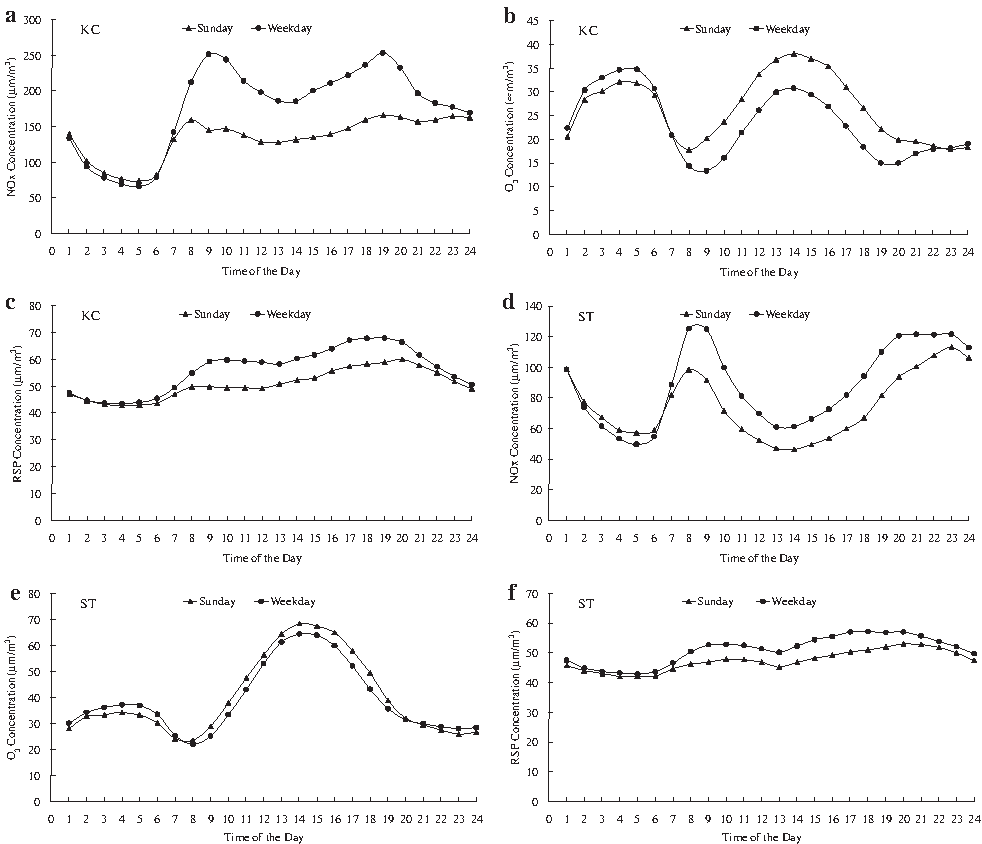
At the nine urban stations, the NOx concentrations at rush hour and afternoon peak O3 time decreased significantly from weekdays to weekends. Figure 2a and b illustrate the daily average difference in weekdays and weekends in NOx and O3 at KC, respectively; the other urban stations followed similar trends. Significant NOx decreases directly reduce NOx inhibition of O3 formation (So and Wang, 2003; Wang and Lu, 2006). O3 accumulation begins at 08:00 on weekends and 09:00 on weekdays. Since less NO is emitted, there is less reaction of O3 with NO (i.e., NO+O3→NO2+O2). Further, fewer hydroxyl radicals are removed, because there is less NO2 present (NO+OH→HNO3; Lawson, 2003).
The greatest contributors of NOx emissions are public electricity generation and road transportation (www.epd.gov.hk/epd/english/environmentinhk/air/data/emission_inve06.html, Hong Kong Air Pollutant Emission Inventory). Since public electricity generation differs little between weekdays and weekends, decreased traffic flow is likely the predominant cause of the lower NOx concentrations on weekends (Lau et al., 2008). Another hypothesis involves the decreased fine particles emissions. We observed significant RSP concentration decreases during the afternoon peak O3 time at the urban stations on weekends, which would increase the radiation available for photolysis, increasing the O3 formation rate (Lawson, 2003).
During the day, weekend RSP concentrations were lower at all urban stations. Figure 2c illustrates the daily RSP variation at KC. From 08:00 to 18:00, significant reductions in weekend RSP concentrations were observed. The decrease was particularly large during the morning rush hour and at roadside stations. Road transportation and public electricity generation are the top emission sources (HIAPEI); Further, Lau et al. (2008) found a positive correlation between traffic flow and RSP concentrations in urban areas. Thus, reduced vehicular particulate matter emissions and roadway transport dust could be the primary cause of the RSP weekend effect.
Differences in new town stations
There was no great difference between weekday and weekend O3 levels at the four newly developed stations.
Figure 2d and e show the daily average NOx and O3 variation between weekdays and weekends at ST; similar trends were observed at the other newly developed stations. Although the four stations experienced large NOx decreases on weekends, the afternoon peak O3 concentration was not significantly different between weekdays and weekends. These stations were downwind of the Pearl River Delta and O3 formation could have been influenced by regional air masses from Mainland China (Chan et al., 1998; Wang and Lu, 2006). However, the 8-h maximum average O3 concentrations at these stations differed significantly between weekdays and weekends, suggesting that, with rapid new development, human activities and local influences could contribute increasingly to O3 levels.
The newly developed stations generally exhibited smaller decreases in RSP concentrations between weekdays and weekends than the urban stations, because human activities were not so intensive. However, there were significant differences between the weekday and weekend RSP concentrations at ST and YL (e.g., Fig. 2f), because they are located in residential areas experiencing rapid development and there is more anthropogenic interference.
Differences in rural stations
There were no significant differences between the weekday and weekend air pollutant concentrations at TM, because there is little human activity there and it is downwind of Mainland China. It is influenced primarily by regional emissions and chemical and transport processes (So and Wang, 2003).
Moreover, the temporal patterns of the O3, NO2, and NOx concentrations at TM were the opposite of the other stations. Lower weekend O3 concentrations at the afternoon peak O3 time and maximum 8-h O3 average were observed at TM, consistent with previous studies (Cleveland and McRae, 1978; Altshuler et al., 1995; Heuss et al., 2003).
Conclusions
Urban Hong Kong monitoring stations showed significant differences in O3, NO2, NOx, and RSP concentrations between weekdays and weekends from January 1999 to October 2007. The afternoon peak O3 and maximum 8-h average O3 concentrations at six urban stations with significant O3 differences were 14% and 22% higher on weekends, respectively. In contrast, the NO2 and NOx concentrations during the afternoon peak O3 time were 19% and 25%, respectively, lower on weekends. The nine urban stations revealed RSP decreases of 14% and 8% for the morning rush hour and the daily average, respectively, from weekdays to weekends.
Combined with a weekend NOx emission decrease, VOC-sensitivity could explain the O3 weekend effect in urban Hong Kong. Further, lower RSP concentrations could reduce sunlight scattering and enhance O3 formation on weekends. Relatively lower morning O3 precursor emissions on weekends did not produce significant O3 weekend effects at the newly developed stations. This could be explained by influences from local and long-range transported emissions. The rural site exhibited no significant difference for the four pollutants, because it received no local input and was influenced only by regional emissions, chemicals, and transport processes from Mainland China.
Footnotes
Acknowledgment
The hourly air pollution data were downloaded from the internal website of the Hong Kong Environment Protection Department.
Author Disclosure Statement
No competing financial interests exist.