




Abstract
Abstract
Microwave (MW) was applied to enhance the removal of heavy oil (diesel and marine fuels) from contaminated sandy soil using granular activated carbon (GAC) as the dielectric medium. Adding GAC to the surface layer of the sand containing diesel fuel or marine fuel and subjecting the soil to 700 W MW irradiation for 30 s led to better removal efficiencies than without GAC addition by 9.5% (92.5% vs. 83%) for diesel fuel, and 11.5% (89.5% vs. 78%) for marine fuel. Additionally, GAC is an excellent MW absorbing material for converting MW energy into thermal energy. When GAC is added as the dielectric medium to convert the MW energy, the soil temperature rose from 52°C to 64°C, because the heat was transferred from GAC to the soil through GAC–soil interface. Meanwhile, volatile gas contained in the soil passes through the soil-GAC interface to reach the high-temperature GAC where the heavy oil is thermally cracked.
Introduction
In recent years, several technologies for remediating the oil contaminated soil have been developed. Soil washing with surfactants is effective in treating oil and heavy metal contaminated soils, but this method is not easy to implement (Urum et al., 2004). The incineration technology has been widely applied to renovate contaminated soil; possible emission of volatile toxic substances via flue gas has caused serious concerns in addition to causing excessive energy consumption (Abramovitch et al., 1998; Li et al., 2009). Fenton's reagent to treat the contaminated soil may be costly if the soil has low permeability, high subsurface heterogeneity, or high alkalinity with high contents of carbonate ions (Goi et al., 2006).
The microwave (MW) radiation is a form of electromagnetic radiation with frequencies ranging from 100 MHz to 300 GHz. The electric field interacts with polar materials, whereas the magnetic filed reacts with charged material (Tai and Jou, 1999) to produce heat directly inside a dielectric substance. The MW heating is rapid and selective (Clark et al., 2000; Yuan et al., 2006; Li et al., 2009); it is a feasible thermal method for treatment of contaminated soil.
In MW treatment, MW will selectively couple with the medium that has higher permittivity loss factor (Robinson et al., 2008). The rate of medium temperature increase caused by absorption of MW energy is given by equation (1) (Clark et al., 2000; Zhang et al., 2006; Moriwaki et al., 2006):
where f is the frequency of the radiation in Hz; ɛ0 is the permittivity of free space (8.854×10⁻¹² F m−1);
In recent years, the pollutants removed from the contaminated soil by using the MW technology include heavy metals (Jou, 2006), hexachlorobenzene (Yuan et al., 2006), polycyclic aromatic hydrocarbons (Goi et al., 2006), polychlorinated biphenyls, and pentachlorophenol (Abramovitch and Capracotta, 2003; Liu et al., 2008). Additionally, adding granular activated carbon (GAC) to enhance MW absorption for more efficient decomposition of volatile organic carbons, polychlorinated biphenyl, and sludge in contaminated soils can achieve consistently high treatment efficiency with low energy consumption (George et al., 1992; Liu and Yu, 2006), and the GAC can be recycled after it becomes exhausted (Liu et al., 2004).
The authors have previously conducted series of experiments demonstrating that GAC or element iron with MW radiation is technically feasible to stabilize chromium (Tai and Jou, 1999), lead (Jou, 2006), and copper (Lee et al., 2010) contained in contaminated soils; combining zerovalent iron with MW energy is effective for decomposing solid pentachlorophenol (Jou, 2008). The research focus of this study is to use the excellent energy absorbing capacity of GAC to convert MW energy into thermal energy directly in the carbon for decomposing diesel and marine fuel contained in a laboratory-prepared contaminated soil.
Experimental Equipment and Methods
Materials
In this study, diesel and marine fuels were used as the target contaminants. Coconut shell GAC of 1.5 mm diameter and 921.71 (m2/g) specific surface area, 0.27 (mL/g) micropore volume, and 597.97 (m2/g) micropore surface area (Beckman Co., SA-300) were used as the dielectric medium. Preparation and analyses of soil samples were carried out according to the National Institute of Environmental Analysis (NIEA) S102.60 B method. The prepared soil sample was placed in a well-ventilated place to dry; the resulting clumps were ground up, passed through a 10-mesh sieve, and then mixed thoroughly. As shown by the analysis results listed in Table 1, the soil is alkaline with a pH of 7.9.
CEC, cation exchange capacity.
Methods
The schematic diagram of the experimental apparatus is shown in Fig. 1. A household MW oven operated at 2.45 GHz with a maximum power output of 750 W was used for generating the MW energy. It was slightly modified by installing a programmable proportional-integral-derivative controller for maintaining a constant preselected MW energy level. For the soil treatment experiment, quartz column reactors were used to hold the soil sample. The bottom of the quartz column reactor was filled with a layer of 5 g clean soil; diesel or marine fuel was injected into the soil layer with a gas chromatography (GC) syringe, and the mixture was left undisturbed for 1 day allowing the oil to be thoroughly absorbed. On top of the soil surface, a layer of 3 g 1.5-mm GAC was added as the dielectric medium to generate heat for enhancing the decomposition of organic contaminants contained in the soil. The column top was then covered with 1 g GAC for absorbing constituents contained in the tail gas. The sample-filled quartz column reactor was placed in the MW oven to be subject to MW irradiation. In this research, the MW energy was controlled at 700 W for various durations, that is, 20, 40, 60, 80, 100, 120, 130, and 150 s. The prepared soil samples contained, respectively, 300, 705, and 1,340 mg/L of diesel, and 440, 890, and 1,480 mg/L of marine fuel.
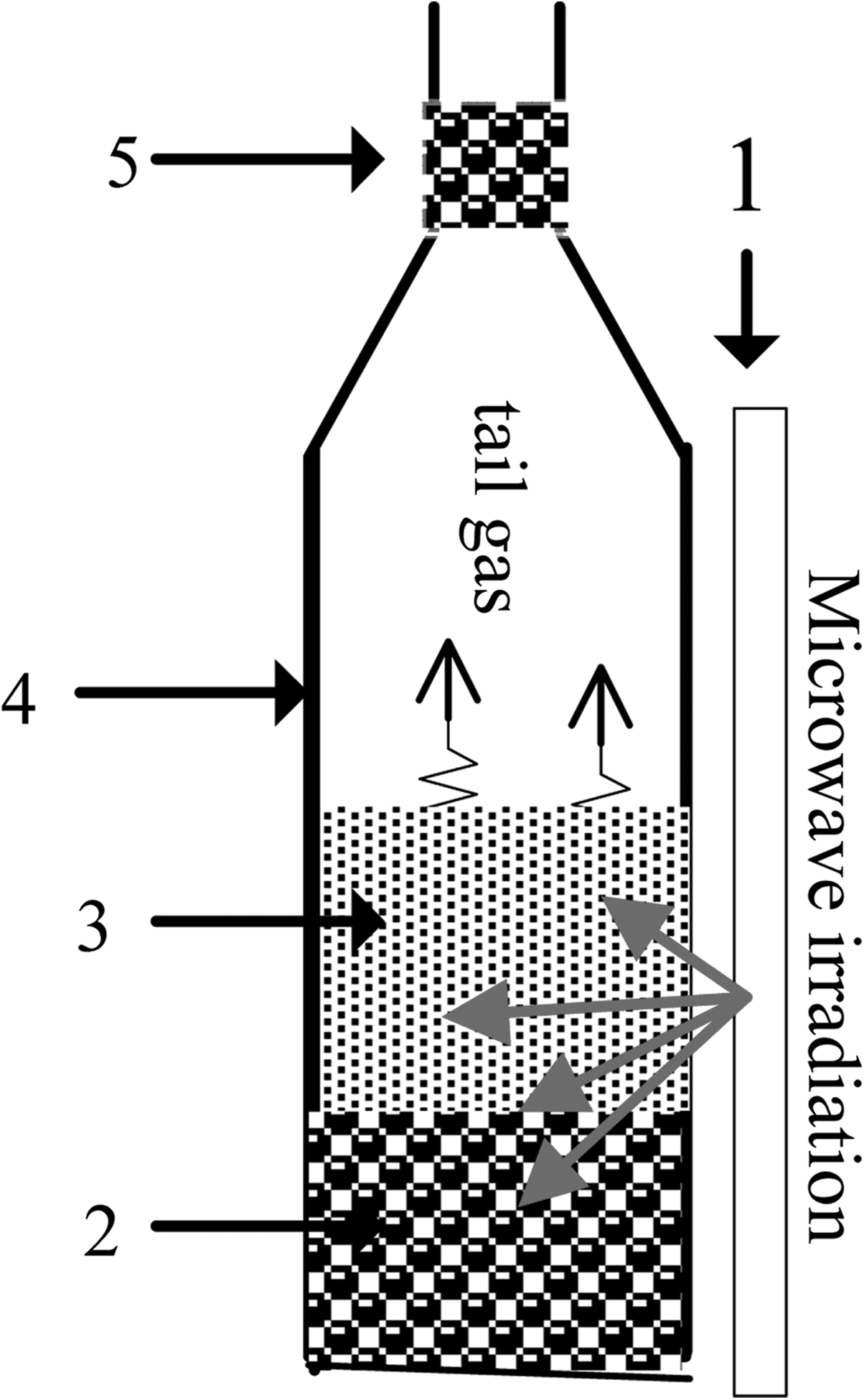
Schematic diagram of the microwave (MW) reactor system. 1, MW generator; 2, oil contaminated soil; 3, granular activated carbon (for generating heat); 4, quartz column reactor; 5, granular activated carbon (for absorbing constituents in the tail gas).
Analyses
The organic matter contained in the soil and carbon was extracted by adding hexane as extracting solvent; the mixture was agitated in an ultrasonic vibrator (Bransonic Co., 3510). Total hydrocarbons in the C10–C40 range were analyzed qualitatively using the NIEA S703.60B method. Quantitative analyses were done on the extracted liquid with a GC/flame ionization detector (HP 6890). The tail gas analyses were carried out using a syringe to injet the gas into the GC/MSD (HP 6890 GC/5973 MSD).
The GC/MSD analyses used a capillary column (30 m×0.25 mm×0.1 μm) for the identification of intermediates and final degradation products. The carrier gas flow rate was maintained constant at 3 mL/min for helium, or 30 mL/min for nitrogen. The oven temperature was programmed to maintain an initial temperature of 50°C for 5 min; it was then increased from 50°C to 350°C at a ramp rate of 10°C/min and then held constant at 350°C for 10 min. The GC injector temperature and the detector temperature were both 350°C. An IR detector (Raytek, Raynger 3i) was used to obtain direct temperature variations of the soil and media surface during the reaction process. The real permittivity and permittivity loss factor of GAC and soil were analyzed using an Impedance Analyzer (Agilent, 4291B) operated at 1.8 GHz and 25°C.
Results and Discussion
Influence of GAC addition on the soil sample temperature and penetration depth
When GAC is added as dielectrics to the surface of the soil layer, the free electrons within the GAC that respond to the electric field component of the MW cause resistive heating (Atwater and Wheeler, 2003). The heat generated is mostly transferred to the adjacent soil layers, but some may be lost by evaporation of the soil moisture (Mavrogianopoulos et al., 2000). The rising of temperature in the soil sample subject to 700-W MW irradiation versus time is shown in Fig. 2. After 150 s, without the use of GAC dielectrics, the 5 g soil sample temperature is 91°C. However, adding 3 g GAC as dielectrics will raise the soil temperature to 126°C, the temperature at the interface of soil and GAC to 344°C, and the GAC temperature to 481°C. In MW treatment, MW will selectively couple with the dielectric media that have higher permittivity loss factors (Robinson et al., 2008). Since GAC has higher dielectric loss factor than soil (8.3 vs. 1.05), the former absorbs more MW energy to produce thermal energy. On the other hand, the calculated average power absorbed using equation (1). for GAC and soil during the treatment period indicates that GAC absorbs more MW power than soil (4.59 W/cm3 vs. 0.55 W/cm3). The heat generated in the soil is transmitted by conventional heat transfer mechanisms (i.e., conduction, convection, and radiation).

Temperature variations for samples subject to 700 W MW (3 g granular activated carbon [GAC] as the dielectric media if used).
Additionally, when the MW travels through a material that has significant dielectric loss, the MW energy will be attenuated. If the energy attenuation is high in the material, the dielectric heating will taper off quickly when the wave is penetrating the dielectric material (Venkatesh and Raghavan, 2004). In addition, GAC is an excellent MW absorbing material, under the same MW power, GAC has a shorter “penetration depth” than soil (1.9 cm vs. 10.5 cm) when the MW power has dropped to 1/e or 36.8% of its transmitted value.
Influence of GAC addition on removal efficiency
MW irradiation will induce molecular vibration of a dielectric medium that leads to temperature rise directly within the medium (Sku et al., 2001; Venkatesh and Raghavan, 2004; Appleton et al., 2005). Various media have different dielectric properties; MWs will selectively couple with the medium that has higher permittivity loss factor (Thostenson and Chou, 1999; Venkatesh and Raghavan, 2004).
Laboratory results were obtained using 0 g (without GAC) and 3 g GAC as dielectric medium placed on 5 g soil samples, which were spiked with 300 mg/L diesel fuel and 440 mg/L marine fuel, respectively, with the MW energy maintained constant at 700 W for 30 s. For diesel, the MW treatment can achieve removal efficiency of 83.0% without GAC. Adding 3 g GAC to the surface of the soil layer will further increase the removal efficiency to 92.5%. Similarly, the removal efficiency of marine fuel is 78.0% without GAC and 89.5% with 3 g GAC added as dielectrics to the surface of the soil layer. Without the use of GAC dielectrics, the soil sample temperature is 52°C, because soil has low dielectric loss factor (1.05) and penetration depth (1.9 cm), the transmission of MW is the soil is greatly limited. Hence, semivolatile diesel and marine fuel are desorbed from the soil matrix by MW that induces molecular dipole rotation and ion migration in the soil (Yuan et al., 2006), and vibration of nonpolar molecules. The friction among vibrating molecules generates heat (Venkatesh and Raghavan, 2004; Appleton et al., 2005). Adding 3 g GAC to the surface of the soil layer will increase the temperature of the underneath soil layer to 64°C, whereas the temperature of the interface between the soil sample and GAC layers is 101°C, and the GAC layer temperature is 185°C. The property of GAC as an excellent dielectric medium to convert the MW energy directly into thermal energy (Bo et al., 2006) is used to generate heat directly inside the GAC layer; the heat is transferred to the soil sample for enhancing the removal of oil from the soil layer.
Influence of GAC addition on removal of concentrated fuels from soil
The elevated soil temperature caused by adding GAC as a dielectric medium to the surface of the soil layer will enhance the removal of concentrated diesel and marine fuels contained in the contaminated soil. Figure 3 shows that the efficiencies of removing 705 mg/L diesel are 41.0% at 60 s and almost 100% at 150 s. For the 1,340 mg/L diesel contained in the soil, the removal efficiencies are 29% at 60 s and 89% at 150 s. Further increasing the MW treatment time will lead to burning of GAC as evidenced by the observation of smoke. Thus, how much diesel removal is caused by decomposing without burning is difficult to determine. Figure 4 shows that the efficiencies of removing 890 mg/L marine fuel are 34.0% at 60 s and 66.0% at 150 s. When the original marine fuel concentration is 1,480 mg/L, the removal efficiencies are 43.0% at 60 s and 74.0% at 150 s. Additionally, if the MW irradiation time increases, more ash in off-white color is observed, thus indicating that the GAC surface is thermally oxidized or burnt.
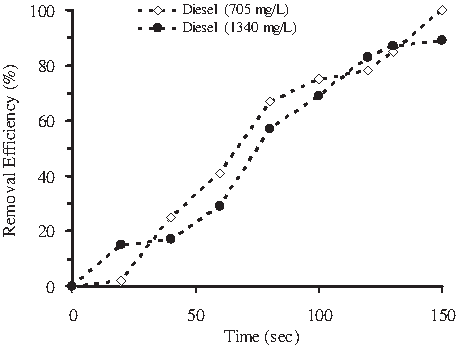
Removal efficiencies versus time for soil samples containing 705 and 1,340 mg/L diesel subject to700 W MW energy with 3 g GAC added.

Removal efficiencies versus time for soil samples containing 890 and 1,480 mg/L marine fuel subject to 700 W MW output with 3 g GAC added.
Identification of end products
Diesel and marine fuels consist of semivolatile organic compounds. The evaporation of any volatile compounds during the MW treatment is detected by placing a layer of 1 g activated carbon on top of the soil to capture any organic compounds that may escape in the tail gas. Quantitative analyses of the tail gas using GC/MSD shows the presence of CO, CO2, and only trace amount of hydrocarbons with low molecular weights that are considered as the end products of fuel decomposition. Since the temperature at the soil and GAC interface of 344°C is much higher than the surrounding temperature, high-temperature pyrolyses can easily occur, thus causing mineralization of diesel and marine fuels to form CO, CO2. This is also supported by the detection of no TPH-d in the C10–C40 range in the GAC that was placed on the top of the sand layer for capturing any fugitive organic matter. These observations indicate a complete thermal decomposition of the organic fuels.
Conclusion
In MW treatment, the MW will selectively couple with the material that has high permittivity loss factor. GAC is an excellent MW absorbing material and has a higher dielectric loss factor than soil (8.3 vs. 1.1); it absorbs and converts more MW energy directly into thermal energy thus resulting in a faster temperature rise than soil. The heat generated in the GAC layer is transported to the soil to assist in raising the soil temperature and thermally cracking the fuels contained in the soil. When exposed to 700 W MW for 150 s, temperature of the soil without GAC addition is 91°C, whereas adding GAC to the surface of the soil layer will boost the soil temperature to 126°C, with 344°C at the interface of GAC and soil layers, and 481°C in the GAC layer. Without GAC addition to the surface of the soil sample, when exposed to 700 W MW for 30 s, 83.0% of the diesel fuel (300 mg/L) and 78.0% of the marine fuel (440 mg/L) contained in the soil sample will be removed. Adding GAC as the dielectric medium, removal of diesel fuel and marine fuel will increase to 92.5% and 89.5%, respectively. Therefore, the results demonstrate that in MW irradiation treatment, adding GAC to the surface of the soil layer will enhance the removal of fuel from the soil. The use of GAC as dielectric media to enhance the thermal cracking of organic substances contained in a contaminated soil is a creative technology for treating heavy oil contaminated soil.
Footnotes
Author Disclosure Statement
No competing financial interests exist.