




Abstract
Abstract
Microwave (MW) was applied to enhance chlorobenzene (CB) removal using commercial micron iron (μ-Fe) particles, nanoscale iron particles (nC-Fe0), and nanoscale iron particles freshly prepared in our laboratory (nP-Fe0) as the dielectric media. CB solution irradiated with 250 W MW for 150 s achieved better CB removal than without MW irradiation, because MW radiation increased the iron oxidization rate, surface activity, and hence, the CB removal rate. MW-induced iron particles were capable of removing 13.6 times (61.2% vs. 4.5% for μ-Fe), 2.8 times (76.5% vs. 27.5% for nP-Fe0), and 3.6 times (65.4% vs. 18.1% for nC-Fe0) more CB, and the CB activation energy decreased to 16.8 kJ/mol (μ-Fe), 3.3 kJ/mol (nP-Fe0), or 3.5 kJ/mol (nC-Fe0). MW-induced iron particles can potentially decompose toxic organic substances as demonstrated in this laboratory study.
Introduction
Microwave (MW) is an electromagnetic radiation with frequencies ranging from 300 MHz to 300 GHz (Tai and Jou, 1999; Yuan et al., 2006). The MW absorbed by a solution causes thermal effect to reduce the activation energy and weaken the chemical bonds of the organic compounds (Zhang et al., 2007; Zhao et al., 2010). Selecting an appropriate medium to absorb the MW energy in order to integrate MW treatment technology has been studied by researchers in various technological and scientific fields, because MW irradiation is known to enhance various reaction kinetics owing to its rapid and homogeneous heating (Park et al., 2000; Menéndez et al., 2002; Takashima et al., 2008). For example, using MW energy–absorbing media with various absorption capacities, for example, granular activated carbon, ZVI, copper, and selected catalysts, has been studied for treating aqueous pentachlorophenol (Liu et al., 2004; Jou, 2008; Jou and Wu, 2008; Lee et al., 2009b), chlorobenzene (CB) (Lee et al., 2009a, 2010; Jou et al., 2010), and P-Chlorophenol (Zhao et al., 2010) or improving the reaction rate of TiO2 photocatalyst (Jou et al., 2008; Mishra et al., 2010) in order to save energy consumption and improve treatment efficiency (Liu et al., 2004).
The objective of this study was to compare the efficiencies of micron ZVI (μ-Fe), nanoscale ZVI particles freshly prepared in laboratory (nP-Fe0), and commercial nanoscale ZVI particles (nC-Fe0) to treat aqueous CB solution with and without MW irradiation.
Experimental Section
Chemicals and materials
A 100 mg/L CB solution was prepared by dissolving 905 μL of 99.9% pure CB (GR Reagent; Tedia) in 99.9% methanol (GR Reagent; Tedia) to form 2000 mg/L stock solution. Next, 200 μL of the stock solution were diluted with deionized water (18.2 MΩ; Millipore Co.) to form the 100 mg/L CB working solution. The study used commercial μ-Fe particles (0.95 m2/g specific surface area) purchased from Riedel-deHaën (99.9%,<212 μm) and ZVI (nC-Fe0) particles (55.8 m2/g specific surface area) obtained from Conyuan Biochemical Technology Ltd. Company (99.9%, <60 nm).
Synthesis of nP-Fe0 particles
The nP-Fe0 particles were synthesized by adding 0.75 M NaBH4 (Lancaster; 98%) aqueous solution drop by drop to a 0.135 M FeCl3·6H2O (SHOWA; 97%) aqueous solution. Without drying, the prepared nP-Fe0 particles were directly used in the subsequent experiment. The resulting nP-Fe0 particles in dry form have diameters between 60 and 80 nm, with 43.6 m2/g specific surface area as determined using the BET method (Beckman Co.; SA-300).
Batch tests
A modified household MW oven operated at 2.45 GHz with a maximum power of 650 W was used for generating the MW energy. The MW energy can be controlled by programming a proportional-integral-derivative (PID) controller to adjust the PID feedback signal for maintaining a preselected MW energy level. The sample was held in an 80-mL boron-silica glass column reactor having low energy loss and heat resistance (up to 700°C); it was installed in the MW oven for carrying out the experiment as schematically shown in Fig. 1.
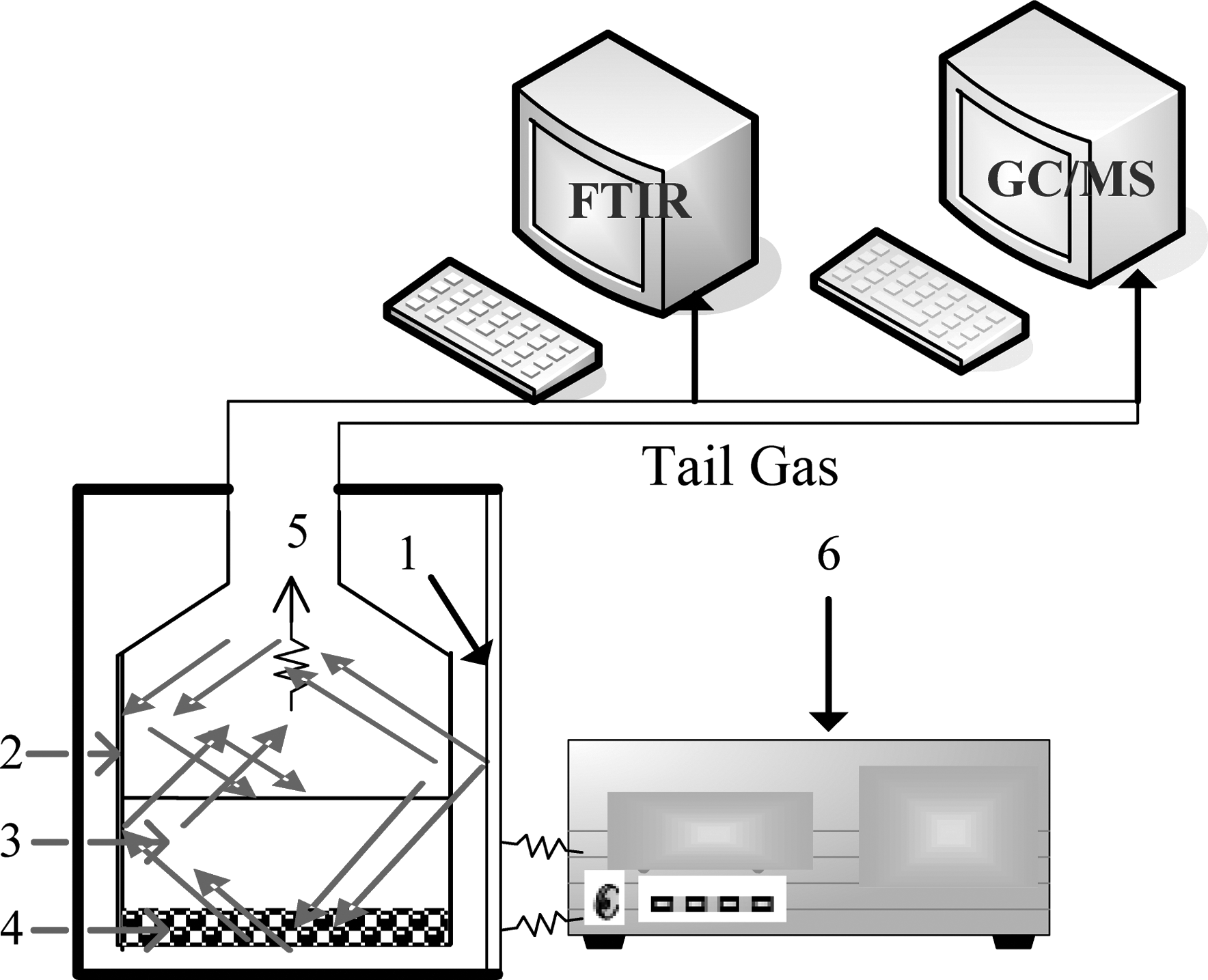
Laboratory setup for conducting the experiment: (1) MW generator, (2) the boron-silica glass vessel reactor, (3) 100 mg/L CB solution, (4) zerovalent iron particles, (5) tail gas, (6) proportional-integral-derivative controller. MW, microwave; CB, chlorobenzene; FTIR, Fourier transform infrared; GC, gas chromatography, MS, mass spectrometry.
The study was initiated by placing 40 mL of 100 mg/L CB solution in the bottle. After adding 1 g of μ-Fe, nP-Fe0, or nC-Fe0, the content was stirred in a constant-temperature shaker at 100 rpm to complete the CB decomposition study at various constant temperatures, that is, 25°C, 40°C, 50°C, and 60°C, for different reaction periods, that is, 30, 60, 120, 150, 180, 210, and 240 min. Samples containing same concentrations of CB (100 mg/L) and Fe particles (1 g of Fe in 40 mL of CB) were placed in the MW oven to be irradiated with 250 W according to the following operating conditions: MW irradiation time=10 s, MW interruption irradiation time=120 s, total irradiation time=150 s, number of cycles=15.
Analysis methods
An HP 6890 gas chromatography (GC) equipped with a capillary column (HP-5MS) and coupled with an HP 5973 mass selective detector (MSD) was used for quantitative analyses of intermediate and final products. Fourier transform infrared (FTIR; NICOLET-is10) with KBr window was used to identify products. The permittivity real and loss factors of ZVI were analyzed using an impedance analyzer (Agilent; 4291B) at 1.8 GHz frequency and 25°C. The ZVI particle surface temperature during MW treatment was measured using an IR instrument (Raynger 3i by Raytek).
Results and Discussion
Effect of surface area on CB degradation
The degradation of chlorinated organic solvents by ZVI is a surface-mediated reaction (Schäfer et al., 2003) and follows a pseudo-first-order reaction (Su and Puls, 1999; Clark et al., 2003).
Figure 2 indicates that at room temperature (25°C), the CB removal efficiencies after 240 min are 4.5% for μ-Fe, 27.5% for nP-Fe0, and 18.1% for nC-Fe0, with reaction rate constants of 2.0×10⁻⁴, 1.3×10⁻³, and 9.0×10⁻⁴ min−1, respectively. The R2 values are 0.95 for μ-Fe samples, 0.97 for nC-Fe0 samples, and 0.98 for nP-Fe0 samples.
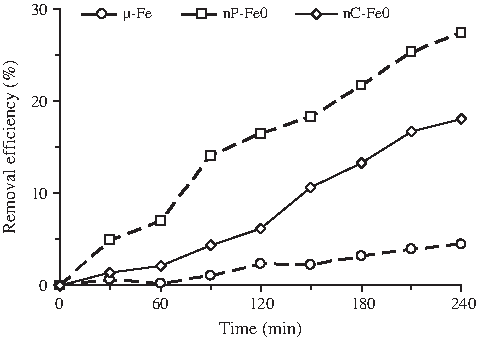
CB removal efficiency for μ-Fe, nP-Fe0, and nC-Fe0 (at 25°C, iron/liquid rate 1 g/50 mL, and CB concentration 100 mg/L). μ-Fe, micron iron; nP-Fe0, nanoscale iron particles freshly prepared in laboratory; nC-Fe0, nanoscale iron particles.
Table 1 reveals that the order of removal efficiency was nP-Fe0>nC-Fe0>μ-Fe. The nC-Fe0 particles have smaller particle size (<60 nm) and larger specific surface area (55.8 m2/g); it should have relatively larger surface to contact the contaminant to be treated. However, laboratory observations reveal that surface activity of the nC-Fe0 particles is difficult to maintain even under appropriate storing conditions, and the reduction of their reactivity is unavoidable so that the CB removal efficiency is adversely affected. In contrast, the freshly prepared undried nanoscale ZVI particles experience less surface oxidation; they were easy to remain suspended in solution for maintaining effective contact with the contaminant so that high CB removal efficiencies can be achieved.
μ-Fe, micron iron; nP-Fe0, nanoscale iron particles freshly prepared in laboratory; nC-Fe0, nanoscale iron particles.
The temperature effect
Results of CB dechlorination with μ-Fe, nP-Fe0, and nC-Fe0 particles at various temperatures can be fitted with the Arrhenius equation (Su and Puls, 1999):
where Ea is activation energy (kJ/mol), R is the molar gas constant (8.314 J/[mol·K]), T is the absolute temperature (K), and A is a preexponential factor (L/[h·m2]).
The activation energy for the transformation of CB measured in the batch system at 25°C–60°C can be estimated from the slope of the plot of ln ksa versus T−1 using linear least-squares analyses. The estimated activation energies of dechlorination for μ-Fe, nP-Fe0, and nC-Fe0 particles are approximately 49.5, 21.9, and 21.8 kJ/mol, respectively.
Effect of MW radiation on CB degradation
When MW irradiation is combined with some suitable MW absorbents as the catalysts in the integrated system, the MW can weaken the chemical bond intensities of various molecules and reduce the activation energy of the reaction system. The nC-Fe0 (commercial) particles have larger surface area (55.8 vs. 43.6 m2/g) and higher dielectric loss factor (39.8 vs. 37.3 F/m) to absorb more MW than the nP-Fe0 particles freshly prepared in the laboratory. However, the former tends to agglomerate and subsidize to the bottom and thus absorbs less MW energy to result in less efficiency of decomposing CB. In contrast, the nP-Fe0 particles were directly applied in wet form; they are thus evenly suspended in the CB solution. This leads to larger surface areas to absorb more MW energy than the nC-Fe0 particles that have settled to the bottom. Hence, the undried, laboratory-prepared nP-Fe0 particles exhibit better CB removal efficiency than either nC-Fe0 or μ-Fe particles. Figure 3 shows that applying 250 W MW for 150 s could remove 76.5% CB for nP-Fe0, 65.4% CB for nC-Fe0, and 61.2% CB for μ-Fe. The activated energy levels are 32.7 kJ/mol for μ-Fe, 18.6 kJ/mol for nP-Fe0, and 18.3 kJ/mol for nC-Fe0. The R2 values are 0.98 for μ-Fe samples, 0.99 for nC-Fe0 samples, and 0.99 for nP-Fe0 samples.

CB removal efficiency for the various iron particles (irradiated with 250 W MW energy for 150 s).
Reaction mechanisms
Analyses of the product using GC/MSD after CB reduction with 1.0 g nC-Fe0 irradiated at 25°C for 240 min show that the major product is benzene. Further FTIR analyses show strong absorption peaks between 2320 and 2380 cm−1 and obvious weak absorption peaks at 665–670, 3598–3630, and 3703–3730 cm−1. These data suggested that CO2 and chloride were also present in the tail gas. The chloride concentration in the original solution increased from 2.9 to 6.3 ppm after the MW treatment.
Further, the nonuniform absorption of MW energy by ZVI particles may produce local hot spots with surface temperature (435°C) much higher than the surrounding temperature. Hence, high-temperature oxidation can easily occur to mineralize benzene into CO2. The ZVI particles generate electrons with the formation of Fe2+ or Fe3+ and H2. When the MW penetrates the solution to reach the surface of ZVI particles, it increases the ZVI reaction rate and creates more active sites on the ZVI surface. The contacts between the high-temperature iron particle surface and H2 gas will enhance iron reduction, CB dechlorination, and benzene mineralization, as schematically shown in Fig. 4.
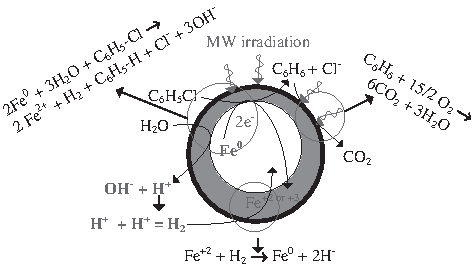
MW irradiation reaching the surface of zerovalent iron particles to initiate reductive reactions for decomposing CB.
Conclusion
Three types of ZVI particles, μ-Fe, nP-Fe0, and nC-Fe0, were used as the MW absorption media to enhance the removal of CB. Laboratory data demonstrate that the MW energy enhances the CB removal rate by 13.6 times (61.2% vs. 4.5% for μ-Fe), 2.8 times (76.5% vs. 27.5% for nP-Fe0), and 3.6 times (65.4% vs. 18.1% for nC-Fe0) higher, and the CB activation energy decreases to 16.8 kJ/mol (μ-Fe), 3.3 kJ/mol (nP-Fe0), and 3.5 kJ/mol (nC-Fe0). The MW radiation enhances ZVI oxidizing capability, surface activity, and CB removal.
Footnotes
Author Disclosure Statement
No competing financial interests exist.