




Abstract
Abstract
Thin films of pure TiO2, silver-deposited TiO2, and platinum-deposited TiO2 were prepared on quartz substrates by a dip-coating process for the photodecomposition of o-cresol under light emitting diodes (LEDs) irradiation instead of a traditional lamp. In this work, effects of noble metal doping, periodic illumination, and LEDs wavelength on the photoactivity, electrical energy consumption, and quantum yield were explored in an effort to better understand the roles of noble metal and LEDs characterization in photocatalytic reactions. Degradation of o-cresol under LED irradiation increased with the decreased wavelength of LEDs, due to the higher power energy of a photon. Pt/TiO2 films on quartz substrates prepared by a photodeposition method exhibited excellent optical characteristics, energy savings, and visible light–induced photocatalytic properties compared with Ag/TiO2 and pure TiO2 (P25). EEO increased from 22 to 31 kWh/m3/order indicating that energy consumption for periodic illumination was significantly lower than continuous illumination under similar experimental conditions. This study showed the feasible and potential use of LEDs in photocatalysis.
Introduction
Titania is active only under UV irradiation (λ<388 nm), which accounts for <5% of solar light energy. Doping TiO2 with a certain kind of metal and metal ion has been frequently attempted not only to retard the fast charge pair recombination (Li and Li, 2002) but also to enable visible light absorption by providing defect states in the band gap (Li and Li, 2002; Wu et al., 2004). There have been various attempts to utilize visible light in TiO2 photocatalysis, which include dye sensitization (Moon et al., 2003), semiconductor coupling (Kim and Choi, 2005), and impurity doping (Asahi et al., 2001; Wu et al., 2004). The nanosized metallic silver particles on a TiO2 surface can accumulate electrons resulting in a better charge separation than in the case of bare TiO2 (Vamathevan et al., 2004; Shie et al., 2008). However, the capture of electrons by Pt is postulated to produce a longer electron—hole pair separation lifetime, and therefore hinder the recombination of electron—hole pairs and enhance the transfer of holes and possibly electrons to O2 adsorbed on the TiO2 surface.
Most previous photocatalytic studies were conducted using black light lamps as ultraviolet light sources (Wu et al., 2004; Vamathevan et al., 2004; Kim and Choi, 2005; Lu et al., 2010); however, the application of these lamps was reported to be deficient in reliability, durability, and luminous efficiency. Recently, the development of light emitting diodes (LEDs) appears to be a promising alternative light source. Even though widespread utilization of diode devices for general lighting is still some years away, LEDs are gradually replacing incandescent lamps in many applications. LEDs are far more efficient in converting electricity into light because the light emission from LEDs is induced by the recombination of excessive electrons and holes; therefore, quantum yields may be attained close to unity. LEDs have an operational lifetime of >100,000 h and are much more rugged and compact than incandescent lamps (Fukuda, 1991). Recently, the studies (Chen et al., 2007; Shie et al., 2008) investigated the feasibility of applications of UVLED instead of the traditional UV lamps as the light source used to treat the indoor air pollutant of formaldehyde and the liquid pollutant by a UV/TiO2 process. The higher photonic efficiency for the decomposition of formate in TiO2 suspension using a rectangular flow photoreactor system with periodic illumination of a partially-covered 40 W black light bulb than those with continuous illumination (Sczechowski et al., 1993). In this work, photodeposition of platinum and silver on TiO2 films was performed, and the optical and photocatalytic properties of Ag/TiO2 and Pt/TiO2 under various wavelengths LEDs irradiations were investigated. In particular, the effects of noble metal doping, periodic illumination and LEDs wavelength on the photoactivity, electrical energy consumption and quantum yield were explored in an effort to better understand the roles of noble metal and LEDs characterization in photocatalytic reactions.
Experimental Section
Photocatalytic activity of photocatalyst
The photocatalytic activities were evaluated by measuring the decomposition rate of o-cresol. The decomposition of o-cresol was performed in a circulation system with one liter effective volume as depicted in Fig. 1a. The photoreactor system used in this study was composed of the light sources, visible light lamp, inner tube, outer tube, and cap. The light sources (visible light lamp and the LEDs tube) were located within the inner reactor tube. The inner and outer reactor tubes of the cylindrical photoreactor used in this study were made of quartz and fused silica, respectively. Specifically, the visible light illumination was conducted using a fluorescent lamp (FL15D-T25) with a wavelength range of 400 to 700 nm and a maximum intensity of 550 nm to produce a power of 10 W. In addition, The LEDs provided light that was 365 nm LEDs (Nichia), 380 nm LEDs (Toyoda), 405 nm LEDs (Daina B5-437-CVD), and 440 nm LEDs (blue LEDs) as shown in Fig. 1b, and the average photon flux of incident light in the aqueous solution is 5.4 W/m2. The light intensity, maximum peak, and wavelength distribution on the external surface of the inner reactor tube were detected by a LI-COR LI-1800 (LI-COR). The light pulse frequency of LEDs was controlled from 0.1 to 1 s by a Mitsubishi FX1s programmable controller. The particular pulsed experiments for photodegradation of o-cresol were operated with various illumination period (τI) and dark period (τD) as shown in Fig. 2. The power consumption of LEDs light source was analyzed by a WM-02 power analyzer/datalogger. The power consumption decreased with increasing dark period (τD).

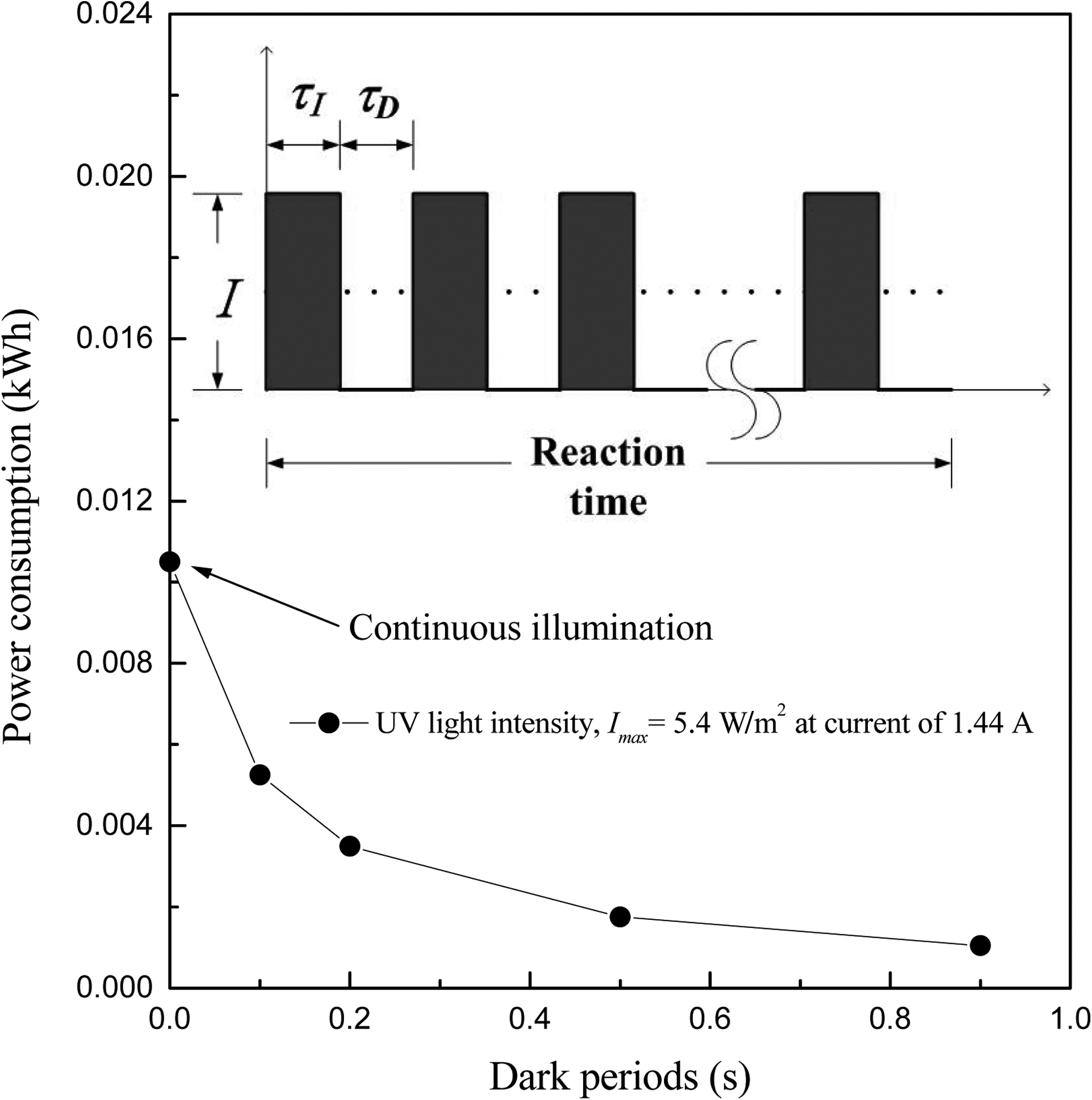
Effect of dark period under controlled periodic illumination on power consumption.
The o-cresol solution was added to the photoreactor and the temperature of solution was kept at 25°C for all experiments. Solution pH value was kept at 3 by the additions of sodium hydroxide and/or perchlorates solutions using a Kyoto Electronic AT-400 automatic potentiometric titrator. Perchlorates and nitrates had very little effect on the photocatalytic reaction, whereas sulfates or phosphates (even at millimolar concentrations) were found to be rapidly adsorbed by the catalyst and to reduce the rate of photocatalytic reaction by 20%–70% (Kabra et al., 2004). The dissolved oxygen from the reaction solution was maintained by varying the airflow rate and was measured by an Orion 820 DO analyzer. The samples were analyzed for the concentration of o-cresol with a Spectra-Physics P1000 HPLC equipped with a UV detector.
Preparation and characterization of photocatalyst
A half liter of aqueous solution, containing 160 g Degussa P-25 TiO2 particles, was held in a 1-L beaker and was then purged with nitrogen to remove dissolved oxygen while being stirred by a magnetic stirrer. About 1.26 g AgNO3 and 2.12 g H2PtCl6·6H2O were dissolved in 20 mL of methanol, respectively. The methanol solution was then mixed with the aqueous solution containing TiO2. The mixed solution then was irradiated by 13.3 W/cm2 UV light using a GTE F15T8/BLB lamp for 8 h. About 0.02 g/L dioctyl sulfosuccinate, a dispersing agent, was added to the mixed solution and was stirred with a sonicator for >8 h. A quartz tube was then impregnated in the mixed solution for about 1 min before it was removed and air-dried. 0.5 wt% Pt/TiO2 or 0.5 wt% Ag/TiO2 film coated on the quartz tube was then put in an oven isothermally at 300°C for 2 h. The platinum and silver loading on the surface of P25 was calculated using the photodeposition method. Platinum and silver concentrations in aqueous solution were analyzed by a GBC 904 Flame AA. The light absorbance of the coatings was determined by a Cray-300 UV/VIS spectrophotometer. The impregnation process could be repeated several times to increase the amount of catalyst coated. X-ray photoelectron spectroscopy (XPS) was performed in a Thermo VG Scientific Sigma Probe spectrometer. All XPS data presented herein were acquired using a monochromatized Al Kα line (1486.6 eV). Peak positions were then calibrated with respect to the carbon 1s peak at 284.5 eV from the adventitious hydrocarbon contamination. To study the recombination of electrons/holes in the photocatalysts, the photoluminescence (PL) (Fluorescence lifetime system TAU-3, PL) emission spectra of the samples were measured.
Results and Discussion
Surface characterization of photocatalysts
The photodeposition of 0.5 wt% platinum on the TiO2 surface during the reaction was indicated by a color change of particles. The thin film color change from white to gray at 0.50 wt%, and similar color changes were observed by the literature (Vamathevan et al., 2004). A brown color was displayed for 0.50 wt% Ag/TiO2 film. Figure 3a and b depicted the high-resolution XPS spectrum of Pt 4f and Ag 3d core levels in TiO2, Ag/TiO2 and Pt/TiO2, respectively. Figure 3 showed the high-resolution XPS spectra of Pt 4f (Fig. 3a), Ag 3d (Fig. 3b), and Ti 2p (Fig. 3c) core levels for the TiO2, Ag/TiO2, and Pt/TiO2, respectively. All XPS binding energies of the Ti 2p, Ag 3d, and Pt 4f photoelectrons for the photocatalysts were consistent with the data found in the literature (Kumar et al., 2000). Figure 3a showed the chemical bonding states of the Pt 4f XPS peaks at 71.2 eV (Pt 4f7/2) and 74.5 eV (Pt 4f5/2), respectively. Based on the result of Pt 4f peak, the Pt/TiO2 primarily contained pure metallic Pt grains on TiO2. Figure 3b showed the chemical bonding states of Ag2O (Ag+, 367.8 eV) and Ag (Ag0, 368.2 eV) based on the Ag 3d XPS peaks. The results presented here indicated that the silver-laden compound used for the Ag/TiO2 primarily contained Ag2O and a small amount of Ag grains.
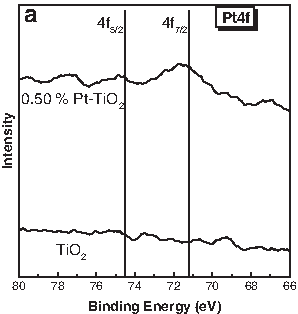
X-ray photoelectron spectroscopy of TiO2 (P25), Ag/TiO2, and Pt/TiO2:
Photocatalytic decomposition of o-Cresol
The visible photocatalytic activity was evaluated by the decomposition rate of o-cresol using visible light lamp and 440 nm (2.81 eV) blue LED as light sources as shown in Fig. 4. The results were similar to the study done by Li and groups (Li and Li, 2002) showed that o-cresol was not able to decompose to CO2 and H2O by pure TiO2 under 440 nm LED irradiation, whereas 0.50 wt% Ag/TiO2 and 0.50 wt% Pt/TiO2 could extend the absorption of visible light. The results demonstrated that 0.50 wt% Pt/TiO2 has an increase in its photodegradation rate as compared with 0.50 wt% Ag/TiO2 under both visible light and 440 nm LED irradiation. Increase in the decomposition of o-cresol by >65% in the aqueous solution could be reached by Pt/TiO2 photocatalyst within about 480 min of reaction time under 440 nm LED irradiation. The pseudo first-order reaction rate constants for o-cresol decomposition with various photocatalysts are summarized in Table 1. For the experiment conducted at pH 3, the maximum degradation rate of o-cresol was obtained for TiO2 with 0.50 wt% Pt under 440 nm LED irradiation. Specifically, the pseudo first-order rate constant of o-cresol photodegradation under 440 nm LED irradiation at pH 3 with 0.50 wt% Pt/TiO2 was 1.7 times higher than that with 0.50 wt% Ag/TiO2. It was possibly due to the enhancement of optical absorption, active sites and electron separation.
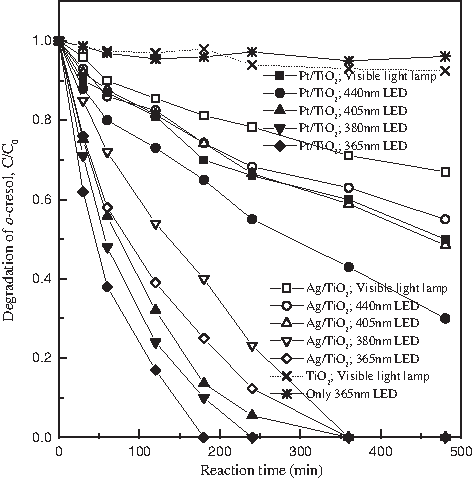
Photocatalytic decompositions of o-cresol in aqueous solution with 0.5 wt% Pt/TiO2 and 0.5 wt% Ag/TiO2 under various LEDs irradiations at solution pH value=3, initial concentration of o-cresol=9 mg/L, gas flow rate of oxygen=70 mL/min, dissolved oxygen=35.4 mg/L.
Electric energy per order (EEO) is defined as the amount of electric energy in kWh required degrading a CA0 by one order of magnitude in a unit volume of aqueous solution (Bolton et al., 2001). For experiments with low contaminant concentrations, EEO (kWh/m3/order) can be calculated using the following formula for first-order reactions in an idealized batch reactor (Bolton et al., 2001):
where P is the rated power (kW), V is the batch reactor volume (L), and k′ is the pseudo first-order rate constant (min−1).
EEO values for Pt/TiO2 were 152 and 208 kWh/m3/order−1 under 440 nm LED irradiation and visible light lamp irradiation, respectively. It was observed that the electrical energy consumption decreased significantly to decompose the o-cresol for the Pt/TiO2 photocatalyst under 440 nm LED irradiation compared with that under visible light lamp irradiation.
The o-Cresol in aqueous solution was subjected to 365, 380, 405, and 440 nm LED irradiations in the presence of 0.50 wt% Pt/TiO2 and 0.50 wt% Ag/TiO2 as shown in Fig. 4. The results demonstrate that Pt/TiO2 has an increase in its photodegradation rate as compared with Ag/TiO2. For 365, 380, and 405 nm LED irradiations, degradation of 99% after a reaction time of 480 min was obtained using a 0.50 wt% Pt/TiO2 catalyst; moreover, degradation of >65% was obtained for 440 nm LED irradiation. The degradation of o-cresol under LED irradiation was increased with the decrease wavelength of LEDs due to higher power energy of the photon. Similar results were also observed in the reported study of TiO2 powder done by Tseng and group (Tseng et al., 2006).
As an important parameter for the activity of various photocatalysts, quantum yields were determined previously for TiO2-photocatalyzed degradation of o-cresol (Wu et al., 2004). The calculated results could be comparable to those reported by previous researchers (Wang et al., 2003) where the reaction order of light intensity lies between 0.5 and 1.0 for experiments conducted with lower light intensities (<80 W/m2). The quantum yield, Φ, is defined as the ratio of the number of molecules taking part in the photoreaction per unit time to the number of absorbed photons per unit of time:
where dNmol/dt is the reaction rate (molecules/s), dNhv/dt is the rate of photons absorbed by the system (photons/s), and Iabs is the UV light intensity of absorption.
As shown in Fig. 5, the quantum yield of 0.50 wt% Pt/TiO2 was higher than that of 0.50 wt% Ag/TiO2 under various LEDs irradiation. The calculated results of quantum yields indicated a 5.4-fold increase (2.66% to 0.48%) was achieved from an irradiated light with wavelength from 365 to 440 nm. The wavelength of UV light has a great effect on the quantum yield of reaction, with significantly faster rates of reaction being caused by 300 nm light than that of a longer wavelength (Stafford et al., 1997). The similar results done by Asahi and group (Asahi et al., 2001) revealed that the quantum yield (3.0%) for the degradation of acetaldehyde with TiO2-xNx photocatalyst under 351 nm light irradiation was higher than that (0.42%) under 436 nm light irradiation.
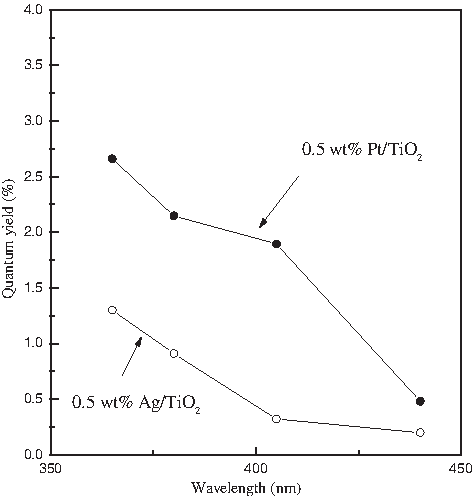
Influence of wavelength on quantum yields with 0.5 wt% Pt/TiO2 and 0.5 wt% Ag/TiO2 under various LEDs irradiations at solution pH value=3, initial concentration of o-cresol=9 mg/L, gas flow rate of oxygen=70 mL/min, dissolved oxygen=35.4 mg/L, light intensity=5.4 W/m2.
Enhancement mechanisms of photocatalysts
The UV–VIS absorption spectra of the photocatalysts pure TiO2 (P25), Ag/TiO2, and Pt/TiO2 are shown in Fig. 6. The optical absorption enhanced significantly in the region of 300–600 nm, due to the presence of Pt, Ag, and Ag2O, in comparison to pure TiO2. The onset of the spectrum appeared at about 22 nm (Pt/TiO2) and 20 nm (Ag/TiO2) in the red shift compared with pure TiO2 (P25). According to the equation Eg= 1239.6/λ g (Li and Li, 2002; Sun et al., 2005), the calculated band gap (Eg) energies were 3.08 eV for pure TiO2 (P25), 2.94 eV for Ag/TiO2, and 2.92 for Pt/TiO2, respectively. The results revealed that Pt, Ag, and Ag2O deposited on the surface of TiO2 should be capable of responding to visible light. Ag and Ag2O deposited on the surface of TiO2 can significantly absorb visible light. The enhancement of visible optical absorption, due to the presence of Pt, Pt(OH)2, and PtO2, has been proven by UV-Vis reflectance spectra (Li and Li, 2002).
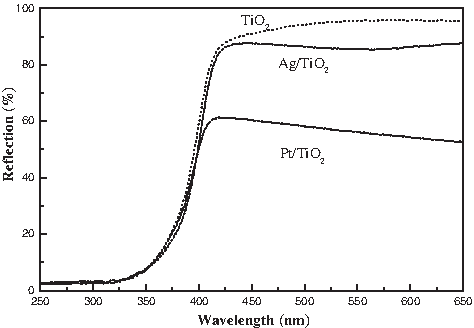
UV-Vis spectra of the photocatalysts in the range of 250–650 nm.
The Ti 2p showed the narrow scans for Ti 2p peaks located at 464.6 eV (Ti 2p1/2) and 458.8 eV (Ti 2p3/2) in the TiO2 (P25), Ag/TiO2 and Pt/TiO2 as shown in the high-resolution XPS spectra (Fig. 3c). The Ti 2p3/2 peak of TiO2 (P25) is narrow and sharp with slight asymmetry and has a binding energy of 458.7 eV (FWHM=1.02 eV) attributed to Ti4+. As Ag and Pt were deposited on TiO2, the Ti 2p peaks became broader and more asymmetric, which represent the existence of two peaks at 457.4 eV and 458.7 eV, matching the trivalent and tetravalent states of Ti, respectively. This might be due to the presence of Ti3+ resulting from the deposition of Pt, Ag2O, and Ag on the TiO2. Compared with Ag/TiO2, the photooxidation of o-cresol for Pt/TiO2 was enhanced due to an increase in Ti3+ vacancy sites on TiO2 due to the deposited Pt on the TiO2. The research conducted by Kumar and groups concluded that defect sites on the TiO2 surface are necessary for the photooxidation of pollutants (Kumar et al., 2000). These defect sites are identified as Ti3+ and are necessary for adsorption and photoactivation of oxygen.
As shown in Fig. 7, the energy levels of free electrons in platinum (6.35 eV) and silver (4.60 eV) are higher than that in TiO2 (4.20 eV). The electrons near the interface in TiO2 flow into platinum (or silver) until the Fermi levels are equal. Because of the electron loss at the interface, the TiO2 layer accumulates positive charges and results in the band turning upward while the major charge carrier is depleted in platinum (or silver) and a depletion layer is formed. The formation of a Schottky Barrier between TiO2 and Pt (or silver) hindered electrons on Pt/TiO2 (or Ag/TiO2) from transferring. However, the active metal for photocatalytic enhancement is platinum (Pt), which can produce a higher Schottky Barrier to facilitate electron capture than silver. Therefore, electrons were stored in the Schottky Barrier and the recombination of electron-hole pairs simultaneously decreased; similar to the observations from PL emission results are shown in Fig. 8.
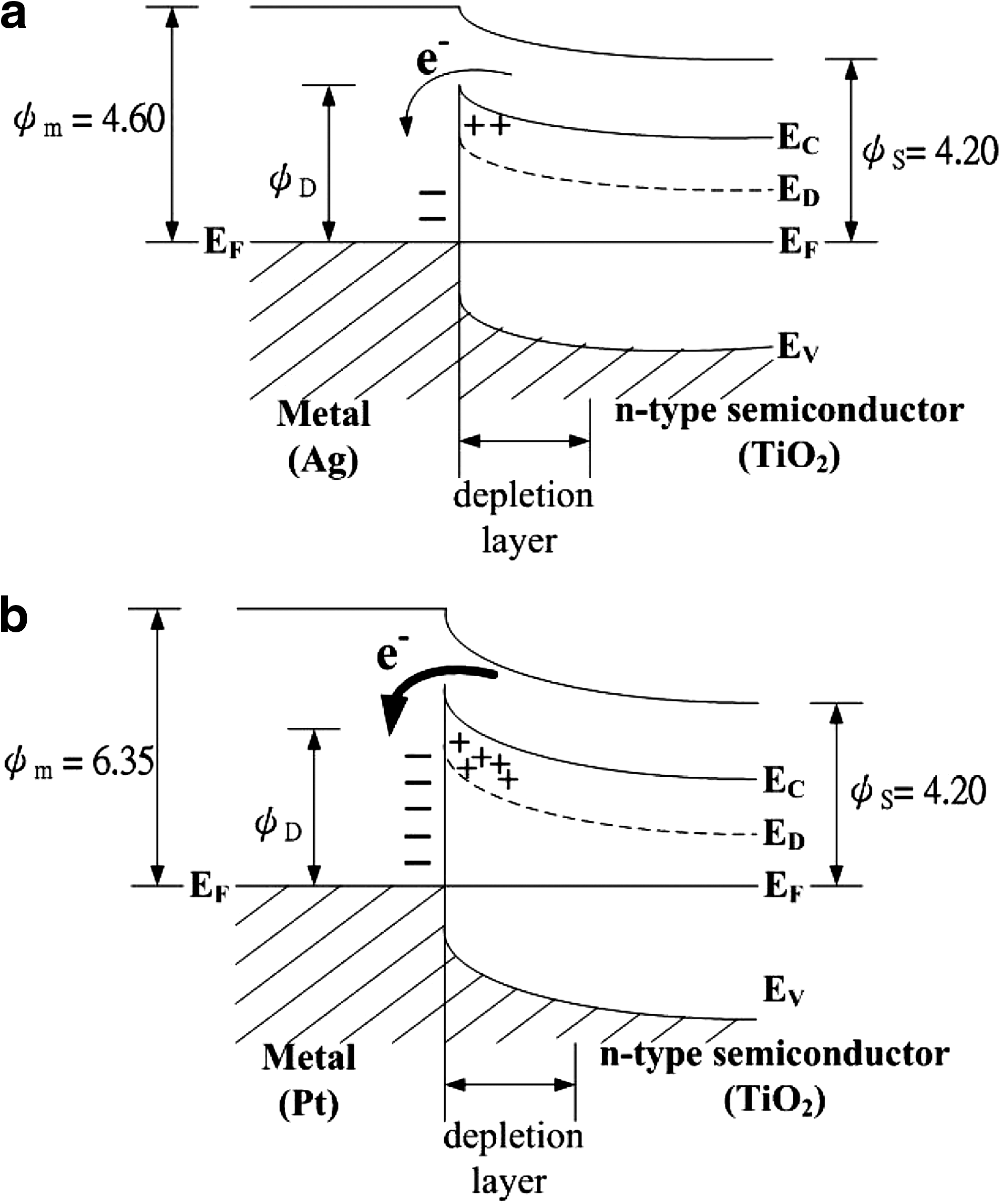
Energy Level variation at the n-type semiconductor-metal interface
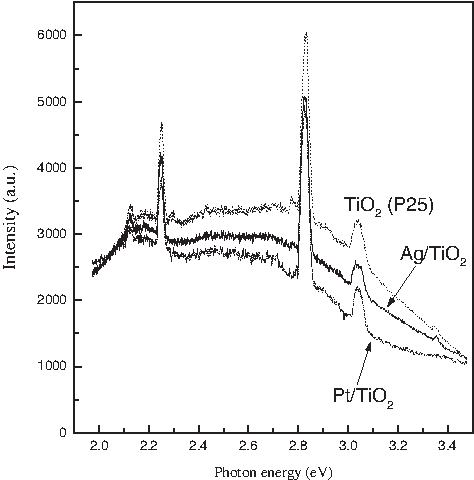
Photoluminescence emission spectra of TiO2 (P25), Pt/TiO2, and Ag/TiO2 in the range of 350–620 nm at 300K.
The PL emission spectra of pure TiO2 performed at room temperature, as shown in Fig. 8, represents peaks that appeared at 3.348, 3.042, 2.832, 2.250, and 2.123 eV, which are equivalent to the wavelength of 370.4, 407.6, 437.8, 551.1, and 584.1 nm. The PL emission peaks of Pt/TiO2 and Ag/TiO2 also show similar positions. The PL intensity of pure TiO2 was apparently greater than that of Ag/TiO2 and Pt/TiO2. It could be concluded that platinum-related and silver-related particles on the surface of TiO2 are instantly accepted by the photo-induced electrons to improve charge separation, and therefore decreased the recombination of the electron/hole pairs in the TiO2, which resulted in lower PL intensities of Pt/TiO2. Similar trends were also observed in the studies done on Pt-doped TiO2 powder (Nakajima et al., 2004). A strong correlation between PL and photocatalytic activity has also been demonstrated for the mixed-phase nanocrystalline titania (Baiju et al., 2009).
Decomposition of o-Cresol under periodic illumination
The photocatalytic oxidation of formate with a bank of black light bulbs using a mechanical light shutter drive for periodic illumination (Buechler et al., 1999). In this study, experiments relating to periodic illumination were benefited greatly by the intrinsic characterization of high-frequency periodic illumination capacity (as short as μs or ms) of the LED. The effect of periodic illumination on the photocatalytic decomposition rate of o-cresol with 0.5 wt% Pt/TiO2 was carried out at UV light intensity of 5.4 W/m2 during various dark (off ) periods and illumination (on) periods. Figure 9 shows that the decomposition of o-cresol is decreased with increasing the dark periods while 365 nm LEDs operated in periodic illumination.
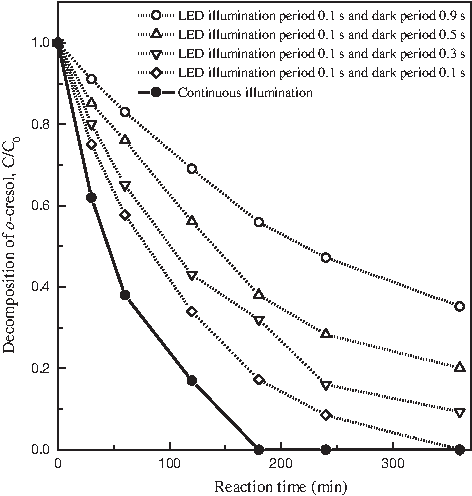
Effect of periodic illumination on photodegradation o-cresol in aqueous solution with 0.50 wt% Pt/TiO2 under 365 nm LEDs irradiation at solution pH value=3, initial concentration of o-cresol=9 mg/L, gas flow rate of oxygen=70 mL/min, dissolved oxygen=35.4 mg/L.
As shown in Table 2, the pseudo first-order reaction rate constants for o-cresol for experiments conducted in periodic illumination were 1.7 to 4.9 times lower than for those experiments conducted in continuous illumination. However, the photons emitted from the 365 nm LEDs used under periodic illumination were 2 to 9 times lower than those under continuous illumination due to the dark (off ) periods from 0.1 to 0.9 s. The enhancement of periodical illumination can be explained by a decrease in average photon flux. As a consequence, the enhancement was possibly ascribed to the decreasing electron-hole recombination.
[o-Cresol]0 = 9 mg/L; pH = 3.
Illumination periods=0.1 s in all periodic illumination experiments.
Therefore, the calculated quantum yield (about 3.9%) for experiments conducted with continuous illumination was much lower than those (5.9% to 16.3%) obtained with periodic illumination. Thus, as pointed out in Cornu et al. (2001), the photonic efficiencies were dependent of the UV light intensity of absorption for both periodic and continuous experiments performed. A similar result reported (Buechler et al., 1999) that the photoefficiency increased from 0.05 during the continuous illumination experiments to 0.20 in periodic illumination. EEO increased from 22 to 31 kWh/m3/order indicating electric energy consumption for periodic illumination was significantly lower than that for continuous illumination under similar experimental conditions. It is expected that the decomposition efficiency and the operation cost for a photocatalytic system could be markedly improved in the future through the advances of LEDs and photoreactors.
Conclusions
The results demonstrated that 0.50 wt% Pt/TiO2 has an increase in its photodegradation rate as compared with 0.50 wt% Ag/TiO2 under both visible light and 440 nm LED irradiation. The calculated band gap (Eg) energies were 3.08 eV for pure TiO2 (P25), 2.94 eV for Ag/TiO2, and 2.92 for Pt/TiO2, respectively. o-Cresol decomposition of 65% and higher in aqueous solution could be reached by Pt/TiO2 photocatalyst within about 480 min of reaction time under 440 nm LED irradiation. EEO values for Pt/TiO2 were 151.8 and 207.6 kWh/m3/order under 440 nm LED irradiation and visible light lamp irradiation, respectively. It observed that the electrical energy consumption decreased significantly to decompose the o-cresol under 440 nm LED irradiation. Moreover, the calculated results of quantum yields indicated a 5.4-fold increase (2.66% to 0.48%) were achieved from an irradiated light wavelength of 365 to 440 nm. EEO increased from 22 to 31 kWh/m3/order indicating electric energy consumption for periodic illumination was significantly lower than that for continuous illumination under similar experimental conditions. This study showed the feasible and potential use of LEDs in photocatalysis.
Footnotes
Acknowledgment
The authors would like to gratefully acknowledge the National Science Council of the Republic of China for financially supporting this research under contract No. NSC 99-2622-E-562-002-CC3.
Author Disclosure Statement
The authors report no competing financial interests.