




Abstract
Abstract
The biorefinery concept has been proposed as a route map to convert biomass into fuels and chemicals, maximizing economic and environmental benefits while minimizing pollution. A biorefinery strategy based on fast pyrolysis is proposed following a two-stage process, where biomass is first subjected to fast pyrolysis, optimized to collect up to 75% (per unit weight of biomass) of a liquid fraction called bio-oil. This bio-oil or its fractions can be upgraded in a second step to different chemicals, to a syngas and/or to energy. In particular, the catalytic steam reforming of the aqueous fraction of bio-oil obtained by fractionation with water is one of the most attractive possibilities for bio-oil upgrading, yielding a H2-rich syngas with low CO content. From the results obtained, it can be concluded that the best alternative for the catalytic steam reforming process is hydrogen production through further purification of the gas obtained.
Introduction
Flash pyrolysis is one of these thermochemical processes, focused on the production of liquids from lignocellulosic biomass with yields to liquid as high as 75% w/w of biomass. The liquid produced, called bio-oil, is composed of a complex mixture of different organic compounds and water in a proportion typically ranging from 70% to 85% w/w of organics (Bridgwater, 2004; Oasmaa and Meier, 2005). The composition of the bio-oil depends on the process conditions employed to produce it, and on the biomass that is used as raw material. Bio-oil can be submitted to water extraction, yielding two fractions (Sipilä et al., 1998): an insoluble fraction, cited as pyrolytic lignin, and an aqueous fraction consisting of carboxylic acids, aldehydes and ketones, alcohols, sugars, low-molecular-weight oligomers, and some other more complex carbohydrates.
The main applications of the bio-oil or its fractions, basically used as fuels or for the production of chemicals, have been pointed out by several authors (Bridgwater, 2004; Czernik and Bridgwater, 2004; Briens et al., 2008). One of the most attractive possibilities for bio-oil upgrading (Chornet et al., 1994) is splitting the bio-oil into two phases by water addition, saving the pyrolytic lignin as a feedstock for the production of fine chemicals (Shabtai et al., 1997; Bridgwater, 2004; Czernik and Bridgwater, 2004; Effendi et al., 2008), and processing the less valuable aqueous fraction through catalytic steam reforming to obtain a gas with a high content of hydrogen (Wang et al., 1997; Czernik et al., 2002; Bimbela et al., 2007, 2009). Catalytic steam reforming of bio-oil offers some advantages over steam gasification of biomass (Van Rossum et al., 2009) such as producing a gas with lower tar content and better quality in terms of higher energy per unit of volume.
The main reactions occurring are the steam reforming of the oxygenates of bio-oil to produce CO, CO2, and H2, along with other equilibrium reactions such as water gas shift (WGS), methane steam reforming, or the Boudouard reaction (Wang et al., 1996). Thus, an appropriate selection of catalyst and operating conditions is required either to maximize hydrogen production or to obtain H2/CO ratios in the syngas similar to those required to become a feedstock for the production of different chemicals and commodities such as synthetic gasoline through Fischer-Tropsch synthesis, methanol, or ammonia (Spath and Dayton, 2003).
Due to the complexity of bio-oil or its fractions, several references can be found in the literature to studies of the steam reforming of individual compounds representative of different chemical groups found in bio-oil rather than the steam reforming of the actual bio-oil itself. For example, acetic acid has been used as a representative compound (Wang et al., 1996; Marquevich et al., 1999; Galdámez et al., 2005; Rioche et al., 2005; Basagiannis and Verykios, 2006, 2007a; Kechagiopoulos et al., 2006, 2009; Takanabe et al., 2006; Bimbela et al., 2007; Vagia and Lemonidou, 2008a; Matas Güell et al., 2009). Nevertheless, some authors have studied the catalytic steam reforming of the bio-oil itself or its aqueous fraction (Czernik et al., 2002; Kechagiopoulos et al., 2006; Medrano et al., 2010). In these references the inherent operational difficulties of working with such a complex material are apparent: formation of carbonaceous deposits, plugging, catalyst deactivation by coke, and the high temperatures required or heterogeneous behavior. Thus, the challenge is to develop a suitable catalyst able to operate with adequate activity and selectivity to hydrogen, with the aim of producing a H2-rich syngas with moderate CO content, while minimizing deactivation by carbon deposition.
The most important parameters for steam reforming are the reaction temperature and the Steam-to-Carbon (S/C) molar ratio. Several authors (Wang et al., 1997, 2007; Rioche et al., 2005; Kechagiopoulos et al., 2006; Basagiannis and Verykios 2007a) among others have investigated the effect of temperature on the steam reforming of oxygenates. In these works, the general tendency observed is that increasing the reaction temperature results in an increase of the carbon conversion to gas. Carbon conversion and hydrogen yield significantly increase in the temperature range of 500°C–700°C (Wang et al., 2007), and according to the thermodynamic analysis of the steam reforming of acetic acid (Vagia and Lemonidou, 2008b), maxima can be found for the production of H2 and CO2 at temperatures slightly over 900 K (627°C).
The effect of the S/C ratio has also been studied in many references in the literature concerning catalytic steam reforming of bio-oil, model compounds, or fractions of it (Wang et al., 1998; García et al., 2000; Kechagiopoulos et al., 2006, 2009; Hu and Lu, 2007; Ramos et al., 2007). The general conclusion inferred in these studies is that carbon conversion, as well as H2 and CO2 yields, increase with increasing S/C ratios. Wang et al. (1997) pointed out that the WGS reaction plays a major role. S/C ratios ≥3 are needed to successfully reform acetic acid and achieve high H2 selectivity (Kechagiopoulos et al., 2009).
The present work aims at analyzing the product gas obtained in the noncatalytic and catalytic steam reforming of model compounds and the aqueous fraction of bio-oil at 650°C. The overall H2/CO ratio and lower heating value (LHV) of the product gas will be discussed to determine whether these product gas compositions meet the requirements necessary either to constitute a promising syngas serving as a feedstock for the production of certain chemicals and commodities, or as a valuable fuel.
Experimental Protocols
The experimental system is based on a micro-reactor test facility that consists of a fixed bed placed inside a tubular quartz reactor. The inner diameter of the quartz reactor is 9 mm, and the height of the bed is about 25 mm. The bed in the catalytic runs is made up of a mixture of sand, used as inert filler, and an Ni coprecipitated catalyst. Sand is the only constituent of the bed in the noncatalytic runs. A schematic diagram of the experimental system is shown in Fig. 1. More details of the experimental system can be found elsewhere (Bimbela et al., 2007).
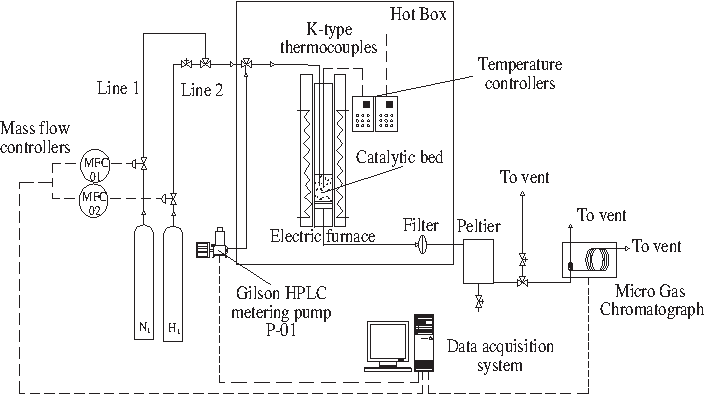
Schematic diagram of experimental setup. HPLC, high performance liquid chromatography.
When feeding the aqueous fraction of bio-oil, the polymerization of the oligomers and sugars present in it, which may cause plugging of the inlet, must be avoided. Therefore, the liquid is not evaporated in the pre-evaporation system, and the whole Hotbox is maintained at room temperature. The liquid is entrained into the reactor by means of two N2 streams with the purpose of creating a nozzle effect.
The model compounds selected were acetic acid, acetol (hydroxyacetone), and butanol. The selection of these model compounds was discussed in previous works (Bimbela et al., 2007, 2009). The concentration of acetic acid was established at 23 wt.% in an aqueous solution, corresponding to an S/C molar ratio of 5.58. The concentration of acetic acid was selected with an organic content similar to that of the aqueous fraction of bio-oil. The concentration of acetol was established at 19.73 wt.% in an aqueous solution, to obtain the same S/C molar ratio as that employed for acetic acid, 5.58. In the case of 1-butanol, an aqueous solution was prepared with a concentration of butanol of 6.54 wt.% by weight, a value that is close to the maximum solubility of 1-butanol in water at room temperature, 7.7 g butanol/100 g water. As a result, the feed had an S/C molar ratio of 14.7 in the case of 1-butanol. The nitrogen flow rate was fixed at 40 STP cm3/min.
The bio-oil was produced from pine wood and supplied by BTG, a company located in the Netherlands. This company has developed the rotating cone technology used for carrying out the flash pyrolysis process. The results from the characterization of the bio-oil and the aqueous fraction prepared from it are presented in Table 1. From the ultimate analysis of the bio-oil, an empirical formula for the organics present in the bio-oil is determined: C H1.47O0.48. The nitrogen content in the bio-oil is negligible and thus not taken into consideration in the empirical formula.
Determined by difference.
The aqueous fraction was separated following a similar method to that described in the literature (Sipilä et al., 1998), which is based on slow dropwise addition of the bio-oil into Milli-Q water, maintaining continuous moderate stirring and subsequent washing and filtering. The bio-oil-to-water mass ratio was set at 1:2 in the present work, to achieve appropriate separation of the aqueous fraction without excessive dilution of the organics in the aqueous phase. Other authors have also employed this ratio when extracting the aqueous fraction of bio-oil (Kechagiopoulos et al., 2006). The organic content of the resultant aqueous phase was 16 wt.%, determined by difference with the water content by Karl-Fischer titration. The S/C ratio was 7.64 and the empirical formula for the organics present in the aqueous fraction is C H2.39O0.71.
The catalysts were prepared in the laboratory by coprecipitation. The preparation method was similar to another described in the literature for preparing nonstoichiometric nickel aluminate catalysts (Al-Ubaid and Wolf, 1988). Details about preparation and characterization of the catalysts prepared can also be checked in previous works (Bimbela et al., 2007, 2009).
The experimental procedure in the catalytic runs implies in situ reduction of the catalyst for 1 h, with hydrogen diluted in nitrogen (10% v/v) at a fixed temperature of 650°C. In the noncatalytic runs, this step is skipped. The effect of the reduction time on the catalyst performance was discussed in the first work (Bimbela et al., 2007). From those results, a reduction time of 1 h had been selected. Afterward, nitrogen is fed in until the reaction temperature is reached, fixed at 650°C in this study, and then the organic is fed in. The reforming reaction time is set at 2 h, after which nitrogen is again fed in as a sweeping gas.
Some of the experiments selected for this study have been reported before (Bimbela et al., 2007, 2009). However, neither the overall heating value of the product gas, the H2/CO ratio of these runs, nor the energy efficiency has been discussed previously. These experiments will be compared with those corresponding to steam reforming experiments performed with the actual aqueous fraction of bio-oil. The runs selected correspond to the noncatalytic steam reforming runs of the different feedstocks and those catalytic steam reforming runs performed at thermodynamic equilibrium conditions through 2 h of reaction.
It has been selected a reaction temperature of 650°C because it is an optimum in hydrogen production and it is a relatively low temperature that decreases the energy input for this endothermic process. The duration of experiment is not important in the present work. Thus, the space velocity values have been selected to obtain a stable performance of the catalyst during the whole experiments.
The gas composition, the LHV, higher heating value (HHV), and the H2/CO ratio obtained in these steam reforming tests will be analyzed. Further, the energy efficiency of the process, defined here as energy content of the product gas with regard to the energy content of the organic fed, has been calculated and discussed. This parameter has been calculated by taking into account the gas yield, expressed as mass of gas produced per mass of organic fed, multiplied by the LHV of the gas produced and divided by the LHV of the organic fed. A similar definition was proposed by Van Rossum et al. (2009). The LHV of the different model compounds has been calculated by taking into account their standard enthalpies of formation (ΔH0f). The ΔH0f values for acetic acid and butanol were taken from tables (Perry and Green, 1999), whereas for acetol, the selected ΔH0f was the value proposed by Espinosa-García and Dóbé (2005). Regarding the LHV of the organics from the aqueous fraction of bio-oil, a correlation proposed by Channiwala and Parikh (2002) was employed to estimate the LHV from the elemental analysis presented in Table 1.
The gas hourly space velocity as referred to C1-equivalent species (GC1HSV) (Wang et al., 1996) has been defined as the volume of C1-equivalent species in the feed at standard temperature and pressure (STP) per unit volume of catalyst (including the void fraction) per hour. Such a definition of the space velocity permits comparing the results of feeds with different numbers of carbon atoms per molecule, particularly when considering complex feedstocks such as the aqueous fraction of bio-oil. The material balance closure has been expressed as the recovery obtained in the experiments, calculated as the sum of gas and liquid overall yields expressed as g/g liquid fed. Total gas yield has been expressed in terms of the mass fraction of analyzed gases (H2, CO, CO2, CH4, and C2) with respect to the sum of organics and water. The carbon conversion to product gases has been calculated as moles of carbon in the product gases/moles of carbon in the feed.
Results and Discussion
Tables 2 and 3 list the relevant data and results of the noncatalytic and catalytic experiments of the different feedstocks at 650°C, respectively. Regarding the noncatalytic steam reforming experiments, it can be observed that the carbon conversion to gas and the product gas composition significantly vary depending on the feedstock despite having similar operating conditions, as can be seen by comparing acetic acid and acetol. The results obtained for the noncatalytic steam reforming of acetic acid show a very low carbon conversion to gas, nearly negligible, in agreement with the results obtained by other authors under similar experimental conditions (Takanabe et al., 2006; Basagiannis and Verykios, 2007a). Basagiannis and Verykios (2007b) stated that homogeneous reactions are significant only at elevated temperatures. Although there are several references in the literature that study the noncatalytic steam reforming of acetic acid (Wang et al., 1996; Galdámez et al., 2005; Rioche et al., 2005; Basagiannis and Verykios, 2006; Vagia and Lemonidou, 2008a; Matas Güell et al., 2009), the different results obtained in these works could be explained by the different operating conditions employed (reaction temperature, S/C ratio, and type of reactor, among others).
Reaction temperature=650°C; material bed=1.8 g of sand.
LHV, lower heating value; HHV, higher heating value; S/C, steam-to-carbon molar ratio; STP, standard temperature and pressure.
Reaction temperature=650°C; material bed=0.1–0.2 g of catalyst and around 1.7 g of sand.
GC1HSV, gas hourly space velocity as referred to C1-equivalent species.
Regarding acetol, the comparison of the result in noncatalytic steam reforming shows differences in the present work with those found in the work of Ramos et al. (2007), pointing out possible wall effect catalytic reactions to explain the differences found both in carbon conversion to gas and in gas compositions. This wall effect could also explain the differences found with the work of Galdámez et al. (2005) in the noncatalytic steam reforming of acetic acid. In the work of Medrano et al. (2009) studying noncatalytic steam reforming of acetol, the wall effect was suppressed by using a fluidized bed quartz reactor, leading to a similar carbon conversion to gas and overall gas yield, but with a rather different composition than in the present work, with greater CH4 and C2 content and almost negligible CO2 content. This could be explained by the different reactor and solid-gas contact. Furthermore, other authors (Vagia and Lemonidou, 2008a) found greater conversions in the noncatalytic steam reforming of acetic acid and acetone at greater temperatures, which is also in agreement with the tendencies found in our previous work (Bimbela et al., 2009).
Interestingly, the CO content in the product gas composition of noncatalytic reforming of the aqueous fraction of bio-oil is the greatest at around 54%. The CO2 content is very similar, around 8%, except for acetic acid where it reaches up to 26%, probably related to the presence of a carboxylic group in the molecule, which might preferentially yield CO2 upon reforming. The greatest methane content was also obtained for acetic acid. Nevertheless, in the case of the aqueous fraction, up to 10.8% of CH4 was found in the product gas composition. The lowest H2 content, however, was observed for the aqueous fraction. The CH4 and C2 content was noticeable in all cases. The C2 content seems to increase with an increasing number of carbon atoms per molecule of organic in the feed, being up to around 7% for the noncatalytic reforming of the aqueous fraction of bio-oil.
The noncatalytic reforming of the aqueous fraction of bio-oil yielded a carbon conversion to gas around 30%, concordant with the results reported by other studies (Kechagiopoulos et al., 2006), obtaining conversions of 20% under similar conditions of temperature, indicating the importance of the catalyst in promoting reforming and WGS reactions.
On the other hand, the heating value of the product gas is very similar for the three model compounds, with LHV values around 13.4 MJ/STP m3, whereas the aqueous fraction of bio-oil might yield a product gas with an LHV of 17.0 MJ/STP m3. Such a value could be considered sufficient for its usage as a fuel gas, with a heating value similar to those typically obtained in biogas production and only half of the heating value of natural gas (Briens et al., 2008). However, if the energy efficiency of the process is taken into account, it can be concluded that noncatalytic steam reforming of these feedstocks is not adequate for producing a fuel gas, since low gas yields are obtained in all cases, resulting in a poor gas production and hence low energy efficiencies.
The overall H2/CO ratios of the noncatalytic steam reforming tests are also quite low, ranging from 0.4 to 3.8, despite the great excess of steam in all the feeds. The lowest value corresponds to the experiment with the aqueous fraction of bio-oil as a feedstock, followed by acetol. In contrast, the overall H2/CO ratio is as high as 3.8 for butanol, thanks to the extremely high H2 content yielded.
Concerning the results shown in Table 3, it can be observed that the carbon conversion to gas significantly increases in the catalytic steam reforming, with overall yields to gases also notably increasing in all cases. Thus, the role of the catalyst is proven, clearly increasing the carbon conversion to gas and clearly modifying the product gas composition, as can be seen by comparing the results in Tables 2 and 3 individually for each feed. Carbon conversion to gas is almost or totally complete in the catalytic steam reforming of the model compounds. At the GC1HSV values used, the gas yields obtained are close to thermodynamic equilibrium (Bimbela et al., 2007, 2009).
Contrarily, carbon conversion to gas only reaches up to 82.62% in the catalytic steam reforming of the aqueous fraction of bio-oil. The average gas composition of the first 50 min of the experiment with the aqueous fraction remained stable. The experimental gas composition including the water content, calculated from the material balance, was input in the simulation software (Aspentech HYSYS 3.2). Disregarding the experimental error, it was obtained that the equilibrium gas composition was achieved.
A comparison of the results obtained in the catalytic steam reforming of acetic acid as a model compound can be found elsewhere (Medrano et al., 2008). It can be observed that the results presented here are similar to others found in the literature. As for the catalytic steam reforming of acetol, Medrano et al. (2009) using an Ni catalyst and a fluidized bed obtained similar values in terms of gas composition (H2, CO, and CO2), but with values of carbon conversion to gas lower than in the present work, as well as Ramos et al. (2007).
In other references related to catalytic steam reforming of the aqueous fraction at similar experimental conditions, the carbon conversion to gas does not usually exceed 90% (Rioche et al., 2005; Kechagiopoulos et al., 2006; Wang et al., 2007; Van Rossum et al., 2009), similarly to the values obtained in the present work. This fact is consequence of the presence of compounds that do not totally vaporize and form carbonaceous deposits. Higher values of carbon conversion to gas are usually achieved at temperatures above 650°C (Czernik et al., 2002; Basagiannis and Verykios, 2007b; Kechagiopoulos et al., 2009). Other studies (Kechagiopoulos et al., 2006) show a carbon conversion to gas of 70%, lower than that obtained here, even at gas hourly space velocities (GHSV) as low as 300 h−1, or 50% (Wang et al., 2007), with non-Ni-based catalysts. As for the H2 content in the gas obtained, similar and even slightly lower values, around 60%–65%, were obtained by several authors (Wang et al., 1998; Czernik et al., 2002; Kechagiopoulos et al., 2006; Van Rossum et al., 2009). A remarkable fact of the results obtained in this work is a high H2/CO ratio, 21, whereas the results published in other works in similar operating conditions are significantly lower (Wang et al., 1998, 2007; Czernik et al., 2002) or similar to other studies, but with significant lower values of GHSV (Kechagiopoulos et al., 2006).
The gas produced has lower LHV and HHV, approximately half of those obtained in the noncatalytic process, due to the shift in the equilibrium of the WGS reaction toward H2 and CO2 production and the conversion by steam reforming of CH4 and C2. However, since gas yields are much higher than those in noncatalytic steam reforming, the energy efficiency of the process is greater in the catalytic steam reforming.
As a result, the overall H2/CO ratios, the LHV, and HHV of the different product gases and the energy efficiencies are modified when compared with their respective noncatalytic reforming experiments. This can be seen, for example, in Fig. 2 by comparing the gas compositions of the noncatalytic and catalytic runs of the different feeds. In particular, H2 and CO2 contents increase while CO diminishes, due to the role played by the catalyst both in the reforming reactions and in the WGS reaction. Moreover, side products such as CH4 and C2 are eliminated, all of this affecting both the H2/CO ratios and the heating values of the product gases obtained in the catalytic runs. Thus, the catalytic steam reforming of these feedstocks implies a significant increase in the H2/CO ratio, though the heating value of the product gas is diminished by around a half of that produced in the noncatalytic reforming experiments.
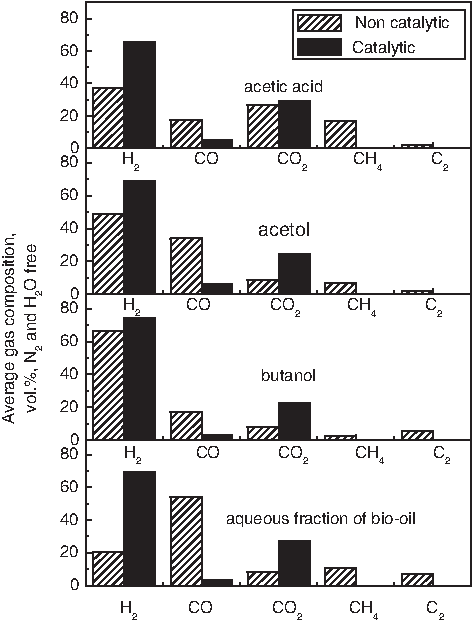
Comparison of the average product gas compositions of noncatalytic and catalytic steam reforming experiments.
A comparison of the H2/CO ratios obtained can also be made against those typical of syngas that are used as feedstocks for the production of several valuable chemicals and commodities. Typical H2/CO ratios ranging from 0.5 through 4.0 are employed in the industry (Spath and Dayton, 2003). From these results, it can be observed that the H2/CO ratios obtained in the catalytic steam reforming experiments (Table 3) are much greater than those usually employed in typical syngas conversion processes. The product gas corresponding to the noncatalytic reforming of the aqueous fraction of bio-oil might be suitable for the production of linear primary alcohols. However, the H2/CO ratios obtained in the catalytic steam reforming of the organics tested are too high compared with the typical H2/CO ratios usually employed (Spath and Dayton, 2003). The best option for the H2-rich syngas produced in the catalytic steam reforming is hydrogen purification through techniques such as pressure-swing adsorption or the steam-iron process (Lorente et al., 2009).
Regarding energy purposes, it can be concluded that the catalytic steam reforming of the aqueous fraction of bio-oil is not appropriate for producing a fuel gas. Certainly, bio-oil could be directly burnt without any previous fractionation (Bridgwater, 2004; Briens et al., 2008), but the present work must be understood within a biorefinery scheme, in which several valuable chemicals could be produced through bio-oil fractionation and the residual aqueous fraction could then be upgraded. Besides, the reforming process of the aqueous fraction has the advantage of producing a clean syngas, without any byproducts (e.g., tars) that might cause drawbacks such as those encountered in direct combustion of bio-oil in diesel engines or in processes such as biomass gasification (Bridgwater, 2004; Briens et al., 2008).
Summary
The noncatalytic steam reforming of the aqueous fraction of bio-oil at 650°C with an S/C ratio of 7.6 produces a gas with an LHV equal to 17 MJ/STP m3, appropriate for its use as a fuel, but the energy efficiency of the process is very low. The catalytic steam reforming of the aqueous fraction of bio-oil at 650°C with an S/C ratio of 7.6 produces a suitable gas for hydrogen production through further purification.
Footnotes
Acknowledgments
The authors express their gratitude to the Spanish Ministerio de Educación y Ciencia (MEC) (Research Project Ref. Num. CTQ2007-62841) and to the Government of Aragon (Research Project Ref. Num. CTPP02/09) for providing financial support for the work, as well as for the FPI grant awarded by the MEC to Fernando Bimbela and co-funded by the European Social Fund (ref. num.: BES-2005–7931).
Author Disclosure Statement
The authors hereby declare that no competing financial interests, actual or potential, exist.