




Abstract
Abstract
Batch and column studies were conducted to evaluate the performance of a novel aminated polyacrylonitrile (TE-PAN) fiber for total chromium removal from electroplating wastewater. Results from batch sorption studies showed that sorption equilibrium of chromium on TE-PAN was achieved within about 10 min. Temperature had no significant effect on sorption isotherms and estimated maximum uptake of total chromium was 133 mg/g. TE-PAN exhibited high removal efficiency over a wide pH range (2–7). Column studies demonstrated that exhausted TE-PAN fibers could be completely regenerated by 0.1 M NaOH for repeated sorption of chromium after as many as 15 sorption-regeneration cycles. FTIR and SEM analyses further validated the efficiency and stability of TE-PAN for chromium removal. Findings of this study have significant practical applications for treatment of chromium contaminated waters.
Introduction
Conventional technologies for treatment of aqueous Cr(VI) include reduction-precipitation (Almaguer-Busso et al., 2009), ion exchange (Tenório and Espinosa, 2001), adsorption (Li et al., 2007), and membrane-based separation (Sachdeva and Kumar, 2008). In the industrial application, chemical reduction of Cr(VI) to less toxic Cr(III) followed by Cr(OH)3 precipitation is the most popular method. However, a large amount of sludge is generated in this process that should be safely disposed of. Ion exchange and adsorption are the most widely studied because they are easy to operate and could be used for advanced treatment. Moreover, when combined with an appropriate desorption step, they could recycle the valuable metal and solve the problem of sludge disposal. Many adsorbents have been studied for chromium removal from aqueous solutions, including ion exchange resin (Tenório and Espinosa, 2001), cellulose (Anirudhan et al., 2009), activated carbon (Fang et al. 2007; Acharya et al., 2009), silica particles (Li et al., 2007) and biomass (Boddu et al., 2003; Park et al., 2008; Kumar and Chakraborty, 2009; Singh et al., 2009; Liu et al., 2010).
Ion exchange fibers have been widely studied as adsorbents for heavy metal ions and other inorganic or organic ions in recent years (Soldatov et al., 1999; Deng et al., 2003, 2008; Deng and Bai 2004). Compared with traditional adsorbents, these fibrous materials have smaller diameter and larger outer specific surface area, making them more available for pollutant adsorption. Moreover, in a fixed-bed, they can be easily compressed or loosened and the head loss is low. Deng and Bai (2004) investigated the removal of Cr(VI) from synthetic wastewater and the associated sorption mechanisms through batch sorption tests. These studies have limitations to predict the performances of the fibrous materials in practical situations, where continuous reactors replace batch operation and actual industrial wastewaters are treated.
The objective of the current study was to explore the application of a novel aminated polyacrylonitrile (TE-PAN) fiber as a sorbent for chromium removal from a real electroplating wastewater. Both batch and column sorption tests were conducted to elucidate the sorption kinetic, influence of solution pH, sorption isotherms, desorption and regeneration performances, and stability of the fiber column. FTIR and SEM analyses were conducted to characterize the TE-PAN fiber before and after chromium sorption, thus providing more information on stability of the sorbent in treatment of chromium contaminated water.
Experimental Section
Materials
The wastewater used in this study was collected from the electroplating process in a machinery company in Zhengzhou, China. Analyses from atomic absorption spectroscopy (ZEEnit700; Analytik Jena) and visible spectroscopy (722N; Shanghai Precision & Scientific Instrument Co., Ltd.) demonstrated that the total chromium concentration was 53.5 mg/L and the Cr(VI) concentration was 32.7 mg/L [i.e., 61% of chromium existed as Cr(VI)]. Details of the wastewater composition were demonstrated in Supplementary Table S1 (Supplementary Data are available online at www.liebertonline.com/ees).
Sample characterization
FTIR spectra of the TE-PAN samples [i.e., (a) original TE-PAN, (b) TE-PAN after chromium sorption, and (c) TE-PAN after NaOH regeneration] were collected on a FTIR spectrometer (Thermo Nicolet IR 200; Thermo Electron Corp.) working in 4,000–400 cm−1. Morphologies of the original TE-PAN and the TE-PAN after 15 cycles of sorption-regeneration were examined by SEM (JSM-6390LV, Japan).
Batch sorption experiments
Generally, 50 mg of sorbent were mixed with 50 mL of chromium-containing wastewater in a 100 mL conical flask at 25°C. After reaching sorption equilibrium, the supernatant was sampled and filtered, and the filtrate was analyzed by atomic absorption spectroscopy for total chromium concentration. Sorption capacity (Qe, mg/g) and removal rate (R, %) of total chromium at equilibriums were calculated using equations
where C0 and Ce (mg/L) are initial and equilibrium concentrations of total chromium, M (g) is dry mass of sorbent, and V (L) is volume of wastewater. Batch sorption experiments were conducted at different time intervals (1–60 min), various pH values (pH 2–9), and a series of Cr(VI) initial concentrations (10–300 mg/L) to evaluate sorption kinetic, effect of pH on chromium sorption, and sorption isotherms, respectively. For sorption isotherms, synthetic wastewater was prepared with Cr(VI) initial concentrations in the range of 10–300 mg/L.
Column sorption experiments
For the column experiments, a column (inner diameter 13 mm, height 60 mm) packed with 1.5 g of TE-PAN was used, and the empty bed contact time was controlled at 0.5 min for wastewater. Before operation, the bed was rinsed with deioned (DI) water and then pretreated with 0.1 M HNO3 to convert the sorbent to its protonated form. After being extensively rinsed with DI water, the electroplating wastewater influents were pumped upward through the column at a flow rate of 10 mL/min. The chromium breakthrough curves were obtained by plotting the total chromium concentrations of the samples versus the empty bed volume (BV). The breakthrough point was designated at the BV when total chromium concentration of effluents exceeded 0.5 mg/L.
After breakthrough, 0.1 M NaOH was used for elution of the sorbed chromium. The elution curve was obtained by plotting the total chromium concentration versus the BV of NaOH solution. After regeneration, the column was washed sequentially with DI water, 0.1 M HNO3 and DI water prior to subsequent sorption. Multiple sorption-regeneration cycles were conducted to demonstrate the sorbent stability in chromium removal from the real wastewater.
Results and Discussions
Sorption kinetics
As shown by the observed removal rate of Cr(VI) versus sorption time (Fig. 1 and Supplementary Fig. S1), the sorption equilibrium was reached very fast and took only about 10 min for the TE-PAN fiber (removal rate >99%). In contrast, the raw PAN had no significant uptake for Cr(VI), indicating that grafting of amine groups could substantially improve its Cr(VI) sorption capacity. Deng and Bai (2004) also reported that the adsorption equilibrium took about 1 h for Cr(VI) species on fiber material.
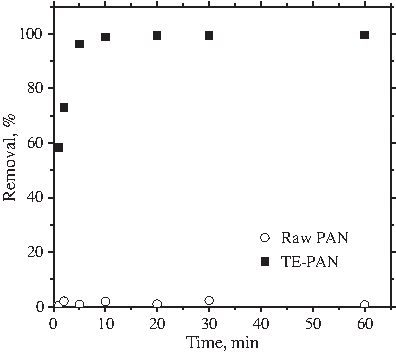
Sorption kinetics of total chromium on both raw PAN and as-synthesized TE-PAN fiber; wastewater pH=5.0 (fixed by 0.01 M acetate buffer), sorbent dosage=1 g/L. PAN, polyacrylonitrile.
Sorption isotherms
As illustrated in Fig. 2, sorption capacities (Qe) of total chromium increased with increasing equilibrium Cr(VI) concentrations, and the two sorption isotherms at 25°C and 40°C had no obvious difference. The estimated maximum uptake (Qm) of chromium from Langmuir fitting was 133 mg/g, much higher than the value (35 mg/g) reported by Deng and Bai (2004) in their study of chromium removal with animated PAN fibers, demonstrating a greater sorption capacity of the as-synthesized TE-PAN.
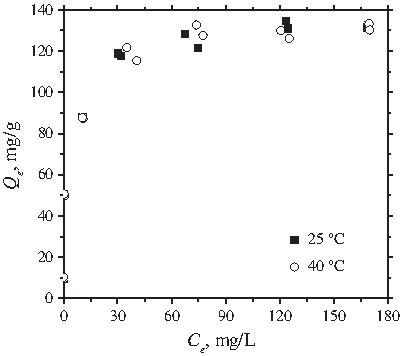
Sorption isotherms of Cr(VI) on TE-PAN fiber under 25°C and 40°C; sorbent dosage=1 g/L, pH=5.0 (fixed by 0.01 M acetate buffer). Synthetic wastewater was prepared from Na2Cr2O7 with Cr(VI) initial concentrations 10–300 mg/L. TE-PAN, novel aminated polyacrylonitrile.
Effect of pH
Both batch (Fig. 3) and column (Fig. 4) sorption tests were conducted to elucidate the effect of solution pH on chromium removal by the TE-PAN fiber. As illustrated in Fig. 3, the aqueous pH at sorption equilibrium (pHe) had a significant impact on chromium removal by TE-PAN. The optimal pHe was in the range of 2–7 where the chromium removal rate kept above 90%. Increasing the solution pHe to 8.7 decreased the removal rate to 80.3%. Under the studied conditions, pHe was always higher than the initial pH (pH0). This proposed that H+ was apt to adsorb on the fiber, with resulting amine groups protonated which was favorable for sorption of anionic Cr(VI) species (such as HCrO4−, CrO42−). At high pH values, the low solution H+ concentration significantly inhibited the amine protonation and consequently decreased the chromium removal rate. Similar pH patterns were reported for Cr(VI) sorption by aminated fibers (Deng and Bai, 2004), anion-exchange resins (Shi et al., 2009), amine-modified celluloses (Anirudhan et al., 2009), etc. The high removal rate (>90%) also suggested that both Cr(VI) and Cr(III) could be efficiently removed by TE-PAN.

Impact of solution pHe (pH at equilibrium) on chromium removal by TE-APN fiber and the relationship between pH0 (initial pH) and pHe; TE-PAN dosage=1 g/L.

Breakthrough curves for chromium sorption by TE-PAN at pH 8.0
To further evaluate the pH impact, two pH values were studied in the column sorption experiments. For each test, two cycles were conducted. Breakthrough curves from these studies (Fig. 4a, b) demonstrated that at pH 8.0, about 220 BVs of wastewater could be efficiently treated in each cycle. However, when pH of the wastewater was adjusted to 5.0, this volume was increased to about 360–380 BVs. This result was similar with the batch tests, demonstrating that the wastewater pH had a significant effect on chromium removal, and a weak acid condition was always beneficial. Moreover, there was no obvious difference for the volume of wastewater between the two cycles.
Regeneration tests
0.1 M NaOH was used to regenerate the sorbent for its further sorption. Results from the desorption curves (Fig. 4c, d) showed that about 14 BVs of NaOH were needed for nearly complete desorption of the chromium sorbed on TE-PAN at pH 8.0. While the volume increased to about 20 BVs for the TE-PAN exhausted at pH 5.0, due to more chromium to be eluted. In addition, the eluted chromium was highly concentrated within 4–6 BVs (e.g., from 6th to 12th BV for tests at pH 5.0), enabling possible recovery or reuse of chromium.
Further studies demonstrated that after repeating the sorption-regeneration process for 15 cycles, only 5%–6% volume loss of the treated wastewater was observed. This indicated that the synthesized TE-PAN was very efficient and stable in chromium-containing wastewater treatment.
FTIR and SEM
As indicated in Fig. 5 (top), the synthesized TE-PAN had several characteristic peaks. Most of them were derived from the original PAN fiber which could be assigned as follows: broad band ranging from 3,100 to 3,700 cm−1 (stretching vibration of OH and NH groups), 2,937, 2,875, 1,452 cm−1 (C-H stretching and blending), 2,243 cm−1 (C≡N stretching in nitrile group), 1,072 cm−1 (C-O stretching), and 538 cm−1 (C=O twisting). After triethylenetetramine grafting, a new broad band appeared at 1,550–1,680 cm−1 (C=O group in amide and N-H group in amine), demonstrating that amine has been successfully introduced in PAN fiber structure. After chromium sorption, two new bands appeared at 899 and 784 cm−1, which disappeared after NaOH desorption, demonstrating that these bands resulted from the sorbed chromium (Li et al., 2007; Toral et al., 2009; Sun et al., 2010). The complete disappearance of these two bands also suggested that NaOH could desorb chromium completely.
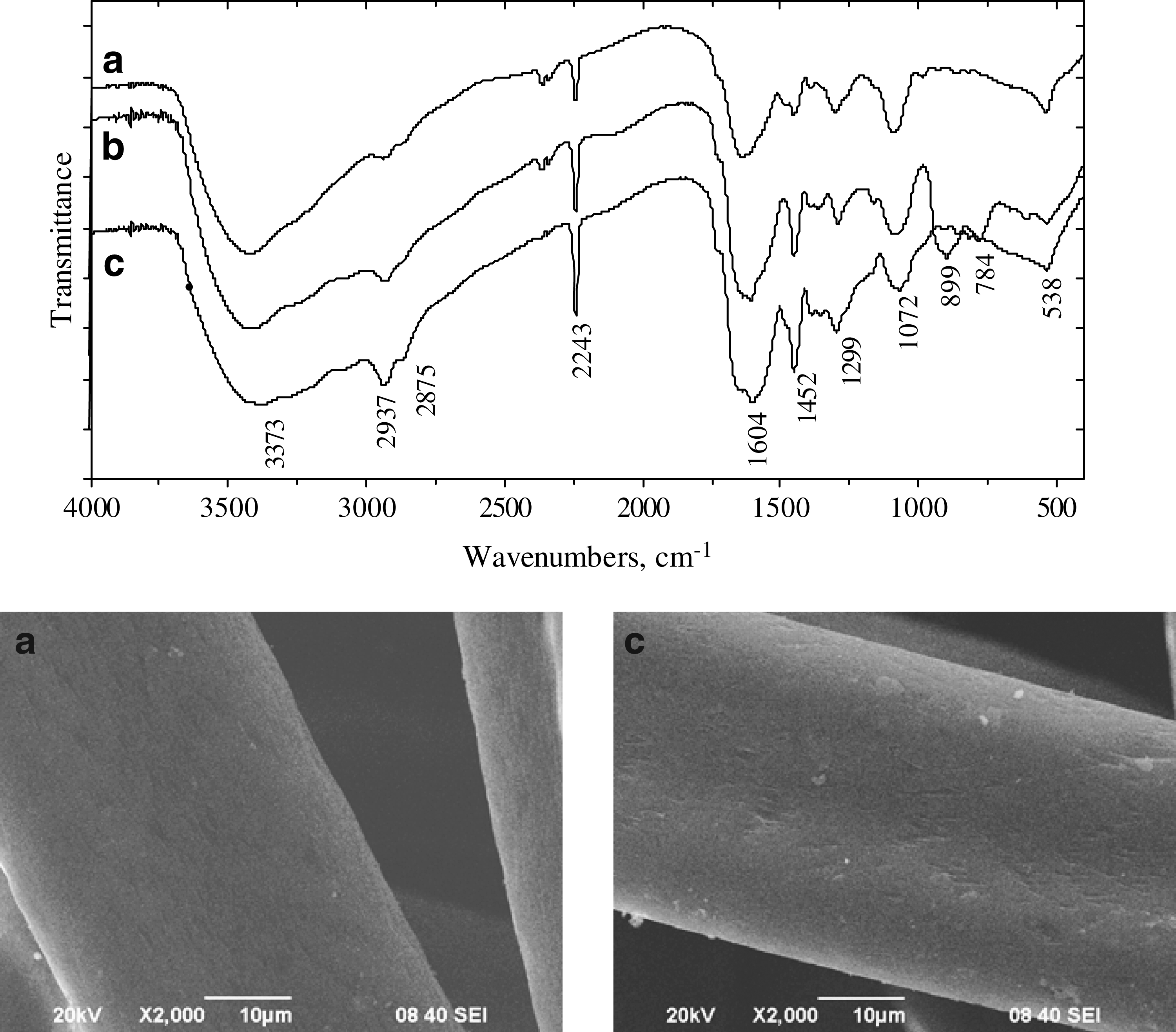
FTIR (top) and SEM photographs (bottom) for
SEM patterns (Fig. 5, bottom) showed that the TE-PAN fiber had a very smooth surface. After 15 cycles of sorption-regeneration, the fiber still kept its good fibrous morphology, indicating that the TE-PAN fiber was stable during the repeated chromium sorption and base regeneration processes.
Conclusions
Grafting of amine groups on PAN fiber using triethylenetetramine could substantially improve its chromium removal performance. The sorption equilibrium was achieved within 10 min. Temperature did not have any obvious effect on the sorption isotherm and the estimated maximum uptake of chromium was particularly high (133 mg/g). Efficient removal of total chromium was observed over a wide pH range (2–7). Results from column experiments demonstrated that 1.5 g fiber could treat 220 BVs of wastewater at pH 8.0 or 380–390 BVs at pH 5.0. After regeneration by 0.1 M NaOH, the fiber could be repeatedly used for chromium removal even after 15 sorption-regeneration cycles. Findings of this study have significant implications for treatment of chromium contaminated waters.
Footnotes
Acknowledgment
Funding for this research was provided by the Major Public Welfare Project in Henan province (grant no. 81100912100).
Author Disclosure Statement
The authors declare that no competing financial conflicts exist.
References
Supplementary Material
Please find the following supplemental material available below.
For Open Access articles published under a Creative Commons License, all supplemental material carries the same license as the article it is associated with.
For non-Open Access articles published, all supplemental material carries a non-exclusive license, and permission requests for re-use of supplemental material or any part of supplemental material shall be sent directly to the copyright owner as specified in the copyright notice associated with the article.
