




Abstract
Abstract
One of the main obstacles to the agricultural use of the sludge produced in wastewater treatment plants are heavy metals that have accumulated. Electrokinetic treatment can be used to remove these heavy metals, but the process is time consuming, sometimes lasting several days. In this study, the effects of different potential gradients were investigated. Electrokinetic experiments were conducted under constant potential gradients (1 V/cm, 3 V/cm, and 5 V/cm) with a treatment time of 16 hours. Results showed that the most efficient removal of metals was achieved at a potential gradient of 5 V/cm. Average removal efficiencies of heavy metals were 30.29% for copper, 43.52% for nickel, and 33.38% for zinc. Accumulation of metals occurred at a distance of 7 cm from the anode at a potential gradient of 1 V/cm. Results of the sequential extraction and sludge pH profiles show that an acidic front generated at the anode reservoir flushed across the sludge chamber and that the higher potential gradient increased the migration velocity, which aided the dissociation and desorption of metals. Furthermore, the use of higher potential gradients made it possible to remove heavy metals from sludge cells in a shorter period of time.
Introduction
Previous studies have shown that electrokinetic remediation is a successful and cost-effective technique for removing heavy metals from soil (Li et al., 1996; Virkutyte et al., 2002). Electrokinetic remediation is the controlled application of electrical migration and electroosmosis together with electrolysis reactions at the electrodes (Acar et al., 1995; Kim et al., 2002). When direct current electric fields are applied to the contaminated soil, a migration of charged ions occurs (Peng et al., 2009). The cations, such as heavy metals, that are present in the soil move toward the cathode, and, because of ionic migration, the anions move toward the anode (Hanay et al., 2009).
Using the experience gained from electrokinetic soil remediation as a reference, a few researchers have begun to study metal removal from sludge using an electrokinetic process (Hanay et al., 2009; Jakobsen et al., 2004; Wang et al., 2005). Although the results have been promising, the process has drawbacks. Specifically, it is very time-consuming (Virkutyte et al., 2002). The overall application time can last several days (Elektorowicz et al., 2006; Giannis et al., 2009). For this technique to be feasible for large-scale soil decontamination, the application time needs to be shortened, and the migration velocity needs to be enhanced.
Of the mechanisms involved in the electrokinetic removal of metals from sludge and soil, electromigration is the most important. The ion electromigration velocity, vem, is directly proportional to the electrical field,
Or, the force applied to the ions is
where F is force (N); zi is the charge of ionic species; e is the elementary charge (1.6×10⁻¹⁹ C); ∇V is the voltage gradient (V/m) (Ferri et al., 2009). Therefore, enhancing the potential gradient may increase the migration velocity and the force that is applied to the ions, which would result in much faster electromigration rates and a shorter time period required to reach the elevated concentration of ions at the cathode (Tuan and Sillanpää, 2010).
Other processes that play important roles in electrokinetic remediation include ion exchange and sorption on the soil surface, chemical reactions (precipitation, dissolution, and complexation), the development of chemical/osmotic gradients resulting from chemical or sorption reactions, and electrochemical reactions at the electrodes (Baraud et al., 1997). As Acar et al. (1995) have pointed out, electrokinetic remediation systems are affected by the electrolysis of water and reduction reactions at the cathode, and electrolysis reactions dominate the chemistry at the electrode surfaces.
In the electrokinetic process, the electrolysis of water is the main reaction that changes pH values (Hanay et al., 2009). Hydrogen ions cause an acid front to migrate through the porous media, which is beneficial for ion dissolution. The hydroxyl anion causes an alkaline front to migrate through the porous media, which causes the precipitation of heavy metals and hinders their removal. To improve the removal of heavy metals, enhancers are often used. Among the enhancers that have been employed are solvents, including hydrogen chloride (HCl), nitric acid (HNO3), and acetic acid for conditioning the catholyte pH (Virkutyte et al., 2005); chemical reagents to improve metal solubility (Hanay et al., 2009; Giannis et al., 2010); ion selective membranes to exclude hydroxide (OH−) migration from cathode compartments into the soil (Virkutyte et al., 2005); and electrolyte circulation to control electrolyte pH (Ouhadi et al., 2010).
This article describes a laboratory investigation on the use of an electrokinetic method that employs higher potential gradients and a shorter processing time for the removal of heavy metals (Ni, Zn, and Cu) from sludge. Three different potential gradients (1 V/cm, 3 V/cm, and 5 V/cm) were used, and the processing time was shortened to 16 hours. The removal efficiency of this method was investigated. The sludge pH and the distribution of heavy metals, before and after treatment were also examined.
Materials and Methods
Materials
A sludge sample was collected from the LiJiao Municipal Wastewater Treatment Plant (WWTP) in Guangzhou, China. The plant utilizes an anaerobic-anoxic-oxic process at a flow rate of 200,000 tons daily. Table 1 summarizes the basic properties of the sludge sample.
Initial content of metal (mg/Kg) was on a dry weight basis.
Chemical and analytical methods
The sludge pH and electrical conductivity (EC) were measured in 1:10 (dry sludge to water) suspensions, using a pH meter (PHS-3C) and a conductivity meter (DDS-307) (Wang et al., 2006). The moisture content of the sludge was determined by the lost weight fraction overnight at a temperature of 105°C. The sludge was oven-dried at 40°C for 48 h before the determining the amount of heavy metals. Total heavy metal concentration was determined by flame atomic absorption spectrometry (Z-2000) after the samples were digested using a microwave-assisted acid-digestion system. After 0.10 g dry sludge (<150 mesh) was weighed in a PTFE digestion vessel, 10 mL aqua regia (HCl/HNO3, 3:1) was added immediately to the sludge.
To determine the binding forms of heavy metals with sludge before and after electrokinetic treatment, a sequential extraction was performed, using the modified three-step European Community Bureau of Reference (BCR) procedure (Hanay et al., 2009; Kazi et al., 2006; Mossop and Davidson, 2003). The method details are summarized in Table 2.
Shaking was applied at 30 rpm.
Extraction of the residual fraction in the microwave oven.
Electrokinetic system
The experimental equipment included a sludge cell, electrode compartments, and electrolyte reservoirs (Fig. 1). The cell dimensions were 280 mm×90 mm×90 mm. A titanium/iridium oxide (Ti/IrO2) anode and a titanium (Ti) cathode with working areas of 80 cm2 were used. To prevent sludge particles from passing into the electrode compartments, two sheets of filter paper were placed between the sludge sample and the electrode compartments. Distilled water was used as an anode electrolyte, and distilled water that was adjusted to pH 3 by adding 1 M HNO3 was used as the cathode electrolyte. Two 5 L tanks were used as electrolyte reservoirs, and another two 5 L tanks were used as effluent reservoirs. Using two peristaltic pumps, electrolyte solutions were pumped to the anode and cathode compartments at 2 mL/min. A DC power source (ZhaoXin) was used to provide a constant potential value.
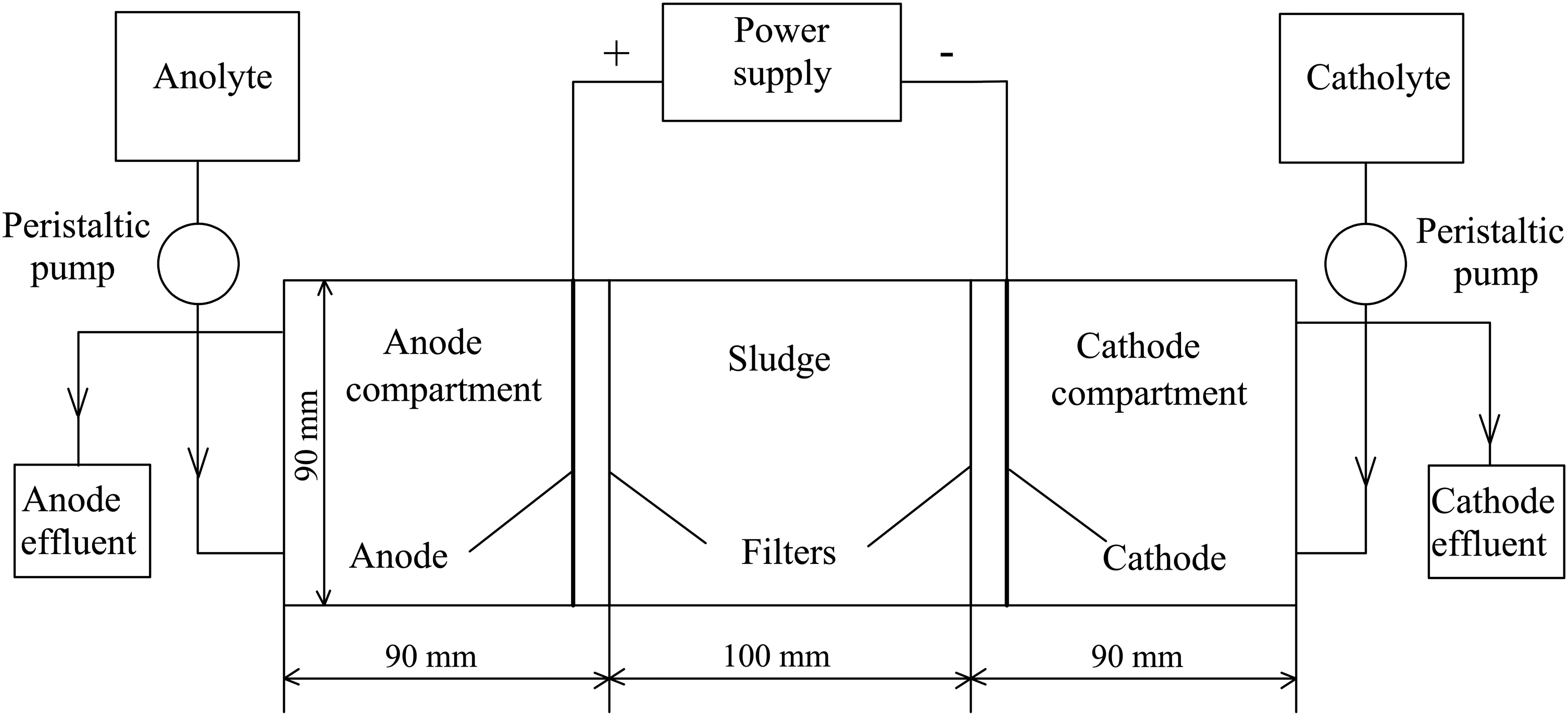
Schematic diagram of electro-kinetic (EK) system.
The electrokinetic cell was filled with homogenized sludge, and all experiments were conducted using a 100 mm-thick sludge compartment.
Results and Discussion
Current density
Figure 2 shows the density variation of the electric current depending on the elapsed time in the electrokinetic cell for conditions with potential gradients of 1 V/cm, 3 V/cm, and 5 V/cm. The electric current density calculation was based on the total electric currents through the cross-section divided by the sludge compartment's dimensions. The current density was low initially for each system and increased thereafter. The changes were inconspicuous at a potential gradient of 1 V/cm and remained between 1.33 mA/cm2 and 1.86 mA/cm2. The density of the electric current was highest after 11 h of operating time at 3 V/cm and and 6 h of operating at 5 V/cm. The density gradually decreased thereafter. At a larger potential gradient, a shorter treatment time was required to achieve the peak values of current density. Several other researchers have reported similar behavior (Cherifi et al., 2009).
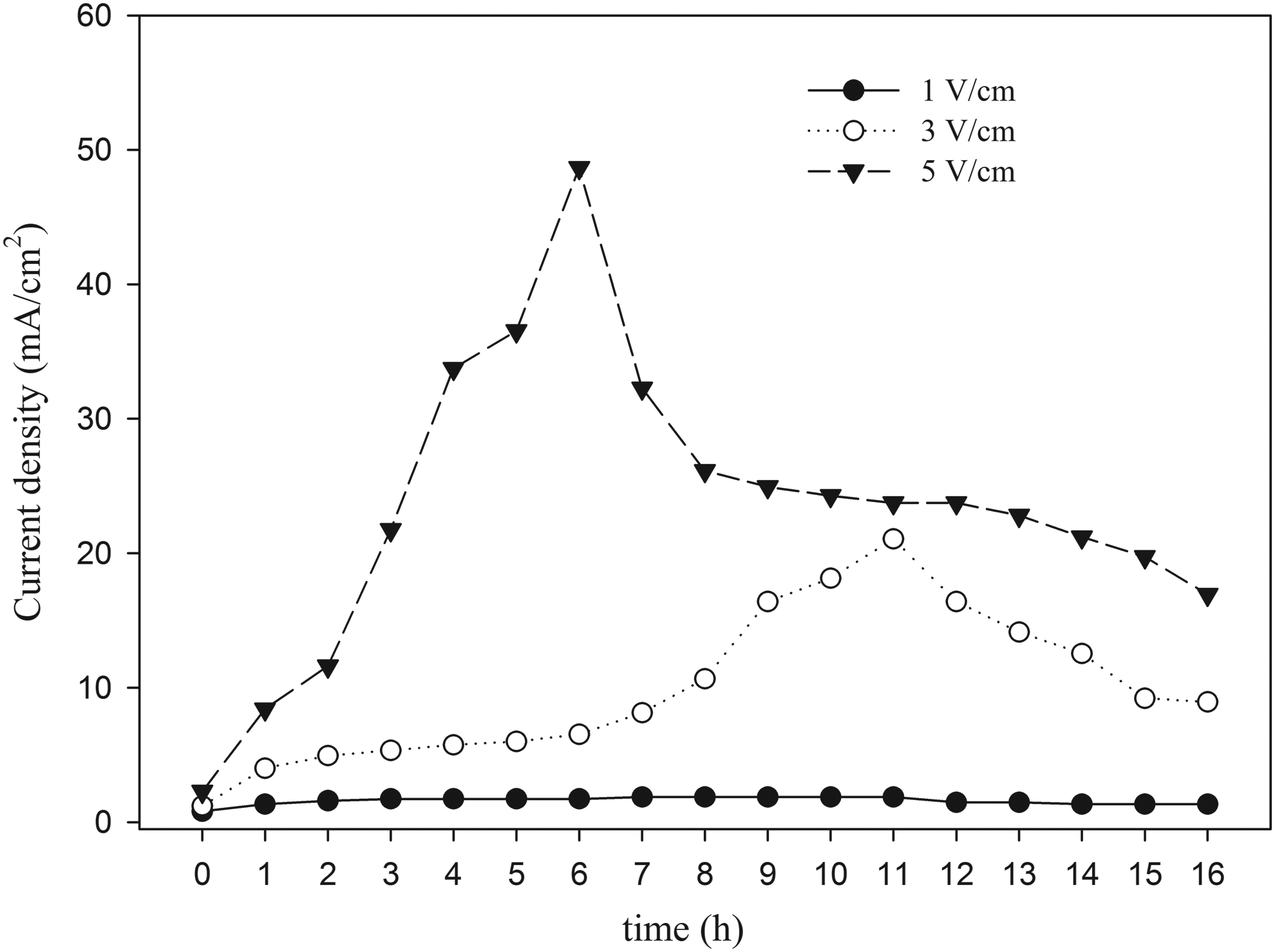
Variation of current density during the process.
When the voltage gradient was first applied, the anolyte infiltrated into the sludge, and the salts that were associated with the dry soil particles dissolved into the water, producing a pore solution with a high ionic strength (Saichek and Reddy, 2003). The dissolved ionic metal contaminants and the hydrogen (H+) ions that migrated toward the cathode contributed to the increase in ionic strength. Because of the strong ionic concentration, the current density peaked within a few hours, and then, because the cations migrated toward the electrode, which caused a decrease in the ion concentration in porous water, the current gradually decreased. Han et al. (2010) found similar phenomena. Gaseous oxygen (O2) and hydrogen (H2) bubbles, which are good insulators, covered the electrodes and reduced the electrical conductivity, which subsequently reduced the current (Virkutyte et al., 2002). The ion electromigration velocity was directly proportional to the electric potential gradient (Baraud et al., 1997), and higher electric potential gradients promoted this process. However, with the application of the higher potential gradient, the increase in current density induced temperature fluctuations in the sludge during treatment. A portion of the electrical energy was converted into Joule heating. The highest sludge temperature appeared near the cathode. Sludge temperature fell when the current decreased. An increase in temperature should increase the ionic electromigration velocity and the electroosmotic flow (Baraud et al., 1999).
Sludge pH profiles
The water electrolysis reaction in which H+ and hydroxide (OH−) are continuously released at the anode and cathode, respectively, is considered to be the predominant reaction under an electric field. During the electrokinetic process, OH− can be neutralized by additional H+, so the movement of H+ would change the sludge pH drastically. Figure 3 shows the sludge pH profiles along the electrokinetic cell for three electrokinetic systems. The acid front generated at the anode compartment flushed across the sludge specimen, lowering the sludge pH values from 6.19 to 2.74, 2.35, and 2.21 in the anode area with potential gradients of 1 V/cm, 3 V/cm, and 5 V/cm, respectively. These values are supported by prior results from other electrokinetic studies (Li et al., 2010; Wang et al., 2005; Yuan and Weng, 2006).

Variations of sludge pH profile in the EK systems.
Figure 3 shows that the sludge pH near the cathode was 6.03, 4.10, and 2.86 with potential gradients of 1 V/cm, 3 V/cm, and 5 V/cm, respectively. The higher potential gradient accelerated H+ transport from anode to cathode. H+ was continuously swept into the cell and decreased the sludge pH. The sludge pH profiles along the electrokinetic cells for the three systems were all lower than the initial sludge pH, especially at 3 V/cm and 5 V/cm. The pH profiles influenced the forms of the contaminants (Karamalidis and Voudrias, 2009; Ma et al., 2010), and the low pH increased the mobility of heavy metals (Wang et al., 2005). Virkutyte et al. (2002) reported that metal-hydroxide precipitation was at a minimum if the pH value was below 4.5. In our work, metal-hydroxide precipitation was inactive across the entire electrokinetic cell at potential gradients of 3 V/cm and 5 V/cm, whereas metal-hydroxide precipitation would only be inactive near the anode area at a potential gradient of 1 V/cm.
Distribution of heavy metals in sludge after EK treatment
The results of the sequential extraction of heavy metals from sludge before and after treatment are plotted in Fig. 4. A previous study (Kirkelund et al., 2010) showed that the exchangeable and reducible phases occur in an electromigration accessible phase and that the metals associated with these phases can be removed during remediation. In the initial sludge, Cu was found primarily in the oxidizable fraction (30.16%) and the residual fraction (66.30%), which is not easily removed by electrokinetic treatment when it is associated with the oxidizable and reducible phases. Ni was found primarily in the residual fraction (47.03%). Zn (23.63% and 28.78%) was found in the exchangeable and reducible fractions, respectively, more so than in the electromigration inaccessible phases (47.58%).
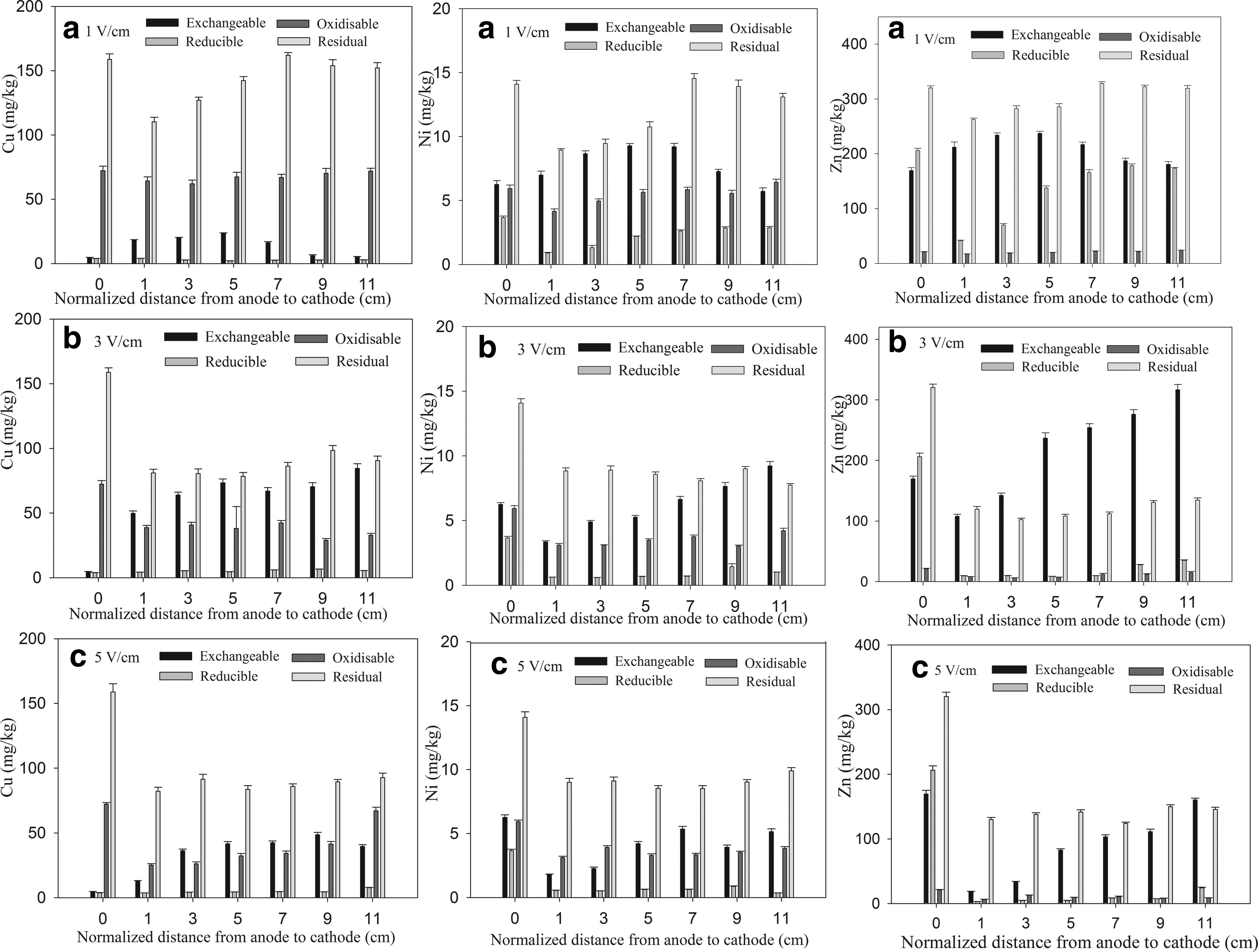
Distribution of heavy metals in sludge after EK treatments. Fractionations of heavy metals in initial sludge represented by 0 cm.
Figure 4a shows the heavy metal fractions of sludge from anode to cathode after the electrokinetic process at a potential gradient of 1 V/cm. Changes were found in the Cu, Ni, and Zn fractions near the anode. The concentrations of the oxidizable fraction and the residual fraction were lower, and the exchangeable fraction was increased. The increase in Cu, Ni, and Zn mobility near the anode was expected, based on the low pH. The highly exchangeable fractions occurred at a distance of 1 cm to 7 cm. These changes became imperceptible beyond 7 cm because the acid front did not arrive.
When the potential gradient reached 3 V/cm, changes were obvious in the Cu, Ni, and Zn fractions in different parts of the sludge cells (Fig. 4b). Initially, the oxidizable and residual fractions of Cu in sludge were 72.25 mg/kg and 158.79 mg/kg. These fractions were then decreased to 38.67 mg/kg and 80.95 mg/kg, respectively. The exchangeable fraction, which was highly mobile, increased from 4.67 mg/kg to 49.68 mg/kg near the anode. These changes can be attributed to the low pH that resulted from the migration of the acid front. The highest value of the exchangeable fraction was 84.44 mg/kg near the cathode, which originated from the electromigration. Changes in the Ni and Zn fractions displayed the same trends. This finding was agreement with Reddy et al. (2001), who also found that significant changes in the exchangeable and soluble fractions occurred after electrokinetic treatment.
Increasing the potential gradient not only changed the fraction of heavy metals but also raised the removal efficiency. When the potential gradient reached 5 V/cm (Fig. 4c), changes in the Cu, Ni, and Zn fractions at different parts of the sludge were more obvious. Initially, the electromigration accessible phase of Zn was 376 mg/kg in the sludge. After treatment, the content of the electromigration accessible phases was 21 mg/kg near the anode and 184 mg/kg near the cathode, which were only 11.75% and 33.30% at a potential gradient of 3 V/cm, respectively. Compared with a potential gradient of 3 V/cm, the contents of metals in the residual fraction decreased. All of these differences show that increasing amounts of heavy metal ions migrated into the catholyte and that the heavy metals in sludge were removed.
Previous studies (Kim et al., 2002; Virkutyte et al., 2002; Wang et al., 2005; Yuan and Weng, 2006) have also found that the changes of metal fractions in the sludge bed occurred continuously along the migration direction of the acid front during treatment. In our work, increasing the potential gradient enhanced the migration velocity of the acid front. We also found that the removal trends of different phases of each metal species appeared differently, and the more loosely bound fractions of metal contaminants were more easily removed by the electrokinetic technique.
Heavy metal removal after electrokinetic treatments
At a potential gradient of 1 V/cm, the removal of heavy metals from sludge was not significant for all of the detected elements (Fig. 5). The highest removal efficiencies—18.05%, 29.87%, and 25.67%— were detected near the anode for Cu, Ni, and Zn, respectively. Removal efficiency decreased further from the anode. However, the concentrations of Cu, Ni, and Zn increased at a distance of 7 cm, meaning that accumulation did occur. Fig. 4a shows that the additional concentration was composed of exchangeable phases moving from the anode. These phases resulted from the dissociation and desorption of metal species at low pH. This finding was in agreement with Yuan and Weng (2006) and Wang et al. (2005), who also found that a concentration accumulation of metals occurred in a lower potential gradient system. The removal efficiencies near the cathode were 2.83–3.15%, 1.14–6.13%, and 1.00–2.75% for Cu, Ni, and Zn, respectively. These results show that a potential gradient of 1 V/cm was not enough to carry sufficient metals out of the sludge chamber and that extending the time period and increasing the potential gradient is necessary.
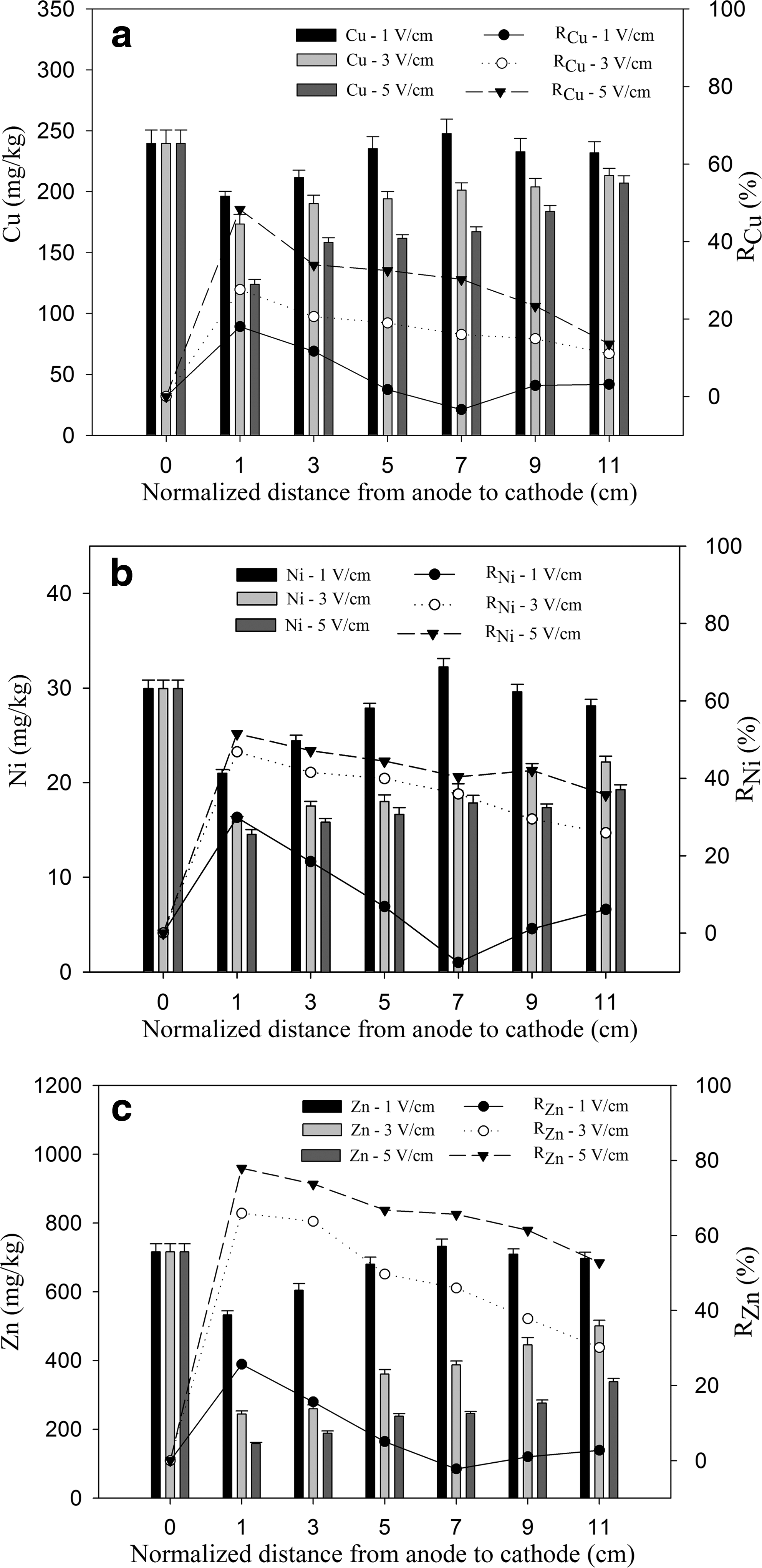
Concentrations and removal efficiencies (RCu, RZn, and RNi) of heavy metals in sludge after EK treatments. Concentrations of heavy metals in initial sludge represented by 0 cm.
When the potential gradient reached 3 V/cm, the accumulation phenomenon dwindled. The removal efficiencies for Cu, Ni, and Zn were 11.03–23.58%, 25.88–46.81%, and 30.12–65.91%, respectively, along the normalized distance from the cathode to the anode. The highest removal efficiencies were obtained at 5 V/cm. As discussed previously, a high potential gradient can accelerate H+ transport and lower the sludge pH in a short period of time, which can lead to more dissociated and desorbed metals in the residual phase. A high potential gradient can improve migration velocity. The removal efficiencies were in the range of 13.57–58.27%, 35.68–51.50%, and 52.77–77.96% for Cu, Ni, and Zn, respectively. Among the metals, Zn was the easiest to remove. In the initial sludge, 52.41% Zn was found in the electromigration accessible phases; 96.46% of Cu was predominantly partitioned in the strongly bound fraction, which resulted in the lowest removal efficiency.
The metal contaminants appeared to be gradually transported toward the cathode by electromigration and electroosmotic purging (Kim et al., 2002). The migration of different metal species showed similar patterns, and their removal efficiencies improved by increasing the potential gradient. This trend agrees with the results reported Park et al. (2009). The electromigration of metal species was significantly affected by the movement of the acid front (sludge pH).
The energy consumptions we calculated were 29.1 kWh/m3, 554.4 kWh/m3, and 2188.5 kWh/m3 for the experiments at potential gradients of 1 V/cm, 3 V/cm, and 5 V/cm, respectively. Energy consumptions will increase or decrease depending on the operating time.
Conclusions
In this study of heavy metal removal from wastewater sludge using electrokinetic systems at potential gradients of 1 V/cm, 3 V/cm, and 5 V/cm, the pH in the sludge chamber was maintained at a low range of 2.35–4.10 and 2.21–2.86 at potential gradients of 3 V/cm and 5 V/cm, respectively. At 1 V/cm, the sludge pH only decreased near the anode, showing that an acidic front generated at the anode reservoir flushed across the sludge chamber and that a higher potential gradient increased the migration velocity.
The results of a sequential extraction analysis revealed that the binding form of metals with sludge after the electrokinetic treatment was changed from the residual fraction to the exchangeable fraction, which is highly mobile. For the 1 V/cm system, these changes became imperceptible beyond a distance of 7 cm from the anode because the acid front did not arrive. The highest removal efficiency of metals occurred at a potential gradient of 5 V/cm. An average of 30.29% Cu, 43.52% Ni, and 33.38% Zn was removed from the sludge.
A concentration accumulation of metals occurred at 7 cm from the anode under a potential gradient of 1 V/cm. The accumulation phenomenon was diminished by using a higher potential gradient.
These results suggest that it is feasible to apply higher potential gradients to remove heavy metals from sludge in a short time. However, the distance between the electrodes becomes longer in field tests compared to lab tests. Therefore, it is necessary to extend the treatment time. Accordingly, it is recommended that further tests focus on scaling-up the electrokinetic process with the aim of optimizing the parameters for field applications.
Footnotes
Acknowledgment
This study was funded by the Guangdong Provincial Eleventh Five-Year Major Demonstration Project (integration technologies and equipment research and development of tidal river water pollution control in Pearl River Delta town; No. 405 2007A0323020).
Author Disclosure Statement
No competing financial interests exist.