




Abstract
Abstract
In the context of water treatment, the ferrate ([FeO4]2−) ion has long been known for its strong oxidizing power and for producing a coagulant from its reduced form [i.e., Fe(III)]. However, it has not been widely applied in water treatment, because of preparation difficulties and high cost. This article describes a low-cost procedure for producing solid potassium ferrate. In this synthetic procedure, NaClO was used in place of chlorine generation; and 10 M KOH was used in place of saturated KOH in the previous procedures. In addition, this study investigated the reactions of potassium ferrate with tetracycline hydrochloride (TC) at different pH and molar ratios. Results showed that the optimal pH range for TC degradation was pH 9–10, and TC could be mostly removed by Fe(VI) in 60 s. However, results showed >70% of TC degraded and <15% of dissolved organic carbon (DOC) reduction at molar ratio of 1:20. The main degradation pathway of TC is proposed based on the experimental data.
Introduction
Fe(VI) in the form of potassium ferrate (K2FeO4) has been found to be a strong oxidant in water and wastewater treatment with a standard half-cell reduction potential of +2.20 and +0.72 V in acidic and basic solutions, respectively (Wood, 1958). Moreover, the reduction product of Fe(VI) in water, iron hydroxide, is nontoxic, which is a coagulant of water treatment (Sharma, 2002, 2010). The expected benefits of this effect in advanced water and wastewater treatment are higher water quality. Therefore, potassium ferrate used to treat pharmaceuticals in water might be a promising method. In this study, potassium ferrate is used to degrade TC in water.
The objective of this study is to decrease the preparation cost of potassium ferrate and investigate TC removal by potassium ferrate at different pH and molar ratios. The data presented in this article would be important to predict potassium ferrate performance to TC removal.
Materials and Methods
Materials
Ferrate nitrate and sodium hypochlorite in this study were used to prepare solid potassium ferrate. The main chemicals include ferric nitrate from Acros, potassium hydroxide from Enox. Sodium hypochlorite with purity 97.5% was from SCRC (1.7 U.S. dollar/500 mL). Table 1 shows the structure and the physical/chemical properties of TC.
All the solutions were prepared with water that had been distilled and then passed through an 18 MΩ Milli-Q water purification system. The stock solution was prepared at a concentration of 0.1 mM.
Methods
Potassium ferrate preparation with a low cost procedure
In this study, potassium ferrate was prepared according to the following scheme:
Two hundred milliliters of 10 M NaOH solutions were added into the 400 mL NaClO solution (free chlorine ≥5%), and the precipitate of NaCl was removed from the suspension by filtration using a GF/C filter paper, leaving a concentrated and strongly alkaline solution of sodium hypochlorite. About 37.5 g of pulverized Fe(NO3)3·9 H2O was slowly added for more than 1 h under cooling conditions (<5°C). In these conditions, the Fe(III) ion was readily oxidized to Fe(VI), and the solution became dark purple in color. Two hundred milliliters of 10 M KOH solution was added to the solution. The resulting dark slurry was filtrated with a glass filter (P-0) and followed by filtering with GF/A filter papers (Whatman Ø70 mm). After the filtrate had been discarded, the precipitate was flushed with n-hexane, n-pentane, methanol, and diethyl ether. The final product, solid potassium ferrate, was collected and stored in a vacuum dryer before further use.
The degradation of TC by potassium ferrate
Potassium ferrate solution was prepared with deionized distilled water and pH buffer solutions before each test. The pH buffer solutions were prepared from potassium hydrogen phosphate (K2HPO4), potassium dihydrogen phosphate (KH2PO4), and potassium borate (K2B4O7·5 H2O) with deionized distilled water. Aqueous TC compounds wanted were prepared with deionized distilled water. All experiments were carried out in 250 mL beakers at room temperature (25°C±2°C). In the experiments, samples were taken periodically up to 20 min. At each sampling time, sodium thiosulfite solution was added immediately to the sample for stopping any further reaction.
Analytical methods
In this study, the concentration of potassium ferrate in an aqueous solution was determined by Ultraviolet-visible spectroscopy (UV/VIS) spectroscopy (Unico 4802). Potassium ferrate dissolved as FeO42− has a distinctive UV/VIS spectrum with a maximum absorbance at 510 nm. The molar absorptivity at 510 nm has been determined as 1150 M−1 cm−1 (Bielski and Thomas, 1987). In addition, the solutions of Fe(VI) were prepared by adding solid samples of K2FeO4 to 0.005 M Na2HPO4/0.001 M borate at pH 9.0 for the stability of Fe(VI) solution (Sharma, 2010).
In this study, the concentration of TC was determined by using high-performance liquid chromatography (Shimadzu LC-2010 AHT), with a VP-ODS column (250 × 4.6 mm) and an ultraviolet detector setting wavelength of 355 nm. Elution was performed with a mobile phase composed of methanol/acetonitrile/oxalic acid (6:18:76, v/v/v). The flow rate of mobile phase was 0.8 mL/min. Organic carbon (OC) is theoretically defined to be carbon that exists as products of nature, altered or partially decomposed products of nature, or man-made products. Dissolved OC (DOC) values of the samples were determined by TOC-VCPH (Shimadzu).
Results and Discussion
Preparation of solid potassium ferrate
Comparing with the previous preparation method of potassium ferrate (Li et al., 2005), the preparation procedure of potassium ferrate in this study was simplified. NaClO was directly used to oxidize ferric nitrate in place of chlorine preparation by HCl and KMnO4, because chlorine is harmful to the environment. Moreover, the sodium hypochlorite is cheaper and decreases the cost of the preparation procedure. In addition, 10 M KOH replaced of saturated KOH of the previous preparation procedure based on the optimum value of KOH solution. To determine the optimum concentration of KOH solution for potassium ferrate preparation, the solubility of potassium ferrate in KOH solution was determined in Fig. 1.
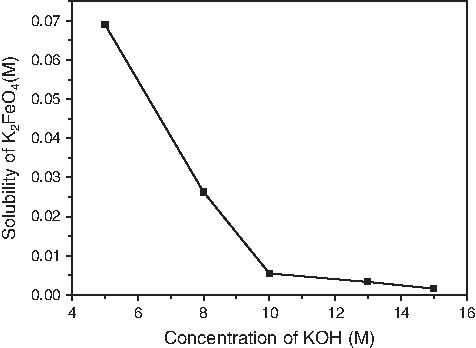
K2FeO4 solubility in the different concentration KOH solution.
It is seen from Fig. 1 that the solubility of potassium ferrate quickly decreased in more than 10 M KOH solutions, because potassium ferrate precipitated in the high alkaline solution. Then, the 10 M KOH solution was used in this preparation procedure in place of the saturated KOH solution used in the other preparation method (Jiang et al., 2001; Li et al., 2005) to save the cost of the preparation procedure. The preparation procedure in this article could reduce at least 50% cost of the previous preparation procedure (Jiang et al., 2001; Li et al., 2005). Therefore, compared with previous preparation methods (Williams and Riley, 1974; Jiang et al., 2001; Li et al., 2005), the preparation procedure of solid potassium ferrate in this study is lower cost, more simplified, and more efficient.
Degradation of TC in aqueous solution by ferrate
The effect of Fe(VI):TC molar ratios
The influence of molar ratio of the reacting compounds on the degradation of TC in water was studied. Since Fe(VI) is most stable when the solution pH >9 with the least adsorption effect of Fe(III) to TC, a set of tests was carried out at pH >9 using different molar ratios of Fe(VI):TC from 1:1 to 1:25 for the least Fe(III) adsorption. The initial concentration of TC was 0.1 mM. The experimental results for the degradation of TC at a different reaction time with various Fe(VI):TC molar ratios are shown in Fig. 2 and Table 2.
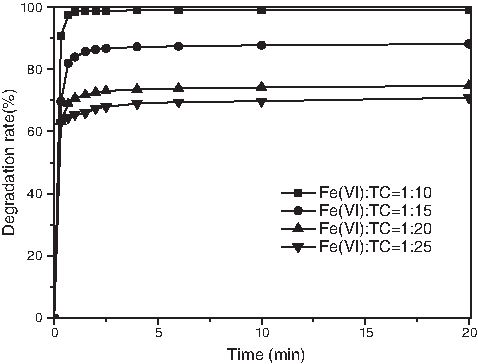
Tetracycline hydrochloride (TC) degradation with reaction time at different Fe(VI):TC molar ratios.
The concentration of TC cannot be detected by high-performance liquid chromatography.
TC, tetracycline hydrochloride.
It is seen from Fig. 2 that the reaction between ferrate and TC is very fast, with a major degradation of TC occurring during the first 60 s, followed by a more gradual further degradation over the next 10–20 min. This is the case for all the molar ratios of Fe(VI):TC from 1:1 to 1:25. Since the major degradation of TC occurs in the first 60 s and the molar concentration of TC is much greater than that of Fe(VI) with the molar ratios of Fe(VI):TC from 1:10 to 1:25, the pseudo-first-order equation was used to fit the major degradation of TC in the first 60 s. The fitting results show that the rates of reaction sharply increased with molar ratio increase. The results indicate that TC is reduced after 20 min by more than 99% with the molar ratio of 1:10. It is seen from Table 2 that in the first 60s, with the molar ratio of 1:1 and 1:5, TC has been completely oxidized by ferrate.
The effect of pH
Since TC has a pKa of 9.7 at 25°C, to study the reaction of TC in its dissociated state with potassium ferrate, a set of tests was carried out with the molar ratios of 1:20 at pH 8–11, considering the decomposition of Fe(VI) (Li et al., 2005). The results are shown in Fig. 3.
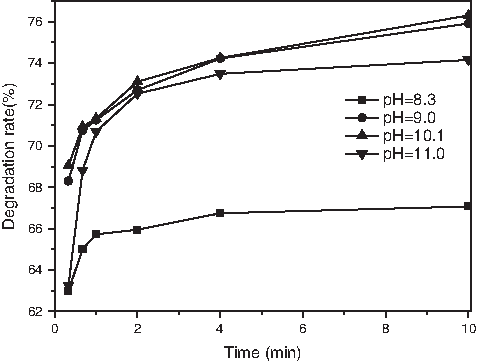
TC degradation by ferrate with reaction time at different pH [Fe(VI):TC=1:20].
It is seen from Fig. 3 that at pH 10.1, the removal of TC is higher than at other pH. The possible reason for the increased degradation is that pH 10.1 is close to the pKa value of TC 9.7, and TC is dissociated at this pH. At pH 10.1, dissociated TC is more readily oxidized by potassium ferrate. In the previous study, the dissociation of the compound increased with pH increase, and de-protonated compounds were found to be more readily oxidized by potassium ferrate (Hoigné and Bader, 1983; Graham et al., 2004; Li et al., 2008). Although the standard half-cell reduction potential of potassium ferrate was higher (Wood, 1958) at acid condition than at neutral and alkaline conditions, the potassium ferrate was unstable at acid and basic conditions (Li et al., 2005). Therefore, at pH 8.3, most potassium ferrate is decomposed, thereby leading to the low removal rate of TC.
In this study, the mineralization degree of TC with potassium ferrate oxidation was investigated by analyzing a variation of DOC concentration in the reaction. The results are shown in Figs. 4 and 5.
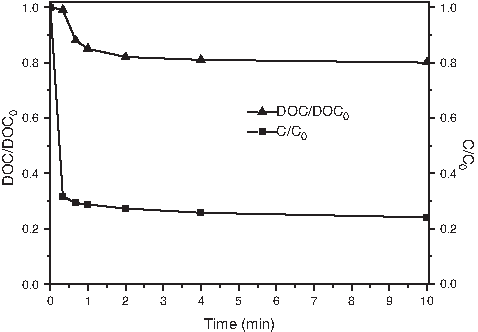
TC degradation and dissolved organic carbon (DOC) reduction with reaction time at pH 9.0 [Fe(VI): TC=1:20].
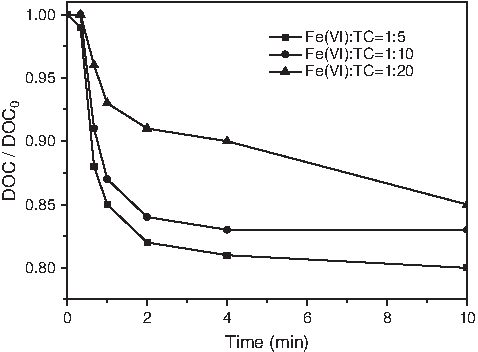
DOC reduction with reaction times at different molar ratios and pH 9.0.
It is seen from Figs. 4 and 5 that after 60 s, >70% of TC is degraded, in comparison with <15% of DOC reduction at molar ratio of 1:20. It has also been observed that there is little mineralization in spite of the rapid degradation of TC by ozonation and photocatalytic oxidation (Dalmázio et al., 2007; Jiao et al., 2008a). Little TC mineralization indicates that the degradation of TC mostly produces intermediate products and little mineralization to carbon dioxide. Then, according to the structure characteristics of TC, the degradation pathway of TC is proposed based on DOC experimental results and concentration results, seen in Fig. 6.

Potential TC·HCl degradation pathway by ferrate oxidation.
It is seen from Fig. 6 that TC loses N-methyl, hydroxyl, and amino groups, which is consistent with the previous work by some of the authors (Jiao et al., 2008a, 2008b). Moreover, the naphthol ring of TC remains intact in the reaction, and TC is slightly mineralized to carbon dioxide. The reason is that bond energy of N-C is low (Raphael et al., 2000). TC has a naphthol ring that is very stable and is not easily mineralized. Therefore, in the reaction, the loss of N-methyl, hydroxyl groups, and amino groups from TC happens.
Conclusion
In this article, a lower-cost preparation procedure of solid potassium ferrate was described. Comparing with the previous preparation method, NaClO was directly used to oxidize ferric nitrate in place of chlorine preparation by HCl and KMnO4. In addition, 10 M KOH solution was used in place of saturated KOH solution based on the optimum value of KOH solution in the preparation procedure. In this study, TC was studied as a typical antibiotic chemical and was successfully degraded by potassium ferrate in the range of molar ratio from 1:1 to 1:10 and pH 8–11. The experiment results showed that more than 98.6% of TC was degraded in the first 60 s at a molar ratio from 1:1 to 1:10. However, >70% of TC degradation and <15% of DOC reduction at a molar ratio of 1:20 show that the degradation of TC mostly produces intermediate products and little mineralization to carbon dioxide.
Footnotes
Acknowledgments
This work was kindly supported by National 11th Five-Year Plan Program (No. 2006BAJ08B06), and by National Major Program on Pollution Control and Management of Water Body (Grant No. 2008ZX07421-002, 2008ZX07420-003).
Author Disclosure Statement
No competing financial interests exist.