




Abstract
Abstract
This study investigated the secondary organic aerosols (SOAs) formation capability of various fragrant and Chinese herbal essential oils in the presence of ozone in a controlled-environment chamber under different test conditions. Air sampling was also conducted in two different types of spa center offering massage therapy using essential oils. The chamber study showed very strong SOAs formation capability in all fragrant essential oils tested, together with almost no SOA formation in the experiments using Chinese herbal oils. As particles smaller than 50 nm dominated the ultrafine particles (<100 nm) in number, this study speculated that SOAs from the reaction of ozone and terpenes initially formed in particle sizes smaller than 50 nm. Not only elevated level of total volatile organic compounds and limonene, but also a significant increase of ultrafine particles was found in spa centers during massage therapy. This study concludes that configuration and ventilation within spa centers can potentially affect the level of indoor air pollutants emitted during massage therapy. Therefore, indoor air quality in the environments using essential oils and the health effects caused by human exposure to volatile organic compounds and terpenes ozonolysis products, such as SOAs, in the spa centers are an area of concern.
Introduction
Secondary organic aerosols (SOAs) in submicrometer or nanometer ranges can be produced as a result of aforementioned reactions (Wolkoff et al., 2008; Chen and Hopke, 2009). Consequently, it is expected that fine and ultrafine particles (UFPs; particles<100 nm) will be generated when essential oils are used in the presence of strong oxidants such as ozone, NO x , and OH radicals. UFPs have been shown to have toxic effects including inflammation, oxidative stress, and impairment of phagocytosis in various mammalian cell lines (Dick et al., 2003; Gilmour et al., 2004; Chang et al., 2005) and pose a stronger toxic effect than an equal amount of fine particles. Moreover, one study has showed that the development of childhood asthma is related to the use of various cleaning materials and fragrances in homes (Sherriff et al., 2005). Therefore, more research efforts on the use of essential oils and the characteristics of the essential oil-originated particles are needed to clarify their impacts on indoor air quality and human health. This work reports the SOAs formation capability of two types of essential oil, fragrance and Chinese herbs, in an environmental chamber and the air sampling results from two types of spa center where massage therapy was performed. Some potential factors contributing to the levels of indoor air pollutants in spa centers are also discussed in this article.
Materials and Methods
Chamber study
Experiments were conducted in a small chamber (0.5 m×0.5 m×0.5 m in dimension) nested inside a larger walk-in environmental chamber (2.2 m×2.2 m×2.3 m). Both chambers were made of stainless steel and the interior surfaces of the smaller chamber were coated with Teflon. Six fragrant essential oils, lavender (Lavandula angustifolis), tea tree (Melaleuca alternifolia), peppermint (Mentha piperita), lemon (Citrus limon), eucalyptus (Eucalyptus radiata), and blend oil, and five Chinese herbal oils, Chinese mulberry (Morus australis), perillae folium (Perilla frutescens), Chinese angelica (Angelica sinensis), bupleuri (Buplerum chinense), and ginseng (Panax ginseng), were selected for chamber study. Bulk samples of these essential oils were analyzed by an Agilent 6890/5973 gas chromatography/mass spectrometry (GC/MS) (Agilent Technologies, Santa Clara, CA) to identify their chemical compositions. The cold trap operating temperature was −30°C and was raised to 250°C for 3 min. The carrier gas was helium and an Agilent column (HP-5 ms, 30 m×0.32 mm i.d.×0.25 μm) was used. The column temperature was held at 40°C for 5 min, after which it was raised to 260°C for 10 min.
The air change rate (ACH) in the small chamber was determined by the sulfur hexafluoride (SF6) decay test and an ACH of 0.2 was obtained. Before each set of experiment, the small chamber was opened and the large chamber was thoroughly ventilated with temperature and relative humidity (RH) maintained at 25°C and 55%, respectively. Particle number and mass concentrations were measured by a TSI model 3934 scanning mobility particle sizer (SMPS; TSI Inc., St. Paul, MN). After the background particle number concentration was measured, a 12-mL bottle (with the opening of 0.2 cm in diameter) filled with essential oil was placed in the smaller chamber (with door closed) to allow for evaporation. Particle concentration was measured 10 min after oil evaporation. After the measurement, certain amount of ozone was injected into the small chamber, and the initial ozone concentration was maintained approximately at 100 ppb. Then the measurement of particle concentration in the presence of ozone was repeated four times. As the scanning period for SMPS was set as 60 s, particle number concentration was measured in ∼11th, 12th, 13th, 14th, and 15th min, respectively. Experiments on each essential oil were repeated three times under the same procedures. The SOAs formation capability of each essential oil was determined by the ratio of the average particle number concentration in the presence of ozone to that in the condition of oil evaporation only.
Air sampling in spa centers
Air sampling was conducted in the massage therapy room of two spa centers, with the measurements being repeated twice for each center on two different business days. To avoid the accumulation of pollutants from the previous service, the air sampling was conducted during the first massage therapy appointment of the day (usually 10:30 am) and only one client was served. The selected centers represent the two major types of spa centers in Taiwan. The first type is an open-plan room, with reception area in the front and service area in the back. Such center generally contains two or three beds, separated by a curtain only, in the service area. Spa center A is categorized as this type and the massage therapy was performed in an area with space volume of 9.7 m3. The second type is usually much larger than the first one. Besides the reception area and office in the front, the remaining space is configured into many cellular rooms with individual air conditioner. Air sampling was carried out in one of the cellular rooms, the room volume being 38.8 m3 in spa center B. The ACH in both spa centers was determined by the same method in the chamber study, and ACH of 1.3 and 0.9 were found in spa centers A and B, respectively. Background air was sampled 30 min before the start of morning trading until the start of massage therapy, and then another air sampling was conducted as massage therapy began. An RAE PGM-7240 ppbRAE air monitor (RAE System Inc., San Jose, CA) was used to measure the level of total volatile organic compounds (TVOCs) in the service area. This TVOCs monitor was calibrated against isobutylene, and therefore, the measured values are isobutylene equivalent.
Our survey showed that blend essential oil is usually used during massage therapy, rather than the essential oil from a named botanical source. Therefore, each massage therapy in the present study was provided with 20 mL of the blend essential oil, which is the same oil used in the chamber study. The result of our GC/MS analysis on blend oil showed that, among all components, limonene is the major component recognized as the SOAs precursor by previous studies (Hoffmann et al., 1997; Wainman et al., 2000; Vartiainen et al., 2006). Additionally, limonene is commonly found in indoor settings and has been widely used in numerous studies on ozone/terpene reaction (Weschler and Shields, 1999; Weschler, 2004; Fan et al., 2005; Vartiainen et al., 2006). Therefore, concentration of limonene inside and outside the spa centers were also measured using Perkin-Elmer stainless-steel tubes packed with 250 mg Tenax-TA 60/80 mesh (Supelco Inc., Bellefonte, PA) equipped with an SKC Model 222 sampling pump (SKC Inc., Eighty Four, PA). Air sampling was conducted according to the U.S. Environmental Protection Agency (EPA) TO-17 tube sampling method (US EPA, 1999) and analysis was carried out using Perkin-Elmer automatic thermal desorption (ATD 400) (Perkin-Elmer Ltd., Beaconsfield, United Kingdom) and Agilent 6890/5973 GC/MSD or GC/FID with the same programmed condition as in chamber study. Particle number concentration was measured by the TSI SMPS. Finally, indoor ozone concentration was monitored using an ozone analyzer (ML® 9810B) from Ecotech Pty. Ltd. (Blackburn, Australia).
Results
Chamber study
Table 1 lists the major constituents and the respective percentages of all essential oils obtained from the analysis of GC/MS. As shown, all fragrant essential oils tested contained terpenes such as d-limonene, α-pinene, and β-pinene, which Hoffmann (Hoffmann et al., 1997) identified as SOAs precursors. No SOAs precursor was identified in the Chinese herbal oils except Chinese mulberry and perillae folium oils, which contain relatively small amount of limonene. The results of the qualitative analysis coincided with the observed changes in particle number concentration when the oils were presented with ozone. Though some unsaturated compounds, such as linoleic acid, palmitic acid, and ethyl linolenate, were also found as the major constituents of the Chinese herbal oils, however, no noticeable SOAs formation was observed when they were presented with ozone. Compared with the identified SOAs precursors, linoleic acid, palmitic acid, and ethyl linolenate have higher molecular weight and less volatility. It is likely that, under the identical experimental condition (i.e., 25°C and
Secondary organic aerosols precursor identified by Hoffmann et al. (1997).
Chinese herbs oils contain small amount of limonene, an identified secondary organic aerosols precursor.
Figure 1 shows the average particle number concentration in different size ranges obtained from essential oils under different test conditions. As bupleuri, ginseng, and Chinese angelica oils do not contain any identified SOAs precursor and the resulted number concentration is largely unaffected with or without ozone introduction, only data from Chinese mulberry and perillae folium oils are shown in Fig. 1 to compare with those obtained from fragrant essential oils. As seen in the figure, ∼11 to 147 times of increase in particle number concentration for fragrant essential oils without ozone introduction was observed, whereas there was only 2% increase in Chinese mulberry and perillae folium oils under the same condition. The increase of particle number concentration was mainly in the sizes smaller than 300 nm and the increase was generally more noticeable with the decreasing particle sizes. Vapor of peppermint oil resulted in nearly 50 times more particles ranging between 26 and 50 nm than in background air. However, the number of particles larger than 300 nm from all essential oils was limited and not significantly different than that in background air.

Average number concentration of essential oil-originated particles in size ranges of
With the presence of 100 ppb ozone in the chamber, particle number concentration in all size ranges were found to increase for all fragrant essential oils. For lemon essential oil, the number concentration of particles ranging between 26 and 50 nm can be up to 400 times greater in the presence of ozone than that for background air. Comparing SOAs formation capability, tea tree oil generated more SOAs than other essential oils. The total number concentration of SOAs can reach as high as 1.9×10⁶/cm3. The increase of particles larger than 100 nm for tea tree oil in the presence of ozone was also greater than that for other essential oils. The increase in particle number concentration for particles larger than 300 nm was limited when compared with that observed in sizes less than 300 nm when ozone was introduced. This result was similar to that in the presence of evaporating oil vapor only. This indicates that SOAs resulting from the reaction between ozone and essential oil vapor occur mainly in sizes smaller than 300 nm.
Spa centers
The average concentrations of TVOC and limonene obtained from spa centers A and B on the two measurement days are shown in Figs. 2 and 3, respectively. As shown in Fig. 2, TVOC concentration during massage therapy in both spa centers apparently increased when essential oil was applied in that period. Moreover, TVOC concentration in spa center B on both days were found to exceed 3000 ppb, the guideline for indoor hourly average TVOC recommended by the Taiwan EPA (2005). Peak TVOC concentration of up to 4500 ppb was observed in spa center B. A similar increasing trend was observed for limonene concentration in Fig. 3. The limonene concentration during massage therapy was found to increase 16 to 60 times more than that in background air and was 2 orders of magnitude higher than that in outdoor air, indicating limonene originated from the spa center. The ozone concentration measured in spa centers A and B varied during the measurement periods, but were all below 50 ppb, the guideline of 8 h time-weighted-average in Taiwan (Taiwan EPA, 2005). Ozone level in center A ranged from 4 to 9 ppb with an average of 7 ppb, and those in center B varied between 6 and 16 ppb, and the mean level was 11 ppb. The measured ozone level is very similar to that reported by Weschler and Shields (1999), at which indoor ozone/terpene reactions occurred. Therefore, oxidation reaction between ozone and SOAs precursor, such as limonene, could take place within spa centers and produce UFPs. As indoor ozone level may be elevated because of indoor activities or infiltration from outdoors, higher UFPs concentration may be observed in the indoor environments where SOAs precursors are present.
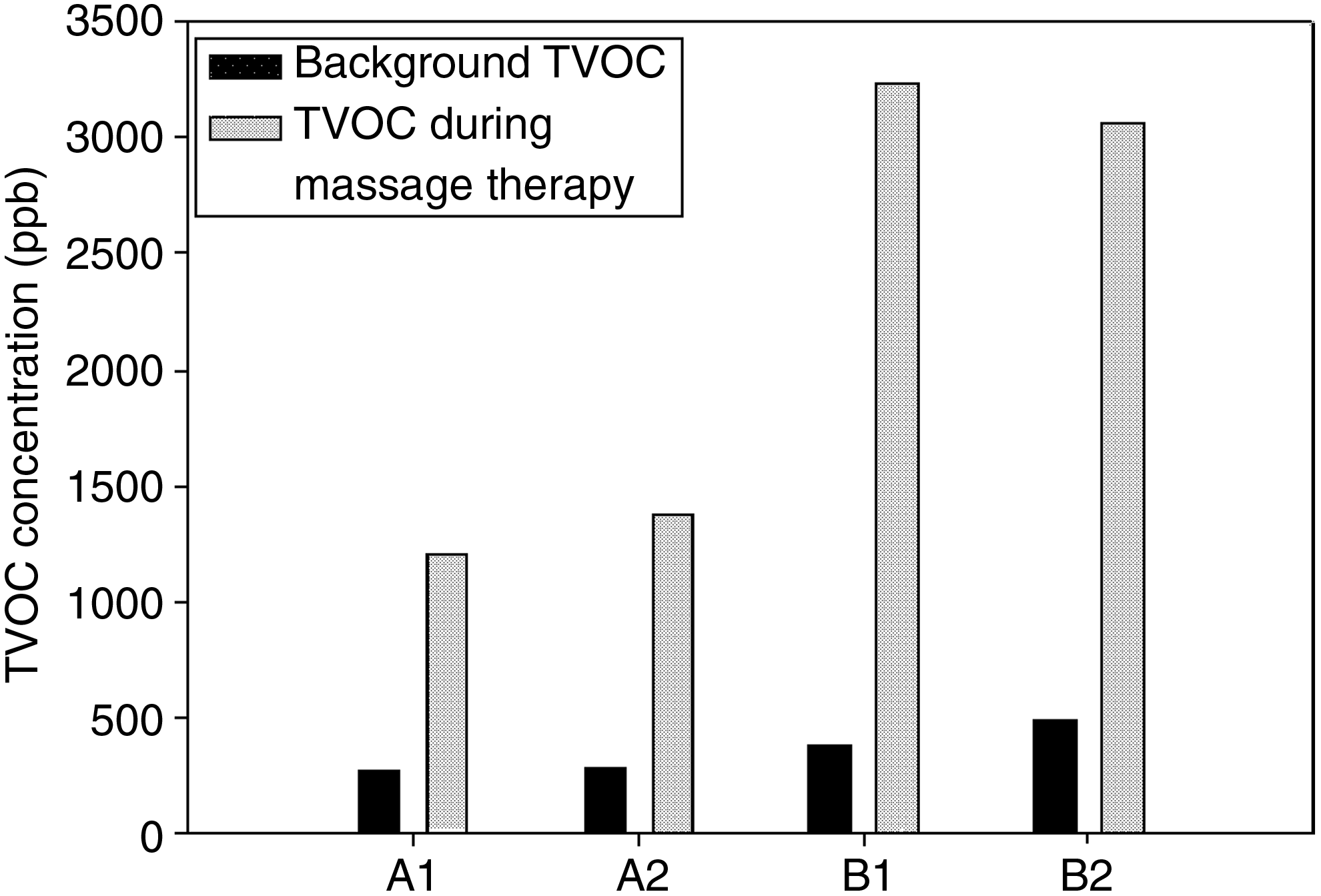
Average concentration of total volatile organic compounds measured in spa centers A and B.
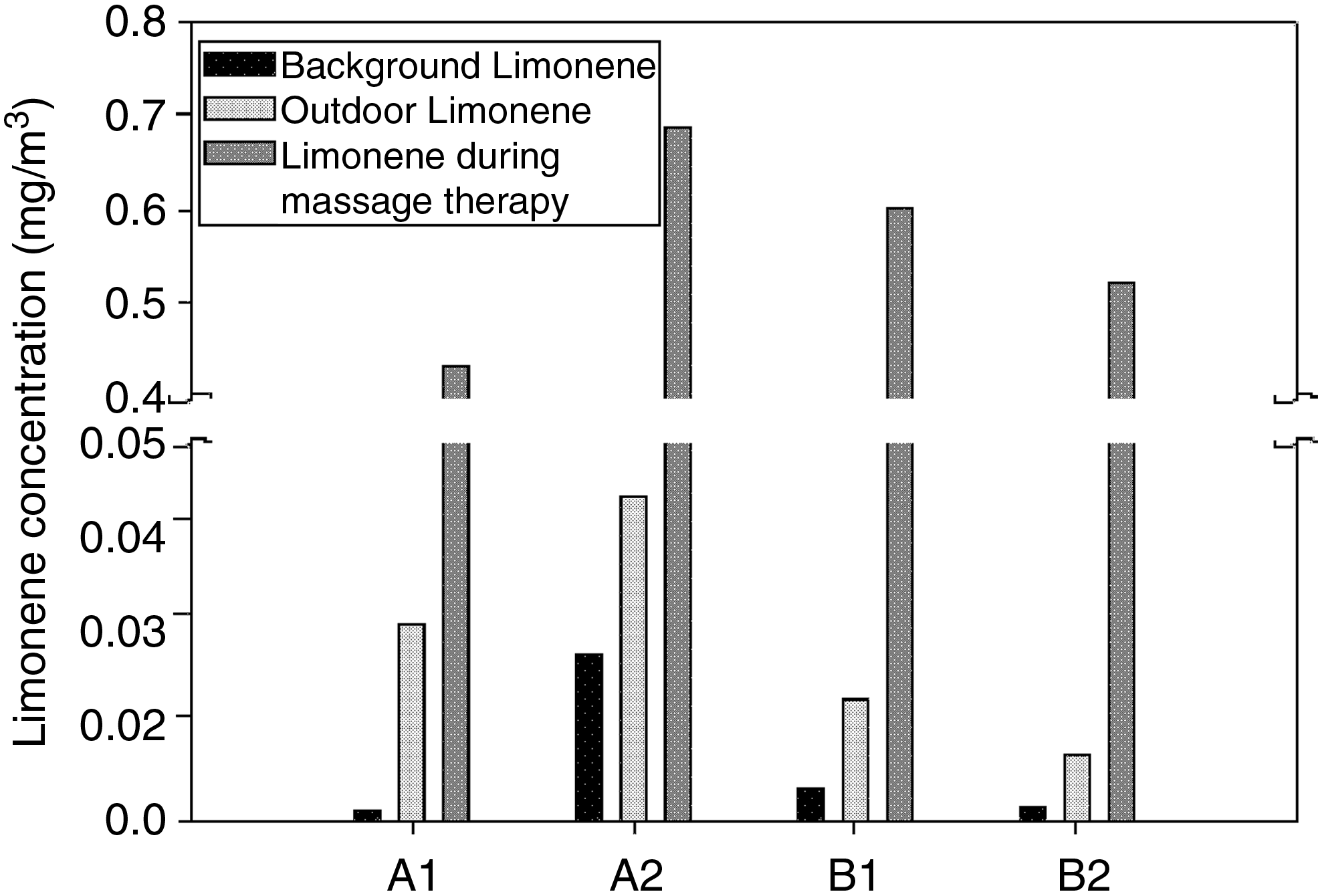
Concentrations of limonene measured in spa centers A and B.
As seen in Fig. 4, the total number concentration of particles (26–600 nm) during massage therapy was much higher than that in background air. Moreover, the increase in number concentration was particularly significant for UFPs. This conforms to the results obtained from the chamber study, which indicates that the increase of particles occurred mainly in UFPs size ranges.
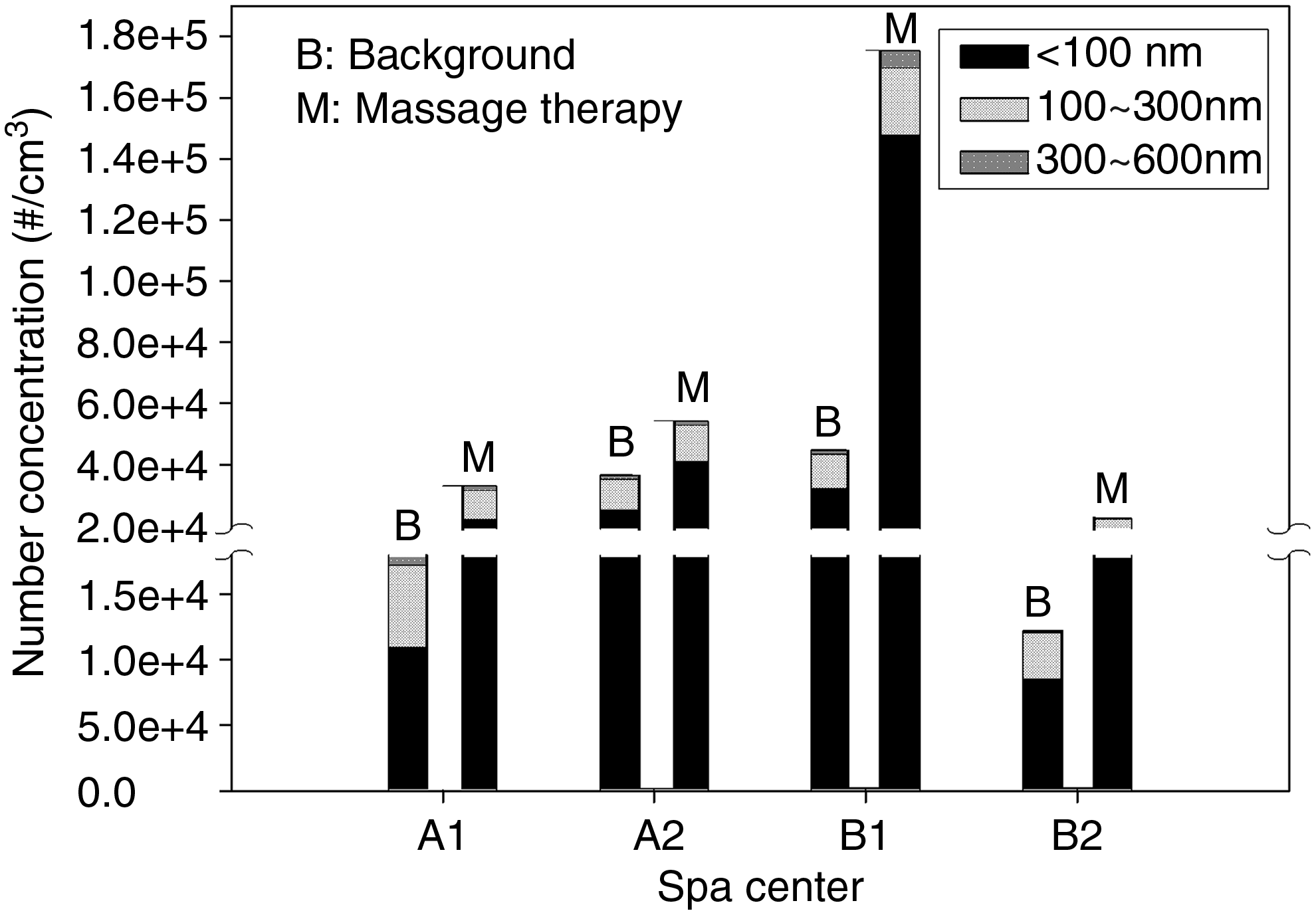
Comparison of number concentration in different size ranges measured before and during massage therapy in spa centers A and B.
Discussion
The results of the chamber study showed that ∼95% of essential oil-originated SOAs are categorized as UFPs and those smaller than 50 nm dominated in number concentration. Similar results were observed in previous studies that a burst of particle number concentration ranging between 20 and 100 nm was found in the initial stage of ozone/limonene reaction (Fan et al., 2005; Sarwar and Corsi, 2007). This study speculated that the majority of SOAs from the reaction of ozone and terpenes initially formed in sizes smaller than 50 nm and grew over time, creating an effective particle growth “wave” described by Sarwar and Corsi (2007). However, it is noteworthy that particle size distribution was measured shortly after ozone was introduced and the microenvironment of the chamber is different from the typical indoor settings in reactants concentration, surface characteristics, and ventilation levels. Thus, the high particle number concentration found herein does not suggest equally high concentration in indoor environments using essential oils. Yet, the data presented indicate that using fragrant essential oils in the similar condition in the present study may generate more SOAs than Chinese herbal oils.
The TVOC concentration found in this study is higher than that in the study on offices and residences using essential oils by burning candle (Su et al., 2007). The peak TVOC concentration reported by Su et al. is about 2300 ppb when eucalyptus oil was evaporated. The higher TVOC concentration in the present study is likely attributable to the greater amount of essential oils used as well as larger surface area for volatilization. To be absorbed into the human skins, essential oils for massage therapy are usually blended with base oils (or carrier oils), such as jojoba or wheatgerm oil. The essential oil in blend oil used in massage therapy is ∼3%, which is higher than the concentration of essential oils used in inhalation method, which involves essential oils being prepared in solution at a concentration of ∼0.5% and evaporated by burning candle or instruments such as ultrasonic aromatherapy atomizer or fumigator. Additionally, 20 mL of blend oil (i.e., 0.6 mL of essential oil) was administered over the human body during a 1-h massage therapy in the present study, compared with just 0.3 mL of essential oil evaporated over a period of 3 h or longer in the study by Su et al. (2007).
The results of air sampling from centers A and B indicate that indoor pollutants, such as TVOC and SOA precursors, increase after massage therapy. However, spa center configuration has the potential to affect the level of indoor air pollutants. In spa center B where massage therapy was performed in a cellular room with limited ventilation, particulate matter and gaseous pollutants tend to be trapped and reach high concentration. In contrast, an open-plan area with higher ACH, such as center A, could prevent air pollutants from accumulating within the service area. When spa centers were closed and ventilation was off, longer residence time is available for chemical reaction to occur and particle size distribution shifts toward larger sizes because of condensation and adsorption of low-volatility products on the surface of existing particles. Based on the results of the present chamber study, fragrant oil-based SOAs increase even in the absence of significant chemistry (i.e., without ozone introduction). Thus, formation and growth of SOAs due to the oxidation reaction and condensation on existing particles are likely to occur in spa centers during closing hours.
An earlier study of indoor TVOCs level in 86 high-rise building offices with central ventilation system in Taipei, Taiwan, showed an 8 h average concentration of 1210 ppb, with a low of 6 ppb and a high of 55,700 ppb (Lu et al., 2007). This finding indicates considerable variation of TVOCs level in indoor environments, influenced by the presence of VOC-emitting office equipment or materials and ACH. As mentioned earlier, air sampling in the present study was conducted during the period of first massage therapy of the day. As more massage therapies would be performed on the day, concentration of TVOCs and limonene were thus likely to increase further during the day, depending on the number of treatments performed and the ventilation level. Therefore, more UFPs may be generated and the gaseous pollutant levels in most spa centers in Taiwan could be potentially higher than the level reported in this work.
Though the increase of UFPs during massage therapy was noted, the mass of those UFPs is very little and hardly contributes to the PM2.5 in spa centers. Based on the consumption of blend oil and the particle mass concentration measured by SMPS in the chamber study, an increase of ∼20.6 and 5.2 μg/m3 of UFP may be generated in spa centers A (room volume=9.7 m3) and B (room volume=38.8 m3), respectively. This calculation was based on only one client being served and 20 mL of blend oil administered in the spa center with the ozone level of 100 ppb and very limited air exchange rate. As air conditioner is usually used and lower ozone level is encountered in spa centers, the increase of PM2.5, because of the use of essential oils, should be limited. However, the number concentration of UFPs had dramatic increase once massage therapy started. Thus, the number concentration, especially for UFPs, seems to be a better indicator of human exposure to particulate matters in the spa centers than that for the mass concentration of PM2.5.
Fig.4 clearly shows that UFPs increased during the application of essential oil (i.e., blend oil) in massage therapy. Therefore, the widespread use of essential oils in indoor environments may increase the level of particulate matter, especially when outdoor ozone concentration is high or ozone-emitting office equipment or appliances are present. Many types of office equipment, such as printers, photocopiers, and all-in-one office machines, have been identified as emission source of ozone (Brown, 1999; Wolkoff, 1999; Lee et al., 2001). One study indicated that ozone level in photocopy centers may increase during large-volume photocopying and can exceed 70 ppb (Lee and Hsu, 2007). Ozone is also emitted when ionization-based indoor cleaners or electrostatic precipitators are used in indoor environments, such as homes, offices, and restaurants, to remove particulate matter and allergens (Niu et al., 2001; Britigan et al., 2006). Thus, SOAs may be generated in an indoor setting where fragrant essential oils are used and ozone-emitting equipment is operating. Additionally, the results from the present chamber study showed that blend oil, compared with other fragrant oils tested, is the least capable to generate SOAs. As mentioned earlier, blend oil is usually used in spa center. Other fragrant oils, such as tea tree, eucalyptus, and lavender are more common in offices or residences. This indicates that more SOAs may be encountered when essential oil of tea tree or eucalyptus is used in spa centers or other indoor settings.
As formations of essential oil-originated UFPs were observed in the chamber and spa centers studies, the health effects caused by human exposure to this type of UFPs should be further evaluated. Moreover, because part of the essential oil is applied on the skin near to the head region during aromatherapy, the “personal reactive clouds” effect (Corsi et al., 2007; Pandrangi and Morrison, 2008) may play an important role in human exposure to ozone/terpenes reaction products. The personal cloud may be defined as the concentration difference between the personal exposures and indoor levels (Wallace and Smith, 2006). Relatively higher concentration of reaction products, such as SOA and carbonyls, are expected to be formed within the breathing zone of both client and aromatherapist. Therefore, further studies to evaluate the personal exposure (e.g., SOA and carbonyls characteristics) and health impacts (e.g., eye or airway irritation) posed by the near-head chemistry in the spa centers are needed.
Microenvironmental characteristics, ozone levels, and methods of using essential oils are important factors for evaluating human exposure to air pollutants in a spa center. To reduce the health risks from aromatherapy, the control of the indoor ozone levels is generally desirable, particularly in the high-ozone period. Activated carbon and HVAC filters have been demonstrated, which can be effective for removing VOCs and ozone (Lee and Davidson, 1999; Hyttinen et al., 2003, 2006; Zhao et al., 2007). Careful selection of indoor surface materials that could react with ozone and produce few byproducts provides another way for ozone removal (Moriske et al., 1998; Hoang et al., 2009; Kunkel et al., 2010). Based on the results from chamber and spa centers, proper use of essential oils and ventilation are critical to the control of indoor SOA during massage therapy. Some other actions could be taken to reduce human exposure to air pollutants in spa centers, that is, use of nonozone emitting air cleaners and rinsing surfaces with water periodically or in the end of business day.
Conclusions
On the basis of the results of this study, we conclude that, in the condition of 25°C and RH 55%, using fragrant essential oils tested in the present study can generate more SOAs than Chinese herbal oils tested. Air sampling in spa centers indicates higher concentration of TVOCs and SOAs precursors during massage therapy. Though indoor ozone level in spa centers studied was well within the guideline in Taiwan, the presence of low-level ozone or ozone emission source will have the potential of SOAs formation. The number concentration of UFPs is an appropriate indicator of human exposure to SOAs in spa center. The results of this study also suggest that ventilation and configuration of indoor space can affect air pollutant levels in spa centers. As aromatherapy, used by the general public and some health institutes, has become one of the most popular complementary therapies, its impact on indoor air quality and health effects cannot be neglected. Future studies should include toxicity tests of the essential oil-originated SOAs and measurements of the ozone/limonene reactions byproducts, such as carbonyls. It is also recommended to evaluate the personal reactive clouds effect during aromatherapy for a better understanding of the health impacts posed by essential oil-originated air pollutants.
Footnotes
Author Disclosure Statement
No competing financial interests exist.