




Abstract
Abstract
A 1-hour temperature-based toxicity test using Daphnia magna was developed and then compared with a 24-hour standard acute toxicity test. The 1-hour toxicity test was based on the observation that daphnids in high temperatures become weak and more susceptible to toxicants than daphnids at room temperature. Theorizing that this relationship could be utilized to produce a short-term toxicity test, we analyzed the experimental data and identified 36.5°C as the ideal temperature for a 1-hour temperature-based toxicity test. After the test was formulated, it was used to screen 15 toxicants. Eight heavy metals, 4 pesticides, 2 anions, phenol, and 2 industrial wastewaters were screened, using the 1-hour toxicity test and the 24-hour standard acute toxicity test. For the 1-hour toxicity test, vials containing 5 daphnids (<24 h), medium, and toxicant, all at room temperature, were prepared and placed in a water bath set at 36.5°C for 1 hour. After 1 hour, the numbers of live (no toxic effect) daphnids and immobilized (toxic effect) daphnids were counted, and the median effective concentrations (EC50) were determined.
A comparison of the EC50 values of the 1-hour temperature-based toxicity test and those of the 24-hour standard acute toxicity test produced a correlation of 0.9999. When individual toxicants were compared, the 24-hour standard acute toxicity test was better at detecting lower test concentrations than the 1-hour temperature-based toxicity test. When both tests were used to screen industrial wastewater and their results were compared, the 1-hour toxicity test showed some promise. However, further testing will need to be done, because only 2 of the 10 samples collected initially contained significant amounts of toxicants for EC50 calculation. Finally, while the 1-hour toxicity test was effective in screening 15 tested toxicants and has the potential to be useful in screening industrial wastewater, this conclusion is limited to those 15 tested toxicants and 2 industrial wastewaters. Additional experiments will be needed for other toxicants. The 1-hour toxicity test presented in this study is the first temperature-based toxicity test developed for D. magna, and it will be an attractive short-term assay for its convenience, cost-efficiency, and replicability.
Introduction
The standard acute toxicity test uses daphnid mobility to determine the toxicity of wastewater. Although daphnids are highly mobile in their natural settings, their movement significantly decreases when damaged by toxicants. Using this behavior pattern as a guide, one can determine the toxicity of wastewater by placing daphnids in the water and looking for a change in their movements. If their mobility decreases, it is likely that a significant amount of toxicant is present. If there is no change mobility, it is likely there is not a significant amount of toxicant.
Although the standard acute toxicity test is effective, it requires test durations of 24 to 48 hours. Therefore, despite its accuracy, it is not ideal in places that require quick results, such as water treatment facilities. In an effort to address this time concern, Bitton et al. (1995, 1997) have developed various short-term toxicity tests, using such a daphnids as Ceriodaphnia dubia. In our laboratory, Lee et al. (1997) developed the Ceriodaphnia algal uptake suppression test (CAUST), which was based on the algal feeding behavior of C. dubia neonates during 1 hour of exposure time. Also from our lab, Jun et al. (2006) developed a 1.25-hour temperature-based toxicity test (TempTox Test) with C. dubia. The TempTox Test is especially interesting because it requires no pretreatments and uses mainly temperature to produce reliable test results. The testing method of the TempTox Test is similar to that of the standard toxicity test with one major difference: The TempTox Test is performed at 35.5°C instead of the room temperature. This setting was based on the observation that daphnids became weaker and more susceptible to toxicants in high temperatures. Theorizing that the temperature could be controlled to weaken, but not kill, daphnids, Jun et al. (2006) identified 35.5°C as the ideal temperature for the TempTox Test.
Although the TempTox Test introduced the idea of temperature-based toxicity tests, a similar test using Daphnia magna, the official daphnid species of Organization for Economic Cooperation and Development (OECD), has not been developed. Thus, in this study, we examined the feasibility of developing a 1-hour temperature-based toxicity test with D. magna. We believe this new test, if successfully developed, will be beneficial for its convenience, cost-efficiency, and replicability.
Methods
Test organisms and culturing process
Thirty D. magna (<24 h) were placed for culturing in a 3.0-L glass beaker with 3.0 L medium. Following the OECD guidelines (OECD, 2004), M4 was used as the test medium, and it was changed twice a week. The temperature of the M4 was maintained at 20°C±1°C. The test organisms were fed once a day with living unicellular green algae Chlorella vulgaris (5 × 10⁵ cell/mL) obtained from Akuanet Co. (Tongyeong, Korea). The test organisms were exposed to light for 16 hours and kept in the dark for 8 hours each day (OECD, 2004). Other unspecified culturing conditions were kept in accordance with the OECD guidelines.
Experimental temperature analyses
Determination of temperature range to kill 50% of D. magna in one hour
Ten 20-mL test vials were filled with 20 mL M4 at room temperature and 10 D. magna (<24 h). The vials were then capped and completely submerged in a water bath (JEIOTECH, Seoul, Korea) set at 20.0°C. Observations for any immobilized daphnids were made every 10 minutes for 800 minutes. The water used in the water bath had pH of 7.4–7.8, a hardness of 80–100 mg calcium carbonate (CaCO3)/L, and an alkalinity of 60–70 mg CaCO3/L. After minute 800, the daphnids were discarded, and a new set of ten 20-mL vials with 10 D. magna (<24 h) and 20 mL of M4 were prepared and placed in the water bath now set at 20.5°C. The temperature of the water bath was raised by 0.5°C from the previous run, from 20.0°C to 20.5°C. The vials were observed at 10 minute intervals for 800 minutes.
This cycle of preparation, incremental increase of temperature, and observation continued until the temperature was high enough to kill 5 daphnids within 60 minutes of exposure, at which point the experiment stopped. Allowable error of temperature was ±0.1°C. All experiments were repeated four times. The number of immobilized daphnids was counted, because death is a clear and convenient indicator of weakened physical state. After collection, the data were evaluated according to their content, pattern, and the OECD guidelines.
Determination of specific temperature
After the initial temperature range analyses, the specific temperature (s-Temp) for a 1-hour temperature-based toxicity test was determined by comparing the effective concentration to induce a response of 50% mortality (EC50) for 1-hour toxicity tests at 36.0°C and 36.5°C to the EC50 for the 24-hour standard acute toxicity test. Between 1-hour toxicity tests at 36.0°C and 36.5°C, the temperature that produced an EC50 closest to the EC50 of the 24-hour standard acute toxicity test was selected as the s-Temp. The EC50 was calculated according to the Probit analysis (Finney, 1971). In this part of the experiment, arsenic (As), cadmium (Cd), chromium (Cr), mercury (Hg), nickel (Ni), lead (Pb), and zinc (Zn) were randomly chosen from a list of 10 heavy metals and used as toxicants. Although it was possible to choose more toxicants, only 7 were chosen. More extensive toxicity tests were conducted later in the experiment.
Lastly, the EC50 values obtained from the experiment were compared with EC50 values from other reference works. If there was a substantial difference, additional experiments were conducted to verify the difference. It is important to note that the EC50 from references were used only as a cautionary measure. Once the differences were verified from repeated experiments, the differences were attributed to innate testing conditions (i.e., culture conditions, exposure media, and so forth), and the EC50 values from the experiment were used in later analyses.
Toxicity tests with reference toxicants
Reference toxicants and industrial wastewaters
The toxicity tests with D. magna used 15 toxicants (8 heavy metals, 4 pesticides, 2 anions, and phenol) commonly found in Korean industrial wastewaters. The 8 heavy metals tested were arsenic trioxide (As2O3); cadmium chloride (CdCl2·H2O); potassium chromate(III) sulfate [CrK(SO4)2·12H2O]; copper sulfate pentahydrate (CuSO4·5H2O); mercury(II) chloride (HgCl2); nickel chloride (NiCl2·6H2O); lead(II) nitrate [Pb(NO3)2]; and zinc sulfate heptahydrate (ZnSO4·7H2O). The 4 pesticides were diazinon [phosphorothioic acid, O,O-diethyl O-(6-methyl-2-(1-methylethyl)-4-pyrimidinyl)ester], fenitrothion [phosphorothioic acid, O,O-dimethyl O-(3-methyl-4-nitrophenyl)ester], malathion (dimethoxy-phosphinothiolyl butanedioic acid diethyl ester), and parathion [phosphorothioic acid O,O-diethyl O-(4-nitrophenyl)ester]. The anions were potassium cyanide (KCN) and sodium fluoride (NaF).
Toxic concentrations were made by dissolving solid toxicant (guaranteed pure chemical with an error of ±0.01 mg) in distilled water and then diluting it in M4 as needed. The Optima 7300DV, an inductively coupled plasma optical emission spectrometer (ICP), was used to check the concentrations of metals before the toxicants were used in the experiment.
In addition to individual toxicants, wastewaters collected from 10 factories in Korea were use in the tests. The wastewater concentrations used were 6.25%, 12.5%, 25%, 50%, and 100%. These were diluted from the original samples with distilled water.
Standard acute toxicity test
A 24-hour standard acute toxicity test was used in this experiment. Although it was possible to choose a slightly more accurate 48-hour standard acute toxicity test, the 24-hour standard acute toxicity test was used because it is the official daphnid test of Korea. Also, the 24-hour standard acute toxicity test, even if slightly less accurate than 48-hour test, is still highly effective in detecting toxicants.
A 24-hour standard acute toxicity test at 20.0°C±0.2°C was performed in accordance with the OECD's D. magna 24-hour Acute Immobilization Test (OECD, 2004). Neonates were taken from cultures more than 14 days old to ensure that no first broods were used. Furthermore, tests with the reference chemical potassium dichromate (K2Cr2O7; MERCK, Darmstadt, Germany), were made periodically to ensure that the test organisms were in proper condition for the experiments.
Following the OECD guidelines, four sets of five different test concentrations of each toxicant were prepared and placed in 20 mL vials that were filled with M4 and 5 D. magna neonates (<24 h). The mixture of neonates, M4, and test concentration was approximately 20 mL in volume. For the heavy metal tests, ethylene diamine tetra acetate (EDTA) was eliminated from the M4 because its presence has been reported to affect the lethal concentration (LC50) calculation. The tests that did not involve heavy metals were performed without eliminating EDTA from M4. Four vials, one per set for four sets, were prepared as a control group for each toxicant. Observations were made at 24 hours, and results were recorded. The EC50 was then calculated as suggested by Probit analysis (Finney, 1971). All experiments were repeated four times.
Temperature-based toxicity test
With the exception of the use of a water bath, all testing conditions, preparations, and items used for the 1-hour temperature-based toxicity test were similar to those used for the 24-hour standard acute toxicity test. Four sets of five different test concentrations of each toxicant were prepared and placed in 20-mL vials with M4 and 5 D. magna neonates (<24 h). For the heavy metal tests, EDTA was eliminated from the M4 because its presence has been reported to affect the LC50 calculation. The tests that did not involve heavy metals were performed without eliminating EDTA from the M4. The mixture of neonates, M4, and test concentration was approximately 20 mL in volume. Four vials, one per set for four sets, were prepared as a control group for each toxicant. At this point, the vials were capped and submerged in a water bath set at 36.5°C for 1 hour. The vials were capped to reduce the effect of the volatility of certain toxicants. After 1 hour, the EC50 was calculated according to the Probit method (Finney, 1971). Each test was repeated four times or more if necessary.
Toxicity tests with industrial wastewater
Ten separate and independent industrial wastewater samples were obtained from factories in Cheongju, Korea. Raw wastewater samples were diluted into 0%, 6.25%, 12.5%, 25%, 50%, and 100% and tested, using the 24-hour standard acute toxicity test at 20°C and the 1-hour toxicity test at 36.5°C. The results were recorded and EC50 calculated. Aside from the water bath, similar items and settings were used to perform both tests.
Result and Discussion
Temperature analyses
Temperature range analysis
When the temperature was increased at 0.5°C intervals from 20.0°C, the temperatures lower than 33.0°C failed to kill any daphnids, even after more than 800 minutes of exposure. Daphnids started to die at 33.0°C and died more rapidly as the temperature increased. At 33.0°C, it took ∼600 minutes for the first daphnid to die, but at 37.5°C, it took <30 minutes. The experiment was stopped at 37.5°C as more than 50% of the daphnids had been immobilized in 60 minutes of exposure (Fig. 1). After the temperature data was obtained, the initial temperature range of 20.0°C–37.5°C was narrowed to a smaller range by performing three analyses: reliability, OECD guideline, and 1-hour test duration.
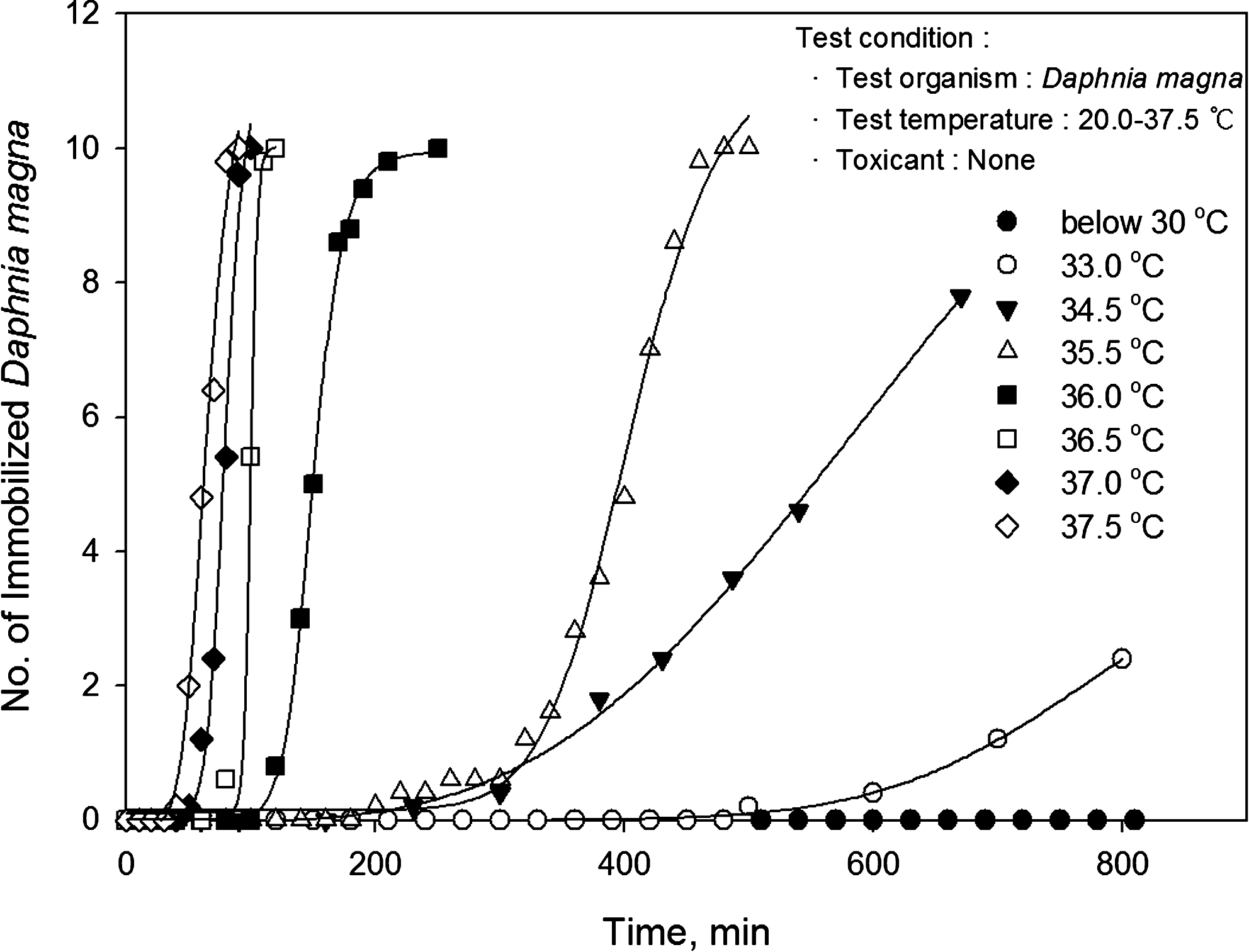
Daphnia magna's sensitivity to temperature.
As with any toxicity test, the 1-hour temperature-based toxicity test has to produce a reliable test result. It must be ascertainable that any observed daphnid immobility was caused by toxicants and not by nontoxicants. When this principle was applied to the experimental design, it followed that the temperature selected for the 1-hour toxicity test could not be the cause of the immobility. Therefore, in narrowing the initial temperature range, those temperatures that could kill a daphnid within 60 minutes of exposure were excluded. Consequently, the temperature of 37.5°C was excluded as the daphnids in this temperature died within 60 minutes of exposure.
Any temperature that violated the OECD guidelines was also excluded from the temperature range. Section 202 of the OECD guidelines states that no more than 10% of the daphnids in a control group should be immobilized during a toxicity test (OECD, 2004). However, as shown in Fig. 1, about 12% of the daphnids were immobilized at 37.0°C in 1 hour; thus, this temperature was excluded.
In performing the 1-hour toxicity test duration analysis, it was assumed that the highest allowed temperatures would produce fastest test results. This assumption was based on two observations: (1) daphnids placed in high temperatures became weak, and (2) weak daphnids died faster than healthy daphnids in toxic water. Applying this assumption, temperatures just under 37.0°C were chosen for closer examination. After three analyses, the temperature range of 36.0°C–36.5°C was selected and further analyzed.
s-Temp analysis
Table 1 summarizes three EC50 values: those from the 1-hour toxicity test at 36.0°C; those from the 1-hour toxicity test at 36.5°C; and those from the 24-hour standard acute toxicity test. After comparing the EC50 values of 1-hour toxicity tests to those of 24-hour standard acute toxicity test, 36.5°C was chosen as the s-Temp for the following reasons. First, the 1-hour toxicity test at 36.0°C produced EC50 results for only three toxicants out of seven, whereas the 1-hour toxicity test at 36.5°C produced EC50 results for all seven chemicals. The omission of EC50 for four toxicants (Cd, Hg, Ni, Zn) is critical, because the testing concentrations were relatively high: 60 μg Cd/L, 50 μg Hg/L, 100 μg Ni/L, and 100 μg Zn/L. Second, even when the EC50 for As, Cr, and Pb were compared, the 1-hour toxicity test at 36.5°C produced an EC50 closer to that of the 24-hour standard acute toxicity test.
tox., toxicity; N.D., not detected.
Although 36.5°C was chosen as the s-Temp, the selection of that temperature based on the conclusion that it was better than the other was not enough. The chosen temperature had to be reliable. To determine reliability, a Pearson correlation analysis was conducted with EC50 values from both the 24-hour standard acute toxicity test and the 1-hour toxicity test at 36.5°C. The correlation coefficient, which measures the strength of the relationship, was 0.9999. After the coefficient was calculated, a t-test was conducted to examine the significance of this correlation. The t-test found that the relationship was significant, as the following values were computed: t=158.10; df=5; and p(two-tail)=0.0000001. Thus it was concluded, albeit based on seven toxicants, the 1-hour toxicity test at 36.5°C was reliable.
Toxicity test analysis
In screening 8 heavy metals, 4 pesticides, 2 anions, and phenol, the 1-hour toxicity test and the 24-hour standard acute toxicity test displayed a strong and significant relationship. As noted previously, the Pearson correlation was 0.9999 when the EC50 values of the tests were compared. Furthermore, the t-test analysis of correlation produced extremely high t-value (t=254.93; df=13), that indicated the significance of the correlation [p(two-tail)=0.0000005].
The scatter plot in Fig. 2 also supported the positive relationship between the two tests. As seen in Fig. 2, 1 toxicants placed within the 1–2 line. The other 4 toxicants outside the 1–2 line had mixed results. For Cd and diazinon, the 24-hour standard acute toxicity test had lower EC50 values than the 1-hour toxicity test; whereas the 1-hour toxicity test had lower EC50 values for cyanide and phenol than the 24-hour standard acute toxicity test.

Correlation of EC50 values obtained from the 1-hour toxicity test at 36.5°C and the 24-hour standard acute toxicity test.
Figure 3 shows a comparison of the two tests by individual toxicants. At low test concentrations, the daphnids in the 24-hour standard acute toxicity test were immobilized more readily than their counterparts in the 1-hour toxicity test. However, as the test concentrations increased, in most cases, these differences were significantly reduced. For most toxicants, the initial differences were marginal. However, for Cd, Pb, and phenol, they were considerable. In general, the 24-hour standard acute toxicity test was better at detecting lower test concentrations than the 1-hour toxicity test.
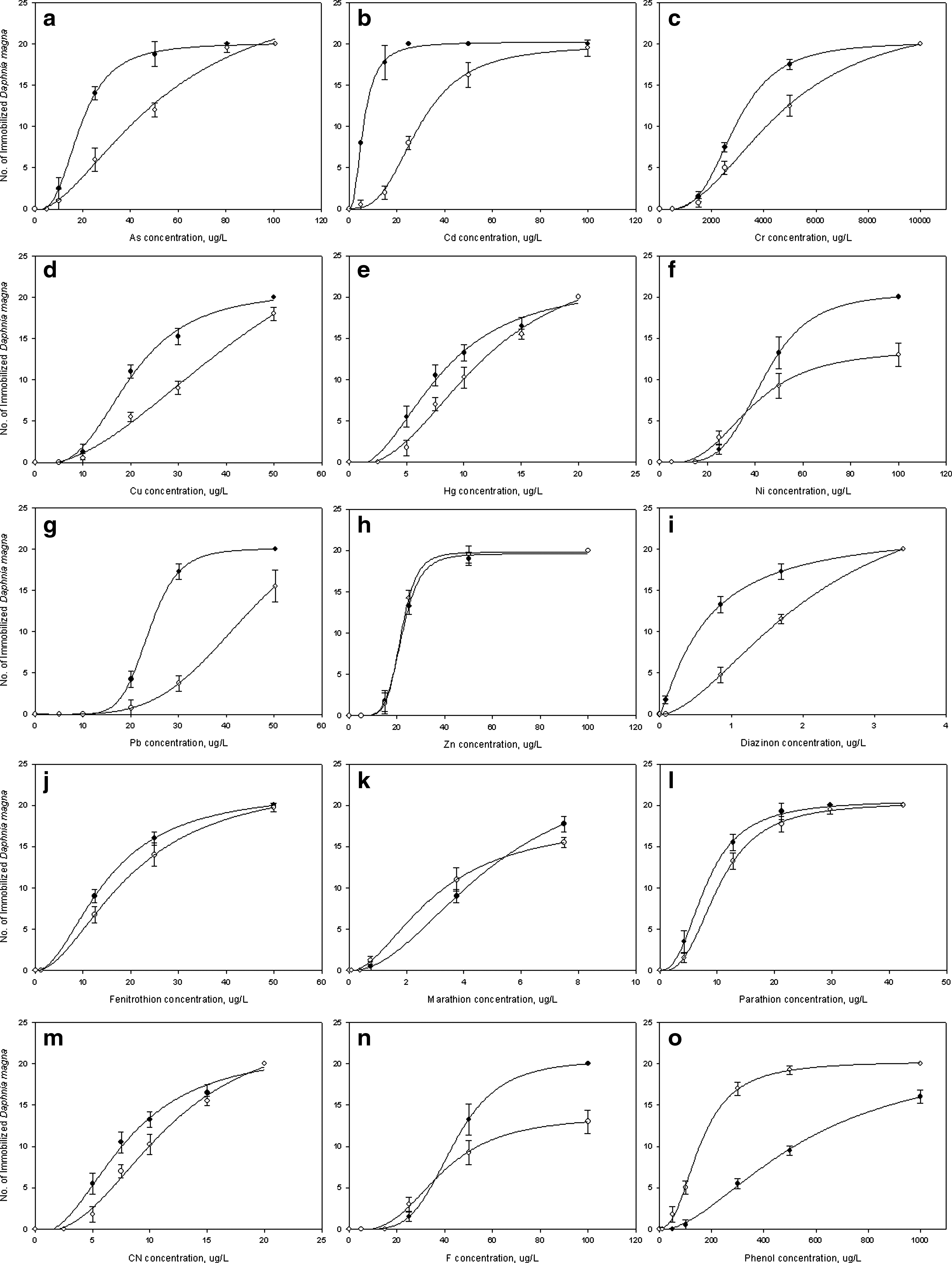
Number of immobilized daphnids by individual toxicants in the 1-hour toxicity test and 24-hour standard acute toxicity test. The toxicants were
Industrial wastewater analysis
Of the 10 industrial wastewater samples analyzed, 8 did not produce EC50 values. Some of the daphnids in these samples showed some toxic effects, but the overall number was less than 50%. Therefore, only two wastewater samples were evaluated and included in this section.
Unlike the 15 single toxicants previously analyzed, the industrial wastewater samples tested were a mixture of numerous toxicants in various concentrations. For industrial water sample 1, the EC50 of 55.2% of raw wastewater was acquired for the 24-hour standard acute toxicity test, and 72.9% of raw wastewater was acquired for the1-hour toxicity test. For industrial water sample 2, the EC50 of 48.9% of raw wastewater was calculated for the 24-hour standard acute toxicity test and 37.9% for 1-hour toxicity test (Table 2). Although this analysis was based on only two samples, the similarity in EC50 values showed that the 1-hour toxicity test at 36.5°C with D. magna can be effective in screening complex samples. However, because the sample number was too small to be significant, additional experiments will be needed to prove the 1-hour toxicity test's effectiveness in screening industrial wastewater.
Conclusion
In this study, the feasibility of designing a 1-hour temperature-based toxicity test with D. magna was investigated. Based on the experimental results, the following conclusions were drawn:
(1) The ideal temperature to conduct the 1-hour temperature-based toxicity test is 36.5°C. (2) When the 1-hour temperature-based toxicity test was compared with 24-hour standard acute toxicity test in screening As, Cd, Cr, Cu, Hg, Ni, Pb, Zn, diazinon, fenitrothion, malathion, parathion, cyanide, fluoride, and phenol, the EC50 data of the two tests had the correlation of 0.9999. (3) Industrial wastewater analysis with the 1-hour temperature-based toxicity test and the 24-hour standard acute toxicity test showed promising results. However, additional experiments will be needed to prove the effectiveness of the 1-hour temperature-based toxicity test in screening complex toxicants because only two samples were used. (4) Although the 24-hour standard acute toxicity test was better at detecting lower test concentrations than the 1-hour temperature-based toxicity test, the latter was effective in screening the 15 tested toxicants. This conclusion is limited to only 15 tested toxicants, and additional experiments will be needed for other toxicants. (5) The 1-hour temperature-based toxicity test also showed a potential to be effective in screening complex industrial wastewater, albeit based on limited samples.
Footnotes
Acknowledgment
This subject is supported by Korea Ministry of Environment as “The Eco-technopia 21 project”.
Author Disclosure Statement
No competing financial interests exist.