




Abstract
Abstract
Ozone oxidation is commonly used to remove taste and odor (T&O) from drinking water. However, this technique is only moderately effective, and is complicated by the formation of aldehyde by-products. In this study, we investigated the efficiency of ozonation with which aluminum oxide catalysts (γ-AlOOH [HAO], γ-Al2O3 [RAO], and α-Al2O3 [AAO]) removed three representative odorous substances (2-methylisoborneol [MIB], 2,4,6-trichloroanisole [TCA], and 2-isopropyl-3-methoxypyrazine [IPMP]) from water and reduced the yields of aldehydes. Application of ozonation alone led to incomplete mineralization of odorous substances and generation of large amounts of aldehydes. In comparison, catalyzed ozonation by the three aluminum oxides substantially increased the removal efficiencies of T&O and reduced the production of aldehydes, albeit to different degrees. In all forms of ozonation, the main aldehyde products were formaldehyde, acetaldehyde, propionaldehyde, n-butyraldehyde, glyoxal, and methylglyoxal. HAO satisfactorily catalyzed the ozone oxidation of TCA and IPMP and effectively reduced the total aldehyde production during their oxidation. Catalyzed ozonation by AAO could not effectively reduce total aldehyde production during the oxidation of TCA and IPMP, which resulted in incomplete removal of T&O from water. Catalyzed ozonation by RAO provided the best results in removing MIB, TCA, and IPMP and reducing total aldehyde production.
Introduction
Natural T&O substances in the water environment primarily originate from secondary metabolic products of algae and other microorganisms (Hattori, 1988). These compounds mainly include geosmin, 2-methylisoborneol (2-MIB), isopropyl methoxypyrazine (IPMP), 2-isobutyl-3-methoxypyrazine (IBMP), and 2,4,6-trichloroanisole (TCA) (Saito et al., 2008). Table 1 lists the basic properties of these typical natural T&O pollutants in drinking water.
Ministry of Construction and Ministry of Public Health of China (2006).
Andreas and Von Gunten (2007).
Conventionally, natural T&O substances can be removed from drinking water through adsorption by activated carbon or oxidation (McGuire, 1999). For better removal efficiency, a large amount of activated carbon is required, which results in higher turbidity that needs further treatment (Liang et al., 2006). Additionally, common pre-oxidants such as potassium permanganate, free chlorine, and chlorine dioxide have relatively weak oxidative potential and therefore do not effectively remove these substances from drinking water (Lalezary et al., 1986a).
Ozone is a strong oxidant extensively used in the treatment of drinking water and sewage (Lalezary et al., 1986b). However, ozone cannot completely oxidize refractory organic pollutants into H2O and CO2 (Von Gunten, 2003). Instead, ozone generally converts large pollutant molecules into smaller oxygen-containing molecules such as acetones, aldehydes, and carboxylic acids (Griffini et al., 1999). These small molecules account for a large fraction of biodegradable organic carbon (BDOC) and assailable organic carbon (AOC) in drinking water distribution (Froese et al., 1999). These constituents can induce rapid recovery and regrowth of microorganisms in the distribution net of drinking water, which may reduce the bio-safety of drinking water (Carlson and Amy, 1998). Moreover, the small-molecular-weight aldehydes may affect human health and generate an unpleasant fruit smell in tap water. (Weinberg et al., 1993). To overcome these problems, advanced biological treatment is usually conducted following ozonation to remove the small-molecule products.
Qi et al. (2008, 2009) reported that heterogeneous catalyzed ozonation can effectively remove even traces of T&O pollutants from drinking water. However, the fate of the smaller products remains unknown. For a thorough evaluation of the effects of this new technique, it is necessary to understand the formation and control of these products.
In this study, we investigated the removal efficiency of three representative odor pollutants (MIB, TCA, and IPMP) from water by catalyzed ozonation using three kinds of aluminum oxides (HAO, RAO, and AAO) and the simultaneous control of the generation of small-molecule aldehyde products. We also attempted to reveal the pattern of aldehyde generation from different odorous pollutants and aluminum oxide catalysts. Our objective was to provide guideline information to enable more rational and effective use of this technique in drinking water treatment.
Materials and Methods
Preparation of catalyst
Aluminum (hydroxyl) oxides used as catalysts were synthesized in our laboratory. HAO was obtained by precipitating aluminum nitrate [Al(NO3)3·9H2O] with ammonia (NH3·H2O). Ammonia was added in drops until the pH of the supernatant fluid reached 9.0. The suspension obtained was aged at 30°C for 10–15 days, and the white precipitates were then rinsed with ultra-pure water (18 MΩ·cm) repeatedly until the conductivity of the supernatant remained constant. Following this, the white precipitates were dried at 70°C to obtain HAO. RAO was obtained by calcining HAO at 450°C for 4 h. AAO was obtained by calcining HAO at 1050°C for 4 h. The crystalline phases of the catalysts were confirmed to be HAO, RAO, and AAO by X-ray diffraction (XRD). The catalysts were ground and screened and those with diameters between 0.075 mm and 0.3 mm were used in experiments.
Chemicals
MIB was synthesized in our lab using the method described by Wood and Snoevink (1977). The purity of the synthesized MIB was above 95.0%, as confirmed by gas chromatography–mass spectrometry (GC-MS). TCA and IPMP (>98% purity) were purchased from Tokyo Kasei Kogyo Co. Ltd. (Tokyo, Japan). The stock solution of T&O compounds was prepared using purified water (≥18.0 MΩ·cm) produced by a Millipore Milli-Q system. The aldehyde standard solution containing 15 different kinds of aldehydes at a concentration of 1 mg/mL was purchased from Aldrich (St. Louis, MO, USA). The derivatization reagent (O-(2,3,4,5,6-pentafluorobenzyl) hydroxylamine [PFBHA] hydrochloride) was supplied by Lancaster (Lancaster, United Kingdom). Other reagents used in this study were of analytical purity or higher grade.
Experimental procedure
The ozonation or catalyzed ozonation of T&O compounds was performed in a cylindrical glass reactor (volume 250 mL). Ozone was produced by a laboratory ozonizer (DHX-SS-1G; Harbin Jiujiu Electrochemistry Engineering Ltd., Harbin, China), with a maximum ozone production of 9 g/h, using pure oxygen as feed gas. By changing the voltage, oxygen flux, and introduction gas time, the dissolved ozone concentration could be controlled. The maximum ozone concentration obtained in water was 312.5 μmol/L. After the generator reached a steady state, ozone gas was bubbled into ultra-pure water in the reactor using a silica dispenser until the desired dissolved ozone concentration of 2.2 mg/L was obtained. The ozone gas was then shut off, and the catalyst and the stock solution of T&O pollutants were immediately added into the liquid. Simultaneously, the magnetic stirrer was turned on. Samples were collected at predetermined time intervals, and the reaction was terminated by adding Na2SO3 (1.0 mmol/L). During the reaction, the solution was buffered by phosphate buffer (0.1 mmol/L). To obtain valid data, all ozonation and catalytic ozonation reactions were carried out three times and the average values calculated.
Analytical methods
The dissolved ozone concentration in liquid was measured by the indigo method (Bader and Hoigné, 1981), and the ozone yield of the laboratory ozonizer was determined by the iodometry method (APHA, 1998). T&O pollutants were extracted from water by n-hexane and analyzed by GC-MS (GC7890-MS5975C; Agilent, Santa Clara, CA, United States) (Shin and Ahn, 2004). For the selected ion monitoring (SIM) mode, m/z values of 152 and 124 for IPMP, 108 and 135 for MIB, and 195 and 210 for TCA were monitored.
Aldehydes generated as by-products in ozonation or catalytic ozonation were derivatized with PFBHA. The polyfunctional compounds thus obtained were extracted from water with n-hexane. The detailed derivatization process followed the EPA Method 556 (Munch et al., 1998). After the derivatization procedure, aldehydes were identified and quantified by a GC equipped with an electron capture detector (GC-ECD, 6890N, HP-5 column 30 m×0.25 mm×0.25 μm; Agilent) analysis. The GC-ECD conditions used were those described in EPA Method 556.
Results and Discussion
Removal of T&O pollutants by catalytic ozonation
The removal efficiencies of T&O pollutants by ozonation alone and by catalytic ozonation were studied. The results are shown in Table 2. The sole ozonation removal efficiency was 33.9%, 67.9%, and 68.5% for MIB, TCA, and IPMP, respectively. The removal efficiency order (MIB<TCA<IPMP) was consistent with the results obtained by Lalezary et al. (1986b). The varying removal efficiencies may be attributed to the differences in the chemical structures of the compounds. MIB is a saturated aliphatic alcohol and contains no unsaturated bonds that are susceptible to attack by ozone. TCA is an aromatic compound, which contains a benzene ring easily attacked by ozone. IPMP is heterocyclic and contains C=C and N=C bonds, which are susceptible to ozone attack. Thus, sole ozonation has limited oxidative capabilities that vary with the chemical structure of T&O compounds.
[O3]0=2.2 mg/L; pH=5.6; [MIB]0=176 μg/L; [TCA]0=200 μg/L; [IPMP]0=380 μg/L; [concentration of catalyst]=500 mg/L; reaction time=20 min.
Catalyzed ozonation by all three aluminum oxides substantially enhanced the removal efficiencies compared to sole ozonation (Table 2). Direct oxidation, adsorption, and catalytic ozonation are the three key steps in the catalyzed ozonation process. Each of these can remove target T&O pollutants in water. The removal efficiency by adsorption was<5% in catalytic ozonation of T&O compounds for 20 min (results not shown). Other papers published by our research groups (Qi et al., 2008, 2009) also confirmed poor adsorption of target T&O pollutants on the surface of aluminum oxides. This is likely due to the strong hydrophilicities of the pollutants. Catalyzed ozonation by aluminum oxides was more effective than sole ozonation and catalyst adsorption combined, confirming that aluminum oxides exhibited significant catalytic activity in removing T&O pollutants. Specifically, HAO and RAO were more effective than AAO (Table 2).
Aluminum oxides can catalyze the decomposition of ozone to produce strongly oxidative hydroxyl radicals, which play a critical role in oxidizing T&O pollutants (Qi et al., 2008). HAO enhanced the removal efficiency of TCA by ozonation, while RAO facilitated the removal efficiency of trace MIB in drinking water. Both these oxides were particularly active at producing hydroxyl radicals (Qi et al., 2009). The catalytic activity of aluminum oxides was different for different pollutants. HAO was most effective in removing TCA and IPMP, and RAO was most useful for MIB degradation in catalytic ozonation. These differences were presumably due to the different surface properties of catalysts and the different molecular structures of the pollutants.
Production of odorous aldehydes in catalytic ozonation
Three primary types of by-products are produced during ozonation of pollutants in water: halides, bromine-containing compounds (e.g., bromates), and small oxygen-containing molecules (e.g., carboxylic acids, aldehydes, and acetones). In this study, we examined the formation of aldehydes that caused fruit odor in drinking water and induced the secondary growth of microorganisms in water supply distribution networks (Weinberg et al., 1993; Carlson and Amy, 1998). Earlier studies have shown that aldehydes account for most of the oxygen-containing substances produced during ozonation of pollutants in water (Von Gunten, 2003). In this study, aldehydes were analyzed by GC-ECD following derivatization with PFBHA. The derivatized aldehydes were transferred to fluorine containing oximes. Figure 1 shows chromatograms of aldehydes that were generated following ozonation (for 20 min) of the three T&O compounds. Six kinds of aldehydes were detected: formaldehyde, acetaldehyde, propionaldehyde, n-butyraldehyde, glyoxal, and methylglyoxal. Subsequent experiments focused on these six aldehydes.
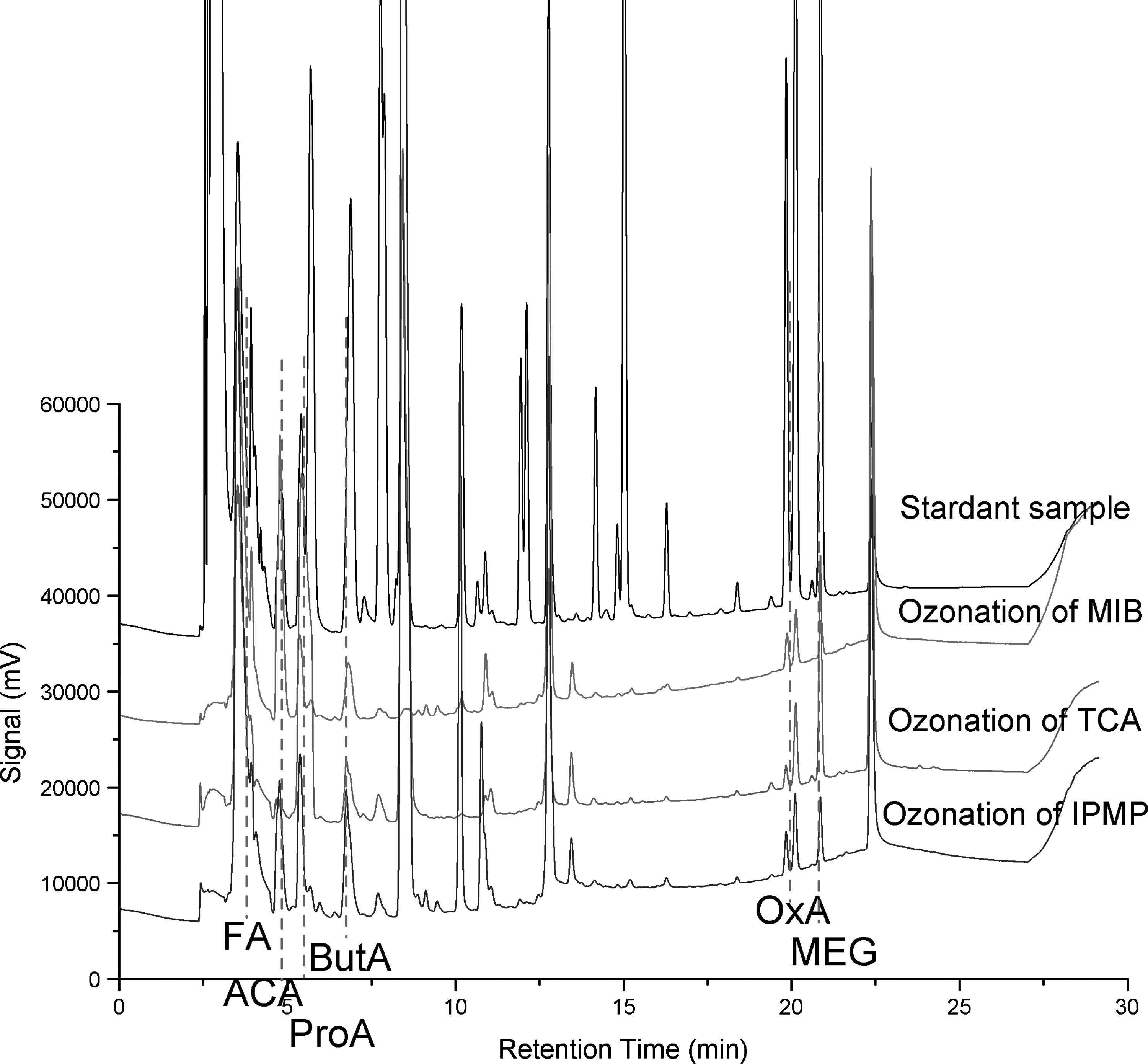
Chromatogram of low-molecular-weight aldehyde by-products. FA, formaldehyde; ACA, acetaldehyde; ProA, propionaldehyde; ButA, butyraldehyde; OxA, glyoxal aldehyde; MEG, methylglyoxal aldehyde; [O3]0=2.2 mg/L; pH=5.6; [concentration of catalyst]=500 mg/L; [MIB]0=176 μg/L; [TCA]0=200 μg/L; [IPMP]0=380 μg/L; reaction time=20 min.
Aldehyde production in ozonation and catalyzed ozonation
Aldehyde production during ozonation alone
Figure 2 depicts the generation yields of aldehydes in sole ozonation of the representative T&O pollutants in water. Under otherwise identical conditions, more aldehydes were produced during ozonation of TCA than during ozonation of MIB or IPMP. Though TCA was efficiently removed from water, due to poor mineralization rate there was formation of more aldehydes. In comparison, IPMP ozonation had a high mineralization rate and produced low levels of aldehyde, and the pollutant was also effectively removed. Due to the saturated aliphatic structure, MIB was not effectively removed by ozonation and produced only limited amounts of aldehyde.

Formation yields of aldehyde by-products in sole ozonation of (
During ozonation of the three pollutants, formaldehyde and acetaldehyde were the primary aldehyde products, while glyoxal and methylglyoxal aldehyde were produced at lower levels. The yields of aldehydes were in the order acetaldehyde>formaldehyde>propionaldehyde>n-butyraldehyde>methylglyoxal aldehyde>glyoxal during ozonation of both MIB and TCA, while for IPMP, the order was formaldehyde>acetaldehyde>propionaldehyde>n-butyraldehyde>methylglyoxal aldehyde>glyoxal.
During the ozonation of MIB, the yields of the primary aldehyde products (formaldehyde and acetaldehyde) increased rapidly, reaching a peak at 10 min. For TCA, the yields of the primary aldehyde products (formaldehyde, acetaldehyde, and propionaldehyde) gradually increased, peaking at 20 min, and then rapidly decreased. During IPMP ozonation, the yields of products were low but increased rapidly with time, peaking at 10 min, and then gradually decreased.
Aldehyde production in HAO-catalyzed ozonation
HAO enhanced the removal rates of T&O pollutants and decreased the formation of aldehyde products. In catalyzed ozonation of MIB by HAO, the yields of aldehyde products followed the order formaldehyde>propionaldehyde>acetaldehyde>n-butyraldehyde>methylglyoxal aldehyde>glyoxal (Fig. 3a). These results indicate that HAO generated an abundance of by-products compared to sole ozonation. In catalyzed ozonation, the production of acetaldehyde was substantially reduced and propionaldehyde replaced acetaldehyde as a major product. The yield of formaldehyde also increased slightly, while that of propionaldehyde increased substantially. This could be due to enhanced mineralization by RAO, which resulted in partial mineralization of acetaldehyde as well as partial conversion into formaldehyde.
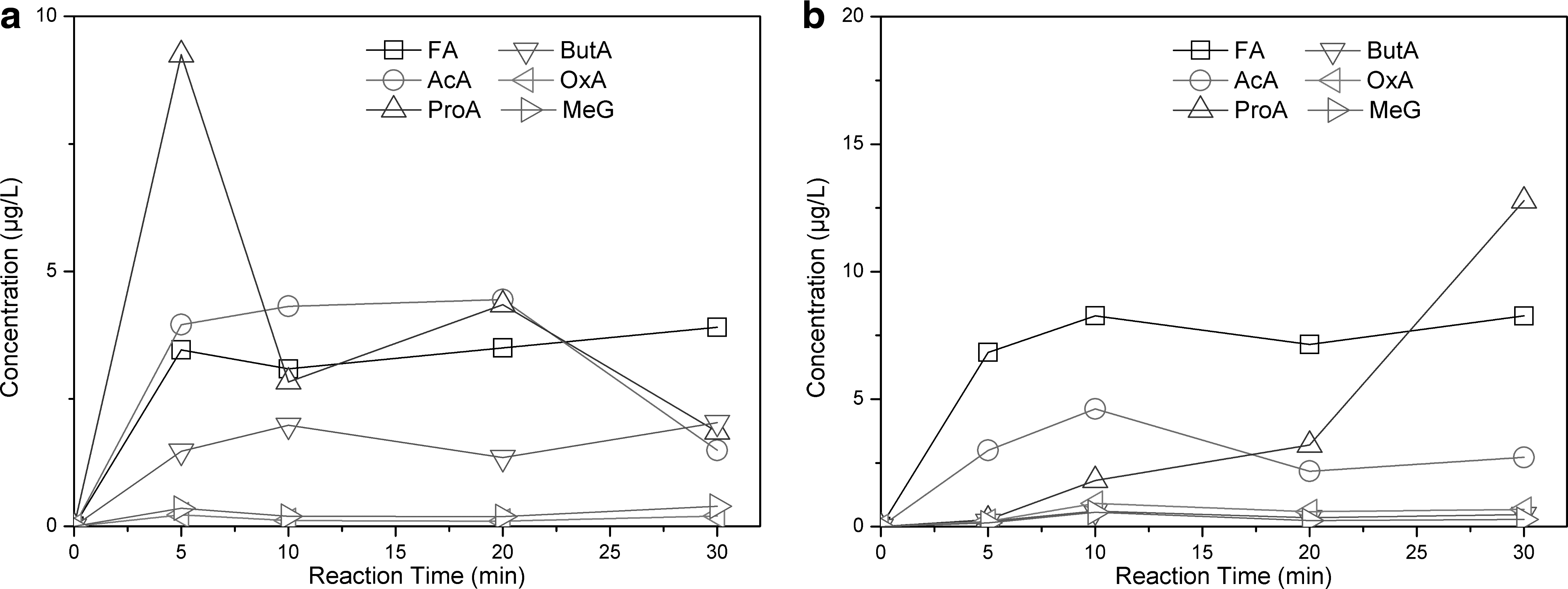
Formation yields of aldehyde by-products in catalytic ozonation of (
In HAO-catalyzed ozonation of TCA, the yields of aldehyde products decreased more substantially (Fig. 3b). Specifically, the yield of acetaldehyde was reduced from 70 μg/L in sole ozonation to 15 μg/L in catalyzed ozonation. The peak time for aldehyde production decreased from 20 min in sole ozonation to 10 min in HAO-catalyzed ozonation, indicating accelerated TCA decomposition and reduced aldehyde production by HAO. Thus, for both MIB and TCA, the introduction of HAO substantially decreased the yield of acetaldehyde and slightly increased the yield of formaldehyde. The production of other aldehyde products was also effectively decreased.
Aldehydes as intermediate products in catalyzed ozonation are polar compounds, with remarkable solubility in water. In general, the surface groups of inorganic mineral were rare except surface hydroxyl groups (Stumm, 1992). This resulted in weak adsorption of aldehydes on the catalyst surface. However, adsorption was not the key factor in reducing the concentrations of aldehydes. Degradation of aldehydes in catalyzed ozonation was mainly due to the catalytic reaction than due to sole ozonation or adsorption.
Aldehyde production during RAO-catalyzed ozonation
RAO also greatly enhanced the removal rates of the T&O pollutants and decreased the production of aldehydes (Fig. 4). In catalytic ozonation of MIB, the yields of formaldehyde and acetaldehyde were reduced to below 5 μg/L (Fig. 4a). The yields of all six aldehyde products peaked at 5 min, which was greatly advanced when compared with the peak time in sole ozonation. These findings indicate that RAO markedly accelerated the oxidation of MIB and the subsequent mineralization of the aldehyde products.
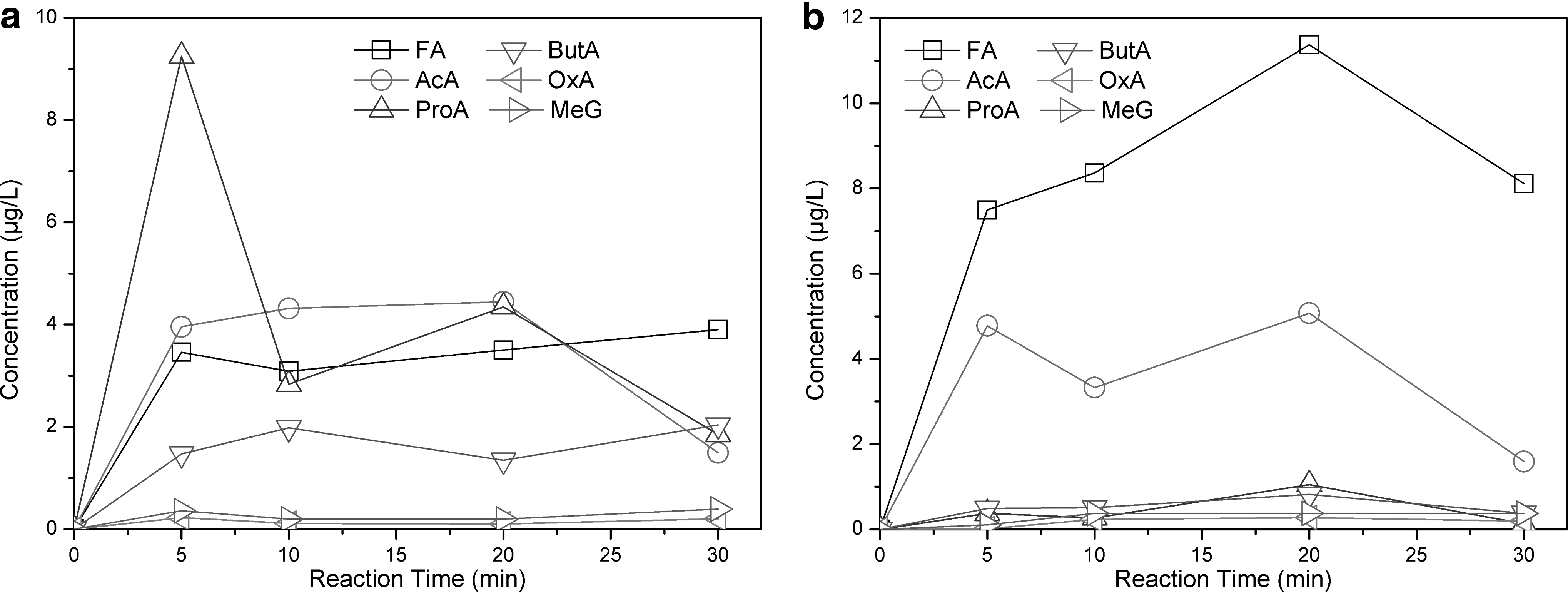
Formation yields of aldehyde by-products in catalytic ozonation of (
Catalyzed ozonation by RAO reduced the production of aldehydes in the degradation of TCA even more effectively (Fig. 4b). The primary aldehyde products were still formaldehyde and acetaldehyde, as in sole ozonation. However, their peak formation was reduced to below 12 μg/L. In comparison, catalyzed ozonation of IPMP improved the removal efficiency, but produced slightly more aldehydes compared to sole ozonation, similar to HAO-catalyzed ozonation. As shown in Fig. 4, RAO substantially reduced the production of aldehydes during oxidation of both MIB and TCA, but was relatively ineffective during oxidation of IPMP.
Aldehyde production during AAO-catalyzed ozonation
Figure 5 depicts the production of aldehydes in AAO-catalyzed ozonation of the three pollutants. The main aldehyde products in MIB ozonation in descending order of peak yield were acetaldehyde, propionaldehyde, and formaldehyde. The yields of formaldehyde, n-butyraldehyde, glyoxal, and methylglyoxal aldehyde peaked at 5 min and then decreased. Acetaldehyde and propionaldehyde yields peaked at 10 min and then decreased. This was due to further degradation of aldehydes by ozonation. Compared to ozonation alone, the yields of formaldehyde and acetaldehyde in catalyzed ozonation were substantially reduced, while that of propionaldeyde increased slightly. These effects were likely due to AAO promoting the degradation of MIB, leading to the production of more propionaldehyde. This improved the mineralizing capability of the reaction system and substantially reduced the concentrations of formaldehyde and acetaldehyde in the by-products.
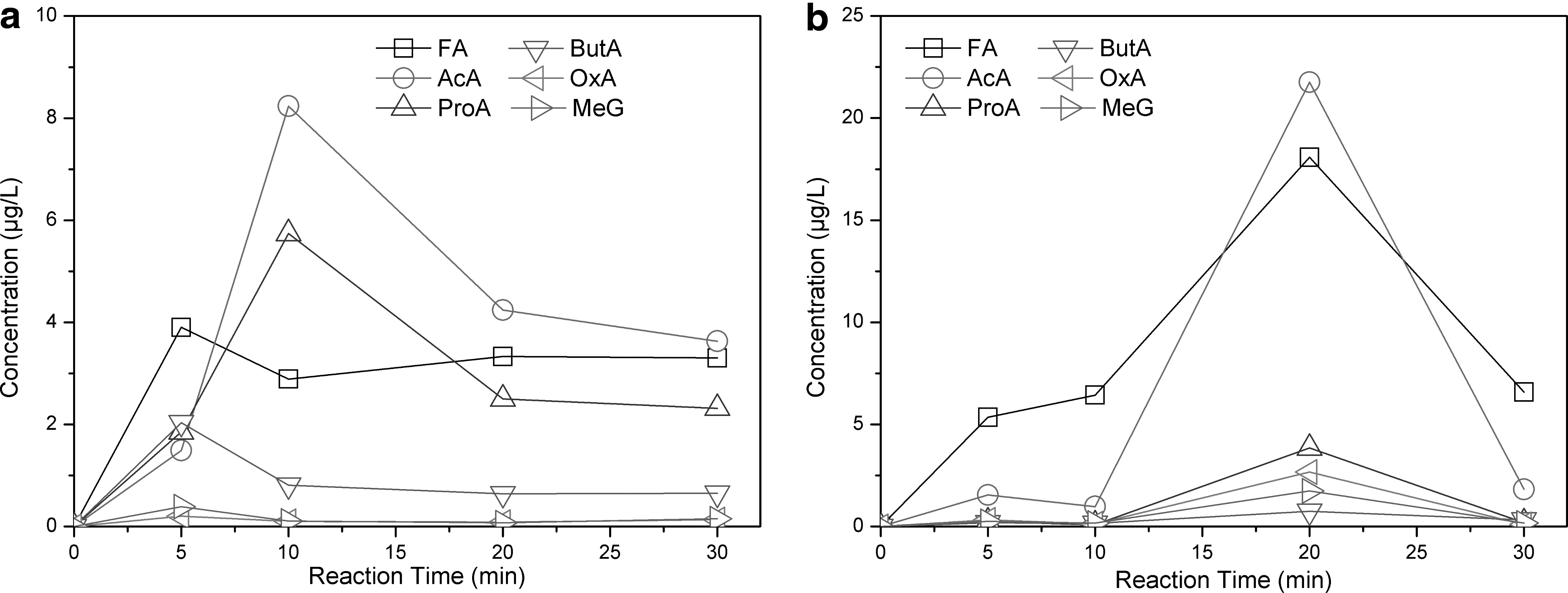
Formation yields of aldehyde by-products in catalytic ozonation of (
AAO-catalyzed ozonation of TCA showed considerably different patterns for aldehyde production. Here, the main aldehyde products were formaldehyde and acetaldehyde, and the yields of all six aldehydic products peaked at 20 min. Also, the yields of formaldehyde, acetaldehyde, and propionaldehyde were substantially reduced compared to sole ozonation of TCA. This shows the stronger oxidative capability of AAO.
In AAO-catalyzed ozonation of IPMP, the main aldehyde products were acetaldehyde, propionaldehyde, and formaldehyde in descending order of yield. The yields of aldehyde products were moderately high compared to sole ozonation, presumably because AAO increased the removal efficiency of IPMP but failed to improve the mineralizing capability, thus producing more unmineralized aldehydes.
Total aldehyde production in ozonation and catalytic ozonation
To better evaluate the effects of catalyzed ozonation on aldehyde production, the total yields of aldehydes during these oxidation processes were investigated (Fig. 6).

Total aldehyde formation yields in ozonation alone and catalytic ozonation. [O3]0=2.2 mg/L; pH=5.6; [MIB]0=176 μg/L; [TCA]0=200 μg/L; [IPMP]0=380 μg/L; [concentration of catalyst]=500 mg/L; reaction time=20 min.
Ozonation alone gave the highest total aldehyde yields, with maximum values of 92.2 μg/L and 12.6 μg/L in the oxidation of TCA and IPMP, respectively. Ozonation of the three T&O pollutants displayed different patterns of total aldehyde production. For MIB and IPMP the total aldehyde yield peaked at 10 min, while for TCA the peak emerged at 20 min.
HAO effectively increased the removal efficiency and reduced the yield of total aldehydes during the oxidation of all three T&O pollutants. Catalytic ozonation of TCA gave the lowest yields of total aldehyde, the peak yield being reduced by 73.5%, from 92.2 μg/L in sole ozonation to 26 μg/L in catalyzed ozonation. The total aldehyde yields for MIB and IPMP were also reduced by 23.3% and 26.7%, respectively, compared to sole ozonation.
AAO was generally less effective at reducing total aldehyde production compared to the other two aluminum oxides. During oxidation of TCA, AAO reduced the peak yield of total aldehyde to 52 μg/L. For MIB, the peak yield was 12.6 μg/L, a decrease of 43.4% compared to sole ozonation. In IPMP oxidation, AAO enhanced the oxidative capacity but failed to improve the mineralizing capability. As a result, the yield of total aldehydes was 63 μg/L, an increase of 271% from sole ozonation. As the oxidative capacity of AAO-catalyzed ozonation remained moderate, the peak times of total aldehyde production during the oxidation of all three T&O pollutants were the same as in sole ozonation.
In the presence of RAO, the total aldehyde yields for all three T&O pollutants were controlled at below 20 μg/L, being 18.7 μg/L for MIB (40% reduction), 19.0 μg/L for TCA (80.6% reduction), and 14.8 μg/L for IPMP (11.7% reduction). In sole ozonation, total aldehyde yields were 27.8 μg/L, 92.2 μg/L, and 12.6 μg/L for MIB, TCA, and IPMP, respectively. Thus, RAO catalytic ozonation exhibited the highest capacity to control the generation of aldehydes among the three aluminum oxides.
Further, RAO catalytic ozonation decreased the peak time of total aldehyde production to 5 min, indicating that the catalyst promoted the chemical attack on target T&O compounds and accelerated their decomposition.
The results of this study show that all three aluminum oxides enhanced the ozonation of T&O pollutants with different mineralizing capabilities for different pollutants. These differences translated into different patterns of aldehyde production in the oxidation reaction. HAO-catalyzed ozonation was excellent at decomposing TCA and IPMP and effectively reduced the total aldehyde production during their decomposition, but did not effectively remove MIB or reduce aldehyde production during its decomposition. In comparison, AAO-catalyzed ozonation was satisfactory at removing the three representative T&O pollutants but poor at reducing the total aldehyde production during the oxidation of TCA and IPMP. Therefore, this process could not completely remove the T&O pollution of water. Among the three catalyzed oxidation processes, RAO-catalyzed ozonation was best at removing T&O pollutants and reducing total aldehyde production.
Conclusions
Based on the above experimental results, the following conclusions can be drawn:
(1) Sole ozonation has limited and substance-specific oxidative effects on T&O pollutants. The three aluminum oxides evaluated herein all substantially increased the removal of the three representative T&O pollutants by >10% when compared to sole ozonation. (2) In both sole ozonation and catalyzed ozonation of the three representative T&O pollutants, the main aldehyde products were formaldehyde, acetaldehyde, propionaldehyde, n-butyraldehyde, glyoxal, and methylglyoxal aldehyde. Sole ozonation cannot effectively remove T&O pollutants, as it produces large amounts of aldehydes. (3) HAO sufficiently catalyzed the ozonation of TCA and IPMP and effectively reduced the total aldehyde production during oxidation. In comparison, AAO-catalyzed ozonation efficiently removed the three representative T&O pollutants but was ineffective at reducing total aldehyde production during the oxidation of TCA and IPMP; therefore, it could not successfully remove T&O pollution in water. Among the three catalyzed oxidation processes, RAO-catalyzed ozonation was best at removing pollutants and reducing total aldehyde production.
Footnotes
Acknowledgments
This work was carried out with the financial support of Beijing Forestry University Young Scientist Fund (No. BLX2W8024), the Fundamental Research Funds for the Central Universities (No. HJ2010-5, No. BLJC200903, and No. YX2010-25), the Specialized Research Fund for the Doctoral Program of Higher Education (No. 20100014120001), and China Post Doctoral Science Foundation (20100470216). The State Key Laboratory of Urban Water Resource and Environment (HIT, ES200901) and the National Natural Science Foundation of China (No. 51108030, and 40903038) also supported this research.
Author Disclosure Statement
No competing financial interests exist.