




Abstract
Abstract
Presence of persistent and toxic pharmaceuticals and personal care products (PPCPs) in water bodies has generated considerable scientific, regulatory, and public interests, requiring the development of cost-effective technologies for PPCP treatment. This study reports that sulfate radical (SR)-based advanced oxidation technologies (AOTs) are promising as a new environmental risk management option for PPCP-contaminated water. Triclosan, sulfamethoxazole, and acetaminophen were effectively decomposed and mineralized by the attack of SRs generated through the activation of peroxymonosulfate (PMS) and persulfate with iron. The PMS/Fe system was more effective than persulfate/Fe but less effective than the H2O2/Fe (Fenton reaction) system that produces hydroxyl radicals. However, when conjugated with cobalt, PMS showed outstanding reactivity toward PPCPs, whereas negligible decomposition of PPCPs by H2O2 was observed. Insights and suggestions on PPCP decomposition by SRs are also discussed, including organic selectivity and system stability. As an alternative to established hydroxyl radical-based AOTs, SR-based AOTs should initiate new strategic plans to manage PPCPs and other emerging chemicals of concern in water resources.
Introduction
Recently, special attention has been given to advanced oxidation technologies (AOTs) where extremely strong and transitional radical species such as hydroxyl radicals (HRs) and sulfate radicals (SRs) are generated to attack organic contaminants. As one of the most practical HR-based AOTs, Fenton reaction (activation of H2O2 with Fe) and its modifications have been extensively researched to decompose PPCPs (Elmolla and Chaudhuri, 2009). Meanwhile, SR-based AOTs have been recently researched to establish the radical generation, organic decomposition kinetics, and reaction pathways and mechanisms (Anipsitakis and Dionysiou, 2003; Anipsitakis et al., 2006). SRs have also been widely used for in situ remediation of contaminated groundwater and soil (Liang et al., 2004; Do et al., 2009). SRs, typically generated via catalytic activation of peroxymonosulfate (PMS) and persulfate (PS) with transition metals, possess higher standard redox potential (2.5–3.1 V) compared to HRs (1.8–2.7 V) over pH values. To mitigate concerns about dissolved metal ions, heterogeneous generation of SRs has also been attempted by introducing solid phase metallic oxide particles that can be easily removed by subsequent filtration (Anipsitakis et al., 2005; Yang et al., 2007, 2008). The reaction mechanisms of SRs with organics are basically similar to those of HRs via electron transfer, hydrogen abstraction, and/or hydrogen addition mechanisms, whereas SRs react more selectively by electron transfer (Neta et al., 1977, 1988), which makes SR-based AOTs unique.
In spite of the high potential of SR-based AOTs for the decomposition of recalcitrant organic contaminants, few research efforts have been given to the destruction of PPCPs. Since organic attack mechanisms of SRs are different from those of HRs and PPCPs are unique with great diversity in their molecular structure and chemical properties, the effectiveness of SR-based AOTs to treat PPCP-contaminated water should be immediately examined and publicized. In this study, we preliminary test some important chemical oxidant/metal catalyst systems to generate SRs and HRs and compare their effectiveness to destroy PPCPs (PMS/Fe vs. PS/Fe, PMS/Fe vs. H2O2/Fe, PMS/Co vs. H2O2/Co).
Materials and Methods
Based on their unique nature and current significance, triclosan (TCS), sulfamethoxazole (SMX), and acetaminophen (ATAP) were selected as target PPCPs in this study, as summarized in Table 1. The U.S. Environmental Protection Agency is recently worried about the potential for endocrine disruption resulting from human exposure to TCS, the most widely used antibiotic chemical in soaps, body washes, and toys (Erickson, 2010). SMX, as a sulfonamide bacteriostatic antibiotic, also poses health risks associated with antibiotic resistance. The removal of ATAP from some popular analgesic combination products has been issued (Muir et al., 1997). Each of the PPCPs has its own molecular structure with unique moieties, which are the primary targets for the radical attack.
PPCP, pharmaceuticals and personal care products; TCS, triclosan; SMX, sulfamethoxazole; ATAP, acetaminophen.
TCS, SMX, ATAP, FeSO4, PMS (as KHSO5), PS (as K2S2O8), and H2O2 were obtained from Sigma-Aldrich and used as received. General experimental procedures for SR-based AOTs and Fenton reaction were reported elsewhere (Anipsitakis and Dionysiou, 2003). PPCP degradation was performed in a 100 mL batch reactor. The mass concentration of PPCPs was fixed at 9 mg/L to set a certain contamination situation in water resource (based on the lowest aqueous solubility of TCS). After short preliminary studies under different PPCP/oxidant/metal conditions, the molar ratios of PPCP to oxidant and oxidant to metal were fixed at 1:80 and 1:1, respectively, for all the experiments. The reason we set the molar (not mass) ratio of oxidant (or metal) to PPCP is to consider the stoichiometry of their reaction. The PPCP to oxidant ratio was increased to 1:10 for some experiments to make better comparisons. The initial pH was adjusted at 7.0 using 1 M sodium hydroxide to promptly compare the reactivities of SRs and HRs. No buffer solution was used to avoid any experimental complexities related to reaction between radicals and buffer species. The solution pH decreased to around 4.0 as a result of acid generation during the decomposition of the oxidants and oxidation of contaminants as well as metal-related acidity. Sample of 0.5 mL was withdrawn and immediately mixed with methanol, a quenching agent for HRs and SRs. All the experiments were triplicated.
The concentrations of PPCPs were determined with a reversed-phase high performance liquid chromatography (1200 series; Agilent) consisting of a quaternary pump, C18 column, and ultraviolet (UV) detector. Briefly, a mixture of water and acetonitrile was used as the mobile phase at water:acetonitrile ratio of 25:75, 50:50, and 75:25 for TCS, SMX, and ATAP, respectively. The wavelengths for UV detection of TCS, SMX, and ATAP, which were predetermined using a UV-visible spectrophotometer (UV 2550; Shimadzu), were set at 280, 240, and 265 nm, respectively. Total organic carbon (TOC) was monitored for 24 h using a TOC analyzer (TOC-VCSH/CSN; Shimadzu).
Results and Discussion
PPCP decomposition by PS/Fe and PMS/Fe
PS, PMS, and H2O2 alone showed negligible reactivity toward the PPCPs, implying that conventional oxidants are not effective to decompose the PPCPs. Figure 1 shows the decomposition of the PPCPs by PS/Fe system. After initial fast destruction of PPCPs within 5 min, no further decomposition was observed for TCS and SMX, whereas 60% decomposition of ATAP was observed after 4 h. Unlike PS/Fe system, the decomposition of PPCPs by PMS/Fe system was immediate and complete within 30 min (SMX showed relatively slower kinetics), as shown in Fig. 2. Since the decomposition of PPCPs under the given conditions was too fast for us to distinguish the kinetics, the PMS concentration was much reduced and the result is shown in the inset of Fig. 2. The PMS/Fe system even with 8 times lower PMS and Fe concentrations (PPCP:PMS:Fe of 1:10:10) was more effective than the PS/Fe system with PPCP:PS:Fe of 1:80:80.
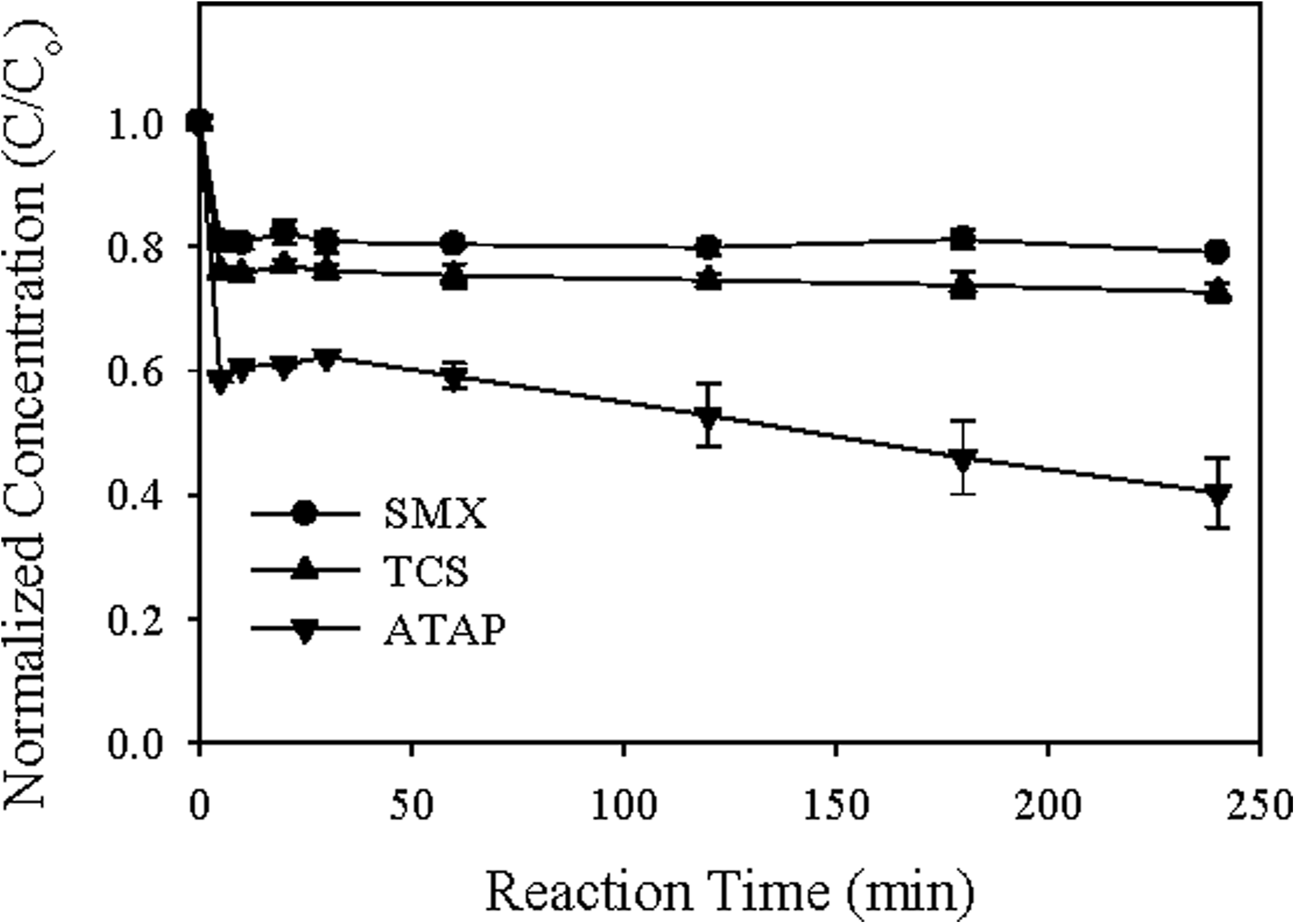
Pharmaceuticals and personal care product (PPCP) decomposition by sulfate radicals (SRs) generated from persulfate (PS)/Fe (PPCP of 9 mg/L, molar ratio of PPCP:PS:Fe at 1:80:80, pH of 7). Error bars are standard deviation of triplicated results.
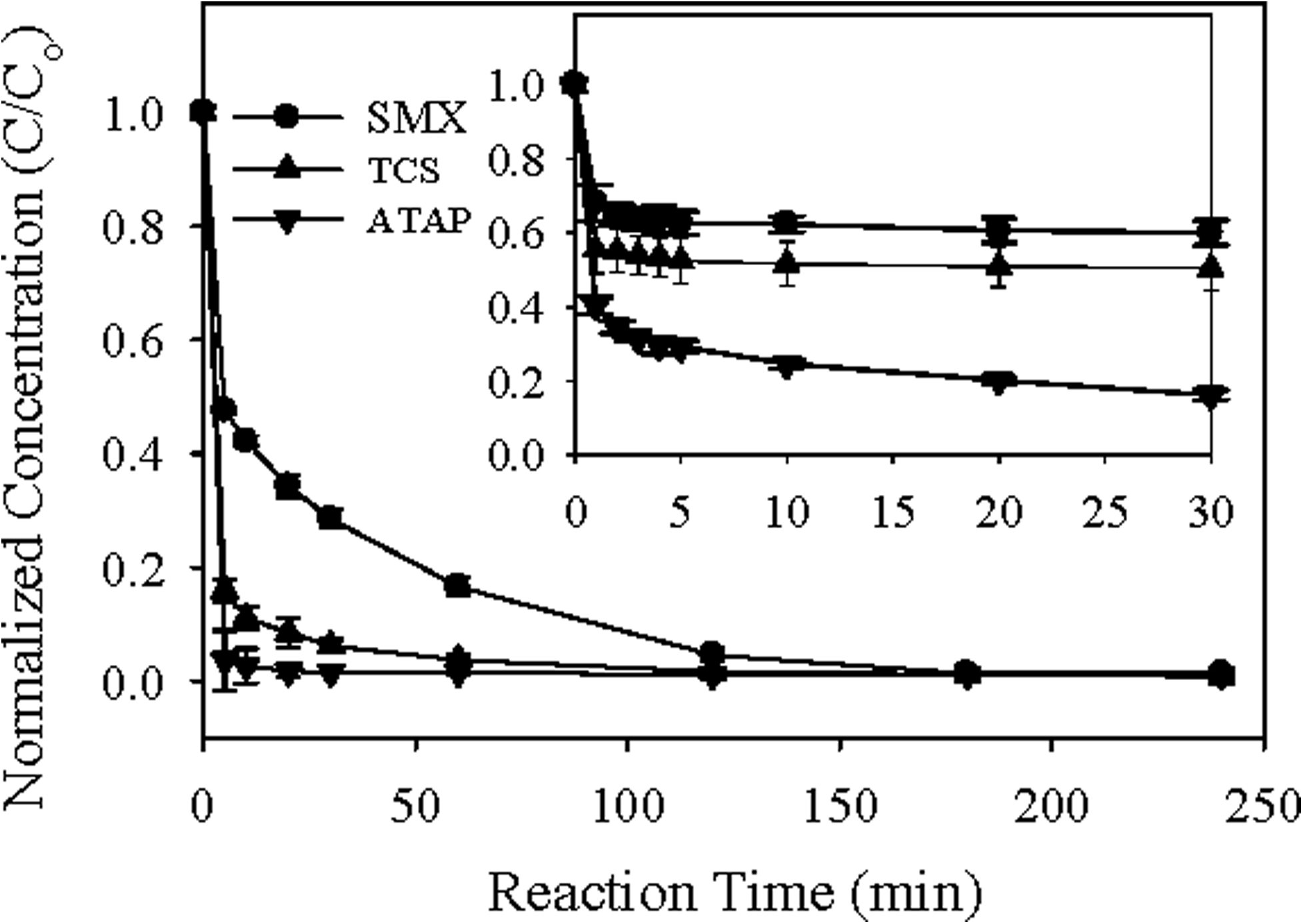
PPCP decomposition by SRs generated from peroxymonosulfate (PMS)/Fe (PPCP of 9 mg/L, molar ratio of PPCP:PMS:Fe at 1:80:80, pH of 7). Error bars are standard deviation of triplicated results. Inset shows PPCP decomposition at a lower PMS loading (PPCP:PMS:Fe at 1:10:10).
When activated with Fe, PMS was more effective than PS for the decomposition of PPCPs due to the chemical stability of PS. Similar observations were reported for the decomposition of 2-chlorobiphenyl and 2,4-dichlorophenol (Anipsitakis and Dionysiou, 2004; Rastogi et al., 2009). However, the slow activation of PS was reported to be suitable for subsurface applications (Huang et al., 2002; Liang et al., 2003, 2004; Killian et al., 2007). The reactivity-saving characteristics of PS/Fe system would be beneficial to systems that are required to respond long-term and low level release of PPCPs to the aquatic environment. It is also known that the effectiveness of PMS and PS depends on conjugated transition metals (Anipsitakis and Dionysiou, 2004). For the purpose of comparison with Fenton reaction, we focused exclusively on Fe (cheap, less toxic, and naturally abundant) in this study. Based on the results, the order of PPCP decomposition was consistent at ATAP>TCS>SMX, which calls for a follow-up study on detailed reaction mechanisms and pathways.
PPCP decomposition by PMS and H2O2 conjugated with Fe and Co
As shown in Fig. 3, immediate decomposition of PPCPs by HRs was observed and their decomposition was not discriminated. The faster decomposition of PPCPs by H2O2/Fe is due to the nonselective hydroxylation of their functional groups by HRs. At a low oxidant dosage (compare insets in Figs. 2 and 3), it is noticed that H2O2/Fe performed better than PMS/Fe. However, interpretation on the comparative effectiveness between H2O2 and PMS should be limited to this specific case of using Fe as an oxidant activator. Other transition metals (e.g., Co, Ag, Ni, Ru, Mn, Ce, and V) have been found to be more or less effective in the activation of H2O2 and PMS to generate HRs and SRs, respectively (Ball and Edwards, 1958; Anipsitakis and Dionysiou, 2004).

PPCP decomposition by hydroxyl radicals generated from H2O2/Fe (PPCP of 9 mg/L, molar ratio of PPCP:H2O2:Fe at 1:80:80, pH of 7). Error bars are the standard deviation of triplicated results. Inset shows PPCP decomposition at a lower H2O2 loading (PPCP:H2O2:Fe of 1:10:10).
As shown in Fig. 4, completely different results were revealed when PMS and H2O2 were activated with Co. The PMS/Co system was as effective as H2O2/Fe system, whereas H2O2/Co system did not show any reactivity toward SMX. This suggests that the use of a best-working catalyst among various transition metals would facilitate the generation of SRs and thus the decomposition of PPCPs. Cobalt was reported to be the best activator of PMS, and PMS/Co combination was shown to effectively decompose some recalcitrant organic contaminants that are resistant to HRs (Anipsitakis and Dionysiou, 2004). Even though there has been a debate, Co conjugated with PMS was reported to behave as a catalyst (or at least catalyst-like) (Zhang and Edwards, 1992; Kim and Edwards, 1995; Anipsitakis and Dionysiou, 2003). Among several metals tested for the activation of PMS, Co exhibited a unique characteristic to decompose PMS with a second order kinetic, compared to a first order decomposition by all the other metals (Ball and Edwards, 1958). However, the use of Co as an oxidant activator should be with caution, considering its health and aesthetic aspects in addition to its reactivity (Anipsitakis et al., 2005; Yang et al., 2007).

Sulfamethoxazole (SMX) decomposition by PMS/Co and H2O2/Co (SMX of 9 mg/L, molar ratio of SMX:PMS[or H2O2]:Co at 1:10:10, pH of 7).
PPCP mineralization by PMS/Fe
One of the most important features of AOTs is their capability to mineralize organic contaminants. The effectiveness of PMS/Fe system to mineralize PPCPs was investigated, as shown in Fig. 5. ATAP and SMX with the highest and lowest decomposition kinetics, respectively, were tested. After 24 h reaction under the given conditions, 55% of SMX and 13% of ATAP were mineralized. Mineralization of recalcitrant compounds is known to take much longer time, compared to immediate transformation of target compounds to intermediates. SMX with the lowest decomposition kinetics was mineralized faster than ATAP with the highest decomposition kinetics. Even though detailed investigation should be followed, the results imply that SRs are also effective for the mineralization of PPCPs.
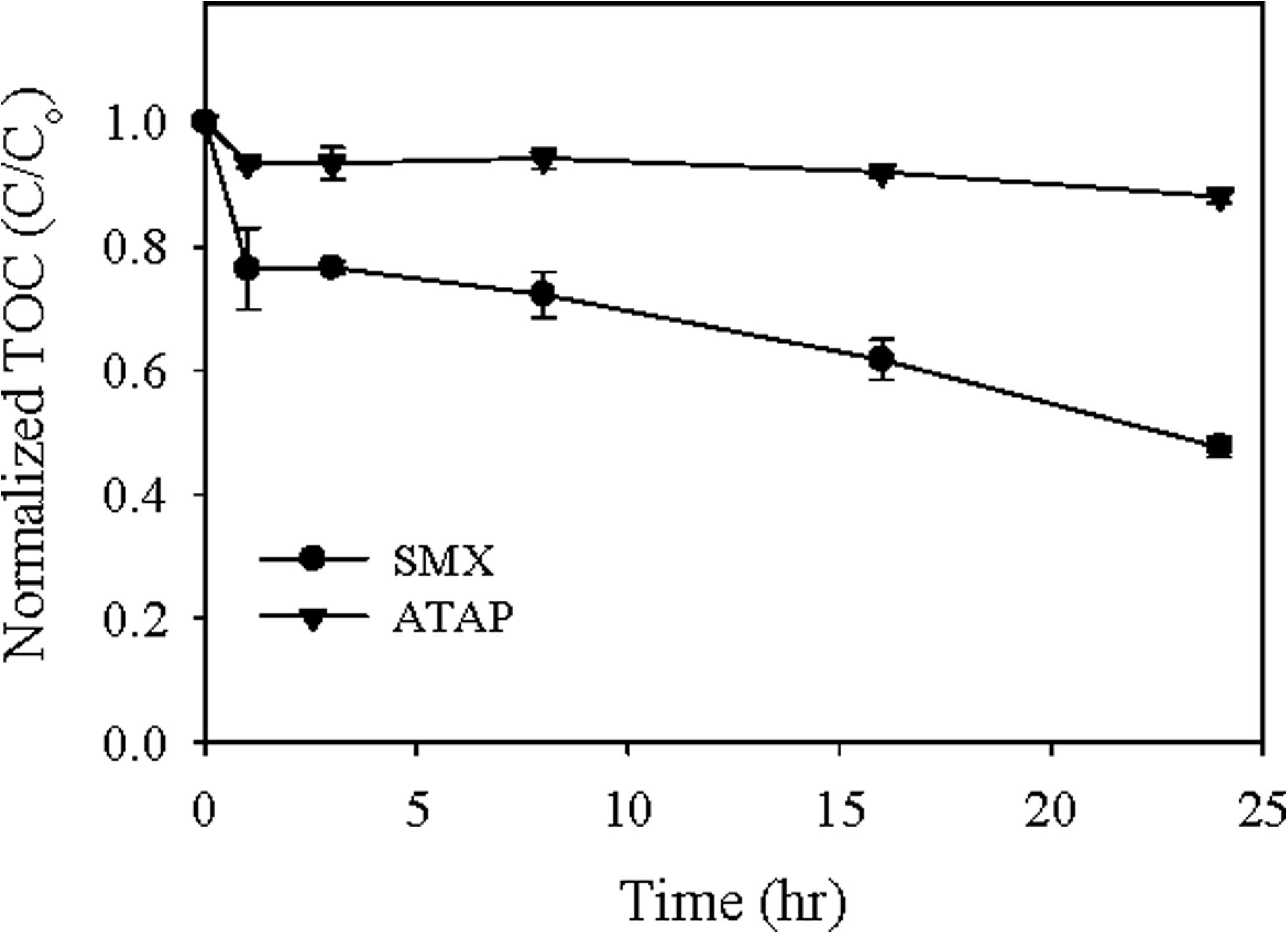
PPCP mineralization by SRs generated from PMS/Fe (PPCP of 9 mg/L, molar ratio of PPCP:PMS:Fe at 1:80:80, pH of 7). Error bars are the standard deviation of triplicated results. This PPCP mineralization test is identical to PPCP decomposition shown in Fig. 2.
Concluding Remark
SRs were as effective as HRs for the decomposition of PPCPs. Considering the simplicity of the radical generation, SR-based AOTs are promising as a new environmental risk management option for PPCP-contaminated water. This study would initiate researchers into new strategic plans to manage PPCPs and other emerging chemicals of concern in water resources, where established Fenton reaction, one of the most practical HR-based AOTs, shows substantial drawbacks (e.g., pH dependence of the reaction, slow kinetics of ferrous iron regeneration, and scavenging of HRs by CO32−/HCO3−). More detailed research studies should be followed to come up with better insights on the decomposition mechanisms and pathways of PPCPs by SR-based AOTs in comparison with HR-based AOTs.
Footnotes
Acknowledgment
Dr. Choi appreciates the financial support of the University of Texas at Arlington in the form of startup funds to initiate this study.
Author Disclosure Statement
No competing financial interests exist.