




Abstract
Abstract
This study for the first time evaluated the soil suitability for onsite wastewater treatment systems (OWTS) within the Alabama Black Belt region and assessed the current status of those OWTS within this area. A local OWTS soil suitability rating system was developed based on current Alabama OWTS regulations and was compared with the existing nationwide Natural Resources Conservation Service soil limitation rating system based on their soil assessment results over the study area. Both rating systems indicate that a large percentage (52%–89%) of land within the study area should not be recommended for conventional OWTS. However, OWTS are widely used and aging in this region. Raster-based OWTS-soil suitability rating system results and US Census–derived demographics were combined in a GIS to prioritize the study area in terms of potential public health threat from OWTS. Although the results lack field verification, two parallel strategies to limit the public health risk from OWTS malfunction are suggested: to extend municipal sewer service to high-risk city fringe areas and to subsidize system retrofit, repair, or replacement of aged OWTS with alternative engineered systems for rural households. Although this study only focused on the Alabama Black Belt area, the presented GIS and demographic methods can be referenced by other regions for similar OWTS assessment purposes.
Introduction
Drain field overload has been recognized as a significant nonpoint source of pollution that will lead to public health risk (US EPA, 2002). Charles et al. (2005) analyzed the results of several intensive septic tank effluent field surveys from 1976 to 1999 in Australia and the United States, including their own field survey of 200 conventional OWTS in Australia. They concluded that prevailing septic tank effluent quality estimates of drain field nutrient load were too low to ensure safe environmental performance and may underestimate actual drain field nutrient loads, indicating that nutrient overloading may be occurring in a significant number of conventional OWTS designed under current Australian and United States regulations. Nam et al. (2009) also revealed through field surveys that conventional OWTS in Vietnam and Thailand generally did not perform as required. Moelants et al. (2008) indicated that only half of OWTS installed in Belgium can provide acceptable treatment. Further, the capability to provide effective attenuation for emerging contaminants such as estrogens and pharmaceuticals is quite limited in a conventional OWTS (Benjamin et al., 2010).
It is currently understood that although the lot size of an OWTS is designed to achieve adequate removal of nutrients and pathogens within a fairly short length of soil (Green and Cliver, 1975; Frankenberger, 1988; Venhuizen, 1995), and since an OWTS loses its contaminants removal capability, the pollution plume gradually expands beyond the drain field (Carroll and Goonetilleke, 2005; Charles et al., 2005, 2008; Seo et al., 2005; Gill et al., 2009). The cumulative impact from large numbers of OWTS in a locality then can create a threat to both the local environment and public health (Carroll and Goonetilleke, 2005). Therefore, the spatial density of OWTS can influence surface and ground water quality due to (1) increased probability of system malfunction and (2) cumulative nutrient and pathogen load that can exceed the capacity of local soils to assimilate (US EPA, 1977, 2002).
Conventional OWTS have been used in the Alabama Black Belt area for decades in spite of the fact that many soils in this rural agricultural region have a high smectitic clay content with severe hydraulic limitations. Soil hydraulic limitations to wastewater absorption include low permeability, high seasonal water table, presence of restrictive layers, and likelihood of flooding (Geographical Survey of Alabama, 1993). According to the US EPA (2002), ∼44% of the houses in Alabama are served by OWTS with an average system malfunction rate of 20%. The relatively high OWTS usage rate in Alabama (5th in the United States by 1990) along with the geographical, economical (median household income $27,088 based on U.S. Census 2009 estimates), and political uniqueness (McCoy et al., 2004) of the Alabama Black Belt area indicate the need for an assessment of general soil conditions for wastewater disposal and the current OWTS status in this region.
The first objective of this study was to assess and rate soil suitability for conventional OWTS in the 14,000 km2 Alabama Black Belt region using a GIS-based soil rating system. The second objective was to assess current OWTS status regarding age, density, and size and prioritize the study for potential public health threat from OWTS malfunction using combined soil suitability rating results and US Census derived demographics.
Materials and Methods
Existing Natural Resources Conservation Service Soil Limitation Rating System for septic tank absorption fields
NRCS (1993) developed a national septic tank absorption field limitation rating system for guiding both heavily and sparsely populated areas in site selection for safe disposal of household effluents. Thirteen soil and site condition criteria (Table 1) taken from Soil Survey Geographic (SSURGO) (NRCS, 2007) are considered as part of the Natural Resources Conservation Service soil limitation rating system (NRCS-SLRS). Soil mapping units in the NRCS-SLRS system are rated as Limiting, Somewhat Limiting, or Not Limiting for OWTS siting and are based on the dominant soil series for each mapping unit. Soil mapping units covered by water or otherwise inaccessible or undevelopable such as military areas are listed by NRCS as Not Rated. The NRCS-SLRS ratings were extracted indirectly using digital SSURGO soil mapping units via the Soil Data Viewer (Version 5.1, USDA). Digital soil information for Dallas and Lowndes Counties is not reported, because county soil survey information had not been completed at the time of this study.
Source: Derived from SSURGO database (NRCS, 2007).
The final ranking should be the least favorable ranking given by the rating criteria.
NRCS, Natural Resources Conservation Service.
New OWTS Soil Suitability Rating System
The new soil rating system ranks each soil mapping unit from the SSURGO database (NRCS, 2007) in the study area for OWTS suitability according to current Site Evaluation Criteria from the Alabama Onsite Sewage Disposal Rules (ADPH, 2006). A rating of (1) Suitable, (2) Marginally Suitable, or (3) Unsuitable (Table 2) was assigned to each mapping unit based on properties of the dominant soil series including percolation rate, depth to restrictive layer and seasonal water table, slope, and annual flooding frequency. Soil mapping units laying within military areas, water bodies, or other restricted areas carry no soil information in the SSURGO database, and, therefore, they were not rated.
Based on Site Evaluation Criteria, Alabama Onsite Sewage Disposal Rules (ADPH, 2006).
The final ranking should be the least favorable ranking given by the rating criteria.
OWTS, onsite wastewater treatment systems.
OWTS Status in the Alabama Black Belt Area
Since there is no detailed OWTS field survey available for the study area, OWTS demographics for the current study were derived from US Census (2000) block group information. Census block groups in this study were categorized as rural if over 70% of the block group population was rated rural by the US Census. Otherwise, the block group was rated as urban. This 70% value is arbitrarily used with the main purpose of estimating the sewer disposal method used by city fringes where sewer line expansion is often behind population expansion. Households classed as urban were assumed to be connected to a public sewer system, and households classed as rural were assumed to be served by an OWTS. However, it also should be noted that since the method used to extract US Census information did not distinguish between single- and multi-family units or commercial and industrial units, individual OWTS status in each Census block group may not be accurately represented.
The lifetime of an OWTS depends on its design, installation, and maintenance. Consequently, if all else were equal, a higher OWTS age suggests a higher probability of malfunction (US EPA, 2002). In the present study, the average house age in each rural block was used to represent average OWTS age. The ratio of total population to the total number of household units in a rural block group was used to represent the average OWTS size (person/unit) in a block group. The ratio of the number of household units to the area of the corresponding rural block group was used to represent average OWTS density (unit/km2).
Prioritizing the study area for potential public health threat from OWTS
Data files containing OWTS-soil suitability rating system (SSRS) ratings, OWTS age, size, and density were each converted into a 141×141 m raster dataset, then into numeric ASCII format. For analysis, the raw data was log-transformed to remove large data variation, then normalized from 0 to 1 to remove scale differences between datasets. The resulting four datasets were analyzed with principal component analysis (PCA), a statistical method for reducing dimensionality in a multivariate dataset (Pearson, 1901), to provide relative weights for the assembled OWTS public health threat variables.
PCA results indicate that the four factors (variables) analyzed are all linearly independent and contribute dominantly to an independent principle component, suggesting that each factor is independent to the others. The proportion of the eigenvalue for each principal component over the sum of the entire eigenvalues was used as a weight coefficient; 0.722, 0.167, 0.093, and 0.018 for OWTS density, OWTS-SSRS rating, OWTS size, and OWTS age, respectively (Table 3). Log transformed and normalized values (0–1) of the four factors; OWTS-SSRS rating, and OWTS age, size, and density, from numeric raw data were then combined into a numeric formula (Equation 1) to estimate the potential OWTS threat to public health within each 141×141 m raster cell using the following equation:
PC1–PC4, principle components 1–4; SSRS, soil suitability rating system.
Results and Discussion
Soil conditions of the Alabama Black Belt Area
Mapped results from the newly developed OWTS-SSRS (Fig. 1) indicate that ∼52% of the study area (Dallas and Lowndes Counties excluded) is rated Unsuitable for conventional OWTS, 31% is rated as Marginally Suitable, and only 15% is rated as Suitable. The corresponding NRCS-SLRS rating map (Fig. 2) indicates that ∼89% of the study area is Limiting for conventional OWTS, 8% is Somewhat Limiting, and only 1% is Not Limiting. Approximately 5% of the area rated as Limiting by NRCS-SLRS is rated as Suitable by the new OWTS-SSRS, whereas 43% of the area that is rated Suitable by the OWTS-SSRS is rated as Not Limiting by NRCS-SLRS.

Soil rating results of the new OWTS Soil Suitability Rating System (OWTS-SSRS), Alabama Black Belt. (Dallas and Lowndes Counties excluded due to unavailability of SSURGO data). OWTS, onsite wastewater treatment systems.

Soil rating results of the NRCS Soil Limitation Rating System (NRCS-SLRS) for septic tank absorption field, Alabama Black Belt. (Dallas and Lowndes Counties excluded due to unavailability of SSURGO data). NRCS, Natural Resources Conservation Service.
It should be noted that the term “Limited” is not the same as the term “Unsuitable.” Although both soil rating systems are based on long-term field experience (USDH, 1969; NRCS, 1993; ADPH, 2006), the NRCS-SLRS was developed as a tool for national level guidance on sites being evaluated for a wide range of potential land use. The newer OWTS-SSRS, on the other hand, was based on environmental legislation specific to Alabama (ADPH, 2006) that regulates the design and permitting of conventional OWTS within the state. NRCS limitation ratings indicate soil properties that may limit the functionality for intended use, but do not necessarily indicate whether the soil is unsuited for that use. Conversely, the “Unsuitable” rating in the new OWTS-SSRS indicates that the soil limitations are so severe as to make the soil unsuitable or the intended use. Consequently, soils identified as “Limited” in the NRCS system could fall in either the “Suitable,” “Marginally suitable,” or “Unsuitable” categories in the new Suitability Rating system.
Further, the two soil rating systems use different unit measurements to characterize water movement in the soil. These differences outweigh the fact that both rating systems share similar site rating criteria, such as depth to restrictive layer, depth to seasonal water table, slope, and flooding frequency. For example, the NRCS-SLRS uses Ksat (soil saturated hydraulic conductivity), whereas the OWTS-SSRS uses percolation rate. Although statistical relationships have been developed between Ksat and percolation rate (Jabro, 2009), it should be noted that Ksat is not directly comparable to percolation rate. Ksat is a measurement of how fast water can pass through a one-dimensional saturated soil medium under one unit hydraulic gradient, whereas percolation rate is a three-dimensional infiltration measurement for a generally unsaturated soil under a variable hydraulic head (SSSA, 2002). For this reason, results from the two soil rating systems cannot be compared quantitatively without understanding the unit measurements referenced in each.
Despite the differences between the two soil rating systems, the general consensus from both systems is that a large percentage of land within the Alabama Black Belt is not recommended for conventional OWTS. This situation calls for alternative systems that can function properly on clayey soils. To make the new OWTS-SSRS more beneficial for the Alabama Black Belt, ratings could be expanded to include soil criteria for selected alternative engineered systems such as aeration treatment units, packed-bed media filters, mounds, or subsurface drip irrigation. An expanded soil rating system that includes advanced engineered systems could benefit regional decision makers in their evaluation of decentralized versus centralized systems in the study area.
Current Status of OWTS
Spatial analysis of US Census block groups in the study area indicates that rural areas represent ∼95% of the Alabama Black Belt area (Fig. 3). Approximately 12% of rural block groups have an estimated OWTS density higher than 15 unit/km2, posing a potential public health threat (US EPA, 1977). These 12% at-risk rural Census block groups are generally found clustered around city fringes (e.g., Montgomery, Selma, and Uniontown), with the highest single block group OWTS density (212 unit/km2) found in Uniontown, AL. Only 1% of rural block groups have an estimated OWTS size greater than 3 person/system and they are also found mostly around city fringe areas as well.
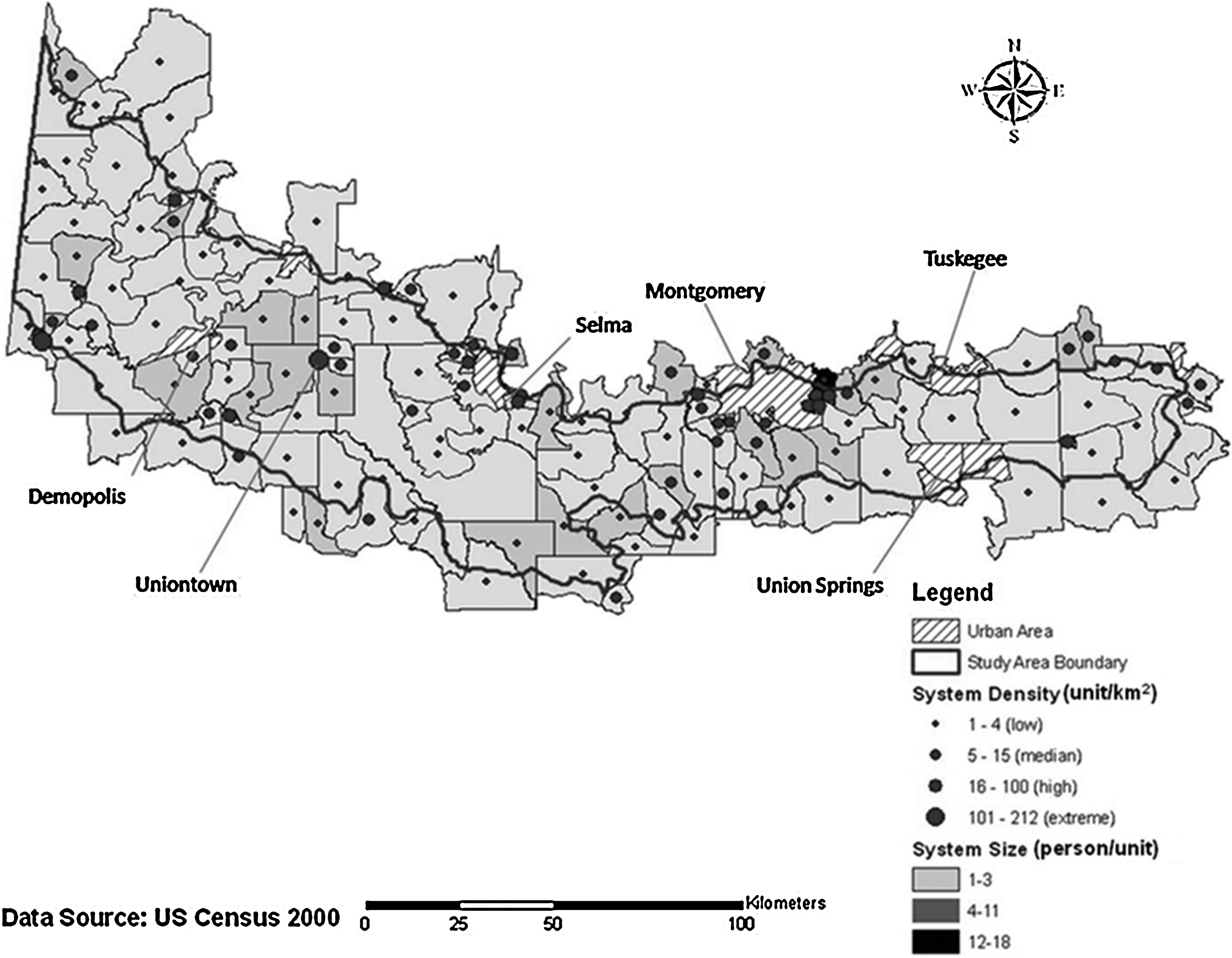
Average OWTS density and size in rural block groups, Alabama Black Belt.
Estimated home age in rural census block groups (data not shown) indicates that ∼97% of rural block groups in 2000 had an average house age over 20 years; and ∼93% had an average house age between 20 and 30 years. Considering that 20 to 30 years ago conventional OWTS was the most widespread onsite system for this region, the average 20-year house age indicates widespread aging of these systems, providing further evidence of a regional public health risk from OWTS. Considering that the Alabama State Department of Health only began regulating OWTS from 2006, OWTS constructed before 2006 also may not meet the current codes.
Study area prioritized for potential public health threat from OWTS
The prioritized regional map (Fig. 4) indicates that city fringes such as Montgomery or around smaller towns such as Selma and Uniontown are of a relatively higher threat from OWTS malfunction, corresponding to their high OWTS densities (Fig. 3). City fringe areas with high OWTS densities have, in fact, been the focus of public health concern for decades as public sewer systems expand to keep up with urban sprawl (DeWalle and Schaff, 1980; Boyle and Otis, 1981), and this study confirms through both PCA and spatial analysis what has been reported by previous researchers that OWTS density is the factor that most influences local environmental and public health conditions (Lipp et al., 2001; Carroll and Goonetilleke, 2005).
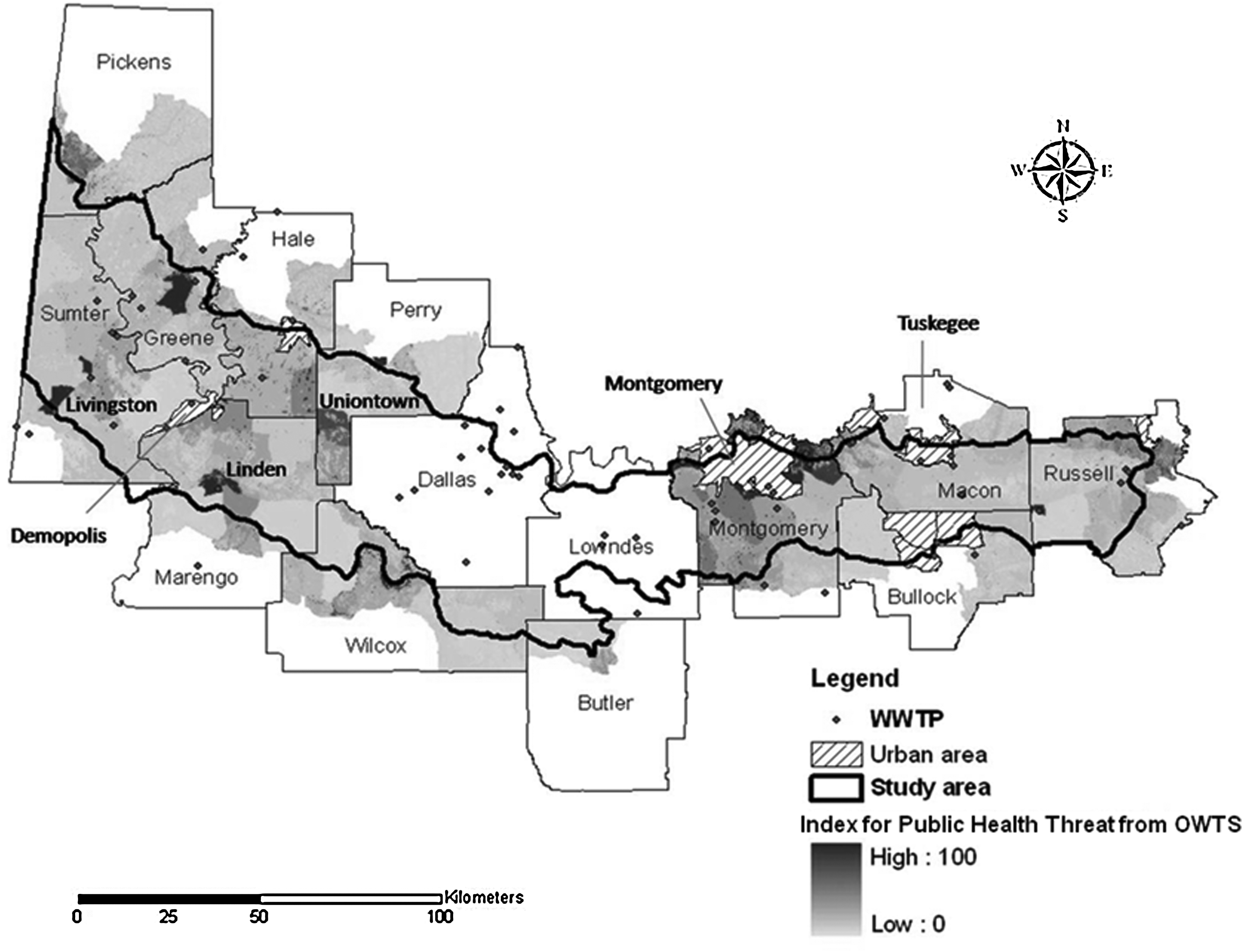
Alabama Black Belt area prioritized for the potential public health threat from OWTS. (Dallas and Lowndes Counties excluded due to unavailability of SSURGO data. Urban areas excluded due to general availability of public sewer service.)
The fact that clayey soils combined with high OWTS densities are prevalent within select urban areas has been recognized by local government planning agencies and municipal utilities who have been proactive in limiting that risk. For example, the Montgomery Water Works & Sanitary Sewer Board has extended collection service to certain clayey soil areas in advance of OWTS malfunction (Montgomery Water Works & Sanitary Sewer Board, personal communication, February 12, 2009). For small towns such as Uniontown, the state of Alabama State has provided subsidies to eliminate local malfunctioning OWTS (ADECA, 2004; Uniontown Public Works Department, personal communication, May 27, 2009).
Although city fringes generally have a higher threat from OWTS, the result of this study suggests that the risks to certain rural areas in the Alabama Black Belt are not insignificant, either. A prevailing system age over 20 years in this predominantly rural region suggests the need to recondition aging OWTS. Since over half of rural sites in the Alabama Black Belt area are not suitable for conventional OWTS, subsidized septic system retrofits would be recommended in those rural communities facing a higher public health threat. Assessment mapping of the type provided in this study can be used to target limited public resources. Across the Alabama Black Belt region, continued targeted governmental efforts are likely needed to successfully manage OWTS related environmental and public health threats. Further, since the assumptions used in this study for OWTS demographic analysis lack field verification, a field survey is still needed for a more detailed OWTS status assessment within this region.
It should be noted that results from this study are only one component within a comprehensive risk management strategy. To manage and mitigate all public health risks inherent with OWTS, several key issues proposed by Carroll et al. (2006) should also be recognized, including feedback from relevant stakeholders, integration of scientific knowledge with industry practice, synthesis of data analysis with risk assessment and management, and identification of the appropriate performance goals for successful management and mitigation of associated risks.
Conclusions
This study for the first time evaluated the soil suitability for OWTS within the Alabama Black Belt region and assessed the current status of those OWTS within this area. A new OWTS was developed based on current Alabama state OWTS regulations (ADPH, 2006) and on site conditions derived from SSURGO digital soil information (NRCS, 2007). The new rating system and the existing nationwide NRCS rating system were used to comparably evaluate the Alabama Black Belt study area in terms of conventional OWTS site suitability. Both assessment tools indicate that soil properties within the Alabama Black Belt study area are generally unsuitable for conventional OWTS due to the prevalence of low permeability clayey soils, shallow ground water table, underground restrictive layers, steep slope, and/or flooding frequency.
Although field verification is needed, demographic analysis based on US Census 2000 data revealed that (1) OWTS are widely used in the Alabama Black Belt; (2) a significant number of existing OWTS in the study area have been operating for >20 years; (3) system size is generally maintained below 3 person/unit except around major urban centers; and (4) 12% of census block groups have an estimated OWTS density higher than the EPA regulated threshold for negative environmental impact (15 unit/km2) and are generally found clustered around city fringes.
Raster-based spatial analysis using combined OWTS-SSRS results still needs field verification, and US Census derived demographics indicate that areas around city fringes have a higher threat to public health as a consequence of older OWTS of larger size and higher density. Two parallel strategies to mitigate such potential threats are suggested. For city fringe communities, the proactive response is to extend municipal sewer service to high-risk clay soil areas in advance of widespread OWTS malfunction. For isolated rural households outside the practical range of municipal sewer service or decentralized community systems, subsidized system retrofit, repair, or replacement of aged OWTS with alternative engineered systems is recommended.
Footnotes
Acknowledgments
This research was funded by Alabama Agricultural Land Grant Alliance (AALGA). The Departments of Biosystems Engineering and Civil Engineering at Auburn University also provided the convenience for this research.
Author Disclosure Statement
No competing financial interests exist.