




Abstract
Abstract
Photocatalytic degradation of bisphenol A (BPA) in aqueous solution under UV irradiation with 253.7 nm, by nano titanium dioxide (TiO2) as a photocatalyst, was investigated in a batch photocatalytic reactor. The degradation effect was studied under different conditions such as TiO2 dosage, irradiation time, pH, and BPA initial concentration. Results show that the photodegradation efficiency of BPA increases with irradiation time, but decreases with increasing BPA initial concentration. Alkaline conditions are favorable for the degradation. When TiO2 was dosed at 1.0 g/L and a BPA initial concentration of 10 mg/L with pH ≥ 9.5, BPA degradation was almost complete after UV irradiation for 90 min. Photocatalytic degradation of BPA by UV/TiO2 exhibited pseudo-first-order reaction kinetics. According to the results of determining the intermediate degradation products using gas chromatography/mass spectrometry, there are multiple pathways of BPA degradation that involve reactions not only between ·OH and BPA or the intermediates but also between various unstable intermediates such as carboxylic, phenolic, and other types of intermediates.
Introduction
Conventional water and wastewater treatment plants are inefficient in removing and degrading many phenolic EDCs, including BPA and alkylphenols (Tanaka et al., 2002; Wu et al., 2009). However, photocatalytic degradation is promising due to its high mineralization efficiency and low toxicity of end products such as carbon dioxide, water, and inorganic mineral ions (Horikoshi et al., 2002). Photocatalytic degradation incorporated with UV irradiation is of great importance because of the ability to completely mineralize BPA. The used photocatalysts included titanium dioxide (TiO2), iron oxides (Rodriguez et al., 2011), H2O2 and H2O2-assisted photoelectrocatalytic oxidation (SafarzadehAmiri et al., 1997), Fenton and photo-Fenton ( He et al., 2009), composite TiO2-Zeolite sheets (Fukahori et al., 2003), and electrochemical enhancement of solar photocatalysis (Frontistis et al., 2011). Nanometer TiO2 has been considered one of the most efficient photocatalysts because of its high activity, insolubility, resistance to corrosion, very low toxicity, and relatively moderate cost and easy access (Marci et al., 2007). In general, photo-induced electrons (e−) and positive holes (h+) are produced from TiO2 surface under illumination of UV light (<380 nm). These species can further produce hydroxyl free radicals (·OH), which is a kind of strong oxidants, contributing to the destruction of contaminants into CO2 and H2O. The simplest photoreaction system is to use an aqueous dispersion or slurry of the photocatalyst, in which photocatalysts such as TiO2 particles were suspended in the form of colloid. The heterogeneous photocatalysis is applied for mineralization of most organic molecules under UV radiation, without supplying any other chemicals in addition to the photocatalyst (e.g., TiO2) and air (Wiszniowski et al., 2006). Recently, a number of efforts have been made to understand the photocatalytic degradation effect of BPA, to improve the photocatalytic activity, and to expand the excitation optical scope from UV to visible light (VIS) in order to save energy (Ohko et al., 2001; Nomiyama et al., 2007; Wang et al., 2009). Quite a few researches have been published to expand the excitation optical scope from UV to VIS by synthesis and application of nano-TiO2 containing hetero-atom (Yap et al., 2011). However, to the best of our knowledge, with regard to the photocatalytic destruction and removal of BPA, a few studies have been reported that involve the use of TiO2 powder in the suspension reaction system using artificial UV light source with 253.7 nm (most of previous works were with 365 nm or simulated sunlight), and the mechanism of photocatalytic degradation BPA by UV/TiO2 has not been fully understood (Tsai et al., 2009). In other words, for industrial wastewater treatment application of this technique, it is important to acquire detailed kinetic information about the photocatalytic process in order to characterize the photocatalytic reactions and design large-scale reactors.
Therefore, it is essential to investigate the optimal photodegradation performance of BPA in water under different process factors, to investigate the reaction kinetics, and to identify the intermediates for the proposed degradation mechanism in the TiO2 suspension reaction system. The main objectives of this study are (1) to evaluate the optimal photodegradation conditions of BPA in water-TiO2 suspended system under a variety of parameters (initial BPA concentration, initial pH, TiO2 dosage, and reaction time); (2) to characterize the extent of photocatalytic mineralization of BPA by monitoring the change of total organic carbon (TOC) and to discuss the kinetics rule of how the heterogeneous photocatalytic oxidation reactions affect the reaction rate; and (3) to identify the reaction intermediate products by using HPLC and gas chromatography/mass spectrometry (GC/MS) analysis and to elucidate the detailed BPA photocatalytic degradation mechanisms and pathways. The results of this work can, thus, provide a theoretical basis for the photocatalytic oxidative degradation of persistent organic pollutants.
Materials and Methods
Materials
BPA (C15H16O2, excellent level of pure, purity > 99.5%) was purchased from Sigma-Aldrich, Inc. N,O-bis(tri-methylsilyl) trifluoroacetamide (BSTFA) (purity > 99%) was obtained from Supelco. Hexamethyl-benzen (C12H18, purity > 99.9%) was purchased from Aldrich as a GC/MS injection internal standard. Dichloromethane, methanol, and acetonitrile were of HPLC grade (Superlco). Other reagents were of analytical grade.
The TiO2 nanoparticles (P25, ∼80% anatase, ∼20% rutile; particle size, ∼20–30 nm; BET area, ∼55 m2·g/L) were supplied by Degussa as the photocatalyst. Before being used in the analytical measurements and photoreaction experiments, TiO2 was dried at about 180°C for 4 h and then stored in a desiccator. Experimental use of water throughout this study was purified with a Milli-Q water ion-exchange system (Millipore Co.) to give a resistivity of 1.8×10⁷ Ω cm.
Experimental set up
Photocatalytic experiments were carried out in a self-designed thermostated cylindrical Pyrex photocatalytic reactor (5 cm of internal diameter and 60 cm of height) with a total volume of about 1,000 mL (Fig. 1). The reactor was cooled by an external water jacket loop that was kept at 25°C±1°C inside the reactor. The sample suspension was irradiated with a 15 W low-pressure UV mercury vapor lamp (peak emission at λ=253.7 nm, outer diameter of 2.5 cm, length of 35 cm) or a 250 W halogen tungsten lamp (λ>365 nm, outer diameter of 1.5 cm, length of 30 cm) in the center of the reactor. In all experiments, the reactor was aerated continuously by air pumped in at a flow rate of 1.2 L/min from the bottom of the reactor. All the reactor systems that were working were kept in darkness.
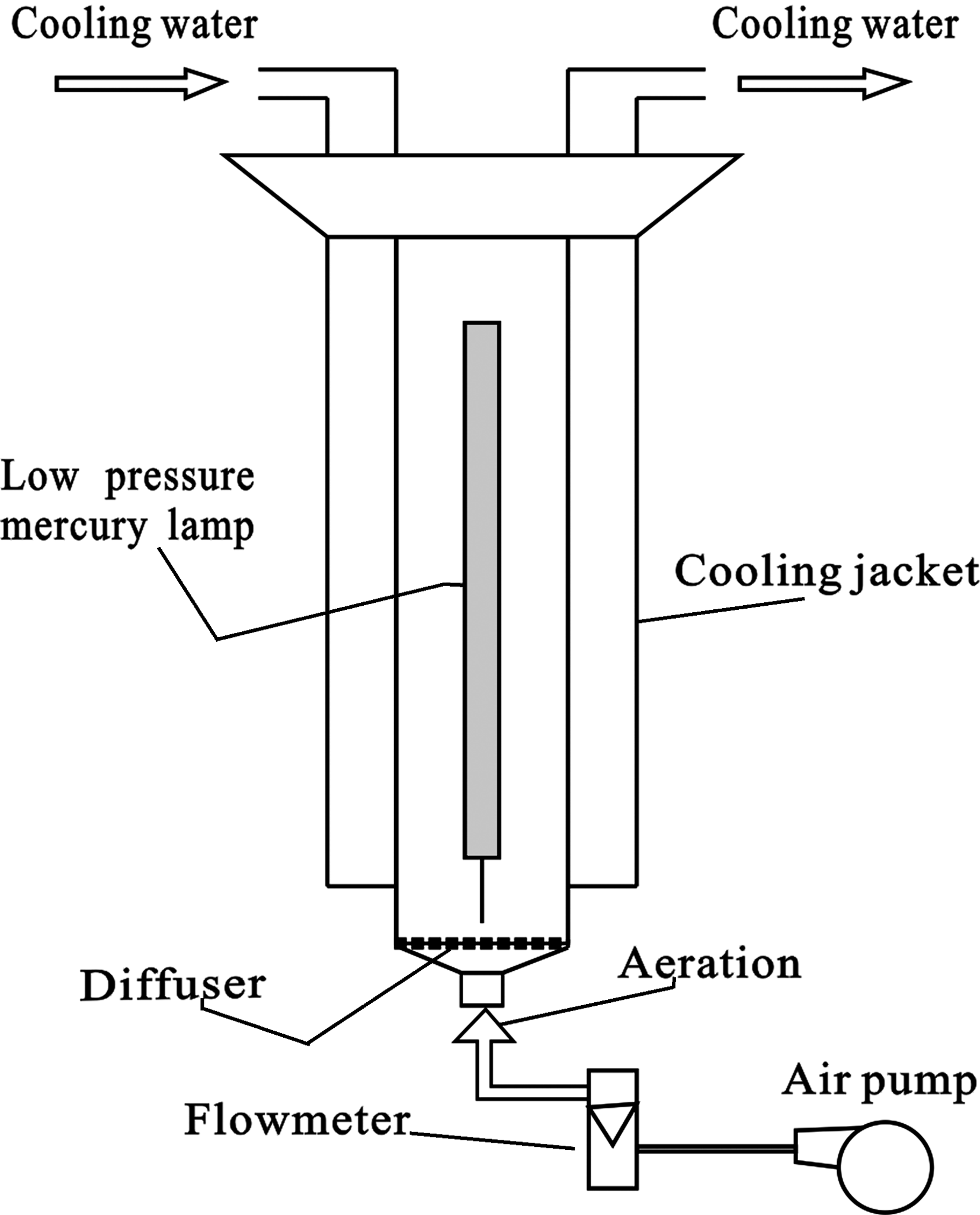
Photocatalytic reaction installation.
Photocatalytic experiments
The 800 mL of BPA water solution with an appropriate concentration of TiO2 was homogenized using ultrasonic dispersion for 30 min in the dark to ensure the establishment of the adsorption/desorption equilibrium. Then, the suspension was introduced immediately into the photocatalytic reactor, the aeration pump and the UV lamp were turned on, and photocatalytic degradation was continuously conducted for 80 min, with a sampling interval of 10 min. The samples were filtered through 0.45 μm millipore filter to remove TiO2. Then, the concentration of BPA in the filtrates was immediately determined. The same set of experiments was done thrice to obtain average experimental results, with relative error limited to 5%. Before the experiments, the lamps were preheated for at least 30 min to obtain a constant light intensity during the experiments. Synchronously, direct photolysis experiments and adsorption control experiments (dark reaction experiments) were also performed. For the former, the same procedure was repeated without the photocatalyst TiO2.
Determination of BPA
The concentration of BPA was determined by HPLC (Agilent 1100) coupled with an ODSC18 stainless steel column (150 mm ×4.5 mm, particle size 5 μm; SUPELCO) at 30°C. The mobile phase was acetonitrile water (60/40, v/v) at a flow rate of 1.0 mL/min. Detection was performed with a photodiode array detector at the wavelength of 228 nm, an injection volume of 20 μL (Zhan et al., 2006).
Identification of BPA intermediates during photocatalysis
TOC analyses were carried out for all of the runs by the TOC analyzer (Liquitoc) in order to follow the photocatalytic mineralization of BPA. Photocatalytic intermediates were identified by GC/MS (Sasaki et al., 2005; Zhan et al., 2006). To identify the photoproducts of BPA, portions of the solution (50 mL) were sampled periodically to determine each variation of the intermediate concentration according to irradiation time, extracted using dichloromethane (20 mL×3), and then dried by anhydrous sodium sulfate. The extracts reduced to 2 mL via rotary evaporation were dried completely with an ultra pure nitrogen stream, and then derivatized by 0.1 mL BSTFA in 40°C for 20 min. These silylated mixtures were analyzed by GC/MS (HP6890-5975 MSD with an AS800 auto-sampler, US).
Results and Discussion
Effect of radiation source and TiO2 adsorption on BPA removal rate
Radiation with different light sources can result in different treatment effects. As can be seen from Fig. 2, in the UV/TiO2 photocatalytic degradation system with a 15 W low voltage mercury lamp (λ=253.7 nm) as radiation light source, the removal rate of BPA was more than 97% after a reaction of 80 min; while in the VIS/TiO2 photocatalytic degradation system using a 250 W halogen tungsten lamp, the removal rate was only 9.1%. Even in a direct photodegradation of UV light without TiO2, the removal rate of BPA was far higher than that in the VIS/TiO2 system, indicating that UV light is more suitable to serve as an excitation light source than VIS light in the photocatalytic degradation of BPA.

Effects of radiation time and TiO2 on BPA removal rate. pH=5.5, TiO2=1.0 g/L. TiO2, titanium dioxide; BPA, bisphenol A.
Usually, the efficiency of photocatalysis depends on the interaction of incident light-organics-photocatalysts. Incident light of shorter wavelength with more energy can result in greater activity of the catalyst and produce more electronic (e−)-cavity (h+) on the surface of TiO2. At the same time, the distance that the photon penetrates through the catalyst crystal can be shortened, and the derivatives e−-h+ are closer to the surface of the particle. Since the band gap of TiO2 is 3.2 eV, it can only absorb photons of 387 nm wavelength or shorter ones, making TiO2 absorb more short-wave ultraviolet light and less visible light (Parra et al., 2004).
In addition, from the viewpoint of organic molecular structure, unsaturated compounds such as unsaturated hydrocarbons, aromatic hydrocarbons, and their derivatives have a strong absorption on short-wave UV light. Since there are two unsaturated benzene ring structures in the molecular structure of BPA, there is almost no absorption of UVA and UVB with a wavelength longer than 290 nm, while there is a strong absorption of UVC with a wavelength shorter than 290 nm. Therefore, when exposed to long-wave ultraviolet and visible light radiation from the sun, it is difficult for BPA to be decomposed by photolysis. By contrast, the absorption of UV light of 253.7 nm wavelength is obvious, and there exists a strong photolysis phenomenon.
During photocatalytic treatment, the pollutant concentration can decrease due to the adsorption of the photocatalyst. In the adsorption dark reaction experiment, the adsorption of BPA to TiO2 was basically stable at around 3%, and its effects on photocatalysis were negligible. In addition, the direct photolysis of BPA with UV mainly depended on direct absorption of UV radiation; while in the UV/TiO2 photocatalytic system, in addition to the adsorption of TiO2 and direct photolysis, the nano-TiO2 under UV irradiation can generate the ·OH of highly oxidative capacity, which can greatly increase BPA photodegradation efficiency. In other words, UV and TiO2 have a very good synergy on the degradation of BPA, as shown by the results of previous studies on other types of organic pollutants (Wei et al., 2009).
Effect of initial pH on BPA removal rate
The influence of the initial pH on the BPA removal rate for the TiO2 suspensions was demonstrated in Fig. 3. It can be seen that BPA removal efficiency increased with increasing of initial pH, and the photocatalysis proceeded much faster under alkaline conditions.
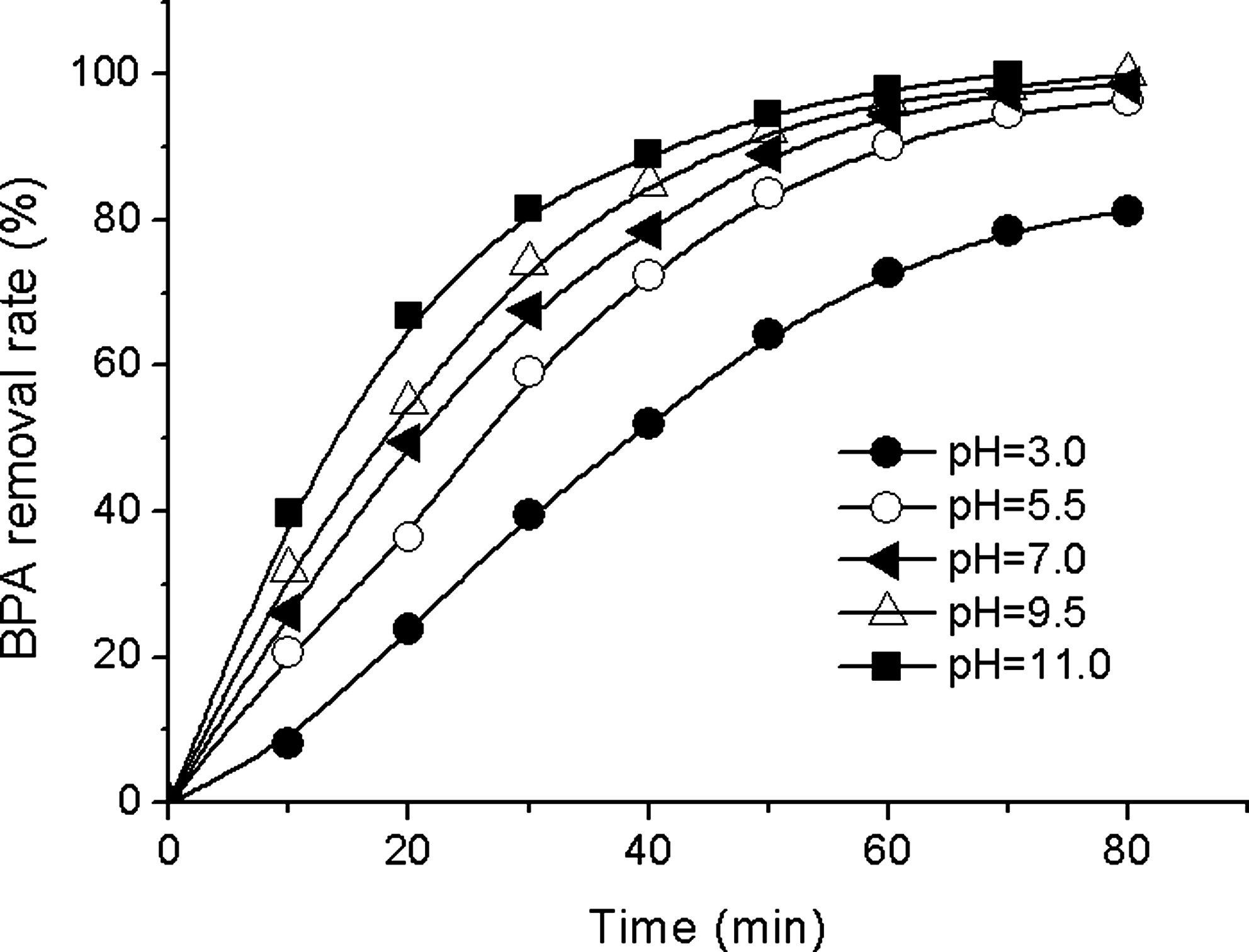
Effects of initial pH on BPA removal rate. [TiO2]=1.0 g/L, C0=10 mg/L.
The pH of the solution directly determines the surface charge of the photocatalyst, and has an important effect on the adsorption and degradation of BPA molecule on the surface of TiO2 (Wu et al., 2009). In fact, the effect of the initial pH on photocatalytic degradation kinetics is rather complex for nano-TiO2 is an amphoteric metal oxide. Usually, the zero point of charge of TiO2 is about pH 6.25. When the pH is lower than 6.25, the TiO2 surface gets a positive charge due to protonation, which is conducive for e− to transfer to the TiO2 surface. When the pH > 6.25, the surface of TiO2 gets a negative charge, which is conducive for h+ to move from the internal to the surface. It indicates that the highest photocatalytic reaction rate could occur in the solution with lower or higher pH that inhibits e− and h+ from re-encountering to make an annihilation compound (Sanchez et al., 1997; Kaneco et al., 2009).
However, in the case of the BPA, with the increase of pH, the BPA molecules in aqueous solution will be more likely to exist in ionic form, hence creating a large number of phenolic hydroxyl group (pKa=9.6–11.3), the negative charge of the oxygen atom on the phenolic hydroxyl increases the electron density on the benzene ring, the absorption spectra of phenolic compounds may be red-shifted due to the delocalization of the negative charge, thus having more overlaps with the source's emission spectra, and this will be beneficial for strong-electrophilic oxhydryl attack to promote photochemical transformation. According to the results of simulation of molecular point charge, it was found that the BPA molecule has two negative oxygen atoms at the hydroxyl groups and four negative carbon atoms at the phenolic group (Tsai et al., 2009; Daskalaki et al., 2011).
Effect of TiO2 dosage on BPA removal rate
The effect of photocatalyst TiO2 on the degradation of BPA in aqueous solution was investigated using different concentrations of TiO2 from 0.2 to 2.0 g/L as shown in Fig. 4. It can be seen that with an increase in TiO2 concentration from 0.2 to 1.0 g/L, the photodegradation efficiency of BPA increased rapidly, until a maximum at TiO2 dosage of 1.0 g/L. The efficiency decreased at TiO2 dosages above 1.0 g/L.
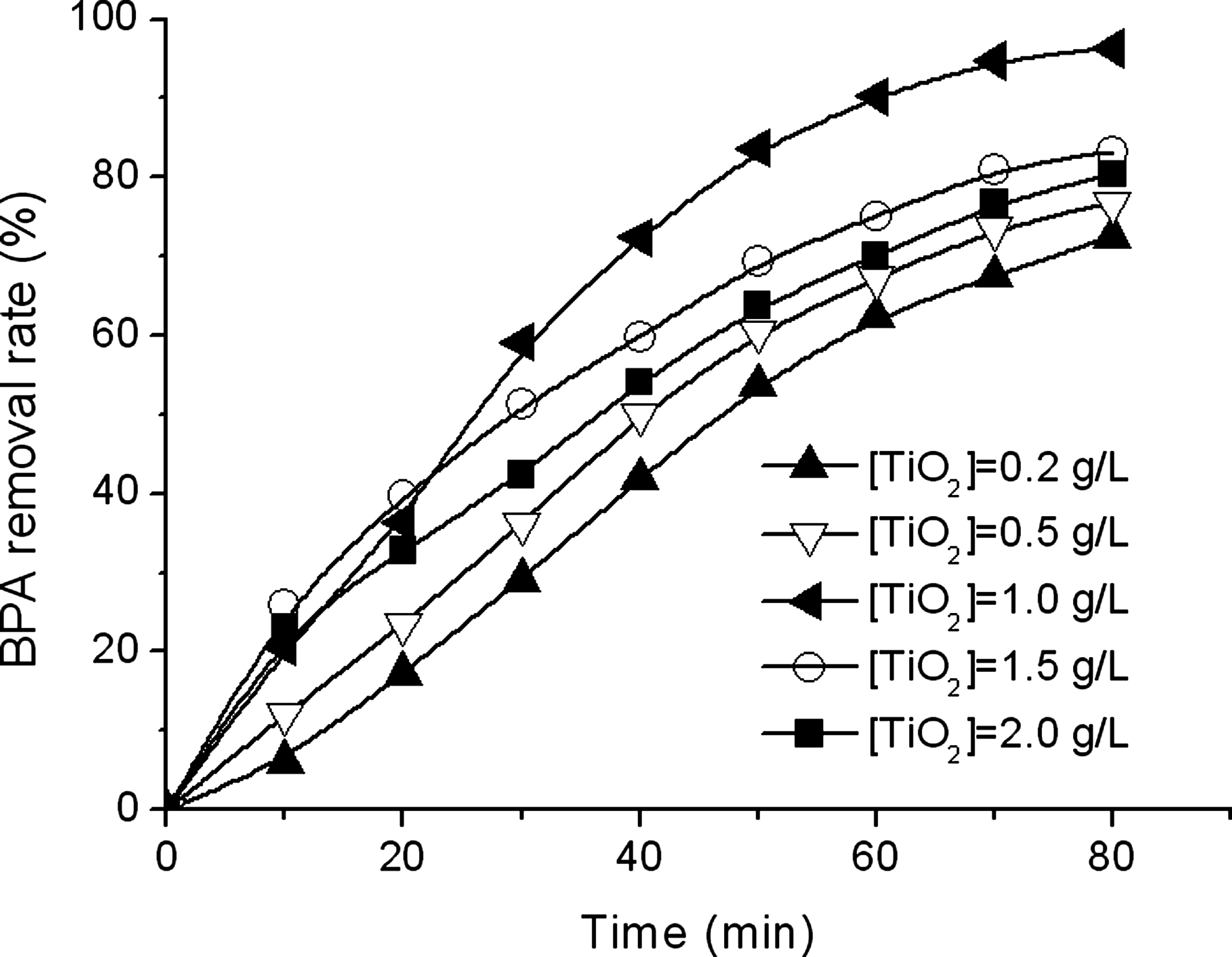
Effects of TiO2 dosage on BPA removal rate. pH=5.5, C0=10 mg/L.
An initial increase in TiO2 dosage may increase the number of photons to produce more e−-h+ and, thus, enhance BPA removal rate. However, a further increase of the catalyst concentration beyond 1.0 g/L may cause light scattering and screening effects due to increase in turbidity of the solution. The excessive TiO2 photocatalyst leads to opacity of the suspension, which prevents the catalyst farthest in solution from being illuminated. The scattering and screening effects reduce the specific activity of the catalyst. At a high concentration of the catalyst, TiO2 particle aggregation may also reduce the catalytic activity (Wei et al., 2009). In this study, the optimum amount of catalyst was found to be 1.0 g/L for the degradation of BPA.
Effect of initial BPA concentration on BPA removal rate
It is significant both theoretically and practically to investigate the dependence of the photocatalytic reaction on the initial BPA concentration (Wang et al., 2009). The effect of initial BPA concentration on the photocatalytic degradation was studied in this article by varying the initial BPA concentration from 2.0 to 50.0 mg/L, and the result is illustrated in Fig. 5.

Effects of BPA initial concentration on BPA removal rate. pH=5.5, [TiO2]=1.0 g/L.
It can be seen that photodegradation efficiency decreased with the BPA initial concentration. For 2.0 mg/L initial concentration, BPA was not detectable after the photocatalysis reaction for 60 min. However, for a 5.0 mg/L initial concentration, the time was 70 min; for 10.0 mg/L, the removal rate of BPA was 97%, but did not change significantly up to a BPA initial concentration of 10 mg/L.
According to the mechanism of photocatalysis, the recombination of photo-generated electrons (e−) and holes (h+) at the surface of TiO2 can be completed within 10−9 s (Wei et al., 2009), but the captured rate of the current carrier is relatively slow, usually ∼10−7–10−8 s. Therefore, the contaminants cannot be degraded unless they are adsorbed on the surface of TiO2. Thus, the surface adsorption process is of paramount importance in controlling the degradation of BPA. At a fixed concentration of TiO2 and consequently constant total sites available for absorption, the degradation efficiency tends to decrease with increasing the BPA initial concentration. In this experiment, since the amount of TiO2 was fixed at 1.0 g/L, the number of the active centers in photocatalyst TiO2 in solution was limited. When the BPA concentration was too high, the active centers that were produced by TiO2 photocatalytic degradation would be occupied by the intermediate products, leading to the decrease of active sites, and, thus, resulted in lower BPA removal rate or inactivation of the pholocatalyst.
Photocatalytic kinetics of BPA
The heterogeneous photodegradation process in an illuminated stirring suspension chamber generally involves complicated reaction mechanisms with the hydroxyl radical (·OH) and the organic solutes adsorbed on the TiO2 surface. The Langmuir-Hinshelwood model (L-H) has been commonly used to describe these processes that are considered as following pseudo-first-order decay kinetics (Sanchez et al., 1997). The L-H equation is now recognized as a basic kinetic equation that describes the reaction of photocatalytic degradation of many organic compounds in TiO2 suspension under UV irradiation (SafarzadehAmiri et al., 1997; Tsai et al., 2009). In this model, the rate of reaction (r) is proportional to the fraction of surface covered by the substrate (Eq. 1):
where C is the concentration of the target compound, t is the irradiation time, k is the true rate constant (which depends on experimental parameters), and K is the constant of adsorption equilibrium of L-H (empirically obtained). On the assumption that only changes in the concentration of the target being considered and the impact of its intermediate products ignored, and that the concentration of the target compound is very low (which makes KC«1), the term KC can be neglected (Herrmann, 1999). So, the L-H model can be simplified as a first-order reaction kinetics equation:
A linear form of Equation (2) is
In this study, the BPA initial concentration C0 was less than 1×10⁻³ mol/L. Hence, Equation (1) could be simplified to Equation (2) and Equation (3), where C0 and Ct are the BPA concentration at times zero and t, respectively, and kap represents the apparent degradation rate constant of a pseudo-first-order reaction. Half-lives t1/2 were calculated using Equation (4) as follows that was derived from Equation (3) by replacing Ct with C0/2:
The kinetic parameters kap and t1/2 for the photocatalytic degradation of BPA were investigated in order to compare the effects of various factors on BPA photodegradation efficiency (Wang et al., 2009). Using the results of the fitting pseudo-first-order model, the values of kap and t1/2 were listed in Table.1. The squared correlation coefficients between ln(C0/C) and t (the illumination time) were between 0.9684 and 0.9983, indicating that the photodegradation reaction of BPA obeys a first-order kinetics model. The same characteristics were noted by previous authors (Tsai et al., 2009).
Photoreaction conditions: TiO2 dosage=1.0 g/L, C0=10 mg/L.
Photoreaction conditions: C0=10 mg/L, initial pH=5.5.
Photoreaction conditions: TiO2 dosage=1.0 g/L, initial pH=5.5.
BPA, bisphenol A.
Mineralization and oxidation state of BPA
The photocatalytic mineralization of BPA was monitored by measuring TOC values during the photocatalytic treatment process. In this case, a relatively slow photocatalysis rate (pH=5.5, TiO2=1 g/L, C0=10 mg/L) was used in the experiments for identification of organic intermediates, which ensures a slower kinetics and provides favorable conditions for the identification. The change of TOC and BPA concentration during UV/TiO2 photocatalytic decomposition was illustrated in Fig. 6. It shows that BPA and the corresponding TOCth (value of calculation on BPA sample) as well as TOC measured values decreased with irradiation time. However, BPA was not entirely transformed into carbon dioxide and water, because TOC values were higher than TOCth, which implies the formation of some organic intermediates. In addition, the removal efficiency of the BPA solution was up to 97% when TOC was almost equal to TOCth, and the complete mineralization of BPA was achieved after 80 min of photocatalytic treatment. The BPA had not been detected in the solution until the reaction time was extended up to 90 min. As has been demonstrated by previous authors, the photocatalytic degradation of organic compounds does not occur instantaneously to form carbon dioxide, but through the formation of intermediate species (Parra et al., 2004; Subagio et al., 2010). In fact, these intermediates have very low transient maximum concentrations as compared with the pollutants themselves as CO2, acetate, and formic acid are formed in the initial stages of the degradation (Herrmann, 1999).
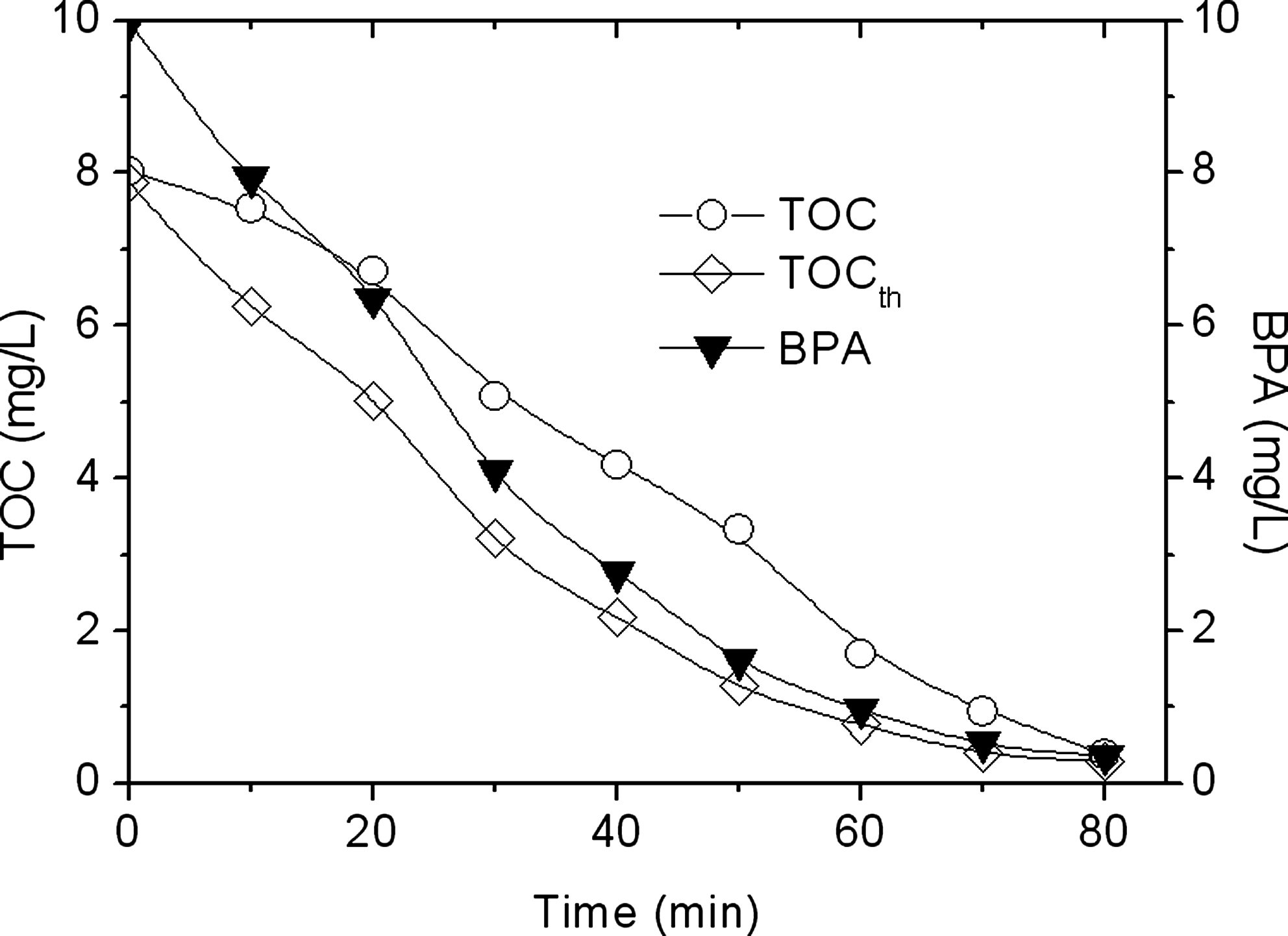
Change of TOC and BPA concentration during the photocatalytic process. [TiO2]=1.0 g/L, pH=5.5, C0=10 mg/L. TOCth, the value of calculation on BPA sample by stoichiometry.
The HPLC chromatograms of the BPA samples, taken from the reactor at different treatment times during the photocatalytic process, were illustrated in Fig. 7. The results demonstrate the disappearance of BPA (peak 6) and formation of its degradation products peaks (peaks 1–5). More than five intermediate products of BPA degradation were formed during photocatalytic treatment. Peaks 1–5 have retention times shorter than BPA (peak 6), which indicates that they are more polar than BPA. This is in agreement with the results of previous works on BPA photocatalysis (Parra et al., 2004; Tai et al., 2005). However, all peak areas of the intermediates were much lower than those of the initial BPA. In other words, fluctuations of these intermediates according to the irradiation time reveal some possible step flows in the degradation pathways of BPA, and it is, therefore, necessary to identify them.

HPLC chromatogram of BPA and its photodegradation products obtained from the photoreaction conditions of [TiO2]=1.0 g/L, pH=5.5, C0=10 mg/L.
Intermediate products and proposed photodegradation mechanism
In this study, the generation and destruction of intermediates during photocatalytic treatment of BPA was monitored by GC/MS. The intermediates at different photocatalytic decomposition times were identified based on their molecular ion and mass spectrometric fragmentation peaks (main fragments: m/z). The main ion fragments of compounds after the treatment of BSTFA were listed in Table 2. Each peak was identified by structural elucidation and interpretation of the mass spectra obtained, and the similarities of the intermediates were compared with GC/MS The NIST library ranged from 80% to 97%. Based on the intermediates, the photocatalytic degradation pathway of BPA was discussed.
Up to now, efforts have been made to identify the intermediate products of BPA decomposition during all kinds of treatment processes using HPLC, GC/MS, and LC/MS in order to understand the possible reaction pathway of BPA. The identified intermediate products of BPA decomposition during photocatalytic degradation include hydroxy-BPA (OH-BPA), p-isopropenylphenol, hydroquinone, 4-isopropenylphenol, glycolic acid acetate, tartaric acid, and formic acid (Tanaka et al., 2002; Huang and Weber, 2005; Nomiyama et al., 2007; Lin et al., 2009). Aliphatic acids as intermediaries are formed by the further oxidation of quinone derivatives (Wang et al., 2011). It is known that phenol is photocatalytically mineralized via the generation of quinone derivatives and organic acids as intermediates. Photocatalytic decomposition of BPA may produce similar intermediates. In this study, the chemical structures of 11 kinds of compounds were identified (Table 2), implying multiple pathways of BPA degradation that involve reactions not only between ·OH and BPA or the intermediates but also between various unstable intermediates such as carboxylic, phenolic, and other intermediates (Huang and Weber, 2005; Lin et al., 2009). Usually, primary intermediates were detected and identified by HPLC and GC/MS of the photocatalytic degradation of various aromatic pollutants corresponding to hydroxylation of the benzene ring. The orientation of aromatic ring hydroxylation depends on the nature of the substituent (Herrmann, 1999). However, in our study, not all intermediates detected were similar to those detected in previous studies. In fact, certain species that should form were hardly detectable, suggesting that aromatic intermediates were rapidly oxidized to organic acids by electro-philic attack of hydroxyl radicals. Therefore, it is essential to find more information of intermediates for inferring the degradation pathways of BPA.
Conclusions
In order to obtain the optimal values of photocatalyst dosage, initial BPA concentration, initial pH, and reaction time, and in order to identify the major intermediate products during photocatalytic degradation of BPA in the 253.7 nm UV-driven suspension system, the photodegradation of BPA in the heterogeneous system with Nano-TiO2 as photocatalyst was investigated in this work. The removal efficiency of BPA in the photoreaction process was more than 99% at the initial BPA concentration of 10 mg/L, TiO2 dosage of 1.0 g/L, and initial pH≥9.5 after UV irradiation for 90 min. Alkaline conditions were favorable for the photocatalytic degradation of BPA. In all the photocatalytic experiments, the photodegradation kinetics for the destruction removal of BPA in water can be well described by the pseudo-first-order reaction model. The apparent first-order reaction constants (kap) obtained by fitting the model seemed to be proportional to TiO2 dosage. However, the values of kap decreased gradually when the initial BPA concentration increased. With GC/MS and HPLC, some intermediate products during the photodegradation of BPA were identified, including acetic acid, p-hydroquinone, and p-hydroxyacetophenone. According to the results of determining the intermediate degradation products using GC/MS, there are multiple pathways of BPA degradation that involve reactions not only between ·OH and BPA or the intermediates but also between various unstable intermediates. In conclusion, photocatalytic degradation of BPA in the TiO2 suspension process proves to be an efficient method for quick degradation of the endocrine disrupting compounds in water.
Footnotes
Acknowledgments
This work was funded by National Natural Science Foundation of China (No. 40972156 and No. 40830748), Bureau of Science and Technology of Wuhan City (No. 200860423203), and Research Fund of MOE Key Lab of Biogeology and Environmental Geology (BGEGF200820).
Author Disclosure Statement
No competing financial interests exist.