




Abstract
Abstract
This study evaluated the feasibility of using struvite deposit recovered from semiconductor wastewater as a slow-release fertilizer for cultivating Lactuca sativa (lettuce). To the best of our knowledge, the plant availability and fertilizer value of the recovered struvite precipitate have never been studied before. In an assessment, the fertilizing value of struvite deposit was compared with that of commercial fertilizers: complex, organic, and compost. Laboratory pot test results clearly showed that lettuce growth was better facilitated with struvite deposit than with commercial fertilizers. In addition, the fixed amounts of nitrogen, phosphorus, potassium, and magnesium were the highest in the lettuce tissue grown in the struvite pots. At the same time, less mercury, lead, chromium, and nickel accumulated in the lettuce tissue grown in the struvite pots than in commercial fertilizer pots. The optimum struvite dosage for the cultivation of lettuce was found to be 0.938 g struvite/kg soil. The column experiments also showed that the nitrogen-leaching rate of struvite deposits was lower than that of complex fertilizer. Results obtained in our study will contribute to the development of methods for the application of struvite precipitate, produced from semiconductor wastewater by crystallization, in the cultivation of lettuce and other plants.
Introduction
Though all the above works demonstrated the effectiveness of struvite obtained from wastewaters as a valuable slow-release fertilizer for agricultural use, to the best of our knowledge, the plant availability and fertilizer value of struvite precipitate obtained from semiconductor wastewater was never tested before. This lack of study may be because semiconductor wastewater commonly contains many refractory chemicals such as organic solvents, acids, bases, salts, heavy metals, fine suspended oxide particles, and other organic and inorganic compounds (Chen and Ray, 2001; Lin and Yang, 2004). Nevertheless, the recovery of nitrogen and phosphate from semiconductor wastewater by struvite precipitation showed promising results (Ryu et al., 2008; Kim et al., 2009; Warmadewanthi and Liu, 2009).
The present study was therefore aimed at investigating the plant availability of nutrients recovered from semiconductor wastewater by struvite precipitation. Specifically, the objectives of this study were (1) to characterize precipitated struvite obtained from a real semiconductor wastewater treatment plant, (2) to evaluate the fertilizing value of the struvite precipitate with pot trial tests for the cultivation of Lactuca sativa (common lettuce) by comparing it with commercial fertilizers, (3) to determine the optimum dosage of struvite precipitate for cultivation, (4) to analyze the levels of nutrients and heavy metals in vegetable tissues grown with struvite and other fertilizers, and (5) to examine the slow-release properties of struvite precipitate.
Materials and Methods
Collection of struvite
Struvite deposit was collected from a semiconductor wastewater treatment facility (SWTF) located in Cheongju, Republic of Korea. Fig. 1 illustrates a schematic of this facility. About 500 m3 of wastewater per day was treated in this facility. As evident from Table 1, the semiconductor wastewater contained significantly high concentrations of ammonia and phosphate. Also, the concentration ranges of total phosphorus (TP) and orthophosphate (PO43−-P) were quite wide compared to other wastewater parameters. This could be due to a used amount of phosphoric acid, consumed as an additive in the chemical mechanical polishing (CMP) process. Ammonia and phosphate were removed by struvite precipitation using the process illustrated in Fig. 1. The 100 L of the settled struvite deposit, produced at the volume ratio of about 10% of treated wastewater, was collected and used as a multinutrient fertilizer for cultivating lettuce in our experiments. In the system of Fig. 1, the effluent NH4+-N concentration was about 17 mg/L and its removal efficiency was 89% on average with a standard deviation of 6%.

Schematic of semiconductor wastewater treatment facility: 1, equalization basin; 2, chemical mixing tank; 3, struvite reaction tank; 4, intermediate settler; 5, fluoride removal tank; 6, final settler.
TCOD, total chemical oxygen demand; SCOD, soluble chemical oxygen demand; TKN, total Kjeldahl nitrogen; TP, total phosphorus.
Cultivation tests: Evaluation of collected struvite as a fertilizer
The fertilizing potential of struvite was evaluated by comparing it with that of popular Korean commercial fertilizers: complex, organic, and compost. The collected struvite deposit was dried in shade at room temperature for 7 days before being used in pot trial tests.
The compositions of struvite deposit and each commercial fertilizer are given in Table 2. The struvite precipitate contained more N and P than the complex and organic fertilizers. The compost fertilizer consisted of 5% organic matter, 0.1% N, 1.0% sodium chloride, and less than 50% water in weight percent. In the complex fertilizer, N, P, potassium (K), and calcium (Ca) existed as (NH4)2HPO4, K2SO4, and Ca(NO3)2.
All indicated figures are based on weight percent (wt%). In this table, compost fertilizer is not included; its composition can be found in the text.
Raw soil samples were taken from a local mountain in Cheongju and dried at room temperature for 15 days. The dried soil was sieved with maximum 1.2 cm prior to filling them in each pot. The soil classification was sandy loam, and it was composed of 54.6% sand, 33.3% silt, and 12.1% clay. The soil pH and electrical conductivity (EC) were 5.3 and 0.2 μs/m, respectively. Other important soil characteristics are provided in Table 3. The concentrations of heavy metals in soil, commercial fertilizers, and struvite are presented in Table 4.
TOC, total organic carbon.
n.d., not detected.
Five sets of three pots (a total of 15 plastic pots) were prepared. Each pot had a surface diameter of 9 cm and a working depth of about 8 cm. About 320 g of sieved soil was mixed with the respective fertilizer sources and added to each pot. The soil surface area of each pot was 0.002826 m2. One set of three pots was used as control, with no fertilizer source added. In the other four sets, three commercial fertilizers and struvite deposit were added to achieve an equivalent concentration of 100 kg N/ha. This application rate was chosen based on a scientific recommendation made by the National Academy of Agricultural Science of Korea in growing lettuce (NAAS, 2007). Using the data given in Table 2 and the soil surface area mentioned above, the specific dosages in the present agricultural tests were determined. The amounts of fertilizer needed to reach 100 kg N/ha were 0.257, 0.566, 28.248, and 0.214 g for complex, organic, compost, and struvite deposit, respectively.
Fluorescent light was continuously supplied to the plants to maintain the specific intensity of illumination. Illuminances were measured as between 5770 and 5850 lux (lx) by a Lux/Fc Light Meter (TM-202; Penmars, Taiwan). The distance between the pots and the lamp was about 50 cm.
Three seeds of Lactuca sativa were planted within the top 1.5 cm of soil in each pot. The room temperature of laboratory was 18.3°C on average with a standard deviation of 1.5°C during the experimental period. To each pot, 25 mL of distilled water was added every 2 days. Length of the lettuce leaves was periodically recorded in each pot. After 63 days the plants were harvested from each pot and weighed before and after drying (in an oven set at 105°C for 24 h) to determine their fresh and dry weights. As done by Li and Zhao (2003), the lettuces were sprayed with distilled water to wash off the dust prior to harvesting. The levels of heavy metals and nutrients in dry vegetables were also analyzed.
Cultivation tests: Determination of optimum struvite dosage
The optimum struvite dosage for cultivating lettuce was determined. Five sets of three pots were filled with 320 g of sieved soil and 0, 0.1, 0.2, 0.3, and 0.4 g of struvite (equivalent to 0, 41.25, 82.50, 123.75, and 165 mg N/kg soil, respectively). Three seeds of lettuce were sowed within the top 1.5 cm of soil in each pot. The room temperature was 19.0°C on average with a standard deviation of 2.0°C during the experimental period. Fluorescent light was also supplied to the plants to maintain the intensity of illumination. Illuminances were between 5670 and 5780 lx. About 25 mL of distilled water was added to each pot every 2 days. Length of leaves was periodically recorded for each pot. After 54 days the plants were harvested and their fresh and dry weights determined.
Evaluation of slow-release properties
A laboratory column test was designed to evaluate the slow-release characteristics, specifically nitrogen-leaching behavior, of struvite deposit compared to that of complex fertilizer. Two identical glass columns, 30 cm in height and 5 cm in diameter, were prepared. Complex fertilizer (909.1 mg) and dried struvite deposit (757.6 mg) were each mixed with 500 g of sieved soil and packed into two separate columns. The amounts of complex fertilizer and struvite deposit used corresponded to an equivalent concentration of 200 mg N/kg sieved soil. Tap water was supplied downward at a flow rate of 20 mL/min in each column for 48 h. The effluent liquid volume and effluent NH4+-N concentration from each column were periodically measured to calculate the cumulative nitrogen mass.
Toxicity test for recovered struvite
Struvite (0.938 g) was dissolved into 1 L distilled water of pH 7 by magnetic bar stirrer for 1 day, and the mixed solution was filtered using a 0.45 μm membrane filter. The filtrate was diluted into 0, 6.25, 12.5, 25, 50, and 100%. Following the Organization for Economic Cooperation and Development (OECD) guideline, the diluted solutions were used in a 24-h standard toxicity test at 20±0.2°C using Daphnia magna (OECD, 2004). Observations were made at 24 h and results were recorded. Then EC50 was calculated as suggested by Probit analysis (Finney, 1971). Based on EC50 value, toxic unit (TU) was determined. The TU is defined as follows:
Analytical procedures
Total chemical oxygen demand (TCOD) and soluble chemical oxygen demand (SCOD) (standard code: 5220 D), total Kjeldahl nitrogen (TKN) (standard code: 4500-N B), and PO43−-P (standard code: 4500-P E) in all samples were analyzed by the Standard Methods (APHA, 2005). NH4+-N and TP were analyzed using DR4000 spectrophotometer (Hach Company, Loveland, CO). Mg2+, Ca2+, Na+, K+, F−, SO42−, and Cl− in raw semiconductor wastewater were measured using a DX-100 ion chromatograph (Dionex, Sunnyvare, CA).
To analyze soil characteristics, 10 g of sieved soil sample was placed in a 100 mL Pyrex tube containing 50 mL of 0.1 N HCl. The mixture was heated at 100°C for 1 h. After the mixture cooled down naturally, 10 mL of 5% nitric acid (HNO3) was added into the tube and mixed using a vortex. The mixture was then centrifuged at 1448 g for 15 min. The supernatant was filtered using a 0.45 μm membrane filter. Then TN, TP, K2O, CaO, MgO, and organic carbon (as COD) were analyzed. TN (standard code: 4500-N) was determined according to the procedure described in Standard Methods (APHA, 2005). K2O, CaO, and MgO were analyzed by inductively coupled plasma-atomic emission spectrometry (ICP-AES 3300DV; Perkin Elmer, San Jose, CA).
Heavy metals contained in dry vegetables were also measured by ICP-AES following acidic digestion. The dry vegetable samples were placed in a Pyrex tube containing 4 mL of conc. HNO3. The mixture was heated at 200°C until dry. After the temperature cooled down naturally, 20 mL of 5% HNO3 was added into the tube and heated at 50°C for 20 min. When the sample temperature came down to room temperature, the solution in each tube was evaluated using ICP-AES. The minimum detection limits of ICP-AES for measuring cadmium (Cd2+), copper (Cu2+), arsenic (As3+), mercury (Hg2+), lead (Pb2+), chromium (Cr3+), zinc (Zn2+), and nickel (Ni2+) were 0.002, 0.001, 0.0002, 0.0909, 0.004, 0.002, 0.0015, and 0.003 mg/L, respectively.
The compositions of commercial fertilizers and dried struvite deposits were analyzed using energy dispersive analysis (EDS) of X-rays. X-ray diffraction (XRD, Model DMS 2000 system; Scintag, Cupertino, CA) was used to further characterize the dried struvite deposit obtained from semiconductor wastewater.
Results and Discussion
Evaluation of struvite precipitation products
XRD analysis was used to characterize the purity of struvite deposits collected from SWTF. The X-ray diffractograms exhibited several peaks indicative of the struvite presence, as illustrated in Fig. 2. The XRD pattern generated from the precipitated matters matched with the database model for struvite, with regard to position and intensity of the peaks. The high purity of struvite deposits could be due to the high NH4+-N removal (89%). In the study by Diwani et al. (2007), where NH4+-N was recovered from industrial wastewater treatment, XRD diffractogram showed the highest peaks when NH4+-N recovery was highest.
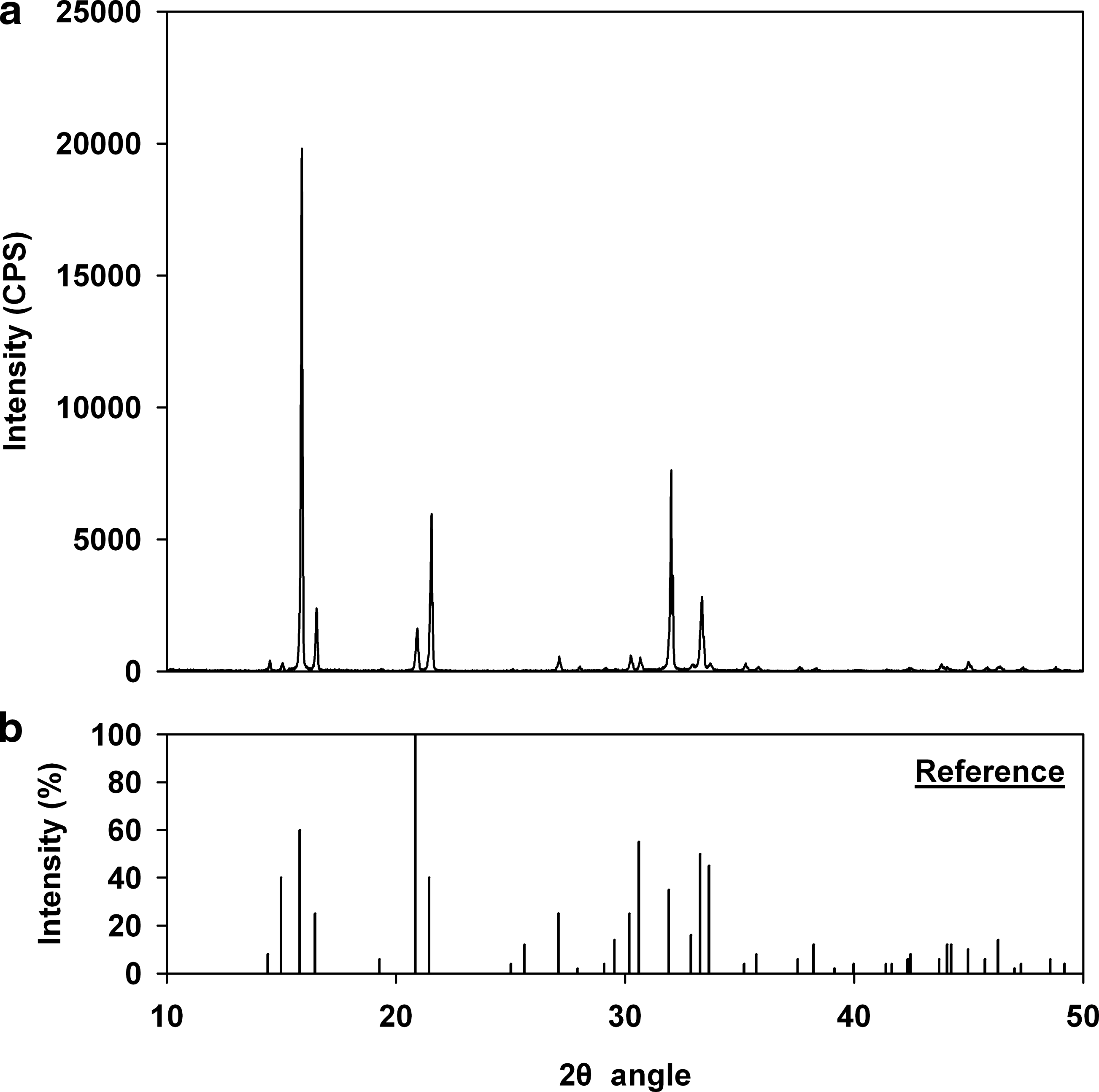
Comparison of XRD diffractograms of
The toxicity of struvite deposits was also examined. Results from the 24-h standard toxicity test showed that struvite deposit did not exhibit toxicity to Daphnia magna at dilutions of 0, 6.25, 12.5, 25, and 50%. However, an insignificant effect of struvite on the swimming motion of Daphnia magna was observed at 100% dilution. Consequently, the TU value was calculated as zero. It means that the struvite deposit used in our experiment has no toxic effect on Daphnia magna.
Fertility evaluation of struvite deposit
The struvite deposits were used in cultivation tests and their fertility were compared with that of commercial fertilizers. The agricultural tests showed that lettuce in the struvite pots sprouted faster (after 6 days) than lettuce in other pots (after 7 days). In addition, the lettuce grew at different rates depending on the fertilizers used. During the experimental period of 63 days, the tallest leaf in each pot was selected and measured. As shown in Fig. 3a, the lettuce in the struvite pots grew much faster than those in other pots even though the applied nitrogen dosage in commercial fertilizers and struvite pots was same (88.28 mg N/kg soil). After 63 days, the plants from each pot were harvested and their fresh and dry weights determined. As evident from Fig. 3b, the addition of struvite significantly increased the average fresh and dry weights of lettuce compared to control. It is well documented by previous studies that the vegetables grown in struvite pots have much higher growth rates than those in control pots (without addition of external N and P) (Li and Zhao, 2003; Diwani et al., 2007; Ganrot et al., 2007; Yetilmezsoy and Sapci-Zengin, 2009). Also, the average fresh and dry weights of lettuce in struvite pots were much higher than those in the commercial fertilizer pots, and decreased in the order struvite > complex fertilizer > organic fertilizer > compost fertilizer. On day 63, the average dry weight of lettuce in control, complex, organic, compost, and struvite pots reached 14.8, 89.4, 52.5, 54.9, and 185.5 mg with standard deviations of 10.3, 25.7, 21.8, 18.2, and 24.7 mg, respectively. This finding is further supported by data in Fig. 3a, where the longest leaf was also found in the same order. These results were due to a difference in the amount of P supplied to the growing media. Fig. 4 clearly illustrates that the growth rates of leaves were determined by the amounts of P rather than of Mg2+ and Ca2+. The amounts of P in the fertilizing sources decreased in the order struvite > complex fertilizer > organic fertilizer > compost fertilizer, and the growth rates of leaves were affected by the applied dosage of P, as shown in Fig. 4a. It is clear from these results that the inferior growth of lettuce in the complex, organic, and compost fertilizer pots was not due to the lack of Ca2+ and Mg2+, but rather due to the lack of P.

Temporal variation of leaf length
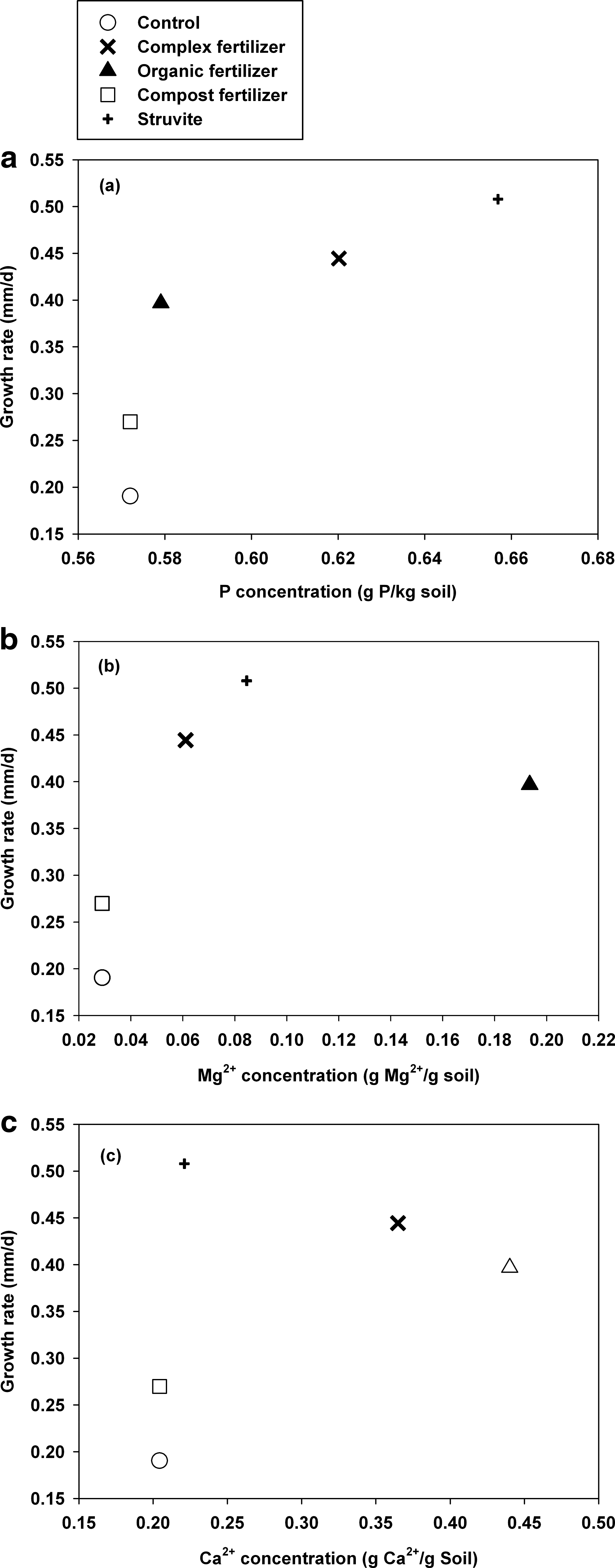
Leaf growth rate of lettuce as a function of the concentration of P
The accumulation of heavy metals in the lettuce tissue was also evaluated. Table 5 shows that heavy metals including Cu2+, Hg2+, Pb2+, Cr3+, and Zn2+ were contained in all samples, whereas Cd2+ and As3+ were not detected in any sample. A previous study by Li and Zhao (2003), in which struvite recovered from landfill leachate was used in growing vegetables, similarly reported no detection of Cd2+ and As3+. As shown in Table 5, the concentrations of Pb2+ and Cr3+ in struvite pots were lower than those in other pots, and nickel (Ni2+) was not detected in struvite pots. The concentration of Cu2+ in struvite pots was slightly higher than in organic and compost fertilizer pots, but lower than that in complex fertilizer pots. The level of Hg2+ in struvite pots was also lower than in all commercial fertilizer pots. The level of Zn2+ in struvite pots was higher than in other pots, except for organic fertilizer pots. In summary, concentrations of Hg2+, Pb2+, and Cr3+ in struvite pots were lower than in commercial fertilizer pots, and Ni2+ concentrations were below the detection limit. The reason for such low concentrations of heavy metals in struvite pots is not clear. One possibility is that Pb2+, Cr3+, and Ni2+ exist in combined forms, such as Pb3(PO4)2, CrOH2+, Cr(OH)2+, Cr(OH)3, Cr(OH)4−, Cr3(OH)45+, CrHPO4+, CrH2PO42+, NiOH+, Ni(OH)2, and Ni(OH)3−, in alkaline soil solution (Ronteltap et al., 2007). The test data for accumulated heavy metals in lettuce tissue indicate that the cultivation of lettuce with struvite deposit recovered from semiconductor wastewater could be safe despite that semiconductor wastewater commonly contains many refractory chemicals including heavy metals (Chen and Ray, 2001; Lin and Yang, 2004). Also, the level of heavy metals contained in struvite deposit is not a cause for considerable concern about soil contamination, especially about soil microorganism toxicity, because the phosphatase activities are inhibited by Cu2+ and Zn2+ in soil samples at high concentrations of 245–658 mg Cu2+/kg soil and 2795–3194 mg Zn2+/kg soil, respectively (Wang et al., 2007).
n.d., not detected.
The availability of nutrients from struvite and commercial fertilizers was estimated by investigating lettuce tissue. Data in Table 6 show that the control pots had the lowest concentration of N, P, K+, Ca2+, and Mg2+ compared to other pots, while struvite pots had the highest concentrations of these elements, except for Ca2+. More uptake of nutrients (N, P, K+, and Mg2+) in struvite pots than in commercial fertilizer pots may be due to the different pH condition in each pot as revealed in the study of Li and Zhao (2003). Diwani et al. (2007) explained that the pronounced effect on nutrients uptake in struvite pots could be due to the increase in solubility from acid generated by nitrification of ammonium ions. Therefore, it may be concluded that the application of struvite recovered from semiconductor wastewater has a positive effect on the nutrient uptake of lettuce.
Effect of struvite dosage on lettuce cultivation
The optimum struvite dosage for cultivating lettuce was determined. During the experimental period of 54 days, the leaf length of lettuce was periodically measured. Fig. 5a illustrates that the leaf length of lettuce increased as the struvite dosage increased from 0 to 0.938 g struvite/kg soil. However, no additional growth was observed when struvite dosage was increased further. A similar trend was observed for the lettuce biomass based on fresh and dry weights as shown in Fig. 5b. The average heaviest fresh and dry weights were 5600 mg (standard deviation: 171.0 mg) and 575 mg (standard deviation: 31 mg) at 0.938 g struvite/kg soil (corresponding to 123.82 mg N/kg soil). However, when the struvite concentration was increased to 1.250 g/kg soil, the fresh and dry weights slightly decreased to 5000 (standard deviation: 270.3 mg) and 472 mg (standard deviation: 206.0 mg), respectively. Thus, increasing the struvite dosage up to 0.938 g/kg soil has a positive effect on biomass, but further increase is ineffective. These findings are supported by Li and Zhao (2003). They explained that increasing the amount of struvite, recovered from landfill leachate, could further stimulate the growth of water convolvulus. However, overdosage of the fertilizing source causes burning of leaves and the inhibition of plant growth.

Temporal variation of leaf length
Comparison of slow-release properties of complex fertilizer and struvite deposit
The NH4+-N leaching from soil–complex fertilizer and soil–struvite mixtures was compared by column tests. In the lab-scale continuous column tests for 48 h, more N was leached from struvite deposit than from complex fertilizer as given in Fig. 6. The cumulative leached nitrogen mass from complex fertilizer and struvite deposit was about 17.6 and 32.9% at steady state, respectively. This explains why struvite pots better facilitate lettuce growth compared to complex fertilizer as illustrated in Fig. 3. The time needed to reach steady state was longer for struvite deposit than for complex fertilizer. This means that struvite recovered from semiconductor wastewater has better slow-release properties than complex fertilizer.

Comparison of complex fertilizer and struvite deposit for cumulative leached nitrogen mass as a function of elapsed time.
Conclusions
Struvite recovered from semiconductor wastewater was evaluated for its fertilizing ability compared to commercial fertilizers in cultivating lettuce. Based on the experimental results, the following conclusions were drawn:
(1) Application of struvite better facilitated lettuce growth than commercial fertilizers (complex, organic, and compost) during the experimental period of 63 days.
(2) The application of struvite resulted in less accumulation of the heavy metals Hg2+, Pb2+, Cr3+, and Ni2+ in vegetable tissue than when commercial fertilizers were used. Moreover, Cd2+, As3+, and Ni2+ were not detected in struvite pots.
(3) The lettuce tissue in struvite pots contained more nutrients (N, P, K+, and Mg2+) than that in commercial fertilizer pots.
(4) The lettuce growth rate increased as struvite dosage increased. The optimum dosage was 0.938 g struvite/kg soil, and any additional dosage over the optimum did not cause more growth of lettuce.
(5) The struvite deposits had higher slow-release property of NH4+-N than the complex fertilizer.
To summarize, struvite deposits recovered from semiconductor wastewater are effective as a multinutrient and slow-release fertilizer in cultivating lettuce. Therefore, it is expected that the application of struvite precipitation in treating semiconductor wastewater will increase and the produced struvite will be more recommended as a fertilizer.
Footnotes
Author Disclosure Statement
The authors declare that no competing financials interests exist.