




Abstract
Abstract
To better understand the distribution and enantiomeric signature of chiral polychlorinated biphenyls (PCBs) in the soil, the concentrations and enantiomeric fractions of three typical chiral PCBs (PCBs 95, 132, and 149) in soil samples collected from Jinan, China, were determined by enantiomer-specific gas chromatographic analysis. The sum of the three chiral PCB congeners was between 22.0 and 695 ng kg−1 dry weight, and the mean enantiomeric fraction values for PCBs 95, 132, and 149 were 0.473±0.025, 0.355±0.146, and 0.527±0.167, respectively. The pollution distribution of PCBs in Jinan soil was source specific and exhibited a weak urban-rural gradient. An analysis of the correlation between soil organic matter and enantiomeric fraction deviations indicated that organic matter played an important role in the enantiomeric compositions of chiral PCBs in soil. Moreover, nonracemic PCBs 95, 132, and 149 occurred in 39%, 58%, and 80% of the Jinan soil samples, respectively, which suggested preferential degradations of the first eluting enantiomer of PCB 95 and (+)-PCB132, as well as either the (+) or (−)-PCB149 enantiomer.
Introduction
Advances in the organic analysis of chiral compounds have directly impacted the validity of reported trend analyses. In all the 209 possible PCB congeners, 78 display axial chirality, among which 19 tri- and tetra-ortho substituted PCBs exist as stable enantiomers at room temperature (Kaiser, 1974). The enantiomers of a chiral compound may exhibit different biological and toxicological properties from each other and from their racemic mixture (Garrison et al., 2000; Ali et al., 2005; Warner et al., 2009). These properties can be used as tracers (Wong et al., 2001a; Robson and Harrad, 2004; Asher et al., 2007; Lehmler et al., 2010) of biological activities because bio-processes can change the enantiomeric composition of a chiral compound. To date, however, little is known about the occurrence, distribution, and fate of chiral PCBs in complex environmental media, which has made current environmental assessments of PCB pollution on the racemate inaccurate (Wong et al., 2001b). A better understanding of the distribution and enantiomeric signature of chiral PCBs in soil is necessary not only to evaluate the environmental quality of the soil but also to provide further information on enantioselective degradation and transformation processes of PCBs. Until recently there have been only a limited number of studies of the enantiomeric signatures of PCBs in soil. Wong et al. (2001a) investigated the enantiomeric ratios (ERs) for eight chiral PCBs in sediment from Lake Hartwell and the Hudson and Housatonic Rivers and found nonracemic ERs. Robson and Harrad (2004) provided evidence of enantioselective degradation of PCBs in topsoil from both urban and rural locations in Great Britain. Wong et al. (2009) reported enantiomeric signatures of PCBs 95, 136, and 149 in urban and rural areas in Canada and investigated their relation to contaminant levels. Kobličková et al. (2008) and Oravec et al. (2010) studied the relationship between enantiomeric compositions of chiral PCBs and soil properties. Furthermore, Singer et al. (2002) examined the ability of PCB-degrading bacteria to differentiate between the enantiomers of four chiral PCB congeners and concluded that enantioselectivity varied with respect to strain, congener, and cosubstrate when multiple PCB-degrading enzyme systems were involved. Soil is a complex and dynamic medium with a range of many physicochemical properties and microbial communities. Soil collected from different sites may have different PCB biotransformation processes with different enantiomer preferences. For example, different enantioselective degradation preferences for PCB149 enantiomers were observed in sediment from different sampling sites in in the Lake Hartwell basin (Wong et al., 2001a). However, to the best of our knowledge, little information concerning to the enantiomeric signatures of chiral PCBs in Chinese soils has been available in the literature until now.
In this paper, the concentrations and enantiomeric compositions of three chiral PCBs (PCBs 95, 132, and 149) in soil samples from urban and rural Jinan were determined. Target chiral PCBs were selected for their sufficient quantities in soil (Robson and Harrad, 2004) and lack of apparent coelutions during chromatographic analysis. The objectives of this study were (1) to investigate the congener- and enantiomer-specific distributions of chiral PCBs in Jinan soil; (2) to evaluate the enantiomeric compositions and enantioselective degradation of chiral PCBs; and (3) to identify influencing factors for the changes of enantiomeric fractions (EFs).
Experimental Protocols
Site description and sample collection
Located on the east coast of China, Jinan (36°40′ N, 117°00′ E), the capital city of Shandong Province, has an area of 8177 km2, a population of approximately 6 million, and a continental monsoon climate with four distinctive seasons. In 2008 soil samples (0–20 cm) were collected from 9 urban sites (U1–U9) and 14 rural sites (R1–R14) in Jinan (Fig. 1). As many industrial parks are located in the rural areas of Jinan, the rural sites were subdivided into two groups: 5 industrial sites (Rural IP: R6–R8, R11, and R12) and 9 farmland sites (Rural FL: R1–R5, R9, R10, R13, and R14). Each soil sample (∼1 kg) was a mixture of 10 subsamples from a circle with a diameter of 5 m. All the soil samples were ground, sieved for a particle fraction of less than 1 mm, and then conserved in glass bottles with lids at −18°C prior to analysis.
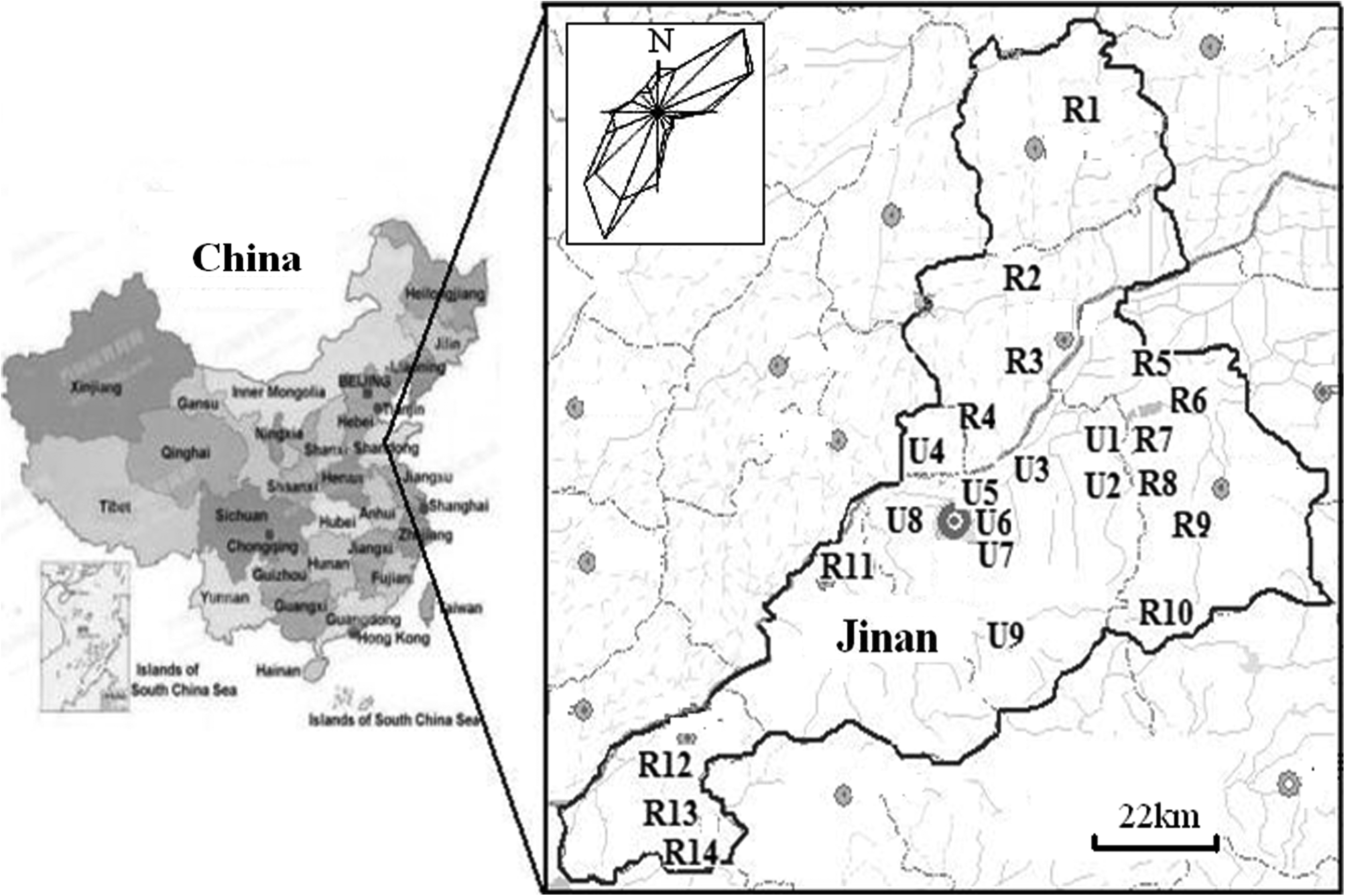
Locations of sampling sites in Jinan, China.
Sample preparation
Each sample (45 g), was homogenized with 5 g anhydrous sodium sulphate (Na2SO4), and introduced to a clean soxhlet apparatus, where it was extracted using 200 mL hexane and acetone (1:1 v/v) for 24 h. Activated copper was added to remove sulfur. Subsequently, the crude extract was concentrated and the solvent was changed into hexane. Purification was performed first by vortex mixing with sulfuric acid (H2SO4 [98%]). The PCBs were then separated using a multilayer column that contained 1 g anhydrous Na2SO4, 2 g 10% silver nitrate (AgNO3) impregnated silica gel, 4 g 3.3% water-deactivated silica gel, and 1.5 g anhydrous Na2SO4. The elution solvent was 40 mL hexane. The eluate was concentrated by rotary evaporator and then reduced to extract 0.5 mL under a gentle nitrogen steam for a gas chromatographic (GC) analysis.
Three duplicates of each soil sample were dried at 80°C for about 48 h to obtain the percent of water in the samples, and the dry weight (dw) of the soil sample was then calculated. The percentage of soil organic matter (SOM) in each sample was determined by dichromate (Cr2O72−) oxidation, according to Method GB 9834-88 (Yang and Jin, 1999).
Analytical procedures
Qualitative and quantitative analyses of target PCBs enantiomers were performed on a gas chromatograph (GC-2014, Shimadzu, Kyoto, Japan) with a 63Ni-electron capture detector (GC-ECD). The temperatures of injector and detector were 260°C and 300°C, respectively. A Chirasil-Dex column (25 m×0.25 mm×0.25 μm) from Varian (Foster City, CA) was chosen, and the column temperature was programmed as follows: initial temperature at 60°C (hold for 2 min); first ramp at 10°C min−1 to 150°C (hold for 20 min); and second ramp at 0.5°C min−1 to 185°C (hold for 50 min). One microliter of each sample was injected in the splitless mode (split opened after 1 min), using an AOC-20i auto-sampler (Shimadzu). The carrier gas was nitrogen at an inlet pressure of 70.1 kPa and a flow rate of 1 mL min−1. Qualification accuracy was further confirmed by gas chromatography (GCMS-QP 2010, Shimadzu) mass spectrometry (GC-MS). Masses monitored using selected ion monitoring were m/z 324 and m/z 326 for PCB 95 as well as m/z 358 and m/z 360 for PCBs 132 and 149.
Quality assurance and quality control
The individual enantiomer response was checked by multiple injections of a racemic mixture standard solution and two commercial formulations (Aroclor1242 and Aroclor1254) at different concentrations on a GC-ECD, followed by GC-MS confirmation. EFs were in agreement with the theoretical values in all cases, and the EFs of standard and commercial formulations ranged from 0.05% to 0.69% relative standard deviation (RSD) for all target PCB enantiomers. Method detection limits of individual PCB enantiomers in this study ranged from 8.05 pg g−1 to 15.4 pg g−1. For every 10 samples, laboratory and field blanks were prepared, extracted, and analyzed in the same manner as the real samples. No peaks matching the target enantiomers were found. Recovery experiments were carried out on spiked soils for every 6 samples. Mean recoveries for individual PCB enantiomers in this study were from 71.42% to 80.12%, and no recovery correction was applied to the results. The reproducibility of this method, expressed by the standard RSDs of multiple analyses of standards, commercial formulations, spiked blank duplicates, and spiked soil duplicates, respectively, was satisfactory (RSD<6).
Statistical analysis
Statistical analysis of obtained data was performed using Statistical Package for the Social Sciences (SPSS) version 13.0. A one-way analysis of variance was used to analyze the significant differences (p<0.05). The 95% confidence interval was used as a conservative measure of EF precision for the racemic standards.
Results and Discussion
Congener-specific distribution of PCBs in soils from Jinan City
Pollution level
The concentrations of PCBs congeners in Jinan soils are shown in Table 1. The ∑3PCBs concentrations were between 22.0 ng kg−1 and 695 ng kg−1dw, with an mean value of 163 ng kg−1 dw. The concentrations of PCBs 95, 132, and 149 congeners ranged from 22.0 to 106 ng kg−1 dw, below detected limit (BDL) to 523 ng kg−1 dw, and BDL to 133 ng kg−1 dw, respectively, with the mean concentration order of PCB 132>PCB 95>PCB 149.
SOM, soluble organic matter; Conc., concentration; EF, enantiomeric fraction; ∑PCBs, the concentration sum of PCB 95, 132 and 149; BDL, below detection limit; —, not calculated.
Table 2 lists the concentration levels of PCBs 95, 132, and 149 in the soils of Jinan and other regions. The contamination level of the three target PCBs in Jinan soil was similar to that in the soil of West Midlands, Great Britain (Jamshidi et al., 2007), and Taiyuan, China (Fu et al., 2009), but much lower than the levels found in Jiangsu Province, China (Zhang et al., 2007), Lake Ontario sediment (Wong et al., 2009; Wong et al., 2002), and South Africa (Batterman et al., 2009). In general, the pollution level of the target PCBs in Jinan was comparatively low.
Co-eluted with PCB 141.
Co-eluted with PCB 153.
Spatial distribution
The highest ∑3PCBs concentration (695 ng kg−1 dw) in the urban samples was observed at site U8, where PCB 132 was found at a concentration of 523 ng kg−1 dw, A nearby transformer factory, which had used PCBs as insulating fluids in transformer production may be the cause of the high PCBresidue. The second highest concentrations in the urban samples were detected at site U1 (296 ng kg−1 dw), and U3 (309 ng kg−1 dw). Nearby power, iron, steel, and chemical plants are probably responsible for these higher values. The soil samples from urban sites U6 and U7, a campus and a park, respectively, had relatively lower concentrations. The lower concentrations may be attributable to the low content of organic matter in soil samples from these sites, as well as their distance from industrial sources.
Among the rural soil samples, higher concentrations were expected and found at sites within or near to industrial parks (R6–R8, R11, and R12). These sites had an average concentration for ∑3PCBs of 178 ng kg−1 dw, which was two times higher than that found in the samples collected from farmland.
Generally speaking, the pollution distribution of PCBs in Jinan soil is source specific. As shown in Fig. 2, a significant concentration gradient of Urban sites > Rural IP sites > Rural FL sites for target PCBs congeners was observed. PCB distribution in Jinan was inconsistent with some previous studies, which have suggested that concentrations of PCBs decline with increasing distance from urban centers (Wilcke et al., 2006; Wu et al., 2011). This may be because of the particular source distribution for PCBs in Jinan. Industrial parks were established in the rural region and are home to cement and steel manufacturing, power plants, pharmaceutical industries and chemical manufacterers, which has led to an increase in the pollution level at those sites.

Comparison of PCB concentrations at urban sites with those at rural sites. IP represents industrial park, and FL represents farmland.
Enantiomeric signatures of PCBs 95, 132, and 149 in Jinan soils
Chiral PCBs are released into the environment as racemic mixtures. The variation of enantiomeric composition is considered to be a useful marker for biological fate processes (Wong et al., 2001a; Robson and Harrad, 2004; Asher et al., 2007; Lehmler et al., 2010). The detection of a racemic signature in soil indicates a lack of enantioselective degradation or that a compound has been recently emitted (Wong et al., 2009; Padma et al., 2003). A nonracemic composition indicates the occurrence of biodegradation and biotransformation (Wong et al., 2001a, Warner et al., 2005; Huckman et al., 2006). In this study, the enantiomeric composition of PCBs 95, 132, and 149 was described as an enantiomeric fraction (EF), which is defined as (Harner et al., 2000),
where A and B are the concentration of (+) enantiomers and the concentration of (−) enantiomers for PCBs 132 and 149, or concentrations of the first and the second eluting enantiomers, respectively, for PCB 95, which has an unknown elution order on the Chirasil-Dex column. A pure single enantiomer would have an EF=0 or 1. A racemic composition (equal amounts of two enantiomers) would have EF=0.500±0.032, as defined by Morrissey et al. (2007). Samples with EFs outside this range can be regarded as nonracemic. EF deviations from racemic compositions are calculated as the absolution of EF−0.500. The greater the deviation from 0.500, the higher degree of nonracemic composition. For the convenience of comparison, the data for enantiomeric compositions in other literature were recomputed using the above definition.
Enantiomeric composition and enantioselective degradation of PCBs
As shown in Fig. 3, a wide range of EFs for PCBs 95, 132, and 149 with mean EFs of 0.473±0.025, 0.355±0.146 and 0.527±0.167, respectively, were found in the Jinan soil samples. Nonracemic PCBs 95, 132, and 149 occurred in 39% (n=23), 58% (n=19) and 80% (n=20) respectively of detectable samples, which suggested more enantioselective degradation and/or less ongoing emission of PCBs in Jinan soil.
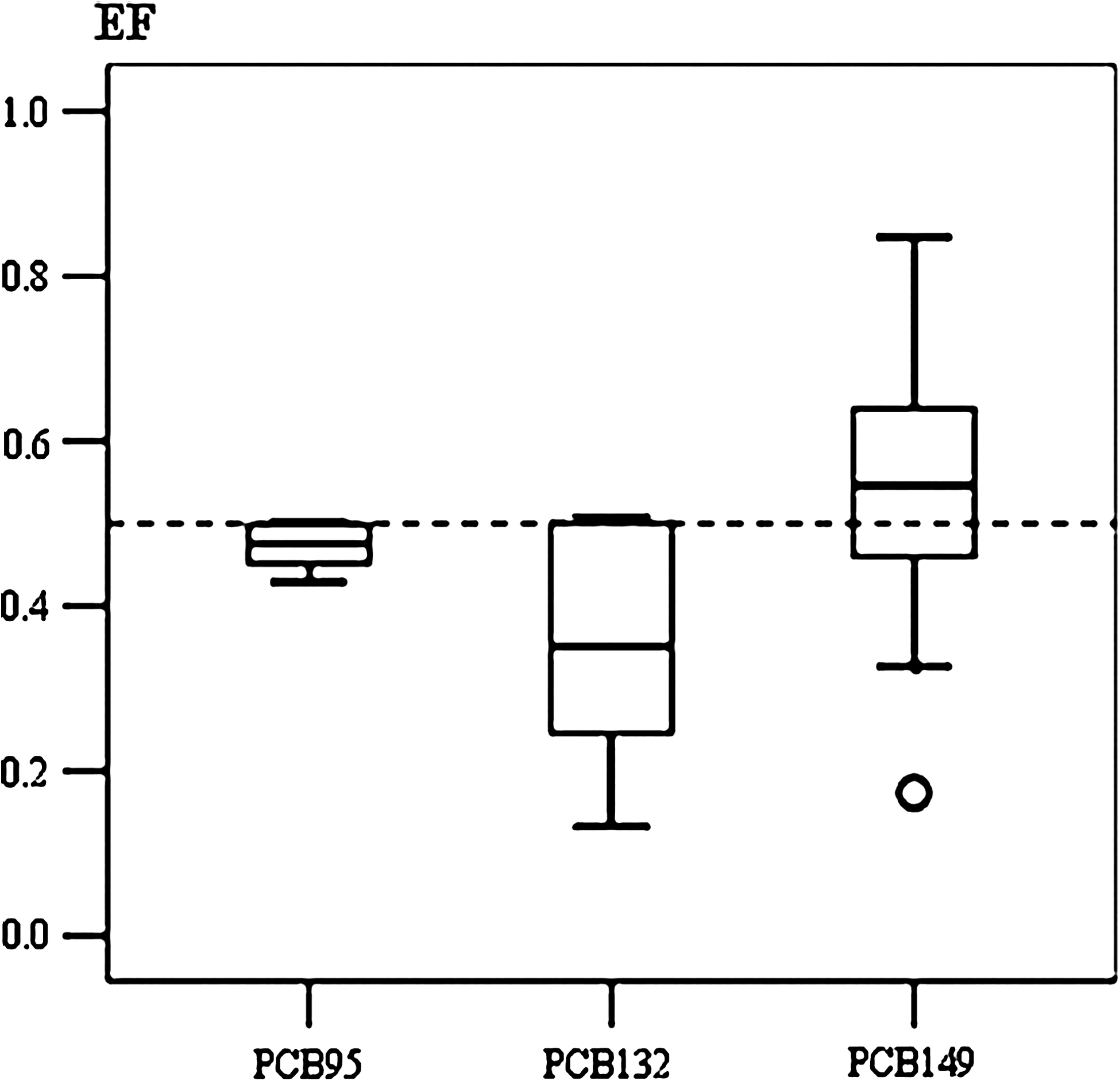
Box plots of EFs of PCBs 95, 132, and 149 in Jinan soils. Dotted line represents racemic EFs of 0.5. Box plot edges represent 25th and 75th percentile. T-bar edges represent 5th and 95th percentile.
The first eluting enantiomer of PCB 95 was observed to be preferentially degraded with EFs of 0.429–0.501, which was consistent with earlier findings of 0.453±0.023 in Great Britain (Robson and Harrad, 2004), 0.441–0.504 in the Hudson River basin and Connecticut River basin (Wong et al., 2001a), as well as 0.409–0.500 in Toronto sediment (Wong et al., 2009). The EFs for PCB 132 in Jinan soils were between 0.132 and 0.509, reflecting preferential degradation of (+)-PCB 132. Similar results of EFs of 0.22–0.54 were reported in soil samples from Czech Republic (Kobličková et al., 2008). Compared to EFs of 0.412–0.698 for PCB 149 found in the Lake Hartwell basin (Wong et al., 2001a), PCB 149 EFs of 0.172–0.847 in Jinan soil showed more variability. Either the (+) or (−) enantiomer occurred in 25.0% and 55.0% respectively was observed to preferential degrade in Jinan soils. Similar degradation patterns of PCB 149 were reported in sediments and water snakes from the Lake Hartwell basin, US (Wong et al., 2001a, 2001b), while only the (+)-PCB 149 was preferentially degraded in soil reported by Kobličková et al. (2008).
Spatial distribution of EFs
Site U8, which had the highest concentration of PCB congeners and a relatively high percentage of SOM, had the maximum EF deviation for PCB 132, while enantiomeric compositions for PCBs 95 and 149 were approximately racemic. Site U1 showed larger EF deviations for all target PCBs. Although site U3 had a concentration level similar to site U1, racemic composition for PCB 95 and opposite enantiomeric degradation pattern (EF>0.5) for PCB149 were observed. Both sites R1 and R13, which possessed lower PCB concentrations and lower percentages of SOM, had larger EF deviations for PCBs 132 and 149, but EFs for PCB149 at site R1 was 0.175 and that at site R13 was 0.847. Overall, there was no significant difference in the variability of the EFs determined in urban and rural soils in Jinan that couldn't support the conclusion that urban sites may have a fresher signature than rural sites (Wong et al., 2009). It is possible that the variability in the enantiomeric composition of PCBs, which was extremely complicated, may have been influenced by soil properties, microbial species and activity, physicochemical parameters, and so on (Kobličková et al., 2008).
Influencing factors for the shift of enantiomeric composition
Figure 4 shows significant positive correlations between EF deviations for PCBs 95 and 132 and the percentage of SOM, that is, greater EF deviations for PCBs 95 and 132 from racemic compositions occurred with a higher content of SOM. The strength of the correlation and the degree of influence the percentage of SOM had on EF deviations was greater for PCB 132 than for PCB 95. EF deviations for PCB149 were not correlated with the percentage of SOM, probably because the process of preferential degradation was more sophisticated, that is, two direction changes (EF<0.5 and EF>0.5). In summary, these results supported, more or less, the assertion that soil organic matter can change the enantiomeric compositions of PCBs in soils, by impacting the activity of the soil microbial community (Buerge et al., 2003; Kurt-Karakus et al.2005).
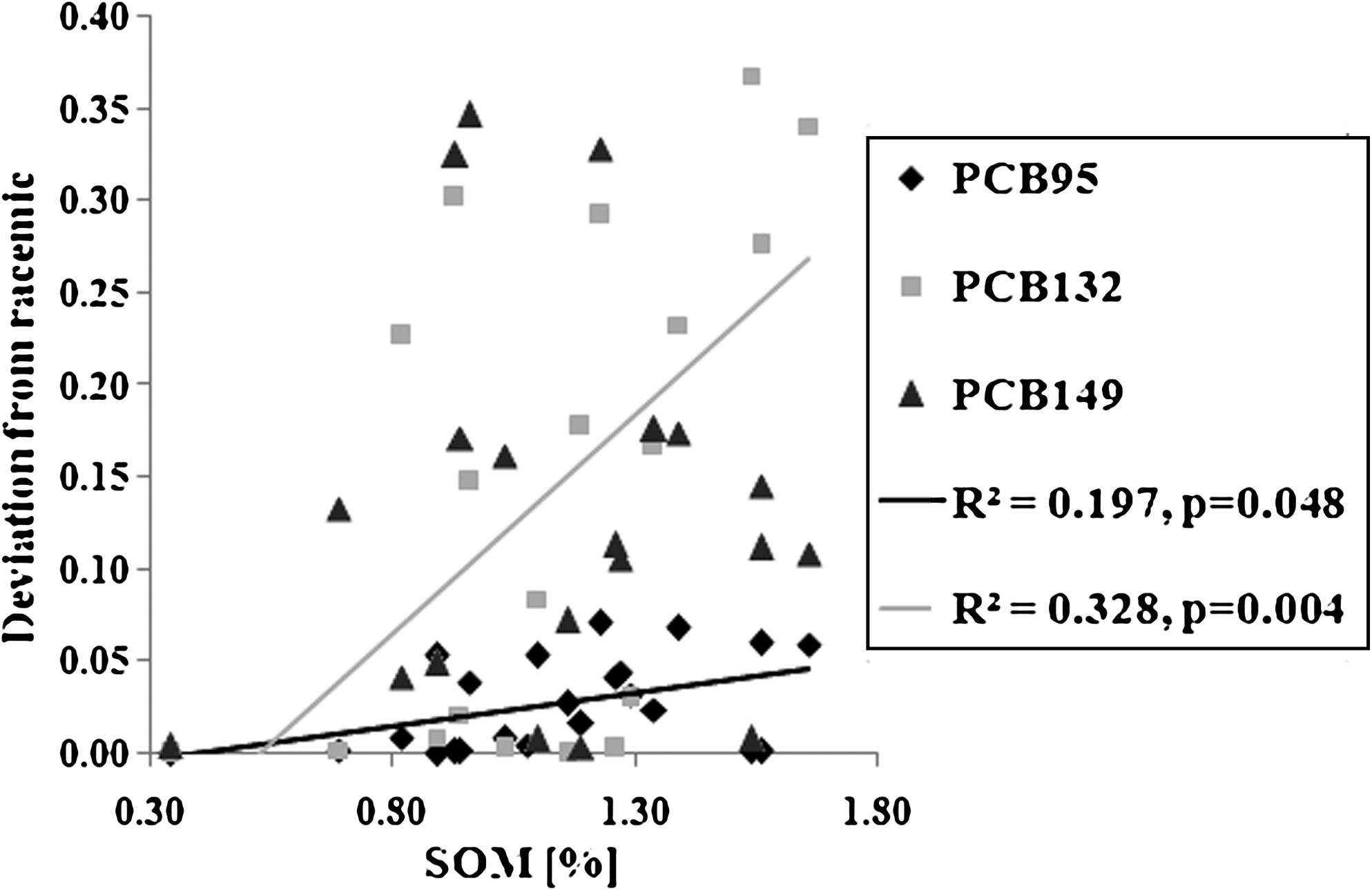
Relationship between EF deviations of PCBs from racemic value (0.5) versus % SOM.
As mentioned previously, the spatial distribution of PCBs was sourcespecific. Hence, EF deviations were correlation analyzed with concentrations to test whether enantiomeric signatures could be related to contaminant levels. No significant relationship between EF deviation for PCBs and the concentration of that contaminant or ∑3PCBs was observed, which suggested that EF deviations for PCBs from racemic compositions were not strongly related to their concentrations in soils.
Summary
Soil samples collected from 23 sampling sites in Jinan, China, had low contamination levels of target PCBs. The spatial distribution of PCBs was sourcespecific, and the concentrations of PCBs in samples near industrial areas were higher than those from agriculture, cultural, and tourism areas. The nonracemic signatures of chiral PCBs in Jinan soil suggested less fresh emission and/or more enantioselective microbial degradation. The first eluting eantiomer of PCB 95 and (+)-PCB132 as well as either the (+) or (−) enantiomer of PCB 149 were preferentially degraded. It was found that greater EF deviations for PCBs from racemic compositions occurred with a higher content of SOM.
Footnotes
Acknowledgments
We would like to express our appreciation for the comments from reviewers. Funding for this work was provided by the Special Funds for the Environmental Public Service Sectors of China (No. 201109022). We are grateful to the Jinan Institute of Environmental Science for providing the support for sample collection.
Disclosure
No competing financial interests exist.