




Abstract
Abstract
On December 25, 2010, two administrative regions with entirely different administrative status, resources, and areas of development, Kaohsiung City and Kaohsiung County, were required by a long-term national land reform program in Taiwan to merge into one administrative entity. A new plan for managing solid wastes had to be quickly implemented to provide services of equal quality to all residents. The government of the new administrative region is required to initiate a new plan at the top level to provide a platform for planning sublevel solid waste collection and disposal systems. To address the issue, this study used an urban planning approach and multi-objective mathematical programming to reconcile conflicting objectives within the system, which must be built and maintained at minimum cost and provide maximum equity. Because the second objective of maximum equity is difficult to express quantitatively, this study initiated an indicator for this variable, that is, to minimize the total metric ton-kilometers of waste being transported. Furthermore, a constraint method was introduced to simplify the two objectives into a single objective function. Additionally, this model pioneered the inclusion of time as a variable. This made possible a time-dependent dynamic annual solution for each year of the 10-year study period. Hence, the model reflected the actual solid waste complexity in the newly merged region and provided valuable information for top-down planning of future subsystems projects.
Introduction
Since the 1980s, many studies have been conducted on MSW optimization. Mathematical models have been developed and implemented for planning long-term solid waste management plans (Chang and Wang, 1996; Minciardi et al., 2002; Cai et al., 2007; Li and Huang, 2009) and for supporting decisions on short-term waste management operation (Baetz, 1990; Chang and Wang, 1994, 1996; Chung, 2010).
In MSW management, uncertainties in costs, impact factors, and objectives have been presented as fuzzy, probability, and/or interval formats. Such uncertainties can affect the related optimization processes and the generated decision schemes (Huang et al., 1993; Yeomans et al., 2003; Lin et al., 2011). These uncertainties have been addressed by various methods developed for that purpose (Zhu and ReVelle, 1993; Chang and Davila, 2007, 2008). However, the inclusion of uncertainties into a superior MSW management plan is thought to cause chaos at the next lower levels as they attend to the details of MSW planning (Pereira and Pinto, 1991; Lee and Kim, 2000; Vincent et al., 2002; Madanipour, 2006; Levy, 2010; Lin et al., 2010). In addition, a superior plan must assume the principle of certainty, and hence, problems with uncertainty will not be considered in this research; and a deterministic model is adopted.
Another fundamental difficulty encountered when planning an MSW management system is the incorporation of objectives that conflict with each other as well as objectives unrelated to economic costs. To resolve this problem, we added intermediate treatment facilities to the current MSW management plan. The addition of these facilities allowed us to develop a multiple-objective mathematical programming model to resolve the conflict between minimum cost and maximum equity.
Experimental Protocols
Multiobjective modeling of MSW system
Most waste disposal systems perform three basic operations: collection, intermediate processing, and final disposal. In this study, a multi-objective model was developed to illustrate the trade-off between cost efficiency and equity in locating waste disposal facilities for a waste disposal system. Here, the equity objective was to minimize the total metric ton-kilometers of waste being transported. To achieve such an objective, a waste disposal facility would need to be located near the areas where waste is generated.
Although transportation costs are minimized in a highly decentralized configuration of disposal facilities, capital investment and unit operation costs are higher because of the increased number of disposal sites that do not achieve economics of scale. For this reason, minimizing waste transportation (metric ton-kilometers) does not necessarily mean that the total cost of the system has been minimized. Thus, a multi-objective optimization is warranted.
Overall, our problems can be modeled by minimizing the total cost under some constraints, which can be described by the following equations:
which is subject to the following constraints:
where:
g=index of intermediate treatment facilities, g=1,2,…,a (a=8) h=index of landfill sites, h=1,2,…,m−a (m−a=10) i=index of feasible facility locations, i=1,2,…,m (m=18) j=index of waste generation areas, j=1,2,…,n (n=33) t=index of time periods, t=1,2,…,r (r=10) A=maximum allowable metric ton-kilometers of waste shipped αg=weight reduction factor for intermediate treatment facility g (G1–G4) C
ght
=unit shipping cost between intermediate treatment facility g and landfill h in time period t CL
ijt
=unit shipping cost between waste generation area j to intermediate treatment facility location i in time period t dij, dgh=distance between waste generation area j and facility location i; distance between intermediate treatment facility g and landfill h LB
it
=the required minimum quantity of solid waste to be incinerated at facility location i in time period t Pgt, Pht=amount of waste processed at intermediate treatment facility g and landfill h in time period t Pit=amount of waste processed at facility location i in time period t qg, qh=initial capacity of intermediate treatment facility g and landfill h Ri=total possible expansion capacity of facility location i Sjt=amount of waste generated in area j in time period t Tght=amount of waste shipped from intermediate treatment facility g to landfill h in time period t Xijt=amount of waste shipped from waste generation area j to facility location i in time period t Ygt, Yht=capacity added to intermediate treatment facility g and landfill h at beginning of time period t Yit=capacity added to facility location i at beginning of time period t λt=financial discount factor in time period t Fit(Yit)=cost of expanding the capacity of facility location i by Y
i
units in time period t Git(Pit)=cost of processing Pi units at facility location i in time period t
The multi-objective programming model developed above reflects the trade-off between cost efficiency and equity in locating waste disposal facilities, which are in conflict with each other. In the present study, the two objective functions were treated by the constraints method (Cohon, 1978; Wu, 2009), in which the minimum system cost in Eq. (1) was listed as the major target and the other one was considered as the secondary target to be lowered as a constraint equation shown as Eq. (2). In Eq. (1), the total costs of processing, transportation, and facility expansion costs over all time periods were considered. Furthermore, the transportation cost included the costs of moving waste from where it is generated to intermediate treatment facilities and then to the landfills.
The equity objective function for solving the multi-objective models was to minimize the total number of metric ton-kilometers for transporting solid waste. Note that the equity objective function was transformed into a constraint in Eq. (2) to simplify the multi-objective programming into a single objective function. To be clearer, the total number of metric ton-kilometers for transporting solid waste was designated to be less than A, referring to the maximum allowable metric ton-kilometers of waste to be shipped, a figure assigned by the policy makers of the new Kaohsiung Municipality. In other word, constraint in Eq. (2) gives the problem its multi-objective character.
Furthermore, the constraints in Eqs. (3) and (4) require that all waste be removed from the solid waste generation areas, and be treated in the same manner. Equations (5) and (6) require that the processing capacities of intermediate treatment facilities and landfills not be exceeded. Equation (7) requires that the quantity of solid waste transported from the waste generation area j to the facility location i must not be less than the required minimum treatment capacity of the facility at i. Equation (8) insures that all the remaining waste after the processing operations is removed from intermediate treatment facilities. Finally, Eq. (9) limits the total expansion of each facility.
Moreover, based on the knowledge of urban planning, the MSW management model should be deterministic and not include any uncertainties to ensure sublevel plans (optimal MSW collection route, optimal collection points, optimal dispatch of manpower, etc.) can proceed smoothly without unexpected events.
Case study and overview of studied system
Figure 1 shows the geographic location of the new Kaohsiung Municipality and location of existing and potential facilities, where G1–G4 are the four existing incineration plants; G5–G8 are the four proposed transfer stations to be decided in the model whether to install or not to install; H1–H10 are the 10 existing final disposal sanitary landfills. Thus, in the model of this study, the facility location i=18 is the combination of the intermediate treatment facilities (G1–G8) and the final disposal landfills (H1–H10). Also shown on Fig. 1 are the 33 solid waste generation areas (indicated by the solid dots), where J1–J22 (Table 1) are located in the region which was formerly Kaohsiung County and J23–J33 are in the territory formerly belonging to Kaohsiung City.
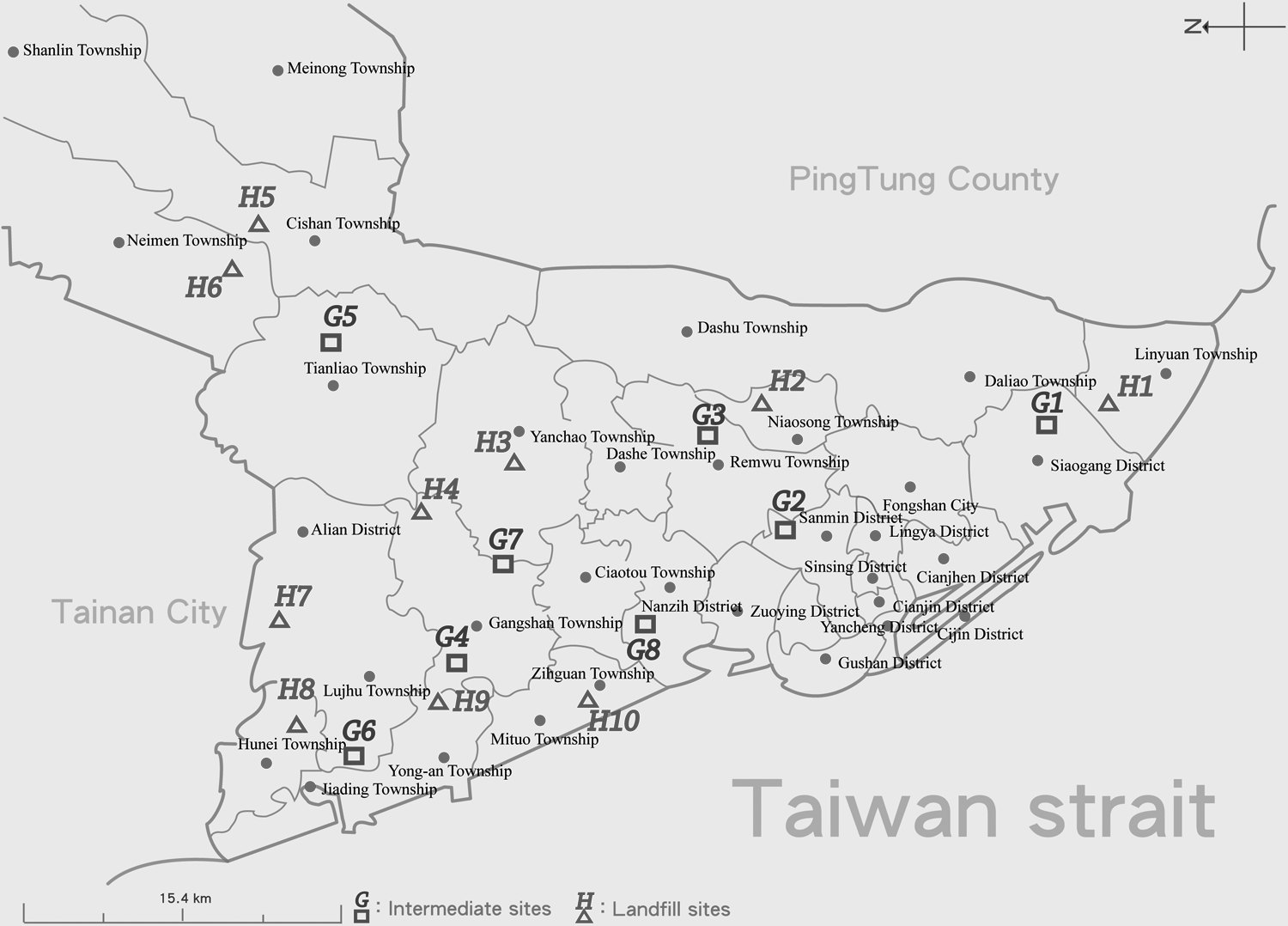
Map of new Kaohsiung Municipality and location of existing and potential facilities, marked with intermediate treatment facilities (□, G), landfill sites (△, H), and solid waste generation areas (●).
The former Kaohsiung County includes administrative regions from J1–J22. The former Kaohsiung City includes administrative regions from J23–J33.
These solid waste generation areas, intermediate treatment facilities, and final disposal sanitary landfills are the key targets to be modeled and optimized in this study. Thus, their influential background parameters are overviewed as follows:
Solid waste generating areas
The purpose of this study is to develop a superior solid waste management plan for the new Kaohsiung Municipality. Therefore, the various previous administrative districts of the city or townships of the county, whose names and populations are listed in Table 1, are assumed to be the waste generation areas when manipulating the mathematical model. The amount of generated waste (Sjt) was based on the quantities of MSW actually collected by the former Kaohsiung City and Kaohsiung County from 1997 to 2006 before merging.
Incineration plants
There are two incineration plants in the former Kaohsiung City: the Central Kaohsiung Incineration Plant and the Southern Kaohsiung Incineration Plant. The central plant, capable of treating 900 tons/day of solid waste (qg1), consists of three 300 tons/day incinerators; the southern plant, which has four 450 tons/day incinerators, can treat 1800 tons/day (qg2). As for the former Kaohsiung County, it also has two incineration plants, one in Renwu and the other in Kangshan. Each plant has three 450 tons/day incinerators and each can treat 1350 tons/day (qg3 and qg4). These four incineration plants, which have design-lives for 30 years each, were put into operation in 1999 and 2000, and thus are far from being replaced. However, the Taiwan Environmental Protection Administration (Taiwan EPA, 2002) has ordered that no more incineration plant be constructed in Taiwan. Hence, the site selection and construction cannot serve as variables in our model.
Intermediate treatment facilities
An intermediate treatment facility may include an incineration plant, solid waste transfer station, solid waste compression station, and other such processing capabilities (Chang et al., 2005). None of these components have been constructed except the four incineration plants. Based on current solid waste collection practices in the study area and the need to minimize the solid waste transportation cost, the policy maker has limited the future building of solid waste transfer stations to Tianliao Township, Luzhu Township, Yanchao Township, and Nanzih District. Therefore, these four future solid waste transfer stations are designed to process 500 tons/day (qg5–qg8) of solid waste in the prescribed multiple-objective mathematical programming model, and will be tested in the model to assess whether to install or not to install.
Sanitary landfills
The former Kaohsiung County has 10 sanitary landfills. Table 2 summarizes their locations and capacity. Because they are all still in working condition, the site selection and expansion did not serve as variables in our model.
Numerical solution and model assumptions
The multiple-objective mathematical programming model could be solved using various available software programs, including Excel, Lingo, Matlab, ILOG CPLEX, and GAMS. However, Lingo (2008) was chosen because it can be used conveniently, practically, and quickly to solve nonlinear problems. In this case study, the following assumptions are made to facilitate computer manipulations and reveal the model significance:
1. The actual distance (dij and dgh) between a solid waste generation area and an intermediate treatment facility or a final disposal landfill is calculated as 1.2 times the linear distance. 2. Expansion of current transfer stations is not considered, as they will not change and so they will not be considered in the model. 3. The methods of transporting solid waste between various points are assumed to remain the same in the future and will not be considered in the model. 4. The expansion of the final disposal landfills after 10 years of operation may be considered in the model. 5. The random variation of solid waste quantity will not be considered in the model. 6. The quantity ratio of incinerated solid waste to the original solid waste (α) is 0.3, assuming that 70% weight reduction is achieved when MSW is incinerated. 7. In this study, t=1,2,…,10, j=1,2,…,33, g=1,2,…,8, i=1,2,…,18, and h=1,2,…,10 are assumed (i.e., r=10, m=18, n=33, a=8, and m−a=10).
Results and Discussion
As stated, the multi-objective model was developed to optimize the trade-off between cost efficiency and equity in allocating waste disposal facilities for a waste disposal system. Thus, we will begin with discussion of the results for compromising the two conflict objectives. More detailed optimized solutions are then described by the decision variables Xijt, Tght, Pit, and Yit.
Compromise of conflicting objectives
Figure 2 shows the 10-year compromise curve of the two conflicting objective functions, minimizing the total system cost and providing maximum equity. If the A value in Eq. (2), maximum allowable metric ton-kilometers of waste shipped, is adjusted, various solutions for minimizing the cost can be obtained and used to plot the compromise curve. According to Fig. 2, if the amount of solid waste transportation increased (equity minimized), the system cost decreased. On the other hand, if the amount of solid waste transportation decreased (equity maximized), the system cost increased. In general, the best compromise solution should be around the turning point. The Kaohsiung Department of Environmental Bureau has therefore selected an A value at (33.9 billion NTD, 90.3 million ton-kilometers) that corresponds to 3125 tons/day of waste processed to represent the best compromise solution.
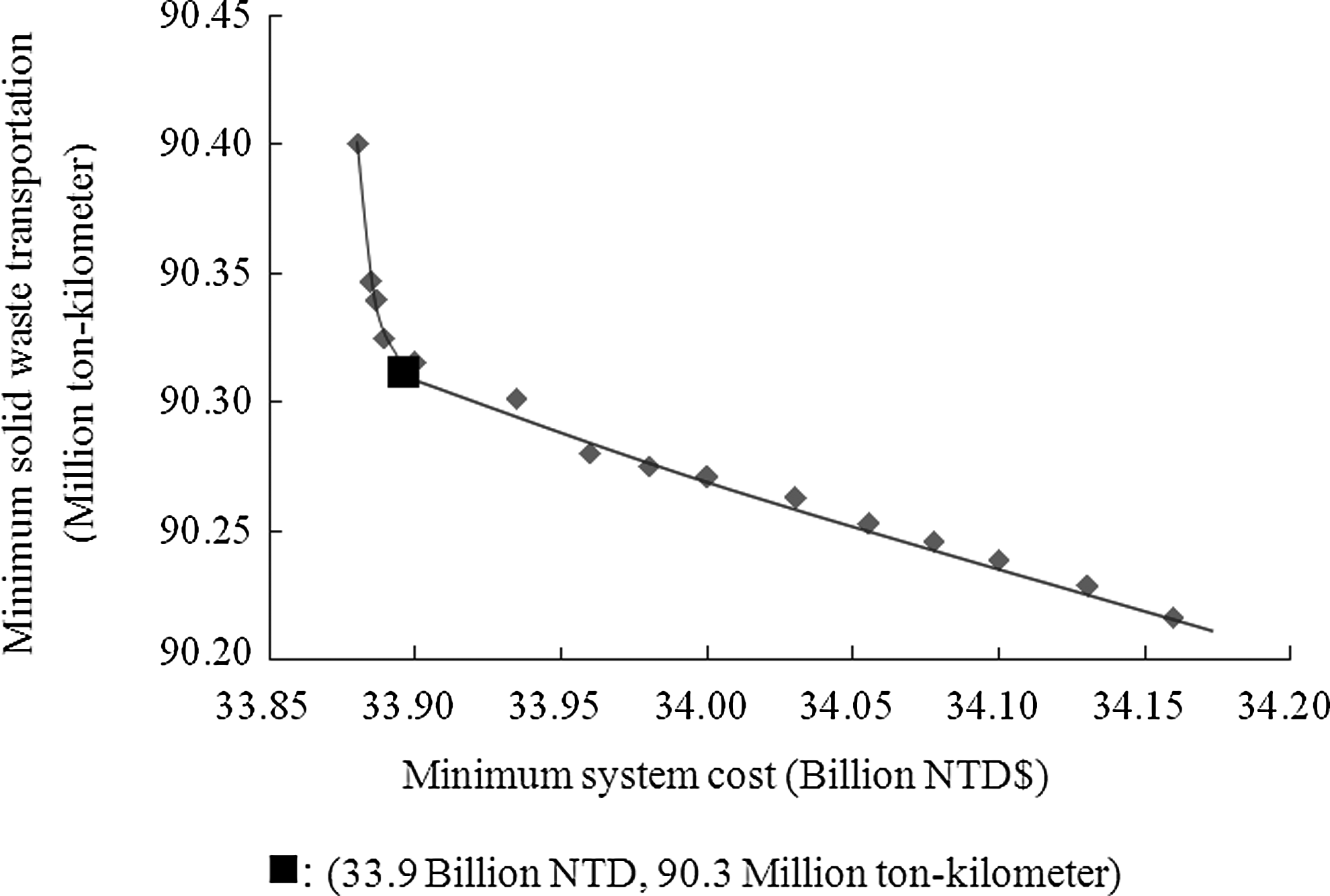
The 10-year trade-off curve of equity and total cost.
In obtaining an optimal solution for a given A value, we had to try various combinations in allocating different treatment facilities. For the best compromise solution, we reached the optimal operation decision in allocating the intermediate treatment facilities, as shown on Table 3. According to the arrangement shown on Table 3, by leaving two incinerators (out of four) in operation at the Southern Kaohsiung Incineration Plant, two out of three at the Central Kaohsiung Incineration Plant, two out of three at the Renwu Incineration Plant, and one out of three at the Kangshan Incineration Plant, an optimized solution was reached. However, the overall operating capacity of 2850 tons/day for all four plants will be less than the daily generated solid waste quantity of 3128 tons. The extra 278 tons must be transported to the sanitary landfill for disposal.
Also shown on Table 3, as proposed by the model, the Tianliao solid waste transfer station (G5) would be constructed, and the other three (G6, G7, and G8) would not be installed. It is worth mentioning that during the modeling processes to reach the above results, the quantity of solid waste generated was shown to greatly influence the results of the model.
Optimal solution for the decision variable Xijt
One of the influential variables to be decided by the multi-objective programming model is the amount of waste to be transported from waste generation area j to facility location i (mainly intermediate treatment facilities here) in time period t, and is denoted as Xijt in the model. Table 4 clearly displays the first-year optimal solution for Xijt. For example, X(1,1,1) suggests Fengshan City (J1) can transport 122,713 tons of solid wastes to the Southern Kaohsiung Incineration Plant (facility location I1) during the first year (T1), while X(1,3,1) suggests Daliao Township (J3) can ship 45,676 tons to location I1 during time period T1, and so forth.
Please note that we had included time as a variable in this model, thus making possible a time-dependent dynamic annual solution for each year of the 10-year study period. In other words, the practical operational outputs for the second year to the 10th year can also be produced in this model. Owing to the limit of the manuscript length, these results are not included. Nowadays, engineers are facing challenges to deal with the complexity of society; thus, the inclusion of the time variable in this model has fulfilled the practical needs of the current dynamics of solid waste generation and management.
Optimal solutions for decision variable Tght
After solid waste was processed at the intermediate treatment facilities, the resulting residue or waste were transported to sanitary landfills for final disposal. Thus, the amount of waste to be transported each year (Tght) from intermediate treatment facility G to landfill H has a direct effect on the total system operation cost. Table 5 lists the quantity of solid waste to be transported from intermediate treatment facilities to the final disposal landfills for the first year; for example, T(1,1,1) suggests 98,500 tons/year of residue to be shipped from the Southern Kaohsiung Incineration Plant (G1) to the Linyuan Township Sanitary Landfill (H1), and 65,700 tons/year to be shipped from Central Kaohsiung Incineration Plant (G2) to the Niaosong Township Sanitary Landfill (H2). Similarly, the practical operational outputs for the second year to the 10th year can also been found.
Optimal solution for decision variable Pit
Another important waste management variable to be decided by the administrator is to allocate the optimized amount of waste to be processed (Pit) at the facility location “i” in time period “t.” Table 6 lists the model output for the first year, for example, P(1,1) suggests 328,500 tons/year of waste to be incinerated at the Southern Kaohsiung Incineration Plant, and 219,000 tons/year at the Central Kaohsiung Incineration Plant. In addition, the model can suggest the practical operational outputs for the second year to the 10th year.
Optimal solution for facility expansion, Yit
Finally, to compromise the above optimized suggestion, the current capacity of some of the existing facilities may need to expand, or installation of a new facility may also be necessary. Our model suggested that the capacities of all facilities need not be expanded for the coming 10 years because the Yit values, which represent the incremental capacity for all existing facilities, remain unchanged based on the A value of the model solution, providing that the Tianliao Transfer Station is newly installed.
The results obtained in this research indicate that changing the solid waste transportation A value (metric ton-kilometers) will affect the cost such that the solid waste route must be modified accordingly. Among various A values and their corresponding optimal solutions, the decision maker is suggested to accept the cost around the turning point of the compromise curve. This solution should be the compromise optimal solution between the cost and equity and fulfill all the constraints at the same time.
Future models will become more complex by taking consideration of manpower, budget, and machinery, increasing intermediate treatment facilities, forecasting waste quantity changes, social and environmental objectives, and adding more constraints. Current software may not be capable of solving such complex mathematical models. Therefore, the MPOS software (e.g., MPOS-BBMIP) recently developed by Northwestern University, or similar system software, will need to be used.
Conclusions
On December 25, 2010, two administrative regions of Kaohsiung with entirely different situations were combined into the new Kaohsiung Municipality. A multi-objective model was developed to make a superior plan of MSW for the new municipality. The model minimizes the metric ton-kilometers of waste shipped as a surrogate for maximizing the equity of the waste disposal system. To compromise the objectives of maximum equity and the minimum operational cost, an A value of 90.3 million ton-kilometers was chosen. The optimal feasible solution was reached when leaving only 7 out of the 13 existing incineration units in operation. Further optimized solutions were also suggested for the amount of waste transported from each waste generation area to each intermediate treatment facility, and then to the final disposal landfills. Moreover, the optimal amount of waste processed at each facility location was also suggested by the model outputs.
One of the important contributions of this model would be the consideration of time periods in this study (t=10 years). Another contribution is the conversion of the second objective function into “the minimum quantity of MSW transported across district boundaries,” which was used to represent maximum equity and can also circumvent the difficulty encountered in the multi-objective modeling.
Finally, it is worth mentioning that the current function of intermediate transfer stations is limited to transferring solid waste. Future planning will include multiple functions, including not only solid waste transfer, but also solid waste compression, resources recovery, and recycling. The new metropolis has a certain growth potential. Therefore, the various influences of social and environmental aspects, as well as future public recycling awareness, economic activities, changes in population and on the solid waste collection and treatment systems need to be considered. To cope with such a complex system, the model can be improved by including constraint equations on political, social, and economic considerations in future research, and, of course, sensitivity analyses are of merit.
Footnotes
Acknowledgments
This research was supported by the I-Shou University Research Development Program (ISU-2010-02-01) and the National Science Council (NSC-100-2221-E214-024) of Taiwan. The authors also deeply appreciate the anonymous reviewers for their insightful comments and suggestions.
Author Disclosure Statement
No competing financial interests exist.