




Abstract
Abstract
Photocatalytic degradation of Reactive Orange 16 (RO16) was investigated using immobilized TiO2 nanoparticles on polyester support in exposure of UV irradiation in recirculated tubular photoreactors. Utilization of the polyester as a support has several advantages, such as low price, remarkable surface area, flexibility, and durability. Moreover, the prepared TiO2/polyester was successfully applied for the photocatalytic degradation of RO16 in aqueous media for several times without any discernible diminution in its activity. Applied TiO2 nanoparticles were characterized by X-ray diffraction (XRD), transmission electron microscopy (TEM), and scanning electron microscopy (SEM). Experimental results indicate that the degradation rate of RO16 follows pseudo-first-order kinetics. With nonlinear regression, a model was developed for prediction of pseudo-first-order rate constants (kapp) as a function of operational parameters, including temperature (295–328K), flow rate (5–15 L·min−1), and initial concentration of RO16 (5–25 mg·L−1) as
Introduction
Among wastewater treatment techniques such as precipitation, coagulation, electrocoagulation, adsorption, and filtration, the UV/TiO2 process, which is classified as one of the advanced oxidation processes (AOPs), has some advantages in comparison with them: (1) complete mineralization of pollutants, (2) producing no secondary (solid) contamination, and (3) low operational cost; moreover, it can be used for the destruction of nonbiodegradable organic contaminants (Gaya and Abdullah, 2008; Aquino et al., 2010; Mahyar et al., 2010). In all AOPs, oxidizing species are generated such as hydroxyl radicals (OH•) and hydroperoxide radicals (
From a practical point of view, TiO2 nanoparticles can be utilized for the photocatalytic treatment of wastewater in two forms of aqueous suspensions or immobilized on inert and stable supports, in batch, semibatch, or continuous systems (Dijkstra et al., 2001a, 2001b; Behnajady et al., 2008; Benotti et al., 2009). Immobilized TiO2 nanoparticles have some privileges in comparison with suspended ones such as (1) no need for separation of them at the end of the process and (2) the satisfactory penetration of UV light through the solution; moreover, the immobilized TiO2 nanoparticles on various supports like glass, sand, polyethylene, and nonwoven paper can be used repeatedly without losing their activity (Matthews, 1991; Aguedach et al., 2005; Zhiyonga et al., 2007; Khataee et al., 2011). Various benefits of the polyester, including low price, remarkable surface area, flexibility, and durability, make it a suitable candidate to use as a support in photocatalytic degradation process. The polyester support with immobilized TiO2 nanoparticles on it was used in the gaseous phase for the degradation of methanol under UV irradiation (Mejía et al., 2010). However, to the best of our knowledge, application of a TiO2/polyester for the destruction of organic contaminants in aqueous media has not been reported.
The aim of the present study was to apply the immobilized TiO2 nanoparticles on the polyester support for photocatalytic degradation of Reactive Orange 16 (RO16) under UV irradiation and then to develop a kinetic model for prediction of apparent pseudo-first-order rate constant (kapp) of RO16 degradation as a function of different operational parameters, including temperature, flow rate (FR), and initial concentration of RO16. Eventually, the obtained model can be utilized to evaluate the required electrical energies per order (EEO) for the UV/TiO2 process at various operational conditions.
Materials and Methods
Materials
All the chemicals used for preparation of TiO2/polyester phtocatalyst and COD measurements were of analytical grade from Merck and used without further purification. The polyester support and RO16 (color index number=17,757, molecular formula=C20H17N3Na2O11S3, Mw=617.5 and λmax=494 nm), were purchased from Arian Bushehr Co. (Iran) and Alvan Sabet Co. (Iran), respectively.
Preparation of TiO2/polyester
The TiO2 nanoparticles were prepared by the thermal hydrolysis method using TiCl4 as a titanium precursor (Pourata et al., 2009). First, the desired amount of TiCl4 was dissolved in double-distilled water in an ice bath to reach 3 M concentration. Next, the obtained solution was added dropwise to a 0.05 M (NH4)2SO4 solution up to 0.5 M and stirred vigorously for an hour at 80°C. Afterward, the pH of the solution was adjusted in 7 by adding NH4OH (2.5 M) to obtain TiO2 precipitation. After that, the obtained white precipitate was filtered, washed with double-distilled water, and dried at room temperature, and finally calcined at 400°C for 2 h.
Poly-methyl methacrylate was synthesized by polymerization of methyl methacrylate monomers using benzoyl peroxide as an initiator (Ahmad et al., 2007). Briefly, 20 mL of MMA was inserted into a 250-mL three-necked round-bottom flask; after that, the solution of 0.15 g of benzoyl peroxide in 100 mL of water was added to the solution. Next, 0.5 g of polyvinyl alcohol and 5 g of di-sodium hydrogen phosphate were added and the solution was stirred for 1 h at 80°C. The reaction was accomplished under nitrogen atmosphere. Upon completion of the reaction, the solution was filtered, washed, and finally dried at 100°C for 24 h under vacuum condition to yield PMMA solid material.
To immobilize the prepared TiO2 nanoparticles on polyester support, the obtained polymer was dissolved in toluene (20% w/w), and then TiO2 nanoparticles were suspended in the solution (15 g·L−1). Thereafter, the polyester support was submerged into the suspension for 15 min, and lastly the obtained TiO2/polyester was dried at room temperature, and washed with double-distilled water.
Characterization of TiO2 nanoparticles
TiO2 nanoparticles were characterized by XRD, TEM, and SEM. The crystalline structure and the average crystallite size of TiO2 nanoparticles were investigated by XRD (Philips X'PERT MPD). From Fig. 1a, the nanocrystalline anatase structure of TiO2 was confirmed by a main peak at 2θ=25.28°; moreover, the mean crystallite size of the photocatalyst was determined by the Scherrer formula (Mahyar and Amani-Ghadim, 2011) as 6.7 nm. Also, the grain size of TiO2 nanoparticles was investigated by the TEM (Philips CM 100). Figure 1b shows that the majority of TiO2 nanoparticles sizes are between 6 and 8 nm, which is consistent with the XRD result. The morphology of the immobilized TiO2 nanoparticles on the polyester support was investigated by a Zeiss LEO 1455 VP-SEM. Figure 2a–c proves that the TiO2 nanoparticles were well-immobilized on the polyester support.


Scanning electron microscopy images of the applied TiO2 nanoparticles immobilized on polyester support with different magnifications:
Experimental procedure
The experimental setup for the UV/TiO2 process consisted of two similar photoreactors, which were joined to each other with the rubber tubing. The photoreactor had a Pyrex reactor (outer diameter=55 mm and inner diameter=50 mm) with a high-pressure mercury lamp (15 W, UV-C, manufactured by Osram) surrounded by a quartz tube (outer diameter=32 mm and inner diameter=30 mm) at the center of it. For measuring UV light intensity, the UV lamp was centered in a quartz tube and the light intensity of 0.9 mW·cm−2 was measured by a UV-Lux-IR meter (Leybold Co.) at the distance of 18 mm, which was equal to the distance between the outer surface of the quartz tube and the inner surface of the pyrex photoreactor. Each of the photoreactors was covered with the metallic cover to protect the laboratory from the harmful UV irradiation. The TiO2/polyester (with the height of 440 mm) was wrapped around the inner wall of the reactors. In each experiment, 2 L of RO16 solution with a known initial concentration was circulated in the semibatch system by a diaphragm pump (Max pressure=125 p.s.i.; WaterSafe). To adjust the FR, a liquid flow meter (LZB-4; Guanshan) was used. A heater was used to maintain the reaction temperature at a constant value within ±0.5°C. The solution was blended by a magnet stirrer to keep the solution homogenous. The UV lamps and the pump were switched on at the beginning of each experiment. At different reaction intervals, the absorbance was measured at λmax=494 nm by a UV-vis spectrophotometer (DR-5000; Hach-Lange) and was related to the concentration by the calibration plot based on the Beer-Lambert's law. The degradation efficiency was defined as the percent ratio of the dye concentration at a definite reaction time relative to that at the beginning of the experiment.
COD measurements were implemented based on the open reflux method (APHA, 2005).
Results and Discussion
Kinetic model development and evaluation
Before kinetic modeling, it is essential to know the photocatalytic degradation kinetics of RO16 at different operational conditions. Therefore, the decolorization plots of RO16 in different operational conditions during the UV/TiO2 process were presented in Fig. 3a–c. Based on pseudo-first-order kinetic supposition [Eq. (1)], the plots of ln ([RO16]/[RO16]0) against irradiation time (t), where [RO16]0 and [RO16] are initial and at time t concentrations of RO16, were obtained. In all graphs, straight lines with correlation coefficients of more than 0.99 proved the suggested kinetics, and the apparent rate constants were calculated from the slope of the plots.
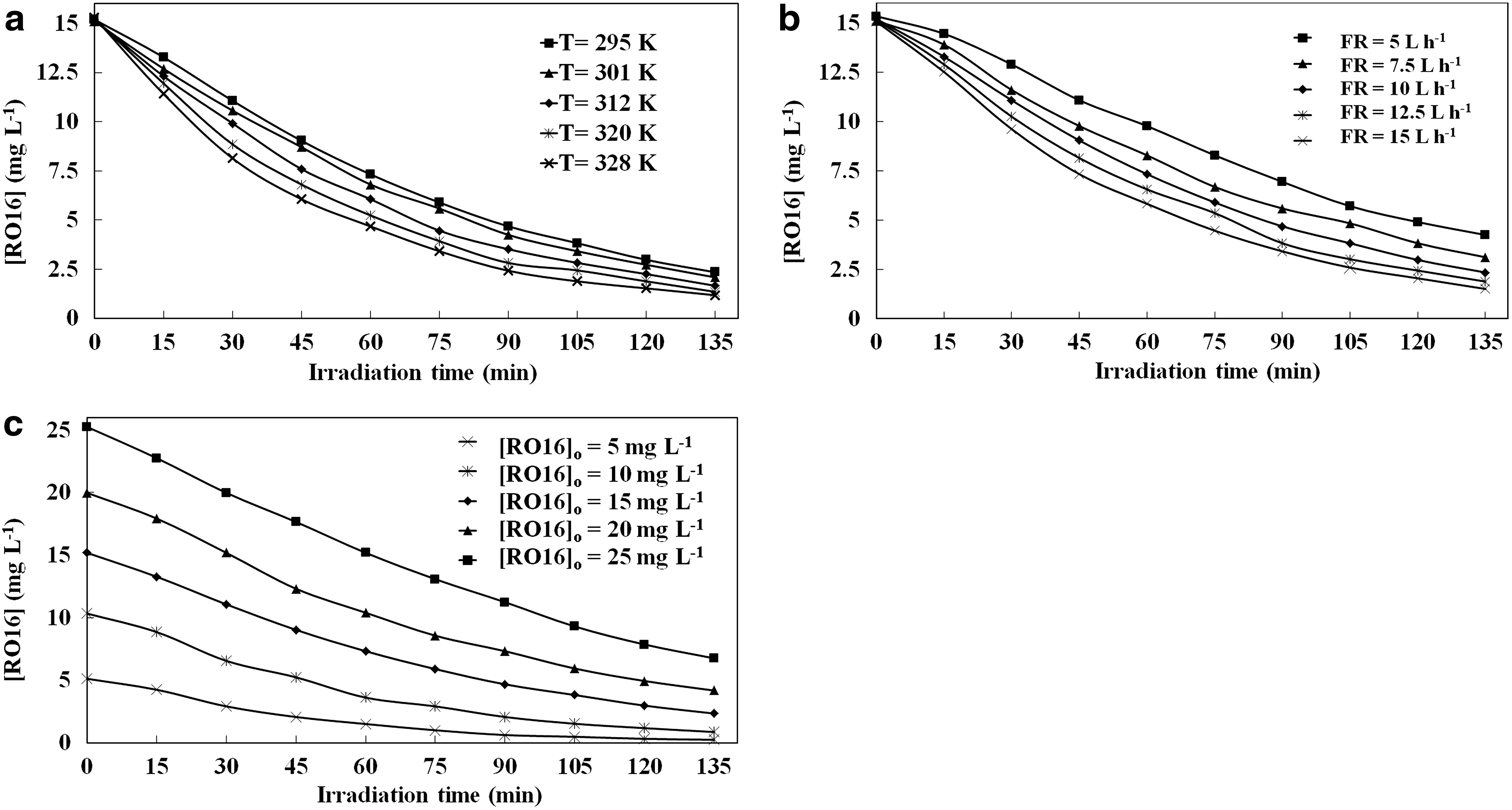
The effect of
A correlation between kapp and the process temperature (T) can be expressed by the Arrhenius equation [Eq. (2)]:
Figure 4 shows that the reaction rate increases as the temperature rises. Although thermal energy is not adequate for activation of TiO2 particles, various studies indicate that increase in process temperature from 20°C up to 80°C promotes the photocatalytic degradation of pollutants (Chong et al., 2010). As a consequence, in this study, the operational temperature was chosen in the range of 22°C to 55°C, which is in accordance with the optimum process temperature for the photocatalytic degradation. Although the amount of adsorption decreases with an increase in the reaction temperature, the photocatalytic reaction competes more effectively with an electron-hole recombination, and thus the photocatalytic reaction rate enhances, which is consistent with the Arrhenius plot (Fig. 4) (Daneshvar et al., 2004; Malato et al., 2009; Chong et al., 2010). From the slope of the Arrhenius plot, the activation energy for the photocatalytic degradation of RO16 was determined as 7.43 kJ·mol−1 in the temperature range of 295K to 328K, which is consistent with other studies that the activation energies were measured between 5.5 and 8.24 kJ·mol−1 (Daneshvar et al., 2004).
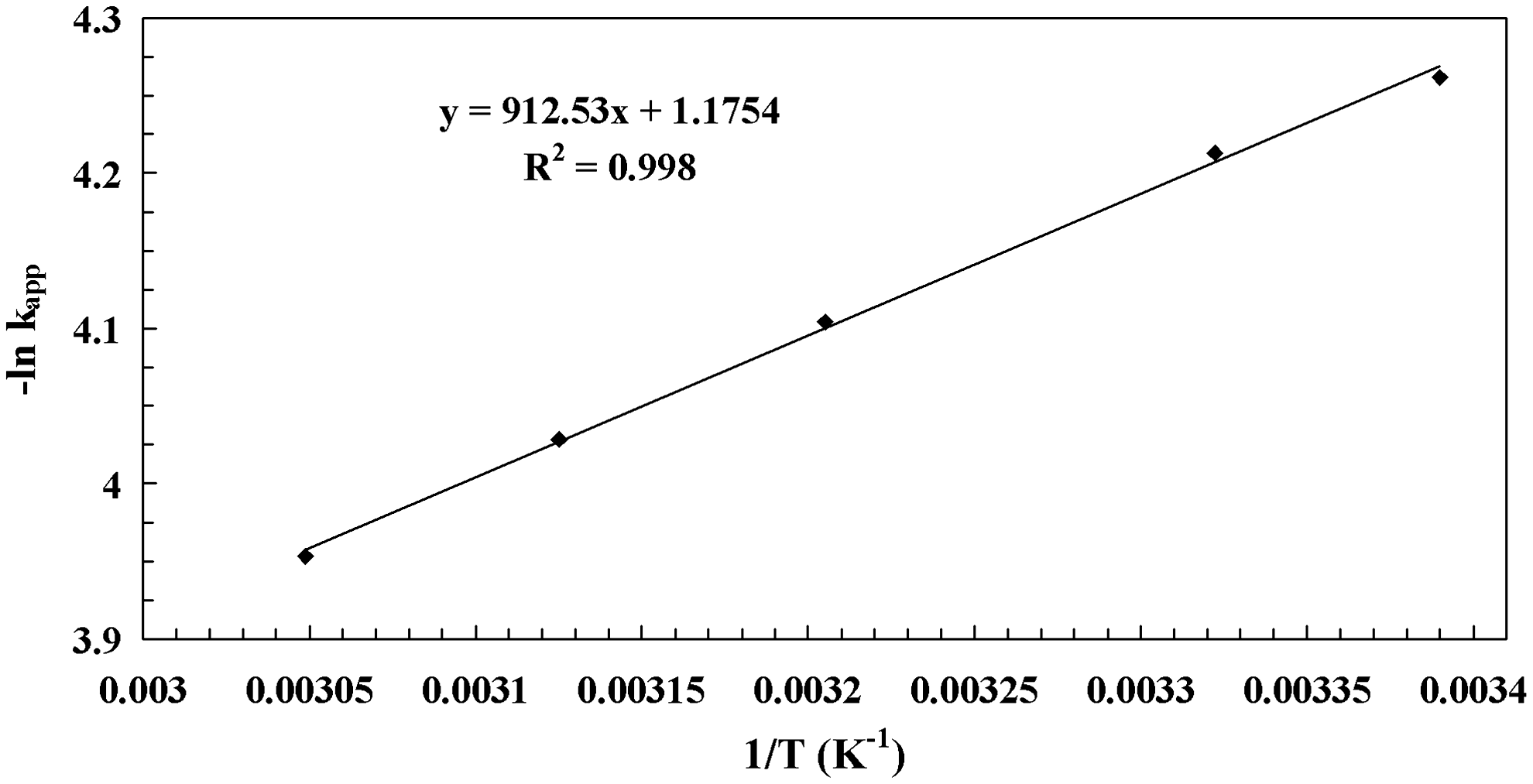
Arrhenius plot for photocatalytic degradation of RO16 ([RO16]0=15 mg·L−1 and FR=10 L·h−1).
As can be observed from Fig. 5, kapp can be correlated to the FR in the range of 5–15 L·h−1 with a power law-type empirical equation [Eq. (3)]:
Figure 5 reveals that the reaction rate enhances with increasing of the FR because of greater mass coefficient, which was caused by more turbulence in the photoreactors. In addition, when external resistance occurs against mass transfer especially at low FRs, the reaction rate promotes with enhancement of the circulating flow rates (Mozia et al., 2007; Laoufi et al., 2008).
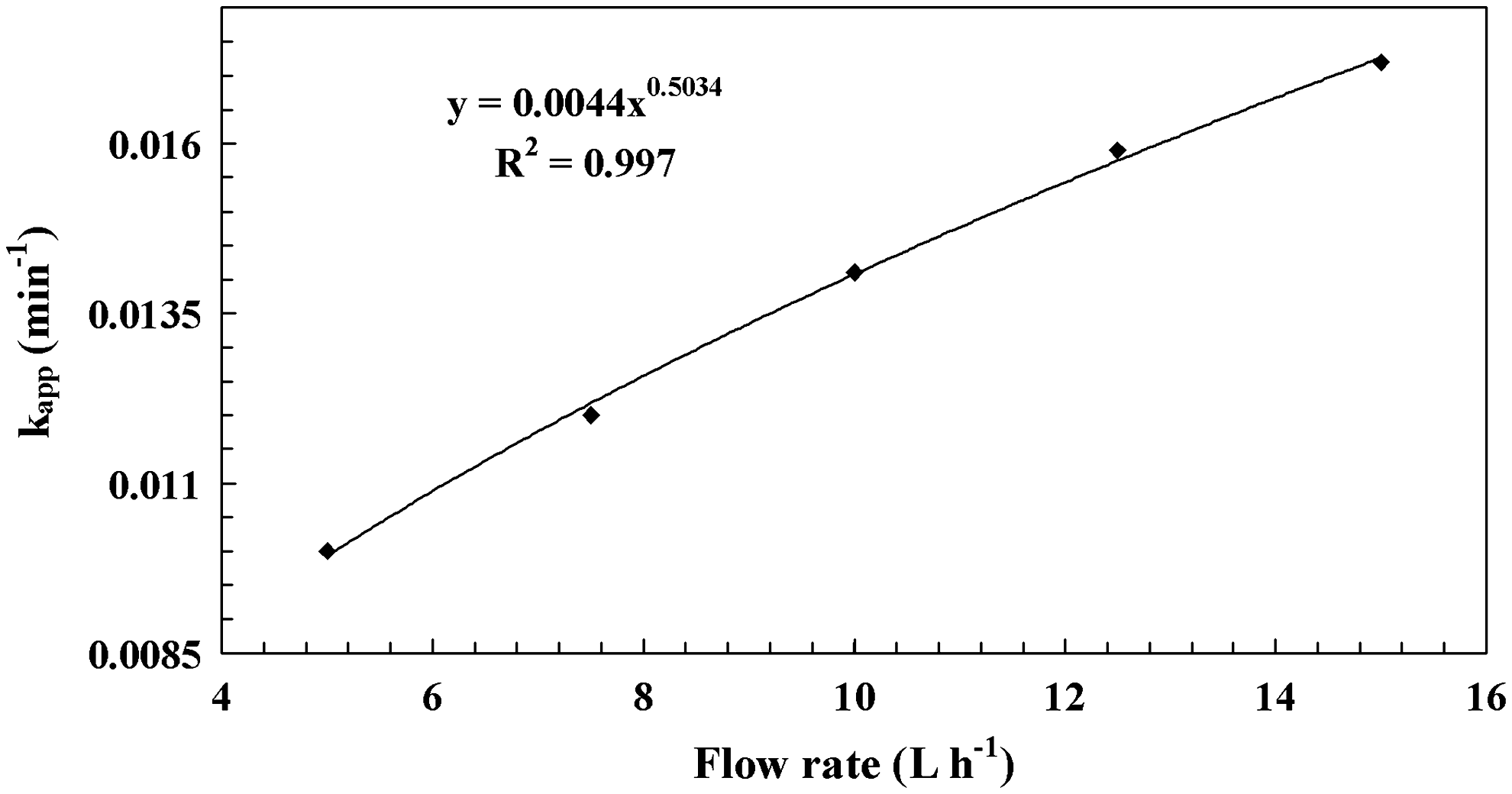
Plot of kapp versus FR ([RO16]0=15 mg·L−1 and T=295K).
A correlation between kapp and intial concentration of RO16 can be concluded [Eq. (4)] from the modified Langmuir-Hinshelwood equation (Daneshvar et al., 2004):
Reaction rate constant (kobs) of the photocatalytic degradation reaction and adsorption rate constant (KR) of RO16 in the concentration range of 5–25 mg·L−1 were estimated from the plot of 1/kapp against [RO16] o (Fig. 6) as 0.340 mg·(L·min)−1 and 0.112 L·mg−1, respectively. Also, Fig. 6 demonstrates that the reaction rate decreases with increasing of initial concentration of RO16. This trend can be explained by constant produced amount of hydroxyl radicals and active sites on TiO2 surface at the same operational conditions, which are not sufficient for the degradation of more RO16 dyes and their degradation intermediates; on the other hand, the solution becomes more impermeable for UV irradiation with increasing of RO16 concentration due to the inner filtration effect of RO16 molecules (Fathinia et al., 2010).
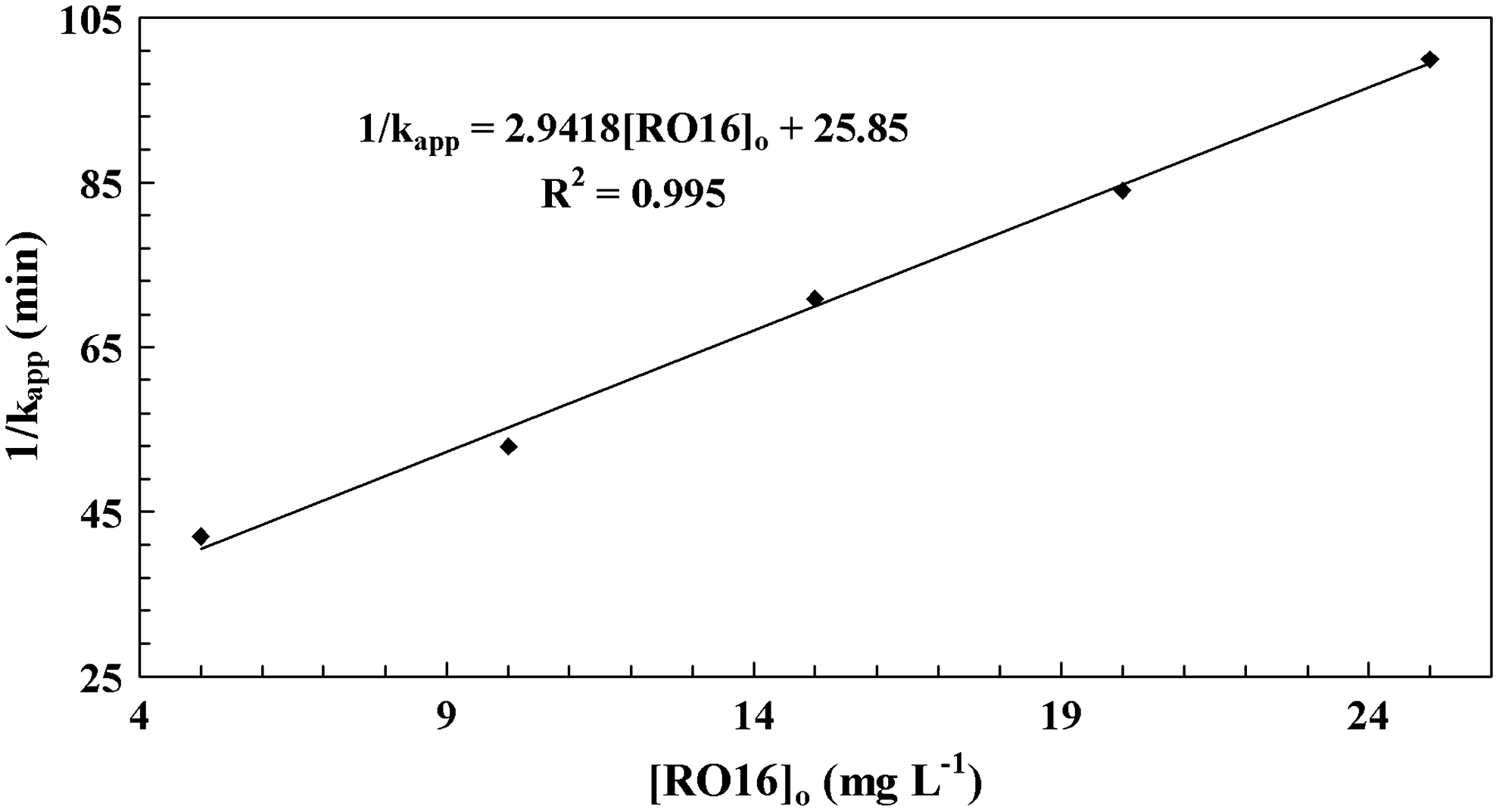
Modified Langmuir plot (T=295K and FR=10 L·h−1)
With the aim of above results a model can be developed for predicting kapp as a function of temperature, FR, and initial concentration of RO16 as following [Eq. (5)]:
Ea, n, and KR were estimated by nonlinear regression analysis with polymath 5.1, and then with known values of T, FR, and [RO16]0, k′ can be calculated as 2.20. By substituting estimated values in Equation (5), the following equation was obtained:
The above equation can determine kapp theoretically in the various ranges of operational conditions. Figure 7 compares experimental and theoretical kapp for degradation of RO16 at several operational conditions. It can be concluded that the experimental data are consistent with predicted data by the model properly in the wide ranges of operational parameters (Table 1).
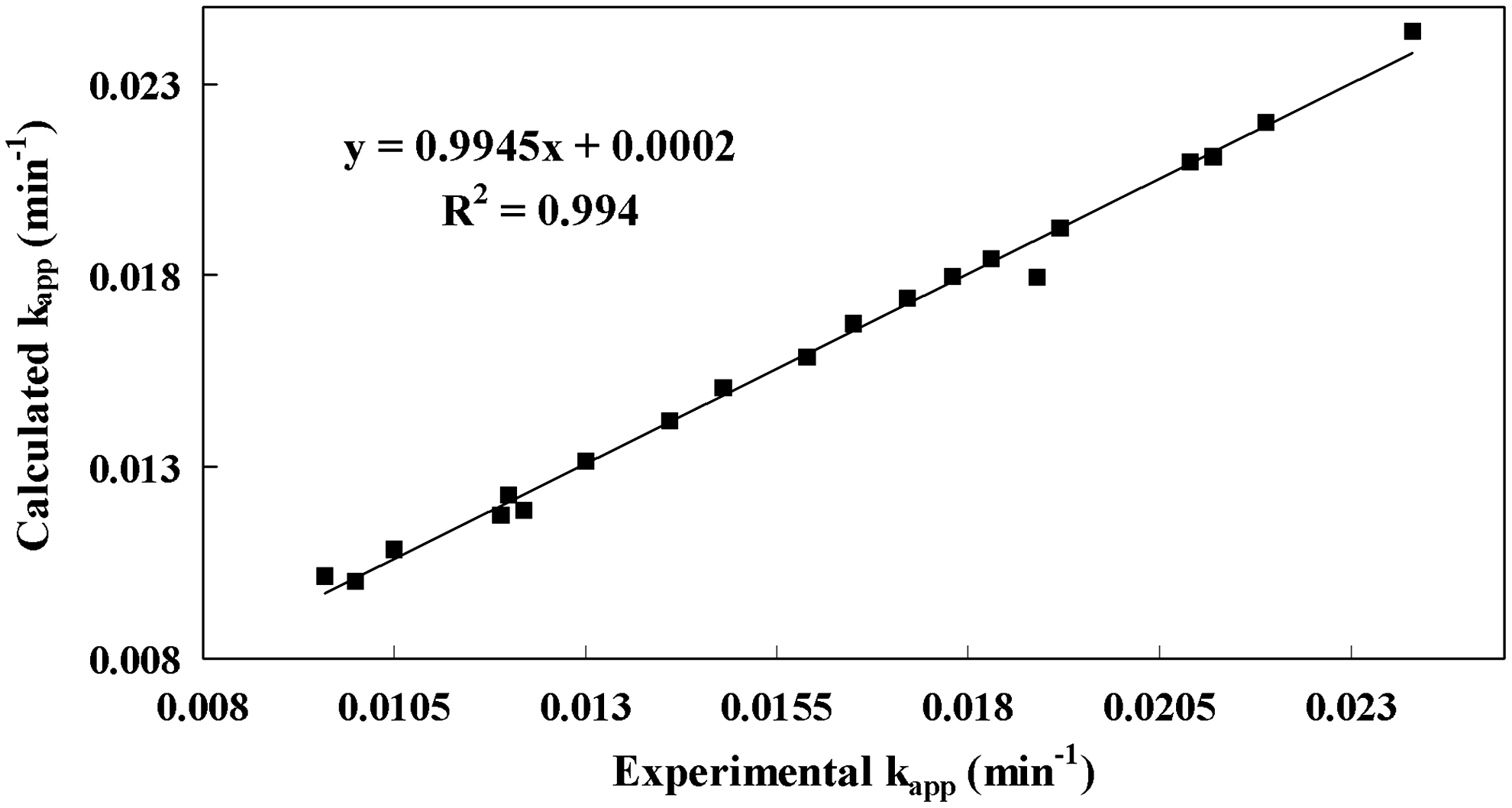
Comparison between the experimental and calculated apparent pseudo-first-order rate constants of the UV/TiO2 process. For experimental details refer to Table 1.
RO16, Reactive Orange 16; EEO, electrical energy per order.
Electrical energy determination
Since the electric energy consumption in AOPs includes a significant part of the operating costs, evaluation of it can be performed by the EEO for the first-order–kinetics regime, which was observed in this study too. EEO was accepted by IUPAC and is defined as the required amount of electric energy (kW·h) to eliminate 90% of a pollutant in one liter of contaminated water; EEO can be measured as following [Eq. (7)] (Behnajady et al., 2009):
where Pel and V are the sum of the input power (kW) from UV lamps to the UV/TiO2 system and the volume of solution (L), respectively. The experimental and predicted EEO values are summarized in Table 1; it can be concluded that the kinetic model can be used successfully for prediction of EEO values at different operational conditions.
Photocatalytic mineralization of RO16
The mineralization of RO16 was monitored by COD decrease during the process with 20 mg·L−1 of RO16 aqueous solution at FR and temperature of 12.5 L·h−1 and 295K, respectively. Based on the open reflux method, the results demonstrated that COD was removed completely after 5 h of irradiation (Fig. 8).

COD removal of RO16 aqueous solution during the UV/TiO2 process ([RO16]0=15 mg·L−1, T=295K, and FR=10 L·h−1). COD, chemical oxygen demand.
Conclusions
The TiO2/polyester was used for photocatalytic degradation of RO16 repeatedly without losing its efficiency. The apparent pseudo-first-order rate constant is affected by operational parameters; it decreases with increasing the initial concentration of RO16 and increases with the enhancement of FR and temperature. With nonlinear regression a model was developed for prediction of kapp at the different operational conditions as following:
EEO was evaluated based on the experimental and theoretical kapp,which were calculated from the model. The results indicated that the model can properly predict the values of kapp at various operational conditions. The results of COD measurements demonstrated that this process can be used for complete mineralization of RO16.
Footnotes
Acknowledgments
The authors sincerely appreciate Water and Wastewater Company of East Azerbaijan and Iranian Nano Technology Initiative Council for financial and other support. We are also grateful to Mrs. Movahed for COD measurements and Mr. Monokchian for his help in running the setup.
Author Disclosure Statement
No competing financial interests exist.