




Abstract
Abstract
This work presents results on the sorption of the azo dyes Remazol Yellow GR110 and Remazol Golden Yellow RNL onto calcined MgAl-CO3 hydrotalcite under different pH (7 and 11) and temperature (25°C and 40°C) conditions. In addition to isotherm and kinetic data, this work also shows results on two techniques (thermal and ion exchange) for hydrotalcite regeneration. The Langmuir isotherm and the pseudo-second-order kinetics fit best the experimental data for both anionic dyes, resulting in a qmax of 106.3 mg/g (0.18 mmol/g) for Remazol Yellow GR110 and a qmax of 657.2 mg/g (1.1 mmol/g) for Remazol Golden Yellow RNL at the best adsorption conditions (25°C and pH=7). Results on layered double hydroxides (LDH) characterization (X-ray diffraction, Fourier-transformed infrared Spectroscopy (FTIR) indicate that the azo dyes did not intercalate into the LDH but were rather adsorbed onto its surface. Thermal recycling reduced the LDH adsorption capacity by 20% to 30% per cycle due to incomplete dye decomposition during the treatment at 500°C. Likewise, the recycling of hydrotalcite via ion exchange was fairly ineffective, as the efficiencies for dye recovery were 15%, 20% and 30% when chloride, hydroxyl and carbonate anions were respectively used as exchangers.
Introduction
An option to complement the conventional biological treatment of textile effluents is the use of a physicochemical step pre- or post-treatment. Several studies have demonstrated that hydrotalcites, which are layered double hydroxides (LDH), are efficient at adsorbing and/or intercalating anionic substances such as dyes, surfactants, halides, sulfates, nitrates, silicates, chlorides, and polymers (Cavani et al., 1991; Ulibarri et al., 1995; Barriga et al., 2002; Seida and Nakano, 2002; Cardoso et al., 2003; Lazaridis, 2003; Das et al., 2006, 2007; Bouraada et al., 2008, 2009; Lv et al., 2008a, 2008b, 2009).
LDH have the formula
The heat treatment of LDH leads to the formation of an oxi-hydroxide mixture (calcined LDH) of the constituent cations following the loss of interlayer carbonate and water. The calcined LDH formed can then be placed in contact with an anionic solution, and the LDH containing the anion of interest are obtained through the regeneration of the layered structure. This process of regeneration of the layered structure after thermal decomposition is called the “memory effect”, and it can be used to remove and recover anionic species from water and wastewater.
In this study, calcined LDHs of the type MgAl-CO3 were used for the removal of the anionic azo dyes Remazol Yellow GR110 and Remazol Golden Yellow RNL from aqueous solutions. In addition to obtaining the thermodynamic and kinetic data of this process, procedures for recycling the LDHs via thermal decomposition and ionic exchange were also investigated.
Experimental
Azo dyes used
The dyes Remazol Yellow GR110 and Remazol Golden Yellow RNL are acid reactive azo dyes that have the molecular formula C20H22N4O11S3.Na2 and C16H18N4O10S3.Na2 as shown by structures A and B, respectively, in Fig. 1. Both dyes were kindly provided by a textile industry located in Itabirito city, MG, Brazil, and were used without purification.
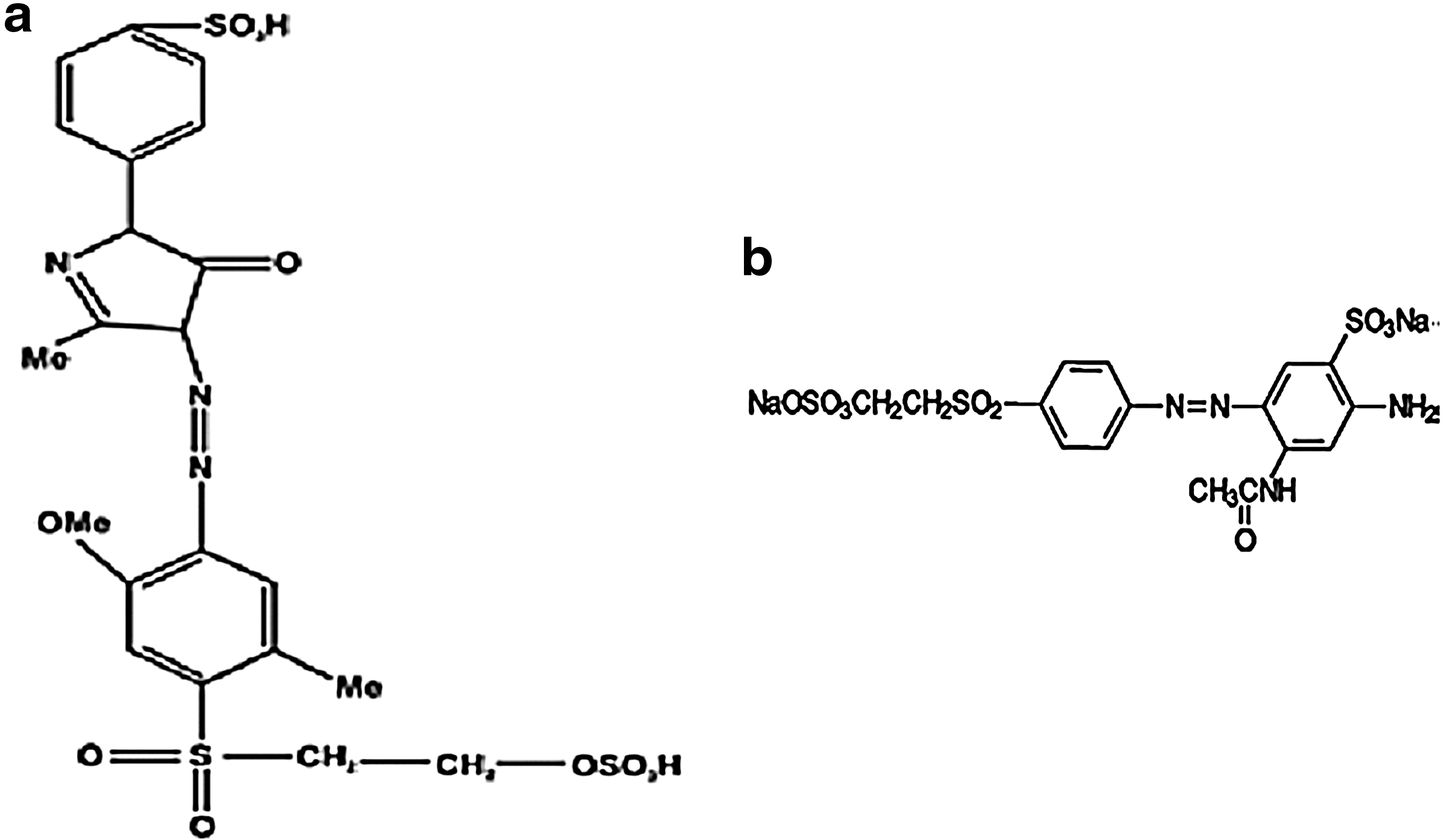
Chemical structure of Remazol Yellow GR 110
Synthesis of LDH
The LDH were synthesized by the direct method of coprecipitation at constant pH, and Equation (1) represents the theoretical synthesis of hydrotalcite with a 2/1 Mg/Al ratio.
Equation (1) was used to estimate the amount of reactants to yield 20 g of the Mg-Al-CO3 LDH type. For this procedure, 42.0907 g of Mg(NO3)2·6H2O and 30.7903 g of Al(NO3)3·9H2O were added in 100 mL of distilled water. This solution was then slowly poured into 100 mL of Na2CO3 (1 M). The pH of the resulting solution was measured and kept at pH 10 using a NaOH (2 M) solution previously prepared. The procedure of adding NaOH and monitoring the pH was carried out for 4 h under continuous stirring at 40°C on a magnetic stirrer with heating. Subsequently, a SOLAB incubator shaker (model SU 201250) was used to keep the reaction at 55°C and 200 rpm for 20 h.
The resulting suspension was then vacuum filtered and dried at 50°C in an oven to obtain LDH of the MgAl-CO3 type. Part of this material was heat treated in an oven for 4 h at 500°C and then kept in a vacuum desiccator. This heat treatment procedure led to the formation of the calcined LDH Mg4Al2O7, which is the material used in the subsequent tests.
Azo dye hydrolysis
The azo dye hydrolysis in the laboratory aimed to submit the dye to the same chemical changes through which it passes during the dyeing process in a textile industry. To prepare 500 mL of 2000 mg/L of hydrolyzed dye solution, 1.00 g of dye was dissolved in distilled water, and 66.66 g of NaCl was added. The resulting mixture was shaken until complete dissolution. The solution was heated to 60°C before adding 2.50 g of NaOH, and the temperature was kept at 60°C for 1 h before adding 3.33 g of Na2CO3. The hydrolyzed dye solution was cooled, transferred to a 500 mL flask, and stored in the dark for subsequent adsorption tests.
Adsorption isotherms
Tests to determine the adsorption isotherms were carried out with the calcined LDH at three different conditions: pH 7 and 25°C (A), pH 11 and 40°C (B), and with the hydrolyzed dye solution at pH 12 and 40°C (C). The pH was monitored and kept at the desired value by adding NaOH 0.01 M or HNO3 0.01 M solutions. These values were chosen because they represent the conditions under which the textile effluent might be submitted throughout the wastewater treatment system; that is, after neutralization for biological treatment (condition A), before neutralization (condition B), and after mercerization and dye hydrolysis (condition C). In each test, 50.00 mg of the calcined LDH was added to 100 mL of dye solutions (raw or hydrolyzed) at concentrations ranging from 10 to 250 mg/L for 24 h using a SOLAB incubator shaker (model SU 201250) at 200 rpm.
After the contact time (24 h), which had been previously determined to ensure equilibrium, an aliquot was withdrawn from each flask and centrifuged for 20 min using an Excelsa model 206 BL at 5000 rpm. Because the supernatant and pellets were returned to the flasks after the color measurements, the solid/liquid ratio was kept constant throughout the experiment. The absorbance of the supernatant was read in an HP8453 spectrophotometer (428 nm for the hydrolyzed samples and 423 nm for the other samples of Remazol Yellow GR110; and 410 nm for the hydrolyzed samples and 417 nm for the other samples of Remazol Golden Yellow RNL). The dye concentration was then calculated from previously obtained external calibration curves.
Adsorption kinetics
Kinetic tests with the calcined LDH were carried out under the same conditions previously described for the adsorption isotherms. From the moment of the initial contact of the dye solution with the calcined LDH, the aliquots were collected in pre-established periods for determining the kinetic curves. Each aliquot was centrifuged for 20 min using an Excelsa model 206 BL at 5000 rpm, and the absorbance of the supernatant was determined by the procedure previously described. All collected samples were returned to the flasks after the absorbance readings.
Effect of temperature and pH
To study the effects of temperature and pH on the dye adsorption/intercalation, tests were performed with 50.00 mg of calcined LDH using a SOLAB incubator shaker (model SU 201250) at 200 rpm for 24 h with 100 mL of a solution containing 25 mg/L of dye at different temperatures (25°C and 40°C) and pH (7 and 11), keeping one parameter constant and varying the other. At the end of the experiment, the absorbance of the supernatant was read, and the residual dye concentration was determined as previously described, thus allowing the determination of the average azo dye removal efficiency for each condition.
LDH recycling capacity
Thermal recycling capacity studies were conducted to evaluate the number of cycles of sorption-calcination-sorption the material was able to withstand without significant loss in sorption capacity. For this purpose, 20.00 mg of calcined LDH was added to 100 mL of a solution containing 300 mg/L of dye and kept at 25°C and pH 7 under continuous mixing (200 rpm in a SOLAB model SU 201250 incubator shaker) for 24 h. After the contact time, the final absorbance of the supernatant was measured, and the resulting powder was submitted to heat treatment for 4 h at 500°C. After this procedure, the powder was weighed and subjected to a new adsorption cycle, keeping constant (at 2/3) the mass ratio between the LDH and the azo dye. This procedure, illustrated in Fig. 2, was performed five times.

Scheme of the memory effect property, which allows thermal recovery of LDH.
In addition to thermal treatment, the recycling of used LDH (loaded with dye) was assessed by the ion exchange process. This test consisted of adding 50.00 mg of the oxi-hydroxide mixture to 50 mL of the 2.8 M solutions of chloride, carbonate, and hydroxide anions to recover the adsorbed dye and obtain new LDH by ion exchange. The tests were carried out at both 25°C and 50°C for 24 h, with the mixing speed maintained at 200 rpm in a SOLAB incubator shaker (model SU 201250). The recovery efficiency was assessed by measuring the supernatant absorption at the maximum azo dye wavelengths previously mentioned.
LDH characterization
To study the structural properties of the material before and after the adsorption experiments, the characterization techniques of specific surface area and porosity, thermo gravimetric analysis (TGA), infrared transmission spectroscopy, X-ray diffraction (XRD) and zeta potential were used as described by Vieira et al. (2009). In addition, the point of zero charge (PCZ) of the LDHs was determined according to the procedure described by Aquino et al. (2010), and the pKa values of both azo dyes were determined by potentiometric titration.
Results and Discussion
Adsorption isotherms
The adsorption isotherms were obtained from graphs that relate the amount of solute adsorbed (mg/g) and the solute concentration (mg/L) at equilibrium. The isotherm models studied were Langmuir, Freundlich, and Temkin, according to Equations (2)–(4):
where q represents the amount of solute adsorbed on the solid phase (mg/g), qmax is the maximum sorption capacity (mg/g), KL is a Langmuir constant related to the affinity between adsorbate and adsorbent (L/mg), Ce is the aqueous phase equilibrium concentration (mg/L), K is the constant of adsorption capacity (L/g), n is the constant of adsorption intensity, KT is the equilibrium bonding constant (L/mol), and B is related to the heat of adsorption (Do, 1998; Onal, 2006; Chairat et al., 2008).
Figure 3 shows the adsorption capacity (mg/g) as a function of dye concentration at equilibrium (mg/L) for the three conditions studied. The adsorption of both dyes was best described by the Langmuir model, indicating that the adsorption occurred in the monolayer and onto a homogeneous surface. In this case, the adsorbate appears to have interacted with specific sites through strong links, with the plateau observed corresponding to a monolayer of adsorbate, especially when the adsorption was carried out at pH 7, where a higher adsorption capacity was observed (Table 1).
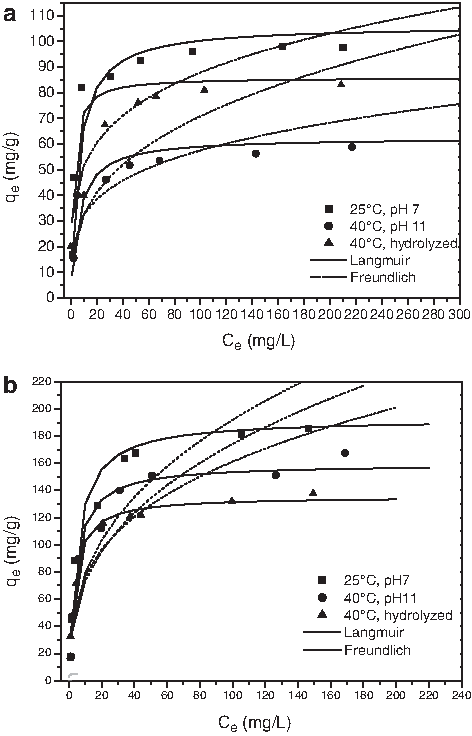
Isotherms of Remazol Yellow GR110
The PCZ was determined at pH 11. At this pH, the potential zeta of the sorbent material (LDH) was zero (0 mV), whereas the pKa values of the azo dyes were 4 and 6 (two inflection points) for Remazol Yellow GR110; and 3, 3.5, and 6 (three inflection points) for Remazol Golden RNL (data not shown). These results suggest that at pH 7, the adsorption might have occurred due to electrostatic interactions between the LDHs (positively charged) and the dyes (negatively charged due to the deprotonation of the sulfonic and sulfate acid groups). At higher pH (11 or 12), the adsorption due to electrostatic interaction would be weakened, which might explain the lower dye removal capacity at such conditions (Table 1).
Figure 3 shows that by increasing the dye concentration the adsorption capacity increased until saturation was reached, indicating that the interaction sites were completely filled. This result is consistent with the adsorption theory, and it reinforces the hypothesis that no intercalation of the dye into the LDH structure occurred, as will be discussed further using the XRD results.
An analysis of Fig. 3 and of the data presented in Table 1 demonstrates that the concomitant increase of temperature and pH resulted in a reduction in the maximum amount of dye adsorbed. According to the shape of the isotherms and the parameters RL (RL=1/[1+KL·C0]) from the Langmuir model, it is concluded that the adsorption isotherms are favorable (0 <RL <1). For Remazol Yellow GR110, the qmax was 106.3 mg/g (0.18 mmol/g) at the best conditions found (25°C, pH 7), which is higher than the values reported in the literature. For instance, Rutz et al. (2008) reported a qmax of 13.1 mg/g for the same dye using wasted alumina as an adsorbent. For Remazol Golden Yellow RNL, the current study found a qmax value of 657.2 mg/g (1.1 mmol/g) at the same best conditions mentioned before. Al-Degs et al. (2000) observed that the Langmuir model also best fitted the experimental data during Remazol Golden Yellow adsorption by activated carbon, and the qmax found varied from 71.4 to 111.1 mg/g.
Adsorption kinetics
The kinetic models studied to establish the order of the adsorption process were pseudo-first-order and pseudo-second-order [Equations (5) and (6)], where qe and qt are the amount of dye adsorbed (mg/g) at equilibrium and time t, respectively; k is the adsorption rate constant for the pseudo-first-order (min−1); and k2 is the adsorption rate constant for the pseudo-second-order (mg/g/min) (Mane et al., 2007).
The curves presented in Fig. 4 best fitted the pseudo-second-order model, which was evaluated by both the correlation coefficient of linear regression (R2) and the difference between the calculated and measured values of q, as shown in Tables 2 and 3. It is observed that the dye removal capacity (qt) was reduced when its initial concentration was lower, probably due to mass transfer limitations, as a smaller amount of dye in the solution implies a decreased driving force for adsorption. In contrast, the tests carried out with the lower dye concentration rendered a higher percentage of dye removal because the amount of calcined LDH used was kept constant; hence, the LDH/dye ratio was higher.
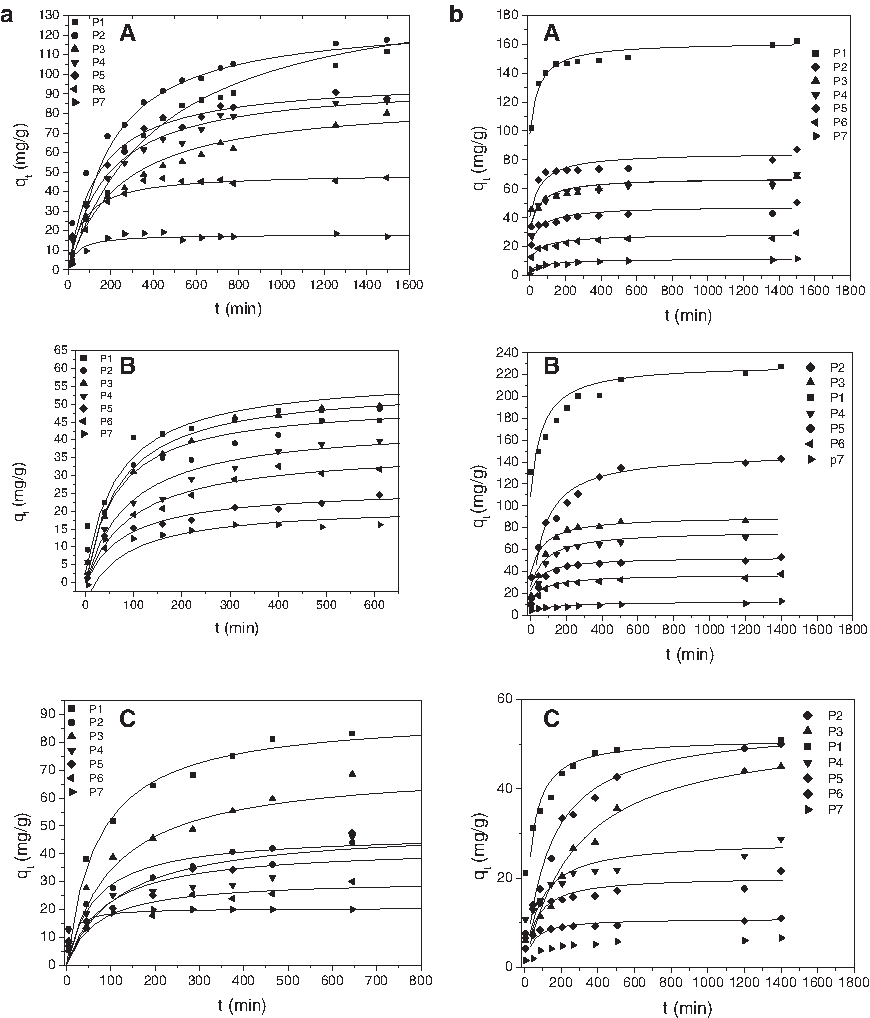
Kinetic curves of the adsorption of Remazol Yellow GR110
Table 4 shows the efficiencies of Remazol Yellow G110 and Remazol Gold Yellow RNL removal by adsorption onto LDH in terms of the pH and temperature values studied. It can be seen that the higher the temperature and pH, the smaller the percentages of dye removal. These results are consistent with those obtained in the isotherm study (Fig. 3 and Table 1). The lower removal at higher pH can be attributed to a competition between the dye and the hydroxyl ion for the adsorption sites and to the PCZ and the zeta potential of the LDH being ∼11. In turn, the decrease in adsorption efficiency at higher temperature is probably due to the adsorption phenomenon being exothermic (Pavan et al., 2000; Crepaldi et al., 2002a; Reis et al., 2004).
LDH recycling capacity
During the hydrotalcite thermal regeneration, there was a loss in the removal capacity of Remazol Yellow GR110 and Remazol Golden Yellow RNL of ∼20% and 30% per cycle, respectively. The initial dye removal (first cycle) was relatively low due to the lower LDH/dye ratio (2/3) employed in the test.
After five cycles, the loss in adsorption capacity was ∼80% to 90% for both dyes, and the dye removal efficiency was below 5%. These results were expected because the thermal analysis indicated that only ∼30% of the dye mass was lost at 500°C (data not shown), that is, the dyes used do not completely decompose at 500°C. Therefore, the residual dye adsorbed accumulated onto the LDH surface along the cycles of regeneration-calcination, precluding the adsorption of new dye molecules. A reduction in recycling capacity has also been reported in LDH studies removing polyethylene terephthalate (10% loss after 5 cycles) and vanadate and arsenate (50% loss after 2 cycles), according to Crepaldi et al. (2002b) and Kovanda et al. (1999). Thermal regeneration at temperatures higher than 500°C is not possible, as the high temperature would irreversibly alter the LDH structure.
With regard to the ion exchange recovery procedure, the results showed that low recovery efficiencies were obtained with all anionic solutions tested. In the best scenario, only 30% of dye adsorbed onto the LDH was recovered for a simple ion exchange with sodium carbonate at 25°C. The recovery efficiency was according to the following anion order:
LDH characterization
The calcined LDH had 21.3 m2/g of surface area and 0.07977 cm3/kg of total porosity, and the material could be characterized as mesoporous. The surface area is small compared with active carbons, but it resulted in relatively high adsorption capacities, as previously described (section 3.1). Because this work shows that the adsorption of Remazol Yellow azo dyes by LDHs was a surface-related phenomenon, it is expected that color removal increases with the increase of the LDH dose. From the adsorption capacities determined, a removal of 75% of Remazol Yellow GR110 from a 100 mg/L solution would require an LDH dose of ∼0.7 g/L; whereas a removal of 99.99% of such azo dye could be accomplished with a higher dose of ∼0.95 g/L.
Figure 5 shows the XRD for the calcined LDH submitted to the process of adsorption using Remazol Yellow GR110 and Remazol golden Yellow RNL. The basal spacing and parameters calculated from the XRD spectra show that a lamellar structure was obtained. Although no chemical analysis was carried out to confirm the composition of the LDH obtained [as indicated in Equation (1)], the XRD data show that the basal spacing given by the peaks (003), (006), (009) and calculated according to Palmer et al. (2009), the net parameters (a=3.0 Å; C=23.6 Å) calculated according to Pérez-Ramirez et al. (2001), and the average particle size (t=24.9 nm) calculated according to Zhao et al. (2009) are typical of an LDH of the MgAl-CO3 type.
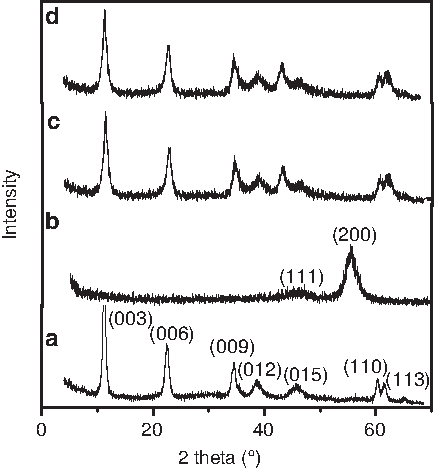
X-ray diffraction of the materials:
The XRD results also showed there was a regeneration of the LDH from the calcined material, but there was no intercalation of the dye molecules. The calculated basal spacing (d003) of 7.8 Å is in accordance with the intercalation of carbonate ions (Kloprogge et al., 2001), which is a ubiquitous contaminant of aqueous solutions. Higher spacing values of ∼20 Å would be expected if the dyes were intercalated between the layers of the material, which would result in a leftward shift of a d(003) peak.
The Fourier-transformed infrared spectroscopy (FTIR) spectra (Fig. 6) show the characteristic bands of both dyes and LDH before and after the adsorption tests. It can be seen that the dyes used in this study had similar FTIR spectra due to their similar structure and the presence of the same acid and azo groups. The spectra highlights are the bands near 1400 cm−1 related to O=S – SO3H stretching; 2900 cm−1 and 1170 cm−1 related to the HO – SO3H and O=S – SO3− groups, respectively; 1460 cm−1 specific to the azo group N=N; 1000 cm−1 and 1500 cm−1 related to the N=N sulfonic acids and sulfonate groups, respectively; and bands of ∼700 cm−1 related to the aromatic rings of both dye molecules.
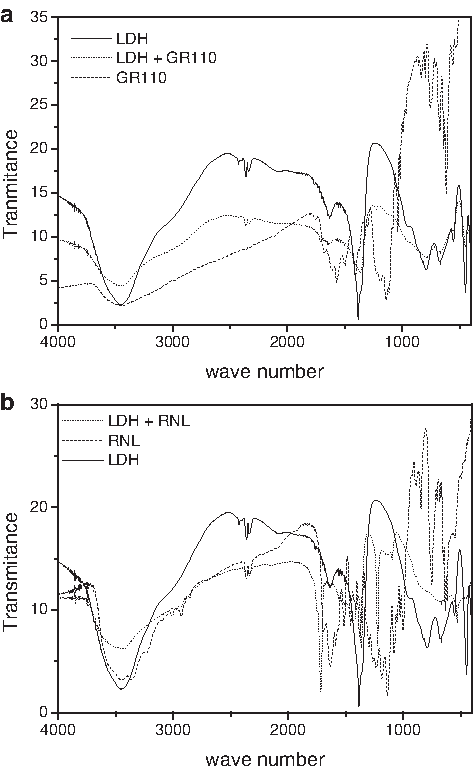
Infrared spectrum of LDH samples after the adsorption tests with Remazol Yellow GR110
Figure 6 also shows that the LDH used for the adsorption of Remazol Yellow GR110 had traces of the dye according to the bands between 1100 cm−1 and 1500 cm−1 related to the sulfonic acid and sulfate groups. Likewise, the LDH used for Remazol Golden Yellow RNL adsorption showed characteristic bands of the azo dye of ∼1200 and 1700 cm−1. These results confirm the TGA data, which indicated that thermal treatment is not a good option for LDH regeneration. These results also suggest that the color removal was due to dye adsorption rather than its intercalation.
Conclusions
The results presented in this paper show that adsorption of the anionic azo dyes Remazol Yellow GR110 and Remazol Golden Yellow RNL onto LDH is possible, and it followed the Langmuir isotherm and the pseudo-second-order model. Thermal recycling resulted in a loss of adsorption capacity, as the recovery efficiency was reduced by 20%–30% per cycle due to incomplete dye decomposition during the heat treatment at 500°C. LDH recycling by ionic exchange was not possible because the dyes were not intercalated into the lamellae structure, as confirmed by the XRD results. Despite the nonoccurrence of dye intercalation, the LDHs proved to be a good azo dye adsorbent because the qmax values obtained at the best conditions studied (pH=7 and T=25°C) were 106.3 and 657.2 mg/g for Remazol Yellow GR110 and Remazol Golden Yellow RNL, respectively. Such adsorption capacities are higher than those reported in the literature for adsorbents that have higher porosity and surface area.
Footnotes
Acknowledgments
The authors would like to thank UFOP, CNPq, FAPEMIG, and CAPES for their financial support.
Author Disclosure Statement
No competing financial interests exist.