




Abstract
Abstract
Polychlorinated dibenzo-p-dioxins and dibenzofurans (PCDD/Fs) are formed jointly with numerous products of incomplete combustion during waste incineration. Chlorobenzenes (CBz) are often cited as surrogates or precursors of PCDD/Fs. Experiments were conducted to investigate the effect of some key parameters on CBz formation, including moisture (H2O), chlorine gas (Cl2), cupric chloride (CuCl2), urea [(NH2)2CO], ammonia (NH3), and ammonium sulfate [(NH4)2SO4]. Cl2 and CuCl2 promoted CBz formation from fly ash, increasing the chlorination degree. In addition, Cl in cupric compound was more active than chlorine atom of Cl2, and chlorine type significantly affected the chlorination process. Less CBz yield was detected after S- and N-containing compounds [(NH2)2CO, NH3, and (NH4)2SO4] were added into reactive ash. High content of moisture in gas prevented CBz synthesis and reduced chlorination. These experimental results are useful to optimize CBz emission control and realize the mechanism of the correlation between CBz and PCDD/Fs.
Introduction
PCDD/Fs formation is always accompanied by numerous chlorinated organics, particularly CBz. Current emissions of pentachlorobenzene (PeCBz) is estimated to be about 121 ton/year, and one of the largest sources appears to be solid wastes, about 32 ton/year (Bailey et al., 2009). The concentration of CBz in flue gas of waste incinerator is much higher than dioxins, as well as 10–100× that of CPh. The surface-mediated reactions of CBz is possibly a significant source of PCDD/F emissions (Nganai, et al., 2011), although the ratio of PCDFs to PCDDs is mostly more than 1.0. Considering the great correlation between CBz and PCDD/Fs, Öberg and Bergstrom (1985) proposed CBz as a surrogate of PCDD/Fs. For more volatile and higher concentration, CBz is easier for sampling and analysis than dioxins. CBz is used as the indicator for dioxins real-time measurement (Blumenstock et al., 2001). However, a few studies concerns on CBz formation, Taylor and Dellinger (1999) made a summary of the heterogeneous mechanism of chlorinated hydrocarbon growth from small hydrocarbons via chlorination and condensation. In our previous study (Yan et al., 2010), it was observed that the optimum temperature for CBz formation from fly ash is 300°C–400°C, which is consistent with the condition for PCDD/Fs and CCl4 formation (Khachatryan and Dellinger, 2003; Zheng et al., 2008). This experimental study investigated the effect of key parameters on CBz formation, including moisture (H2O), chlorine gas (Cl2), cupric chloride (CuCl2), urea [(NH2)2CO], ammonia (NH3), and ammonium sulfate [(NH4)2SO4], and made a comparison with dioxins formation for understanding the mechanism of the correlation between CBz and PCDD/Fs.
Materials and Methods
Fly ash preparation
According to the Chinese National Implementation Plan for the Stockholm Convention on Persistent Organic Pollutants (2007), PCDD/Fs emission from hospital waste combustion is 1.18 kg I-TEQ (International Toxic Equivalency) in 2004, China, accounting for 11.5% of total PCDD/Fs emission (just 3.3% from municipal solid waste incinerator). So, we are quite concerned with PCDD/Fs formation and emissions from a hospital waste incinerator (HWI). Four ashes were used in these experiments. The raw ash (RA) was collected from the exit of the bag house in a HWI. Then, RA was Soxhlet-extracted 24 h by toluene, and dried in fume hood, named SEA. Cobo et al. (2009) well investigated the characterization of fly ash before and after extraction with toluene, and there was a significant difference. A mixture of SEA and CuCl2·2H2O was produced by shaking for 6 h in a churn-dasher, defined as CuDA. A simple model ash (MA) was mixed of active carbon (3.1%), quartz sand (96.7%), and CuCl2·2H2O (0.2%). The element content in ash and Brunauer-Emment-Teller (BET) surface area are present in Table 1. Fe and Cu exist in fly ash as shown in Table 1. The BET values of RA, SEA, and active carbon for MA are 11.6, 11.05, and 931.2 m2/g, respectively.
Brunauer–Emmet–Teller (BET) surface area of active carbon used in MA.
RA, raw fly ash from a medical waste incinerator; SEA, ash made through Soxhlet extraction of RA (toluene, 24 h); MA, model ash (consists of activated carbon [3.1%], quartz sand [96.7%], and CuCl2·2H2O [0.2%]).
Reaction works
Experiments were conducted in a quartz tube furnace (Fig. 1). The furnace has three independent heaters and temperature controllers (Ta, Tb and Tc) in line. The total length of the furnace is 1.5 m, and each independent heater is 0.5 m long. Reactive fly ash (or other agents) was located between two quartz fibers at the end of the internal tube (0.5 m), so the reactive gas flew through the ash. Two successive solution bubblers (acetone:n-hexane=1:4, 100 mL for each bubbler) standing in two ice baths absorbed the gas-phase products from the exhaust effluent. Every kind of experiment was performed twice for the duplication test, and the average value was used as the final result. Each experiment lasted 1 h, as the internal tube was inserted into the furnace; the gas flow is 300 mL/min, the contact time of gas after ash location is ∼68 s, as the reported work demonstrates that the reaction time significantly affects CBz yield (Lavric and Konnov, 2005); temperature was set at 350°C as the optimum temperature for dioxins formation by the de novo route. Based on our previous research (Yan et al., 2010) and in line with the literature (Ismo et al., 1997), CBz is predominantly in the gas-phase (over 90%) at 350°C, so only the evolved gas-phase product was collected and determined in this study. The reactive ash and additive in each experiment are shown in Table 2.
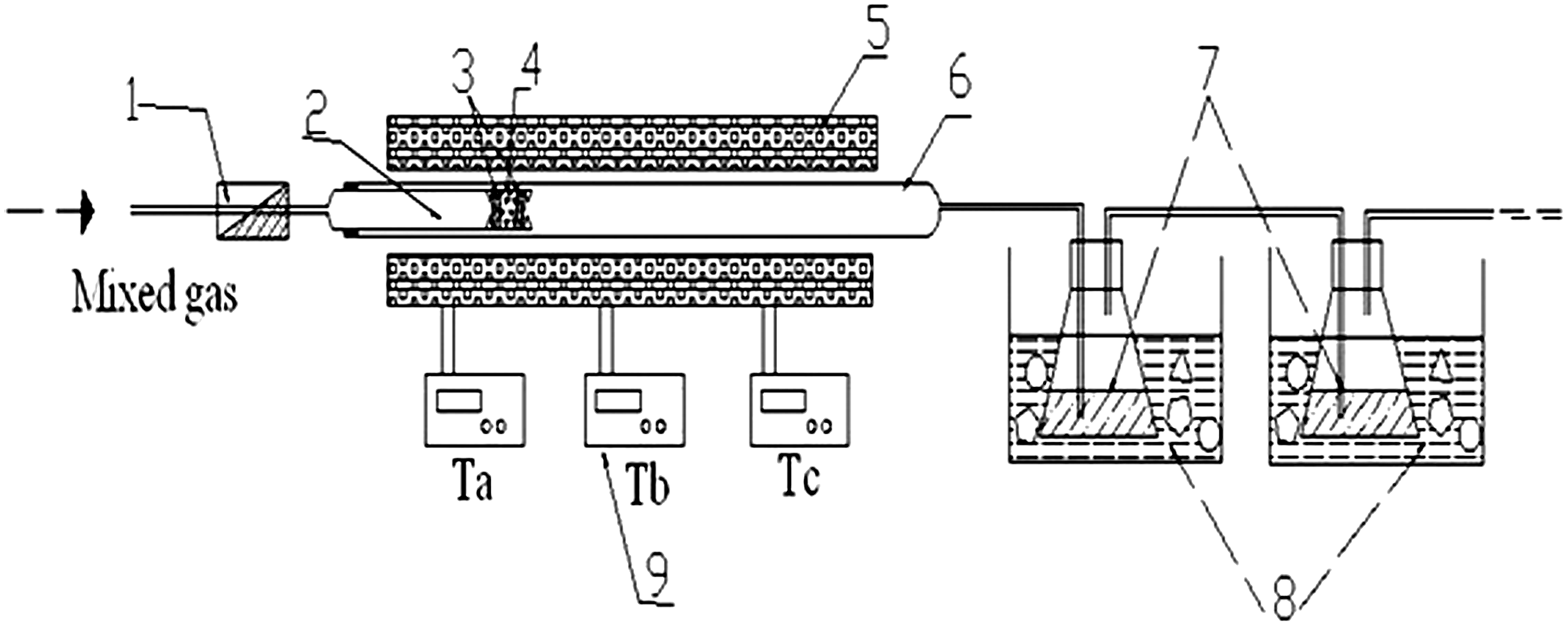
Sketch system of short tube furnace: 1, mass flow meter; 2, internal tube; 3, quartz fiber; 4, fly ash; 5, furnace; 6, external tube; 7, solution (acetone:n-hexane=1:4); 8, ice bath; 9, temperature controller.
Mixture of SEA and 1% CuCl2·2H2O.
Pretreatment and clean up procedures
After each experiment, the external parts of the furnace (connection tubes) were cooled and washed by the solution (acetone:n-hexane=1:4) and collected together with the bubbler solution for further analysis. Another clean absorption was used for the next experiment. Pretreatment was done according to Chinese State Standard Methods HJ/T74-2001 and GB 7492-87, consisting of a cleanup procedure (H2SO4 treatment, multilayer silica gel column) and gentle nitrogen gas concentration, briefly as follows: The solution was concentrated by rotary evaporation into ∼5 mL; then, the initially concentrated solution was washed by 20 mL H2SO4 with 40 mL hexane, then with 20 mL distilled water, and dewatered by Na2SO4; the primary clean solution was concentrated by rotary evaporation again; the solution was dropped through 8 g acid silica (5.6 g neutral silica and 3.4 g H2SO4) and 4 g alkaline silica (3.1 g neutral silica and 0.9 g NaOH solution with 1 mol/L); finally, the clean solution was concentrated by rotary evaporation and blown to 1 mL by a gentle nitrogen stream. The sample was stored in a refrigerator for gas chromatography (GC) analysis. The blank analysis and recovery analysis experiments were done before the experimental study.
GC analysis
CBz was analyzed by GC-electron capture detector (ECD) (GC 6890N; Agilent) after the separation on a DB-5 column (30 m×0.25 mm×0.25 μm), as ECD is quite sensitive to chlorinated compounds. The temperature program of the GC oven was set as follows: initial temperature 80°C, held for 4 min; increased at 5°C/min to 106°C, held for 0.5 min; then increased at 8°C/min to 250°C and held for 15 min. CBz standard solutions were purchased from Aldrich. The average recovery of high chlorinated compounds is above 80%, while the recovery of lower chlorinated species is not good for their quite lower boiling point, for instance, only ∼25% for monochlorobenzene. So, we just focused on the formation of high chlorinated congeners. In the RA, CBz concentrations are 1.72 ng/g of tetrachlorobenzene (TeCBz), 4.60 ng/g of PeCBz, and 5.05 ng/g of hexachlorobenzene (HxCBz), respectively.
Results and Discussion
The effects of moisture, Cl2, CuCl2, and three N- and S-containing suppressants were investigated and confronted with literature sources. Taylor and Lenoir (2001) made a review of chloroaromatic formation in incineration processes, including CBz and PCDD/Fs. The main routes for chloroaromatic formation consist of chlorination and condensation (Taylor and Dellinger, 1999). The key factors of PCDD/Fs formation and inhibition are well studied, and CBz has a great correlation with PCDD/Fs, so the comparison between CBz and PCDD/Fs was carried too. This would promote a better understanding of CBz formation and the correlation between CBz and PCDD/Fs.
Effect of moisture on CBz formation
Müller and Gubbins (1998) found that the adsorption of water occurs on the active sites on the surfaces of active carbon. Jay and Stieglitz. (1991) reported that in the presence of water vapor, considerably less PCDD and PCDF was detected. Water also can favor PCDD/Fs formation, provides more reactive sites on fly ash surface for dioxins formation (Li et al., 2006). Moisture may counteract chlorination, thus influencing CBz formation.
The effect of moisture on CBz formation is shown in Fig. 2a (distribution) and Fig. 2b (amount). Steam stimulates CBz formation, below 10% moisture-in-gas. The CBz amount increases from 2410 to 5380 ng/g with 10% moisture content and slightly reduces (4650 ng/g, 13.6% reduction) under 15% steam gas. This evolution is mainly resulted by TeCBz, as PeCBz already attains its maximum yield at 5% moisture-in-gas (Fig. 2b). HxCBz formation is inhibited in the presence of water. Stieglitz et al. (1990) indicated that the homologue patterns shifted to lower chlorinated homologues, and increased PCDD production from oxidized fly ash at 300°C, after water had been introduced. This experimental result of the CBz amount is consistent with PCDD/Fs change in Stieglitz's study. Shao et al. (2010a) found a decrease in the PCDD/Fs chlorination level with water addition, in a fully synthetic matrix. He argued that H2O converted CuCl2 into CuCl2·CuO, and finally to CuO, which caused the declining organochlorine (C-Cl) formation rates. Steam might influence the absorption and adsorption of reagents and products, as the absorption and adsorption are in the process of a heterogeneous reaction, so water might indirectly affect the formation of CBz. Water also alters the equilibrium of the Deacon Reaction: 2HCl+ 1/2O2→H2O+Cl2. Generally, the effect of moisture on PCDD/Fs and CBz is quite similar.

Effect of moisture on chlorobenzenes (CBz) formation from raw ash (RA):
Effect of Cl2 gas on CBz formation
Cl2 is thought as a cardinal factor in dioxins synthesis, in conjunction with the Deacon Reaction catalytically converting HCl into much more reactive Cl2. Khachatryan and Dellinger (2003) did a great study on chlorinated hydrocarbons formation from Cl2 and activated carbon, which demonstrated that chlorine atoms could react with carbon to form chlorinated hydrocarbons directly without an intermediate. Cl2 should strongly influence the formation of CBz from fly ash.
In this study, 500/1000 ppm Cl2 was introduced into the reaction in B2 and B3 experiments. The experimental results are present in Table 3. Every species increases after Cl2 addition. When Cl2 is 500 ppm, compared with none Cl2, the amount of CBz increases from 820 to 1400 ng/g, with 71.3% promotion. The chlorination degree increases from 4.42 to 4.72 with 1000 ppm Cl2. The test demonstrates that Cl2 works as an effective Cl source in CBz formation. By balance calculation, 500 ppm of Cl2 blew 60 min with 300 mL/min, accounting for 0.80 mmol of chlorine atoms. After experiments (B2), more than 22.26 nmol of chlorine was transferred to TeCBz (15.19 nmol), PeCBz (5.95 nmol), and HxCBz (1.12 nmol), which indicates that the efficiency of chlorination by Cl2 is 2.79×10⁻⁵. Meanwhile, more than 60.29 nmol of chlorine replaced hydrogen atom under 1000 ppm Cl2, and the chlorination efficiency is 3.74×10⁻⁵. Cl2 can boost PCDD/Fs formation in waste incineration (Thomas and Mccreight, 2008) and de novo formation in lab experiments (Wikstrom et al., 2003). When 200 ppm Cl2 was added into an entrained flow reactor (Wikstrom et al., 2003), PCDF yield increased from 405 to 2500 pmol, with a promotion of 5.17 times. Cl2 supplies the active Cl atom, and enhances the chlorination reaction. Chlorination is the critical reaction in the formation process of CBz and PCDD/Fs.
HxCBz, hexachlorobenzene; PeCBz, pentachlorobenzene; TeCBz, tetrachlorobenzene.
Effect of CuCl2 on CBz formation
Weber et al. (2001) studied the role of cupric chloride in PCDD/Fs formation on fly ash; chlorination was fast and stopped, after CuCl2 had been added and reduced. He postulated the following reaction to take place: 2CuCl2+R-H→2CuCl+R-Cl+HCl. In CBz formation, CuCl2 possibly plays a double role too, as a chlorination catalyst and as a Cl source, similar to the role in PCDD/Fs formation.
A direct comparison of CBz formation with and without CuCl2 is present in Table 4. After CuCl2,·2H2O is mixed with ash (SEA), each congener of CBz formation was promoted. The chlorination degree increases from 4.42 to 4.90. For instance, when 1% CuCl2·2H2O is added into SEA, the CBz amount significantly increases from 820 to 2550 ng/g, means over 210%. By calculation, 0.02 g CuCl2·2H2O (1% additive) equals 0.26 mmol of chlorine atoms added in the C2 experiment. Compared with the none catalyst experiment (B1), more 67.7 nmol of chlorine converts to Te ∼ HxCBz. In addition, the efficiency of chlorine conversion from CuCl2 to CBz is 2.6×10⁻⁴, which is much larger than that of Cl2 (5.57×10⁻⁵). Cl in cupric compound is more active than the chlorine atom of Cl2, so the type of chlorine significantly affects the chlorination process. Öberg and Ohrstrom (2003) investigated the influence of chlorine input and catalytic activity on CBz and PCDD/Fs, and a quite similar effect was found, as well as got a well correlation between sum CBz and PCDD/Fs amount, the coefficient was 0.953. In another two researches (Kuzuhara et al., 2003; Lu et al., 2007), the activity of metallic chlorines on the formation of organic chlorine and PCDD/Fs during low-temperature oxidation of carbon was obtained as NaCl<MgCl2<KCl<AlCl3<CaCl2<FeCl3<< CuCl2. So, CuCl2 has a strong promotion on CBz formation as the effect on PCDD/Fs synthesis.
Chlorination degree, defined as the following equation (m, mass):
Cl-CBz=[4×m(TeCBz)+5×m(PeCBz)+6×m(HxCBz)]/[m(TeCBz)+m(PeCBz)+m(HxCBz)]
Effect of urea on CBz formation
Urea as an inhibitor of PCDD/Fs formation has been investigated in lots of studies. Urea addition to fuel, before combustion, is proved to be very effective for dioxins control. In our experiments, urea was mixed with four kinds of ashes, and the mixture was heated to investigate the effect of urea on CBz formation.
Experimental results are shown in Fig. 3. Less CBz was detected in all of four ash experiments, which implies that urea prevents CBz formation. The inhibition efficiency varies among different ash, for instance, 2% additive with inhibition efficiency of 6% (SEA) ∼55% (MA). This indicates that the effect of urea on CBz formation is related to ash properties. In addition, the reduction percentages for CBz different species are different, such as when 5% was added into MA, 89%, 79%, and 51% for TeCBz, PeCBz, and HxCBz, respectively. This is different from the effect of urea on PCDD/Fs in other studies. In the research by Ruokojärvi et al. (2001), total PCDD/Fs concentration decreased after urea had been added into fly ash, the decrease is greatest for most highly (octa-) chlorinated isomers. There are some potential mechanisms of urea suppressing dioxins formation. Tuppurainen et al. (1999) gave the assumption of producing a new urea-metal complex. When urea is heated, it will emit ammonia, which can neutralize HCl and Cl2. Kuzuhara (2005) detected organic compound containing amino (NH2-) and cyanide (CN-) after urea addition. Lippert et al. (1991) pointed out that amine blocked the active sites of copper surface for PCDD/Fs formation. The possible mechanism of urea reducing CBz formation is similar as the potential reason on PCDD/Fs generation.

Effect of urea on CBz formation from four different ashes.
Effect of ammonia
Ammonia contains N and belongs to one of the inhibitors for PCDD/Fs formation (Ruokojärvi et al., 1998). Ammonia displays a significant inhibition on CBz formation as depicted in the results in Table 5. Except SEA, each CBz congener directly reduced after 500 ppm ammonia was introduced into the reaction. The reduction of total CBz is in the range of 40.5% (MA) to 57.1% (RA). Except MA, more ammonia does not further prevent CBz formation. When ammonia concentration is 1000 ppm, CBz yield from MA significantly reduced, in detail, TeCBz from 4450 to 1320 ng/g (70.2%), PeCBz from 3030 to 894 ng/g (70.4%), and HxCBz from 1420 to 409 ng/g (71.1%), respectively. Takacs and Moilanen (1991) investigated the simultaneous control of PCDD/Fs, NOx, and HCl, and figured out the possible working reaction: 2NH3+3Cl2→N2+6HCl and NH3+HCl→NH4Cl. Ammonia can block the active chlorine source and prevent the chlorination reaction, which causes the reduction of both CBz and PCDD/Fs.
Effect of (NH4)2SO4 on CBz formation
Pandelova et al. (2005) found that 3 wt.% addition of (NH4)2SO4 (basis=fuel combusted) resulted in >90% reduction of PCDD/Fs emissions. The widely accepted mechanism is that sulfate poisons activate metal catalysts by converting CuCl2 into CuSO4 (Ruokojärvi et al., 2001). Obviously, (NH4)2SO4 is an effective inhibitor for CBz emissions, as the experimental results are depicted in Fig. 4. 2% addition of (NH4)2SO4 reduces 83% of the CBz amount, and 5% of the inhibitor results in 98% less of CBz yield. CuCl2 is the catalyst of CBz formation, and (NH4)2SO4 can poison the active catalyst. (NH4)2SO4 is considered the best option as a PCDD/Fs effective inhibitor, as the single N- and S-containing compounds are perfect inhibitors.

Effect of ammonium sulfate [(NH4)2SO4] on CBz formation from model ash (MA).
Conclusion
After a series of lab experimental work, it is observed that most of the key parameters for PCDD/Fs formation have a similar influence on CBz formation, including moisture, metal complex, Cl2-, S-, and N-containing compounds. High content of moisture reduces CBz formation. CuCl2 and Cl2 increase CBz yield from ash, Cl in cupric compound is more active than the chlorine atom of Cl2, chlorine type significantly affects the chlorination process. S- and N-containing compounds [urea, ammonia, and (NH4)2SO4] inhibit CBz formation, and (NH4)2SO4 has the highest inhibition efficiency. These experimental results can be used to explain the great correlation between CBz and PCDD/Fs in previous research. In addition, adding S- or N-containing compounds during combustion is useful for organic pollutants emission control.
Footnotes
Acknowledgments
This study was financially supported by the Major State Basic Research Development Program of China (973 Program) (No. 2011CB201500) and Scholarship Award for Excellent Doctoral Student granted by the Ministry of Education.
Author Disclosure Statement
The authors give their official statement that no competing financial interests exist for this article and this study.