Selenium (Se) is emerging as a contaminant that must be dealt with in many areas of the world, especially those areas impacted by past or current mining activities. In this study, we evaluate the effectiveness of synthesized nano-magnetite when used as an adsorbent to remove anionic selenium species from aqueous solutions. In conjunction with studies on the effects of pH, temperature, concentration, contact time, and presence of competing anions on selenium removal efficiency, a series of batch adsorption experiments were conducted to study adsorption isotherms and adsorptive thermodynamics. Compared with either natural magnetite (<5 μm) or nano-iron (∼10 nm), nano-magnetite (10–20 nm) was found to be a better adsorbent for selenite, while nano-iron showed better adsorption performance for selenate. From an initial selenium concentration of 100 μg-Se/L, which is comparable to those commonly found in mine water or mining impacted streams, a final concentration of <5 μg-Se/L could be achieved, using nano-magnetite. Low pH favored selenite adsorption, and elevated temperature enhanced selenium removal. Selenite adsorption followed the Freundlich isotherm model, and the presence of common anions did not significantly affect the adsorption capacity of nano-magnetite for selenite. Selective adsorption demonstrated that nano-magnetite could be a very promising nano-sorbent to treat selenium contaminated water.
Introduction
Selenium (Se), an emerging global contaminant, is widely but unevenly distributed in rocks, soil, and coal, as well as other fossil fuels (Lemly, 2004). It is an essential micronutrient for humans and animals but toxic when ingested in amounts higher than those needed for optimum nutrition (Reid et al.2004; Schlekat et al.2004). Even so, Se regulations vary from country to country. For drinking water, most countries have adopted the World Health Organization (WHO) guideline (WHO, 2003), of 10 μg-Se/L. In the United States, 50 μg-Se/L is the current Environmental Protection Agency (EPA) limit for both the maximum contaminant level (MCL) and the MCL goal (MCLG), although a new limit of 5 μg-Se/L has been proposed. For surface water, the U.S. Clean Water Act of 1977 and its subsequent amendments list Se as a priority toxic pollutant and adopts freshwater acute and chronic criteria of 20 μg-Se/L and 5 μg-Se/L, respectively. Because of the likelihood of bioaccumulation through the food chain, Se levels exceeding the freshwater criteria can pose a serious risk to aquatic life and humans. In addition to its natural occurrence, anthropogenic processes, such as mining of minerals, combustion of coal, metal smelting, oil refining and utilization, and agricultural irrigation can lead to the release of Se (Lemly, 2004). Adams and Pennington (2005) and Renner (2005) have noted that mining operations and the subsequent processing and utilization of coal and minerals can result in the release of Se as oxyanions into wastewater and mine drainage. In streams impacted by surface coal mining in the central Appalachian basin, the Se concentration was higher (median 12 μg-Se/L) than that found in streams draining undisturbed areas (median 1.5 μg-Se/L) (Neuzil et al., 2007). Parida et al (1977), have found that Se can be present in four different oxidation states—selenide (Se2−), elemental selenium (Se0), selenite \documentclass{aastex}\usepackage{amsbsy}\usepackage{amsfonts}\usepackage{amssymb}\usepackage{bm}\usepackage{mathrsfs}\usepackage{pifont}\usepackage{stmaryrd}\usepackage{textcomp}\usepackage{portland, xspace}\usepackage{amsmath, amsxtra}\pagestyle{empty}\DeclareMathSizes{10}{9}{7}{6}\begin{document}
$$({\rm SeO}_3^{2-})$$
\end{document}, and selenate \documentclass{aastex}\usepackage{amsbsy}\usepackage{amsfonts}\usepackage{amssymb}\usepackage{bm}\usepackage{mathrsfs}\usepackage{pifont}\usepackage{stmaryrd}\usepackage{textcomp}\usepackage{portland, xspace}\usepackage{amsmath, amsxtra}\pagestyle{empty}\DeclareMathSizes{10}{9}{7}{6}\begin{document}
$$({\rm SeO}_4^{2-})$$
\end{document}—in aquatic environments. Of these, \documentclass{aastex}\usepackage{amsbsy}\usepackage{amsfonts}\usepackage{amssymb}\usepackage{bm}\usepackage{mathrsfs}\usepackage{pifont}\usepackage{stmaryrd}\usepackage{textcomp}\usepackage{portland, xspace}\usepackage{amsmath, amsxtra}\pagestyle{empty}\DeclareMathSizes{10}{9}{7}{6}\begin{document}
$${\rm SeO}_3^{2-}$$
\end{document} and \documentclass{aastex}\usepackage{amsbsy}\usepackage{amsfonts}\usepackage{amssymb}\usepackage{bm}\usepackage{mathrsfs}\usepackage{pifont}\usepackage{stmaryrd}\usepackage{textcomp}\usepackage{portland, xspace}\usepackage{amsmath, amsxtra}\pagestyle{empty}\DeclareMathSizes{10}{9}{7}{6}\begin{document}
$${\rm SeO}_4^{2-}$$
\end{document}are the more soluble and mobile (Sharmasarkar and Vance, 2002; Benjamin, 1983).
Although there are a number of technologies available for removing Se from water and wastewater, each has its own drawbacks. Conventional water treatment practices such as lime neutralization, softening, and ferric coagulation (Mavrov et al., 2006; Kapoor et al., 1995), result in high residual Se and large volumes of Se-containing sludge. Ion exchange and membrane processes such as reverse osmosis, nanofiltration, and emulsion liquid membranes have also been used. Ion exchange has been reported to be more effective for \documentclass{aastex}\usepackage{amsbsy}\usepackage{amsfonts}\usepackage{amssymb}\usepackage{bm}\usepackage{mathrsfs}\usepackage{pifont}\usepackage{stmaryrd}\usepackage{textcomp}\usepackage{portland, xspace}\usepackage{amsmath, amsxtra}\pagestyle{empty}\DeclareMathSizes{10}{9}{7}{6}\begin{document}
$${\rm SeO}_3^{2-}$$
\end{document} removal than for \documentclass{aastex}\usepackage{amsbsy}\usepackage{amsfonts}\usepackage{amssymb}\usepackage{bm}\usepackage{mathrsfs}\usepackage{pifont}\usepackage{stmaryrd}\usepackage{textcomp}\usepackage{portland, xspace}\usepackage{amsmath, amsxtra}\pagestyle{empty}\DeclareMathSizes{10}{9}{7}{6}\begin{document}
$${\rm SeO}_4^{2-}$$
\end{document}, and Twidwell (2005) has noted total dissolved solids and other anions interfere greatly with the Se removal. Reverse osmosis and nanofiltration techniques are rather uncommon, because pretreatment for both of these methods is complicated. Emulsion liquid membrane is preferred for sulfate rather \documentclass{aastex}\usepackage{amsbsy}\usepackage{amsfonts}\usepackage{amssymb}\usepackage{bm}\usepackage{mathrsfs}\usepackage{pifont}\usepackage{stmaryrd}\usepackage{textcomp}\usepackage{portland, xspace}\usepackage{amsmath, amsxtra}\pagestyle{empty}\DeclareMathSizes{10}{9}{7}{6}\begin{document}
$${\rm SeO}_4^{2-}$$
\end{document} removal, and it is pH dependent (Mavrov et al., 2006; Gleason et al., 1996). While Se reduction has been used, and \documentclass{aastex}\usepackage{amsbsy}\usepackage{amsfonts}\usepackage{amssymb}\usepackage{bm}\usepackage{mathrsfs}\usepackage{pifont}\usepackage{stmaryrd}\usepackage{textcomp}\usepackage{portland, xspace}\usepackage{amsmath, amsxtra}\pagestyle{empty}\DeclareMathSizes{10}{9}{7}{6}\begin{document}
$${\rm SeO}_4^{2-}$$
\end{document} can be reduced to \documentclass{aastex}\usepackage{amsbsy}\usepackage{amsfonts}\usepackage{amssymb}\usepackage{bm}\usepackage{mathrsfs}\usepackage{pifont}\usepackage{stmaryrd}\usepackage{textcomp}\usepackage{portland, xspace}\usepackage{amsmath, amsxtra}\pagestyle{empty}\DeclareMathSizes{10}{9}{7}{6}\begin{document}
$${\rm SeO}_3^{2-}$$
\end{document}or elemental Se to facilitate its removal, the process generates large volumes of sludge (Mavrov et al., 2006). Other factors that have affected the wide application of this technique include the high cost of reagents and interferences by dissolved oxygen and other anions (Mavrov et al., 2006). In recent years, biological processes for the removal of Se have received great attention (Hunter and Manter, 2009; Takada et al., 2008), but the operating time and size of bioreactors are obvious challenges. Adsorption is by far the most researched and most promising method for treating Se laden water. Among the adsorbents used are alumina, activated carbon, manganese nodule leached residues, sulphuric acid-treated peanut shell, and various iron oxides/hydroxides (El-Shafey, 2007; Dash and Parida, 2007). The iron-based adsorbents include amorphous iron oxyhydroxide (Parida et al., 1997; Balistrieri and Chao, 1990; Benjamin, 1983), goethite (Zhang and Sparks, 1990), ferrihydrite (Parida et al., 1997), “waste” iron (III) hydroxide (Namasivayam and Prathap, 2006), hematite and magnetite (Martinez et al., 2006), goethite and hematite (Rovira et al., 2008), and iron-coated granular activated carbon (Zhang et al., 2008). The major drawbacks to using these adsorbents are the preferential adsorption for either \documentclass{aastex}\usepackage{amsbsy}\usepackage{amsfonts}\usepackage{amssymb}\usepackage{bm}\usepackage{mathrsfs}\usepackage{pifont}\usepackage{stmaryrd}\usepackage{textcomp}\usepackage{portland, xspace}\usepackage{amsmath, amsxtra}\pagestyle{empty}\DeclareMathSizes{10}{9}{7}{6}\begin{document}
$${\rm SeO}_3^{2-}$$
\end{document}or \documentclass{aastex}\usepackage{amsbsy}\usepackage{amsfonts}\usepackage{amssymb}\usepackage{bm}\usepackage{mathrsfs}\usepackage{pifont}\usepackage{stmaryrd}\usepackage{textcomp}\usepackage{portland, xspace}\usepackage{amsmath, amsxtra}\pagestyle{empty}\DeclareMathSizes{10}{9}{7}{6}\begin{document}
$${\rm SeO}_4^{2-}$$
\end{document} and interferences by anions such as phosphates.
Nanotechnology is a cross-discipline field with great potential in pollution prevention, treatment, and remediation. While the applications of nanoparticles are promising, the associated high costs and the potential consequences of nanoparticles on public health are limiting factors. Consequently, low-cost, environmentally friendly nano-materials are the focus of many recent research efforts (Missana et al., 2009; Hu et al., 2004). Of the materials studied, nano-magnetite has received significant attention because it is relatively inexpensive to make, safe to handle, and friendly to the environment. Nano-sized magnetite has been studied as an adsorbent to remove such contaminants as chromium (VI) (Cr6+) (Hu et al., 2004), and methylene blue (Mak and Chen, 2004), as well as copper, zinc, arsenic, and dichlorophenol (Cumbal and SenGupta, 2005) from aqueous solutions. Missana et al. (2009) evaluated the sorption of \documentclass{aastex}\usepackage{amsbsy}\usepackage{amsfonts}\usepackage{amssymb}\usepackage{bm}\usepackage{mathrsfs}\usepackage{pifont}\usepackage{stmaryrd}\usepackage{textcomp}\usepackage{portland, xspace}\usepackage{amsmath, amsxtra}\pagestyle{empty}\DeclareMathSizes{10}{9}{7}{6}\begin{document}
$${\rm SeO}_3^{2-}$$
\end{document} by nanocrystalline magnetite and found \documentclass{aastex}\usepackage{amsbsy}\usepackage{amsfonts}\usepackage{amssymb}\usepackage{bm}\usepackage{mathrsfs}\usepackage{pifont}\usepackage{stmaryrd}\usepackage{textcomp}\usepackage{portland, xspace}\usepackage{amsmath, amsxtra}\pagestyle{empty}\DeclareMathSizes{10}{9}{7}{6}\begin{document}
$${\rm SeO}_3^{2-}$$
\end{document} retention by magnetite was affected by dissolution and coprecipitation processes. However, the size of magnetite (50–200 nm) used for the tests was relatively large (Missana et al., 2009).
This study evaluated the adsorption performance of nano-magnetite (10–20 nm) that was used to remove Se anions (\documentclass{aastex}\usepackage{amsbsy}\usepackage{amsfonts}\usepackage{amssymb}\usepackage{bm}\usepackage{mathrsfs}\usepackage{pifont}\usepackage{stmaryrd}\usepackage{textcomp}\usepackage{portland, xspace}\usepackage{amsmath, amsxtra}\pagestyle{empty}\DeclareMathSizes{10}{9}{7}{6}\begin{document}
$${\rm SeO}_3^{2-}$$
\end{document} and \documentclass{aastex}\usepackage{amsbsy}\usepackage{amsfonts}\usepackage{amssymb}\usepackage{bm}\usepackage{mathrsfs}\usepackage{pifont}\usepackage{stmaryrd}\usepackage{textcomp}\usepackage{portland, xspace}\usepackage{amsmath, amsxtra}\pagestyle{empty}\DeclareMathSizes{10}{9}{7}{6}\begin{document}
$${\rm SeO}_4^{2-}$$
\end{document}) from water and wastewater. The study also compared the effectiveness of magnetite as a nano-sorbent to the effectiveness of natural magnetite (<5 μm) and zero-valent nano-iron (∼10 nm). Specifically, a series of batch experiments were conducted to study adsorption capacity and thermodynamics under various conditions of pH, temperature, concentration, contact time, and competing anions.
Materials and Methods
Materials
Analytical grade chemicals of iron (III) sulfate [Fe2(SO4)3], ammonium hydroxide (NH4OH), sodium hydroxide (NaOH), and sulfuric acid (H2SO4) were purchased from Fisher Scientific, Inc. (Rochester, NY). Iron (II) sulfate (FeSO4·7H2O) and sodium selenate (Na2SeO4) were obtained from ACROS Organics (Morris Plains, NJ). Sodium selenite (Na2SeO3) was purchased from MP Biomedicals (Solon, OH). All chemical solutions were prepared using Millipore deionized water. A stock solution of 100 mg-Se/L was prepared with deionized water using the aforementioned Se salts, and working solutions (50, 100, 250, 500 and 1000 μg-Se/L) for the adsorption experiments were prepared from the stock solution. Natural magnetite (<5 μm, Fe3O4) was acquired from Cerac Inc. (Milwaukee, WI) and zero-valent nano-iron (∼10 nm, element Fe) was obtained from Quantum Sphere (Santa Ana, CA).
Nano-magnetite preparation
Synthesis of nano-magnetite was performed under room temperature using a co-precipitation method developed by Wei and Viadero (2007). Briefly, a solution of [Fe3+]:[Fe2+]=2:1 was prepared with deionized water that was de-aerated by N2(g) bubbling prior to use. A 25% ammonium hydroxide solution was gradually added to the solution to form black precipitates. Precipitation was allowed to continue at 25°C for 30 min, with mechanical stirring and continuous N2(g) bubbling. The synthesized nano-magnetite particles were then separated from the solution by placing a magnet underneath the reactor. The magnetite particles were drawn to the bottom, and the supernatant was decanted. After that, the magnetite particles were washed three to four times by resuspending the particles in deionized water. This was followed by centrifugation at 4000 rpm (∼900 g) for 10 min with a Sorvall RC 5C+ centrifuge (Thermo Fisher Scientific, Waltham, MA). The nano-magnetite was then vacuum-dried and pulverized. Particle sizes were analyzed by a transmission electron microscope (TEM) and estimated to range from 10 nm to 20 nm. Detailed characterization of the nano-magnetite can be found in our previous work (Wei and Viadero, 2007). For the purpose of comparison, natural magnetite (<5 μm) and nano-iron (∼10 nm) were also evaluated as adsorbents. The amount of each adsorbent applied in the experiments is reported in grams of dry weight.
Batch adsorption studies
Batch adsorption experiments were performed by mixing 100 mL of Se (\documentclass{aastex}\usepackage{amsbsy}\usepackage{amsfonts}\usepackage{amssymb}\usepackage{bm}\usepackage{mathrsfs}\usepackage{pifont}\usepackage{stmaryrd}\usepackage{textcomp}\usepackage{portland, xspace}\usepackage{amsmath, amsxtra}\pagestyle{empty}\DeclareMathSizes{10}{9}{7}{6}\begin{document}
$${\rm SeO}_3^{2-}$$
\end{document} or \documentclass{aastex}\usepackage{amsbsy}\usepackage{amsfonts}\usepackage{amssymb}\usepackage{bm}\usepackage{mathrsfs}\usepackage{pifont}\usepackage{stmaryrd}\usepackage{textcomp}\usepackage{portland, xspace}\usepackage{amsmath, amsxtra}\pagestyle{empty}\DeclareMathSizes{10}{9}{7}{6}\begin{document}
$${\rm SeO}_4^{2-}$$
\end{document}) solutions of different concentrations with predetermined amounts of the three adsorbents (0.1, 0.5, 1.0, 2.0 and 5.0 g/L) in a temperature-controlled shaker (200 rpm) at 25°C for 24 h. Each mixture was then subjected to a magnet to separate nano-magnetite from the solution, and the supernatant was subsequently filtered through a 0.45 μm membrane filter. The concentration of Se was measured using a graphite furnace atomic absorption spectrometer (GFAAS, Varian SpectrAA 210 Zeeman, Foster City, CA). Allowing adsorption to take place for periods of time ranging from 5 min to 1440 min with two initial Se concentrations (100 or 250 μg-Se/L) at pH 4 and 25°C made it possible to study adsorption kinetics. The effect of pH was evaluated for the range of 2–9 with increment levels of 1. The solution pH was adjusted by adding diluted H2SO4 and NaOH. Adsorption was allowed to last for 24 h to ensure adsorption equilibrium. Temperature effects were evaluated for the range of 25–45°C for three initial Se concentrations (100, 250, and 500 μg-Se/L). Adsorption capacities were characterized by developing isotherms (e.g., Freundlich) for equilibrium conditions (24 h) at two different levels of initial pHs (4 and 6). All the adsorption tests were carried out in triplicate and the mean values were reported.
Effect of interfering anions
Three competitive anions (chloride, sulfate, and nitrate) that can coexist with Se oxyanions in water or wastewater were also studied for their effect on Se adsorption. The experiments were conducted at 25°C, pH 4.0±0.1, and an adsorbent dose of 0.1 g/L for a contact time of 24 h. Because most water impacted by mining is acidic with low pHs, pH 4 was chosen. The concentrations of the various anionic species were controlled at 0.05 M. The effect of sulfate anions was further investigated by varying its concentrations (0.01, 0.03, 0.05, and 0.1 M), while all other experimental conditions remaining unchanged.
Results and Discussion
Effect of contact time
The effect of contact time on final \documentclass{aastex}\usepackage{amsbsy}\usepackage{amsfonts}\usepackage{amssymb}\usepackage{bm}\usepackage{mathrsfs}\usepackage{pifont}\usepackage{stmaryrd}\usepackage{textcomp}\usepackage{portland, xspace}\usepackage{amsmath, amsxtra}\pagestyle{empty}\DeclareMathSizes{10}{9}{7}{6}\begin{document}
$${\rm SeO}_3^{2-}$$
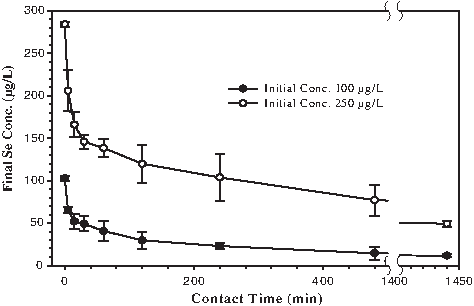
\end{document}concentration is presented in Fig. 1 for two initial Se concentrations of 100 μg-Se/L and 250 μg-Se/L. Rapid adsorption with almost 50% removal of \documentclass{aastex}\usepackage{amsbsy}\usepackage{amsfonts}\usepackage{amssymb}\usepackage{bm}\usepackage{mathrsfs}\usepackage{pifont}\usepackage{stmaryrd}\usepackage{textcomp}\usepackage{portland, xspace}\usepackage{amsmath, amsxtra}\pagestyle{empty}\DeclareMathSizes{10}{9}{7}{6}\begin{document}
$${\rm SeO}_3^{2-}$$
\end{document} was observed in the first 30 min. Thereafter the adsorption slowed down and gradually reached equilibrium. Since no significant adsorption was observed after that time period, 24 h mixing was used as the contact time in all further adsorption tests. Goh and Lim (2004) reported similar behavior for \documentclass{aastex}\usepackage{amsbsy}\usepackage{amsfonts}\usepackage{amssymb}\usepackage{bm}\usepackage{mathrsfs}\usepackage{pifont}\usepackage{stmaryrd}\usepackage{textcomp}\usepackage{portland, xspace}\usepackage{amsmath, amsxtra}\pagestyle{empty}\DeclareMathSizes{10}{9}{7}{6}\begin{document}
$${\rm SeO}_3^{2-}$$
\end{document} adsorption on a tropical soil. There, the adsorption rate was rapid in the first hour, plateaued after 8 hours, and approached equilibrium at about 24 hours. A few other studies using iron oxide as an adsorbent have reported a comparatively shorter time required for adsorption, for example, 2 hours for adsorption of \documentclass{aastex}\usepackage{amsbsy}\usepackage{amsfonts}\usepackage{amssymb}\usepackage{bm}\usepackage{mathrsfs}\usepackage{pifont}\usepackage{stmaryrd}\usepackage{textcomp}\usepackage{portland, xspace}\usepackage{amsmath, amsxtra}\pagestyle{empty}\DeclareMathSizes{10}{9}{7}{6}\begin{document}
$${\rm SeO}_3^{2-}$$
\end{document} on different forms of iron oxyhydroxides and ferrihydrite (Parida et al., 1997).
Effect of contact time on final selenite concentration. (Adsorbent dose 0.1 g/L; pH 4.0±0.1; 25°C; 24 h mixing time; initial concentrations 100 μg/L and 250 μg/L)
Comparison of nano-magnetite with natural magnetite and nano-iron: selenite (\documentclass{aastex}\usepackage{amsbsy}\usepackage{amsfonts}\usepackage{amssymb}\usepackage{bm}\usepackage{mathrsfs}\usepackage{pifont}\usepackage{stmaryrd}\usepackage{textcomp}\usepackage{portland, xspace}\usepackage{amsmath, amsxtra}\pagestyle{empty}\DeclareMathSizes{10}{9}{7}{6}\begin{document}
$${SeO}_3^{2-}$$
\end{document}) and selenate (\documentclass{aastex}\usepackage{amsbsy}\usepackage{amsfonts}\usepackage{amssymb}\usepackage{bm}\usepackage{mathrsfs}\usepackage{pifont}\usepackage{stmaryrd}\usepackage{textcomp}\usepackage{portland, xspace}\usepackage{amsmath, amsxtra}\pagestyle{empty}\DeclareMathSizes{10}{9}{7}{6}\begin{document}
$${SeO}_4^{2-}$$
\end{document}) adsorption
The effect of adsorbent doses on the \documentclass{aastex}\usepackage{amsbsy}\usepackage{amsfonts}\usepackage{amssymb}\usepackage{bm}\usepackage{mathrsfs}\usepackage{pifont}\usepackage{stmaryrd}\usepackage{textcomp}\usepackage{portland, xspace}\usepackage{amsmath, amsxtra}\pagestyle{empty}\DeclareMathSizes{10}{9}{7}{6}\begin{document}
$${\rm SeO}_3^{2-}$$
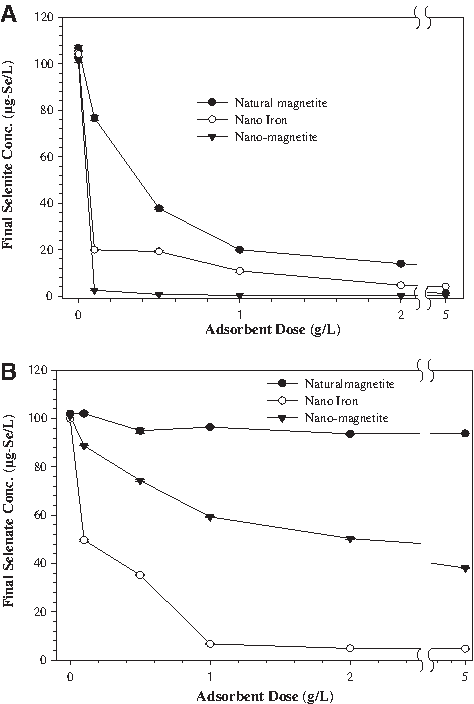
\end{document} removal for the three adsorbents is shown in Fig. 2A. With an initial \documentclass{aastex}\usepackage{amsbsy}\usepackage{amsfonts}\usepackage{amssymb}\usepackage{bm}\usepackage{mathrsfs}\usepackage{pifont}\usepackage{stmaryrd}\usepackage{textcomp}\usepackage{portland, xspace}\usepackage{amsmath, amsxtra}\pagestyle{empty}\DeclareMathSizes{10}{9}{7}{6}\begin{document}
$${\rm SeO}_3^{2-}$$
\end{document}concentration of 100 μg-Se/L (comparable to the Se level commonly found in mine water or mining impacted streams), the Se concentration decreased with increasing doses for all adsorbents. When compared to nano-iron and natural magnetite, the nano-magnetite synthesized for this study demonstrated a superior adsorption performance in removing \documentclass{aastex}\usepackage{amsbsy}\usepackage{amsfonts}\usepackage{amssymb}\usepackage{bm}\usepackage{mathrsfs}\usepackage{pifont}\usepackage{stmaryrd}\usepackage{textcomp}\usepackage{portland, xspace}\usepackage{amsmath, amsxtra}\pagestyle{empty}\DeclareMathSizes{10}{9}{7}{6}\begin{document}
$${\rm SeO}_3^{2-}$$
\end{document}. For nano-magnetite, a final concentration of <5 μg-Se/L was achieved at a dose of 0.1 g/L with an adsorption capacity of ∼1 mg-Se per gram of adsorbent. The greater surface area offered by nano-magnetite in comparison to the surface area offered by natural magnetite (<5 μm) may be the reason for better \documentclass{aastex}\usepackage{amsbsy}\usepackage{amsfonts}\usepackage{amssymb}\usepackage{bm}\usepackage{mathrsfs}\usepackage{pifont}\usepackage{stmaryrd}\usepackage{textcomp}\usepackage{portland, xspace}\usepackage{amsmath, amsxtra}\pagestyle{empty}\DeclareMathSizes{10}{9}{7}{6}\begin{document}
$${\rm SeO}_3^{2-}$$
\end{document}adsorption. The poor performance of nano-iron may be due to surface oxidation and severe agglomeration during storage.
Selenite (A) and selenate (B) removal by three adsorbents at varying doses. (Mixing time 24 h; 25°C; pH 4.0±0.1; initial concentration 100 μg-Se/L)
Since both \documentclass{aastex}\usepackage{amsbsy}\usepackage{amsfonts}\usepackage{amssymb}\usepackage{bm}\usepackage{mathrsfs}\usepackage{pifont}\usepackage{stmaryrd}\usepackage{textcomp}\usepackage{portland, xspace}\usepackage{amsmath, amsxtra}\pagestyle{empty}\DeclareMathSizes{10}{9}{7}{6}\begin{document}
$${\rm SeO}_3^{2-}$$
\end{document} and \documentclass{aastex}\usepackage{amsbsy}\usepackage{amsfonts}\usepackage{amssymb}\usepackage{bm}\usepackage{mathrsfs}\usepackage{pifont}\usepackage{stmaryrd}\usepackage{textcomp}\usepackage{portland, xspace}\usepackage{amsmath, amsxtra}\pagestyle{empty}\DeclareMathSizes{10}{9}{7}{6}\begin{document}
$${\rm SeO}_4^{2-}$$
\end{document} are commonly present in Se laden water, a study was conducted to determine if the nano-magnetite was equally efficient in removing \documentclass{aastex}\usepackage{amsbsy}\usepackage{amsfonts}\usepackage{amssymb}\usepackage{bm}\usepackage{mathrsfs}\usepackage{pifont}\usepackage{stmaryrd}\usepackage{textcomp}\usepackage{portland, xspace}\usepackage{amsmath, amsxtra}\pagestyle{empty}\DeclareMathSizes{10}{9}{7}{6}\begin{document}
$${\rm SeO}_4^{2-}$$
\end{document} oxyanions. The effect of adsorbent doses on the final \documentclass{aastex}\usepackage{amsbsy}\usepackage{amsfonts}\usepackage{amssymb}\usepackage{bm}\usepackage{mathrsfs}\usepackage{pifont}\usepackage{stmaryrd}\usepackage{textcomp}\usepackage{portland, xspace}\usepackage{amsmath, amsxtra}\pagestyle{empty}\DeclareMathSizes{10}{9}{7}{6}\begin{document}
$${\rm SeO}_4^{2-}$$
\end{document}concentration for the three adsorbents is presented in Fig. 2B. Clearly natural magnetite was ineffective in removing \documentclass{aastex}\usepackage{amsbsy}\usepackage{amsfonts}\usepackage{amssymb}\usepackage{bm}\usepackage{mathrsfs}\usepackage{pifont}\usepackage{stmaryrd}\usepackage{textcomp}\usepackage{portland, xspace}\usepackage{amsmath, amsxtra}\pagestyle{empty}\DeclareMathSizes{10}{9}{7}{6}\begin{document}
$${\rm SeO}_4^{2-}$$
\end{document} from aqueous solutions. Among the three adsorbents, nano-iron showed best adsorption for \documentclass{aastex}\usepackage{amsbsy}\usepackage{amsfonts}\usepackage{amssymb}\usepackage{bm}\usepackage{mathrsfs}\usepackage{pifont}\usepackage{stmaryrd}\usepackage{textcomp}\usepackage{portland, xspace}\usepackage{amsmath, amsxtra}\pagestyle{empty}\DeclareMathSizes{10}{9}{7}{6}\begin{document}
$${\rm SeO}_4^{2-}$$
\end{document}. This may be an attribute of its stronger reducing power, which can convert \documentclass{aastex}\usepackage{amsbsy}\usepackage{amsfonts}\usepackage{amssymb}\usepackage{bm}\usepackage{mathrsfs}\usepackage{pifont}\usepackage{stmaryrd}\usepackage{textcomp}\usepackage{portland, xspace}\usepackage{amsmath, amsxtra}\pagestyle{empty}\DeclareMathSizes{10}{9}{7}{6}\begin{document}
$${\rm SeO}_4^{2-}$$
\end{document} to \documentclass{aastex}\usepackage{amsbsy}\usepackage{amsfonts}\usepackage{amssymb}\usepackage{bm}\usepackage{mathrsfs}\usepackage{pifont}\usepackage{stmaryrd}\usepackage{textcomp}\usepackage{portland, xspace}\usepackage{amsmath, amsxtra}\pagestyle{empty}\DeclareMathSizes{10}{9}{7}{6}\begin{document}
$${\rm SeO}_3^{2-}$$
\end{document}, a species considered an easier target for adsorption (Mavrov et al., 2006). Compared with Fig. 2A, nano-iron demonstrated similar adsorption performance for both \documentclass{aastex}\usepackage{amsbsy}\usepackage{amsfonts}\usepackage{amssymb}\usepackage{bm}\usepackage{mathrsfs}\usepackage{pifont}\usepackage{stmaryrd}\usepackage{textcomp}\usepackage{portland, xspace}\usepackage{amsmath, amsxtra}\pagestyle{empty}\DeclareMathSizes{10}{9}{7}{6}\begin{document}
$${\rm SeO}_3^{2-}$$
\end{document} and \documentclass{aastex}\usepackage{amsbsy}\usepackage{amsfonts}\usepackage{amssymb}\usepackage{bm}\usepackage{mathrsfs}\usepackage{pifont}\usepackage{stmaryrd}\usepackage{textcomp}\usepackage{portland, xspace}\usepackage{amsmath, amsxtra}\pagestyle{empty}\DeclareMathSizes{10}{9}{7}{6}\begin{document}
$${\rm SeO}_4^{2-}$$
\end{document}, while nano-magnetite showed lower adsorption for \documentclass{aastex}\usepackage{amsbsy}\usepackage{amsfonts}\usepackage{amssymb}\usepackage{bm}\usepackage{mathrsfs}\usepackage{pifont}\usepackage{stmaryrd}\usepackage{textcomp}\usepackage{portland, xspace}\usepackage{amsmath, amsxtra}\pagestyle{empty}\DeclareMathSizes{10}{9}{7}{6}\begin{document}
$${\rm SeO}_4^{2-}$$
\end{document} than for \documentclass{aastex}\usepackage{amsbsy}\usepackage{amsfonts}\usepackage{amssymb}\usepackage{bm}\usepackage{mathrsfs}\usepackage{pifont}\usepackage{stmaryrd}\usepackage{textcomp}\usepackage{portland, xspace}\usepackage{amsmath, amsxtra}\pagestyle{empty}\DeclareMathSizes{10}{9}{7}{6}\begin{document}
$${\rm SeO}_3^{2-}$$
\end{document}. The lower adsorption of nano-magnetite for \documentclass{aastex}\usepackage{amsbsy}\usepackage{amsfonts}\usepackage{amssymb}\usepackage{bm}\usepackage{mathrsfs}\usepackage{pifont}\usepackage{stmaryrd}\usepackage{textcomp}\usepackage{portland, xspace}\usepackage{amsmath, amsxtra}\pagestyle{empty}\DeclareMathSizes{10}{9}{7}{6}\begin{document}
$${\rm SeO}_4^{2-}$$
\end{document} is not in agreement with a previous study by Martinez et al. (2006), which found that magnetite's adsorption for \documentclass{aastex}\usepackage{amsbsy}\usepackage{amsfonts}\usepackage{amssymb}\usepackage{bm}\usepackage{mathrsfs}\usepackage{pifont}\usepackage{stmaryrd}\usepackage{textcomp}\usepackage{portland, xspace}\usepackage{amsmath, amsxtra}\pagestyle{empty}\DeclareMathSizes{10}{9}{7}{6}\begin{document}
$${\rm SeO}_4^{2-}$$
\end{document} was similar to or greater than its adsorption for \documentclass{aastex}\usepackage{amsbsy}\usepackage{amsfonts}\usepackage{amssymb}\usepackage{bm}\usepackage{mathrsfs}\usepackage{pifont}\usepackage{stmaryrd}\usepackage{textcomp}\usepackage{portland, xspace}\usepackage{amsmath, amsxtra}\pagestyle{empty}\DeclareMathSizes{10}{9}{7}{6}\begin{document}
$${\rm SeO}_3^{2-}$$
\end{document}.
Effect of pH
The effect of pH on final \documentclass{aastex}\usepackage{amsbsy}\usepackage{amsfonts}\usepackage{amssymb}\usepackage{bm}\usepackage{mathrsfs}\usepackage{pifont}\usepackage{stmaryrd}\usepackage{textcomp}\usepackage{portland, xspace}\usepackage{amsmath, amsxtra}\pagestyle{empty}\DeclareMathSizes{10}{9}{7}{6}\begin{document}
$${\rm SeO}_3^{2-}$$
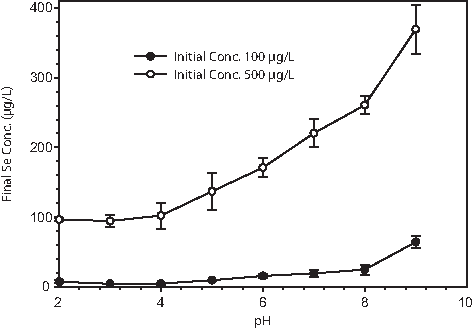
\end{document} concentration is presented in Fig. 3. The final Se concentration increased as the pH increased from 4.0 to 9.0, indicating that a lower pH favored Se adsorption. The better Se removal at lower pHs could be an advantage for nano-magnetite use in treating mine water, which is typically low in pH (Wei et al., 2005). When the pH was lower than 4.0, the \documentclass{aastex}\usepackage{amsbsy}\usepackage{amsfonts}\usepackage{amssymb}\usepackage{bm}\usepackage{mathrsfs}\usepackage{pifont}\usepackage{stmaryrd}\usepackage{textcomp}\usepackage{portland, xspace}\usepackage{amsmath, amsxtra}\pagestyle{empty}\DeclareMathSizes{10}{9}{7}{6}\begin{document}
$${\rm SeO}_3^{2-}$$
\end{document} adsorption onto nano-magnetite was relatively independent of pH. Irrespective of initial concentrations of 100 μg-Se/L and 500 μg-Se/L, \documentclass{aastex}\usepackage{amsbsy}\usepackage{amsfonts}\usepackage{amssymb}\usepackage{bm}\usepackage{mathrsfs}\usepackage{pifont}\usepackage{stmaryrd}\usepackage{textcomp}\usepackage{portland, xspace}\usepackage{amsmath, amsxtra}\pagestyle{empty}\DeclareMathSizes{10}{9}{7}{6}\begin{document}
$${\rm SeO}_3^{2-}$$
\end{document} adsorption decreased significantly at pH ≥ 8.0. This behavior may be attributed to the surface charge and speciation theories of Se in aqueous solution. The greater adsorption achieved at pH < 8.0 may be due to the attraction between anionic \documentclass{aastex}\usepackage{amsbsy}\usepackage{amsfonts}\usepackage{amssymb}\usepackage{bm}\usepackage{mathrsfs}\usepackage{pifont}\usepackage{stmaryrd}\usepackage{textcomp}\usepackage{portland, xspace}\usepackage{amsmath, amsxtra}\pagestyle{empty}\DeclareMathSizes{10}{9}{7}{6}\begin{document}
$${\rm SeO}_3^{2-}$$
\end{document} ions and positively charged adsorbent surfaces, because the surface charge of nano-magnetite is positive at pH < 8.0 and negative at pH > 9.0 (Cornell and Schwertmann, 2003). In addition, the biselenite ion (HSeO3-) is the predominant ion in aqueous solution at a pH range between 3.5 and 8.0 and may be responsible for maximum adsorption at the low pH (Rovira et al., 2008; El-Shafey, 2007; Linkson, 1990). Similar trends were observed in cases of \documentclass{aastex}\usepackage{amsbsy}\usepackage{amsfonts}\usepackage{amssymb}\usepackage{bm}\usepackage{mathrsfs}\usepackage{pifont}\usepackage{stmaryrd}\usepackage{textcomp}\usepackage{portland, xspace}\usepackage{amsmath, amsxtra}\pagestyle{empty}\DeclareMathSizes{10}{9}{7}{6}\begin{document}
$${\rm SeO}_3^{2-}$$
\end{document} adsorption onto iron oxyhydroxides and ferrihydrite, and they were attributed to characteristic anionic behavior of \documentclass{aastex}\usepackage{amsbsy}\usepackage{amsfonts}\usepackage{amssymb}\usepackage{bm}\usepackage{mathrsfs}\usepackage{pifont}\usepackage{stmaryrd}\usepackage{textcomp}\usepackage{portland, xspace}\usepackage{amsmath, amsxtra}\pagestyle{empty}\DeclareMathSizes{10}{9}{7}{6}\begin{document}
$${\rm SeO}_3^{2-}$$
\end{document} species (Parida et al., 1997). The similarity repeated with \documentclass{aastex}\usepackage{amsbsy}\usepackage{amsfonts}\usepackage{amssymb}\usepackage{bm}\usepackage{mathrsfs}\usepackage{pifont}\usepackage{stmaryrd}\usepackage{textcomp}\usepackage{portland, xspace}\usepackage{amsmath, amsxtra}\pagestyle{empty}\DeclareMathSizes{10}{9}{7}{6}\begin{document}
$${\rm SeO}_3^{2-}$$
\end{document} adsorption studies using goethite and hematite where the sorption edge for \documentclass{aastex}\usepackage{amsbsy}\usepackage{amsfonts}\usepackage{amssymb}\usepackage{bm}\usepackage{mathrsfs}\usepackage{pifont}\usepackage{stmaryrd}\usepackage{textcomp}\usepackage{portland, xspace}\usepackage{amsmath, amsxtra}\pagestyle{empty}\DeclareMathSizes{10}{9}{7}{6}\begin{document}
$${\rm SeO}_3^{2-}$$
\end{document} was reported to coincide with the predominance of HSeO3− (Rovira et al., 2008).
Effect of pH on final selenite concentration. (Adsorbent dose 0.1 g/L; pH 4.0±0.1; mixing time 24 h; 25°C; initial concentration 100 μg/L and 500 μg/L)
Effect of temperature and adsorption thermodynamics
The effect of temperature on final \documentclass{aastex}\usepackage{amsbsy}\usepackage{amsfonts}\usepackage{amssymb}\usepackage{bm}\usepackage{mathrsfs}\usepackage{pifont}\usepackage{stmaryrd}\usepackage{textcomp}\usepackage{portland, xspace}\usepackage{amsmath, amsxtra}\pagestyle{empty}\DeclareMathSizes{10}{9}{7}{6}\begin{document}
$${\rm SeO}_3^{2-}$$
\end{document} concentration is presented in Fig. 4A. It was observed that the final \documentclass{aastex}\usepackage{amsbsy}\usepackage{amsfonts}\usepackage{amssymb}\usepackage{bm}\usepackage{mathrsfs}\usepackage{pifont}\usepackage{stmaryrd}\usepackage{textcomp}\usepackage{portland, xspace}\usepackage{amsmath, amsxtra}\pagestyle{empty}\DeclareMathSizes{10}{9}{7}{6}\begin{document}
$${\rm SeO}_3^{2-}$$
\end{document} concentration decreased as temperature increased from 25°C to 45°C, at which point the removal efficiency for \documentclass{aastex}\usepackage{amsbsy}\usepackage{amsfonts}\usepackage{amssymb}\usepackage{bm}\usepackage{mathrsfs}\usepackage{pifont}\usepackage{stmaryrd}\usepackage{textcomp}\usepackage{portland, xspace}\usepackage{amsmath, amsxtra}\pagestyle{empty}\DeclareMathSizes{10}{9}{7}{6}\begin{document}
$${\rm SeO}_3^{2-}$$
\end{document} was above 90%. The trend was independent of the initial Se concentrations, indicating high temperatures favored \documentclass{aastex}\usepackage{amsbsy}\usepackage{amsfonts}\usepackage{amssymb}\usepackage{bm}\usepackage{mathrsfs}\usepackage{pifont}\usepackage{stmaryrd}\usepackage{textcomp}\usepackage{portland, xspace}\usepackage{amsmath, amsxtra}\pagestyle{empty}\DeclareMathSizes{10}{9}{7}{6}\begin{document}
$${\rm SeO}_3^{2-}$$
\end{document} adsorption onto the surfaces of nano-magnetite. The results were in an agreement with previous studies in which \documentclass{aastex}\usepackage{amsbsy}\usepackage{amsfonts}\usepackage{amssymb}\usepackage{bm}\usepackage{mathrsfs}\usepackage{pifont}\usepackage{stmaryrd}\usepackage{textcomp}\usepackage{portland, xspace}\usepackage{amsmath, amsxtra}\pagestyle{empty}\DeclareMathSizes{10}{9}{7}{6}\begin{document}
$${\rm SeO}_3^{2-}$$
\end{document} removal was achieved using iron-coated granular activated carbon (GAC) (Zhang et al., 2008). Adsorption onto untreated Fe(III)/Cr(III) hydroxide solid waste increased as temperature increased from 32°C to 60°C (Namasivayam and Prathap, 2006). A similar phenomenon was observed using manganese nodule leached residues between 25°C and 55°C (Dash and Parida, 2007) and again in the case of \documentclass{aastex}\usepackage{amsbsy}\usepackage{amsfonts}\usepackage{amssymb}\usepackage{bm}\usepackage{mathrsfs}\usepackage{pifont}\usepackage{stmaryrd}\usepackage{textcomp}\usepackage{portland, xspace}\usepackage{amsmath, amsxtra}\pagestyle{empty}\DeclareMathSizes{10}{9}{7}{6}\begin{document}
$${\rm SeO}_3^{2-}$$
\end{document}sorption onto sulfuric acid-treated peanut shell between 25°C and 45°C (El-Shafey, 2007).
Effect of temperature on (A) final selenite concentration and on (B) van't Hoff plot. (Adsorbent dose 0.1 g/L; pH 4.0±0.1; mixing time 24 h; initial concentrations 100, 250 and 500 μg-Se/L)
The thermodynamic parameters of adsorption, namely, free energy (ΔG0), enthalpy (\documentclass{aastex}\usepackage{amsbsy}\usepackage{amsfonts}\usepackage{amssymb}\usepackage{bm}\usepackage{mathrsfs}\usepackage{pifont}\usepackage{stmaryrd}\usepackage{textcomp}\usepackage{portland, xspace}\usepackage{amsmath, amsxtra}\pagestyle{empty}\DeclareMathSizes{10}{9}{7}{6}\begin{document}
$$\Delta H_{ads}^0$$
\end{document}), and entropy (ΔS0), were calculated in order to explain the thermodynamic nature involved in the adsorption process. Free energy change (ΔG°) was calculated from Equation (1):
\documentclass{aastex}\usepackage{amsbsy}\usepackage{amsfonts}\usepackage{amssymb}\usepackage{bm}\usepackage{mathrsfs}\usepackage{pifont}\usepackage{stmaryrd}\usepackage{textcomp}\usepackage{portland, xspace}\usepackage{amsmath, amsxtra}\pagestyle{empty}\DeclareMathSizes{10}{9}{7}{6}\begin{document}
\begin{align*}
\Delta G^0 = - RT\ {\rm ln}\ (K_c) \tag{1}
\end{align*}
\end{document}
where R is universal gas constant (8.314 kJ/kmol/K); T is absolute temperature in Kelvin; and Kc is the equilibrium constant (ratio of the concentration of \documentclass{aastex}\usepackage{amsbsy}\usepackage{amsfonts}\usepackage{amssymb}\usepackage{bm}\usepackage{mathrsfs}\usepackage{pifont}\usepackage{stmaryrd}\usepackage{textcomp}\usepackage{portland, xspace}\usepackage{amsmath, amsxtra}\pagestyle{empty}\DeclareMathSizes{10}{9}{7}{6}\begin{document}
$${\rm SeO}_3^{2-}$$
\end{document} ions adsorbed on nano-magnetite to that of \documentclass{aastex}\usepackage{amsbsy}\usepackage{amsfonts}\usepackage{amssymb}\usepackage{bm}\usepackage{mathrsfs}\usepackage{pifont}\usepackage{stmaryrd}\usepackage{textcomp}\usepackage{portland, xspace}\usepackage{amsmath, amsxtra}\pagestyle{empty}\DeclareMathSizes{10}{9}{7}{6}\begin{document}
$${\rm SeO}_3^{2-}$$
\end{document} ions in the aqueous phase at equilibrium). The existence of a linear relationship between ln (Kc) and 1/T, as shown in Fig. 4B, indicates the adsorption of \documentclass{aastex}\usepackage{amsbsy}\usepackage{amsfonts}\usepackage{amssymb}\usepackage{bm}\usepackage{mathrsfs}\usepackage{pifont}\usepackage{stmaryrd}\usepackage{textcomp}\usepackage{portland, xspace}\usepackage{amsmath, amsxtra}\pagestyle{empty}\DeclareMathSizes{10}{9}{7}{6}\begin{document}
$${\rm SeO}_3^{2-}$$
\end{document} followed the van't Hoff equation [Eq. (2)], from which the values of enthalpy (\documentclass{aastex}\usepackage{amsbsy}\usepackage{amsfonts}\usepackage{amssymb}\usepackage{bm}\usepackage{mathrsfs}\usepackage{pifont}\usepackage{stmaryrd}\usepackage{textcomp}\usepackage{portland, xspace}\usepackage{amsmath, amsxtra}\pagestyle{empty}\DeclareMathSizes{10}{9}{7}{6}\begin{document}
$$\Delta H_{ads}^0$$
\end{document}), and entropy (ΔS0) can be estimated from the slope and intercept of the linear plots.
\documentclass{aastex}\usepackage{amsbsy}\usepackage{amsfonts}\usepackage{amssymb}\usepackage{bm}\usepackage{mathrsfs}\usepackage{pifont}\usepackage{stmaryrd}\usepackage{textcomp}\usepackage{portland, xspace}\usepackage{amsmath, amsxtra}\pagestyle{empty}\DeclareMathSizes{10}{9}{7}{6}\begin{document}
\begin{align*}
\ln (K_c) = \frac {- \Delta H_{ads}^0} {RT} + \frac {\Delta S^0} {R} \tag{2}
\end{align*}
\end{document}
The calculated thermodynamic parameters are presented in the Table 1. The negative values of ΔG0 indicate the spontaneity of the adsorption process. The positive value of \documentclass{aastex}\usepackage{amsbsy}\usepackage{amsfonts}\usepackage{amssymb}\usepackage{bm}\usepackage{mathrsfs}\usepackage{pifont}\usepackage{stmaryrd}\usepackage{textcomp}\usepackage{portland, xspace}\usepackage{amsmath, amsxtra}\pagestyle{empty}\DeclareMathSizes{10}{9}{7}{6}\begin{document}
$$\Delta H_{ads}^0$$
\end{document} indicates endothermic adsorption, which explains why the elevated temperature led to enhanced \documentclass{aastex}\usepackage{amsbsy}\usepackage{amsfonts}\usepackage{amssymb}\usepackage{bm}\usepackage{mathrsfs}\usepackage{pifont}\usepackage{stmaryrd}\usepackage{textcomp}\usepackage{portland, xspace}\usepackage{amsmath, amsxtra}\pagestyle{empty}\DeclareMathSizes{10}{9}{7}{6}\begin{document}
$${\rm SeO}_3^{2-}$$
\end{document} adsorption onto the surfaces of nano-magnetite (Fig. 4A). The higher temperature may have also increased the kinetic energy of \documentclass{aastex}\usepackage{amsbsy}\usepackage{amsfonts}\usepackage{amssymb}\usepackage{bm}\usepackage{mathrsfs}\usepackage{pifont}\usepackage{stmaryrd}\usepackage{textcomp}\usepackage{portland, xspace}\usepackage{amsmath, amsxtra}\pagestyle{empty}\DeclareMathSizes{10}{9}{7}{6}\begin{document}
$${\rm SeO}_3^{2-}$$
\end{document} ions, so that they could be transported easily to adsorption sites. The finding was consistent with \documentclass{aastex}\usepackage{amsbsy}\usepackage{amsfonts}\usepackage{amssymb}\usepackage{bm}\usepackage{mathrsfs}\usepackage{pifont}\usepackage{stmaryrd}\usepackage{textcomp}\usepackage{portland, xspace}\usepackage{amsmath, amsxtra}\pagestyle{empty}\DeclareMathSizes{10}{9}{7}{6}\begin{document}
$${\rm SeO}_3^{2-}$$
\end{document} adsorption onto untreated Fe(III)/Cr(III) hydroxide solid waste and manganese nodule leached residues (Dash and Parida, 2007; Namasivayam and Prathap, 2006). The positive value of entropy change (ΔS0) reveals an increase in randomness at the solid/solution interface due to the adsorption of \documentclass{aastex}\usepackage{amsbsy}\usepackage{amsfonts}\usepackage{amssymb}\usepackage{bm}\usepackage{mathrsfs}\usepackage{pifont}\usepackage{stmaryrd}\usepackage{textcomp}\usepackage{portland, xspace}\usepackage{amsmath, amsxtra}\pagestyle{empty}\DeclareMathSizes{10}{9}{7}{6}\begin{document}
$${\rm SeO}_3^{2-}$$
\end{document} onto nano-magnetite.
Thermodynamic Parameters for the Adsorption of Selenite on Nano-Magnetite at Different Temperatures
Initial Conc. (μg-Se/L)
Temperature (°C)
Kc
ΔG0 (kJ/mol)
ΔH0ads (kJ/mol)
ΔS0 (kJ/mol/K)
100
25
22.9
−7.7
7.32
0.028
35
33.3
−9.0
45
103.5
−12.2
250
25
3.2
−2.9
6.43
0.023
35
5.5
−4.4
45
12.5
−6.7
500
25
0.02
−9.5
22.9
0.073
35
0.2
−3.7
45
2.7
−2.6
Adsorption isotherms
Adsorption isotherms can predict adsorption processes at equilibrium conditions, and therefore are the best means of assessing the performance of a system (Basha and Jha, 2008). The relationship between equilibrium \documentclass{aastex}\usepackage{amsbsy}\usepackage{amsfonts}\usepackage{amssymb}\usepackage{bm}\usepackage{mathrsfs}\usepackage{pifont}\usepackage{stmaryrd}\usepackage{textcomp}\usepackage{portland, xspace}\usepackage{amsmath, amsxtra}\pagestyle{empty}\DeclareMathSizes{10}{9}{7}{6}\begin{document}
$${\rm SeO}_3^{2-}$$
\end{document} concentration and adsorption capacity is illustrated in Fig. 5. The adsorption capacity at pH 4.0 was approximately 470 μg-Se/g with a final \documentclass{aastex}\usepackage{amsbsy}\usepackage{amsfonts}\usepackage{amssymb}\usepackage{bm}\usepackage{mathrsfs}\usepackage{pifont}\usepackage{stmaryrd}\usepackage{textcomp}\usepackage{portland, xspace}\usepackage{amsmath, amsxtra}\pagestyle{empty}\DeclareMathSizes{10}{9}{7}{6}\begin{document}
$${\rm SeO}_3^{2-}$$
\end{document} concentration of 0.80 μg-Se/L and increased to 7500 μg-Se/g with a final \documentclass{aastex}\usepackage{amsbsy}\usepackage{amsfonts}\usepackage{amssymb}\usepackage{bm}\usepackage{mathrsfs}\usepackage{pifont}\usepackage{stmaryrd}\usepackage{textcomp}\usepackage{portland, xspace}\usepackage{amsmath, amsxtra}\pagestyle{empty}\DeclareMathSizes{10}{9}{7}{6}\begin{document}
$${\rm SeO}_3^{2-}$$
\end{document} concentration of 347 μg-Se/L. The adsorption capacity was lower at pH 6.0 with 400 μg-Se/g at a final \documentclass{aastex}\usepackage{amsbsy}\usepackage{amsfonts}\usepackage{amssymb}\usepackage{bm}\usepackage{mathrsfs}\usepackage{pifont}\usepackage{stmaryrd}\usepackage{textcomp}\usepackage{portland, xspace}\usepackage{amsmath, amsxtra}\pagestyle{empty}\DeclareMathSizes{10}{9}{7}{6}\begin{document}
$${\rm SeO}_3^{2-}$$
\end{document}concentration of 3.11 μg-Se/L and 7000 μg-Se/g at 370 μg-Se/L. Therefore, if the target final Se is <5 μg-Se/L (the proposed new EPA Se regulation), nano-magnetite can be used in pH 4–6 with a satisfactory adsorption capacity of >400 μg-Se/g.
Relationship between equilibrium selenite concentration and adsorption capacity of nano-magnetite. (Adsorbent dose 0.1 g/L; mixing time 24 h; 25°C).
The linear relationship on a log-log scale in Fig. 5 indicates the adsorption of \documentclass{aastex}\usepackage{amsbsy}\usepackage{amsfonts}\usepackage{amssymb}\usepackage{bm}\usepackage{mathrsfs}\usepackage{pifont}\usepackage{stmaryrd}\usepackage{textcomp}\usepackage{portland, xspace}\usepackage{amsmath, amsxtra}\pagestyle{empty}\DeclareMathSizes{10}{9}{7}{6}\begin{document}
$${\rm SeO}_3^{2-}$$
\end{document} onto the surface of nano-magentite followed the Freundlich isotherm, expressed by Equation (3):
\documentclass{aastex}\usepackage{amsbsy}\usepackage{amsfonts}\usepackage{amssymb}\usepackage{bm}\usepackage{mathrsfs}\usepackage{pifont}\usepackage{stmaryrd}\usepackage{textcomp}\usepackage{portland, xspace}\usepackage{amsmath, amsxtra}\pagestyle{empty}\DeclareMathSizes{10}{9}{7}{6}\begin{document}
\begin{align*}
q_e = KC_e^{1 / n} \tag{3}
\end{align*}
\end{document}
where Ce and qe are the equilibrium \documentclass{aastex}\usepackage{amsbsy}\usepackage{amsfonts}\usepackage{amssymb}\usepackage{bm}\usepackage{mathrsfs}\usepackage{pifont}\usepackage{stmaryrd}\usepackage{textcomp}\usepackage{portland, xspace}\usepackage{amsmath, amsxtra}\pagestyle{empty}\DeclareMathSizes{10}{9}{7}{6}\begin{document}
$${\rm SeO}_3^{2-}$$
\end{document} concentration in solution (μg-Se/L) and the corresponding adsorption capacity on nano-magnetite (μg-Se/g-adsorbent), and K and 1/n are empirical constants determined through regression analysis. The n values of 2.19 (pH 4.0) and 1.80 (pH 6.0) fell in the range of 1–10, indicating favorable adsorption (Basha and Jha, 2008). In addition, the Freundlich isotherm model revealed that \documentclass{aastex}\usepackage{amsbsy}\usepackage{amsfonts}\usepackage{amssymb}\usepackage{bm}\usepackage{mathrsfs}\usepackage{pifont}\usepackage{stmaryrd}\usepackage{textcomp}\usepackage{portland, xspace}\usepackage{amsmath, amsxtra}\pagestyle{empty}\DeclareMathSizes{10}{9}{7}{6}\begin{document}
$${\rm SeO}_3^{2-}$$
\end{document} adsorption took place heterogeneously due to the diversity of sorption sites offered by the nano-magnetite (Hamdaoui and Naffrechoux, 2007).
Interfering anions
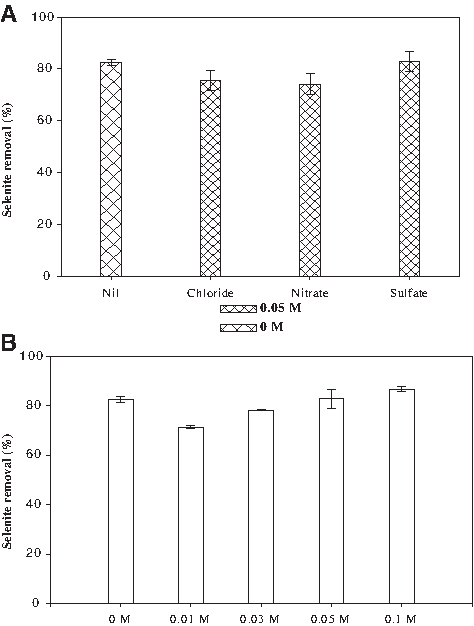
The presence of competing anions in the aqueous solution may interfere with Se adsorption onto the active sites of the nano-magnetite, hence reducing the Se removal efficiency. The percentage of Se removal in the presence of competing anions such as chloride, sulfate, and nitrate at an initial \documentclass{aastex}\usepackage{amsbsy}\usepackage{amsfonts}\usepackage{amssymb}\usepackage{bm}\usepackage{mathrsfs}\usepackage{pifont}\usepackage{stmaryrd}\usepackage{textcomp}\usepackage{portland, xspace}\usepackage{amsmath, amsxtra}\pagestyle{empty}\DeclareMathSizes{10}{9}{7}{6}\begin{document}
$${\rm SeO}_3^{2-}$$
\end{document} concentration of 250 μg-Se/L at pH 4.0 are shown in Fig. 6A. The presence of chloride and nitrate caused a minor reduction in \documentclass{aastex}\usepackage{amsbsy}\usepackage{amsfonts}\usepackage{amssymb}\usepackage{bm}\usepackage{mathrsfs}\usepackage{pifont}\usepackage{stmaryrd}\usepackage{textcomp}\usepackage{portland, xspace}\usepackage{amsmath, amsxtra}\pagestyle{empty}\DeclareMathSizes{10}{9}{7}{6}\begin{document}
$${\rm SeO}_3^{2-}$$
\end{document} adsorption, while sulfate at 0.05 M did not significantly affect the adsorption capacity of nano-magnetite, which indicates the adsorption of nano-magnetite for \documentclass{aastex}\usepackage{amsbsy}\usepackage{amsfonts}\usepackage{amssymb}\usepackage{bm}\usepackage{mathrsfs}\usepackage{pifont}\usepackage{stmaryrd}\usepackage{textcomp}\usepackage{portland, xspace}\usepackage{amsmath, amsxtra}\pagestyle{empty}\DeclareMathSizes{10}{9}{7}{6}\begin{document}
$${\rm SeO}_3^{2-}$$
\end{document} was selective. A similar observation was made in case of a tropical soil as an adsorbent for \documentclass{aastex}\usepackage{amsbsy}\usepackage{amsfonts}\usepackage{amssymb}\usepackage{bm}\usepackage{mathrsfs}\usepackage{pifont}\usepackage{stmaryrd}\usepackage{textcomp}\usepackage{portland, xspace}\usepackage{amsmath, amsxtra}\pagestyle{empty}\DeclareMathSizes{10}{9}{7}{6}\begin{document}
$${\rm SeO}_3^{2-}$$
\end{document} removal in which the presence of \documentclass{aastex}\usepackage{amsbsy}\usepackage{amsfonts}\usepackage{amssymb}\usepackage{bm}\usepackage{mathrsfs}\usepackage{pifont}\usepackage{stmaryrd}\usepackage{textcomp}\usepackage{portland, xspace}\usepackage{amsmath, amsxtra}\pagestyle{empty}\DeclareMathSizes{10}{9}{7}{6}\begin{document}
$${\rm SO}_4^{2-}$$
\end{document} hardly affected adsorption even when the concentration was increased from 0.01 M to 0.05 M (Goh and Lim, 2004). Another study that involved \documentclass{aastex}\usepackage{amsbsy}\usepackage{amsfonts}\usepackage{amssymb}\usepackage{bm}\usepackage{mathrsfs}\usepackage{pifont}\usepackage{stmaryrd}\usepackage{textcomp}\usepackage{portland, xspace}\usepackage{amsmath, amsxtra}\pagestyle{empty}\DeclareMathSizes{10}{9}{7}{6}\begin{document}
$${\rm SeO}_3^{2-}$$
\end{document} removal using iron-coated granular activated carbon (GAC) also reported insignificant impact on \documentclass{aastex}\usepackage{amsbsy}\usepackage{amsfonts}\usepackage{amssymb}\usepackage{bm}\usepackage{mathrsfs}\usepackage{pifont}\usepackage{stmaryrd}\usepackage{textcomp}\usepackage{portland, xspace}\usepackage{amsmath, amsxtra}\pagestyle{empty}\DeclareMathSizes{10}{9}{7}{6}\begin{document}
$${\rm SeO}_3^{2-}$$
\end{document} adsorption in the presence of \documentclass{aastex}\usepackage{amsbsy}\usepackage{amsfonts}\usepackage{amssymb}\usepackage{bm}\usepackage{mathrsfs}\usepackage{pifont}\usepackage{stmaryrd}\usepackage{textcomp}\usepackage{portland, xspace}\usepackage{amsmath, amsxtra}\pagestyle{empty}\DeclareMathSizes{10}{9}{7}{6}\begin{document}
$${\rm SO}_4^{2-}$$
\end{document} ions (Zhang et al., 2008). The adsorption of \documentclass{aastex}\usepackage{amsbsy}\usepackage{amsfonts}\usepackage{amssymb}\usepackage{bm}\usepackage{mathrsfs}\usepackage{pifont}\usepackage{stmaryrd}\usepackage{textcomp}\usepackage{portland, xspace}\usepackage{amsmath, amsxtra}\pagestyle{empty}\DeclareMathSizes{10}{9}{7}{6}\begin{document}
$${\rm SeO}_3^{2-}$$
\end{document} using manganese nodule leached residues was reported to have decreased from 91% to 74% and 80% in the presence of sulfate and nirate (Dash and Parida, 2007).
Selenite removal by nano-magnetite in (A) the absence and presence of anions (0.05 M) and in (B) the presence of varying sulfate concentrations (24 h; 25°C; pH 4.0±0.1; initial concentration 250 μg-Se/L; adsorbent dose 0.1 g/L).
Since sulfate commonly occurs in water impacted by mining, a further investigation using ionic strengths of 0.01, 0.03, 0.05 and 0.1 M of sulfate at an initial concentration of 250 μg-Se/L and pH 4.0 was carried out. As shown in Fig. 6B, the presence of sulfate did not interfere with Se adsorption by nano-magnetite and actually enhanced adsorption slightly at higher concentrations of sulfate, such as 0.l M. This finding indicates that nano-magnetite is promising in treating Se-containing mine water.
Implication for sustainable engineered processes
Nano-magnetite is a low-cost, environmentally friendly adsorbent that has found broad applications in the removal of various inorganic and organic contaminants (Missana et al., 2009; Cumbal and SenGupta, 2005; and Hu et al., 2004). Results from this study indicate that nano-magnetite may be a promising adsorbent for Se removal. Favorable adsorption at lower pH levels shows the applicability of nano-magnetite in the treatment of acid mine drainage containing Se. One advantage of using nano-magnetite is that the nanoparticles can be readily removed from the liquid after adsorption by means of magnetic separation using an external magnetic field (Cumbal and SenGupta, 2005), facilitating the recovery of the nano-magnetite. Another advantage of nano-magnetite as an adsorbent in sustainable engineered processes is that it can be relatively easily regenerated. As shown in Fig. 3, higher pH levels depress Se adsorption. Little adsorption was observed at pH 9, which indicates the selenium adsorption was reversible. Thus, adsorbent regeneration could be achieved by simple pH adjustment (>9) when the adsorption capacity is exhausted. The regenerated adsorbent can be recycled to the Se removal process, while the concentrated solution from the regeneration process can be used to recover Se for other uses. The primary limitation of nano-magnetite as an adsorbent is its inapplicability in adsorption columns to treat large wastewater streams because of its small particle size and low permeability in packed columns. It may be possible to deposit the magnetite nanoparticles onto a porous medium support that would be suitable for column application.
Conclusions
Synthesized nano-magnetite was used as an adsorbent in this study to investigate Se removal from aqueous solutions. Compared to either natural magnetite (<5 μm) or nano-iron (∼10 nm), nano-magnetite (10–20 nm) was found to be a better adsorbent for \documentclass{aastex}\usepackage{amsbsy}\usepackage{amsfonts}\usepackage{amssymb}\usepackage{bm}\usepackage{mathrsfs}\usepackage{pifont}\usepackage{stmaryrd}\usepackage{textcomp}\usepackage{portland, xspace}\usepackage{amsmath, amsxtra}\pagestyle{empty}\DeclareMathSizes{10}{9}{7}{6}\begin{document}
$${\rm SeO}_3^{2-}$$
\end{document}, while nano-iron showed better adsorption performance for \documentclass{aastex}\usepackage{amsbsy}\usepackage{amsfonts}\usepackage{amssymb}\usepackage{bm}\usepackage{mathrsfs}\usepackage{pifont}\usepackage{stmaryrd}\usepackage{textcomp}\usepackage{portland, xspace}\usepackage{amsmath, amsxtra}\pagestyle{empty}\DeclareMathSizes{10}{9}{7}{6}\begin{document}
$${\rm SeO}_4^{2-}$$
\end{document}. The results indicated that a final effluent concentration of less than 5 μg-Se/L could be achieved in removing \documentclass{aastex}\usepackage{amsbsy}\usepackage{amsfonts}\usepackage{amssymb}\usepackage{bm}\usepackage{mathrsfs}\usepackage{pifont}\usepackage{stmaryrd}\usepackage{textcomp}\usepackage{portland, xspace}\usepackage{amsmath, amsxtra}\pagestyle{empty}\DeclareMathSizes{10}{9}{7}{6}\begin{document}
$${\rm SeO}_3^{2-}$$
\end{document} from Se laden solutions with initial concentrations of 100 μg-Se/L, which are comparable to those commonly found in mine water or mining impacted streams. The high \documentclass{aastex}\usepackage{amsbsy}\usepackage{amsfonts}\usepackage{amssymb}\usepackage{bm}\usepackage{mathrsfs}\usepackage{pifont}\usepackage{stmaryrd}\usepackage{textcomp}\usepackage{portland, xspace}\usepackage{amsmath, amsxtra}\pagestyle{empty}\DeclareMathSizes{10}{9}{7}{6}\begin{document}
$${\rm SeO}_3^{2-}$$
\end{document} removal efficiency in a low pH range (<4) was an advantage for nano-magnetite use in treating low pH water such as acidic mine water or mine drainage. Adsorption of \documentclass{aastex}\usepackage{amsbsy}\usepackage{amsfonts}\usepackage{amssymb}\usepackage{bm}\usepackage{mathrsfs}\usepackage{pifont}\usepackage{stmaryrd}\usepackage{textcomp}\usepackage{portland, xspace}\usepackage{amsmath, amsxtra}\pagestyle{empty}\DeclareMathSizes{10}{9}{7}{6}\begin{document}
$${\rm SeO}_3^{2-}$$
\end{document} onto nano-magnetite was a spontaneous, endothermic process, indicating high temperatures favored Se removal. The \documentclass{aastex}\usepackage{amsbsy}\usepackage{amsfonts}\usepackage{amssymb}\usepackage{bm}\usepackage{mathrsfs}\usepackage{pifont}\usepackage{stmaryrd}\usepackage{textcomp}\usepackage{portland, xspace}\usepackage{amsmath, amsxtra}\pagestyle{empty}\DeclareMathSizes{10}{9}{7}{6}\begin{document}
$${\rm SeO}_3^{2-}$$
\end{document} adsorption followed the Freundlich isotherm model, and the adsorption was heterogeneous at the surfaces of nano-magnetite. Presence of common anions did not significantly affect the adsorption capacity of nano-magnetite for \documentclass{aastex}\usepackage{amsbsy}\usepackage{amsfonts}\usepackage{amssymb}\usepackage{bm}\usepackage{mathrsfs}\usepackage{pifont}\usepackage{stmaryrd}\usepackage{textcomp}\usepackage{portland, xspace}\usepackage{amsmath, amsxtra}\pagestyle{empty}\DeclareMathSizes{10}{9}{7}{6}\begin{document}
$${\rm SeO}_3^{2-}$$
\end{document}. The selective adsorption demonstrated nano-magnetite could be a very promising nano-sorbent in removing Se from water or wastewater.
Footnotes
Acknowledgments
The authors gratefully acknowledge financial support from Center for Advanced Separation Technologies (CAST) and U.S. Department of Energy (DOE).
References
1.
AdamsD.J., PenningtonP.2005. Selenium and arsenic removal from mining wastewaters. Preprint. 2005 Society for Mining Metallurgy, and Exploration Annual Meeting, February 28–March 2, Salt Lake City, UT, 385.
2.
BalistrieriS.L., ChaoT.T.1990. Adsorption of selenium by amorphous iron oxyhydroxide and manganese dioxide. Geochim. Cosmochim. AC, 54:739.
3.
BashaS., JhaB.2008. Estimation of isotherm parameters of biosorption of Cd(II) and Pb(II) onto brown seaweed, Lobophora variegata. J. Chem. Eng. Data, 53:449.
4.
BenjaminM.M.1983. Adsorption and surface precipitation of metals on amorphous iron oxyhydroxide. Environ. Sci. Technol., 17:686.
5.
CornellR.M., SchwertmannU.2003. The Iron Oxides: Structure, Properties, Reactions, Occurrences, and Uses. Weinheim, Germany: Wiley-VCH GmbH & Co. KGaA.
6.
CumbalL.H., SenGuptaA.K.2005. Preparation and characterization of magnetically active dual-zone sorbent. Ind. Eng. Chem. Res., 44:600.
7.
DashS.S., ParidaK.M.2007. Studies on selenite adsorption using manganese nodule leached residues. J. Colloid Interf. Sci., 307:333.
8.
El-ShafeyE.I.2007. Removal of Se (IV) from aqueous solution using sulphuric acid-treated peanut shell. J. Environ. Manage., 84:620.
9.
GleasonK.J., YuJ., BungeA.L., WrightJ.D.1996. Removal of selenium from contaminated waters using emulsion liquid membranes. BartschR.A., WayJ.D.Chemical Separations with Liquid Membranes. Washington, DC: American Chemical Society, 342.
10.
GohK.H., LimT.T.2004. Geochemistry of inorganic arsenic and selenium in a tropical soil: Effect of reaction time, pH, and competitive anions on arsenic and selenium adsorption. Chemosphere, 55:849.
11.
HamdaouiO., NaffrechouxE.2007. Modeling of sorption isotherms of phenol and chlorophenols onto granular activated carbon. Part I. Two-parameter models and equations allowing determination of thermodynamic parameters. J. Hazard. Mater., 147:381.
12.
HuJ., LoI.M.C., ChenG.2004. Removal of Cr(VI) by magnetite nanoparticle. Water Sci. Technol., 50:139.
13.
HunterW.J., ManterD.K.2009. Reduction of selenite to elemental red selenium by Pseudomonas sp. Strain CA5. Curr. Microbiol., 58:493.
14.
KapoorA., TanjoreS., ViraraghavanT.1995. Removal of selenium from water and wastewater. Int. J. Environ. Stud., 49:137.
15.
LemlyD.A.2004. Aquatic selenium pollution is a global environmental safety issue. Ecotox. Environ. Safe., 59:44.
16.
LinksonP.B.1990. The stability of selenium in aqueous systems. Chemeca 90: The Eighteenth Australasian Chemical Engineering Conference. Auckland, New Zealand: RMIT Publishing, 161.
17.
MakS.Y., ChenD.H.2004. Fast adsorption of methylene blue on polyacrylic acid bound iron oxide magnetite nanoparticles. Dyes Pigments, 61:93.
18.
MartinezM., GimenezJ., de PabloJ., RoviraM., DuroL.2006. Sorption of selenium(IV) and selenium(VI) onto magnetite. Appl. Surf. Sci., 252:3767.
19.
MavrovV., StamenovS., TodorovaE., ChmielH., ErweT.2006. New hybrid electrocoagulation membrane process for removing selenium from industrial wastewater. Desalination, 201:290.
20.
MissanaT., AlonsoU., ScheinostA.C., GranizoN., García-GutiérrezM.2009. Selenite retention by nanocrystalline magnetite: Role of adsorption, reduction and dissolution/co-precipitation processes. Geochim. Cosmochim. Ac., 73:6205.
21.
NamasivayamC., PrathapK.2006. Removal of selenite using ‘waste’ Fe (III)/Cr (III) hydroxide: Adsorption kinetics and isotherms. Toxicol. Environ. Chem., 8:85.
22.
NeuzilS., DulayF.T., CecilC., FedorkoN., RentonJ.J., BhumblD.K.2007. Selenium Concentrations in Middle Pennsylvanian Coal Bearing Strata in the Central Appalachian Basin. Washington, DC: U.S. Geological Survey.
23.
ParidaK.M., GoraiB., DasN.N., RaoS.B.1997. Studies on ferric oxide hydroxides. III. Adsorption of selenite (\documentclass{aastex}\usepackage{amsbsy}\usepackage{amsfonts}\usepackage{amssymb}\usepackage{bm}\usepackage{mathrsfs}\usepackage{pifont}\usepackage{stmaryrd}\usepackage{textcomp}\usepackage{portland, xspace}\usepackage{amsmath, amsxtra}\pagestyle{empty}\DeclareMathSizes{10}{9}{7}{6}\begin{document}
$${\rm SeO}_3^{2-}$$
\end{document}) on different forms of iron oxyhydroxides. J. Colloid Interf. Sci., 185:355.
24.
ReidM.E., StrattonM.S., LillicoA.J., FakihM., NatarajanR., ClarkL.C., MarshallJ.R.2004. A report of high-dose selenium supplementation: Response and toxicities. J. Trace Elem. Med. Bio., 18:69.
25.
RennerR.2005. Proposed selenium standard under attack. Environ. Sci. Technol., 39:125A.
26.
RoviraM., GimenezJ., MartinezM., Martinez-LladoX., de PabloJ., MartiV., DuroL.2008. Sorption of selenium (IV) and selenium(VI) onto natural iron oxides: Goethite and hematite. J. Hazard. Mater., 150:279.
27.
SchlekatC.E., PurkersonD.G., LuomaS.N.2004. Modeling selenium bioaccumulation through arthropod food webs in San Francisco Bay, California, USA. Environ. Toxicol. Chem., 23:3003.
TakadaT., HirataM., KokubuS., ToorisakaE., OzakiM., HanoT.2008. Kinetic study on biological reduction of selenium compounds. Process Biochem., 43:1304.
30.
TwidwellL., McCloskeyJ., JoyceH., DahlgrenE., HaddenA.2005. Removal of selenium oxyanions from mine water utilizing elemental iron and galvanically coupled metals. YoungC.A., KellarJ.J., FreeM.L., DrelichJ.Innovations in Natural Resource Processing: Proceedings of the Jan D. Miller Symposium. Littleton, CO: Society for Mining Metallurgy & Exploration, 299.
31.
WeiX., ViaderoR.C., BuzbyK.M.2005. Recovery of iron and aluminum from acid mine drainage by selective precipitation. Environ. Eng. Sci., 22:745.
32.
WeiX., ViaderoR.C.2007. Synthesis of magnetite nanoparticles with ferric iron recovered from acid mine drainage: Implications for environmental engineering. Colloid. Surface. A, 294:280.
33.
World Health Organization. 2003. Selenium in Drinking-Water: Background Document for Preparation of WHO Guidelines for Drinking-Water Quality. Geneva, Switzerland: World Health Organization.
34.
ZhangN., LinL.S., GangD.2008. Adsorptive selenite removal from water using iron-coated GAC adsorbents. Water Res., 42:3809.
35.
ZhangP., SparksD.L.1990. Kinetics of selenate and selenite adsorption/desorption at the goethite/water interface. Environ. Sci. Technol., 24:1848.