




Abstract
Abstract
Studies on arsenic removal by zero-valent iron (ZVI)–based system have focused mostly on batch or small scale tests. In this research, pilot-scale studies were carried out on arsenic removal by technologies developed in rapid small-scale column tests (RSSCTs). Pilot-scale studies can provide significant information on final scale-up to full-scale operation, which RSSCT inherently was not able to provide. In addition, comparison between pilot column and RSSCT breakthrough profiles could help validate RSSCT design, especially RSSCT for arsenic. Results from pilot studies indicate that arsenic removal by a system of ZVI plus iron-tailored granular activated carbon showed significant promise for practical applications. The best performance was achieved when ZVI worked together with carbon pretailored by an iron-salt evaporation method. In addition, the similarity in arsenic breakthrough curves between RSSCTs and pilot studies serves to confirm that it is appropriate to assume proportional diffusivity for arsenic oxyanions in RSSCT design.
Introduction
Among technologies under investigation, adsorption has successfully been applied for the removal of arsenic (As). Iron oxide–coated sand (Gupta et al., 2005), iron oxide–impregnated activated carbon (Jang et al., 2009), and iron-tailored polymer (Cumbal and Sengupta, 2005) have been shown to be effective in As adsorption.
Besides iron-loaded adsorbents, zero-valent iron (ZVI) for removing As oxyanions has also attracted much attention in recent years (Su and Puls, 2003; Bang et al., 2005; Sun et al., 2006; Biterna et al., 2007; Beak and Wilkin, 2009; Eljamal et al., 2011). Arsenic removal with ZVI has occurred primarily as the arsenate or arsenite oxyanions of As were adsorbed and/or co-precipitated with the corrosion products when ZVI is in contact with water. The main issue with ZVI application is that when a ZVI filter is used alone, the unit clogs with iron oxides, and excessive iron exits from the unit. Therefore, many studies have focused on appraising whether ZVI can be solubilized, such that the resulting As-laden iron hydroxide colloids could be caught in a subsequent filter. Bang et al. (2005) employed a separate sand filter that followed ZVI corrosion, and the system was able to control iron effluent to less than 0.3 mg/L. However, this additional filter may add to the complexity of the system.
The main objective of the research has been to develop an As removal system that couples the high pore volume, structural cohesiveness, and low costs of granular activated carbon (GAC) with the As-sorbing propensity and low costs of iron. Previous research in rapid small-scale column tests (RSSCTs) offered promise that the concept of blending ZVI with iron-tailored GAC performs well (Chen et al., 2008; Zou et al., 2010). However, the inherent nature of RSSCTs precludes them from providing simulation information regarding what is the most favorable configuration of ZVI use within a full-scale GAC bed that contains full-scale GAC grains. In this research, different configurations of coupling ZVI rods and GAC were tested in pilot columns to investigate the feasibility of this method.
Materials and Methods
Water sources for pilot columns and RSSCT
Due to the large amount of water consumed by pilot-scale columns, As-spiked tap water was used for all columns. This water contained an alkalinity of 150–200 mg/L as CaCO3, and a conductivity of 600–700 μS/cm. The As feed solution was deionized water that was spiked with Na2HAsO4·7H2O to about 50 mg As(V)/L. About 1.0 mL/min of this feed solution was then combined with tap water (at 0.85 L/min) to make a targeted As concentration for the pilot column influent of 50–60 μg/L. pH of the water was around 7.1–7.4.
Activated carbons
A bituminous-based GAC named as AquaCarb was used in both RSSCT and pilot tests. AquaCarb had a surface area of 723 m2/g, micropore volume of 0.3 mL/g, and mesopore volume of 0.1 mL/g.
Zero-valent iron
The iron rods employed as the ZVI source were made of plain steel. The composition of the iron rod is as follows: Fe 98.51%–99.10%, C 0.15%–0.20%, Mn 0.60%–0.90%, Si 0.15%–0.32%, and S 0%–0.05%.
Iron tailoring by iron-salt evaporation
For iron-tailored GAC, 2 g of GAC was added to 200 mL of DI water solution that contained 2 g of hydrated ferric nitrate [Fe(NO)3·9H2O]. To achieve an iron oxide impregnation on the activated carbon, the iron-GAC slurry was heated to 60°C or 100°C until dry, cooled at room temperature, washed with distilled water, dried, and sieved. The final product had an iron content of 11.7%–12.4%.
For the pilot-scale column tests, the same iron tailoring protocol was followed as previously described. In each batch, 0.5 kg of GAC was tailored. The final product had an iron content around 11%.
Rapid small-scale column tests
RSSCTs were designed to simulate the adsorption conditions that would occur in a full-scale bed. The tests were conducted with GACs of grain size US mesh #200×400 (38–75 μm) and an empty bed contact time (EBCT) of 0.53 min which with proportional diffusivity would simulate full-scale operation that employs a grain size US mesh #12×40 (425–1700 μm) with EBCT of 10 min. The RSSCT columns used were 13.5-cm long and 0.5 cm in diameter. Each test held about 1.67 g of iron-tailored activated carbon, and it was this mass of carbon that was kept constant in the RSSCTs. Duplicates were run for RSSCTs.
Pilot columns
Pilot columns were constructed from 150-cm-long sections of PVC pipes (inside diameter of 7.3 cm). The columns were packed with layers of aquarium gravel and sand (5-cm deep). The gravel and sand layers prevented the activated carbon from exiting the bottom of the bed, and the depth of these layers helped to ensure that there would be no preferential flow through the bottom of the activated carbon as might occur if the activated carbon was located very near the exit of the column. Activated carbon with a bed depth of 100 cm was then added atop the sand. Particle size of GAC in pilot columns was US mesh #20×50 (0.42–0.85 mm). Table 1 lists the carbon and iron sources used in the pilot columns.
ZVI, zero-valent iron; GAC, granular activated carbon.
Specifically, column #1 was the control column with virgin AquaCarb. Columns #2 and 3 were columns for iron-tailored AquaCarb. In column #4, plain steel rods were used as the ZVI source, and these were placed through the full length of the carbon bed. Columns #5–7 were GAC carbons with branched plain steel rods in the first 2/3 of the carbon bed. The rods in columns #4–6 had a 0.64-cm diameter while that in column #7 was 0.32 cm in diameter. The branched rod system was as shown in Fig. 1.
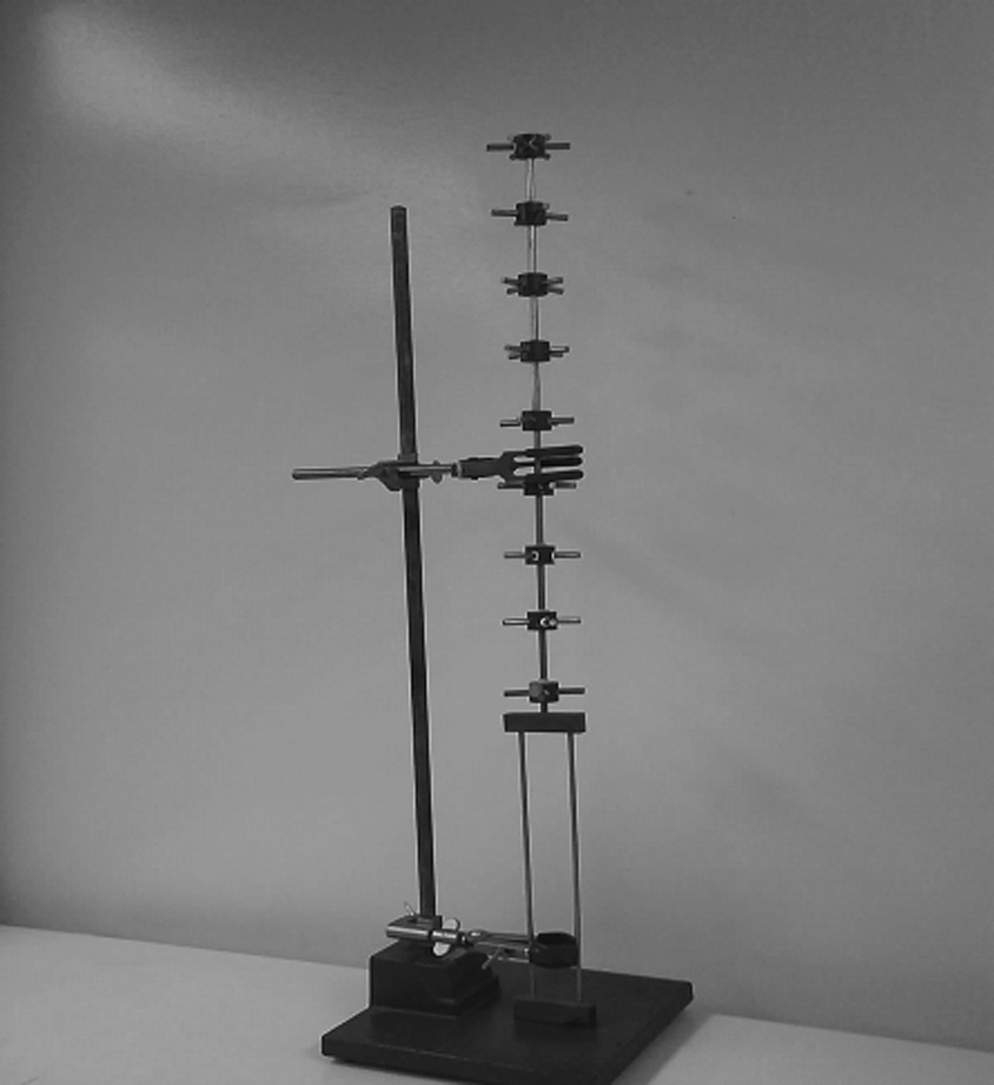
Configuration of branched rods.
All of these pilot columns were operated in the down-flow mode with an EBCT of 5 min. This EBCT corresponds to a flow rate of 0.85 L/min or hydraulic loading rate of 20.3 cm/min. All pilot columns were run in duplication.
Chemical analysis
Arsenic analysis was conducted via an inductively coupled plasma-mass spectrophotometry (ICP-MS). Iron was analyzed by a Shimadzu Atomic Absorption Spectrophotometer (AA-6601F) unit with flame atomization.
Results and Discussion
Comparison of RSSCTs with pilot-scale columns
In designing RSSCT columns, it is necessary to assume a relationship between the EBCTs in the RSSCT column, as compared with the full-scale bed. The relationship is contingent on the intraparticle diffusion coefficient, which in turn depends on particle size. If intraparticle diffusivities do not change with particle size, then a constant diffusivity approach can be used, and the ratio of the EBCTs is directly proportional to the squared ratio of the carbon grain diameters. Alternatively, the proportional diffusivity method assumes that intraparticle diffusivity is a linear function of particle size and that the ratio of the EBCTs is directly proportional to the ratio of the carbon grain diameters. To determine which method is appropriate for the simulation of a specific adsorbate, the comparison between the simulated breakthrough curve and the full-scale or pilot-scale breakthrough curve must be performed. RSSCT in this research was designed based on the hypothesis that proportional diffusivity was the appropriate similitude equation for the As oxyanions. The proportional diffusivity is described by EBCTSC/EBCTFC=DSC/DFC (Crittenden et al., 1986; Hand et al., 1989). SC is the small-scale column, FC is the full-scale column being modeled, and D is the geometric average size of the GAC grains. The RSSCT breakthrough curves were compared with those from pilot-scale to evaluate whether the similitude design with proportional diffusivity was valid for depicting arsenate sorption in RSSCTs.
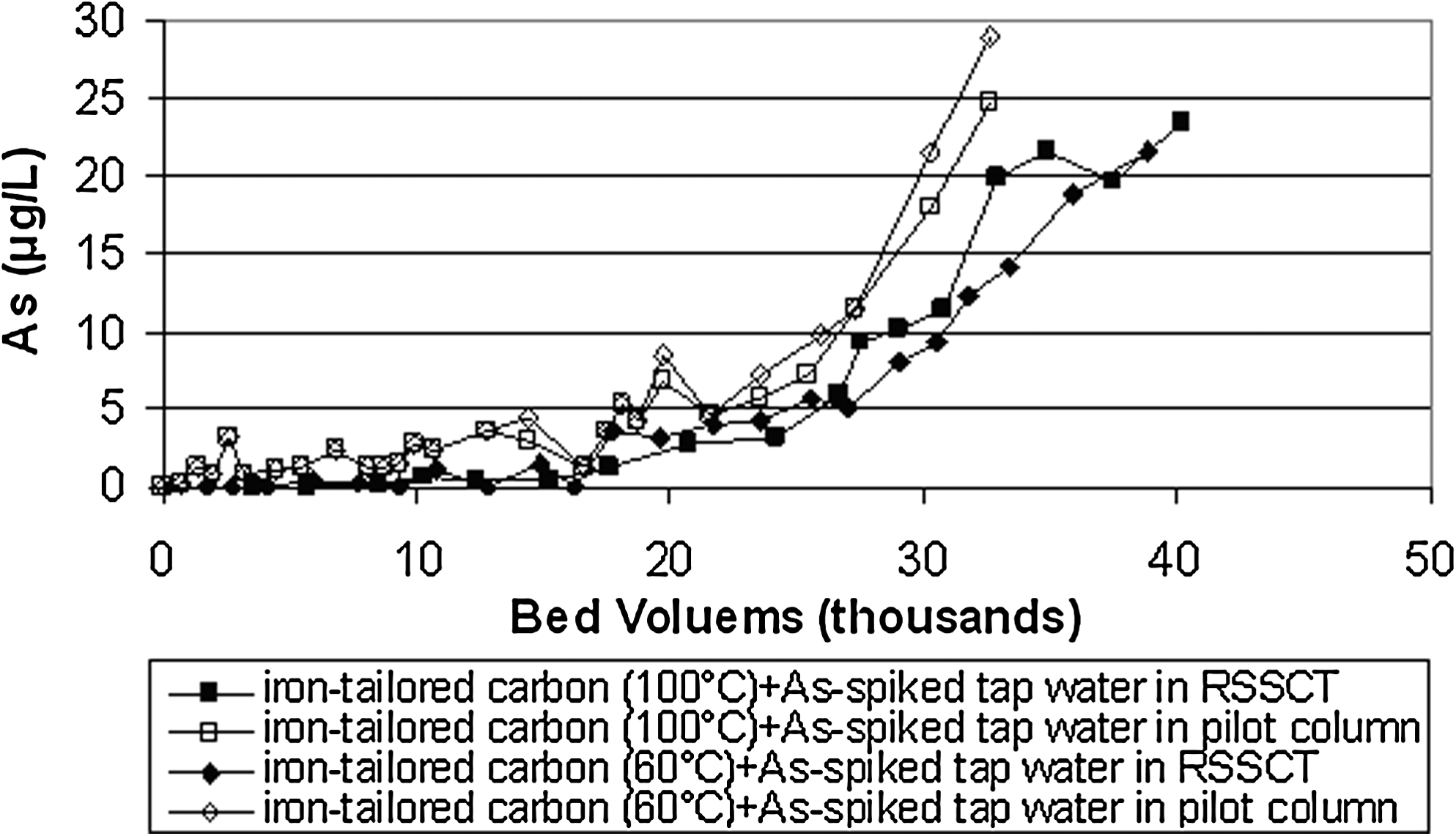
Figure 2 is the breakthrough curves from RSSCTs and pilot columns for carbons tailored at 60°C and 100°C, respectively. Table 2 summarizes the bed volumes to 10 μg/L breakthrough as a function of the curing temperature in the RSSCTs and pilot columns.
Arsenic breakthrough for iron-tailored (cured 60°C and 100°C) carbon in rapid small-scale column tests (RSSCTs) and pilot tests.
RSSCT, rapid small-scale column test.
As shown in Table 2, for GAC tailored at 60°C and 100°C, bed volumes to breakthrough are 8.2% and 1.5% longer in RSSCT than those from pilot columns. This maybe attributed to the difference in iron contents: the tailored carbons made for the pilot columns had an iron content around 11%, while those used in RSSCTs have had an iron content of 11.7%–12.4%. When the bed volume data are normalized to a uniform iron content of 12.4% Fe, the pilot columns achieved bed volumes to 10 μg/L As breakthrough that were very close (3% difference) to counterpart values with RSSCTs.
The results indicate that the proportional diffusivity similitude offered quite a good match to operations with full-scale GAC grains when monitoring the sorption of arsenate and arsenite in iron-tailored GAC.
In addition, both in pilot columns and RSSCTs, the tailoring temperature of 60°C or 100°C made little difference in the bed volumes to 10 μg/L As breakthrough. Tailoring temperature of 60°C was recommended for GAC impregnation of iron for As removal.
No iron was detected above 0.2 mg/L in the effluent from these RSSCTs or pilot columns #2 and #3.
Pilot-scale studies with ZVI rod and GAC
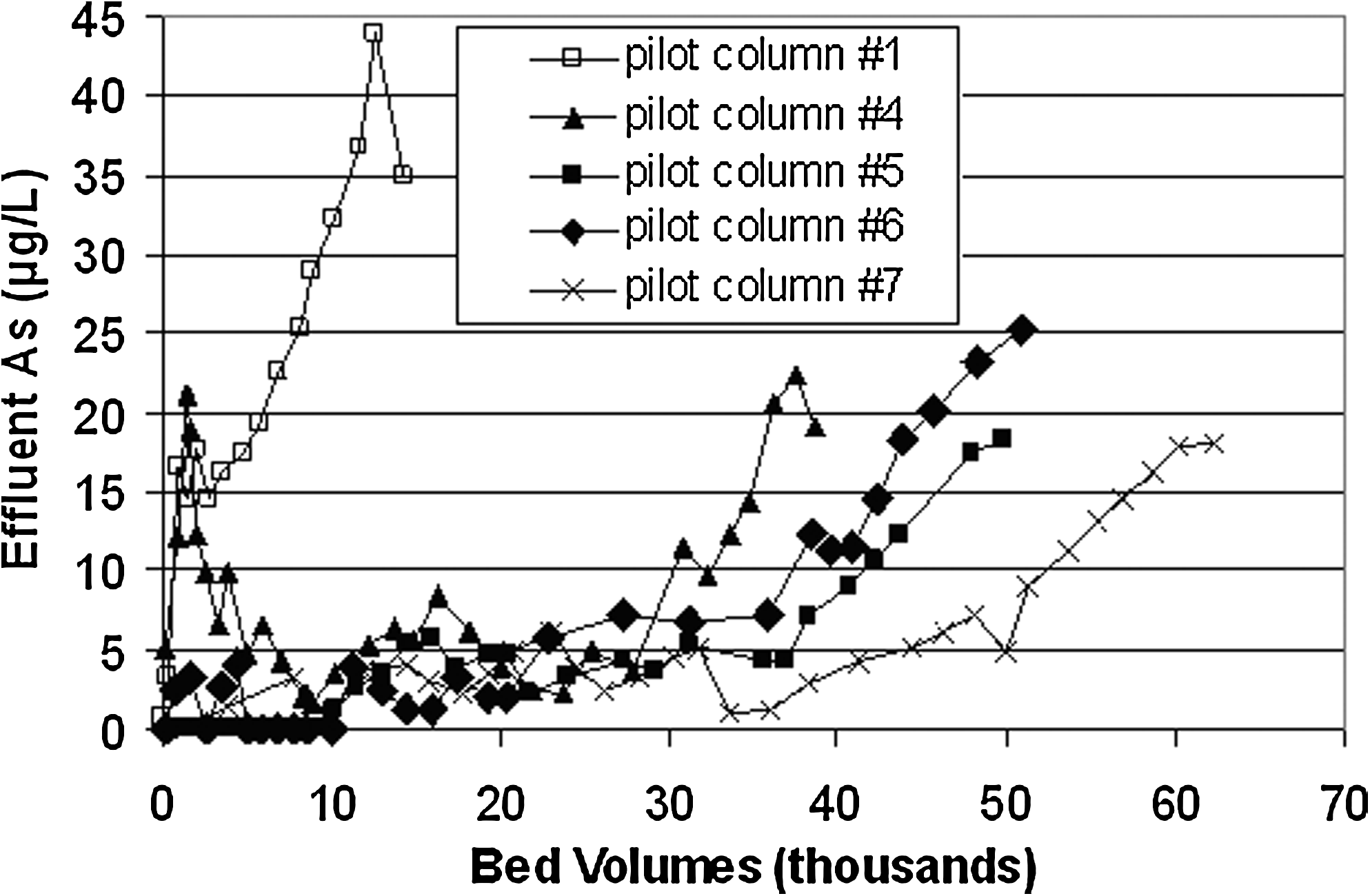
Duplicates of pilot columns showed high reproducibility. Data shown below are average of the duplicated runs. Figure 3 shows the As breakthrough curves for pilot columns with or without iron rods and Table 3 summarizes all the pilot test results.
Arsenic breakthrough for pilot columns with or without iron rods as zero-valent iron resources.
As shown in Table 3, virgin GAC had little adsorption for As. The most favorable configuration of GAC and ZVI was for column #7, where iron-tailored activated carbon was coupled with 0.32-cm-diameter steel rods that were placed in the top 2/3 of the GAC bed. In this case, the pilot column processed 52,000 BV before 10 μg/L As was consistently reached. This was compared with 42,000 bed volume when coupling 0.64-cm steel rods with iron-tailored GAC (column #6), and with around 26,000 bed volumes when using just iron-tailored GAC (columns #2 and #3). This indicates that installation of ZVI rods significantly increased GAC's bed life for As. In addition, the higher bed volume with rod of smaller diameter maybe attributed to the fact that smaller rod supplied higher surface area for corrosion when the masses of ZVI were the same.
In further comparison, when virgin AquaCarb was coupled with 0.64-cm steel rods (column #5), breakthrough occurred at 38,300 BV; that is 4000 BV lower than that of column #6, where iron-tailored carbon was coupled with steel rods. This indicated that iron-tailored carbon did play a role in adsorbing As. The combination of the iron-tailored AquaCarb plus branched rods offered a double barrier against As breakthrough.
It also appears that using branched rod had a significant effect. With the same influent pH and carbon, the branched rod run (column #5) exhibited breakthrough at 38,000 bed volumes. Pilot column #4 applied a straight rod, and it exhibited continuous breakthrough at 29,500 bed volumes (with some breakthrough also occurring at 1000–4000 BV). The initial breakthrough may have been because of the uneven distribution of iron corrosion products in the beginning stages of the test with these vertical rods. Arsenic may have leaked through the bed from locations that did not possess much iron. The subsequent configuration with the horizontal branched rods had resolved this issue. The branched rods offered an iron source that was more evenly distributed across the carbon cross section and resulted in considerably less As leakage during the first 2000 bed volumes.
Effluent iron concentrations were closely monitored. When the rods were placed in the top 2/3 of the GAC media (columns #5–7), effluent iron concentrations constantly remained under 0.2 mg/L for the duration of the operation. Thus, results were favorable when the bottom 1/3 of the carbon served as a filter/sorber of the corroded iron products that were generated in the top portions of the bed. In contrast, when the vertical rods reached all the way to the bottom of the media (column #4), effluent iron remained above 0.3 mg/L for most of the run.
Table 4 lists the performance of some of the existing ZVI-based As removal system from literature. Literature on pilot-scale study on ZVI system is rare. Among the column tests that are published, experimental conditions varied greatly making direct comparison difficult. Overall, system with ZVI powder or particles often encounters problem of clogging thus led to leaching of As way before exhaustion of ZVI sources, and a relatively low bed volumes. Zou et al. (2010) applied galvanized steel sheet as a ZVI source and were able to operate more than 150,000 BV in small-column tests. However, As greater than 10 μg/L was detected in the first 20,000 BV. The authors attributed this early leaching of As to the time it took for ZVI corrosion to take effect. Results from the ZVI and GAC system in this research indicate that GAC provided storage for ZVI corrosion products and was able to greatly extend the bed life. GAC in the system also provided extra adsorption of As and no early As release was observed thus ensured water safety.
EBCT, empty bed contact time.
Conclusions
Pilot-scale studies investigate As removal by technologies that were developed in RSSCTs. The pilot studies addressed scale-up issues that inherently could not be addressed with RSSCTs. The results indicate that As removal by a system of ZVI plus iron-tailored GAC showed great promise for practical applications. The best performance was achieved when ZVI in the form of plain steel rod worked together iron-tailored GAC. The column was able to operate about 52,000 BV before 10 μg/L As breakthrough occurred. In addition, iron concentration was kept under 0.2 mg/L when part of the carbon was used as a scavenger bed for iron.
Pilot-scale studies were further compared with results from RSSCTs. The similarity in As breakthrough curves between these two systems served to prove that it is appropriate to assume proportional diffusivity for As in RSSCT design.
Footnotes
Acknowledgments
This work was supported by the National Natural Science Foundation of China (51078233), the Shanghai Pujiang Program (10PJ1407900), and the Innovation Program of Shanghai Municipal Education Commission (11YZ115).
Author Disclosure Statement
No competing financial interests exist.