




Abstract
Abstract
Estrogen in wastewater are responsible for a significant part of the endocrine-disrupting effects observed in the aquatic environment. The effect of sludge retention time (SRT) on the removal and fate of 17β-estradiol (E2) and 17α-ethinylestradiol (EE2) in an anaerobic–anoxic–oxic activated sludge system designed for nutrient removal was investigated by laboratory-scale experiments using synthetic wastewater. With a hydraulic retention time of 8 h, when SRT ranged 10–25 days, E2 was almost completely removed from water, and EE2 removal efficiency was 65%–81%. Both estrogens were easily sorbed onto activated sludge. Distribution coefficients (Kd) of estrogens on anaerobic sludge were greater than those on anoxic and aerobic sludges. Mass balance calculation indicated that 99% of influent E2 was degraded by the activated sludge process, and 1% remained in excess sludge; of influent EE2, 62.0%–80.1% was biodegraded; 18.9%–34.7% was released in effluent; and 0.88%–3.31% remained in excess sludge. Optimal SRT was 20 days for both estrogen and nutrient removal. E2 was almost completely degraded, and EE2 was only partly degraded in the activated sludge process. Residual estrogen on excess sludge must be considered in the sludge treatment and disposal processes. The originality of the work is that removal of nutrients and estrogens were linked, and optimal SRT for both estrogen and nutrient removal in an enhanced biological phosphorus removal system was determined. This has an important implication for the design and operation of full-scale wastewater treatment plants.
Introduction
Sorption and biodegradation are important mechanisms for the removal of estrogens in biological wastewater treatment systems (Xu et al., 2008; McAdam et al., 2010; Gomes et al., 2011; Paterakis et al., 2012). Based on the measured sorption constants, Andersen et al. (2005) have predicted that about 50%–75% of estrogens (estrone [E1], E2, and EE2) can be sorbed to the activated sludge in a sewage treatment plant. The degree of sorption is estrogen dependent. Usually, the synthetic estrogens (EE2) are easier to be sorbed than the natural estrogens (E2) due to their stronger hydrophobicity. Further, natural and synthetic estrogens present in municipal wastewater can be biodegraded in the activated sludge treatment processes (Coquery et al., 2010). Joss et al. (2004) have studied the removal of estrogens (E1, E2, and EE2) in several municipal wastewater treatment processes and indicated >90% removal of all estrogens in the activated sludge processes with nitrification and denitrification (sludge retention time [SRT] of 12–15 days). The aerobic degradation of E2 and EE2 was investigated in batch experiments with activated sludge from a conventional and a membrane sewage treatment plant by Weber et al. (2005). Their results indicated that E2 was converted to the metabolite E1, which was further transformed within 3 days; however, EE2 was persistent in both processes. Koh et al. (2009) observed the removal efficiencies of >90% for steroid estrogens in a nitrifying/denitrifying activated sludge plant and another nitrifying/denitrifying activated sludge plant with phosphorus removal, which both had sludge ages of 13 days; their mass balance calculations indicated that more than 70% of the total steroid estrogens were biodegraded. Hashimoto and Murakami (2009) have studied the degradation characteristics of natural and synthetic estrogens in an oxidation-ditch process, and the results showed that the rapid degradation of E2 was achieved at a longer sludge retention time (SRT>15 days); the degradation of EE2 showed that the lag phase of 2 h and EE2 was finally degraded completely after 24 h.
The SRT is a very important operational parameter in activated sludge treatment processes, relating to the growth rate of microorganisms. Field surveys in full-scale WWTPs have indicated that plants with a high SRT generally showed high and stable removal of both estrogens and estrogenic activity (Hashimoto et al., 2007; Muller et al., 2008). With regard to natural estrogens, Clara et al. (2005) have observed a strong correlation between achievable effluent concentrations and SRT. Joss et al. (2004) indicated that the degradation activity of the natural estrogens was higher in the membrane bioreactor than in the conventional activated sludge process by a factor of 2–3. The higher age of the sludge processed in the membrane reactor (30 days as compared to 11 days in the conventional system) allowed the growth and higher accumulation of specialized estrogen-degrading microorganisms. For EE2, a correlation between achieved effluent concentrations or removal efficiencies and the SRT was not detectable (Clara et al., 2005). Kreuzinger et al. (2004) proposed that higher SRTs allowed the enrichment of slowly growing bacteria and consequently the establishment of a more diverse microcosm with broader physiological capabilities and greater potential for endocrine-disrupting compound (EDC) removal compared to WWTPs with low SRTs.
In recent years, due to eutrophication problems in China, most WWTPs were upgraded to have the function of nutrient removal. Enhanced biological phosphorus removal (EBPR) processes are becoming popular treatment processes. Therefore, it is important to evaluate the behavior of estrogens in the WWTPs designed for nutrient removal. Although there have been many researches on estrogen removal in activated sludge systems, most of them were conducted to investigate the fate of estrogens in the full-scale WWTPs, in which most did not use the EBPR processes. Moreover, the effect of operational parameters such as SRT on the fate of estrogens in activated sludge systems designed for nutrient removal was not well investigated.
The objective of this article was to investigate the effect of SRT on the removal and fate of E2 and EE2 in the nutrient-removal biological treatment processes. For our investigation, a laboratory-scale anaerobic–anoxic–oxic (AAO) activated sludge system was established, and synthetic wastewater was used. The E2 and EE2 concentrations in the aqueous phase and solid phase in each treatment unit were measured separately; estrogen removal by sorption and biodegradation in anaerobic, anoxic, and oxic units were evaluated, respectively. Mass balances were calculated to assess the fate of E2 and EE2 in the AAO activated sludge system.
Materials and Methods
Chemicals and synthetic wastewater
E2 (CAS 50-28-2, >98%) and EE2 (CAS 57-63-2, >98%) were purchased from Sigma-Aldrich. Other reagents of analytical grade were supplied by Sinopharm Chemical Reagent Co. Ltd.
The synthetic wastewater was prepared using tap water, supplemented with nutrients, trace elements, and buffering compounds. The composition of the synthetic wastewater is listed in Table 1. The average chemical oxygen demand (COD), total nitrogen (TN), and total phosphorus (TP) of the synthetic wastewater were 375, 40, and 6 mg/L, respectively. The initial concentrations of E2 and EE2 spiked in the synthetic wastewater were ∼15 and ∼5 μg/L, respectively.
EDTA, ethylenediaminetetraacetic acid.
Seed sludge and acclimation
The seed sludge was obtained from the return activated sludge tanks of the Shanghai Changqiao Municipal Wastewater Treatment Plant, China. The activated sludge was acclimated in the AAO activated sludge systems with the synthetic wastewater. The AAO systems were placed in a temperature-controlled room at 25°C. During the acclimation period, the operational parameters were as follows: SRT was 20 days; the total hydraulic retention time (HRT) was 8 h (HRT of the anaerobic, anoxic, and oxic units were 1, 2.5, and 4.5 h, respectively); the sludge recycle ratio was 100%; the recycle ratio of mixed liquor was 300%.
Reactor systems and the experimental procedure
The laboratory-scale AAO activated sludge system consisted of an anaerobic tank, an anoxic tank, an aerobic tank and a settling tank (Fig. 1). As the HRT ratio of the anaerobic, anoxic, and oxic tanks was set as 1:2.5:4.5, the working volumes of the three unit tanks were 2, 5, and 9 L, respectively. The aerobic tank was equipped with a set of diffusion aerators to maintain the dissolved oxygen in the range of 2–4 mg/L. Mixing was achieved using a motor-driven mixer in each unit. The shaft speed was moderate to make wastewater and activated sludge mixing completely, but not to shear the flocs. The sludge was returned from the bottom of the sedimentation tank to the anaerobic reactor. The mixed liquor was recycled from the aerobic tank to the anoxic tank. Two AAO systems were set up, one used for E2 removal and another for EE2 removal.

Schematic diagram of anaerobic–anoxic–oxic (AAO) activated sludge system.
During the experimental period studying the effects of SRT on the fate of estrogens, the operational condition was the same with the acclimation period, except for the change of SRT. The SRT was adjusted by changing the amount of waste sludge discharged from the system. The SRT was set at 10, 12, 15, 20, and 25 days, respectively. To assess the removal of estrogens by sorption and biodegradation, the concentrations of E2 and EE2 in the aqueous and solid phases were measured separately. To consider the nutrient removal concurrently, conventional parameters such as COD, ammonium (NH4+-N), TN, and TP in the aqueous phase were also measured. Samples were taken and measured every day. When the removal efficiencies of both conventional parameters and estrogens were stable (±3% variation), the AAO systems were operated for at least one more week before the SRT was changed. The duration of the experiment for each tested SRT was two or three times of the SRT.
Sample preparation and analytical methods
The aqueous- and solid-phase samples were prepared according to the method described by Zeng et al. (2009b). Briefly, a sample of 300 mL mixed liquor was taken from the relative unit of the AAO system. The sample was then centrifuged and separated to aqueous and solid phases. The 250 mL aqueous sample was filtered through a 0.45-μm microfiber filter to eliminate the suspended solids. The filtrate was extracted with C18 solid-phase extraction (SPE) cartridges (SUPELCO SPE system), which was then eluted sequentially using 4 mL of methanol and 10 mL of dichloromethane. After the eluates were reduced to dryness with nitrogen, the residue was dissolved in 1 mL of methanol, to be analyzed.
The solid phases were freeze-dried at −57°C for more than 48 h. The dried pellets were ground into powder before extraction. E2 or EE2 in the solid phases was extracted into the aqueous phase ultrasonically. The solvents used for ultrasonic extraction were a methanol and acetate buffer solution (pH 5.0) mixture (90/10, v/v).
The concentration of E2 and EE2 was determined using high-performance liquid chromatography (HPLC) equipped with a fluorescence detector (Prostar; Varian), according to the method described by Zeng et al. (2009b). A reversed-phase ODS Hypersil analytical column (250 mm×4.6 mm, 5-μm particle diameter; from Thermo Electron Corporation) was used for the separation. The excitation/emission wavelengths were 280/307 nm. E2 and EE2 were analyzed separately. The analytical procedures were almost the same except that the mobile phase (water–acetonitrile solution) ratios were different: 65/35 for E2 and 61/39 for EE2 (v/v).
The limit of detection was defined as three times background (signal-to-noise ratio of 3), and limit of quantitation (LOQ) as 10 times background (signal-to-noise ratio of 10). The LOQs of the HPLC instrument for E2 and EE2 were 0.25 and 1 μg/L, respectively. A linear calibration was obtained in the range of 5–2500 μg/L. Since most sample concentrations were <5 μg/L, before HPLC analyses, the 250 mL sample was prepared with SPE and finally dissolved in 1 mL of methanol. Therefore, estrogen concentrating multiple was 250, and the LOQ of the SPE-HPLC method was 1 and 4 ng/L for E2 and EE2, respectively. The recoveries were between 90% and 100%.
Mass balance
The mass balance of estrogens in the AAO system is shown in Fig. 2. It is assumed that no degradation occurred in the sedimentation tank. The estrogen concentrations in the aqueous phase of the influent into the anaerobic, anoxic, and oxic tanks were calculated according to Equations (1–3):
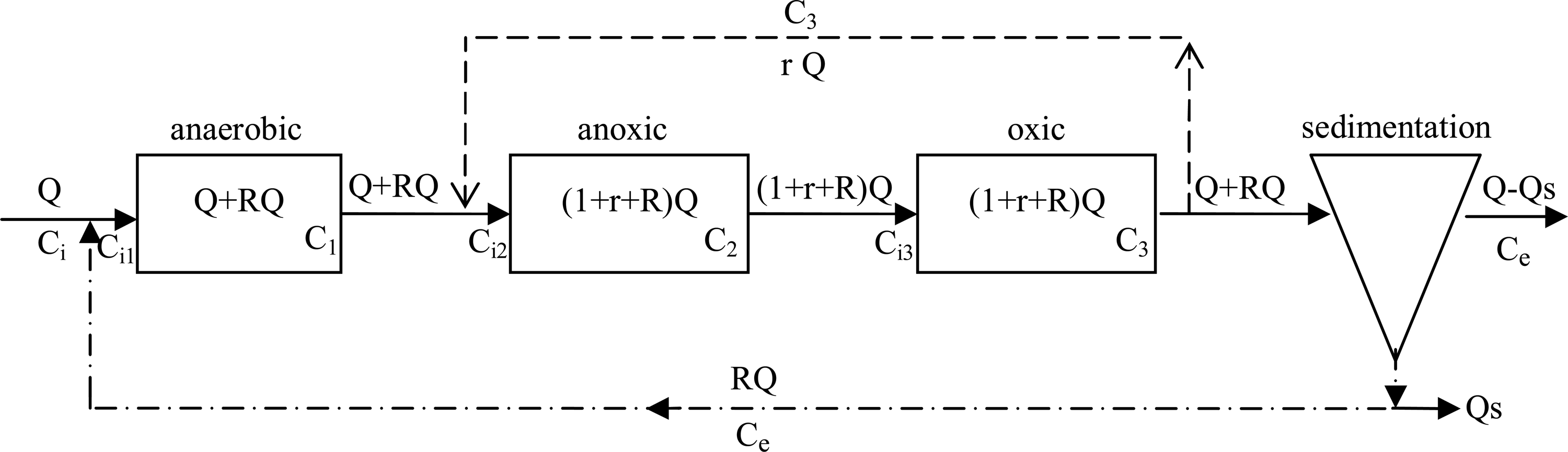
Flow chart of AAO system for mass balance calculation. Q and QS are the influent flow rate and excess sludge flow rate, respectively (L/h); QS=16 L/(SRT×24 h/day); r and R are recycle ratios of mixed liquor and activated sludge, respectively (%); Ci and Ce are estrogen concentrations in the influent and effluent of the system, respectively (μg/L), measured; Ci1, Ci2, and Ci3 are the estrogen concentrations in the aqueous phase of the influent into the anaerobic, anoxic, and oxic units, respectively (μg/L), calculated; C1, C2, and C3 are the estrogen concentrations in the aqueous phase of the effluent out of the anaerobic, anoxic, and oxic units, respectively (μg/L), measured. SRT, sludge retention time.
where Ci and Ce are estrogen concentrations in the influent and effluent of the system, respectively (μg/L), measured; Ci and Ce are also aqueous estrogen concentrations; Ci1, Ci2, and Ci3 are the estrogen concentrations in the aqueous phase of the influent into the anaerobic, anoxic, and oxic units, respectively (μg/L), calculated; C1, C2, and C3 are the estrogen concentrations in the aqueous phase of the effluent out of the anaerobic, anoxic, and oxic units, respectively (μg/L), measured; C3 is equal to Ce; r and R are recycle ratios of mixed liquor and activated sludge, respectively (%).
The overall estrogen removal efficiency of the system and the estrogen removal fractions in anaerobic, anoxic, and oxic units were calculated according to Equations (4–7):
The above removal means estrogen removal from water, which was caused by both sorption and degradation. In each unit, the estrogen concentration decrease in the mixed liquor was attributed to degradation, and the difference between the removal and degradation was caused by sorption on the sludge.
The sorption of estrogens onto the activated sludge can be well described by a linear isotherm, which is usually described as partitioning between the aqueous and solid phases (Andersen et al., 2005; Zeng et al., 2009b):
where Cs is the estrogen concentration in the solid phase (μg/kg), and Cw is the estrogen concentration in the aqueous phase (μg/L); Kd is the distribution coefficient between the solid and water phases (L/kg). Carballa et al. (2007) proposed to the use the solid–water distribution coefficient (Kd) to calculate the concentrations in the solid phase from those measured in the aqueous phase.
If the mixed liquor-suspended solids (MLSS; kg/L) in the activated sludge tank are known, the fraction of steroid estrogens that would be sorbed to the solid phase is calculated using the Kd values (L/kg) with the Equation (9):
As the excess sludge was discharged from the sedimentation tank, the fraction of the steroid estrogen that will be removed by excess sludge could be calculated as Equation (10):
where C3S is the concentration of estrogen sorbed onto the excess sludge (μg/kg); Q and QS are the influent flow rate and excess sludge flow rate, respectively (L/h).
Results and Discussion
Acclimation
During the acclimation period, the removal rates of COD, TN, and TP increased as prolonged operation time. After 25 days, all the removal efficiencies of conventional parameters were stabilized: 81%±3.0%, 80%±2.8%, and 89%±3.2% for COD, TN, and TP, respectively. The acclimation was considered completed. Then, the estrogens were spiked to evaluate the estrogen removal capacity of the system under the acclimatization conditions, finding that the removal rate of EE2 was 78%±2.5%; E2 was not detectable in the effluent.
Effect of SRT on removal of conventional parameters
The removal of conventional parameters in the AAO systems at different SRTs is depicted in Fig. 3. The results indicated that there was no significant difference of COD removal when the SRT was in the range of 10–25 days. COD of the final effluent from the secondary sedimentation tanks was <60 mg/L in both AAO systems, and the removal efficiencies of COD were >85%. The removal of NH4+-N and TN increased with the increase of the SRT. The NH4+-N removal efficiencies increased from 90%±2.6% to 97%±2.5%, and the TN removal efficiencies increased from 51%±1.3% to 84%±2.9% when the SRT was increased from 10 to 25 days. In contrast, removal of TP decreased from 97%±3.1% to 70%±2.1% with the increase of the SRT in the range of 10–25 days. The results showed that the suitable SRT was 20 days for both nitrogen and phosphorus removal. Under the conditions of SRT=20 days, HRT=8 h, sludge recycle ratio=30%, and mixed liquor recycle ratio=300%, the removal efficiencies of COD, TN, and TP were 86%±3.0%, 80%±2.1%, and 88%±2.5%, respectively.
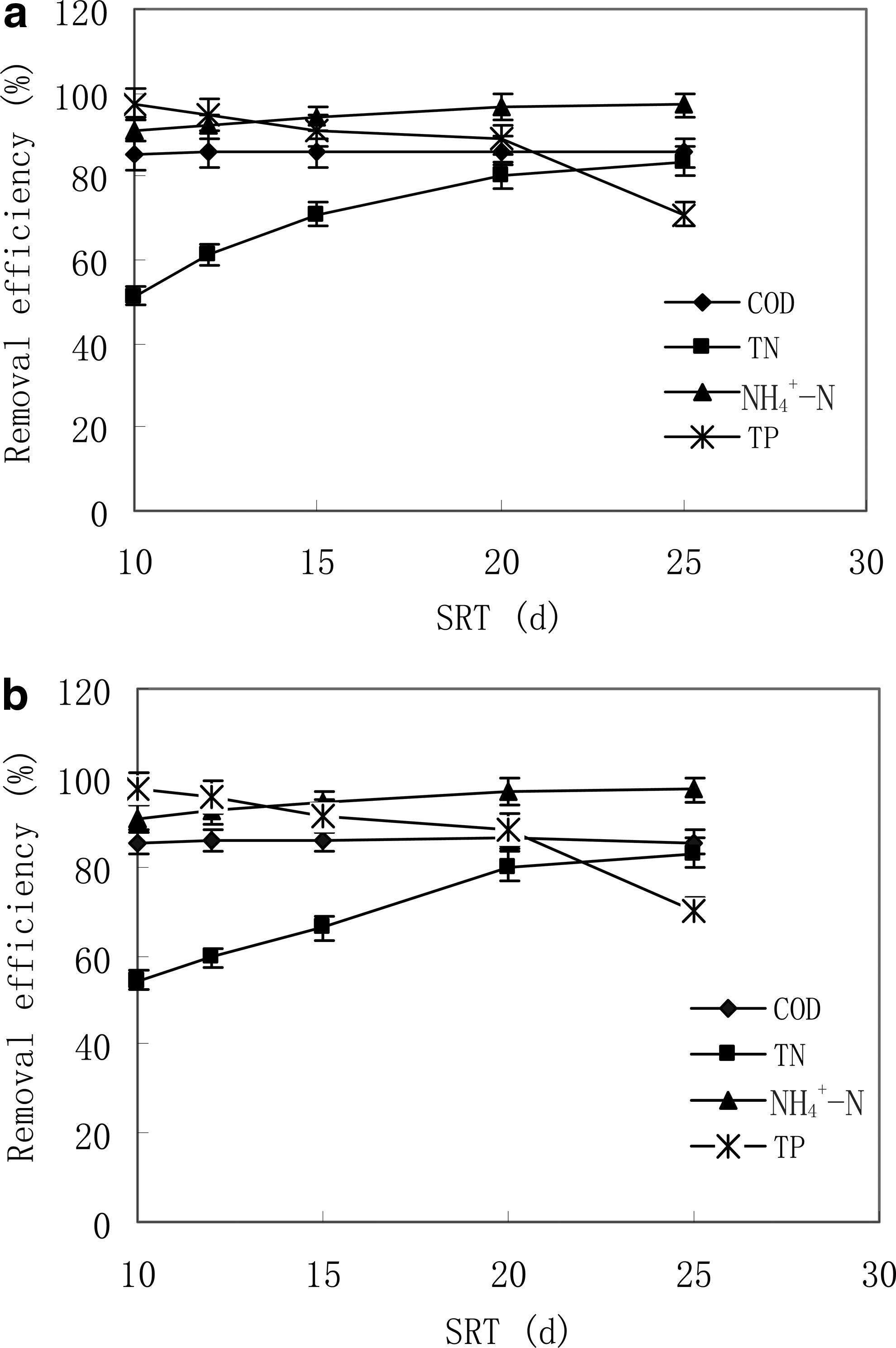
Removal of conventional parameters in AAO systems spiked with 17β-estradiol (E2)
Effect of SRT on removal of estrogen in the AAO system
The concentrations of E2 and EE2 in the aqueous and solid phases in each unit of the AAO systems at different SRTs are listed in Tables 2 and 3. During the tested SRT range (10–25 days), E2 was removed from water dramatically in the anaerobic tank, which might be caused by both sorption and biodegradation. With the mixed liquor flowing from the anaerobic unit to the anoxic and oxic units in the system, E2 concentrations in both the solid phase and aqueous phase decreased. This indicates that E2 was biodegraded. The concentration of E2 in the final effluent was not detected, indicating that E2 was not persistent and could be almost completely degraded by an activated sludge. Lee and Liu (2002) also found that sewage bacteria were capable of completely biodegrading natural estrogenic compounds into inactive products. In the oxic unit, the E2 concentration was not detectable in the aqueous phase, but there was still some residue in the solid phase (17.9–21.1 μg/kg). This suggests that E2 might accumulate in the sludge and be released with the excess sludge.
Data are the means of five samples.
The estrogen concentrations in the aqueous phase.
The sum of the concentration in the aqueous and solid phase, after reaction.
E2, 17β-estradiol; SRT, sludge retention time; n.d., not detected.
Data are the means of five samples.
The estrogen concentrations in the aqueous phase.
The sum of the concentration in the aqueous and solid phase, after reaction.
Overall removal rate by sorption and biodegradation.
EE2, 17α-ethinylestradiol.
EE2 was not as biodegradable as E2. The residual concentration of EE2 in the final effluent was 19%–32% of the influent concentration in the tested SRT ranges (Table 3). Furuichi et al. (2006) indicated that natural estrogenic activities can be efficiently removed by appropriate treatment, but synthetic estrogenic compounds are removed relatively less efficiently. The EE2 removal efficiency increased from 65.3%±0.6% to 81.0%±0.8% when the SRT was increased from 10 to 20 days. However, when the SRT was further increased to 25 days, the EE2 removal efficiency decreased to 76.5%±0.7%. As the estrogen removal was attributed to sorption onto the activated sludge and the following biotransformation by the activated sludge, a longer SRT allows the effective biodegradation of EE2 by microorganisms. However, an excessive SRT may cause the decay of microorganisms and allow the release of sludge-sorbed estrogens to the aqueous phase, thus decreasing the overall removal efficiency of EE2. Decay of the sludge at SRT=25 days was also proved by the significant decrease of phosphorus removal in Fig. 2. Therefore, the optimal SRT for EE2 removal should be 20 days.
Table 3 shows that the total concentrations of EE2 in the anaerobic unit were even greater than its influent concentrations. This indicates that EE2 accumulated in the sludge and back to the system with the return sludge; EE2 in the influent was sorbed onto the sludge and was not degraded in the anaerobic unit. The degradation of EE2 mainly took place in the anoxic and oxic units. In the review dedicated to the removal mechanisms for EDCs in wastewater treatment, Liu et al. (2009) indicated that the anaerobic degradation of EE2 was not observed in multiple trials over long incubation periods. Our previous study (Zeng et al., 2009a) using batch experiments to investigate the removal of EE2 by activated sludge under anaerobic conditions also indicated that no biodegradation of EE2 was observed in the absence of nitrate, and the removal of EE2 from water was a result of sorption onto activated sludge; however, in the presence of nitrate, biodegradation was the dominant process for EE2 removal. Data in the present study using a continuous flow system verify the persistence of EE2 under anaerobic conditions and degradability of EE2 under the anoxic conditions.
The removal fractions from water of COD, E2, and EE2 in the aqueous phase in the anaerobic, anoxic, and oxic units of the AAO systems are shown in Fig. 4. The removal fractions of COD and estrogens in the anaerobic unit were greater than those in the anoxic and oxic units. Of the overall COD removal efficiencies (85%–86%), the removal fractions of COD in the anaerobic, anoxic, and oxic units were 58%–65%, 6%–8%, and 14%–21%, respectively. The higher removal fractions of COD in the anaerobic unit may be caused by being used as a carbon source for phosphate release. Of the overall E2 removal efficiencies (>99%), the anaerobic, anoxic, and oxic units were responsible for 71%–74%, 2%–6%, and 20%–27%, respectively, when the SRT was in the range of 10–25 days. The removal of E2 was mainly observed in the anaerobic unit, which was caused by sorption and the subsequent degradation. The biodegradation of E2 under anaerobic conditions has also been reported by Czajka and Londry (2006). The anaerobic, anoxic, and oxic units were responsible for 20%–36%, 2%–7%, and 35%–43% of the overall EE2 removal (65%–81%), respectively. As described above, EE2 in the anaerobic unit was removed due to sorption to the activated sludge. Both the E2 and EE2 removal fractions in the anoxic unit were limited, and a more significant degradation took place in the oxic unit. This increased rate of estrogen degradation under oxic conditions vs. under anoxic conditions was also observed by other researchers (Lim et al., 2007). The anoxic condition was thus considered to be not favorable to the effective degradation of estrogens as compared with the aerobic conditions.
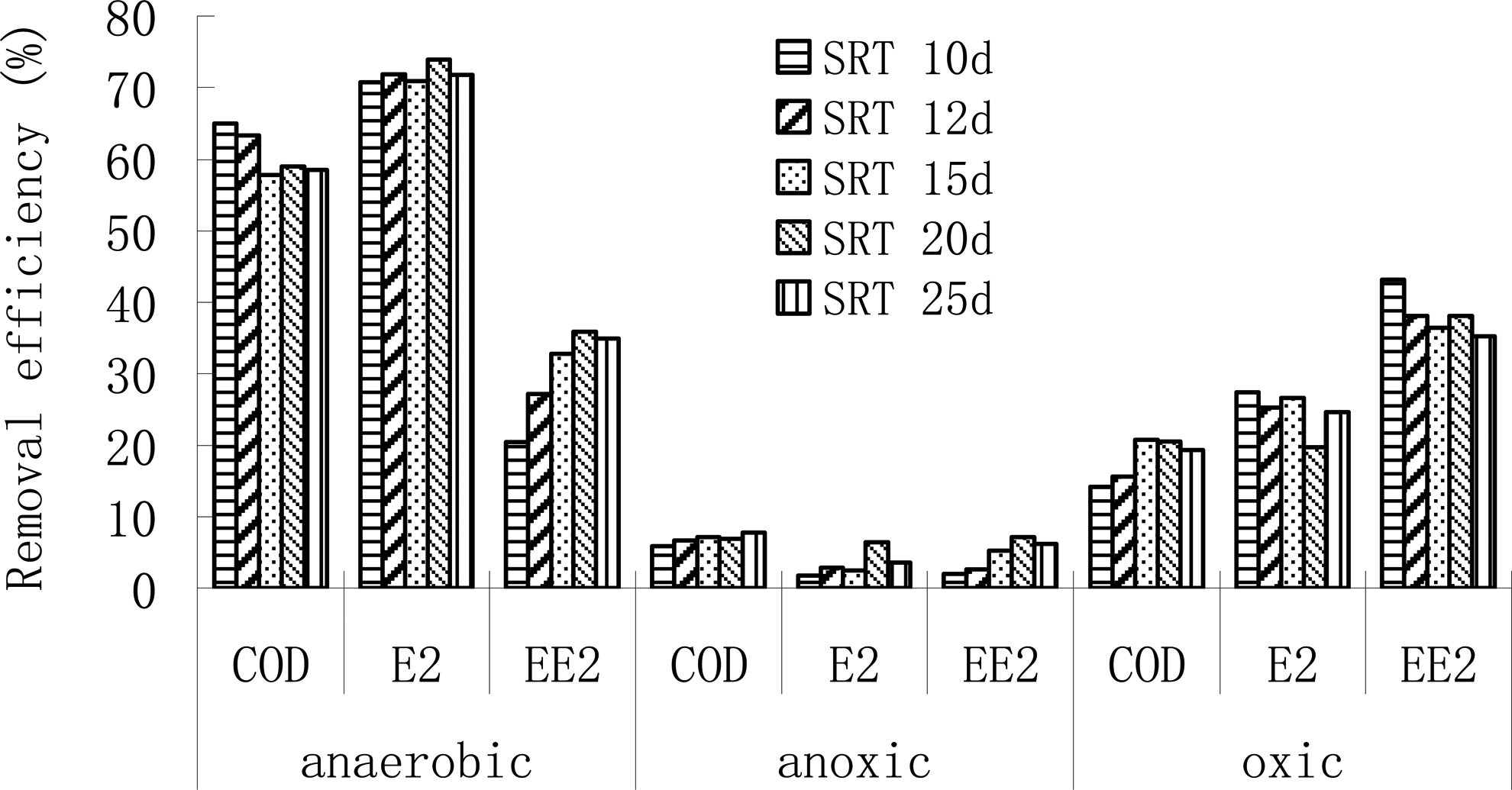
Removal efficiencies from water of chemical oxygen demand (COD), E2, and EE2 in the anaerobic, anoxic, and oxic units.
Distribution coefficient of estrogen onto activated sludge
Under the following operational conditions, total HRT=8 h, sludge recycle ratio=100%, and recycle ratio of mixed liquor=300%; when the AAO system was stable at each tested SRT, the solid–water distribution coefficients (Kd) of E2 and EE2 in each unit were calculated and are listed in Tables 2 and 3. They show that the distribution coefficients of the activated sludge in the anoxic and oxic tanks were lower than those in the anaerobic tank. In the AAO system, the influent first contacted with the anaerobic sludge, so anaerobic sludge may sorb more organic compounds than the following anoxic and oxic sludge; further, the degradation rates of most organic compounds were much slower under the anaerobic conditions than under the anoxic/aerobic conditions. Moreover, the anaerobic sludge had a greater organic matter content than the anoxic/oxic sludge, thus causing the superior anaerobic Kd to anoxic Kd or oxic Kd. This difference indicates that sorption plays an important role in removing E2 and EE2 in the anaerobic unit.
Tables 2 and 3 also indicate that the distribution coefficients of EE2 were greater than those of E2 in each unit. The results are consistent with Ying et al. (2003), who observed that the distribution coefficients of EE2 measured on the sediment were greater than those of E2. No significant difference was observed with Kd at different SRTs.
Carballa et al. (2007) proposed using the distribution coefficient to calculate the concentrations of micropollutants in the sludge from measured aqueous-phase concentrations to avoid the expensive and time-consuming analysis in the solid phase. The removal fraction of steroid estrogens by sorption onto activated sludge was calculated using the Kd value by Andersen et al. (2005). To evaluate the fate of estrogens in the AAO systems, the removal of E2 and EE2 by the discharge of the excess sludge was calculated using Kd in the oxic unit (for EE2) or the anoxic unit (for E2) in the present research [Eqs. (9) and (10)].
Effect of SRT on the fate of estrogens in the AAO system
The fate of E2 and EE2 in the AAO systems at different SRTs (10–25 days) based on the mass balance calculation are shown in Fig. 5. SRT has no significant effect on the fate of E2 in the tested SRT range. About 99.0% of the total influent E2 was removed by biodegradation in the AAO system, and only 1.0% of the total influent E2 was removed with the discharge of excess sludge. The fact that E2 was not detectable in the effluent at different SRTs indicated that E2 was almost completely removed. This agrees with the findings of Pholchan et al. (2008), who observed that ≥98% of E2 was removed regardless of the SRT in sequencing batch reactors operating at different sludge ages. For EE2, about 0.88%–3.31% of the total influent EE2 was removed by sorption on the excess sludge, and the removed EE2 fraction decreased with the increasing SRT. Besides the fraction that remained in the excess sludge, 18.9%–34.7% of the influent EE2 was released with the final effluent, and 62.0%–80.1% was biodegraded in the AAO system. Under the optimum conditions of SRT=20 days, 77.8%±3.2% of the total influent EE2 was transformed by the activated sludge process; 3.26%±0.2% remained in the excess sludge; and 18.9%±0.7% was released with the final effluent. It is obvious that the removal of estrogens by the sorption process in the AAO system is less than that removed by the biodegradation process. Therefore, biodegradation appears to be the dominant removal pathway for steroid estrogens, as demonstrated in Fig. 5, where mass balance calculations indicate that more than 60% of the total steroid estrogens were biodegraded. This conclusion is in agreement with Andersen et al. (2005), who found that the contribution of estrogen sorption to excess sludge was small relative to estrogen degradation. Residual estrogens, especially EE2, on the excess sludge must be considered in the sludge treatment and disposal processes.
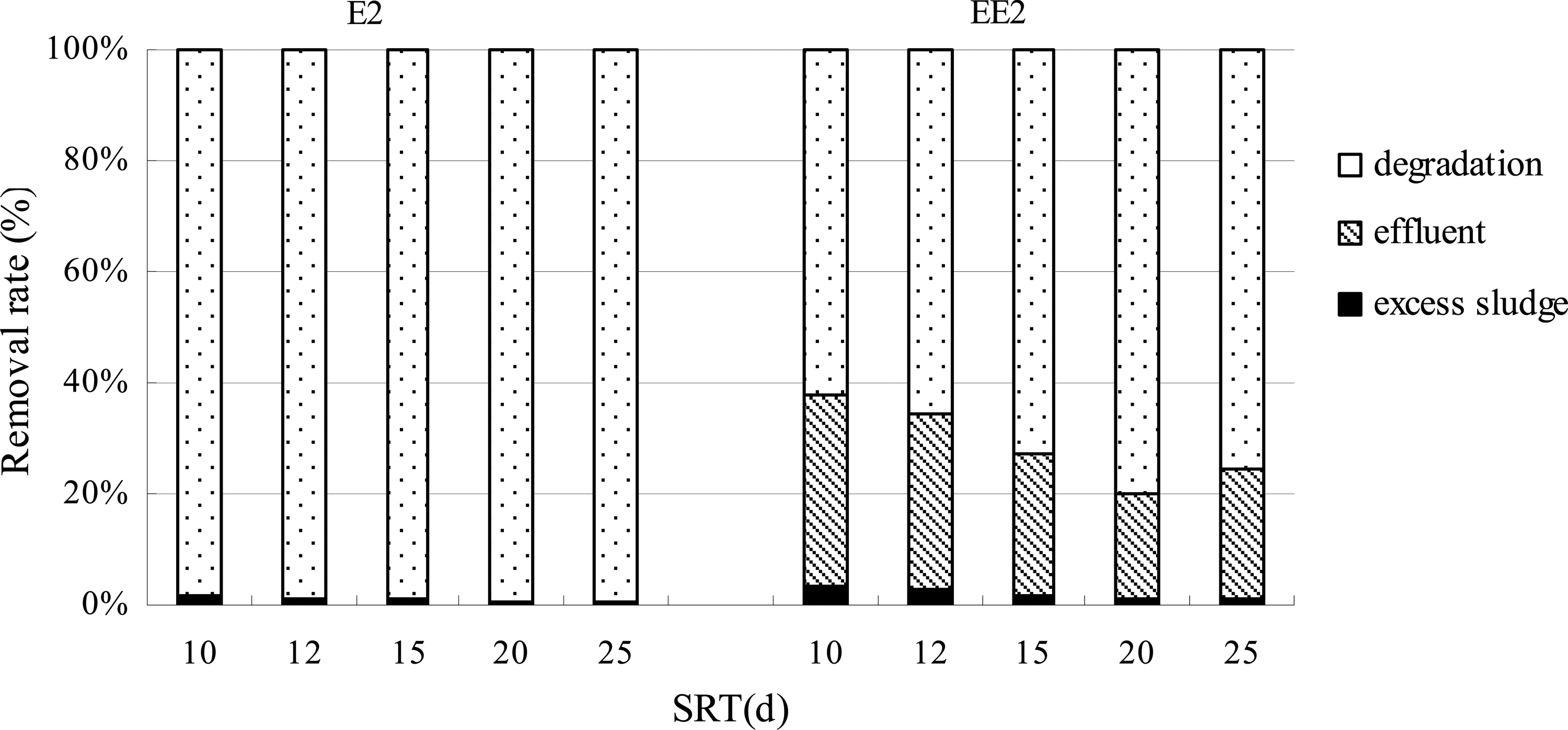
Fates of E2 and EE2 in AAO system at different SRTs.
Conclusion
Over the SRT range of 10–25 days, the E2 removal efficiency from water was >99%, and the SRT has no significant effect on E2 removal. The overall EE2 removal efficiency from water increased when the SRT was increased from 10 to 20 days, but decreased when the SRT was further increased to 25 days. The optimum SRT was 20 days for both nutrient and estrogen removal. Under the optimum conditions, the removal efficiencies of COD, TN, and TP were 86%±3.0%, 80%±2.1%, and 88%±2.5%, respectively; E2 was not detectable in the final effluent, and the overall removal efficiency of EE2 was 81%±2.4%. Of the total E2 influent, 99.0%±1.5% was degraded by the activated sludge and 1.0% sorbed on the excess sludge. Thus, the risk of extensive accumulation of natural estrogens normally found in sewage effluents in the environment is small. Of the total influent EE2, 77.8%±2.2% was degraded by the activated sludge process and 3.26%±0.2% sorbed on the excess sludge; 18.9%±0.7% was released with the final effluent. Based on the distribution coefficients, the sorption capability of estrogens on the activated sludge in the anaerobic units was greater than that in the anoxic and oxic units.
Footnotes
Acknowledgments
This work was supported by the National Hi-Tech Research and Development Program of China (863) (2011AA060902), the Science and Technology Commission of Shanghai Municipality (11230700700), the National Natural Science Foundation of China (grant no. 50878165 and 50578114), and the Program for New Century Excellent Talents in University (NCET-08-0403).
Author Disclosure Statement
No competing financial interests exist.