




Abstract
Abstract
Thiophenic sulfur compounds are released during coal gasification, carbonization, and combustion. Previous studies indicate that thiophenic sulfur compounds degrade very slowly in the environment, and are more carcinogenic than polycyclic aromatic hydrocarbons and nitrogenous compounds. Therefore, it is very important to study the principle of thiophenic sulfur compounds during coal conversion, in order to control their emission and promote clean coal utilization. To realize this goal and understand the formation mechanism of thiophenic sulfur compounds, this study focused on the release behavior of thiophenic sulfur compounds during coal pyrolysis, which is an important phase for all coal thermal conversion processes. The pyrolyzer (CDS-5250) and gas chromatography–mass spectrometry (Focus GC-DSQII) were used to analyze thiophenic sulfur compounds in situ. Several coals with different coal ranks and sulfur contents were chosen as experimental samples, and thiophenic sulfur compounds of the gas produced during pyrolysis under different temperatures and heating rates were investigated. Levels of benzothiophene and dibenzothiophene were obtained during pyrolysis at temperatures ranging from 200°C to 1300°C, and heating rates ranging from 6°C/ms to 14°C/ms and 6°C/s to 14°C/s. Moreover, the relationship between the total amount of benzothiophene and dibenzothiophene released during coal pyrolysis and the organic sulfur content in coal was also discussed. This study is beneficial for understanding the formation and control of thiophenic sulfur compounds, since it provides a series of significant results that show the impact that operation conditions and organic sulfur content in coal have on the amount and species of thiophenic sulfur compounds produced during coal pyrolysis.
Introduction
Numerous articles have reported various methods for obtaining the structural configuration of thiophenic sulfur compounds in coal (Sun and Li, 1997; Liu et al., 2007; Wijaya and Zhang, 2012). For example, X-ray photoelectron spectroscopy (XPS) and X-ray absorption near edge structure (XANES) have been used to obtain important organic sulfur structure information, but curve-fitting the data in the treatment process was always arbitrarily influenced by individual discrepancy due to tiny differences in the binding energy between different thiophenic and nonthiophenic sulfur compounds in coal. In addition, those methods can only be used in cold model analysis of solid sulfuric samples and does not reflect the formation process of thiophenic sulfur compounds. Therefore, it is necessary to develop a method for online analysis of thiophenic sulfur compounds released during coal pyrolysis. For this purpose, pyrolysis–gas chromatography–mass spectrometry (PY-GC-MS) technology has been used in this study (Marinov et al., 2005; Stefanova et al., 2005; Gonsalvesh et al., 2012). PY-GC-MS provides information at the molecular level, in particular with the presence of thiophenic forms (Eglinton et al., 1990, 1994). The flash pyrolyzer (CDS-5250) coupled with the GC-MS (Focus GC-DSQII) provides a better solution for a quantitative and qualitative analysis of a multicomponent mixture, and allows the various forms of thiophenic sulfur compounds that occur during coal pyrolysis to be observed in situ. Benzothiophene and dibenzothiophene were investigated as target compounds, and several coals with different coal ranks were chosen as experimental samples. This study puts emphasis on the effect that pyrolysis temperature, heating rate, and organic sulfur content have on benzothiophene and dibenzothiophene released during coal pyrolysis. To gain a more fundamental understanding of thiophene sufur compounds produced during coal pyrolysis, a multistep program was used in the present work so that a temperature increase could be arranged for pyrolysis to facilitate a pyrolysis experiment of the same coal under different temperatures briefly, each coal sample could run the GC automatically and carry out the analysis at different temperature steps after a programmed temperature increase. A series of important data about how the amount and species of thiophenic sulfur compounds vary with temperature would be used to study the principle of thiophenic sulfur compounds released during coal pyrolysis.
Experimental Methods
Coal samples
Typical coal samples with different coal ranks and from different mineral veins were collected in China. These coals include HLH (Huolinhe lignite from Inner Mongolia), YM (Yima bituminous/long flame coal from Henan), YBS (Yuanbaoshan lignite from Inner Mongolia), YZ (Yanzhou bituminous/gas coal from Shandong), FX (Fenxi bituminous/coking coal from Shanxi), LL (Liulin bituminous/coking coal from Shanxi), and SG (Sangei bituminous/lean coal from Shanxi). Coal with particles sized between 0.15–0.25 mm was sieved. The basic data are shown in Table 1.
Mad and Aad, content of moisture and ash in coal on air-dried basis; Vdaf, Cdaf, Hdaf, Odaf, Ndaf, and Sdaf: content of volatile compounds, carbon, hydrogen, oxygen, nitrogen, and sulfur, respectively, in coal on dry ash-free basis; HLH, Huolinhe lignite from Inner Mongolia; YM, Yima bituminous/long flame coal from Henan; YBS, Yuanbaoshan lignite from Inner Mongolia; YZ, Yanzhou bituminous/gas coal from Shandong; FX, Fenxi bituminous/coking coal from Shanxi; LL, Liulin bituminous/coking coal from Shanxi; SG, Sangei bituminous/lean coal from Shanxi.
Apparatus
The flash pyrolyzer (CDS-5250) is connected to the GC-MS (Focus GC-DSQII) by the transmission line.
Operating conditions
1. Gas chromatography conditions: chromatographic column, DB-5 (30 m×0.25 mm×0.25 μm) capillary column; carrier gas, He; rate of flow, 1 mL/min; inlet temperature, 250°C; oven temperature, programmed from 50°C (initial time, 3 min) to 250°C at the rate of 5°C/min (held for 10 min); inject mode, splitless; transfer line temperature, 310°C.
2. Mass spectrometry conditions: electro energy, 70 eV; ion source temperature, 250°C.
3. Pyrolyzer conditions: heating rate, 6–14°C/ms; pyrolysis temperature, 200–1300°C. The samples are pyrolyzed at different temperatures and heating rates, and the chromatograph and the spectrum are obtained at every set; then, the objective compounds are analyzed in situ.
Operation steps
1. Standard solution: benzothiophene (concentration, 50 μg/mL; purity, 99.0%) and dibenzothiophene (concentration, 50 μg/mL; purity, 98.3%) were obtained from Accustandard, Inc. (NewHaven, CT). The concentrations of the standard mixture solution: 0.2 μg/mL, 0.4 μg/mL, 0.6 μg/mL, 0.8 μg/mL, 1 μg/mL; inject a 1 μL solution per concentration to the GC-MS, analyze, and get the external standard line.
2. An analytical balance is used to precisely weigh 1 mg coal samples.
3. The quartz tube is enclosed by the coal samples and inserted into the pyrolyzer.
4. The GC-MS is used to analyze the products of the pyrolysis at different temperatures and heating rates.
Examples of the chromatography and mass spectrometry of the coal samples
The chromatograph apex produced during coal pyrolysis was compared with the chromatograph apex of the standard solution; the retention time of the chromatographic peak, the characteristic ion apex of the target compounds, and the searching results of a mass spectrogram were qualitatively analyzed. As shown in Figs. 1–3, the retention time of benzothiophene was ∼16.56 min and the main characteristic ions were 134, 90, 89, 135, and 67; the retention time of dibenzothiophene was ∼30.78 min and the main characteristic ions were 184, 185, 139, 152, and 92. After the target compounds were determined, they were analyzed quantitatively using a standard external method.
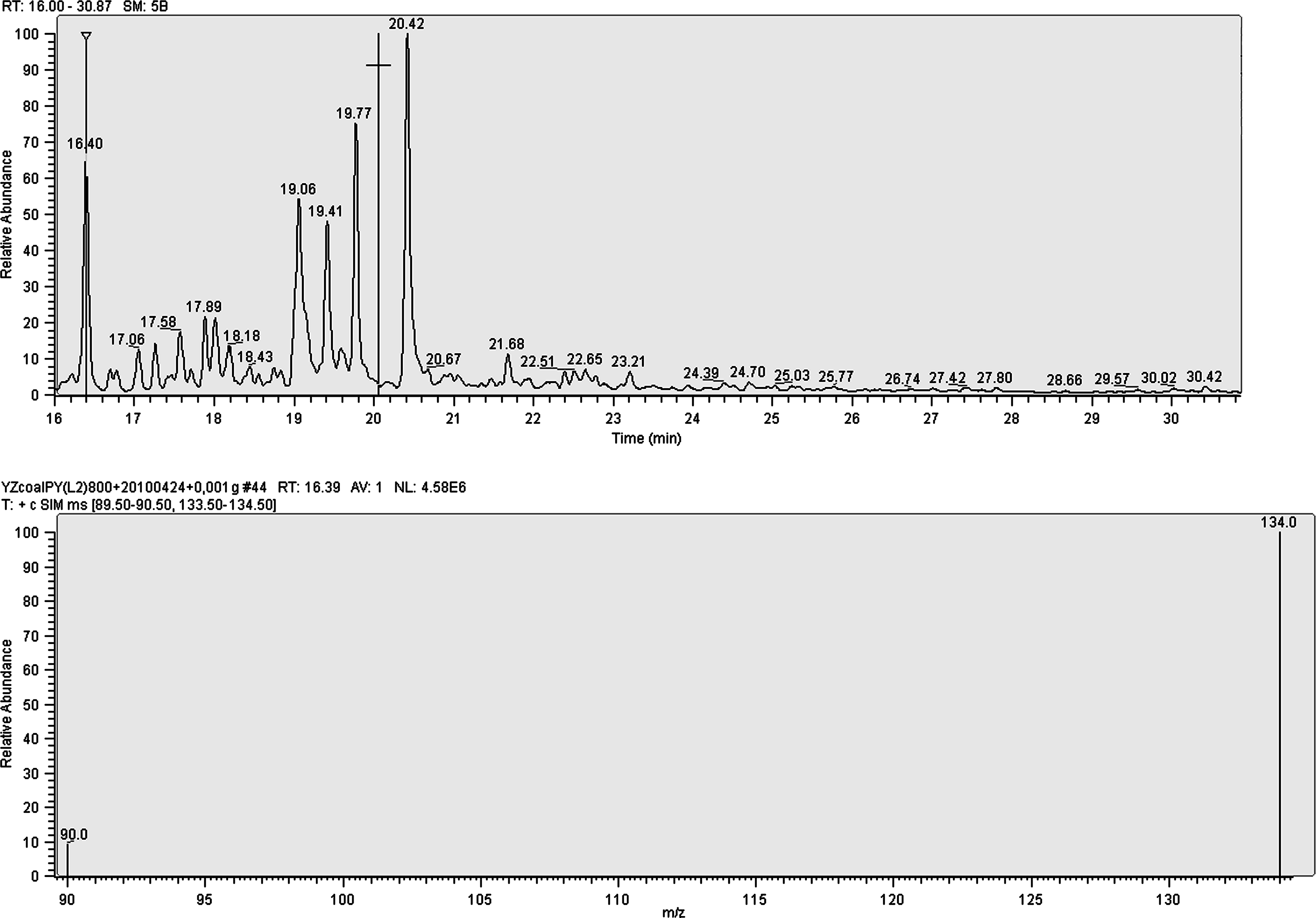
Chromatography apex and mass spectrometry of Yanzhou bituminous/gas coal from Shandong (YZ coal), pyrolyzed at 800°C.
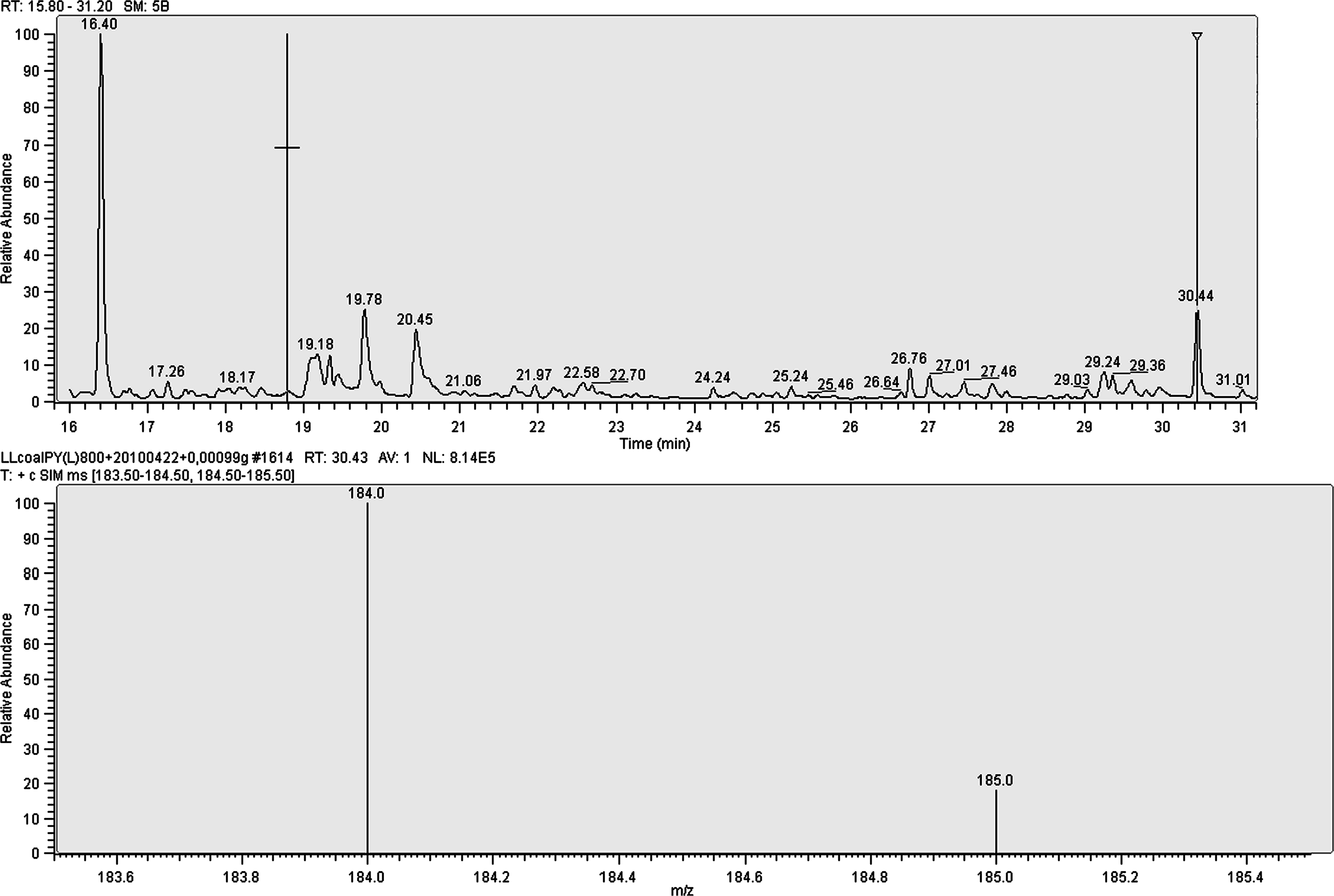
Chromatography apex and mass spectrometry of Liulin bituminous/coking coal from Shanxi (LL coal), pyrolyzed at 800°C.
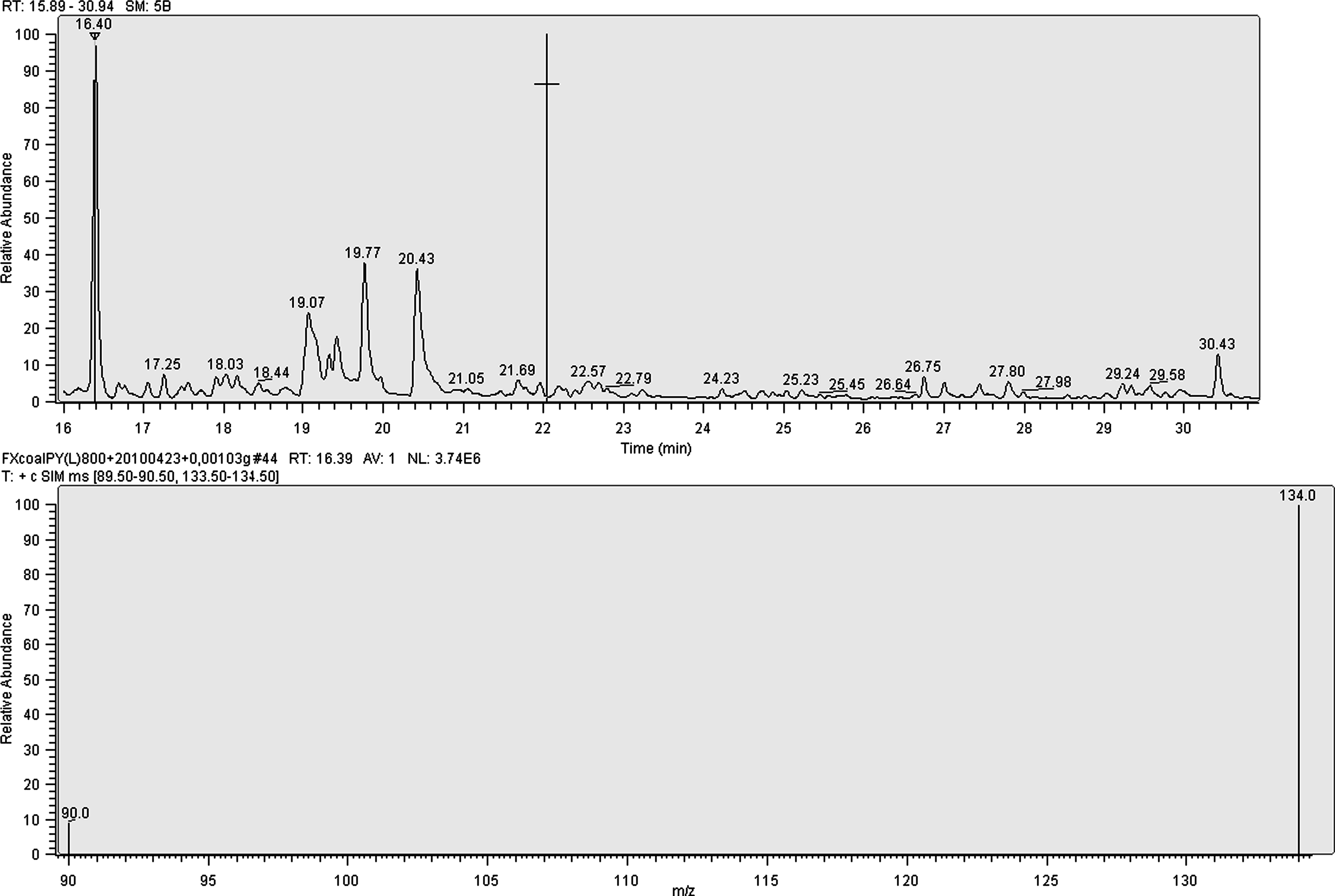
Chromatography apex and mass spectrometry of Fenxi bituminous/coking coal from Shanxi (FX coal), pyrolyzed at 800°C.
Results and Discussion
Effect of pyrolysis temperature on the release of thiophenic sulfur compounds
To understand the formation mechanism of thiophenic sulfur compounds during coal pyrolysis, HLH, YM, YBS, YZ, FX, LL, and SG coal samples were pyrolyzed from 200°C to 1300°C, and the gas products were analyzed by the GC-MS in situ at 200°C, 400°C, 600°C, 800°C, 1000°C, 1200°C, and 1300°C. Results of the analysis of thiophenic sulfur compounds at different temperatures show that the amount of thiophenic sulfur compounds obviously increased as the temperatures rose (Fig. 4). The peak value of thiophenic sulfur compounds during YZ coal pyrolysis reached 5.60 μg/g at the temperature of 800°C, and then decreased as the temperature increased.
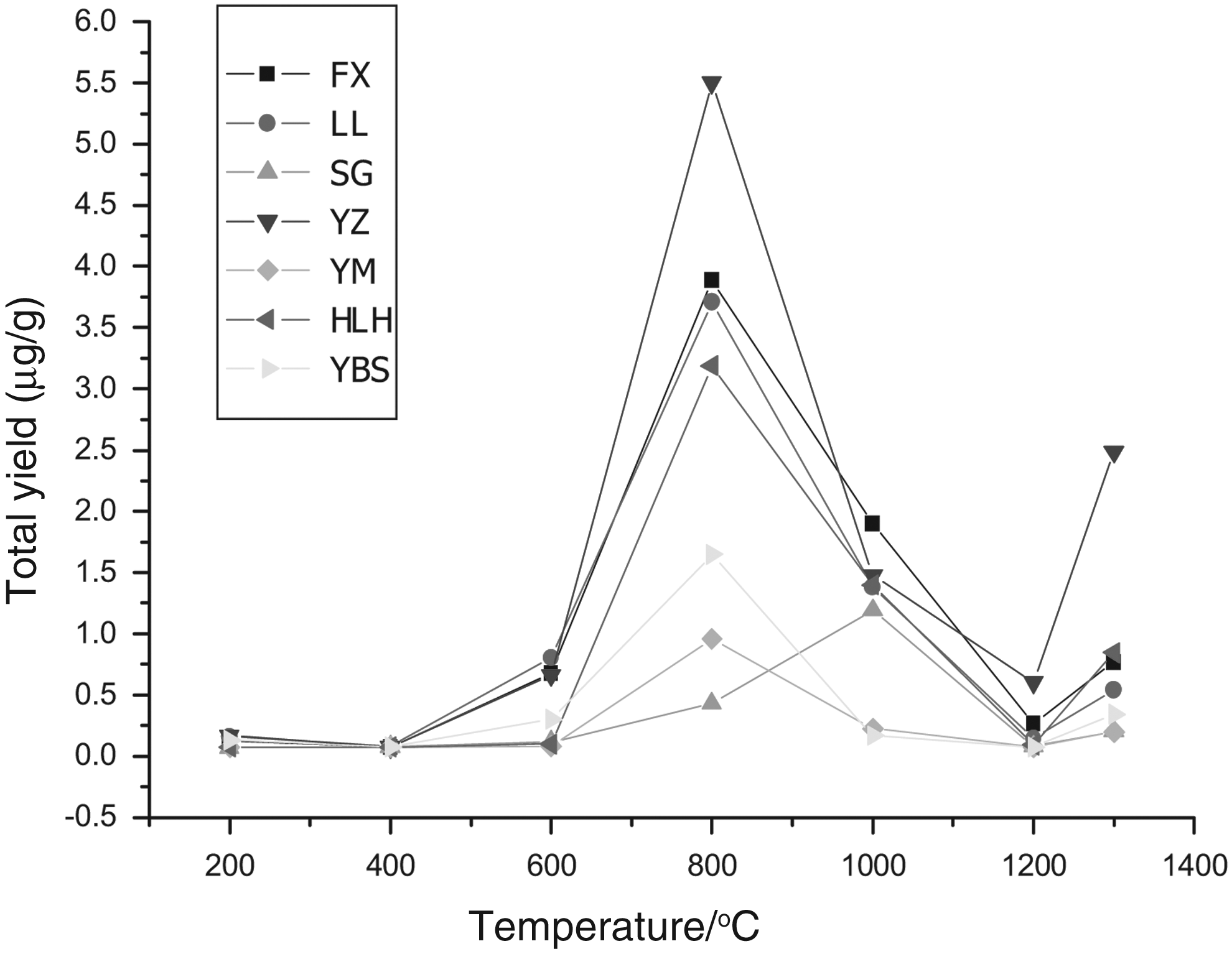
Correlation of benzothiophene and dibenzothiophene concentrations with coal pyrolysis temperature.
Results show that the quantity of thiophenic sulfur compounds was very low at 600°C, increased quickly as the temperature ranged from 600°C to 800°C, and then declined again. This indicates that thiophenic sulfur compounds were released when the macromolecular structure of the coal underwent thermal cracking from 600°C to 800°C. Concentrations increased again when the pyrolysis temperature ranged from 1200°C to 1300°C, when there may be enough energy present for free radical reactions to form thiophenic sulfur compounds.
The process of coal pyrolysis includes both physical and chemical reactions. Temperature is one of the most important process parameters for the coal pyrolysis reaction. It has an effect on both the first decomposition reaction and the secondary reaction of the volatiles. The pyrolysis process of coal includes some other reactions: decomposition at the macromolecular level, condensation at the micromolecular level, and free radical reaction (Fig. 5).

Formation and decomposition reactions of thiophenic sulfur compounds during coal pyrolysis.
Results indicate that the C–S bond could cause the decomposition (Huang et al., 2005); parts of the products could be formed into H2S by reacting with H2. The thiophenic sulfur compounds started decomposing when the temperature rose above 800°C (Calkins, 1987); they decomposed into sulfur radicals first, and then the products might have reacted with other sulfur-containing compounds. Consequently, the amount of the benzothiophene and dibenzothiophene decreased as the temperature rose above 800°C. When the temperature was above 1200°C, the amount of benzothiophene and dibenzothiophene increased again because no more hydrogen radicals reacted with the sulfur radicals, and then more condensation reactions of sulfur radicals occurred to form the thiophenic sulfur compounds.
Effect of heating rate on release of thiophenic sulfur compounds
The heating rate can also play an important role in the amount of thiophenic sulfur compounds released during coal pyrolysis. The release behavior of the benzothiophene and dibenzothiophene at the rapid heating rates of 6°C/ms, 8°C/ms, 10°C/ms, 12°C/ms, and 14°C/ms and the medium heating rates of 6°C/s, 8°C/s, 10°C/s, 12°C/s, and 14°C/s are discussed. YZ and LL coal were chosen as samples in this study.
Figures 6 and 7 demonstrate that the amount of benzothiophene and dibenzothiophene are impacted by the heating rate during coal pyrolysis. A rapid heating is more favorable to the release of benzothiophene and dibenzothiophene than the medium heating rate for coal pyrolysis. The maximum amounts of benzothiophene and dibenzothiophene came to 17.90 μg/g and 7.77 μg/g at heating rates of 12°C/ms and 14°C/ms, respectively, during YZ and LL coal pyrolysis. This difference might be related to the differences in the absolute organic sulfur content of the two coals (absolute organic sulfur content of YZ coal was higher).
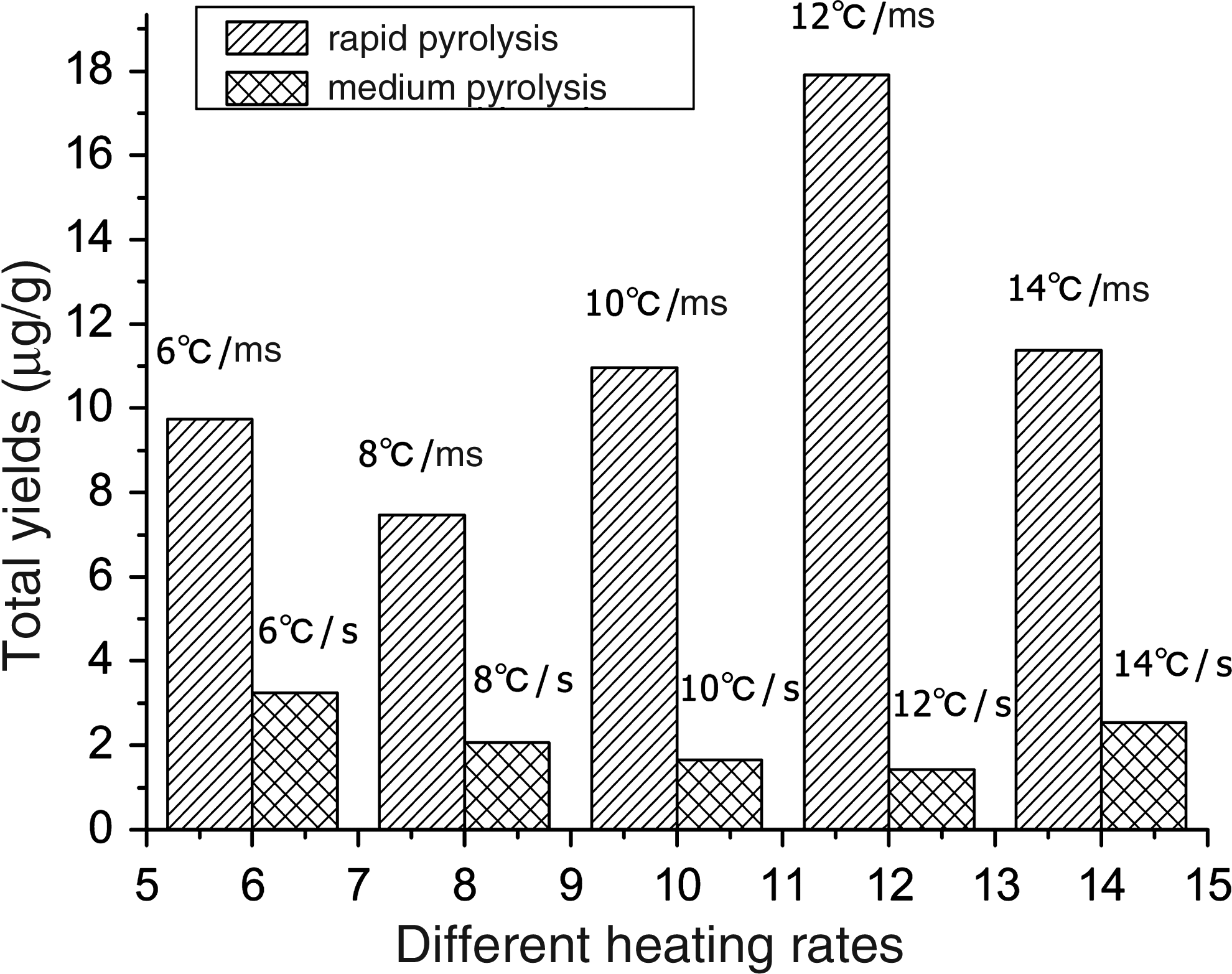
Total yields of benzothiophene and dibenzothiophene with rapid and medium pyrolysis of YZ coal.

Total yields of benzothiophene and dibenzothiophene with rapid and medium pyrolysis of LL coal.
During coal pyrolysis, coal granules go through the process of drying, softening, fusing, liquifying, expansion, and contraction. The residence time of volatiles at the medium heating rate was longer than at the rapid heating rate; there was enough time for some deposits to form and block up the coal pores, so the microcellular structure of the coal samples was poor at the medium heating rate. With an increase in pyrolysis time, the pore volume of coal became small (Liu et al., 2005). This made the emission rate of the volatiles slower at the medium heating rate, which meant that the amount of benzothiophene and dibenzothiophene released was lower. However, the coal granules had a loose structure and abundant pores at the rapid pyrolysis rate, which accelerated the escape of volatiles and suppressed the formation of sediments. Consequently, the amount of benzothiophene and dibenzothiophene released was higher at the rapid pyrolysis rate than at the medium heating rate.
Effect of organic sulfur content on release of thiophenic sulfur compounds
Results of the experiment also show that there was a correlation between the total amounts of benzothiophene and dibenzothiophene released during coal pyrolysis and the organic sulfur content of the coal samples. As the organic sulfur content increased, the total amounts of benzothiophene and dibenzothiophene released during coal pyrolysis also increased. The total amounts of benzothiophene and dibenzothiophene released from different coals during pyrolysis are summarized in Table 2.
The basic data of the sulfur forms of the chosen coals are shown in Table 3. Sulfur forms include St (total sulfur), Ss (sulfate sulfur), Sp (pyretic sulfur), and So (organic sulfur).
St, total sulfur; Ss, sulfate sulfur; Sp, pyretic sulfur; So, organic sulfur.
Figure 8 shows that the total amounts of benzothiophene and dibenzothiophene released during the coal pyrolysis increased linearly with increasing organic sulfur content of the coal. With an increase in the total sulfur content or organic sulfur content of coal, the sulfur-containing gas increased greatly during coal pyrolysis (Hu et al., 2004). In addition, the total amount of benzothiophene and dibenzothiophene released was independent of the inorganic sulfur content (Fig. 9).

Total yields of benzothiophene and dibenzothiophene with the organic sulfur content in the coal.
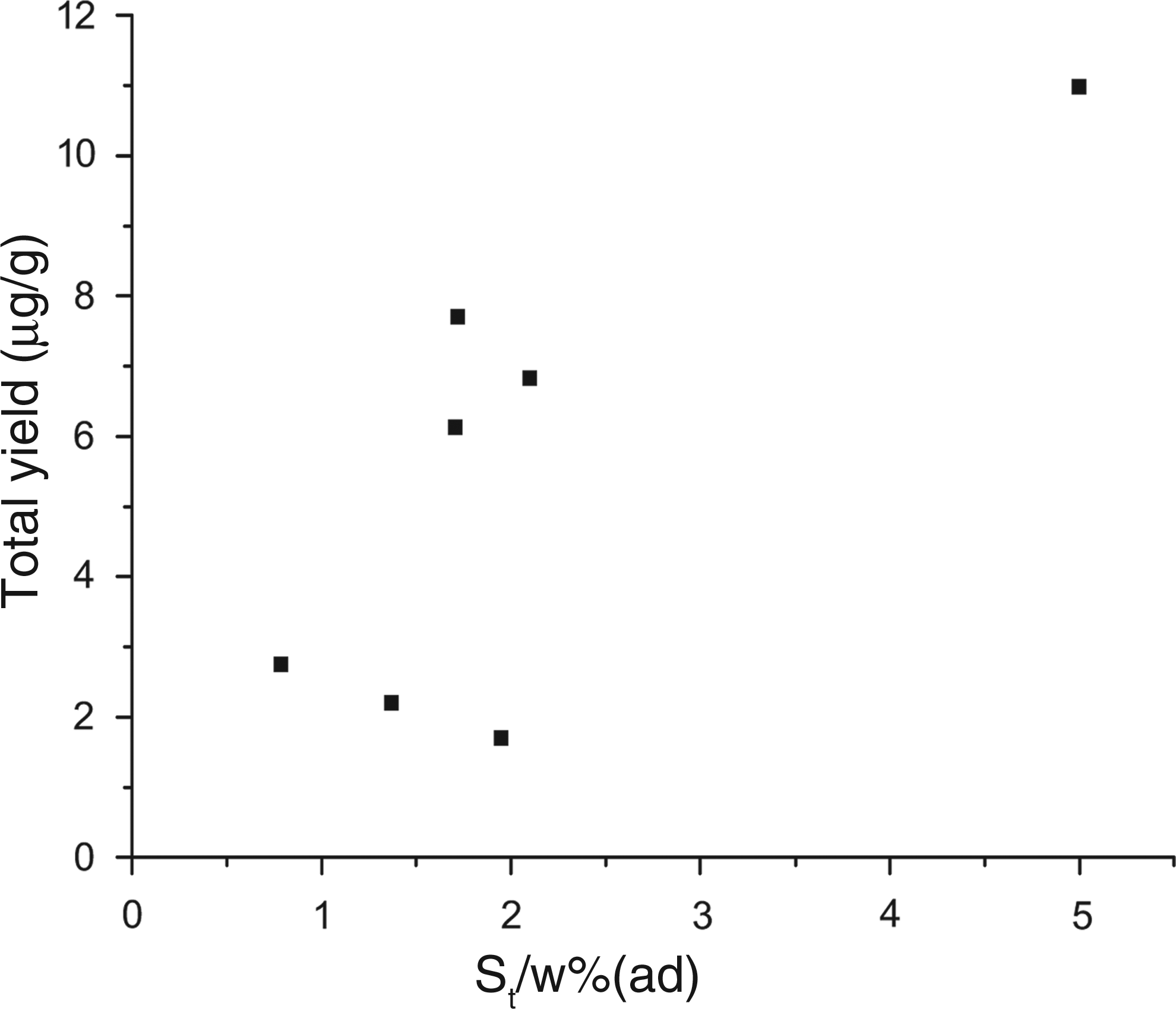
Total yields of benzothiophene and dibenzothiophene with the total sulfur content in the coal.
The relative yield of sulfur release is related to the state of sulfur in coal and the interactions between sulfur species and coal fragments (Xu et al., 2004). When the temperature was below 800°C, a proportion of the benzothiophene and dibenzothiophene was formed by the pyrogenation of the macromolecular thiophenic sulfur compounds in the coal. An explanation for this could be that the bridge bonds, such as –O–, –S–, and –S–S–, were not strong and were broken during coal pyrolysis (Fig. 10). As the temperature rose above 1200°C, the thiophenic sulfur compounds were produced by the free radical reaction and by the condensation of sulfur-containing fragments. The free radical reaction and sulfur-containing fragments were mainly formed by organic sulfur compounds, so the organic sulfur content in coal had a direct effect on the amount of benzothiophene and dibenzothiophene released during coal pyrolysis. However, the inorganic sulfur in coal was not present in the macromolecular structure compounds, and it was hard to form the thiophenic sulfur compounds during coal pyrolysis.

Decomposition reactions of bridge bond to form thiophenic sulfur compounds during coal pyrolysis.
Conclusions
Temperature had the greatest effect on the total amounts of benzothiophene and dibenzothiophene released during coal pyrolysis. With increasing temperature, the amount of benzothiophene and dibenzothiophene first increased, and then decreased. The amounts of benzothiophene and dibenzothiophene reached peak values at 800°C. Heating rate was another important factor that influenced the release behavior of the benzothiophene and dibenzothiophene during the process of coal pyrolysis. The amount of benzothiophene and dibenzothiophene released was much higher at a rapid pyrolysis rate than at a medium heating rate. With increasing organic sulfur content of the coal, the amounts of benzothiophene and dibenzothiophene increased during coal pyrolysis, but the content of inorganic sulfur in the coal had no significant effect on the amounts of benzothiophene and dibenzothiophene.
Footnotes
Acknowledgment
This research was supported by the National Natural Science Foundation of China (Grant No. 20876103).
Disclosure Statement
No competing financial interests exist.